
Chevrolet Nova Coupe buyer's guide
Chevrolet Nova Coupe -- the model's own buyer's guide: variants, values and what to check.
Years listed: 1970-1972 · Series: Nova
Overview and history
The Chevrolet Nova coupe is the simplest idea Chevrolet ever sold well: a light, compact, rear-drive two-door with a straight-six if you wanted economy and almost any small-block V8 if you did not. It began life as the Chevy II, rushed into production for 1962 to answer Ford's Falcon, and ended in 1979 as the Nova, by then a softer, heavier compact fighting emissions rules and fuel prices. Between those points the same formula — unibody shell, bolt-on front subframe, leaf-sprung live rear axle, and an engine bay that accepted far more power than the chassis ever needed — produced everything from a thrifty commuter to some of the most feared street cars of the muscle era. The coupe is where most of that story lives, and the body style buyers still chase first.
Be clear about names before you look at a single car. From 1962 to 1968 the line was the Chevy II, and Nova was its top trim series; from 1969 every car was simply a Nova. Paperwork and trim tags on an early car will say Chevy II, and that is correct, not a discrepancy. Super Sport — SS — was a package layered over the coupe, not a body style, and because SS badges and trim are all reproduced, SS identity is the most argued-over question in this market. Hold one rule: the badge proves nothing. The vehicle number, trim tag, engine stampings and factory paperwork prove things.
The history falls into four generations. The first, 1962 to 1965, is a crisp, upright compact offered as a two-door sedan and, in Nova trim, as a pillarless hardtop Sport Coupe. The second, 1966 and 1967 only, kept the mechanical idea in a sharper shell and made the car's performance reputation, above all with the high-revving 327 L79 V8. The third, 1968 to 1974, is longer and wider, shares its front subframe architecture with the first-generation Camaro, and is the big-block generation: from 1968 to 1970 you could order a coupe with a factory 396 big-block. The fourth, 1975 to 1979, added weight, safety bumpers and strangled, low-compression engines; it rides better, and it is nobody's muscle car in factory form. The models section takes each generation in turn.
Our own listings pool shows you where today's market concentrates, and you should weight everything that follows by it. We currently track 30 Nova coupes, 16 offered for sale and 14 recorded as sold, spanning 1964 to 1978 in the pool itself. The spread is not even at all. Eleven of the 30 cars — more than a third — are 1972 models alone. By generation, 22 of the 30 are third-generation cars from 1969 to 1973, seven are Chevy II-era cars from 1964 to 1967, and just one car, a 1978, represents the whole fourth generation; there are no 1962, 1963 or 1979 coupes in the pool as we write. Twenty-seven of the 30 cars come through dealer sources, so this is a market of largely finished, photographed-for-sale cars, not a cross-section of every Nova surviving in barns and driveways. Treat the pool as a picture of what dealers choose to stock — third-generation coupes, led by 1972 — rather than as a survival census.
That skew matters: parts, knowledge and comparison cars are deepest for the 1968 to 1972 cars, and the pool also carries claimed rarities — a 1966 SS listed as an L79 car and a 1969 coupe listed as a real SS 396 L78 — plus a 1965 straight-axle 454 gasser and a 1971 resto-mod, both honestly described as modified. No headline verifies a rarity claim; verify those with numbers and paperwork before paying, exactly as the inspection section sets out.
One more piece of honesty about evidence. We examined the detailed photo notes for only 4 of the 30 pool cars, and in that small sample none of the four recorded rust, smoke, leaks or visible damage. Do not read that as a finding that Nova coupes do not rust — they do, extensively. Four dealer-prepared cars prove nothing either way, and the sample is too small to quote incidence figures from, so this guide quotes none. Its rust map comes from the car's design — where water sits, where mud packs, where panels trap moisture — and from what decades of restorers have had to weld. Judge the car in front of you, not a statistic.
What the Nova coupe offers today is choice at almost every level of commitment, from a hand-tool six-cylinder sedan to a big-block car bought on documentation as much as condition. Rust, accident repair and identity decide whether one is a good buy, and the rest of this guide answers them in that order.
The models
Every Nova coupe is a two-door, but Chevrolet sold that idea in several distinct bodies, and confusing them is the first pricing mistake buyers make. On the 1962 to 1967 cars there are two different coupes. The two-door sedan has a full centre pillar, framed door glass and a more upright roof; it was the cheaper body, it is the stiffer shell, and drag racers have always liked it for that reason. The Sport Coupe hardtop, offered in Nova trim, has no centre pillar, frameless door glass and a lower, sleeker roofline; it was the style buy when new and still draws the eye first. They share floors and running gear, but roofs, glass and much bright trim do not interchange, so a hardtop with sedan parts, or the reverse, is a car to look at twice. From 1968 the range simplified to a single coupe body, joined for 1973 and 1974 by a hatchback whose opening rear panel is a water path the coupe does not have; where a hatchback has been filed as a coupe, treat its aperture, hinges, struts and seal as an extra inspection area.
Trim and performance packages layer over those bodies: base coupe, custom trims varying by year, Rally Nova in the early seventies — largely stripes, wheels and suspension touches — and SS at the top. Two warnings belong with that ladder. First, from 1973 onward the SS became primarily an appearance and handling package over modest engines, so a late SS badge promises far less than a 1969 one. Second, every rung can be climbed retrospectively with reproduction parts: badges, grilles, hoods, stripes, consoles and bucket seats all bolt on. A dressed base coupe is not automatically dishonest — owners have built tributes for decades — but it must be priced as the car its numbers say it is, not the car its badges describe.
| Model | Years | Engine | Output | Built | Character |
|---|---|---|---|---|---|
| Chevy II 100 / 300 two-door sedan | 1962–1965 | 153 four or 194 six | 90–120 hp | Large volume | The economy original; plain, light, honest |
| Nova 400 Sport Coupe hardtop | 1962–1965 | 194 six, 283 V8 from 1964 | 120–220 hp | Volume seller in Nova trim | The style buy of the first generation |
| Nova SS coupe | 1963–1967 | Six, then 283 / 327 V8 | 120–350 hp | A minority of production | Dress-up first, real performance with the V8s |
| Nova SS 327 L79 coupe | 1966–1967 | 327 V8, L79 | 350 hp in 1966, 325 hp in 1967 | Low thousands at most; figures argued over | The connoisseur Chevy II; verify everything |
| Nova coupe, third generation | 1968–1974 | 230 / 250 six, 307 / 350 V8 | 140–250 hp gross, then net | The bulk of production in these years | The mainstream car; the pool's centre of gravity |
| Nova SS 350 coupe | 1968–1972 | 350 V8 | 255–300 hp gross | Tens of thousands | The usable muscle Nova; the default fast buy |
| Nova SS 396 coupe | 1968–1970 | 396 big-block V8 | 325 or 375 hp gross | A small minority of SS production | The flagship; documentation decides value |
| Nova Rally and SS coupe | 1973–1974 | 250 six, 307 / 350 V8 | Modest net outputs | Volume trims | Appearance-led; buy on condition, not badge |
| Nova coupe, fourth generation | 1975–1979 | 250 six, 305 / 350 V8 | Low net outputs | Large volume | The comfortable late car; usable and overlooked |
The first generation, 1962 to 1965. The 1962 Chevy II arrived in 100 and 300 series, with the Nova 400 as flagship trim, on a 110-inch wheelbase; the coupe choice is sedan or Nova hardtop. Engines began with the 153 four and 194 six; a V8 was not on the original menu, and Chevrolet corrected that for 1964 with the 283, which transforms the car. The SS package arrived for 1963 with bucket seats and bright trim, and early SS cars could still be sixes, which surprises buyers who assume SS always meant V8. The 1965 car added cleaner styling and the 327 in higher states of tune. In our pool this generation is single 1964 and 1965 cars — an SS coupe and the big-block gasser.
The second generation, 1966 and 1967. Two years only, and for many enthusiasts the sweet spot: sharper styling, the prettiest hardtop roofline the Nova ever wore, and the L79 327 at the top of the engine list, rated at 350 horsepower in 1966 and 325 horsepower in 1967. An L79 coupe is genuinely quick and genuinely rare, which is why the 1966 L79 SS in our pool, listed in Ermine White, is precisely the kind of car whose stampings, casting dates and paperwork you check before discussing price at all. Ordinary 1966 and 1967 coupes are charming, simpler and far easier to verify. Four pool cars are 1966 models and one is a 1967 — representation well beyond a two-year span, and a sign sellers stock what enthusiasts ask for.
The third generation, 1968 to 1974. The 1968 redesign moved the coupe to a 111-inch wheelbase, gave it the Camaro-style bolt-on front subframe and made room — just — for the big-block. The 1968 and 1969 cars are the purest; 1970 to 1972 cars are close relatives; 1973 and 1974 cars carry energy-absorbing bumpers, a hatchback option and a heavier feel. This is the generation the pool is built from: 22 of the 30 cars, including all eleven 1972s. The SS 350 is the volume performance car; the SS 396 — marketed as a 396 even as displacement moved to 402 cubic inches for 1970 — is the flagship. The 1969 pool car listed as a real SS 396 L78 four-speed is the textbook car to buy on evidence: L78 means the 375-horsepower solid-lifter engine, and the gap between a real one and a dressed 350 car is the gap between two different markets. Dealer 427 conversions sit above even those; never accept a conversion claim without continuous paperwork.
The fourth generation, 1975 to 1979. The last rear-drive coupe is heavier, quieter and plusher, with bigger bumpers and engines tuned for emissions and economy. Concours and LN trims chased comfort. It is the easiest Nova to drive daily and the hardest to justify restoring expensively, because finished value rarely repays major bodywork. The pool's single 1978 coupe stands for all of them.
Engines and gearboxes
The fours and sixes: 153, 194, 230 and 250
The base engines are Chevrolet's overhead-valve inline family, and they are the toughest, cheapest part of any Nova coupe to live with. The 153-cubic-inch four is a cut-down six in character: willing, unrefined and slow in modern traffic. The 194 six that launched with the car, and the 230 and 250 sixes that followed, are the engines most coupes actually left the factory with; the 250, commonest in third- and fourth-generation cars, is the pick of them — torquey and supported by every parts counter in the country. All are seven-main-bearing, hydraulic-lifter engines that tolerate neglect better than any V8 in this guide, and when they fail they fail slowly — oil consumption, lifter tick, declining compression — rather than suddenly.
What to check is specific. The integrated intake manifold and head casting used on later 250s cracks and complicates sealing; an earlier separate-manifold head is preferred, so ask which head a late car carries. Valve stem seals harden and give a puff of blue smoke on start-up after sitting — a modest job, not a rebuild; smoke under load is rings and bores, which is a rebuild. The single-barrel Rochester carburettors wear at the throttle shaft, leak air and produce an unstable idle owners chase through the ignition for months; wiggle the shaft and watch the idle change before condemning anything else. A silted radiator will let a healthy six overheat in traffic, so watch the gauge in slow traffic after a fast run, not just at cruise. Rebuilding a six properly is a mid-thousands job with labour, which is why so many tired six-cylinder coupes were V8-swapped instead — and why a matching six-cylinder coupe in honest condition is rarer than it sounds.
The small-blocks: 283, 307, 327 and 350
The small-block Chevrolet V8 is the heart of the Nova coupe story, and one basic architecture covers the whole period. All are overhead-valve, hydraulic-lifter in road tune, with the distributor at the back of the block and the engine number stamped on a pad at the front of the right-hand deck, in front of the cylinder head. Learn that pad. It carries the assembly stamp and, on most cars from the late sixties onward, a partial vehicle identification number derivative. That pad, more than any badge, tests whether the engine in the car is the engine it was born with — and on performance cars, whether it is even the right type. A pad decked smooth during a rebuild has lost that evidence forever: an honest misfortune on a driver, a serious value question on a claimed rarity.
The 283, available from 1964, is a sweet, free-revving engine and the correct V8 for a first-generation car. The 307, the economy small-block of 1968 onward, is durable, unexciting and the engine most often replaced by a 350 — so a third-generation coupe wearing 350 badges needs its pad checked before you assume anything. The 327 is the connoisseur small-block, offered from mild to the L79, the most misrepresented engine in the Nova world. The L79 uses high-compression pistons, the famous high-performance hydraulic camshaft shared with hotter Corvette applications, large-valve heads in most applications and an aluminium intake with a large Holley four-barrel. It idles with a lope, wants revs, and should feel dramatically stronger than a standard 327 from about 3,500 rpm upward. It should also come with paperwork: casting numbers, casting dates preceding the build date, correct stampings and ideally the Protect-o-Plate. A car that merely feels fast proves nothing — a warmed-over 350 feels fast too.
The 350, available from 1969 and the standard SS engine, is the best all-round Nova V8 ever fitted: strong torque and endless parts support. In SS form in 1969 and 1970 it came in 255-horsepower and 300-horsepower gross-rated versions; from 1971 the industry moved to net ratings and falling compression, so a 1971 or 1972 SS 350 is softer than a 1970 car's figures suggest, though still satisfying. Judge any small-block the same way. From stone cold a healthy engine fires promptly, shows good oil pressure and does not clatter beyond a second of lifter noise. Blue smoke at start-up only is valve seals; under hard acceleration it is rings. A rhythmic exhaust puff with a misfire on one cylinder is often a worn camshaft lobe, diagnosed with a vacuum gauge and compression test, not by ear. Coolant in the oil means head gasket or cracking until proved otherwise. A quality stock rebuild, removed, machined and refitted by a shop, is a substantial four-figure to low-five-figure job — which is why a documented rebuild with invoices is worth real money and an undocumented claim of one is worth almost nothing.
The big-blocks: 396 and 402
The big-block coupe exists for three model years, 1968, 1969 and 1970, and only as an SS. Chevrolet's Mark IV big-block was offered in the Nova in 325-horsepower form with hydraulic lifters and in 375-horsepower L78 form with solid lifters, a high-lift camshaft, rectangular-port heads and a Holley carburettor on an aluminium intake. For 1970 the bore grew and the engine displaced 402 cubic inches while still being badged and sold as a 396 — so a 1970 car badged 396 with a 402 under the hood is factory-correct, not a swap. That single fact has generated more false accusations and more false defences than any other in this market. Settle it, as always, with stampings and casting numbers, not with the badge and not with displacement measured by eye, which cannot be done.
The big-block changes the car beyond its power. It is heavier over the front wheels, needs its own mounts, manifolds, radiator and front springs, and fills the bay so completely that trivial small-block jobs — plugs, starter, manifold gaskets — become slow. Heat is the standing condition: a big-block with a marginal radiator, missing shroud or tired fan coupling will overheat in traffic, and a car described as running hot by nature is describing a cooling system that needs money — an overhaul in the hundreds to low thousands depending on whether the radiator can be re-cored. The L78's solid lifters need periodic lash adjustment and tick mechanically, which is normal; a seller who cannot say when the lash was last set is telling you about the maintenance. A proper big-block rebuild costs materially more than a small-block one, and correct L78 parts are expensive in their own right. That is the economic reason clones exist, and why inspection of a big-block car starts with paperwork and numbers.
One myth to bury: a swapped engine does not make a car worthless or a fake — engines were changed under warranty, by dealers and by owners throughout these cars' lives. What a swap changes is the category, and therefore the price: original-engine car, period-correct replacement, or tribute. Insist the seller names the category and prices the car in it.
Gearboxes, axles and the late engines
Manual gearboxes divide by generation and engine. Three-speed manuals were the base fitment for years and are sturdy, unsporting boxes. The four-speeds that matter are Muncie units — wide-ratio M20, close-ratio M21 and, in a few high-performance applications, the heavy-duty M22 with straighter-cut, noisier gears. A genuine M22 whines in the lower gears; every worn Muncie is now described hopefully as an M22, so check case and stampings rather than paying for a noise. Saginaw four-speeds sit behind sixes and mild V8s and are serviceable; they are not Muncies and should not be priced as Muncies. Test any manual for second-gear synchromesh on a fast downchange, a clutch that bites without judder or slip at full throttle, and no jumping out of gear on the overrun. A Muncie rebuild is a four-figure job fitted; a clutch is in the high hundreds to low thousands. In our pool, manuals are a clear minority — roughly a third of records that state a transmission — with a single five-speed record that can only be a conversion, since no factory five-speed was offered. Judge any such car on the conversion, including whether the tunnel has been cut.
Automatics dominate the pool. The two-speed Powerglide served sixes and mild V8s in the sixties; it is tough, blunts performance, and is correct in an early car. The TH350 behind sixes and small-blocks and the TH400 behind big-blocks suit the third-generation coupe best, with firm shifts and enormous specialist support. A healthy box changes without flaring, engages promptly and does not slip under full throttle. Delayed cold engagement that improves warm points to hardened seals; flaring on one change points to wear in that element; dark, burnt-smelling fluid means overheating, and a rebuild — typically a low-to-mid four-figure job fitted — belongs in the price. Four-speed automatics in pool records are likewise conversions; no coupe left the factory with an overdrive automatic.
Rear axles are 8.2-inch and, increasingly, 8.5-inch corporate units, open or with Positraction limited-slip; the 8.5-inch axle is stronger than its economy image suggests. Check for whine changing between drive and overrun (ring-and-pinion wear or setup), backlash clunk, and pinion and axle seal leaks — the latter soak the rear brake shoes and quietly ruin rear braking. A Positraction run without the limited-slip additive chatters on tight turns and is usually cured by an oil change with the correct additive, a cheap test that separates a trivial fault from a dear one. Monoleaf springs on economy cars sag and allow axle wind-up under power.
Finally, the late engines. Fourth-generation coupes use the 250 six and low-compression 305 and 350 V8s, with emissions equipment — exhaust gas recirculation, air injection on many applications, catalytic converters from 1975 — that defines how they run. They are durable rather than fast, and most running faults are vacuum faults: perished hoses and leaking diaphragms producing lean idles and hesitation owners blame on the carburettor. The Rochester Quadrajet is excellent when its throttle-shaft bores are tight and miserable when they have worn oval. Before paying for late-car engine work, have the vacuum system checked hose by hose; it is the cheapest diagnostic hour on the car. Where emissions equipment must be present for inspection, verify completeness before purchase.
Problem areas
A Nova coupe is a unibody car with no separate chassis to save it: the shell is the structure, the subframe bolts to the shell, and the rear springs hang from the shell. That is why this section leads with rust and identity and treats mechanics last. The expensive problems are structural corrosion, hidden accident and modification history, and paying a rarity price for a car that cannot prove it is rare. Everything mechanical is available and fixable at a predictable cost; a rotten torque box or a misrepresented SS is neither. Our examined photo-note sample is only four cars, as the overview explained, so no incidence percentages are quoted here; the map below is where these shells actually fail, in the order to check them.
Rust: the map
Work from the structure outward. Cosmetic rust on a door skin is a negotiation point; rust in the places that carry the subframe, the springs or the seat belts is a decision point.
Rear quarter panels and wheelhouses. The commonest serious Nova rust, and the most commonly concealed. Mud and water pack behind the rear wheel, where quarter panel, outer wheelhouse and trunk floor extension meet in a layered joint that traps moisture, and the panel rots from inside outward. By the time bubbles show behind the wheel, the wheelhouse and drop-off panel are usually involved too. Run your hand inside the lip, look inside the trunk at the quarter inners, and run a cloth-wrapped magnet along the lower quarters. Reproduction quarters are readily available, but cutting out, welding, aligning and painting a pair properly is a multi-thousand-dollar job, and it most often uncovers further trunk floor work once cutting starts. Thick underseal blown only over the rear quarters of an otherwise honestly finished car is a question the seller should answer with photographs of the work.
Trunk floor and spare-wheel area. Water enters past the rear window seal, the trunk seal and, on 1973 and 1974 hatchbacks, the hatch aperture, and settles in the floor pressings and around the fuel tank. Lift mat and spare on every car. Surface scale cleans up; perforation around the tank straps means a floor section, and because the tank must come out, the bill grows beyond the panel price. Check the floor extensions down behind the quarters with a torch: they rot with the quarters and are awkward, labour-heavy metal to replace well.
Floor pans and the cowl. Windscreen seals perish, the cowl plenum fills with leaves, its drains block, and water routes into the plenum seams and firewall or over into the heater box and front footwells. The result is the classic pattern: front pans holed at the lowest point, toe boards soft at the seam, seat mountings weakened. Lift every carpet you can, press the pans hard, and look from underneath at the seams rather than the middle of each pan. A floor section welded and finished properly is in the high hundreds to low thousands per side, and floors rarely rot alone. On a car you are serious about, pour a jug of water into the plenum grille with permission: it should exit behind the front wheels. If it arrives in a footwell, you have found the leak and priced a seal and plenum repair into the car.
Front subframe, its mounts and the core support. On 1968-onward cars the subframe carries the engine and front suspension and bolts to the body at mounts whose rubber and steel cups perish and rust. The rails rot at the steering-box and idler areas and where mud sits on top of them, and the core support rusts at its lower mounts and around the battery. A subframe can be unbolted, repaired or replaced, but supporting the engine, stripping the clip and realigning everything makes it a multi-thousand-dollar undertaking, and a car that needs it needs its price set accordingly. On 1962 to 1967 cars the front clip is likewise bolt-on; check the inner fender aprons, shock towers and firewall joints with the same suspicion. In every generation, check the body mount points in the floor: a sound subframe bolted to rotten floor metal is not a sound car.
Rear spring mounts, torque boxes and the rear frame rails. Follow the leaf springs to both ends. The front spring eyes mount in pockets formed in the floor and rail structure — the torque-box area — and the rear shackles hang from the rear rails beside the trunk floor. These areas carry every acceleration and braking load the axle delivers, live in road spray, and are hard to see without a lift and a torch. Soft metal, cracked underseal with rust bleeding through, or plated-over spring hangers are walk-away findings at any serious price until a body specialist has probed them on a lift and quoted the repair in writing. This, more than any shiny panel, separates a car you can improve from a car you must rebuild.
The smaller traps, which together price a car. Door bottoms, where blocked drains let the door hold water until skin and frame flange bubble together. Lower front fenders behind the wheels. The windscreen and rear window apertures, which rust under seals and trim clips, so glass-out paint is worth more than paint applied around the rubbers. The battery tray and inner fender beneath it, eaten by acid. The rocker panels, less structural than floor and torque boxes but a faithful record of salt and neglect. None alone kills a car; three or four together under fresh paint describe paint applied over the problems, and the correct response is to price the car as if the paint were not there.
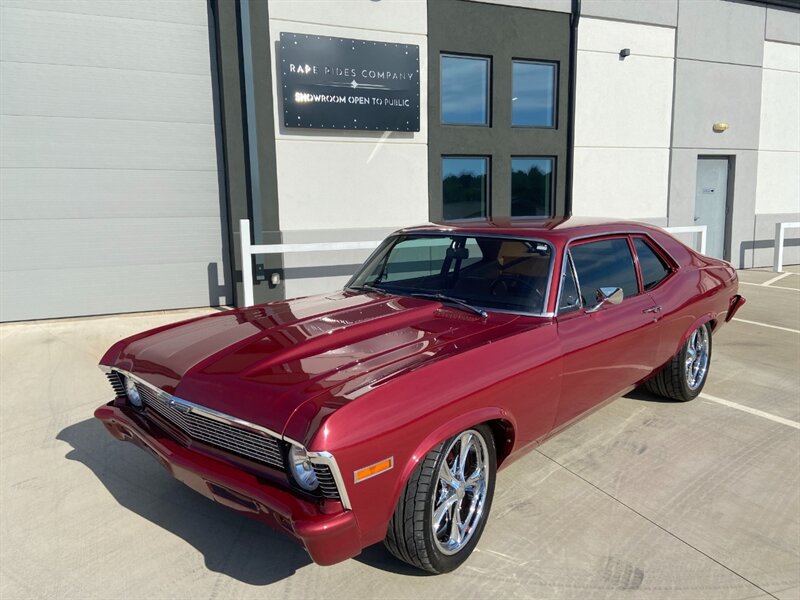

Identity, clones and modified cars
No Nova problem area costs buyers more money per incident than this one, because the sums ride on words: SS, L79, L78, matching numbers, original engine, documented. Establish what each claim actually requires before you value it.
An SS claim for 1968 onward cannot be proved from the vehicle identification number alone, because the SS was an option package rather than a separate series with its own number in those years. That is why paperwork matters so much on third-generation cars. The evidence that settles it, in descending order of strength, is: a factory build sheet — sometimes found under the rear seat, above the fuel tank or in the seat springs — listing the option codes the car was built with; the Protect-o-Plate and original dealer invoice; a cowl trim tag consistent with the car's equipment and colours, noting that the tag alone does not list the SS option on most years; engine and gearbox stampings of the correct type, date and, where applicable, partial vehicle number; and period photographs with a continuous ownership trail. For 1972, the fifth character of the vehicle number does encode the factory engine, which tests whether a car was born with a V8 of the right family, though it still does not by itself prove the SS package. For 1963 to 1967 cars the SS was a distinct model and the vehicle number carries more of the answer, one reason early SS cars are easier to authenticate. In every year, a seller who has genuinely established SS identity will show you the evidence unpressed. A seller offering only badges, a story and indignation is selling you the story.
Cloned and dressed cars are not all dishonest, and modified cars are not all inferior. Our pool contains the honest end of the spectrum: a 1965 gasser build, to be judged entirely on chassis workmanship, welds and safety equipment, and a 1971 resto-mod, whose value lies in its components and the body under them. The dishonest end is a base car presented as a factory rarity. The defences are boring and total: decode the vehicle number, photograph the trim tag and every stamping, check casting dates fall before the build date, confirm the performance hardware that should be present actually is — front discs, a correct heavy-duty axle, multi-leaf springs, the correct sway bar — and treat any pattern of missing items as the answer.
Engine swaps deserve the same calm treatment. A 350 in place of a 307, or in place of a tired 250 six, or a big-block in a small-block car: all common, all legitimate when disclosed, all value-changing. Check the workmanship that decides whether a swap is an improvement or a liability: correct mounts and frame stands for the engine fitted, a radiator and shroud sized for it, front springs matched to its weight — a V8-swapped six-cylinder car on six-cylinder springs sits nose-down — wiring spliced and fused properly, and exhaust clearance at the steering box and starter. A swapped car done well can be the best-driving Nova you will find; done cheaply, it concentrates every fault in this section into one engine bay.
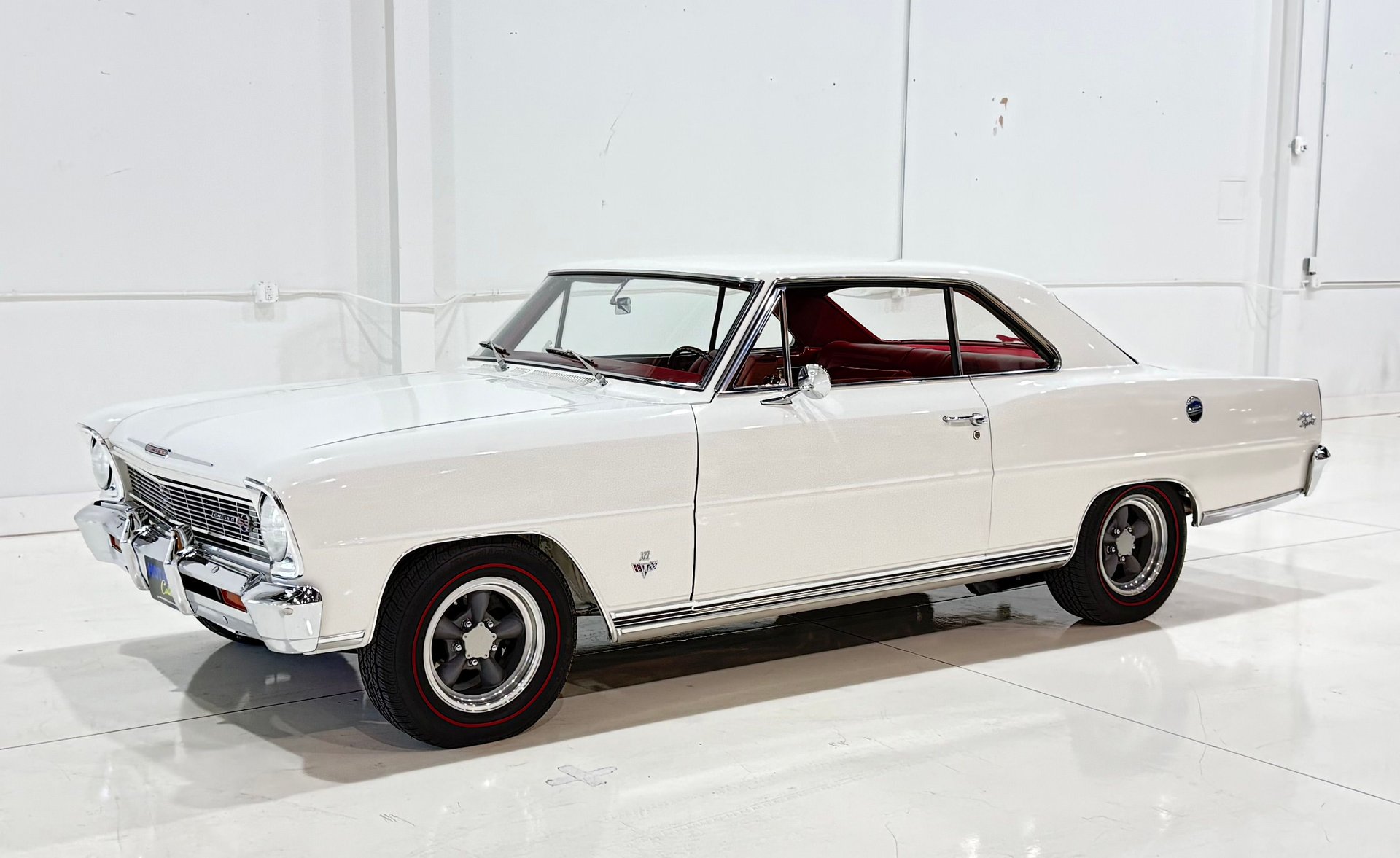

Suspension, steering, brakes and structure in use
The front suspension is conventional — coil springs, unequal-length arms, ball joints — and its faults are wear faults: worn ball joints, perished bushings and tired steering joints produce wander, uneven tyre wear and direction changes over bumps. A full front-end refresh, fitted and aligned, sits in the low thousands; the trap is paying SS money for a car that needs it immediately. On subframe cars add the mounts: collapsed mounts let the structure sit low and misaligned, panel gaps wander, and no shimming fixes alignment until the mounts are renewed. The mount set is inexpensive; seized bolts are the labour.
Rear faults centre on the leaf springs. Sagging springs change the pinion angle and can introduce a vibration under power owners misdiagnose as an axle fault. Worn bushings let the axle move laterally, felt as a wagging rear on lane changes. Axle tramp under hard acceleration means weak springs, worn bushings or tired dampers, and repeated tramp breaks parts. Springs and bushings are affordable; there is no excuse for pricing a car as sorted while it does this.
Brakes divide by era: drums all round on early cars, adequate when perfectly maintained and disappointing when merely average; front discs with the later performance packages transform confidence. Any car that has sat needs the hydraulics gone through — master cylinder, cylinders or calipers, hoses and fluid — from the high hundreds into the low thousands fitted. Pulling under braking, a slowly sinking pedal and fluid weeping at a rear wheel are findings to price, not quirks. On disc conversions, check for the correct master cylinder and proportioning, not discs plumbed hopefully into a drum system. Steering boxes wear at the centre of travel, giving free play straight ahead with tightness on lock; a modest amount adjusts out, beyond that an exchange box is in the hundreds.
Interior, trim and electrics
Interiors decide how a Nova feels to own, and they punish partial work. Foams and covers split at the seams and the driver's bolster first, and a full quality retrim in the correct grain is a four-figure job for buckets and bench once foams and labour are counted. Bench-to-bucket conversions are common and legitimate when disclosed; check the floor for correct mounting reinforcements and for crude shifter holes, which are both rust starters and a sign of the standard of work elsewhere. Headlinings sag, door cards warp at their lower edges from the same water that rots the door bottoms, and dashes crack in sun-state cars; a replacement dash pad fitted is a several-hundred-dollar job. Bright trim is the slow cost: good unpitted stainless and pot-metal is the hardest part of an early car to replace, rechroming is quoted per piece and adds up to a four-figure programme, and hardtop quarter windows drop and jam on their complex linkage — a few hundred dollars per side for a specialist to set the glass geometry right.
Electrics are the Nova's easiest system, which is why electrical chaos is such a useful warning sign. The factory system is simple — alternator from 1963, conventional fuses, minimal electronics — and faults are earths, corroded connectors and switches: cheap in parts, slow in tracing. What should worry you is amateur rewiring, unfused added circuits, and a swap harness rejoined with household connectors; a car butchered there has usually been butchered elsewhere, to the same standard. Test everything, including every gauge: a dead temperature gauge is not a small fault on a car whose engine you are judging by that instrument.
How to inspect one
Allow two hours, not one. Bring a torch, a cloth-wrapped magnet and a friend to work lights and brakes while you watch. Insist on a cold engine and, at serious money, a lift inspection. Work in this order: identity first, structure second, mechanics third — the order of the cost of being wrong.

- Paperwork and identity first. Match the vehicle identification number on the title to the plate on the car — door jamb area on early cars, base of the windscreen on later cars. Decode it for year, plant and, on 1972 cars, factory engine. Photograph the cowl trim tag. On any SS, L79 or L78 claim, ask for the build sheet, Protect-o-Plate, invoice or title trail now, at the start, as the identity discussion in the problem areas requires. If the evidence is not available, reclassify the car as an unproven tribute and inspect and price it as one.
- Cold start and engine manners. Start from stone cold yourself. Watch for blue smoke at start-up (valve seals, as the engine section explains) and continuous smoke under load (rings), and listen for lifter clatter that does not fade and any deep knock following engine speed. Check oil pressure hot and cold, and the oil on the dipstick: milky emulsion or a fuel smell both stop the viewing until explained.
- Stampings while the bonnet is open. Read the engine pad at the front of the right-hand deck: assembly stamp and partial vehicle number where present. Check casting dates on block, heads and intake against the build date. Confirm the engine family fitted matches the car's story — a claimed big-block car needs a big-block, with the mounts, radiator and manifolds the big-block section describes, not a dressed small-block.
- Underneath on a lift: structure before shine. Torch the rear spring pockets and torque boxes, the rear rails and shackle mounts, the floor seams and the subframe and its mounts, in that order — the rust map in the problem areas is your checklist. Prod suspect metal with a screwdriver, with permission. Perforation in spring mounts, torque boxes or subframe mounting points ends the inspection for most buyers; get a written body-shop quotation or walk away.
- Quarters, trunk and floors. Run the wrapped magnet over both rear quarters, lower doors and front fender bottoms. Open the trunk, lift mat and spare, and torch the floor pressings, tank area and quarter drop-offs. Lift the interior carpets where you can and press every floor pan. Water staining, underseal fresh in one area only, or filler shown by the magnet test all send you back to the rust section's pricing before you go further.
- Cowl and water test. Check both window apertures for bubbling under seals and trim, and look into the cowl plenum for leaf litter and corrosion. With permission, pour water into the plenum grille and confirm it exits behind the front wheels, not into the footwells. Check the heater on every fan speed; a silent fan on a car with wet carpets is one connected story, not two faults.
- Panels, gaps and accident signs. Sight down each flank for ripples, mismatched gaps, overspray on rubbers, and weld or pull marks on inner fenders and core support. Check the subframe for bend and elongated bolt holes. A straight, honestly gapped car with faded paint beats a glossy car whose gaps wander, every time.
- Suspension and steering by hand. Rock each front wheel for ball-joint and bearing play. Bounce each corner and watch it settle in one movement. Check subframe mount rubber for collapse. Turn the steering lock to lock and feel for tight spots either side of a sloppy centre — the worn-box pattern from the problem areas.
- The test drive. Fifteen to twenty minutes, mixed roads, including a fast stretch and a rough surface. A manual must take a brisk downchange into second without grinding and must not jump out of gear on the overrun. An automatic must engage promptly, change without flaring and kick down cleanly. Accelerate hard once, safely, and watch behind you for smoke; brake hard once and feel for pull and judder. Listen for axle whine changing between drive and coast, and for rear tramp under power.
- Heat and electrics under load. End the drive in traffic or at a long idle and watch the temperature gauge — the big-block and late-car cooling warnings are tested here, not at cruise. Then work everything electrical: lights, indicators, horn, wipers, washers, fan, every gauge. Note anything dead as a tracing job to price, and treat amateur rewiring as the warning sign the problem areas describe.
- Interior and glass. Sit in every seat. Feel for broken springs and collapsed foam, and check seat belts and their floor anchorages for rust around the bolts — a structural check disguised as a trim check. Work every window fully, especially hardtop quarter windows. Inspect headlining seams, the dash top for cracks and door cards at their lower edges for the water damage matching the door bottoms from step 5.
- Stance and final photograph. Park on level ground, stand back and photograph the car in profile and from each rear three-quarter, as in the figure for step 1. Sag at one corner, a nose-down sit on a swapped car, or a low rear on tired springs all show more clearly in a photograph than in person. Then put your numbers together: price, plus the structural, mechanical and trim jobs this inspection actually found, each priced from the ranges in this guide. If that total buys a better car already done, buy that car instead.
Values
The build beneath this guide carries the current numbers, refreshed as the market moves. This section teaches you how to read them, because the spread between cheapest and dearest cars wearing the same badge is unusually wide here.
The first driver is category, not condition. A verified original-engine SS 396, a small-block SS, a standard V8 coupe, a six-cylinder coupe and a tribute or resto-mod are five different markets sharing one silhouette. Compare a car against recorded sales only within its own category, and be brutally honest about which category the evidence puts it in. The commonest reading error in this market is pricing an unproven car against proven-car sales because the badges match. Badges do not set the category. Documents do.
The second driver is structure. Between two cars in the same category, a genuinely solid shell with original quarters, floors and spring mounts is worth a large premium over a car needing welded repairs, and the premium is rational: bodywork is the costliest, slowest and least reversible work on the car, and a repaired shell, however well done, is a different object from an unrepaired one. Original paint, even faded, carries its own premium because it is evidence. Fresh paint carries none until the seller shows you photographs of the metal underneath it before the paint went on.
Third, read asking prices and achieved prices as different species. Dealer asking prices, which dominate our pool, describe optimism and presentation; recorded sale results describe what a buyer actually paid, faults visible. A car listed for months is telling you its price is above its market. Use long-listed cars to learn what the market refuses, not what it pays.
The project-to-driver gap is unusually deceptive. A rough coupe can look temptingly far below a finished car, but the gap has to fund structural welding, paint, an engine or gearbox rebuild, brakes, suspension and an interior — a total at shop rates that regularly exceeds the price difference to a good car, before your own time is counted. The exception is the buyer who welds and paints competently at home, for whom a structurally honest project is rational because the labour is theirs. Know which buyer you are before deciding a project is cheap.
Premiums that are real, when evidence supports them: documented original drivetrain; the L79 and L78 engines when proved, not claimed; a four-speed manual in a performance coupe; working factory air conditioning; and an unrepaired, rust-free shell in any category. Premiums that evaporate on inspection: SS presentation without SS evidence, a claimed fresh rebuild without invoices, fresh paint without metal photographs, and low mileage without a paper trail, on cars whose odometers have had fifty years to be replaced, disconnected or go round again. Negotiate from the inspection list, item by item, with the job costs from this guide in hand. A seller who has priced honestly will recognise the arithmetic; a seller who will not discuss it is asking you to pay for the faults as well as the car.
Parts and ownership
The Nova coupe is one of the best-supported American classics you can own, and that support is the strongest argument for the car. Chevrolet built Novas in the millions, the small-block V8 is the most supported engine family in the hobby, and the third-generation coupe shares its subframe thinking and many service parts with the early Camaro. A competent general classic shop can maintain the whole car; you want a genuine specialist only for authentication questions and big-block and L79-specific parts decisions.
Easy and inexpensive: service items for every engine; brake shoes, pads, discs, drums and hydraulics; ball joints, bushings, springs, dampers and steering joints; water pumps, alternators, starters and radiators for the common engines; standard exhaust systems; weatherstrips and glass rubbers; and most wear parts for the TH350, TH400, Powerglide and Muncie gearboxes. Most of it orders today and arrives this week at prices close to modern-car money, and used service parts are plentiful at swap meets.
Available but to be budgeted: reproduction body panels for the popular years, especially 1968 to 1972 — variable in pressing quality and always needing trial fitting and finishing labour, so the panel price is the smaller half of any panel job — plus interior kits in correct grains, subframes for the 1968-onward cars, and trim of variable reproduction quality. For early hardtops, glass, roof and trim parts are thinner on the ground, and a complete, correct interior is a genuine asset to price into a car.
Hard, dear or specialist: correct, date-matched performance components — L79 and L78 heads, intakes, carburettors and distributors — which trade in a market of their own and attract restamped parts, so buy them on evidence, as you would the car; big-block exhaust manifolds and Nova-specific mounting hardware; unpitted trim for early cars; and factory paperwork itself, which cannot be bought at any price and is why documented cars hold their premium. Rechroming is quoted per piece and adds up to a four-figure programme across a whole car.
Running costs and the first year. A sorted coupe is a realistic regular-use classic, returning low twenties in miles per gallon for a gently driven six and low teens for a big-block used as intended. Budget the first year for the deferred maintenance the inspection found plus fluids, brake hoses, aged tyres regardless of tread depth, and a cooling service on any car with unknown history. Catching up a running car typically costs a low four-figure sum before improvement work; recommissioning a car that has sat for years is a mid four-figure programme at a shop even when nothing structural is found. Storage is decisive: these shells rust from trapped moisture, so a dry, ventilated garage and an annual hour underneath clearing drains and checking the rust map does more for survival than any product applied to the paint.
Which one to buy
- The all-rounder: 1968 to 1972 SS 350 coupe, or a plain 350 coupe in the same years. The deepest parts support and the strongest market. A plain V8 coupe in superb structural condition beats a shabby SS at the same money, every time.
- The value buy: a six-cylinder or 307 coupe with a genuinely solid shell. The cheapest entry to the shape, simple to run, and the easiest car in the world to improve later — provided you buy it as what it is.
- The connoisseur car: 1966 or 1967 SS, above all a proved L79. The prettiest shell and the finest engine the line carried. Buy only with stampings, dates and paperwork that survive hostile scrutiny, and pay the premium only for the proof.
- The flagship: 1968 to 1970 SS 396, L78 if proved, 325-horsepower car if not. The L78 is a specialist purchase; the hydraulic-lifter car is the same theatre with lower running costs. Cooling, mounts and documentation decide both.
- The character buy: the honest modified car — gasser, resto-mod or well-executed swap. Judged as workmanship, not originality, these can be the most fun per dollar in the guide. Our pool's 1965 gasser and 1971 resto-mod are the type specimens: buy the fabrication and the body, ignore the badges.
- The easy-going buy: 1975 to 1979 coupe. Comfortable, quiet and overlooked. Buy the best shell and interior you can find, and do not commission a restoration the finished value will not carry.
- The one to avoid at any badge: the unproven rarity. SS, L79 or L78 claims with no build sheet, no coherent stampings and a seller who resists decoding are not a bargain version of the real thing. That is a standard car at a rarity price, and the discount for the risk belongs to you, not the seller.
And the rule that overrides all of the above: buy the least rusty, most honestly documented car you can find, in the specification you can live with. Engines, gearboxes, interiors and brakes all renew at prices you can plan for. Rot in the spring mounts and torque boxes, and an identity the paperwork cannot support, are the two faults no Nova coupe ever quite recovers from — one in the workshop, the other in the market.
See the 5 Nova Coupe cars currently listed.