
Chevrolet Nomad buyer's guide
Chevrolet Nomad -- the model's own buyer's guide: variants, values and what to check.
Years listed: 1955-1957 · Series: Tri-Five
Overview and history
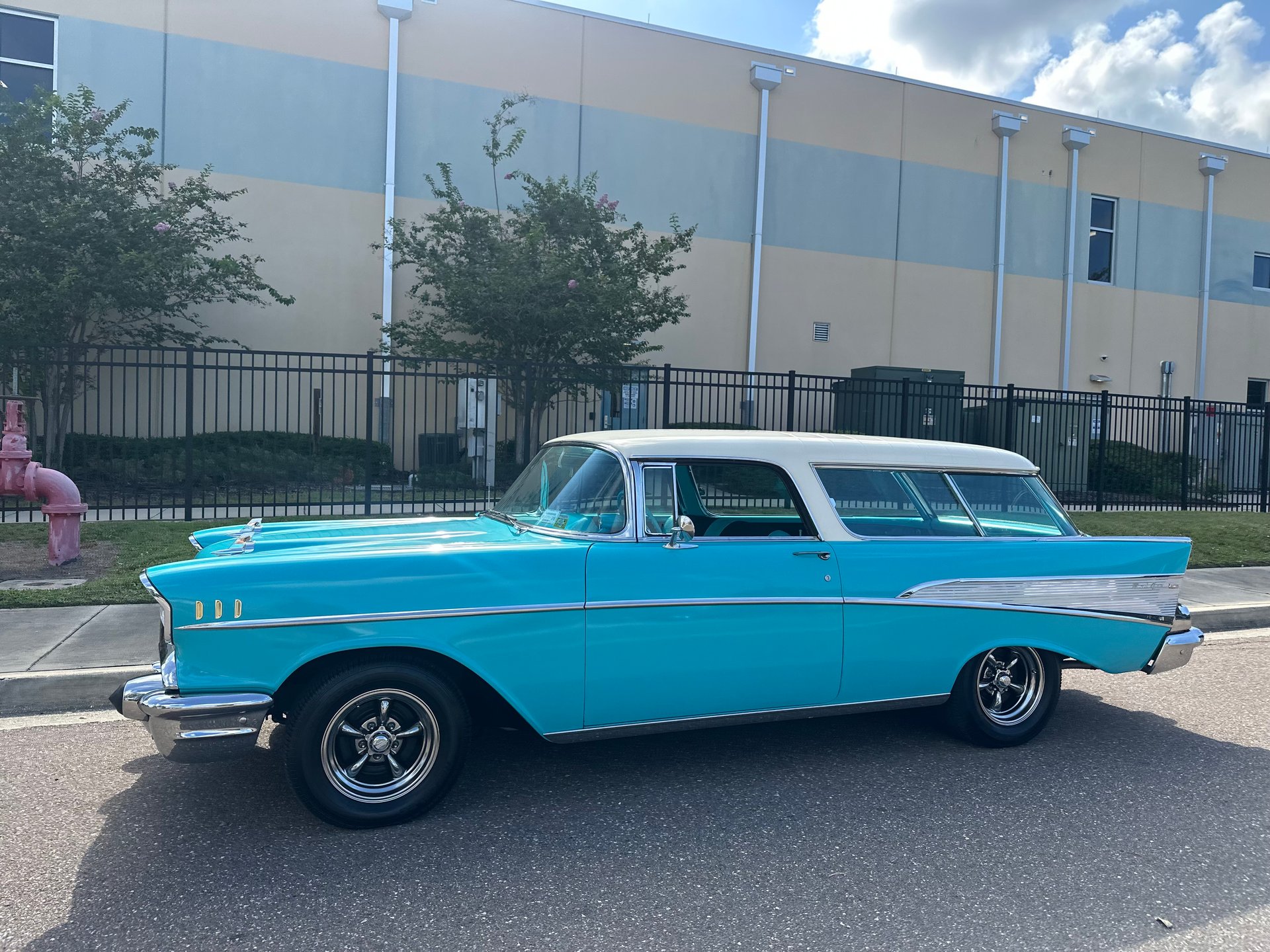
The Chevrolet Nomad is two cars wearing one name, and only one of them matters to most buyers. The first is the 1955–57 Bel Air Nomad: a two-door sport wagon built on the Tri-Five Chevrolet, with a slanted B-pillar, a ribbed roof, curved rear side glass and more chrome than any wagon had a right to — the car that turned a working station wagon into a piece of sculpture. The second is everything Chevrolet later stuck the badge on: four-door Bel Air and Impala wagons for 1958–61, the base Chevelle wagon for 1968–72, and a Vega variant in the 1970s. Those later cars are honest wagons and a few are interesting, but they share nothing with the Tri-Five car except the nameplate. This guide is about the 1955–57 car, because that is the Nomad the market means, and it is the Nomad in our listings: every one of the 26 Nomads we currently track — 15 for sale and 11 sold — is a Tri-Five car, split between 1955 (8), 1956 (6) and 1957 (12).
The idea started as a show car. At the 1954 General Motors Motorama, Chevrolet displayed the Corvette Nomad, a fibreglass two-door wagon on the Corvette theme, styled under Harley Earl with Carl Renner doing much of the defining work — the forward-slanted pillars, the wrap-around rear glass and the fluted roof. The response was strong enough that GM rushed the shape onto the all-new 1955 Chevrolet instead of the Corvette. That decision explains the car you are buying today: the roof, pillars, doors, rear quarters, tailgate and glass are unique to the Nomad, grafted onto a mass-produced Bel Air front clip, chassis and drivetrain. The glamorous half is rare and expensive to restore; the mechanical half is one of the best-supported American cars ever built. Hold that split in mind through every section of this guide, because it decides what a Nomad is worth and what it costs to fix.
It was never a volume car. The Nomad was the most expensive Chevrolet you could buy apart from the Corvette, priced above the Bel Air convertible, and it seated six in a body that carried less than a cheaper four-door Townsman wagon. Buyers admired it and bought the practical car instead. Production across the three years was just 22,375 cars — 8,386 in 1955, 7,886 in 1956 and 6,103 in 1957 — against roughly five million Tri-Five Chevrolets of all kinds. A Nomad is about one-third of one percent of Tri-Five production, and the survival rate of a working wagon is worse than that of a convertible bought as a toy. Pontiac built a sister car, the Star Chief Safari, on the same idea; it is not covered here.
The intervening seventy years matter as much as the three at GM. Nomads became hot rods, surf wagons, drag cars and, in the last thirty years, restomods: a large share of the cars offered today — including several in our own pool, listed openly as restomods and LS builds — are original Nomad bodies over substantially modern machinery. That is not a lesser kind of Nomad, but it is a different purchase, inspected and valued differently, and this guide treats the two streams — stock and modified — separately wherever they diverge. What no stream escapes is the body. A Nomad shell with sound floors, quarters, roof and tailgate is the asset. Engines unbolt. That roof does not.
The models
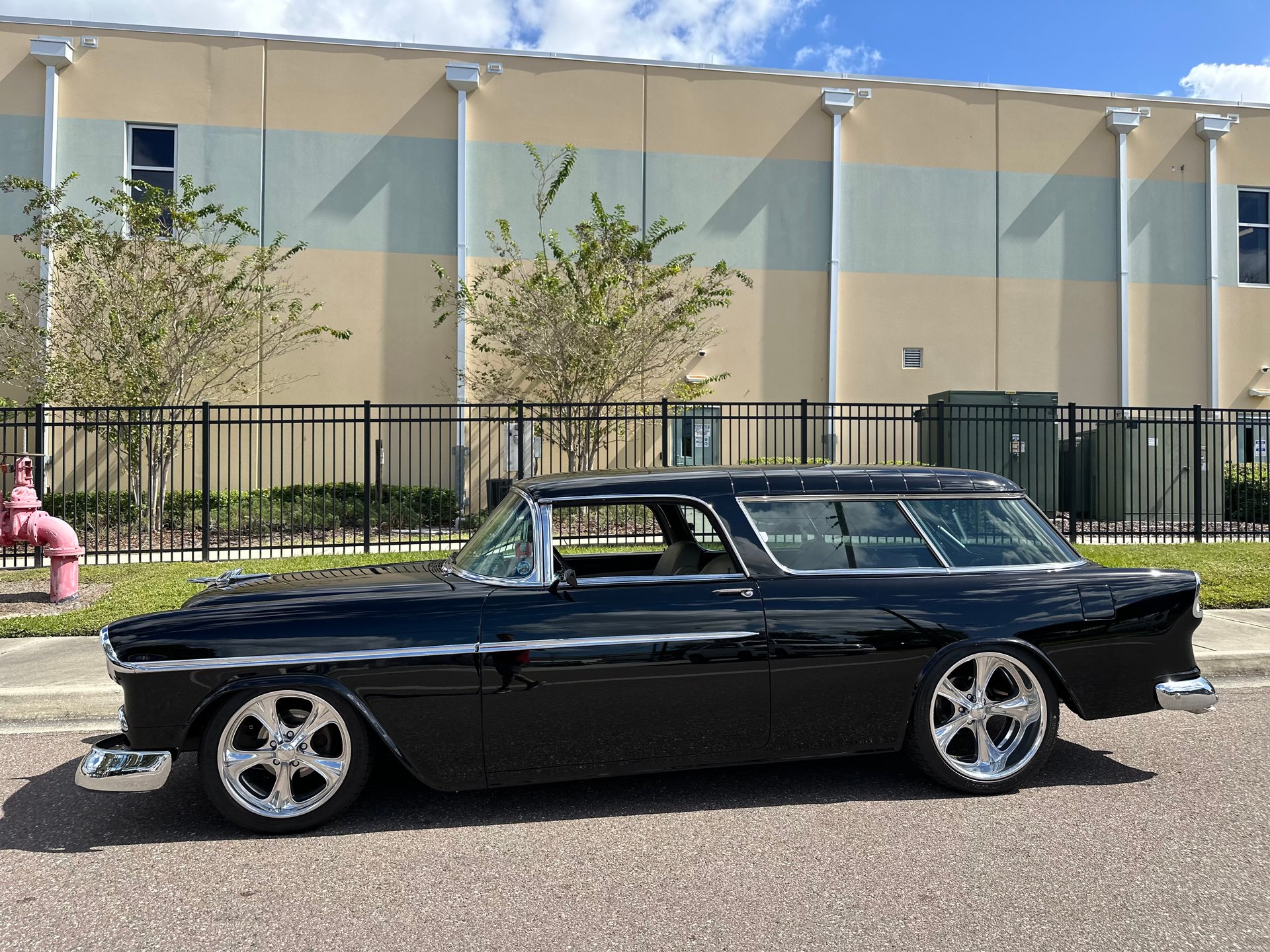
There is exactly one Nomad body in each Tri-Five year: a two-door wagon in the Bel Air series (the 2400 series, body style 1064DF on the cowl tag), differing year to year by the annual facelift and by the engine list, which changed dramatically across the three years. There were no trim levels within the Nomad — every car got full Bel Air equipment, carpet, brightwork and the ribbed tailgate treatment — so the "models" that matter are the three model years and the engine fitted. The table gives the headline factory V8 for each year; the full engine ladder is in the next section.
| Model | Years | Engine | Output | Built | Character |
|---|---|---|---|---|---|
| Nomad (1955) | 1955 | 265 cu in V8 (4.3L), 2-barrel | 162 hp | 8,386 | The original: egg-crate grille, full-radius rear arches, "eyebrow" headlamp trim |
| Nomad (1956) | 1956 | 265 cu in V8 (4.3L), 2-barrel | 162 hp | 7,886 | The refined car; full-width grille, cut rear arches, the best cruiser of the three |
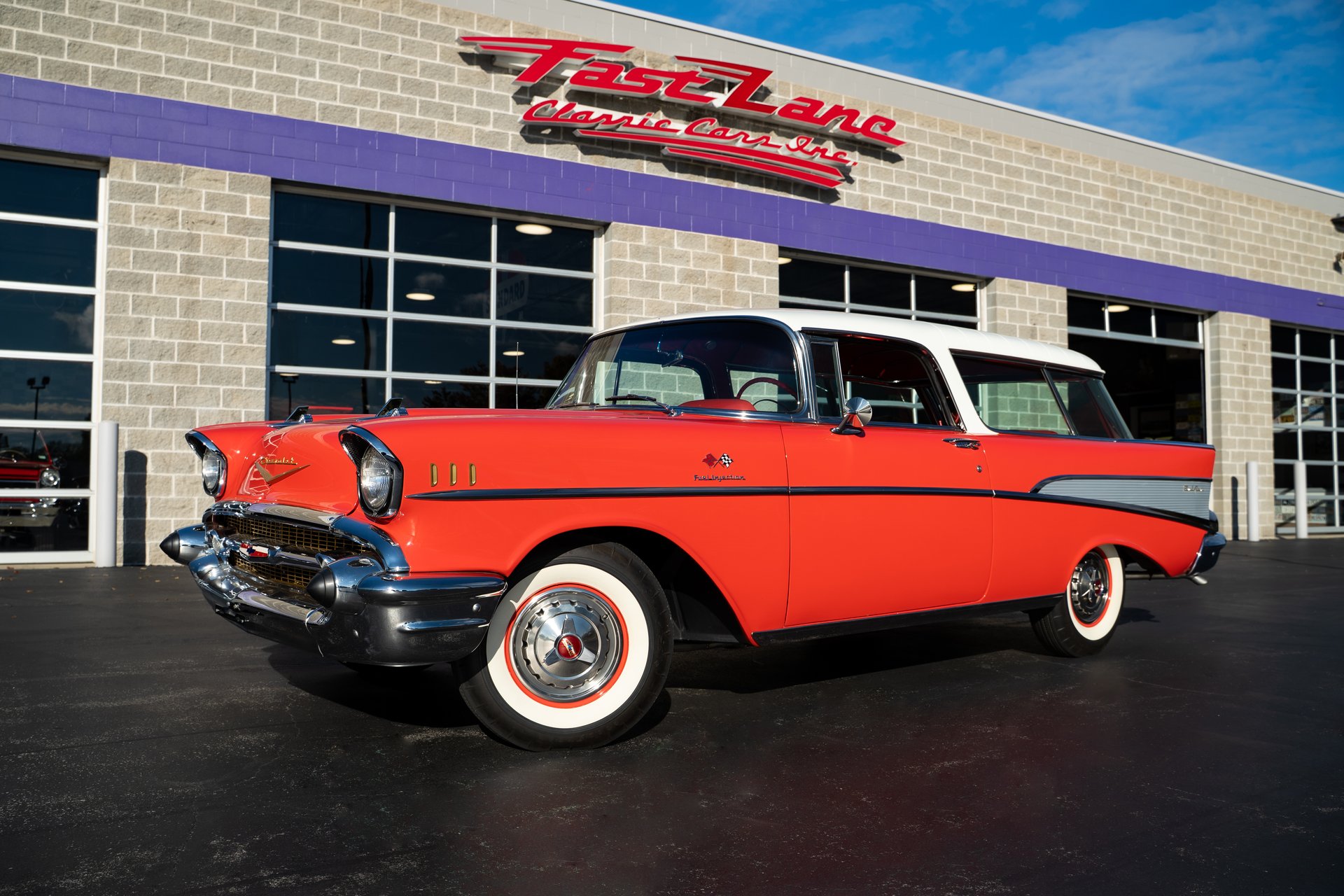
| Nomad (1957) | 1957 | 283 cu in V8 (4.6L), 2-barrel | 185 hp | 6,103 | The icon: fins, gold trim, and the fuel-injection option at the top of the range |
| Nomad (four-door) | 1958–1961 | 283/348 cu in V8 | 185–250 hp | series production | A top-trim conventional wagon; the name carried over, the body did not |
| Nomad (Chevelle) | 1968–1972 | 307/350 cu in V8 | 200–270 hp (gross) | series production | The base Chevelle wagon; a nameplate revival, unrelated to the Tri-Five car |
(Outputs are period SAE gross figures for the base V8. The standard engine in all three Tri-Five years was actually the 235 cu in "Blue Flame" six; most Nomads were ordered with a V8, and a six-cylinder car today is a curiosity. Later Nomads are listed for completeness — they are different cars, valued as trim variants of their own ranges, and none appears in our current pool.)
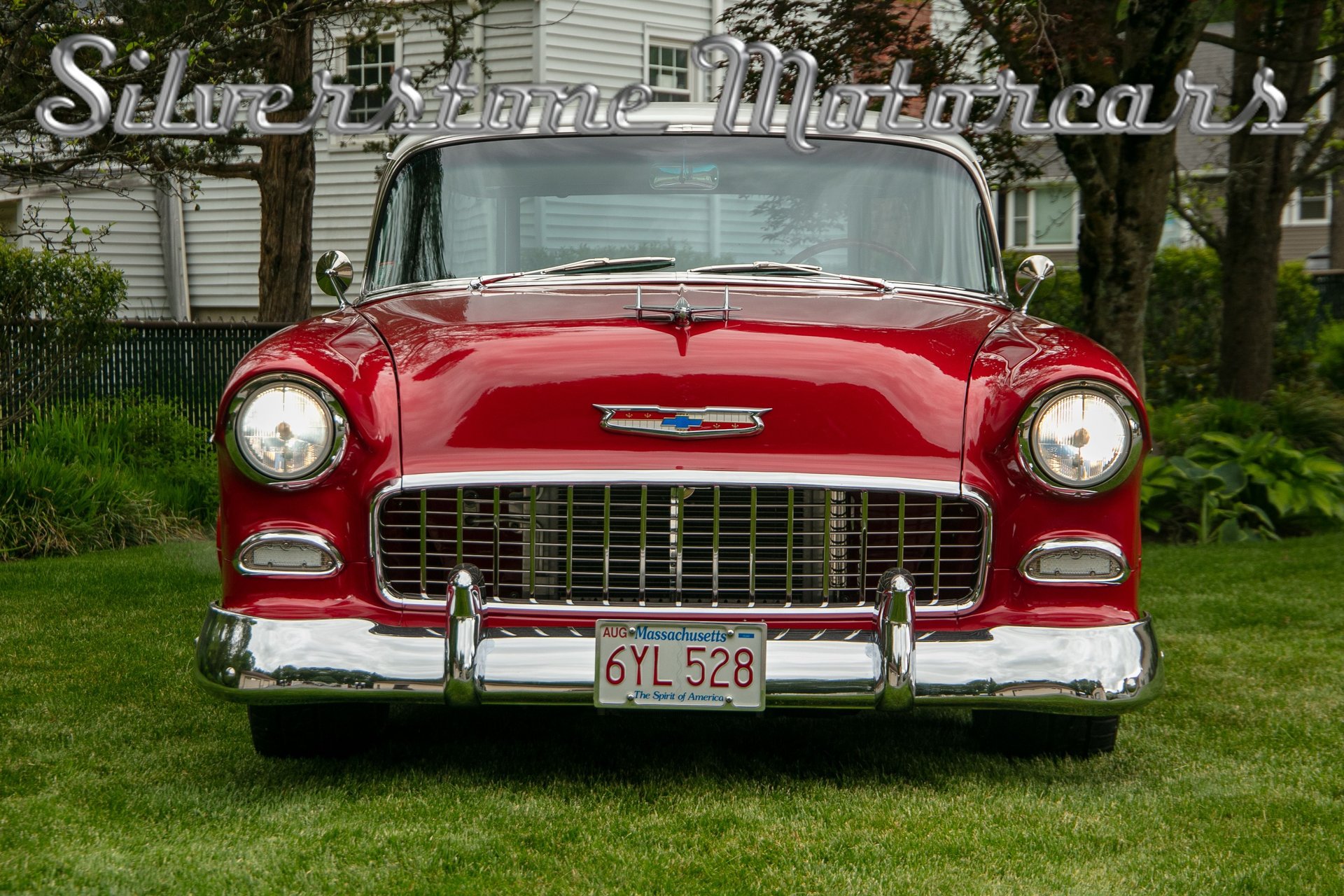
1955. The first Nomad is the most distinctive and the most idiosyncratic. The grille is a Ferrari-inspired egg-crate, the headlamps wear little chrome eyebrows unique to the year (and unique to the Nomad and Bel Air), the rear wheel arches are full-radius round openings, and the interior uses a waffle-pattern vinyl that owners either love or replace. Early 1955 cars are the most "show car" of the run and the least developed: the 265 V8 was brand new, the electrical system is 6-volt on six-cylinder cars (V8s are 12-volt — check what you are looking at), and a number of one-year-only small parts will slow a restoration. The tailgate wears seven vertical chrome bars over its ribs in 1955–56.
1956. Chevrolet cleaned the design up: a full-width grille, side trim that runs the length of the car, and rear arches cut back to expose more of the wheel, making the car look lower and longer. The engine room is the story — outputs rose, and the dual-four-barrel 225 hp engine arrived mid-range. Many experienced Tri-Five hands call the 1956 the sweet spot: the developed mechanicals without the 1957's fussier styling and one-year trim. It is the rarest year in our pool, with six cars against eight 1955s and twelve 1957s.
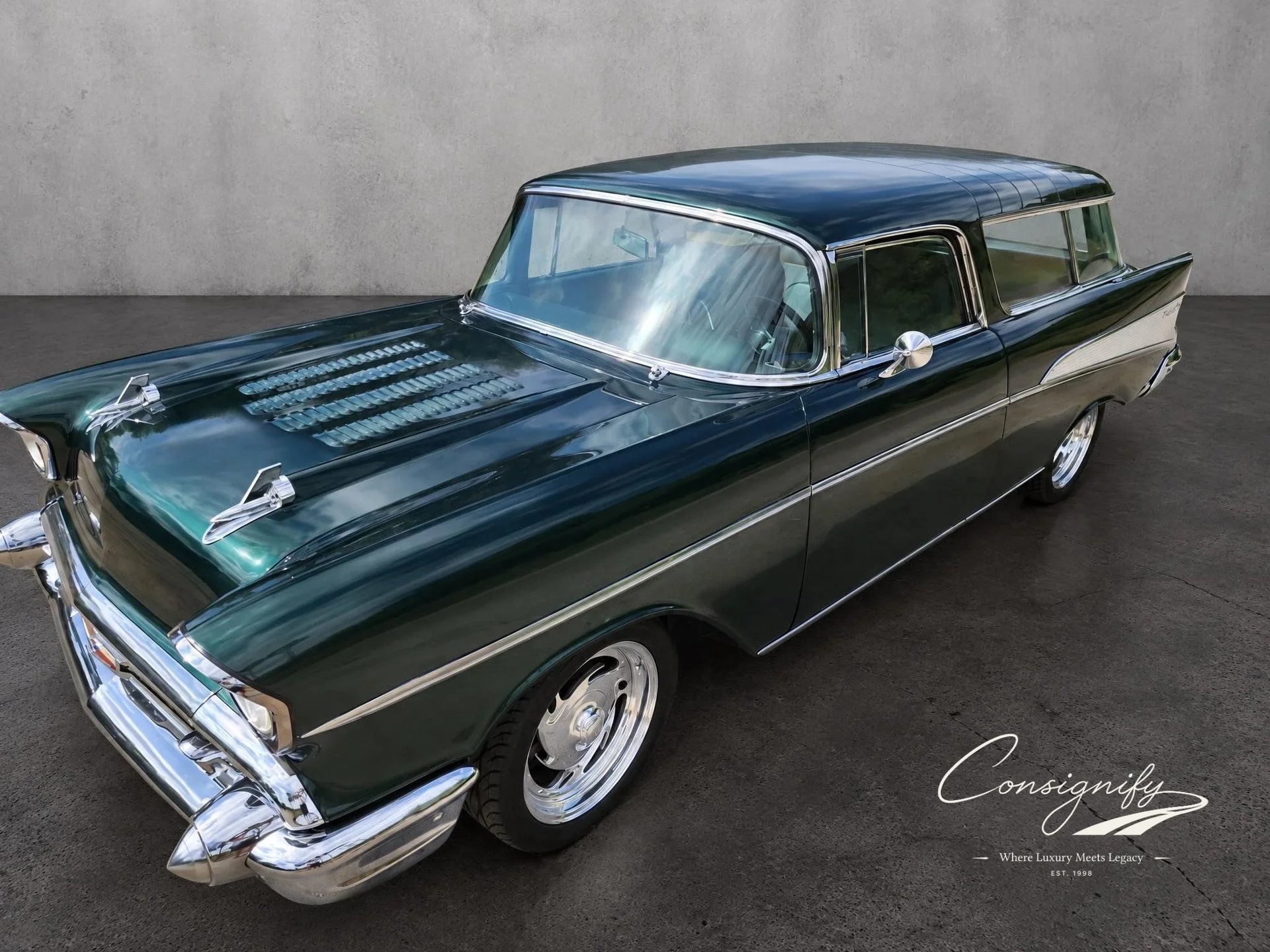
1957. The famous one. Longer, lower-looking, with real tailfins, a gold-anodised grille mesh and Bel Air side insert, twin hood "windsplits" and the three gold fender louvres that mark a V8 Bel Air. Under the hood the 283 arrived, and with it the Rochester Ramjet fuel injection — a genuine 1957 Nomad fuelie is one of the most collectible American wagons in existence, and also one of the most faked, because the scripts, the injection unit and even the supporting hardware can all be bought and bolted on. The cowl tag will not prove a fuelie; only documentation and the correct dated components do. Section 3 covers the checks. Much of the 1957 dashboard and trim is one-year-only, which cuts both ways: the look is unmistakable, the parts hunt is longer.
The name afterwards. For 1958 the Nomad became the top four-door wagon in the new, larger Chevrolet line, and it continued as the Impala-level wagon through 1961 — competent, handsome in 1959–60 form, and worth a fraction of a Tri-Five car. Chevrolet revived the name for the base Chevelle station wagon from 1968 to 1972 and used it briefly on a Vega wagon variant in the mid-1970s. If you are offered one of these at Tri-Five money on the strength of the badge, walk away: the market prices them as what they are.
Engines and gearboxes
The six: 235 cu in "Blue Flame"
Every Tri-Five Nomad's standard engine was the 235.5 cu in (3.9-litre) overhead-valve straight six, Chevrolet's "Blue Flame," rated at 123 hp in 1955 and 140 hp from 1956. It is a stout, simple engine — but with two generational traps a buyer must know. First, oiling: 1953–54-pattern 235s used splash-and-scoop lubrication for the connecting rods, while the full-pressure-oiling version is the one fitted to these cars; any replacement engine of unknown origin needs its identity checked rather than assumed, because the splash-oiler is a materially weaker engine. Second, electrics: six-cylinder 1955 cars are 6-volt, where the V8s are 12-volt, so a six-cylinder 1955 Nomad cranks slowly by design and suffers every 6-volt malaise — dim lamps, lazy starting with a marginal battery, and a generator that cannot keep up with modern traffic use of lights and wipers together.
On the road the six is adequate and no more, and almost nobody ordered it in a top-of-the-range wagon. A six-cylinder Nomad today raises a question rather than a premium: verify from the VIN that the car left the factory as a six (no leading "V" — see the inspection section) and treat an undocumented six-to-V8 conversion as a modified car. The checks are simple: even compression, no bottom-end knock under load from cold, and no milky emulsion under the oil filler — the 235's long head warps if badly overheated, and a skim plus gasket is a few hundred dollars where a cracked casting is an engine hunt.
The small-block V8s: 265 and 283
The engine that made the Tri-Five famous debuted with it. The 265 cu in (4.3-litre) small-block of 1955 — designed under Ed Cole's team with Zora Arkus-Duntov's input on the performance side — is an overhead-valve V8 with a short stroke, a lightweight cast block and enormous headroom, and its 1957 bored-out descendant, the 283 (4.6 litres), is the definitive early small-block. Both are tough, cheap to rebuild and supported by possibly the largest parts ecosystem of any engine on earth. What you are buying is rarely the basic engine; it is the specification on top of it, and the ladder matters:
- 1955 265: 162 hp with a two-barrel carburettor; 180 hp as the "Power Pack" — a four-barrel (Rochester 4GC or Carter WCFB) with dual exhausts. Note the 1955 block has no provision for a full-flow oil filter at the side of the block; filtration was an optional bypass canister on top of the engine. Absence of a spin-on filter is correct on a 1955, not a defect — but it is one reason a documented oil-change history matters more on this year.
- 1956 265: 162 hp two-barrel, 170 hp with Powerglide, 205 hp Power Pack four-barrel, and 225 hp with twin four-barrel Carter WCFBs on an aluminium intake — the Corvette specification, available in the passenger-car line and occasionally found in Nomads.
- 1957 283: 185 hp two-barrel; 220 hp Power Pack four-barrel; 245 hp and 270 hp with twin four-barrels (hydraulic and solid lifters respectively); and the Ramjet fuel-injected engines at 250 hp (hydraulic lifters, 9.5:1 compression) and 283 hp (solid lifters, 10.5:1) — the famous one-horsepower-per-cubic-inch engine. The 265 continued as a 162 hp base V8 early in 1957.
Judging one is standard small-block work, done in order. Cold-start it and listen: a brief top-end tick that fades is lifter bleed-down; a deep knock that quietens as oil pressure builds is main-bearing wear and an engine-out budget. Blue smoke at start-up after sitting is valve stem seals — a modest job done with the heads on. Blue smoke under sustained load is rings or bores. The rear main seal leaks on nearly all of them (the original rope seal weeps; a two-piece modern seal fitted at rebuild is the cure), so read an oily bellhousing as normal-but-budgeted, and a dry one as evidence of recent engine work. Check the stamped pad ahead of the passenger-side head: its suffix code decodes the original application, and the casting date at the back of the block should precede the car's build date. A "matching numbers" claim means that pad, those dates and the casting numbers agree — not that the seller says so. Overheating is the small-block's one habitual vice here: the original radiators are marginal in modern traffic, and a car that creeps up at idle but cools at speed has an airflow or radiator-core problem, while one that heats under load points at head gaskets or a blocked system. Do not let a seller blame "they all do that" for a gauge in the red.
Carburettors. Two-barrel cars use a Rochester 2GC; four-barrel cars a Rochester 4GC or Carter WCFB; twin-four cars a matched pair of WCFBs with progressive linkage. Seventy years on, the faults are wear, not design: throttle shafts worn oval in the base plate suck air and make the idle wander however you adjust the mixture screws — rock the shaft by hand and feel for play before paying for a "tune." Warped air horns leak at the top gasket. The twin-four setup adds synchronisation: a car sweet at cruise and flat pulling away usually has the linkage opening the secondaries out of sequence. Rebuilds by a specialist who will re-bush shafts run roughly $400–900 per carburettor, and a car advertised as a dual-quad car with a single four-barrel hiding under the air cleaner is a negotiation, not a discovery to make after purchase.
Ramjet fuel injection (1957). The Rochester Ramjet is a continuous-flow mechanical injection system: an engine-driven high-pressure pump feeds a fuel meter that meters against airflow through a venturi in the air meter, with a separate cold-start enrichment circuit. When it is right, a fuelie starts instantly, idles cleanly and pulls harder than any carburetted 283. When it is wrong, almost nobody can fix it by ear — the surviving specialists are few, and a full rebuild and calibration of a complete, correct unit runs roughly $3,000–6,000. The failure mechanisms are specific: the spill plunger and its bore wear, giving hot-start flooding and a rich idle; the axle-link and vacuum circuits in the fuel meter drift out of calibration; the cold-start (cranking signal) valve sticks, so the car either will not start cold or enriches itself warm; and modern ethanol fuel attacks the original seals and diaphragms, so any unit not rebuilt in the ethanol era is on borrowed time. The identity checks matter more than the tuning ones: a genuine 1957 passenger-car unit carries the correct part numbers for the year (early and late units differ), the air meter and fuel meter numbers must be a matched, plausible pair, the car should carry the correct fuelie core support, air cleaner and fender scripts — and none of it proves anything without paperwork, because complete clone installations are a cottage industry. Price an undocumented "fuelie" as a 283 four-barrel car plus the value of the parts fitted, and you will never be hurt.
The modified engines. A large slice of today's market — our pool includes cars listed as LS3-supercharged and multiple restomods — runs later machinery: 350, 383-stroker and big-block swaps, and increasingly LS-series engines (LS1/LS3, sometimes supercharged) with electronic injection. Judge these as hot rods, not classics with a different motor. The questions are workmanship questions: proper fabricated or kit mounts rather than stacked washers; a labelled harness rather than a birds-nest of scotch-locks; a cooling system (aluminium radiator, shrouded electric fans) that holds temperature at idle with the air conditioning on; a proper in-tank pump and return line for the injection; and brakes and a rear axle that match the power — an LS3 against the original rear axle and single-circuit drums is a mismatch you will pay to correct. A well-built restomod is the easiest Nomad to live with; a badly built one is the hardest to value, because every fault is one-off.
Gearboxes
Three-speed manual. The standard gearbox is Chevrolet's Synchro-Mesh three-speed, column-shifted, with synchromesh on second and third only — first is a crash engagement at anything above walking pace, which is normal, not a fault. An overdrive version (the Borg-Warner R10 overdrive unit behind the three-speed) was optional and is genuinely desirable for highway use; check it engages — the overdrive depends on a working governor, solenoid, kickdown switch and relay, and a car whose overdrive "just needs a wire" usually needs the set. Worn second-gear synchromesh is the standard wear item: a crunch on the 3–2 downshift that double-clutching cures is synchro wear, priced as a gearbox rebuild at roughly $1,200–2,500. A handful of 1957 cars received the Borg-Warner T-10 four-speed late in the year (a Corvette-led option, rare in passenger cars); a claimed factory four-speed Nomad needs documentation, as most four-speeds in these cars are later swaps — which, done well with a proper floor shifter, are a useability plus rather than a defect.
Powerglide. The default automatic is the two-speed Powerglide, in 1955–57 form with a cast-iron case — the aluminium Powerglide is a 1962-and-later unit, so an aluminium case in a Tri-Five is a later transplant. It is a simple, strong box with one defining characteristic: a single upshift and no automatic downshift to low at speed, so performance is leisurely and entirely normal. The checks are fluid colour and smell (dark, burnt fluid is a rebuild conversation at roughly $1,500–3,000), a firm shift without flare, no delay engaging Drive or Reverse from cold (front pump and seal wear), and leaks — the cast-iron Powerglide marks its territory from the front pump seal and selector shaft, and a car that has sat often leaks dramatically for its first weeks back in use as seals re-swell, then settles. Distinguish that from a leak that worsens with use. A car that feels gutless is usually geared and cammed as built, not broken.
Turboglide (1957). Chevrolet's answer to Buick's Dynaflow was a continuously variable-effect triple-turbine automatic, offered only from 1957, with a distinctive "GR" grade-retard position on the quadrant. It was troublesome when new, is troublesome now, and parts and rebuild knowledge are genuinely scarce — a specialist Turboglide rebuild can run $3,500–6,000 if you can find the man. A 1957 Nomad with a working Turboglide is a fascinating survivor; a 1957 Nomad with a slipping Turboglide is a car whose price must carry the conversion to Powerglide or a modern automatic that most owners eventually choose.
Later automatics in modified cars. Our listed cars carry the common swaps: the TH350 three-speed and the 700-R4 and 200-4R four-speed overdrive automatics — the overdrive boxes are the ones you want for a driver, their tall top gear transforming a Tri-Five on the highway. On any overdrive swap, the critical check is the TV (throttle-valve) cable: it is not a kickdown cable, it controls line pressure, and a misadjusted cable burns the gearbox up in a few hundred miles while feeling almost normal. If the seller cannot tell you who set the TV cable and how, budget as though the box is living on luck, and verify shift quality and fluid condition with extra care on the test drive.
Problem areas
Everything in this section follows from the car's construction: a mass-produced Tri-Five chassis and front clip, which rust and wear in well-documented, fixable ways, carrying a low-production wagon body aft of the windshield, which rusts and wears in ways that can end the car's economics. We photo-checked 13 of the Nomads in our store in detail for this guide; rust featured in the notes on 5 of those 13 cars and visible damage in 2 — on a pool that is mostly dealer-presented, restored cars. On unrestored cars, assume the proportions are worse. Work through a Nomad from the structure outwards, and never let a strong engine talk you out of what the floors are telling you.
Rust: the map
Floors, toe boards and body mounts. The Tri-Five floorpan rots in a predictable pattern: the front footwells and toe boards (water past the windshield seal and the cowl vent sits under the carpet and the factory sound-deadening holds it there), the areas above the body-mount braces, and the rear cargo floor over the spare-wheel well. The Nomad adds a trap of its own — the cargo floor is long, flat and covered, so rot under the rear carpet or a modern plywood-and-carpet load floor can hide until you lift it. Lift everything. Surface rust on a floor is a wire-brush-and-treat afternoon; perforation at a body-mount point is structural, because the body is bolted to the frame through those braces, and a floor that flexes around its mounts is a body-off conversation. Individual floor pans and braces are reproduced and cheap (a pan is a few hundred dollars; fitting and welding is the bill, roughly $800–2,000 a side done properly) — what you are pricing is how many of them the car needs at once.
Inner and outer rockers, and the lower cowl. The rocker panels are the Tri-Five's classic rust site, and on a two-door they are long, structural and loaded by the door aperture. Prod the full length, especially the front end behind the front wheel where road grit blasts the paint, and the rear end where the rocker meets the quarter. Fresh stone-chip over the rockers on an otherwise honest car is a question; fresh stone-chip over filler is the commonest single deception in the Tri-Five market, and a magnet wrapped in cloth answers it in seconds. The lower A-post and cowl sides rot from the inside where the cowl drains block; bubbling at the base of the windshield pillar or at the bottom rear corner of the front fender is the surface sign of a cavity that is already through. Fender bottoms themselves are reproduced; cowl and A-post repair is fabrication, priced per car.
Rear quarters and wheel arches. The Nomad's rear quarters are unique pressings — longer, with the wagon's side glass above them and the arch shapes that differ by year (full-radius in 1955, cut for 1956–57) — and they rust at the arch lip, at the bottom behind the wheel where the inner tub meets the outer skin, and along the lower edge ahead of the wheel. Patch panels exist for the arch and lower sections; a full quarter is a major panel, expensive to buy and expensive to hang straight, and a Nomad with both quarters holed at the tubs is a restoration project whatever the listing calls it. While you are there, open the fuel filler (in the left rear fender on 1955–56, hidden behind the left tailfin's trim on 1957) and check the filler neck and the panel around it — spilt fuel and trapped water rot the neck and the floor beneath it.
The frame. The Tri-Five frame is a separate ladder chassis, stronger than the body it carries — which is why Nomads survive to be restored at all. It rusts at the rear rails over the axle, at the body-mount outriggers, and at the front crossmember where oil and road salt combine. Surface scale is normal; perforation or heavy pitting at a mount or spring hanger is not. Two variants exist — a standard welded frame and a one-piece "California" frame with smooth, seamless rails that carries a modest cachet with restorers — but condition beats variant every time. A bent frame shows as uneven panel gaps that do not respond to door adjustment; put accident questions to the car on a lift, not from photographs.
The small traps. Battery tray and the inner fender beneath it (acid, as on every car of the era). Headlamp buckets and the front fender eyebrows on a 1955. Door bottoms — Nomad doors are long hardtop doors, and a door that has filled with water through blocked drains rots its bottom skin and frame; skins are reproduced, complete doors effectively are not, so a rotten door is a repair, not a replacement. The roof drip rails: the seam sealer cracks, water enters, and the roof edge rots under the stainless trim — run a fingertip along the rail and feel for rust roughness under the trim. And the windshield surround's lower corners, where a leaking screen has been quietly feeding the toe boards for decades.
The Nomad-only panels: roof, pillars, gates and glass
This is the section that prices Nomads. Everything here is unique to 22,375 cars, much of it shared with nothing else GM built.
The roof and its ribs. The roof panel carries the transverse flutes pressed into its rear half — stiffening ribs, there to stop a very large, nearly flat panel drumming. They are also a truth test: a roof filled smooth has had work, and one that ripples between the ribs has had filler or a hard life. Rust starts at the front corners above the windshield and along the drip rails, and the headlining hides the inside face — press it at the corners and feel for crunch. A roof panel replacement is a specialist fabrication job; treat roof rust as a near-walk-away on a car priced as finished.
The slanted B-pillars and sliding glass. The pillar that gives the car its look is a chrome-trimmed, forward-raked casting-and-pressing assembly, and the rear side glass is in two pieces: a fixed curved rear pane and a sliding front section that runs in felt-lined channels. The channels hold water; the felts perish; the sliders seize, then get forced, then the glass gets chipped at the edges. Curved Nomad side glass is reproduced in small runs and priced like it — several hundred dollars a pane when available — and the sliding mechanism's small parts are a hunt. Operate both sliders on any viewing. A car with both sides sliding sweetly and original-looking glass has been cared for in the details, which is the best proxy there is for the rest of it.
The liftgate and tailgate. The rear opening is in two pieces: an upper liftgate, hinged at the roof and held by torsion bars, with a large curved glass; and a lower tailgate that folds down, skinned with the ribbed panel and (1955–56) its chrome bars. The failure list is mechanical and expensive. The liftgate frame is a chrome-plated assembly that pits, and its hinges and torsion bars fatigue — a gate that will not stay up needs bars or hinge work, not a broom handle, and the bars are under serious tension, so this is a job to price, not to improvise. The tailgate rots from the bottom edge up — a hollow panel that fills with water through its own seams — and its hinges and strikers wear until the gate rattles and sits crooked. Alignment is the sum of everything: a gate that closes flush, with even gaps and a working latch on both sides, is evidence of a straight shell; a gate that needs a hip to close is evidence of the opposite. Re-chroming a pitted liftgate frame is a four-figure bill; add it up before you fall for the car.
Seals and leaks. A Nomad has more glass, more seals and more shut-lines than any other Tri-Five, and it leaks like it means it. Windshield and liftgate seals, sliding-glass felts, tailgate seal and door weatherstrips are all available — a full kit is a few hundred dollars — but fitting them so the car is actually dry is labour and adjustment, and a "new seals" claim is tested with a hose, not by looking. Water in the cargo area rots the rear floor; water past the windshield rots the front floors; water in the doors rots the doors. On a Nomad, damp is not a smell, it is a budget line.
Suspension, steering and brakes
The chassis is conventional and honest: independent front suspension by unequal-length wishbones with coil springs and ball joints — new for Chevrolet in 1955 — a live rear axle on semi-elliptic leaf springs, recirculating-ball steering and 11-inch drum brakes all round. None of it is exotic, and all of it is probably worn.
Front end. Ball joints, tie-rod ends, idler arm and control-arm bushes are the wear set; the idler arm is the classic failure, giving steering that wanders and follows road camber. Jack the front up, rock each wheel at 12-and-6 and at 3-and-9, and separate ball-joint play (12-and-6) from linkage play (3-and-9). A full front-end rebuild in parts is modest — a few hundred dollars — plus alignment; what it transforms is the car. Sagging front springs and cracked rear leaves are age items; check the rear spring hangers and shackles for frame rust while you judge them.
Steering. The manual steering box wears at centre, where it has lived: free play at the straight-ahead that adjustment only partly removes is a box rebuild or a replacement, roughly $400–800 exchanged. Factory power steering was a ram-and-valve system driven from the generator-mounted pump on early cars; it leaks from the ram seals and the control valve, and wanders when worn. Many cars now carry a modern integral power box conversion (the 500/605-series boxes) — a good conversion is a genuine improvement and common enough not to fear; judge it on play and leaks, not originality, unless the car is priced as a concours stocker.
Brakes. The stock system is a single-circuit master cylinder feeding four drums — adequate when new, marginal now, and unforgiving of neglect: a single hydraulic failure is a total failure. The inspection is drums off or through the inspection slots: scored drums, leaking wheel cylinders (pull back the dust boots), perished flex hoses and a master cylinder weeping into the booster area or down the firewall. A full stock rebuild — cylinders, shoes, hoses, master — is roughly $800–1,500 in parts and labour and makes the car safe as designed. A very large share of cars have been converted to front discs with a dual-circuit master and a booster; that is the single most valuable modification a driver Nomad can have, and the checks become disc thickness, caliper seizure and whether the conversion used a proper proportioning valve — a disc conversion that locks its rears first will show it on the test drive's hard stop, which is why the inspection section insists on one.
Interior and trim
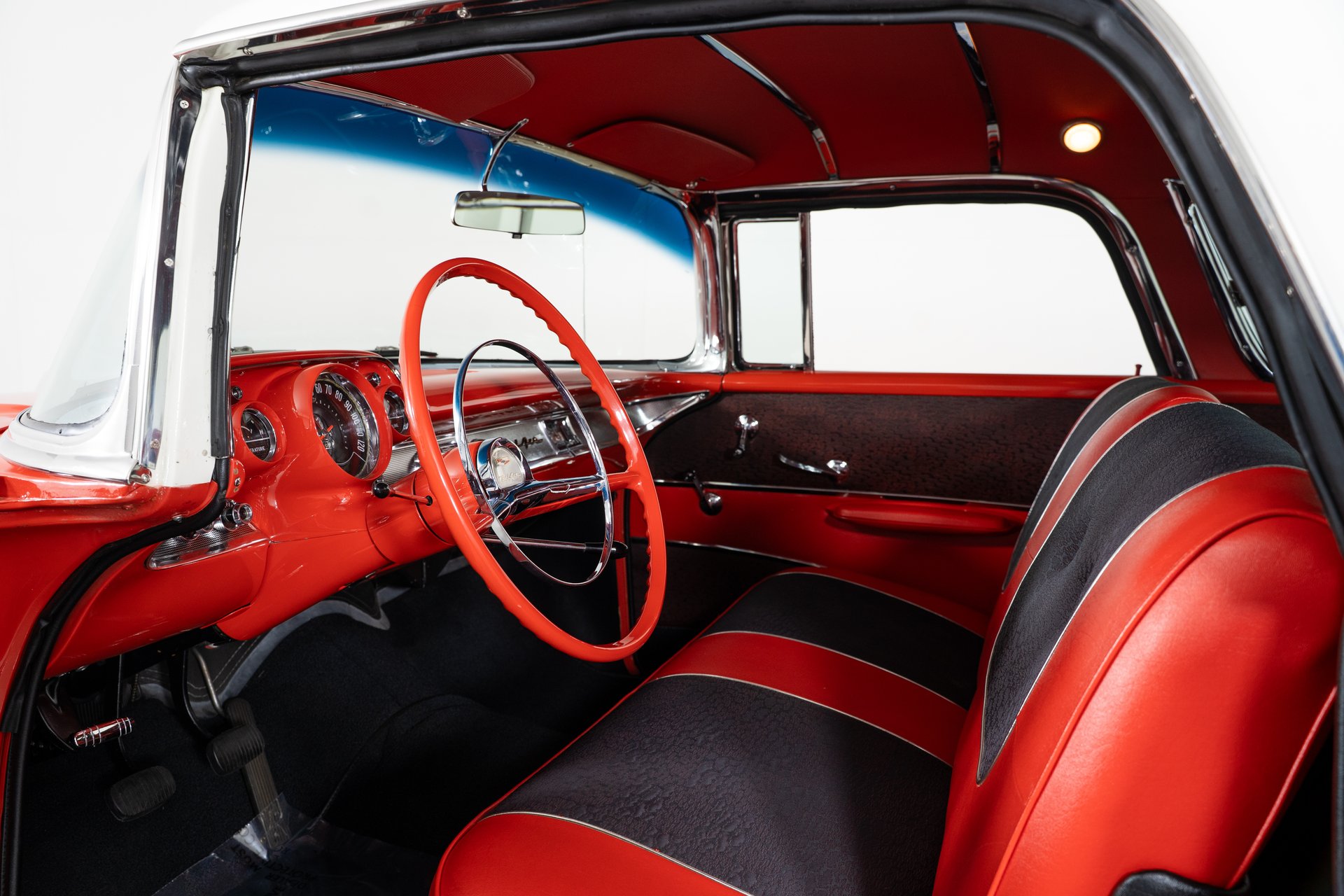
The Nomad interior is Bel Air-grade: a full-width dash (steel in 1955–56, restyled for 1957), a bench seat, pattern vinyl and cloth trim that changed by year, carpet rather than rubber mats, and — the Nomad signature — a headlining carried on exposed chrome bows over the cargo area, with ribbed trim panels in the load bay. Original-pattern upholstery kits are reproduced for all three years (the 1955 waffle pattern included); a full retrim in kit form is roughly $1,500–3,000 in materials, and a professional full interior runs well into five figures. The cost traps are the Nomad-specific pieces: the chrome headlining bows, the cargo-area stainless and ribbed panels, and the liftgate interior trim. A car with a complete, presentable cargo area is materially rarer than a car with nice front seats — restorers do the cabin first and the load bay when the money runs out, which tells you where to look for the truth about a restoration's completeness.
Seats split and sag at the driver's cushion edge first, and a seat that looks right but sits like a deckchair needs pads, not covers. Door cards warp from the door leaks described above. The instruments are simple and repairable, the clock rarely works, and the 1957 dash's bright trim panels pit. None of it stops a car being driven, all of it costs real money to make right, and a Nomad is priced at sale substantially on its interior. Weight it accordingly.
Electrics
Tri-Five electrics are simple — a generator (alternator conversions are common and welcome on a driver), a voltage regulator, insulation that is now seventy years old, and earths that corrode at the body. The failure pattern is resistance, not mystery: dim headlamps, a slow starter and flickering dash lights on a car with a good battery is a voltage-drop hunt — clean the battery terminals, the engine-to-body earth strap and the starter connections before condemning components. A car on its generator that discharges at idle with the lights on is behaving as designed; one that discharges at cruise has a regulator or generator fault. Replacement harnesses, made to factory patterns, are available for every year and are among the best-value jobs in the car — roughly $600–1,200 for the main harnesses. Vacuum wipers on six-cylinder and early cars (electric on most V8s) stop under acceleration by design — the engine's vacuum is busy elsewhere. Judge accessories one by one, because on a car this simple "everything works" is achievable, and a car where it does has been maintained, not just restored.
How to inspect one
Allow two hours, bring a torch, a magnet wrapped in cloth, and a friend to work the pedals and lights. If the car passes you, pay for a lift inspection before money changes hands — on a Nomad the underside and the tailgate shut-lines are the car, and neither can be judged from a driveway alone.
- Paperwork and identity first. Match the VIN plate — on the driver's door hinge pillar — to the title. Decode it: a V8 car's VIN begins with "V", followed by the series letter (C for Bel Air), the model year (55, 56 or 57) and the assembly-plant letter; a six-cylinder car has no leading V. Then read the cowl tag on the firewall: the style number should read 55-, 56- or 57-1064DF — that DF body is the Nomad, and a car whose cowl tag says anything else is not a factory Nomad body, whatever has been built onto it. The tag also carries the original trim and paint codes: a car whose codes match its presentation is worth more than a nicer car whose don't. Check the engine's stamped pad against the seller's story (next step) before you look at anything shiny.
- Cold start. Insist the engine is stone cold. A small-block should fire quickly, show oil pressure at once and settle; note start-up smoke (valve seals), any knock in the first seconds (bearings), and lifter tick that does not fade. A fuel-injected 1957 that needs prolonged cranking hot or cold is showing you the Ramjet faults from the engine section — price the specialist, not the seller's optimism.
- The engine pad and the bay. Read the suffix stamp on the pad ahead of the passenger-side head and the block casting date; agree them with the year and specification claimed. Then judge the bay as evidence: original finishes and undisturbed fasteners on a stock car; on a restomod, harness quality, cooling capacity and mount fabrication, per the engine section. Check coolant condition (rusty water means a neglected system), oil condition, and the radiator for the idle-temperature behaviour you will test at step 10.
- Underneath. Torch the full length of both rockers, prod the floor seams, the body-mount braces and the front footwells, then the rear cargo floor from below and the frame rails over the rear axle. Perforation at mounts, rockers or frame is structural money. Read the underside as the seller's honesty test: an honestly dirty, surface-rusted underside on a driver is fine; a fresh, uniform coat of black over everything — seams, mounts, brake lines — is a cover-up until proven otherwise.
- The rear of the car, slowly. Open the liftgate: it should rise and stay up on its torsion bars. Work the tailgate down and up; feel its bottom edge for filler and perforation, and check the gate's shut-lines and latch engagement on both sides. Look inside the cargo floor with every cover lifted, and at the spare well. Examine the liftgate frame's chrome for pitting with your fingertips — your eyes will forgive what your fingers won't, and re-chroming is priced by the piece.
- Glass and sliders. Operate both sliding side windows through their full travel. Check every curved pane for chips at the edges, delamination and scratches, and price any bad pane as the specialist item it is. Run the door glasses and check the vent windows' seals. Then hose-test if the seller allows, or at minimum look for the water tracks — silt lines inside the cargo trim, tide marks under the carpets — that tell you which seals are already failing.
- Body and gaps. Walk the magnet over the rockers, the lower quarters, the arch lips and the door bottoms. Sight down each flank for ripples in those long rear quarters. Check that the doors — big, heavy hardtop doors — open without dropping and close without a lift; sagging hinges are cheap, but a door that cannot be adjusted into its aperture is telling you about the shell. Count the brightwork honestly: eyebrows on a 1955, the liftgate frame, the tailgate bars, the side spears. Every missing or pitted piece is a line in the budget.
- Interior and cargo trim. Sit in the driver's seat and feel for the frame through the pad. Check the headlining bows' chrome, the cargo-area panels and stainless, and the load floor's trim. A restored cabin with a shabby cargo bay is an unfinished restoration — price the unfinished half. Work the heater blower, the wipers and every switch while you are seated.
- Front end and steering. With the front raised, rock each wheel at 12-and-6 (ball joints) and 3-and-9 (linkage and idler arm), per the problem section. On the ground, measure the steering's free play at centre. Check the tyres for the wear pattern that reports alignment and worn joints more honestly than any seller.
- The test drive. Twenty minutes, mixed roads, a highway stretch and — with permission — one hard stop from speed. The Powerglide car should make its single shift cleanly; a manual should take second without a crunch; an overdrive automatic swap should shift into top and hold it, its fluid still pink afterwards. Note idle temperature in traffic, hot oil pressure, brake pull, steering wander, and every tailgate rattle — the drive is where gate, hinge and body-mount wear announces itself.
- Heat, electrics and stance. Back at base, idling hot: temperature stable, no coolant smell in the cabin (heater core), all lamps lit and equally bright, indicators cancelling, charging behaving. Then stand back and look at the stance — level side to side, the slightest nose-up acceptable, sag at one corner a spring or mount question. Photograph the car in pure profile; stance faults you talked yourself out of in person are obvious in a picture.
- Price the car you actually saw. Write down, before you negotiate, the list this inspection produced: structure, gates and glass, brightwork, interior completeness, mechanical jobs. The correct offer is the value of the finished car minus that list at real prices — which is why two cars that look identical in photographs can honestly be a full restoration budget apart.
Values
The market block beneath this guide carries our current listing figures, computed from the store at every build; this section teaches you how to read them, because a Nomad's numbers mislead the unwary more than most.
First, the condition spread is enormous and it is driven by the body, not the badge. A Nomad is worth what its shell, glass, gates and brightwork are worth, plus or minus the mechanical story. Two 1957 cars can sit a restoration budget apart with identical engines, because one needs quarters, floors, a liftgate frame re-chromed and a cargo-area retrim, and the other needs tyres. Compare like with like: a project, a driver, a stock restoration and a high-end restomod are four different markets sharing one name, and a median drawn across all four describes none of them.
Second, originality is priced in layers. At the top of the stock market sit documented cars: matching engine pad and dates, cowl-tag paint and trim matching the car, and — in a different league again — a documented 1957 fuel-injected car, where the paperwork is most of the value because the hardware can be replicated. Below that, honest drivers trade on condition alone, and modifications are neutral-to-negative: a colour change to a period colour costs little, a non-original colour costs more, and a smoothed roof costs a stock buyer entirely. Restomods invert the logic — the money follows build quality and specification (modern chassis, LS power, air conditioning, discs) and originality is worth nothing beyond the shell — but that market is thinner and more fashion-sensitive. The strongest restomod prices go to cars built by known shops with invoices; a home-built car with no paperwork is valued as the sum of its visible parts, minus doubt.
Third, asking and achieved prices part company on Nomads more than on common Tri-Fives, because sellers anchor on publicised results for exceptional cars. Our pool is dealer-heavy — 23 of the 26 cars we track come through dealers, with 3 from eBay — and dealer asking prices for polished stock are the top of the market, not the middle of it. A Nomad unsold through a season is usually priced as if restoration work the photographs don't show had already been done. Your inspection list, priced, is the negotiation. Finally, the years: 1957s draw the widest audience and the fuelie premium; 1955s have the purist following and the one-year-parts tax; 1956s are chronically the value of the three — the developed car without the fashion premium.
Parts and ownership
The Nomad splits cleanly in two as an ownership proposition, and the split is the body line at the windshield.
Easy, cheap and everywhere: everything mechanical and everything ahead of the doors. The small-block Chevrolet is the best-supported engine in the hobby — rebuild kits, heads, intakes, ignition and cooling parts at every price level, usually off the shelf. Suspension, steering and brake wear parts, windshield and door glass, seals, wiring harnesses, upholstery kits in the correct patterns, floor pans, rockers, front fenders and most patch panels are reproduced by a competitive industry (Danchuk's catalogue was the Tri-Five bible for decades; the trade continues through Classic Industries, Eckler's and a crowd of specialists). A sorted Nomad is a genuinely usable classic: any competent general mechanic can service it, consumables cost modern-car money, and fuel consumption in the mid-teens is the honest expectation for a carburetted V8 car.
Harder and dearer: everything Nomad-only. Curved rear side glass and liftgate glass (reproduced in runs; expect waits and four-figure sets), the liftgate frame and its chrome, tailgate skins and hardware, the chrome headlining bows and cargo-area stainless, correct 1955 eyebrows and waffle-pattern trim, and any full quarter panel. None of it is unobtainable — the Nomad's following is deep and the specialists (and the swap-meet and NOS trade) are active — but it is priced like low-production coachwork, because it is. The Ramjet injection sits in this category too: a handful of specialists, four-figure rebuilds, and ethanol-era seals as a standing maintenance item. The practical consequence is the mantra of this guide: buy the body, the glass and the gates; the mechanicals will always be fixable at prices you can plan for.
Running costs and the first year. Budget the first year of any new purchase for deferred maintenance: a full brake hydraulic refresh if the car has sat ($800–1,500), tyres by date code rather than tread (a set of correct-look radials or bias-plies is a four-figure line), every fluid, the cooling system gone through, and the seal-and-leak work that keeps the cargo floor alive. Recommissioning a long-stored Nomad at a shop runs $4,000–8,000 before cosmetics. Insurance through the agreed-value classic market is straightforward and, relative to the car's value, cheap; the one ownership trap is storage — a Nomad stored damp is a Nomad rotting in its floors, quarters and tailgate simultaneously, so dry storage is not a luxury item in the budget, it is the budget's foundation.
Which one to buy
- The all-rounder: a 1956 V8 driver. The developed mechanicals, the cleanest styling, and chronically the softest prices of the three years. A 205 hp Power Pack car with a sound shell is the Nomad to buy if you intend to drive one.
- The icon: a documented 1957. Buy it for the fins and the look, pay for the paperwork, and verify a fuel-injected car to the standard in the engine section — an undocumented "fuelie" is a four-barrel car with jewellery on.
- The purist's car: a 1955. The closest to the show car, with the egg-crate grille and the eyebrows — and the one-year parts hunt as the price of admission. Buy the most complete one you can find; completeness is the whole game on a 1955.
- The value buy: a six-cylinder or colour-changed car with a perfect shell. The market discounts the "wrong" specification far more than the cost of living with it — or, on a six, of a well-documented V8 conversion done later, at driver prices.
- The modern driver: a well-built restomod. LS power, overdrive automatic, discs and air conditioning in the best-looking wagon of the fifties. Buy the build quality and the invoices, insist on the TV-cable and cooling checks, and pay nothing for the previous owner's taste in wheels.
- The project: only with your eyes open. A project makes sense when the shell, glass and gates are sound and the missing value is mechanical or cosmetic. One that needs quarters, floors, roof work and glass is not a cheaper Nomad; it is a more expensive one, paid in instalments.
And the rule that overrides all of the above: buy the least rusty, most complete Nomad shell you can find, in the specification you can live with. Engines, gearboxes, brakes and interiors are all fixable at prices you can plan for. The roof, the pillars, the gates and the glass are the car — and they are the one part of a Nomad that money cannot quickly make original again.
See the 11 Nomad cars currently listed.