
Chevrolet K20 Pickup buyer's guide
Chevrolet K20 Pickup -- the model's own buyer's guide: variants, values and what to check.
Years listed: 1971-1987 · Series: C/K Trucks
Overview and history
The Chevrolet K20 is the three-quarter-ton, four-wheel-drive pickup in Chevrolet's C/K line — and once you decode the badge, the whole truck explains itself. C means two-wheel drive, K means four-wheel drive, and the number is the payload class: 10 for half-ton, 20 for three-quarter-ton, 30 for one-ton. A K20, then, is the heavy working four-by-four: heavier frame, heavier axles, higher payload and towing ratings than a K10, leaf springs at both ends, and running gear chosen for work first and comfort second. If the K10 is the truck people bought to hunt, fish and commute, the K20 is the truck people bought to plough snow, haul firewood, pull a trailer and carry a slide-in camper — and most of them were used exactly that hard for exactly that long.
Chevrolet launched the C/K naming with the all-new 1960 pickups, and the four-wheel-drive K models were part of the range from the start. That matters, because factory four-wheel drive was still a novelty in 1960: before it, a four-by-four Chevrolet was usually a two-wheel-drive truck converted by an outside firm such as NAPCO. The factory K trucks changed the proposition completely — you could order one from any Chevrolet dealer and service it with ordinary Chevrolet parts. Through three generations — the 1960–1966 trucks, the 1967–1972 Action Line, and the long-lived 1973–1987 Rounded Line that everyone now calls the Square Body — the K20 kept the same basic recipe and steadily refined it: more power, better brakes, stronger axles, better transfer cases and, eventually, a cabin you could spend all day in.
The trucks filed here under K20 show that whole arc in miniature. The pool behind this guide holds 19 trucks, 12 offered for sale and 7 recorded as sold, running from a 1966 first-generation truck through to a 1987 Square Body, with 1972 — the last and most developed year of the second generation — the most common year, with 5 of the 19. Dealer listings make up the largest source, with Facebook Marketplace trucks and Bring a Trailer sales behind them: working classics at dealers and in private ads, and the best-presented examples at auction.
Why buy a three-quarter-ton at all, when half-tons are cheaper and more fashionable? Because the K20's extra metal is exactly what survives: the full-floating rear axle, the cast-iron NP205 transfer case, the deep first gear of the SM465 manual — components rated well beyond anything a classic-truck life will now ask of them. A K20 has also never carried the collector premium of a short-bed K10, so the same money buys a stronger, often less messed-about truck. The catch is the one this guide returns to again and again. These were tools. Rust, tired steering, stretched transfer-case chains and decades of well-meant modification are the norm, and the difference between a good K20 and an expensive one is condition and originality of the running gear — not the shine on the paint.
One naming trap before anything else. For 1987, the last year in our pool, Chevrolet renamed the old C/K line R (two-wheel drive) and V (four-wheel drive) to free up the C/K letters for the new 1988 trucks. A 1987 K20 is therefore documented as a V20, and you will find it filed here, sensibly, as a K20 — the same Square Body truck with a new letter.
The models
Every K20 is a pickup, but three generations, two bed lengths, three cab configurations in the later years and four trim levels mean no two decades of truck feel alike. Work through the generations first, because generation decides almost everything about how a K20 drives, rusts and costs to put right.
| Model | Years | Engine | Output | Built | Character |
|---|---|---|---|---|---|
| K20 (first generation) | 1960–1966 | 292 six / 283–327 V8 | 165–220 hp | Not published separately | The pioneer; leaf springs, drum brakes, real rarity now |
| K20 (Action Line) | 1967–1972 | 250/292 six, 307/350/402 V8 | 155–300 hp | Not published separately | The classic shape; discs from 1971, NP205 arrives |
| K20 (Square Body) | 1973–1986 | Six, 305/350/400/454 V8, 6.2 diesel | 130–230 hp | Not published separately | The volume truck; 14-bolt axle, best parts support |
| V20 (Square Body, renamed) | 1987 only | 350 V8 with fuel injection, 6.2 diesel | 210 hp class | Not published separately | Same truck, new letter; throttle-body injection arrives |
Chevrolet never published a clean K20-only production split, and any source that gives you a precise K20 build figure by year is guessing — K20s were always the minority of C/K production, well behind the half-tons, which is why good ones are thinner on the ground than K10 buyers expect. Outputs above are period gross ratings for the early cars and net ratings for the later ones, so compare them within a generation, not across the table.
The first generation (1960–1966). The 1960 trucks were radical for Chevrolet: a new frame and a lower cab. The K models kept it simple — leaf springs and a solid front axle, as every K20 would for the whole of this guide's span. Power came from the 292-cubic-inch inline six, a tall-deck torque engine that suits the truck perfectly, or from the small-block V8s, the 283 and later the 327. The transfer case is the Rockwell T221, the gearboxes a three-speed manual or the near-indestructible SM420 four-speed with its non-synchronised crawler first, and the brakes are drums all round. The single 1966 truck in our pool represents this generation, and that scarcity is typical: first-generation K20s were bought in small numbers, worked to death, and are now genuinely rare. Buy one for its character, not as a cheap way into the model.
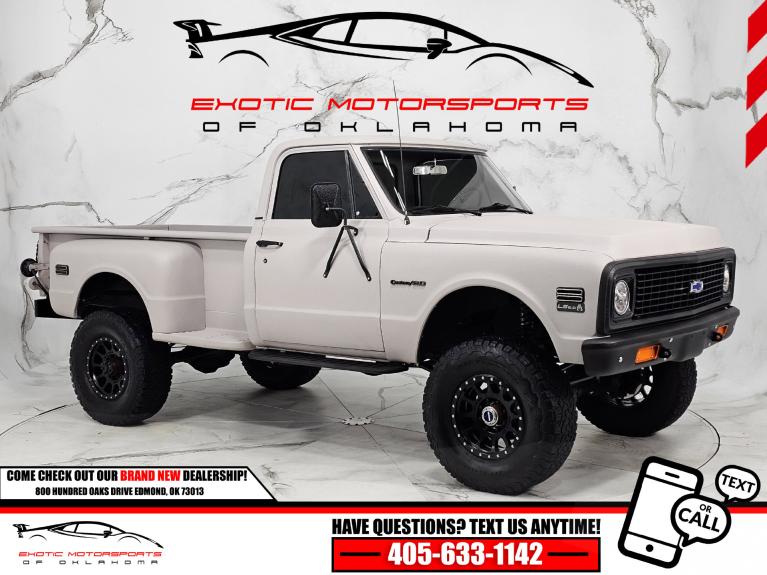
The Action Line (1967–1972). This is the generation that made the Chevrolet pickup a style object as well as a tool — lower, wider, cleaner, with leaf springs retained on the K20. The engine range widened in both directions: the 250 and 292 sixes at the bottom, the 307 small-block as the standard V8, the 350 from 1969, and the 402 big-block — a bored 396, badged as a 400 — at the top from 1970. Two dates matter when you shop this generation. Front disc brakes arrived for 1971, and they transform both safety and parts buying; a 1967–1970 truck on drums is period-correct but asks more of you. And from 1969 the gear-driven NP205 transfer case progressively replaced the Rockwell T221 — the NP205 is the case you want, for reasons the next sections make clear. The five 1972 trucks in our pool are no accident: the last year combines discs, the mature engine range and the best trim availability, and the market knows it.
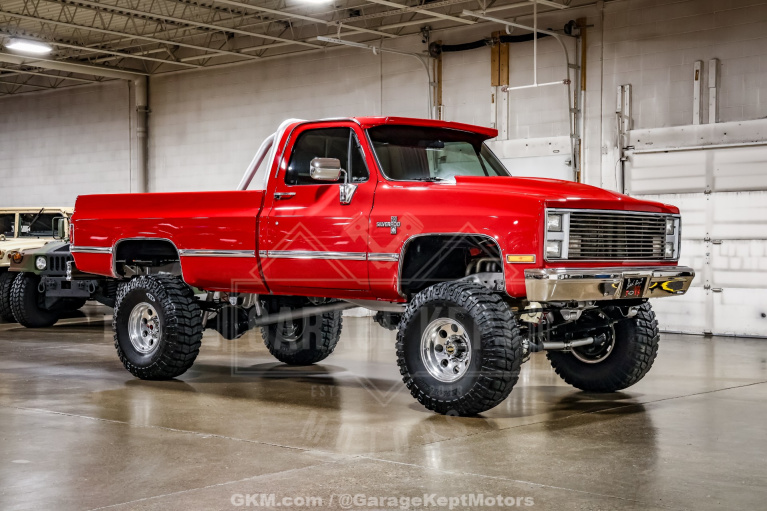
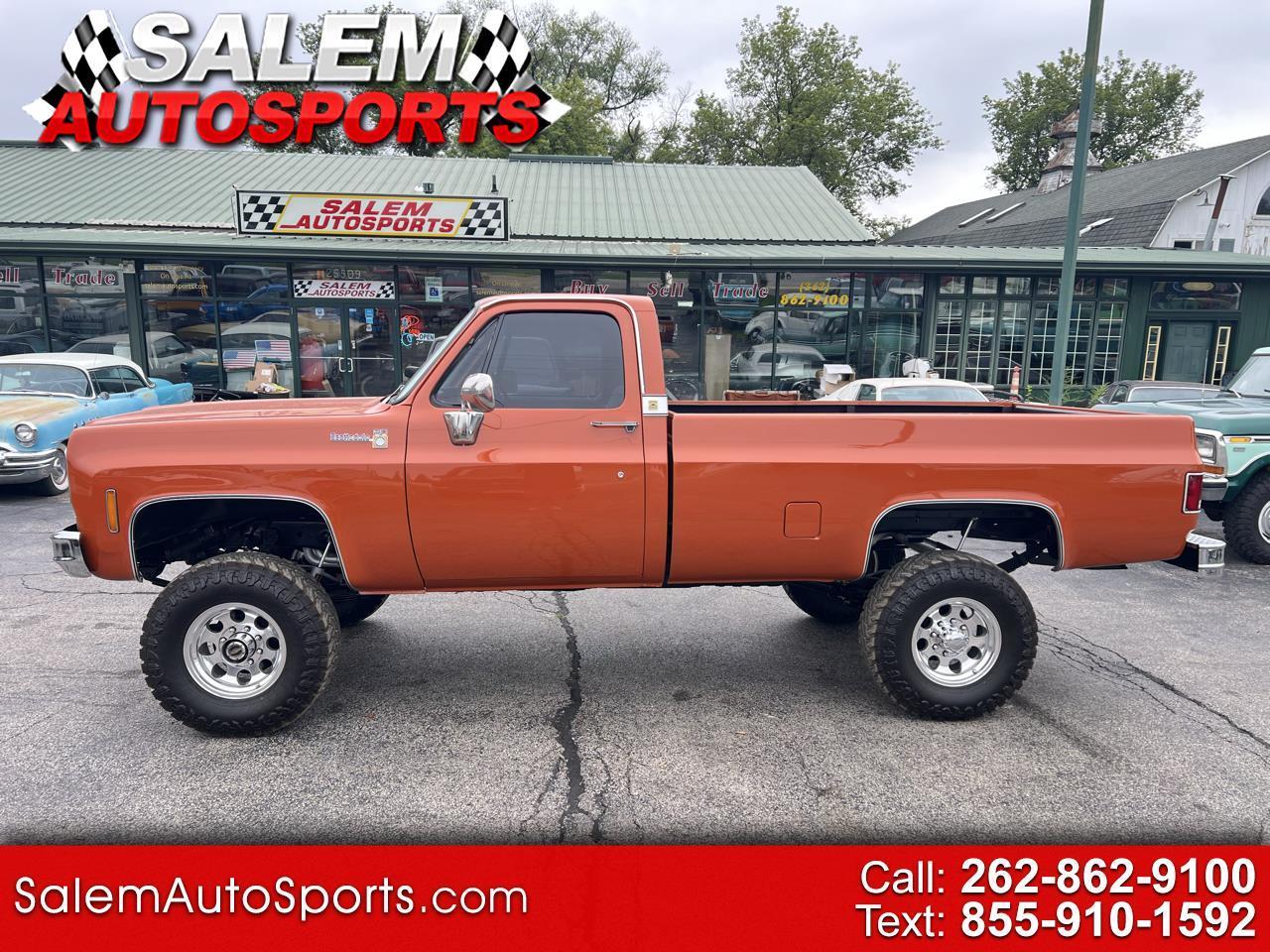
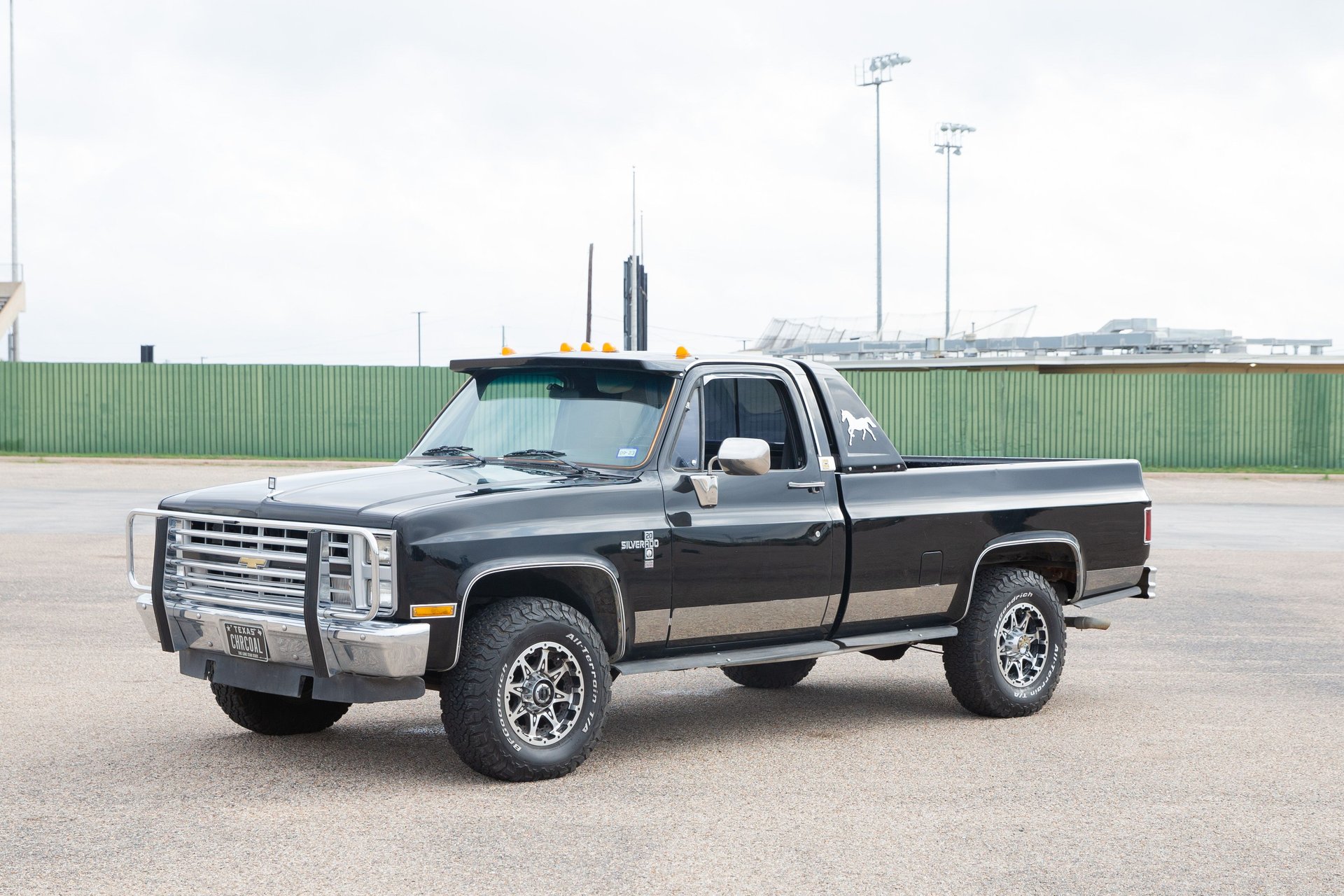
The Square Body (1973–1987). Chevrolet's Rounded Line — Square Body to everyone now — ran for fifteen model years and accounts for the majority of surviving K20s. The engineering step that matters most came with it: the GM 14-bolt, 10.5-inch full-floating rear axle, one of the strongest axles ever fitted to a light truck. Trim stratified into a clear ladder. Custom Deluxe is the base work truck, with vinyl and rubber mats. Scottsdale sits above it — the orange 1976 Scottsdale and the red 1984 Scottsdale in our pool are typical — adding cloth trim and brighter mouldings. Cheyenne adds more still, and Silverado is the flagship, with carpet, woodgrain-effect trim, and the highest likelihood of air conditioning, cruise control and power windows. Cabs are regular cab for most trucks, crew cab for the heavy haulers, and the extended Bonus Cab without a rear seat. Beds are the 6.5-foot short bed — rare on a K20 — or the 8-foot long bed that dominates the listings.
Trim badges deserve one warning that applies across all three generations: badges, mouldings and even whole front clips swap between these trucks in an afternoon, and many trucks wear Silverado trim on a Custom Deluxe cab, or a later grille in an earlier truck. The truth is on the Service Parts Identification label — the SPID label, inside the glovebox door on Square Body trucks, listing every factory option code — and on earlier trucks the VIN plate and cowl tag tell the story. Price the truck the codes describe, not the badges it wears.
Engines and gearboxes
A K20 could be ordered with everything from a 130-horsepower six to a 454 big-block, and the engines divide cleanly into families that behave, fail and cost money in completely different ways. Judge the engine family first and the individual engine second.
The sixes and the small-blocks
The inline sixes (250 and 292). The 250-cubic-inch six powered base trucks in the second and early third generations; the 292, with its taller block and longer stroke, is the one with the reputation, and it is deserved — peak torque arrives low, the bottom end is effectively unburstable in standard tune, and it will pull a loaded K20 up a grade in top gear where a small V8 is hunting for revs. Available from the first generation into the Square Body era in declining numbers, the 292 is now the connoisseur's engine in an early truck and a running-cost bargain anywhere: a single-barrel carburettor (the Rochester Monojet on later cars) and service parts at pocket-money prices. The known weaknesses are exhaust-manifold cracking, a carburettor that wears its throttle shaft and leaks air at the base, and oil leaks from every gasket the engine owns. None is expensive. What a six will not do is cruise a lifted truck on oversize tyres at modern highway speeds — gearing, not power, is the limit, and the modification section below explains why.
The small-block V8s (283, 307, 305, 327, 350 and 400). The small-block is the default K20 engine and the 350 is the default small-block: fitted from 1969 to the end of production, in two- and four-barrel form, with the Rochester Quadrajet on most four-barrel applications. It is the best-supported engine in this entire guide — every part, from a water pump to a complete crate engine, is available off the shelf — and a healthy one is smooth, torquey and good for very high mileages with oil changes and a timing chain. The earlier 283 and 327 are the same architecture in smaller, sweeter-revving sizes. The 307 (1968–1973) does everything adequately and excites nobody, which makes 307 trucks cheaper for no mechanical reason — a genuine value route. The 305, standard in many Square Body years, is the emissions-era engine: adequate in a stock truck, strangled in a lifted one, and prone to the soft-camshaft wear that afflicted GM engines of the late 1970s and early 1980s, where a wiped cam lobe shows as a rhythmic misfire and a ticking lifter no adjustment cures. The 400 small-block (1975–1980) is the interesting one: siamesed cylinder bores give real big-block torque, but make it the least tolerant small-block of overheating, so a 400 truck's cooling history matters more than its mileage. Across all small-blocks the checks are the same: cold-start smoke that clears in seconds is valve stem seals, at $600–1,200 with the heads in place; smoke under load is rings and a rebuild conversation at $3,500–6,500; a knock at cold idle that fades warm is piston slap on a high-mile engine, tolerable; and any small-block that has overheated repeatedly needs head-gasket and head-flatness checks before you price it as a runner.
For 1987, the renamed V20 brought throttle-body fuel injection to the 350 — a simple, reliable system that starts in any weather and cures the Quadrajet's cold manners. It is the easiest classic K20 engine to live with daily, and its diagnostics are a flashing check-engine light and a paperclip, not a laptop.
The big-blocks and the diesels
The big-blocks (402 and 454). The 402 of 1970–1972 is a 396 bored out for emissions-era production, badged as a 400, and it gives the Action Line trucks effortless, understressed performance. The 454, offered in the Square Body K20 from the mid-1970s into the 1980s, is the heavy-hauler's engine: in a truck rated to tow and carry what a K20 is rated for, its torque from idle is not a luxury, it is the point. Both engines are fundamentally tough — deep-skirt blocks, cooling capacity sized for work — and both drink fuel at a rate that makes the sixes look free: expect single-figure to low-double-figure miles per gallon in real use. Failure modes are heat and neglect rather than design. Exhaust manifolds crack and their bolts seize and snap in the heads, turning a $150 manifold into a $800–1,500 extraction job. Rear main seals leak. A 454 that has towed heavy on a clogged radiator will have cooked its valve seals and possibly its head gaskets. And verify the engine is what the badge claims: big-blocks command premiums, small-blocks wear big-block air-cleaner decals convincingly, and the casting numbers and suffix code on the block pad in front of the passenger-side head settle the question in two minutes. A truck priced as a 454 that carries a 350 is the oldest trick in this market.
The diesels (5.7 and 6.2). Two diesel options appear in the Square Body years, and they could not differ more in reputation. The 5.7-litre Oldsmobile-derived diesel (1978–1981) was built from a gasoline block architecture and earned its poor reputation honestly — head-bolt and head-gasket failures, injection-pump wear, sensitivity to water in fuel; most were swapped for gasoline engines decades ago, so a diesel-VIN truck with a V8 under the hood is normal, not suspicious. The 6.2-litre Detroit Diesel (1982–1987) is a proper, purpose-designed economy diesel: indirect injection, no turbocharger, modest power, excellent economy, and a long service life if the injection pump and glow-plug system are maintained. Its costs concentrate in the Stanadyne injection pump (a rebuild runs roughly $800–1,500), glow plugs and controller, and harmonic-balancer failure on high-mile engines, which if ignored can damage the crankshaft. Cold starting tells you most of what you need: a healthy 6.2 fires after one glow-plug cycle with a brief grey haze; a truck that needs ether to start is telling you the glow system, the compression or both are tired, and ether starting itself damages these engines.
Gearboxes, transfer cases and hubs
This is the section that defines a K20, because four-wheel drive is not one system but three — gearbox, transfer case and front-axle engagement — and each has its own variants, strengths and failure signatures.
Gearboxes. The manual story is dominated by one box: the SM465, fitted from 1968 to the end of production, a cast-iron four-speed with a 6.55:1 first gear so low it is marked L on the knob and used only for starting heavy loads, crawling and ploughing. Second through fourth are synchronised, first and reverse are not, and the box is famously tolerant of abuse. Wear shows as jumping out of third gear on the overrun, a worn second-gear synchroniser, and sloppy shift-lever pivots — all rebuildable, with a full rebuild at $1,200–2,200 plus removal. Before it, early trucks used the SM420, equally tough, with an even lower first. A three-speed manual was the base fitment in many years and is adequate with a six or small V8. Automatics divide by era: the two-speed Powerglide lingered into the late 1960s as a light-duty option rarely seen in a K20; the Turbo Hydra-Matic 350 became the standard automatic through the 1970s; and the Turbo Hydra-Matic 400 — the heavy-duty three-speed — is the automatic a towing K20 wants, strong enough that failure usually means age, heat or a life behind a 454 rather than weakness. Rebuild costs run $1,800–3,000 for a TH350 and $2,200–3,500 for a TH400 fitted. The overdrive 700R4 appears in lighter-duty 1980s applications and is marginal behind big-blocks or in heavy towing; our pool's listings also record later overdrive swaps, including a 4L80 automatic — treat any non-standard gearbox as a modification to be judged on its installation quality. On any automatic, fluid colour and smell plus prompt, firm engagement of drive and reverse tell you more than the seller's account of a rebuild; ask for the invoice, because a rebuilt box with paperwork and one without are priced a rebuild apart.
Transfer cases. Four cases cover the whole span, and knowing which one a truck carries is the single most useful piece of K20 knowledge there is. The Rockwell T221 (1960 to about 1968) is a gear-driven, part-time case, tough but now the hardest to source parts for. The NP205 (from 1969, standard through the 1970s and available into the 1980s behind the SM465) is the legend: cast-iron housing, all-gear drive, no chain, part-time operation with a 1.96:1 low range, and a reputation for outliving the truck around it. Its faults are age faults — leaking seals, worn idler-gear bearings giving a growl in low range, and a shift linkage that wears until engagement feels vague. A seal and bearing refresh runs $600–1,200; the case itself almost never dies. The NP203 (1973–1979, standard with most automatics in those years) is the opposite philosophy: a full-time case with an inter-axle differential, chain-driven to the front output, designed to be driven in four-wheel drive on dry pavement. The chain stretches with age, announcing itself as a clunk or slap on throttle changes and, when badly worn, a ratcheting under load as the chain jumps the sprockets. A chain replacement is $700–1,400 in parts and labour. Many NP203 trucks were converted to part-time operation with aftermarket kits of varying quality — a converted case with locking hubs is fine if done properly, suspect if the conversion is undocumented. The NP208 (1981–1987, the standard late Square Body case) is an aluminium, chain-drive, part-time case with a deep 2.61:1 low range: lighter and quieter, but the chain stretches as the NP203's does and the rear slip-yoke and its seal are wear items. Budget $800–1,600 for a chain-and-seals rebuild. On every case the same tests apply: engage low range and drive slowly on full lock on a loose surface, listening for chain slap or gear growl, and confirm the front propshaft is present and its joints tight — a missing front shaft means the four-wheel drive has been unused, broken or abandoned, and each of those is a different price.
Locking hubs and front axles. A part-time K20 drives only its rear wheels until you lock the front hubs and engage the transfer case, and the hub is the part owners forget until it fails in mud. Early trucks used manual hubs by Dana/Spicer and Warn — simple, strong dials. Turn them: a manual hub should rotate to LOCK and FREE with firm, even resistance; gritty or half-engaging hubs need a strip, clean and re-grease at $150–400 the pair, and neglected hubs corrode internally until the splines fret. Square Body trucks of the 1980s brought automatic locking hubs, which engage when the transfer case drives the front shafts — convenient, fragile with age, and the first thing experienced owners replace with manual hubs; an auto-hub truck that clunks, engages on one side only, or stays locked is showing you a known weakness, not a mystery. Front axles follow the same arc: the Dana 44 under first- and second-generation trucks and early Square Bodies, replaced progressively by GM's corporate 10-bolt front axle from the late 1970s — comparable in strength, and both adequate at standard tyre sizes. The rear axle story is happier still: early trucks used the Eaton HO52/HO72 or Dana-built axles, and from 1973 the 14-bolt full-float, which is why a Square Body rear axle should be the last thing you worry about and the first thing you verify is original — 14-bolts are valuable enough to have been swapped and sold separately.

Problem areas
Everything in this section follows one rule: on a K20, the mechanicals are strong and the structure is what kills trucks. Almost any engine, gearbox or transfer case in this guide can be rebuilt for a knowable sum. A rusted frame, a cab that has lost its mounts, or a truck whose modifications have worn out its steering will consume money without ever becoming a good truck. In the 7 K20s we photo-checked for this guide, rust was noted in 2 and visible damage in 1 — small numbers, because sellers photograph paint, not frame rails. Assume every truck needs the forensic examination below, and be pleased when one passes it.
Rust and the frame: the map
Start with the frame, because a K20 frame works harder than a half-ton's and rust attacks it in predictable places.
Frame rails and crossmembers. The C-channel frame rusts from the inside of the channel outward, and the worst areas are where mud and road salt sit: the rails under the cab, the rear rails over and behind the rear axle, around the spring hangers and shackle mounts, and at every crossmember joint where two pieces of steel trap moisture between them. Prod with a screwdriver, with the seller's permission, and tap with a small hammer — sound steel rings, rotten steel thuds and flakes. Surface scale is normal and treatable; perforation, lamination (the steel splitting into layers) or a rail thinned enough to flex under the hammer is structural. Frame repair is fabrication: a competent welder can plate and section a rail at $800–2,500 per area, but a frame rotten in several places is a parts truck, whatever the cab looks like. Check straightness at the same time: sight down each rail, look for diamond (one rail ahead of the other after a frontal impact), kinked flanges at the front horns, and amateur weld repairs around the steering-box mount — which leads directly to the Square Body's signature frame fault, covered under steering below.
Cab rust. The cab rusts where water sits. On all three generations the list is the same, in roughly this order: cab corners behind the doors; rocker panels, inner and outer; floor pans under the mats, worst at the front footwells where windshield and cowl leaks feed them; the cowl itself, where leaves compost against the fresh-air vents; door bottoms, where blocked drain holes let doors fill with water; and the windshield frame on trucks that have had screens replaced carelessly. Square Body trucks add the inner front fenders and the battery tray corner, where acid and trapped mud eat the tray, the inner fender and the radiator support beneath it. Cab mounts deserve their own check: the rubber cushions perish and the brackets rust, and a cab sitting low on one side, or doors that have dropped and need a lift to close, are often mounts, not hinges. A full set of mounts is $150–350 in parts, but fitting them to a truck whose floor and brackets are rotten turns into floor repair first — the pattern of all cab work. Price the common jobs honestly: rocker panels and cab corners, cut out, welded and painted, run $1,200–3,000 a side; a floor pan section fitted and painted $800–1,800 a side; a cab-off restoration of a rotten Square Body cab exceeds the value of most trucks, which is why a solid Southern or Western cab commands its premium.
Bed rust. The bed floor rusts over its supports, at the front panel where water and debris collect behind the cab, and around the wheel tubs. A wavy, patched bed floor is not necessarily a problem — a working truck's bed should look worked — but rust at the mounting points and front cross sill is structural to the bed. Replacement floors and panels are available for all three generations, which keeps this annoying rather than fatal: $1,000–2,500 to replace and paint a Fleetside floor properly.


Drivetrain wear: transfer cases, hubs, steering and brakes
Transfer-case wear in practice. The engine section named the cases; here is how their wear presents on a viewing. An NP205 that whines lightly in low range is normal; one that growls under load, jumps out of gear, or is covered in fresh oil after a drive needs its bearings and seals priced in. An NP203 or NP208 with a stretched chain clunks as you come on and off the throttle at low speed, and in a low-range test on a loose surface a badly stretched chain ratchets and bangs. Do that test on gravel or dirt, never on dry tarmac in a part-time truck: a part-time system has no centre differential, the driveline winds up on grippy surfaces, and wind-up clunks on tarmac are the system working, not failing. Full-time NP203 trucks are the exception and can be tested anywhere. Check the shift action itself: cases that have sat unused for years seize at the linkage, and a truck whose lever will not move has been a two-wheel-drive truck for a long time — ask why.
Hubs, U-joints and propshafts. Lock the hubs and drive: a front axle that vibrates above 30 mph with the hubs locked points to worn front propshaft universal joints, a bent shaft, or — on lifted trucks — bad joint angles, covered below. Universal joints are cheap ($25–60 each in parts) but a full set across both shafts fitted is $400–800, and a shaft that needs re-tubing and balancing runs $300–600. Front axle joints at the steering knuckles wear on trucks that have steered heavy loads with the hubs locked, and ball joints or kingpin bushings set the front-end budget: a full refresh of joints, bushings, tie-rod ends and an alignment runs $1,200–2,500, and it transforms a wandering truck, so do not let a seller price tired steering as a small fault or dismiss it as character.
Steering, and the frame crack you must look for. K20 steering is a recirculating-ball box working through a drag link to leaf-sprung solid axles, and it was never sports-car precise — but it should be consistent, free of dead spots and free of knocks. Play at the wheel divides into box wear (adjustable to a point, then a rebuild at $350–700 exchanged), worn tie-rod and drag-link ends, worn spring bushings letting the axle steer itself, and the Square Body speciality: cracks in the frame around the steering-box mounting bolts. The box works against the left frame rail every time you steer a heavy truck at parking speeds, worst of all with big tyres, and the rail fatigues and cracks around the bolt holes. Inspect with a torch while an assistant rocks the wheel: cracks radiate from the bolt holes, and a box that moves against the rail is a box about to tear out. Repair plates and brace kits exist precisely because this is common — a weld-in repair plus brace runs $400–900 fitted — and an undamaged, braced rail is a selling point worth paying for. Power steering, near-universal on later trucks, adds pump whine and hose leaks to the list.
Brakes. Drums all round on first-generation trucks, front discs from 1971, and discs with vacuum assistance through the Square Body years, with hydroboost on diesel and some heavy-spec trucks. The system is conventional and every part is available, so brake faults are budget items, not buying obstacles — unless neglect has spread. The standard recommissioning list on a truck that has sat is master cylinder, wheel cylinders or calipers, flexible hoses, and steel lines where they run along the frame rail and rust invisibly under their clips: a full hydraulic refresh with lines runs $1,000–2,200 fitted. Test pedal feel (a sinking pedal is master cylinder or a leak; a hard pedal with poor stopping on a hydroboost truck is the booster circuit or pump), check the parking brake holds on a slope, and brake firmly from 50 mph on the test drive: pulling to one side is a seized caliper or collapsed hose, and judder is warped rotors or out-of-round drums, each a few hundred dollars, none a surprise.
Lifts, oversize tyres and other modifications
No classic truck is modified more casually than a four-wheel-drive Chevrolet, and no section of this guide will save you more money than this one. Modifications are not automatically bad — a well-engineered lift on quality components can be better than worn original suspension — but every modification moves loads and angles away from what the factory engineered, and the wear shows up in the steering, the joints and the gearing rather than in the lift kit itself.
Suspension lifts. K20s are lifted with taller leaf springs (the right way), with lift blocks between axle and spring (acceptable at the rear in moderation, dangerous at the front, where blocks under the steering axle are illegal in many states and bad practice everywhere), and with body lifts that raise the cab on spacers and strain every linkage, hose and wire between frame and body. Judge a lifted truck on its details: spring lifts should come with corrected steering (a raised steering arm, drop pitman arm or crossover steering on tall lifts), longer brake hoses, and shocks matched to the travel. A tall truck on standard steering geometry will bump-steer and wander, and the steering box and frame rail pay for it — re-read the frame-crack paragraph with a lifted truck in mind. Cheap lift springs ride brutally and sag unevenly within a few years.
Oversize tyres and gearing. Stock K20 tyres are roughly 31 inches tall. Every inch above that raises the effective gearing, dulls acceleration, makes the speedometer under-read (by about 10 percent at 35 inches), and works the wheel bearings, ball joints and steering box harder. The arithmetic a seller will not do for you: a truck geared for 31-inch tyres on 35s has lost the equivalent of a full axle-ratio step, so a 350 that felt strong now feels flat, a 305 feels hopeless, and an automatic's converter runs hotter doing it. The correct fix is re-gearing both axles — $1,800–3,000 the pair fitted — and the word both is the trap: a truck re-geared at the rear only will destroy its transfer case the first time four-wheel drive is engaged on a hard surface, because front and rear axles turn at different speeds. Always confirm both axles carry the same ratio, by the axle tags and codes or a chalk-and-count check, on any truck with non-standard tyres. Tyres that rub at full lock, or sit outside the arches throwing grit down the sides, tell you the fitment was chosen for looks in a car park.
Other common modifications. Winches and snowploughs are period-correct K20 work and both are hard on the front of the truck: plough trucks live in salt, idle for hours, and carry hundreds of pounds hung off the front frame horns — inspect the front rails, springs and steering on a plough truck as if the mileage were double. Dual fuel tanks on Square Body trucks sit outside the frame rails (the famous saddle tanks): faults in the selector valve and its dash switch present as a truck that runs one tank dry while the gauge reads the other, or cross-fills one tank from the other; selector valves run $100–250 in parts and the diagnosis is fiddly rather than expensive. What matters to a buyer is that the tanks, straps and lines are sound and properly plumbed, because a perished line on any fuel system is a fire risk first and a history lesson second. Engine swaps are endemic and are judged by the same rule as gearbox swaps: paperwork, correct mounts, cooling sized for the engine fitted, and wiring done as engineering rather than sculpture. A swapped truck is worth the sum of what is actually in it, not the badge on the fender.
Cab, interior, electrics and the rest
The K20 cab is a simple, durable place, and its faults are priced in hundreds rather than thousands — with two exceptions. The first is the heater and air-conditioning system on Square Body trucks: a heater core is a dashboard-out job on many configurations ($700–1,400 fitted, mostly labour), and dead factory air conditioning needs $800–1,800 to recommission properly. The second is a full interior: a bench seat retrimmed in correct vinyl or cloth runs $800–1,800, and door cards, headlining, dash pad (Square Body pads crack in the sun, universally) and carpets together reach $1,500–3,000 in parts alone, so a sun-baked Southwestern truck with a perfect frame may still carry a four-figure interior bill. Electrics are period-simple: fusible links and grounds cause most mysteries, and the Square Body's printed-circuit instrument cluster develops cracked tracks that kill gauges one at a time — a cluster repair is $200–500 and a common, honest fault. Wipers, washers, lights and the heater blower on all speeds remain the best five-minute health check on any truck: one where everything works has been used and maintained, and one where nothing works has usually been parked for a reason nobody is telling you.

How to inspect one
Allow at least an hour, bring a torch, a small hammer and screwdriver for prodding (with the seller's permission), a magnet wrapped in cloth, and overalls — on a K20 the inspection happens underneath. If the truck passes you, pay for a lift inspection before money changes hands; the frame and cab mounts cannot be judged properly from a driveway.
- Start with the paperwork and the codes. Match the VIN on the title to the plate on the door jamb or dash and the frame stamping. On a Square Body, read the SPID label inside the glovebox door: it lists the engine, axle ratio, trim and every factory option the truck was built with, and it outranks every badge on the truck. Remember the 1987 rename — a 1987 truck documented as a V20 and filed as a K20 is correct, not a discrepancy.
- Cold start. Insist the engine is cold when you arrive. A gasoline truck should fire promptly and settle; a 6.2 diesel should start after one glow-plug cycle without ether. Watch the exhaust: blue smoke that clears is stem seals, smoke under load later is rings, and a six or small-block that rattles badly at the top end from cold and never quiets is telling you about its camshaft and lifters.
- Frame first, on the ground. Torch and hammer along both frame rails, under the cab, over the rear axle, and at every spring hanger and crossmember joint, exactly as the rust section maps them. Perforation or lamination in the rails ends the inspection at parts-truck money. While you are down there, read the cab mounts and floor supports.
- The steering-box rail. On a Square Body, inspect the left frame rail around the steering-box bolts with the torch while an assistant rocks the steering wheel. Cracks radiating from the bolt holes, or the box moving against the rail, price in the weld repair and brace from the problem areas — and on a lifted truck, treat this step as pass-or-fail.
- Cab and bed rust circuit. Cab corners, rockers, front footwells under the mats, door bottoms, cowl and battery-tray corner, then the bed floor front panel, wheel tubs and mounting sills. Use the magnet on rockers and cab corners — filler announces itself — and remember that floors rarely rot alone: floor rust is a marker for the whole shell.
- Hubs and transfer case, on dirt. Find gravel, dirt or grass. Lock the front hubs — manual hubs should turn with firm, even resistance — engage four-wheel drive high and low, and drive slowly on full lock both ways. Listen for chain slap or ratcheting from an NP203 or NP208, growl from an NP205, and clunks that say universal joints. Confirm the front propshaft is present and tight. Never run this test on dry tarmac in a part-time truck.
- Axle ratios and tyre check. Read the tyre size and compare it with stock. If the truck wears oversize tyres, verify both axles carry the same ratio — tags, codes, or a chalk-and-count check turning the wheels — because a mismatched pair is a transfer case waiting to be destroyed, as the modification section explains.
- Gearbox behaviour. On an SM465 manual, check third gear on the overrun for jumping out and second-gear synchromesh on a downchange. On an automatic, engagement of drive and reverse should be prompt and firm, changes clean without flaring, and the fluid pink-to-red and unburnt. A long delay into reverse is a rebuild conversation.
- The test drive. Twenty minutes minimum, including a highway stretch and a rough road. The steering should track consistently without a dead spot or knock; brake firmly from speed and feel for pull or judder; let a lifted truck run over bumps and feel for bump steer. Check the speedometer against a phone GPS — a big error confirms uncorrected oversize tyres.
- Heat, gauges and electrics. Idle it hot. Watch temperature stability (critical on a 400 small-block), oil pressure, and charging. Work the heater and blower on every speed, every light, the wipers and washers, all gauges, and — on a dual-tank Square Body — switch tanks and confirm the gauge and the fuel supply both follow the switch.
- Stance and springs. Stand back and look. A K20 should sit level side to side with the front springs holding a slight positive arch; flat or reversed front springs are tired, a lean is a broken leaf or a sagged spring, and front lift blocks are a walk-away fault on any truck, at any price.
- Interior and history last. Sit on the bench, check the dash pad, door cards and headlining, and price the interior as the parts section budgets it. Then read the history file: invoices for transfer-case chains, axle work, steering braces and re-gearing are worth real money, because those are the jobs the next owner otherwise pays for.

Values
The figures that matter for this model are computed from this site's own listings and recorded sales, and they sit below this guide — the listed-now summary and the market block are refreshed every time the site rebuilds, so use them rather than any number quoted elsewhere. What follows is how to read them.
The K20 market is really two markets sharing a badge. The first is the working-classic market: honest trucks bought to be used, where condition of frame, cab and running gear does almost all the pricing and generation matters less than sellers pretend — a solid Square Body and a solid Action Line in the same mechanical and structural condition are closer in value than their shapes suggest. The second is the presentation market, visible in the auction results among our recorded sales, where straight panels, correct trim, a documented drivetrain and a desirable specification — a 350 or big-block, an NP205, a short option list of the right options — pull a truck clear of the working market entirely. First-generation trucks sit outside both: too rare to have a liquid market, priced car by car on originality and survival.
Read the spread, not the headline. Within any generation, the gap between the cheapest and the dearest truck is a condition gap, and the cheap end shares a short list of stories: frame and cab rust, a stretched transfer-case chain and tired steering, a lift fitted without the gearing or steering correction to go with it, or a diesel truck with starting troubles. None of those is a bargain at any discount, because each costs more to put right than the saving. The premium end is equally legible: documented axle and transfer-case work, an un-cracked and braced steering rail, correct ratios on sensibly sized tyres, and a cab that has never been welded. Those trucks are worth stretching for, because you are buying work you would otherwise commission.
Specification moves value in a predictable order. Engines first: a 350 is the liquid default, a genuine big-block carries a real premium when the casting numbers prove it, a 292 six in an early truck has its own following, a 305 needs to be cheaper to make sense, and diesel trucks price on their starting behaviour and pump history rather than their badges. Running gear second: an NP205 truck is worth more than an identical chain-case truck to most informed buyers, a manual SM465 and a TH400 are both respected, and any undocumented swap — engine, gearbox or axle — discounts a truck until its installation quality is proven. Presentation last, and least: paint is the easiest thing to change and the least reliable guide to the truck underneath it.
Two cautions apply to every figure below this guide. Asking prices in the classifieds sit above achieved prices as a matter of habit in this market, and the recorded sales are the corrective — where the two disagree, believe the sales. And the sample for any single year or specification is small, so one exceptional or one desperate truck moves a median violently; the range and the individual cars behind it tell you more than any single summary number. There is no such thing as a cheap K20 that stays cheap — there are only trucks whose bills you have read in advance, and trucks whose bills you have not.
Parts and ownership
The K20 is one of the best-supported classic trucks in existence: Chevrolet built the C/K line in the millions, the mechanicals overlap with the half-tons and two-wheel-drive trucks, and the aftermarket treats the Square Body as a core product line. Almost nothing in this guide is unobtainable; the skill is knowing what is cheap, what is dear, and what is cheap only if you buy the right truck to begin with.
Easy: every service item for every engine in this guide — filters, plugs, ignition parts, water pumps, alternators, starters — plus small-block and big-block internal parts off the shelf, Quadrajet and Monojet carburettor kits, brake discs, drums, calipers, cylinders and hoses, steel brake and fuel lines in pre-bent sets, universal joints, leaf springs in standard and lift heights, steering boxes, tie rods and drag links, cab mount kits, rocker panels, cab corners, floor pans and bed panels for all three generations, glass, rubbers and weatherstrips, and interior trim including dash pads, seat covers in correct patterns and door cards. Order today, fit this weekend, at prices close to modern-truck money.
Harder and dearer: Rockwell T221 transfer-case internals (long out of production; parts are a specialist and used-parts hunt), correct date-coded big-block components, 6.2 diesel injection pumps rebuilt properly ($800–1,500), first-generation sheet metal and trim, which was never reproduced to Square Body depth, crew-cab panels, and good original chrome for the Action Line trucks. None of it is impossible; all of it rewards patience over urgency. A quality repaint on a long-bed truck starts around $8,000 and rises quickly with panel work — which is why this guide's mantra is to buy the frame and cab, and fix the mechanics.
Running costs. A sorted K20 is a realistic regular-use classic with one honest caveat: fuel. Sixes and small-blocks in gentle use return economy in the low-to-mid teens per gallon, big-blocks live in single figures when worked, and the 6.2 diesel is the economy champion. Servicing is within any competent general mechanic's scope — nothing on the truck requires a marque specialist — and insurance sits in line with other working classics. The budget line that catches new owners is the first year. Catching up deferred maintenance on a running truck — all fluids, brake hydraulics, steering joints, hub service and age-expired tyres — honestly costs $2,000–4,500 before you improve anything, and recommissioning a truck that has sat for years runs $4,000–8,000 at a shop. Buy a truck in regular use over one that has been asleep, even at a higher price, and keep the four-wheel-drive system exercised: a K20 whose hubs are locked and case engaged for a few miles every month stays a four-wheel-drive truck, and one left in two-wheel drive for a decade often does not.
Which one to buy
- The all-rounder: a 1971–1972 Action Line 350 with the NP205. Front discs, the best-supported engine, the strongest transfer case and the classic shape — the five 1972 trucks in our listings show where the demand sits. Buy the least rusty one and drive it.
- The value buy: a Square Body Scottsdale or Custom Deluxe with a 350 and a TH400. The strongest rear axle in the guide, the best parts support of any classic truck, and none of the Silverado premium. Mid-trim working trucks are the cheapest route into a genuinely good K20.
- The workhorse: a 454 Square Body, bought on cooling-system and frame evidence. Nothing else in this guide tows and hauls like it. Verify the engine by its casting numbers, check the steering rail twice, and budget for fuel with your eyes open.
- The character buy: a first-generation truck with the 292 six. Rare, simple, honest and slow in the best way. Buy it for what it is — the original factory four-by-four — and judge it on frame, cab and originality, because mechanical help is cheap and sheet metal is not.
- The economy buy: a 6.2 diesel Square Body that starts on one glow cycle. The cheapest K20 to run and a genuinely durable engine when its pump and glow system are maintained. Walk away from ether starts and from any truck whose cold start the seller wants to do before you arrive.
- The modern-manners buy: a 1987 V20 with the injected 350. Filed here as a K20, badged as a V20, and the easiest truck in this guide to live with daily — all-weather starting and Square Body strength in one package.
And the rule that overrides all of the above: buy the least rusty frame and cab you can find, with the running gear you can verify. Engines, gearboxes, chains, hubs and steering can all be rebuilt for prices you can plan for. A rotten frame, a cab off its mounts, or mismatched axles will cost more to put right than the finished truck is worth — and it is the one part of a K20 that no money makes original again.
See the 13 K20 Pickup cars currently listed.