
Chevrolet K1500 Ext Cab 141.5" WB 4WD buyer's guide
Chevrolet K1500 Ext Cab 141.5" WB 4WD -- the model's own buyer's guide: variants, values and what to check.
Years listed: 1990-1998 · Series: C/K Trucks
Overview and history
The Chevrolet K1500 is the four-wheel-drive half-ton pickup of the GMT400 generation — the truck GM launched for 1988 and kept building, with one major engine change in the middle, through the end of the 1990s. The badge decodes simply: in GM's C/K naming, C means two-wheel drive and K means four-wheel drive, and 1500 is the half-ton class. Its GMC twin is the Sierra K1500, mechanically the same truck with different trim. Everything here is the K — the 4x4 — because the four-wheel-drive hardware, the independent front suspension that came with it, and the transfer case are exactly what separate a good buy from an expensive one.
The GMT400 was a clean-sheet break from the square-body trucks it replaced. The styling went rounded and flush-glazed, and underneath, the four-wheel-drive models traded the old solid front axle on leaf springs for an independent front suspension with torsion bars — a decision that made the K1500 ride and steer like no 4x4 pickup before it, and that defines both its appeal and its wear pattern today. The frame stayed a conventional steel ladder, the rear axle a live axle on leaf springs, and the drivetrain resolutely truck-simple: a small-block V8 in most trucks, throttle-body injection at first, a four-speed automatic, and a part-time transfer case with low range.
We currently track 23 K1500s on Classic Listings, 18 of them for sale and 5 recorded sold, and the shape of that pool tells you where the market lives. The years run from 1990 to 1998 and bunch hard in the middle: 1995 alone accounts for 8 of the 23, with 1997 next at 4. Every one files under the C/K Trucks series, the overwhelming majority are automatics — 19 trucks with a transmission recorded list some form of four-speed automatic — and the dominant body is the Extended Cab short-bed on the 141.5-inch wheelbase. Regular cabs, long beds and the Sportside step-bed all appear, but the extended cab is the truck the market kept. Seventeen of the 23 came through dealers, five through Facebook Marketplace and one through Bring a Trailer — a mix that matters in the Values section, because dealer and private trucks are priced on different logic.
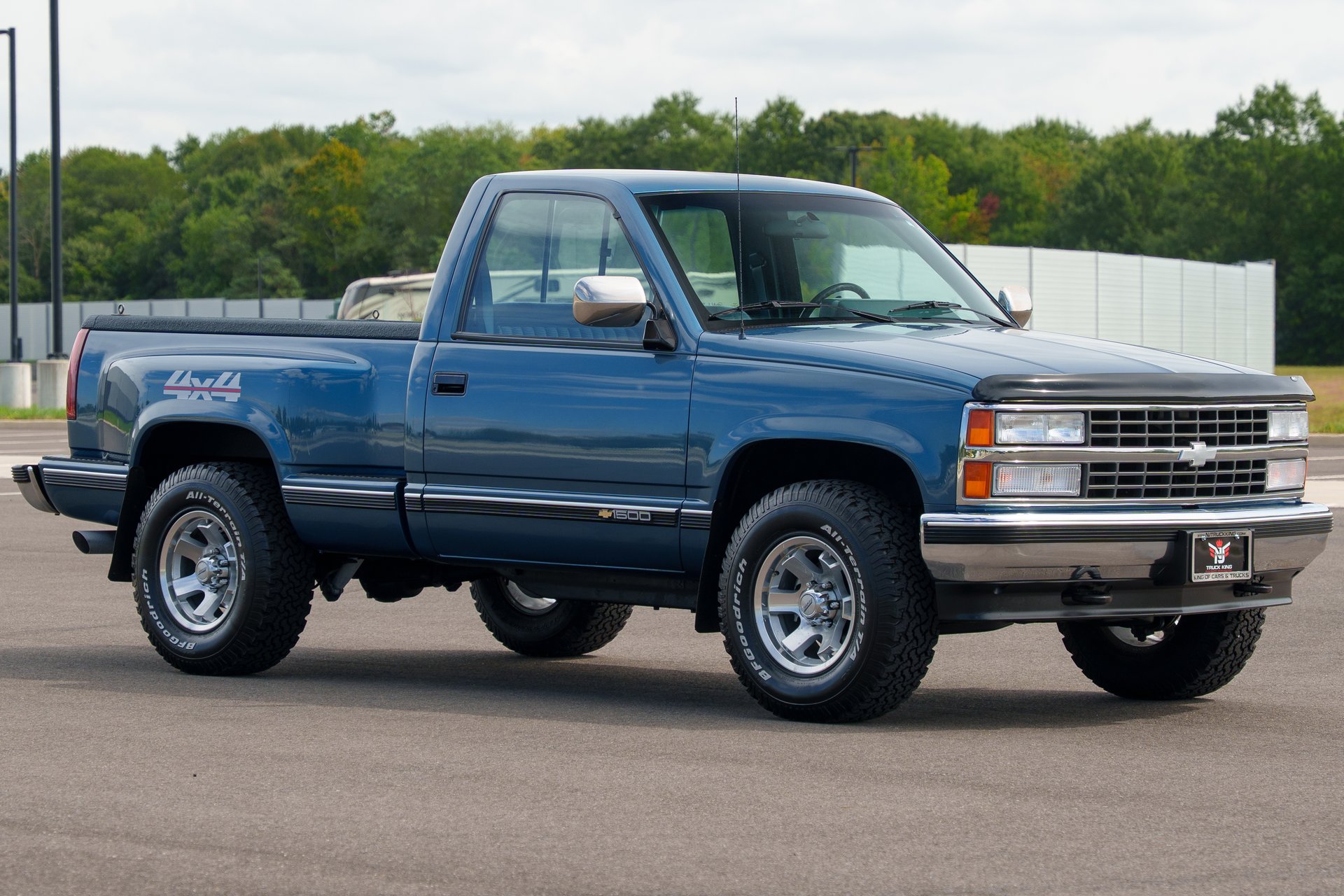
The generation divides into three eras, and you should learn to see them at a glance because they price and fail differently. The early trucks, 1988–94, carry the original interior and throttle-body-injected engines throughout. The 1995 model year brought a completely new, much more modern interior but kept the TBI engines for one more year — a one-year combination: new cabin, old fuel system. Then 1996 brought the Vortec engines, with a useful step in power and a new set of known faults. Production ran through 1998, carried into 1999 as the C/K Classic alongside the new Silverado.
Why buy one now? Because the GMT400 is new enough to have injection that starts on a cold morning, an overdrive automatic and steering a modern driver finds normal — and old enough to be simple, rebuildable, and supported by one of the deepest parts networks in the hobby. The trap is equally clear: these were working trucks, most have worked, and the difference between a good K1500 and a money pit is frame rust, front-end wear and deferred maintenance — in that order — not the odometer.
The models
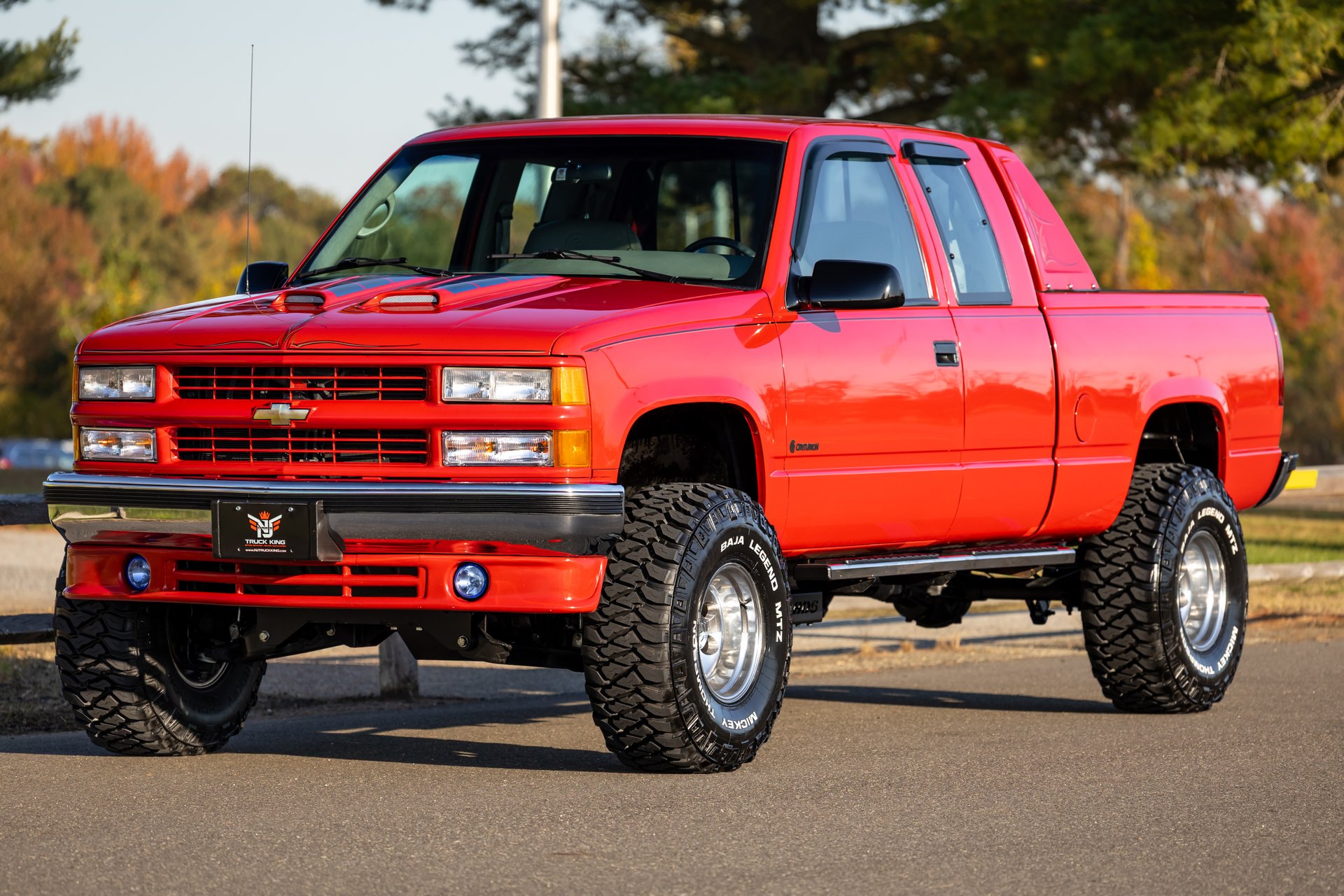
Every K1500 is a half-ton 4x4 built on the GMT400 platform, but the range spreads wider than the badge suggests: three cab styles, three bed lengths, two bed styles, three trim levels and five engines across the run. The badge on the door will not tell you most of that. The VIN, the glovebox RPO sticker and a tape measure will. Learn the configurations first, because configuration — more than trim — drives both usability and price.
| Model | Years | Engine | Output | Built | Character |
|---|---|---|---|---|---|
| K1500 Regular Cab 117.5" WB | 1988–1999 | 4.3 V6 / 5.0 / 5.7 V8 | 160–255 hp | Not published by configuration | Short-bed single cab; the lightest, simplest K1500 |
| K1500 Regular Cab 131.5" WB | 1988–1999 | 5.0 / 5.7 V8 | 175–255 hp | Not published by configuration | Long-bed work truck; 8-foot bed, plainest spec |
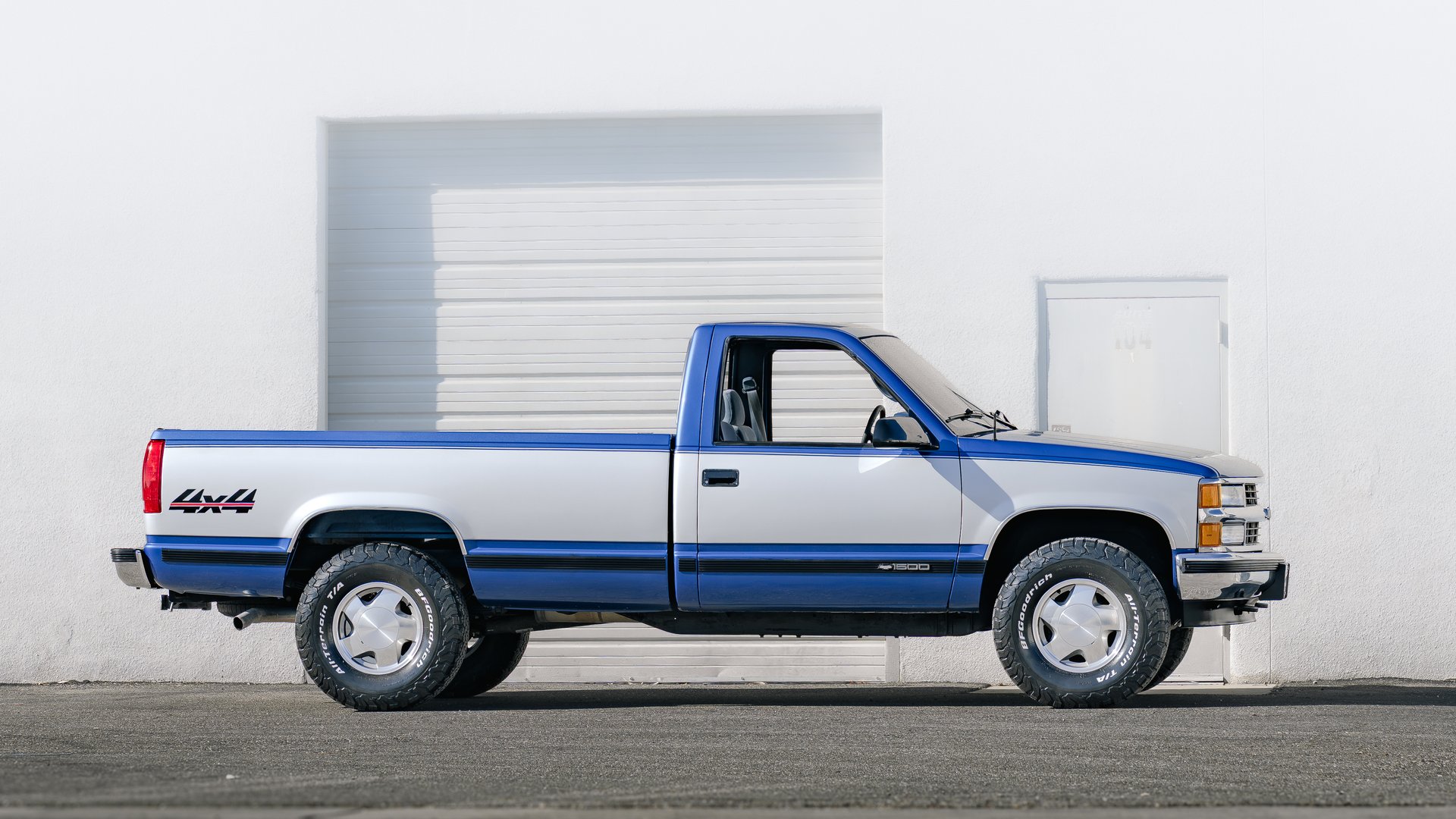
| K1500 Extended Cab 141.5" WB | 1990–1999 | 5.0 / 5.7 V8 | 175–255 hp | Not published by configuration | The market's centre: short bed, jump-seat rear cab |
| K1500 Extended Cab 155.5" WB | 1990–1999 | 5.7 V8 | 210–255 hp | Not published by configuration | Long-bed extended cab; rarer, the hauler's pick |
| K1500 Sportside | 1988–1999 | 5.0 / 5.7 V8 | 175–255 hp | Not published by configuration | Step-bed styling on reg/ext cab; style premium, less bed width |
| K1500 W/T 1500 | 1990–1999 | 4.3 V6 / 5.0 V8 | 160–230 hp | Not published by configuration | Work Truck: vinyl, steel wheels, black grille — honest spec |
| K1500 diesel | 1988–1999 | 6.2 / 6.5 diesel V8 | 130–215 hp | Not published by configuration | Rare in half-tons; economy and torque, specialist faults |
GM does not publish production broken down by cab and bed configuration, and any source that gives you a precise figure for, say, 1995 Extended Cabs is inventing it — so the table says so rather than guess. What matters is not rarity by the numbers but survival: regular-cab short-beds and Sportsides survive disproportionately as hobby trucks, while long-bed work trucks were used up.
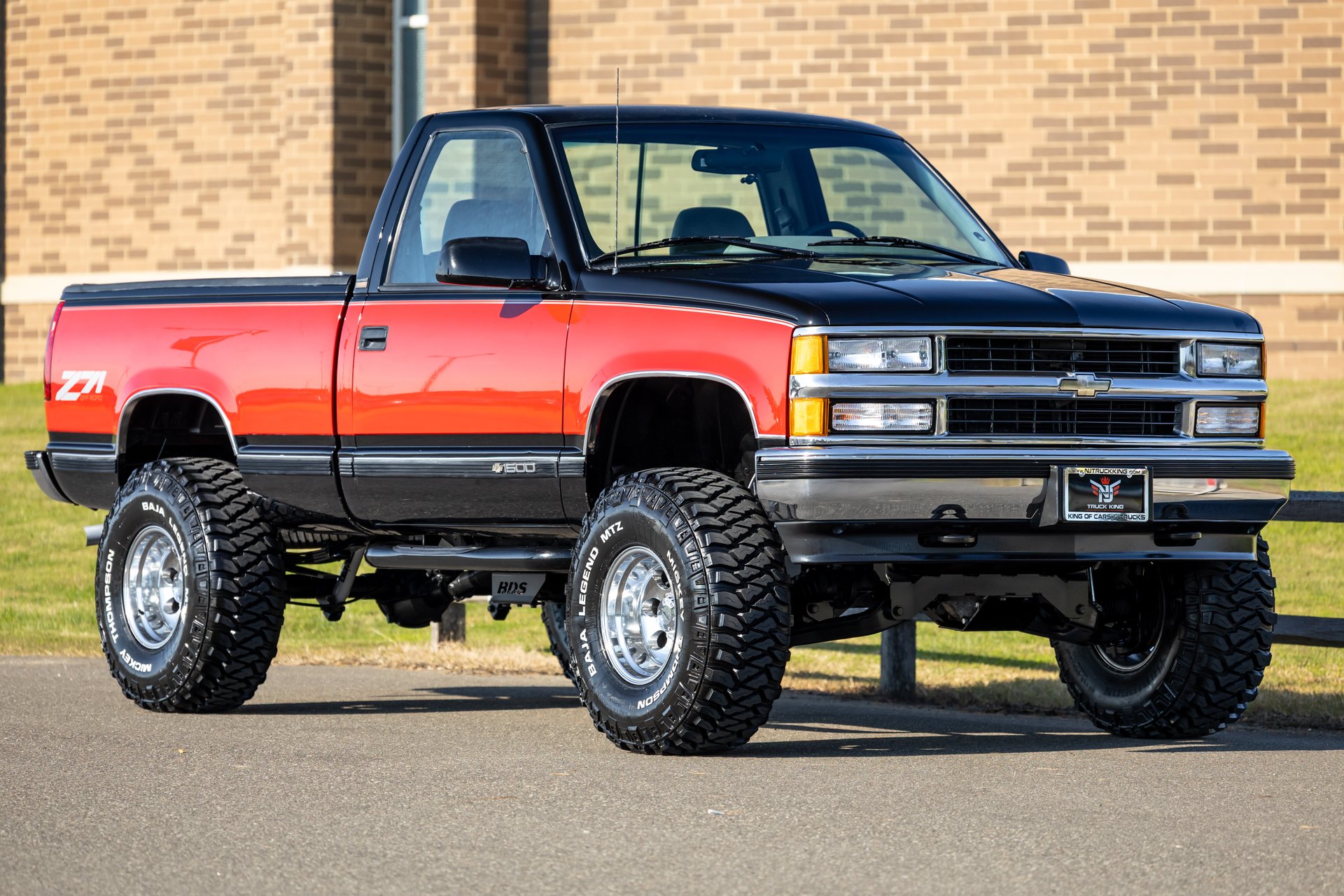
Cabs and beds. The regular cab comes on two wheelbases: 117.5 inches with the 6.5-foot short bed, and 131.5 inches with the 8-foot long bed. The extended cab arrived for 1990 and sits on a 141.5-inch wheelbase with the short bed, or 155.5 inches with the long bed; the 141.5-inch extended cab dominates our listings pool, because it carries people and cargo and still fits in a parking space. A third door arrived for 1997 on extended cabs and is worth having — check it opens, because the latch and handle are known weak points. Crew cabs were a 3500-chassis item, not a K1500; a "crew cab K1500" is a conversion or a mislabel, and either way it needs explaining. Beds come as Fleetside, with full width between the wheelhouses, or Sportside, the step-bed with flared rear fenders and a narrower floor. The Sportside looks wonderful and carries less; plywood does not lie flat in it the way sellers imply.
Trim. Early trucks use the standard ladder: Cheyenne at the bottom, Scottsdale in the middle, Silverado at the top. From 1990 the W/T — Work Truck — undercut even the Cheyenne with a black grille, steel wheels and vinyl bench, usually with the 4.3 V6. Silverado trim brings cloth or leather, carpet, chrome and most of the options. Trim matters less than condition at this age, with one exception: the Z71 off-road package — skid plates, heavy-duty shocks, a limited-slip differential in many applications and the decals everyone copies. Z71 is an RPO code, not a look: a truck with Z71 stickers and no Z71 code on the glovebox sticker is a truck with stickers, and you should pay for it accordingly. The same sticker settles the axle ratio (GU6 is 3.42, GT4 is 3.73, G80 is the locking differential) and the engine (L05 is the TBI 5.7, L31 the Vortec 5.7, L30 the Vortec 5.0, LB4/L35 the 4.3). Spend two minutes with that sticker on every viewing; it is the truck's data card, and it ends arguments.
The SUV overlap. One naming trap deserves a paragraph, because it sits inside our own pool. The full-size Blazer (1992–94) and its successor the two-door Tahoe (1995 onward) are GMT400 K1500 mechanicals under an SUV body, and listings blur them into the K1500 file; Tahoe-badged trucks appear in the pool for exactly that reason. Mechanically this guide covers them, but they rust in SUV places (tailgate, rear quarters, roof rails) rather than pickup places, and their market is different. This guide weights to the pickups, which are what the pool mainly holds.
Special editions. The K1500 line has no factory flagship in the mould of the two-wheel-drive 454 SS — that truck was a C1500, and a K1500 wearing 454 SS cues is a tribute, not a rarity. What the K line offers instead is specification: a Silverado extended cab with the L31 Vortec 5.7, 3.73 gears, the G80 locker and the Z71 package is the best truck GM built in this line, and the market knows it.
Engines and gearboxes
The K1500 engine story is one clean dividing line: throttle-body injection from 1988 to 1995, Vortec from 1996 to the end. Everything else — the 4.3 V6 at the bottom, the diesels at the margin — orbits those two V8 families. Learn to identify which side of the line a truck sits on before you discuss price, because the two systems share almost no parts, fail in almost completely different ways, and suit different owners.
The TBI engines: 4.3, 5.0 and 5.7, 1988–1995
Throttle-body injection is fuel injection at its simplest: one or two injectors in a unit that sits where a carburettor would, spraying fuel into a throttle body at low pressure — 9 to 13 psi. The engines beneath it are the classic small-block Chevrolet in its last traditional form: iron block, iron heads, hydraulic lifters, a timing chain, and swirl-port heads designed to tumble the mixture at low speed, which is why these engines pull so cleanly off idle and run out of breath so completely at the top end.
The 4.3 V6 (LB4) is literally three-quarters of a 5.7 V8 — same bore and stroke, two cylinders removed — and shares the V8's bottom-end toughness. Output is around 160 hp: adequate in a regular cab, merely sufficient in an extended cab; most 4.3 K1500s are W/T work trucks. Its firing intervals give it a characteristic lope at idle that buyers misread as a misfire. Judge it by whether it pulls smoothly, not by whether the idle is glassy — it never was.
The 5.0 (L03) makes about 170 hp and is the engine to walk past. It is not a bad engine — same architecture, same reliability — but it works harder for less result, drinks almost what the 5.7 drinks, and carries a resale penalty out of proportion to the real-world difference. Buy one only when the truck around it is exceptional and the price already reflects the badge.
The 5.7 (L05) is the TBI engine to own: about 210 hp, a broad, lazy torque curve, and a reputation for 250,000-mile service that is, for once, earned. The long block is rarely the problem. What fails is everything bolted to it, in a short, predictable list. The TBI unit's injector pod gaskets weep; the fuel pressure regulator diaphragm, built into the pod, ruptures and floods the engine at idle; the throttle-body base gasket shrinks and leaks vacuum, giving a hunting idle owners chase through sensors for months. The EGR valve carbons up and sticks, causing a surge at cruise and a stall at lights. The distributor's ignition module and pickup coil fail with age — the classic presentation is a truck that dies hot and restarts cold, and the fix is a quality module at about $60–150 in parts. Coolant leaks at the intake manifold seals are routine. None of it is serious money: a full TBI unit rebuild with injectors, regulator and gaskets runs $150–350 in parts; a shop doing the whole catch-up — module, EGR, hoses, thermostat, intake reseal — lands between $600 and $1,200.
The TBI test on a viewing is therefore not "does it run well" but "does it run well hot, at idle, after a restart." Insist on a cold start, let it idle to full temperature, switch it off, wait five minutes and restart it. Heat-soak exposes the module, the regulator and the starter in one sequence.
The Vortec engines: 1996–1999
For 1996 GM rebuilt the top of the small-block and renamed the range. Vortec heads — a fast-burn chamber with genuinely better flow — a higher compression ratio and, critically, a new fuel system transformed the outputs: the Vortec 5000 (L30) 5.0 makes about 230 hp, and the Vortec 5700 (L31) 5.7 about 255 hp with 330 lb-ft of torque. The Vortec 4300 (L35) 4.3 V6 gained the same treatment at about 190 hp. These are meaningfully quicker, more economical trucks, and a 1996–98 Vortec 5.7 extended cab is the performance pick of the range.
The fuel system is where the bill lives. The V8s use Central Sequential Fuel Injection — CSFI — universally nicknamed the "spider": a central injector body under the upper intake plenum that distributes fuel through individual tubes to poppet nozzles at each port. The system runs at high pressure, roughly 60 to 66 psi, and it is fussy about every psi of it. Three failure modes account for nearly every Vortec running complaint you will ever meet.
First, the poppet nozzles stick and gum, especially on trucks that sit or run poor fuel, giving a cylinder-specific misfire, a rough idle and a flashing check-engine light under load. The definitive fix is the factory-updated MPFI conversion — a revised spider with true electronic injectors at the end of each tube, replacing the poppets entirely. Parts run roughly $300–500 and the job is a half-day for a competent home mechanic with the plenum off; a shop will charge $700–1,200 fitted. A truck with documented MPFI conversion is worth a premium over one still on original poppets.
Second, the fuel pressure regulator lives inside the plenum, on the spider, and when its diaphragm leaks it dribbles raw fuel into the intake — hard hot starting, a rich smell, fuel washing into the oil in bad cases. It presents like a dozen other faults, and the test is fuel pressure behaviour: pressure that will not hold after the pump stops, on a Vortec, is the regulator or a leaking poppet until proven otherwise.
Third, a weak in-tank fuel pump. The Vortec needs its full 60-plus psi to open the poppets cleanly; a tired pump delivering 50 psi gives extended cranking and a lean stumble no sensor replacement cures. A fuel pressure gauge on the test port — key-on pressure, running pressure, and leak-down over five minutes — is a twenty-minute test that prices the whole fuel system. Do not buy a hard-starting Vortec without it. The pump is a $150–350 part; the cost is access, so $500–900 at a shop.
The other signature Vortec fault is the intake manifold gasket. GM's original gaskets used a plastic carrier that degrades — the Dex-Cool controversy of the era attached itself to this joint — and the failure is coolant leaking externally at the front corners, or internally into the valley and the oil. Milkshake oil on a Vortec is this gasket until proven otherwise, and caught early it is a gasket set and a weekend: $80–150 in parts, $600–1,000 at a shop. Caught late, it is bearings. Check the coolant level, the oil filler cap and the front corners of the intake on every viewing. Distributor wear is the companion fault: the housing and gear wear, camshaft position correlation drifts, and the truck sets a P1345 code and runs retarded — a new distributor, timed with a scan tool setting cam retard to zero degrees, is a $200–400 part and an hour or two of labour.
The diesels: 6.2 and 6.5
A minority of K1500s carry the Detroit Diesel V8s: the naturally aspirated 6.2 in the early years (around 130–140 hp) and the 6.5, mostly turbocharged (L56 and L65 calibrations, up to about 215 hp), from 1994. In a half-ton they make sense on torque and economy rather than speed, and ownership sense only if you actively want one. The 6.5's known faults are specific: the Stanadyne DS4 electronic injection pump on 1994-on trucks, and above all its pump-mounted driver (PMD) module, which cooks in engine heat and causes stalling that cures itself on cooling — the standard fix is a remote PMD relocation kit on a heat sink, $250–450 in parts. Crankshaft and harmonic balancer failures, overheating under load, and glow-plug faults round out the list. A diesel with records from a diesel-literate owner is a fine truck; a cheap one with "a stalling issue" is a research project.
Gearboxes and the four-wheel-drive system
Nearly every K1500 you will meet — 19 of the 23 in our pool list one — carries the four-speed automatic. Early trucks use the 700R4, renamed 4L60 in 1990: a hydraulically controlled overdrive automatic whose health depends on the TV (throttle valve) cable being correctly adjusted — a misadjusted cable drops line pressure and burns the 3-4 clutch pack, so a 700R4 truck with vague, stacked shifts and a slack cable is a rebuild looking for a date. From 1993 the 4L60-E replaced it: same basic geartrain, electronically controlled shifts, a better reputation when maintained. Its wear pattern is well mapped: the 3-4 clutch pack is the consumable, the sun shell can crack (the uprated "Beast" shell is the standard rebuild fix), and tired units flare on the 2-3 shift and shudder in lockup. The test is a full-throttle run through all four gears and a steady cruise to feel lockup engage cleanly around 45–50 mph. A fluid and filter service is $150–300; a quality rebuild runs $2,200–3,500 fitted, and a documented rebuild is a selling point, not a stigma. Five-speed manuals — the NV3500 — exist and are delightful, but our pool contains none; judge one on synchromesh into third and pay no rarity premium, because the market does not.
The transfer case divides by shifter. Most trucks use the NP241, with a floor lever and a reputation for being close to unbreakable; its chain stretches over very high miles and slaps under load, and the slip-yoke can clunk on take-up, which is a grease-and-inspect item, not a rebuild. Later, higher-trim trucks offer the NP243 push-button case, whose shift motor and encoder can fail and leave you in whatever range you last used — cycle it through 2HI, 4HI and 4LO on gravel, and listen. The last trucks add the NP246 AutoTrac with an automatic mode and a clutch pack that wears. Front-axle engagement is by an actuator on the front differential: early trucks use a thermal actuator notoriously slow in cold weather — engagement can take half a minute on a frosty morning — and the standard upgrade is the later electric actuator, $100–250 in parts. A K1500 whose 4WD "works but takes a while" in July has an actuator dying; in January it has a two-wheel-drive truck.
There are no manual hubs to lock — the front axle uses a disconnect at the differential — and the G80 Gov-Lok locking rear differential, when fitted, locks mechanically under wheel-speed difference and unlocks at road speed. It is effective and fragile under abuse; a G80 truck that clunks from the rear on tight turns is telling you the unit is worn. Never accept "the 4WD is fine, I just never use it" — unused systems on these trucks seize, they do not rest.

Problem areas
Everything in this section is drawn from the trucks themselves. We currently track 23 K1500s, and for 18 of them we have gone through the sellers' photo sets and records in detail. In that sample of 18, rust is mentioned on 7 trucks, visible damage on 8, and leaks on 3 — and no truck drew a mention for exhaust smoke, which matches the small-block's reputation: the engines rarely die, the truck around them is what you are inspecting. Note where our pool lives: nine of the 23 trucks are in New Jersey, with others in Pennsylvania and Nebraska alongside Texas, Florida and Arizona trucks — a salt-belt weighting to keep in mind, because a K1500's condition is decided less by its year than by its winters. Work through this section in order: frame first, because frame rust ends the conversation, then the front end this generation wears out by design, then the body, then everything else.
Rust: the frame and cab map
Rust on a GMT400 follows the salt, the mud and the trapped water, and it follows them to specific, checkable places. Learn the map and walk it in order.
The frame at the rear arch. The single most important check on any K1500. The frame rails kick up over the rear axle, and that arch — plus the section behind it, around the spring hangers and fuel tank crossmember — traps salt and mud against the steel and rots from inside the rail outward. Surface scale is normal at this age and means nothing; what condemns a truck is perforation, flaking that comes away in layers, and rails gone thin and wavy at the arch. Prod hard with a screwdriver (with the seller's permission) at the arch, the hanger rivets, and where crossmembers meet the rails. Frame repair is sectioning and welding by a fabricator — realistically $1,500–4,000 for one properly repaired arch section, and a truck needing both sides is a parts truck wearing a price tag. This is the walk-away item: everything else in this guide is a negotiation, a perforated frame at the arch is a verdict.
The front frame and steering box area. Check the rails around the steering box mounting — the box's leverage works the rail, and cracks radiate from the bolt holes on trucks that have run oversize tyres or worked a plough; cracks here are weldable ($400–900 with the box removed) but tell you the truck has been worked hard. Check also the front crossmember and the core support mounts.
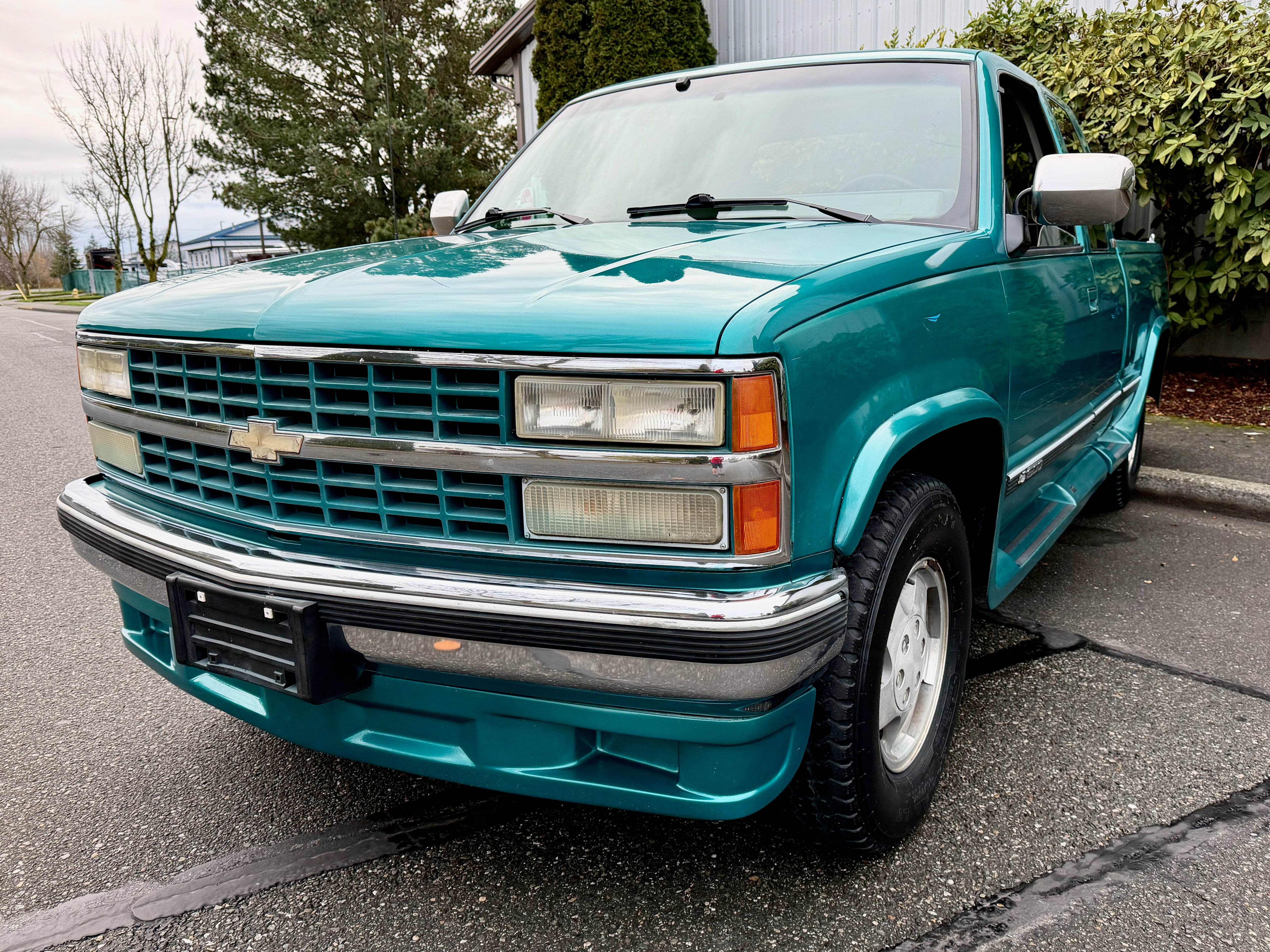
Cab corners and rockers. The extended cab's rear corners are the classic GMT400 rot spot: the cab corner is a closed box that collects condensation and whatever the rear wheel throws, and it rots from inside out — by the time the paint bubbles, the inner structure is involved. Press hard, look from underneath with a torch, and check inside, under the rear seat. Rockers follow the same pattern. Repair panels are cheap — $40–120 a side — but the labour to cut, weld and paint both corners and both rockers properly runs $1,200–2,800, and a truck bubbling at all four places has earned a full underneath inspection before any other conversation. Regular cabs rot at the same corners and at the back of the cab floor.
The bed. The bed floor rots over its cross sills — lift any bedliner, because a drop-in liner is the best rust-hiding device ever sold, and sellers know it. The wheelhouses bubble at the arch lip, and the lower rear quarters hold mud against the panel. A perforated bed floor is a floor section or a replacement bed ($800–2,500 fitted and painted); arch bubbles are a panel job in the cab-corner range. On Sportsides the fibreglass fenders do not rust — but their mounting points and the steel bed beneath them do.
Doors, fenders and the small traps. Door bottoms rot where the drain slots block; run a fingertip along the bottom edge of each door and feel for bubbling, then check the drains are clear. Front fenders bubble behind the front wheels where the splash shield traps grit. The core support rusts at its lower corners. A leaking windshield wets the cab floor — lift the mats and prod the pans at the toe boards, because cab floors rot from the inside when a truck has lived with wet carpets. The battery tray rots under the battery from acid; rock the battery and look at the tray edges below it.
Read the underside's cosmetics as evidence. Factory undercoat at thirty years old looks honestly patchy — thin at edges, stone-chipped, dirty. A uniform coat of fresh black underseal blown over frame, lines and crossmembers the week before sale is a cover-up until proven otherwise: nobody re-undercoats a sound frame for your benefit. A truck presented with a washed, dry underside on a lift is a seller with nothing to hide — reward it.
The IFS front end: steering, suspension and hubs
The independent front suspension is the K1500's defining engineering choice and its defining wear item. Instead of a solid axle, each front wheel hangs on upper and lower control arms, sprung by torsion bars that run back to a crossmember, with the front differential mounted to the frame and CV-jointed half-shafts driving the wheels. It rides beautifully. It also contains more wear joints than the solid axle it replaced, and at this age most trucks need some or all of them.
Idler and pitman arms. The steering linkage is a conventional relay-rod layout, and its two wear pivots — the pitman arm off the steering box and the idler arm on the opposite rail — are the first things to go loose. A worn idler lets the linkage float, and the truck wanders, follows ruts and wears the front tyres' inner edges. The test: with the truck on the ground, have a helper rock the steering wheel while you watch the linkage from below — play shows as lost motion before the wheels respond. The parts are cheap ($40–120 each) and a pair fitted with an alignment runs $350–650; the point is diagnosis, because sellers routinely blame "old truck steering" for what is a $100 arm.
Ball joints and control-arm bushings. Upper and lower ball joints carry the torsion-bar load, and worn lowers are a safety item, not a noise item — check for play with the suspension unloaded, wheel rocked top to bottom, and inspect the boots. Pressed and riveted joints make this a shop job for most owners: $250–500 a side fitted for joints, more with bushings. Bushings perish and shift the alignment; a full front-end refresh — ball joints, bushings, idler, pitman, tie-rod ends, alignment — is the job most K1500s actually need, at $1,200–2,200 at a shop. Price a vague-driving truck as if it needs all of it, because it usually does.
Torsion bars and ride height. The bars themselves rarely fail, but they sag, and previous owners "fix" stance by cranking the adjuster bolts — which raises the ride height, steepens the CV angles, stiffens the ride and accelerates CV and ball-joint wear. Measure the stance against the factory trim height (the Z-height measurement in the service manual) and look at the adjusters: a truck cranked to the top of its adjustment, sitting nose-high, has been levelled the cheap way. That is not a walk-away, but it is a front-end wear multiplier, and the CV boots will show it.
CV shafts, hubs and the front differential. CV boots split with age and with cranked torsion bars; a split boot that has thrown its grease is a shaft replacement, $150–350 a side fitted. The front wheel bearings are sealed unit hubs — they hum rather than rattle, and the test is a swerve test on the drive (the noise changes as load transfers) plus play at the wheel; $200–450 a side fitted. The differential itself is strong, but its axle seals weep and the rear pinion seal weeps more — a damp pinion with correct oil level is a monitor item, a dry-and-grinding one is a rebuild.
Steering box and pump. The recirculating-ball box wears in the centre of its travel, giving on-centre play that adjustment only partly cures — over-tightening makes the steering bind off-centre, so a truck tight at the locks and loose in the middle has been adjusted past its wear. A rebuilt box is $300–600 fitted. Pumps whine and high-pressure hoses weep; both are cheap. Judge the system on the drive: a sorted K1500 steers with a precision no solid-axle truck of the era matches.
Brakes. Front discs, rear drums for most of the run, with rear-wheel ABS on early trucks and four-wheel ABS later. The faults are age faults: seized calipers, perished flex hoses, a tired master cylinder, and above all rusted steel brake and fuel lines — in the salt belt, original lines are a consumable, and a full line set in nickel-copper, fitted, runs $600–1,200. Check the lines along the driver's frame rail with the same care as the frame itself: a line that flakes when you rub it is a line about to fail. ABS faults are usually sensor or hub tone-ring money, not module money.
Body, bed and interior
Paint and trim. Factory colours in our pool run to red, black, green, blue and white, and the era's clearcoat is the weak point: peeling clearcoat on horizontal surfaces — hood, roof, bed rails — is endemic on 1990s GM paint. A quality repaint of a truck this size starts around $5,000 and climbs fast, which is why original paint with honest fade beats a cheap respray with overspray on the rubbers. Check panel gaps and the bolts on fenders and bed for wrench marks — accident history on a work truck is normal, undisclosed frame-straightening is not.
The interior, two generations. The 1988–94 cabin is upright, squared and hard-wearing; the 1995-on cabin is a full redesign — curved dash, proper glovebox, driver airbag (passenger airbag from 1997) — and a large part of why 1995-on trucks command their premium. Wear points are shared: the driver's seat bolster and cushion collapse first (sit in the driver's seat, always), the headliner sags (a $200–400 retrim), dash pads crack on the early interior, and door panels loosen at their clips. Seat foam and covers are reproduced; a front bench or buckets retrimmed runs $600–1,500. In extended cabs, check the jump seats and the third-door latch on 1997-on trucks.
Electrics and accessories. Faults here are component faults. The recurring list: window regulators and motors slow and die ($150–350 a side fitted); HVAC blend-door actuators click, stick and lose temperature control ($40–120 parts buried at varying depths of dash — ask which one before accepting a quote); the heater blower and its resistor fail in the usual GM pattern, losing speeds one by one; wiper modules develop the famous phantom-wipe fault from cracked solder joints on the pulse board — a $30–80 board or a resolder, and one of the most satisfying cheap fixes on the truck. Air conditioning on early trucks was R12; most have been converted to R134a, and a proper conversion (compressor, drier, seals) is worth money, while a can-and-a-prayer conversion is an $800–1,500 recommission waiting. Test the air conditioning on every viewing, whatever the month.
Fuel system outside the engine bay. The in-tank pump and sending unit are one assembly; the sender's rheostat wears and gives a wandering or lying fuel gauge — budget the assembly ($250–500 fitted) on any truck whose gauge misbehaves, and remember the Vortec pressure test uses this same pump. Steel tanks rust at the straps and seams in the salt belt; tanks are $200–400 in parts. All of it is underneath, which is why the lift inspection in the next section is not optional.
How to inspect one
Allow ninety minutes, bring a torch, a screwdriver for prodding (with the seller's permission), a magnet in a cloth, and — for a Vortec — a fuel pressure gauge if you can borrow one. If the truck passes you, pay for a lift inspection before money changes hands; the frame arch check alone is worth the fee. Our photo sample is a warning: of the 18 trucks we examined in detail, 8 showed visible damage and 7 mentioned rust — expect to find things, and price what you find.
- Paperwork and the RPO sticker first. Match the VIN on the title to the dash plate and the door sticker. Then open the glovebox and read the RPO codes: L05 or L31 settles TBI versus Vortec 5.7, G80 confirms the locking differential, GT4 or GU6 the axle ratio, Z71 the off-road package, and the transmission code tells you which automatic you are judging. A truck whose hardware contradicts its sticker — a Vortec badge on a TBI engine, Z71 decals with no Z71 code — has been altered or misdescribed, and everything else the seller says gets re-checked from here.
- Cold start, whatever the engine. Insist the truck is cold when you arrive. A TBI should fire at once and settle to a fast idle that steps down; a Vortec may crank a touch longer but must start without throttle. Watch the exhaust for the first ten seconds: a puff of blue that clears is valve seals (a known, priceable job); continuous smoke is not. Listen for lifter tick that fades (common, minor) versus a bottom-end knock that does not (walk away).
- The frame arch. Before any other underneath work, get the torch on the frame rails where they kick up over the rear axle, the spring hangers and the tank crossmember — the rust map from the Problem areas section. Prod with the screwdriver. Perforation or layered flaking here ends the inspection: thank the seller and leave. Scale that rings solid is fine and normal.
- The rest of the underside. Work forward: cab corners from below, rocker inners, floor pans at the toe boards, brake and fuel lines along the driver's rail (rub any flaking line — if it sheds rust, it is in the price), the front crossmember, the steering box mounting for cracks, and the bed floor over its sills. Read the underseal: patchy and honest is factory; a fresh uniform black coat over everything is a question the seller answers, not you.
- Cab corners, rockers and bed from above. Press hard on both cab corners, run the magnet along the rockers and rear wheel arches, and lift any bedliner — the liner check is non-negotiable, it hides the bed floor's worst rot. Check door bottoms for bubbling and clear drain slots, and feel along the bottom edge of every door.
- Front-end play. With the truck on the ground, have a helper rock the steering wheel while you watch the idler arm, pitman arm and tie rods from below for lost motion. Then, suspension unloaded, rock each front wheel top-to-bottom for ball-joint play and side-to-side for bearing and tie-rod play. Note the torsion-bar adjusters: bolts wound to the top and a nose-high stance mean a cranked truck with accelerated wear priced in.
- The 4WD system, on dirt. Find gravel or grass. Engage 4HI and confirm the front axle actually pulls — a tight full-lock turn on loose ground should bind and hop slightly. Cycle to 4LO and back, and on a push-button truck (NP243 or NP246) make every shift the button offers, twice. Note how long front engagement takes: the thermal actuator from the gearbox section is slow when cold and dead when it takes minutes on a warm day. "Never used it" is a fault report, not a feature.
- The test drive: gearbox. Fifteen minutes minimum, including a stretch where you can use full throttle safely. A 700R4/4L60 should shift firmly with a correctly tensioned TV cable feel — no stacked, flaring shifts. A 4L60-E should make the 2-3 shift without flare and lock the converter cleanly around 45–50 mph in cruise. Any shudder in lockup, any flare, any delay into reverse is rebuild money ($2,200–3,500) coming off the price.
- The test drive: steering, brakes, stance. The truck should track straight hands-off, steer precisely for its size, and show no wander over bumps — wander plus a knock is the front-end refresh from the Problem areas section, priced in. Brake firmly from speed: straight stop, no judder, no pull, a pedal that stays hard. Stand back afterwards and judge stance: level to slightly nose-down is right; a sagging front is torsion bars or wear, a sagging rear is springs.
- Engine health checks by system. On a TBI: hot idle quality, a hot restart after five minutes' soak (the ignition-module test), and a look at the TBI pod for fuel weep. On a Vortec: fuel pressure — key-on, running, and leak-down over five minutes; pressure that falls away is the regulator or poppets from the engine section. Check the oil filler cap and coolant level for the intake-gasket signature, and the front corners of the intake for coolant staining. On either: oil pressure strong at speed, temperature stable at a long idle.
- Electrics and comfort, all of them. Work every window, the wipers on every setting (phantom wipes are the pulse board), the blower on every speed, the heater and — whatever the weather — the air conditioning. Test the blend doors by sweeping temperature hot to cold. Count the dead items and price them; they add up faster than any single mechanical fault on this list.
- Interior and load space last. Sit in the driver's seat and feel for the collapsed cushion and dead bolster; check the headliner, dash pad, jump seats or rear bench, and the third-door latch on a 1997-on extended cab. Check the tailgate's cables and hinges. A sound original interior is the hardest thing on a K1500 to recreate cheaply, so weight it — but never let a pretty cabin talk you out of what steps 3 and 4 found underneath.
Values
The market block beneath this guide carries the current numbers — what is listed now, at what asks, and what recorded sales have achieved — and it is refreshed at every build, so this section deliberately carries no prices of its own. What it can teach you, durably, is how to read those numbers, because the K1500 market is one where the spread between the cheapest and dearest truck wearing the same badge is enormous, and almost all of that spread is condition and configuration rather than year or mileage.
The condition spread is the market. A K1500 can be a rusted work truck at the end of its life, a tidy preserved driver, or a low-mile showpiece, and the three barely inhabit the same market. The project end is defined by the frame: a truck with a perforated rear arch is worth its drivetrain and panels, and no mileage figure changes that. The driver middle — sound frame, honest wear, everything working — is where most of our 18 for-sale trucks sit, and where patience is rewarded, because supply is deep. The top end belongs to low-mile, rust-free, late Vortec extended cabs, increasingly sold at auction, where two determined bidders can carry a truck well past what the classifieds would suggest. Compare a listing within its band first; a driver priced like a showpiece is the commonest overpricing error in this market.
Asking prices are not achieved prices, and channel matters. Seventeen of the 23 trucks we track came through dealers, five through Facebook and one through Bring a Trailer — three different price logics. Dealer asks include prep and margin, and on a truck this age often include the front-end refresh the private market leaves to you: a dealer premium for a genuinely prepared truck is rational, for a washed one it is not. Private asks start optimistic and negotiate. Auction results are the only true achieved prices, and they skew to the best trucks because the channel selects for them. Use the recorded-sales block as your anchor, and treat classified asks as opening positions.
What carries a premium, and why. Configuration first: the extended cab out-earns the regular cab, the Vortec 5.7 out-earns the TBI 5.7, and both out-earn the 5.0 and the 4.3 by margins wider than the mechanical differences justify — because buyers are purchasing usability and resale, not just transport. The verified Z71 package and the G80 locker add value when the RPO sticker proves them; decals alone add nothing. Colour matters at the margins — red and black lead our pool's counts and its desirability too — and originality matters increasingly at the top: an unmodified, unlifted, uncranked truck is now the scarce thing. A lifted truck is worth less than the same truck stock, whatever was spent on the lift, unless the work is documented and exactly what you wanted.
The project-versus-driver gap. The gap between a project and a driver is not a discount, it is a budget transfer: the cheap truck needs the front-end refresh, the brake lines, the cab corners and the deferred services, and priced honestly those jobs consume most of the gap within the first year. The exception is the truck you can do yourself — the K1500 rewards home labour, because the parts are cheap and the jobs are documented. If you are paying shop rates, buy the driver. If your labour is free, the project math can work — but only on a sound frame, because frame welding is neither cheap nor truly DIY for most owners.
Negotiation reality. The negotiation that works is the inspection-based one: arrive with the priced list — cab corners, idler and pitman, brake lines, the Vortec fuel-pressure result — and negotiate from costs both sides can verify. The negotiation that fails is the mileage argument; on a thirty-year-old truck, condition evidence beats the odometer every time.
Parts and ownership
The K1500's ownership case rests on one fact: GM built GMT400 trucks in the millions, the small-block Chevrolet is the most supported engine family on earth, and the aftermarket treats this generation as a core product line. Almost everything is available, most of it cheap by classic standards, and much of it can be fitted with ordinary tools in an ordinary garage.
Easy and cheap: service items across the board — filters, plugs, belts, hoses, thermostats; brake discs, pads, calipers, drums and shoes; the full front-end wear catalogue (idler and pitman arms, tie-rod ends, ball joints, bushings); shocks; water pumps, alternators, starters; TBI rebuild parts and sensors; radiators; exhaust systems; glass, weatherstrips and common trim; and the patch panels — cab corners, rockers, wheel-arch sections, bed floors — that make the body repairs in this guide routine rather than bespoke. Order today, fit this weekend is a realistic rhythm for most of it.
Available, at a price: the Vortec MPFI conversion spider (the fix that ends the poppet era, and worth every cent), distributors and quality ignition modules, 4L60-E rebuilds with the upgraded sun shell and 3-4 pack — budget the $2,200–3,500 range quoted earlier and insist on the upgrades in writing; NP241 chains and shift motors for the push-button cases; front CV shafts and unit hubs; brake and fuel line sets in nickel-copper; air-conditioning compressors and conversion kits; seat foam and upholstery kits; and diesel items for the 6.5, where Stanadyne pump work and PMD relocation kits are specialist-supplied but well established.
Harder: perfect original trim and interior plastics in the right colours (the yards are the source, and good pieces move fast), Sportside-specific bed parts, early-interior dash pads uncracked, and rust-free original beds and cabs in the salt belt — which is why southern shells travel north on trailers, and why a rust-free shell commands its premium.
Running costs and the first-year budget. In our photo-examined sample of 18 trucks, leaks were noted on 3 and visible damage on 8 — the pattern of a fleet that has been used, and the reason the first-year catch-up budget matters more than the purchase negotiation. Plan on the deferred-maintenance sweep in year one: all fluids including transfer case and both differentials, the flagged front-end items, brake hoses and suspect lines, plugs and ignition service, and the small electrical list. At shop rates that is realistically $1,500–3,500 on a typical truck; at home, a third of that in parts. Fuel consumption is truck consumption: mid-teens mpg in mixed use for a V8, better on a run, worse in winter 4WD use.
Living with one. A sorted K1500 tows respectably within its ratings (check the RPO-based rating for your axle ratio rather than a brochure number), hauls what a half-ton hauls, and starts in winter. Keep the 4WD exercised monthly, keep the torsion-bar stance honest, and wash the frame arch and cab corners after salt season as deliberately as you wash the paint. Buy the frame, maintain the front end, and fix the small things while they are small: that is the whole ownership doctrine for this generation.
Which one to buy
- The all-rounder: 1996–98 Extended Cab 141.5", Vortec 5700, 4L60-E. The strongest engine, the modern cabin, the configuration the market wants, and the deepest pool to buy from. Insist on the fuel-pressure test and the intake-gasket check, and pay the premium for a documented MPFI conversion.
- The value buy: 1995 Extended Cab, TBI 5.7. One-year combination: the new interior with the simplest fuel system GM ever fitted to a V8. Slower than a Vortec and cheaper for it, and every fault it has is a cheap fault. If the frame is clean, this is the most truck per dollar in the range.
- The simple life: 1988–94 Regular Cab short bed, 5.7 TBI. The lightest, simplest K1500, with nothing fitted that cannot be rebuilt on a bench. Judge it on frame and cab corners, because at this age those are the truck.
- The worker: Regular or Extended Cab long bed, 5.7, 3.73 gears. The 8-foot bed earns its keep, and long-bed trucks are the cheapest way into a sound frame, because the hobby market overlooks them. Verify the ratio on the RPO sticker and budget the front-end refresh — working trucks wear it first.
- The stylist: Sportside. The prettiest GMT400, and the market pays for the looks. Buy it for the shape, eyes open about the narrower bed, and check the steel under the fibreglass fenders carefully.
- The specialist: 6.5 diesel. Only if you want the diesel specifically, and only with records, a relocated PMD and a healthy cooling system. A cheap, stalling 6.5 is the most expensive K1500 there is.
- The one to avoid: any K1500 with a perforated frame at the rear arch — and its close relation, the cranked-and-lifted truck with worn everything, sold at a premium for its modifications. Modifications subtract; rust at the arch disqualifies.
And the rule that overrides all of the above: buy the frame, then the configuration, then the engine — in that order. A sound frame under the wrong engine is a truck you can fix or sell; the right engine over a rotten arch is a parts donor. Check the arch first, read the RPO sticker second, and let everything else be negotiation.
See the 23 K1500 Ext Cab 141.5" WB 4WD cars currently listed.