
Chevrolet K10 buyer's guide
Chevrolet K10 -- the model's own buyer's guide: variants, values and what to check.
Years listed: 1960-1987 · Series: C/K Trucks
Overview and history
The Chevrolet K10 is the half-ton, four-wheel-drive pickup that taught America a work truck could also be a lifestyle truck. The letter tells you the drivetrain and the number tells you the payload class: C means two-wheel drive, K means four-wheel drive, and 10 means the half-ton chassis, with the shortest frame, the lightest axles and the widest choice of beds and cabs Chevrolet offered. Underneath the badge, a K10 is a C10 with a driven front axle, a transfer case and leaf springs at both ends — and that simple, repairable formula carried it, with two full restyles, from 1960 to 1986, plus a final year in 1987 when Chevrolet renamed the last Square Body four-wheel drives V10 and kept selling them alongside the new GMT400 trucks.
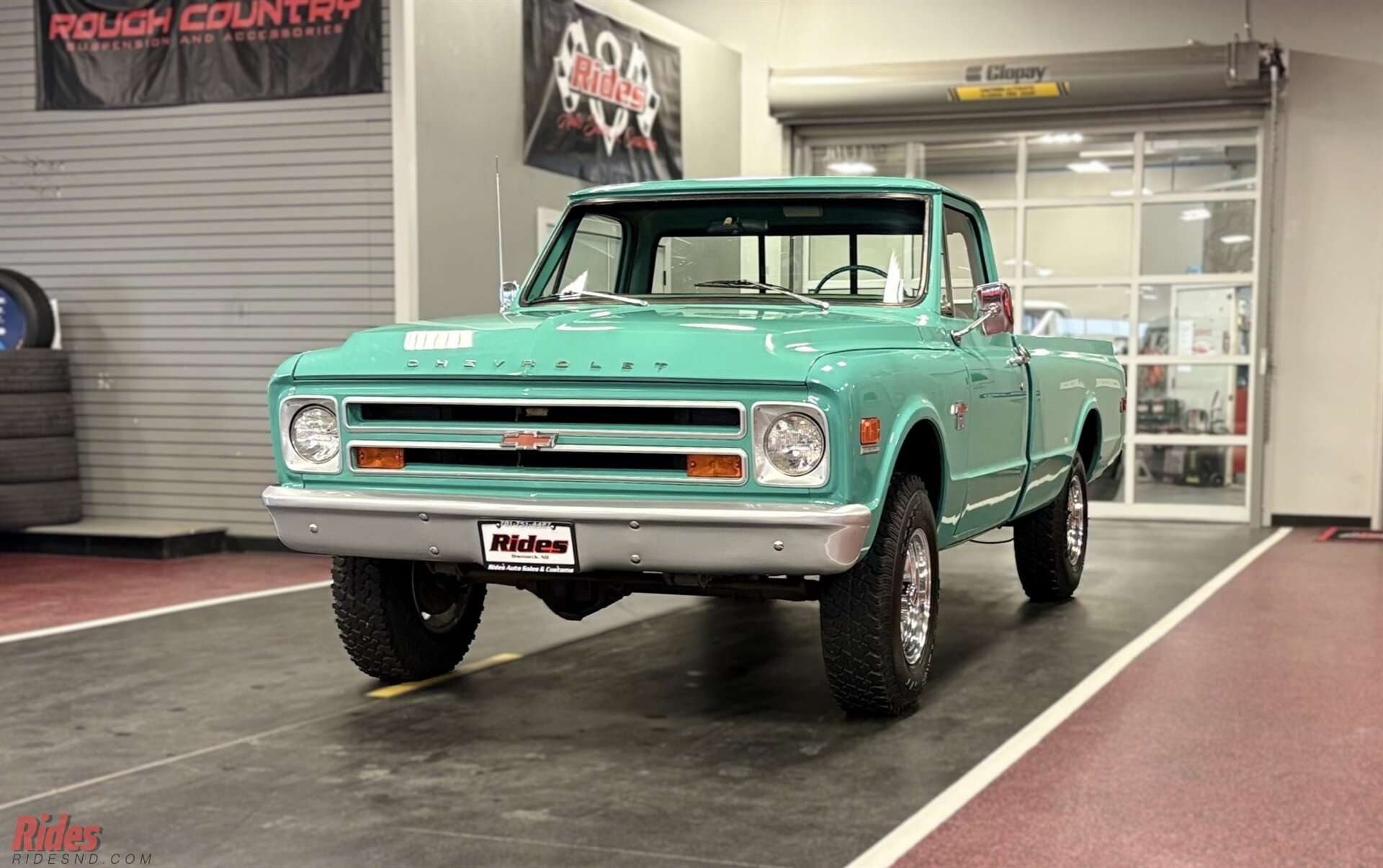
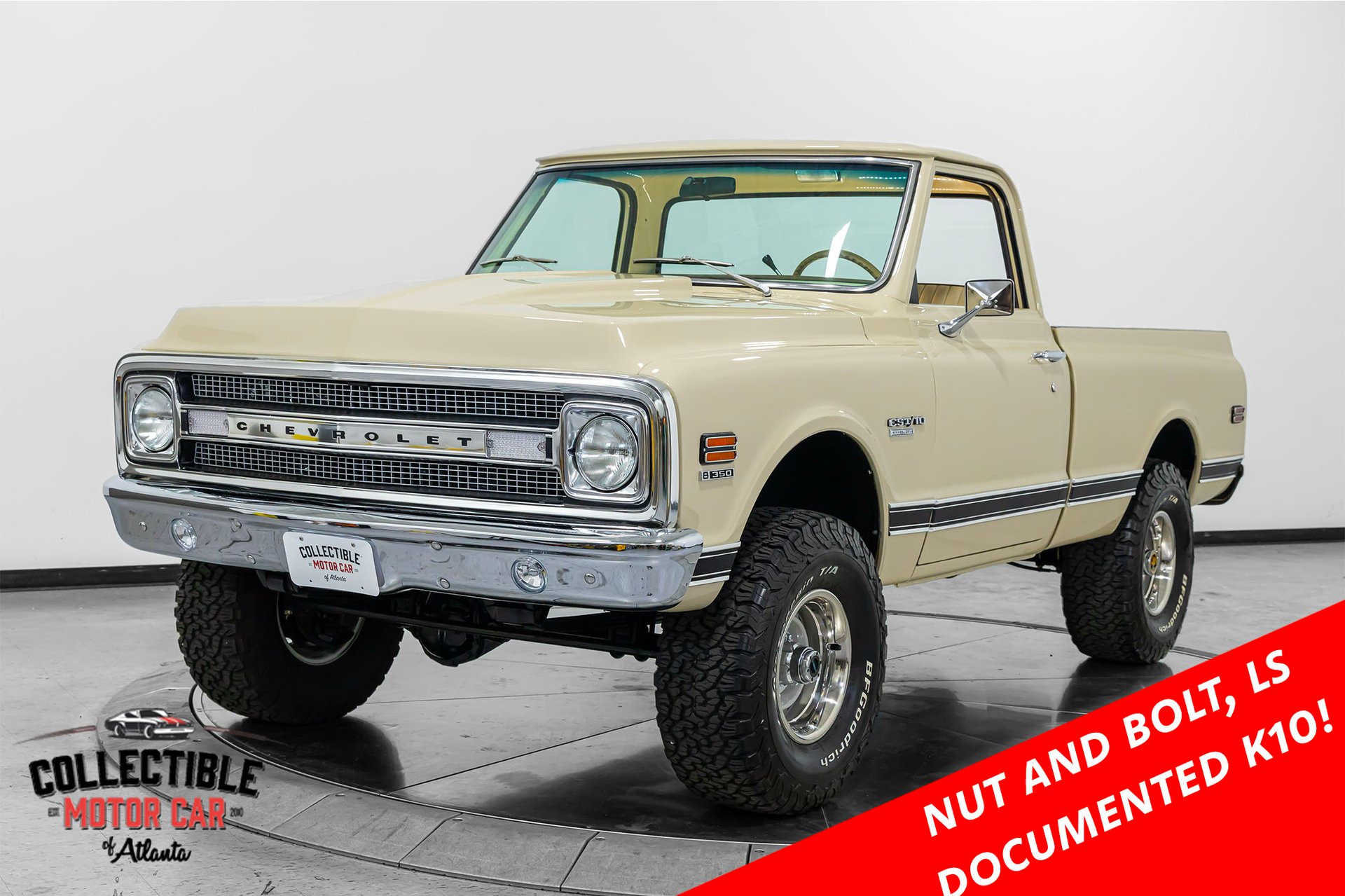
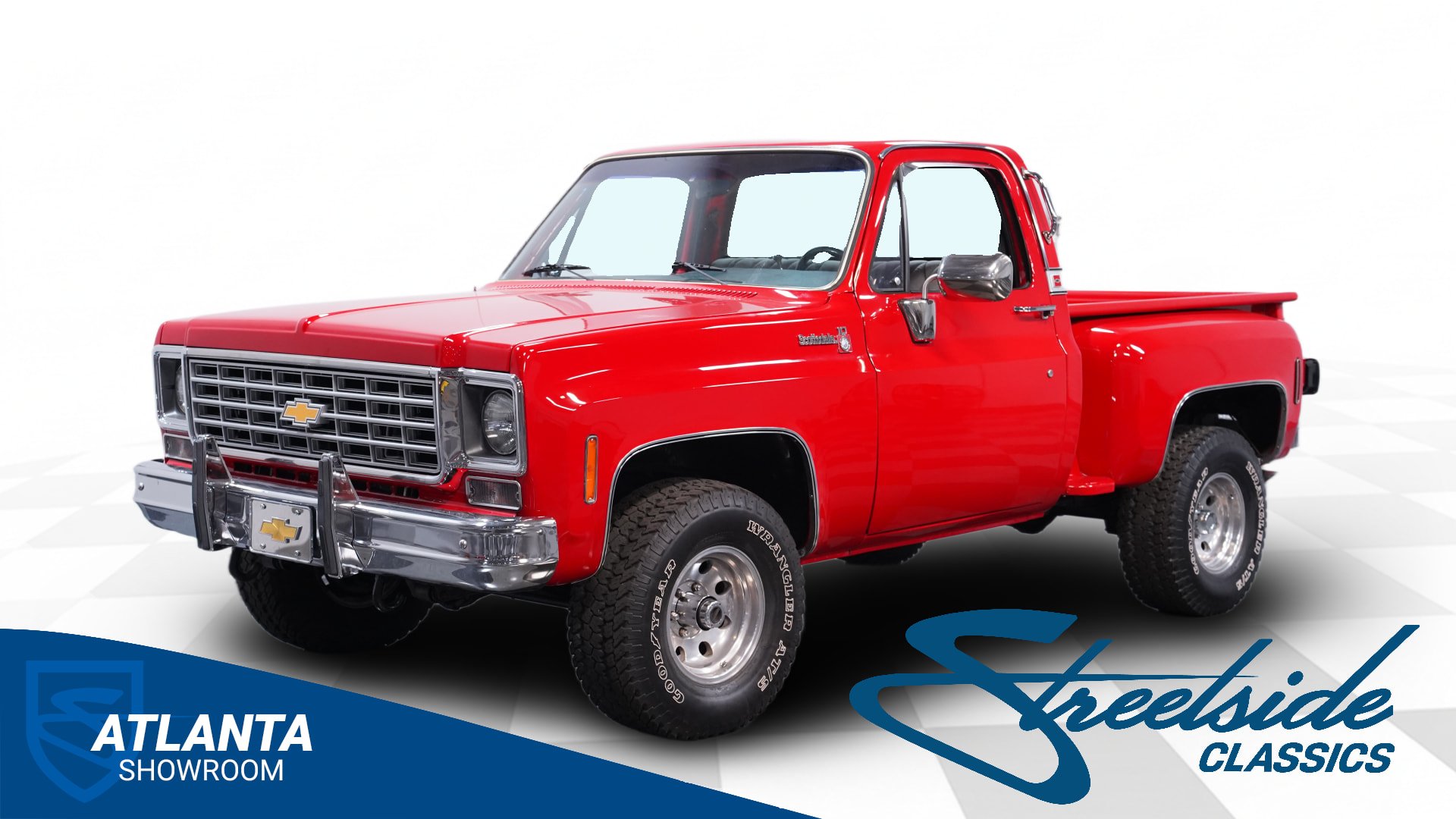
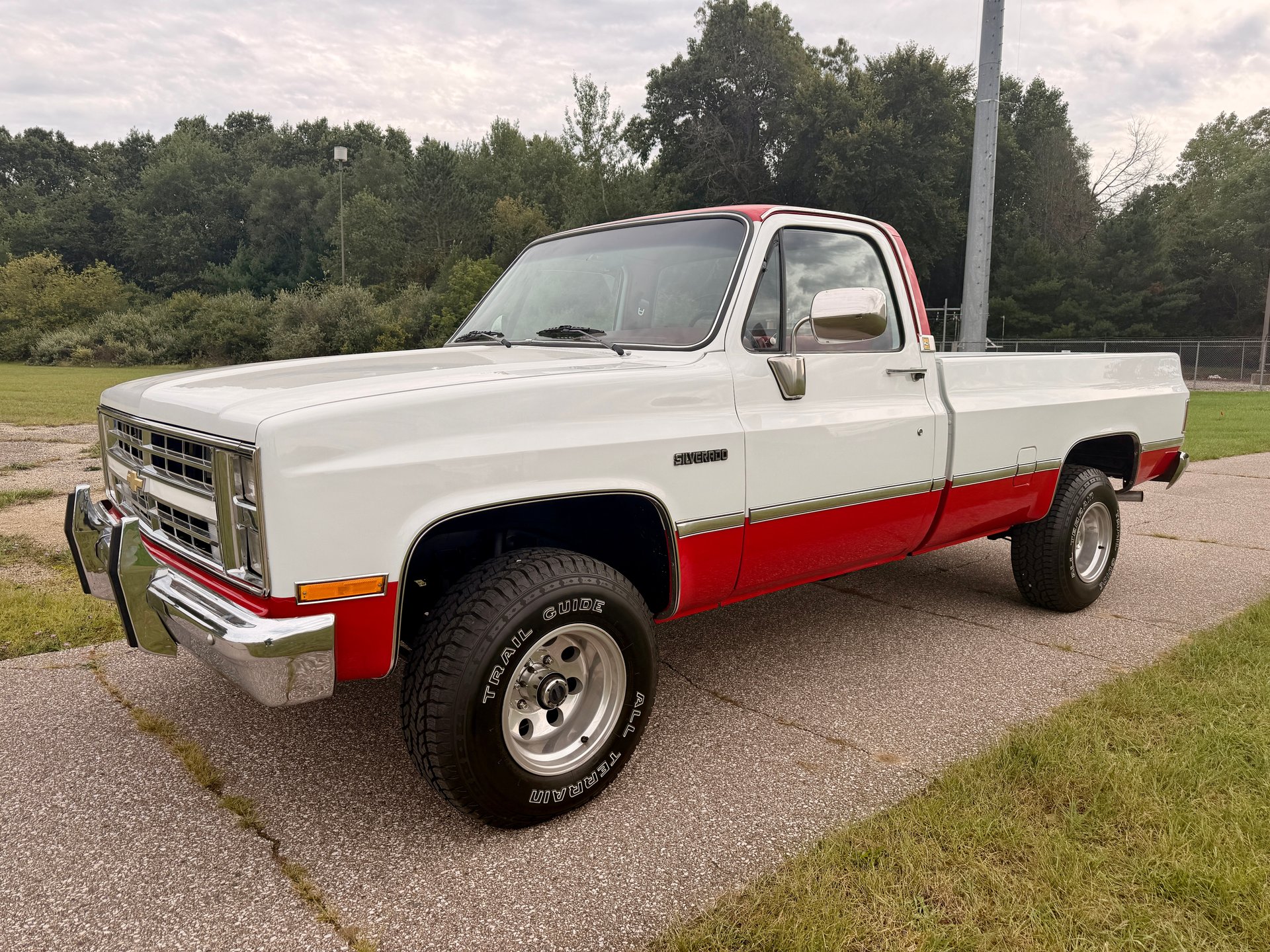
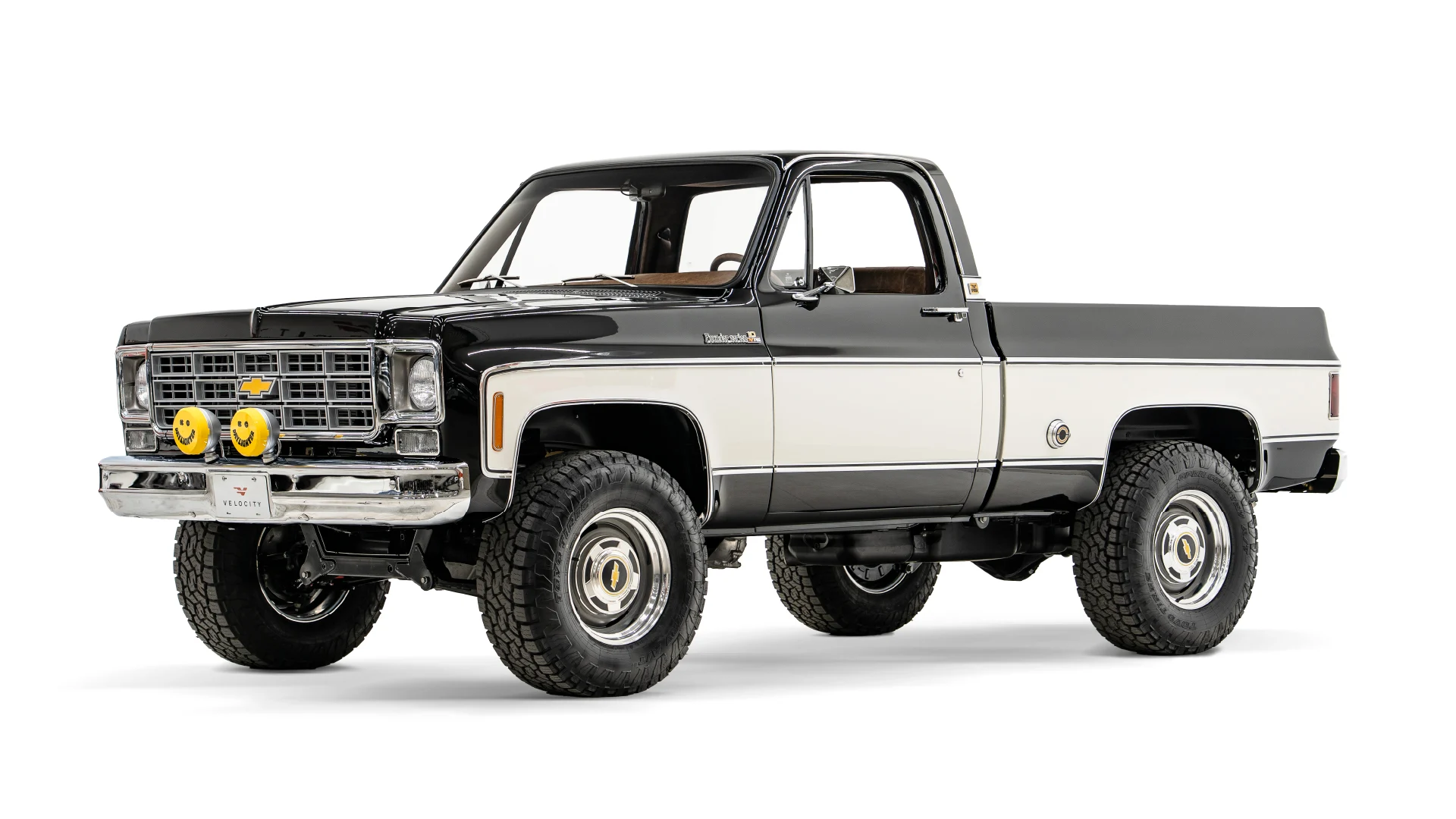
That 27-year run crosses three distinct generations, and you need to know which one you are standing in front of before anything else makes sense. The first-generation trucks of 1960–1966 are tall, narrow-cab work trucks with a solid front axle on leaf springs and styling that still carries the 1950s in its wraparound glass. The second generation of 1967–1972 — the Action Line — changed the market: a lower, wider, car-influenced cab, front disc brakes from 1971, and trim levels that invited buyers to order a truck the way they ordered an Impala. The third generation of 1973–1987 — the Rounded Line, known to everyone as the Square Body — squared the styling off, added full-time four-wheel drive as an option, and ran so long that it spans the whole emissions era, from points ignition to computer-controlled Quadrajets and, in the final year, throttle-body fuel injection.
Across all three, the K10 was never one truck. Chevrolet sold it as a short-bed Fleetside for the buyer who wanted a hunting and second-car truck, as a long-bed Stepside or Fleetside for the buyer who actually worked it, and — a point that catches newcomers out — as a K10 Suburban, the four-wheel-drive wagon that shares the pickup's chassis and running gear under an enclosed body. The Blazer, from 1969, is the short-wheelbase relative: mechanically a shortened K10, sharing so many parts that Blazer knowledge is part of K10 ownership. When you read a listing, read the bed, the wheelbase and the body first: a short-bed 1969 Fleetside, a long-bed 1974 Stepside and a K10 Suburban are three different propositions wearing one badge.
The other thing to understand before you shop is how these trucks were used. A K10 was bought to plough snow, launch boats, haul firewood and drive to a deer camp — work that is hard on frames, axles, transfer cases and beds in a way a contemporary C10 street truck never saw. Rust belt trucks pushed snow with salt spread behind them; farm trucks idled and carried overloads; Western trucks escaped the salt but baked their interiors doing ranch miles on dirt. Very few K10s lived the garaged life of a period Corvette, and the honest truck that has been worked, maintained and kept dry is worth more than the shiny truck painted over a hard life. Almost everything in this guide follows from that: on a K10 you buy the frame, the cab and the four-wheel-drive system first, and the paint last.
The market has sorted itself accordingly. The 1967–1972 Action Line short-beds have become genuine collector trucks, with Cheyenne Super trim, factory air conditioning and a 350 V8 as the specification everyone wants. Square Bodies are bought as usable classics: power steering, disc brakes and automatics in most examples, and a reproduction industry that can supply almost every panel. First-generation trucks are the connoisseur's corner — rarer as four-wheel drives, with thinner parts support. None of that ranking matters as much as condition: a rusty frame or a rotted cab on any generation costs more to put right than the difference between generations. Learn the systems, learn the rust map, and judge each truck on what is actually in front of you.
The models
There is no single K10 specification to learn. There are three generations, two bed lengths, two bed styles, a wagon body, and a trim ladder that climbs from a vinyl-seat work truck to something close to a luxury car. The table below is the orientation map — outputs are period gross ratings for the early engines and net ratings once the industry changed over for 1972, and production is given only where a defensible figure exists, because Chevrolet reported C/K production in combined series totals that mix two- and four-wheel drive, pickups and Suburbans, and any precise K10-only total printed without that caveat would be invented.
| Model | Years | Engine | Output | Built | Character |
|---|---|---|---|---|---|
| K10 first generation | 1960–1966 | 230/250 six; 283 V8 | 120–175 hp | Not separately reported | Tall-cab work truck; rarest as a 4x4, most original survivors |
| K10 Action Line, six | 1967–1972 | 250 six; 292 six | 155–170 hp gross | Not separately reported | Simple, honest, slow; the 292 is the worker's six |
| K10 Action Line V8 | 1967–1972 | 307, 327, 350 V8 | 200–255 hp gross | Not separately reported | The collector core, above all the 350 Cheyenne Super short-bed |
| K10 Square Body, early | 1973–1980 | 250 six; 305, 350, 400 V8 | 100–175 hp net | Not separately reported | Full-time 4x4 era; best equipment, heaviest emissions load late on |
| K10 Square Body, late | 1981–1986 | 305, 350 V8; 6.2 diesel | 130–160 hp net | Not separately reported | Lighter, overdrive automatic arrives, computer carburettors to check |
| V10 (K10 successor badge) | 1987 | 305, 350 V8, throttle-body injection | 160–170 hp net | Not separately reported | The final Square Body year; injection makes it the easiest to live with |
| K10 Suburban | 1960–1987 | As pickups by year | As pickups by year | Not separately reported | The wagon on the same chassis; family space, same rust and running gear |
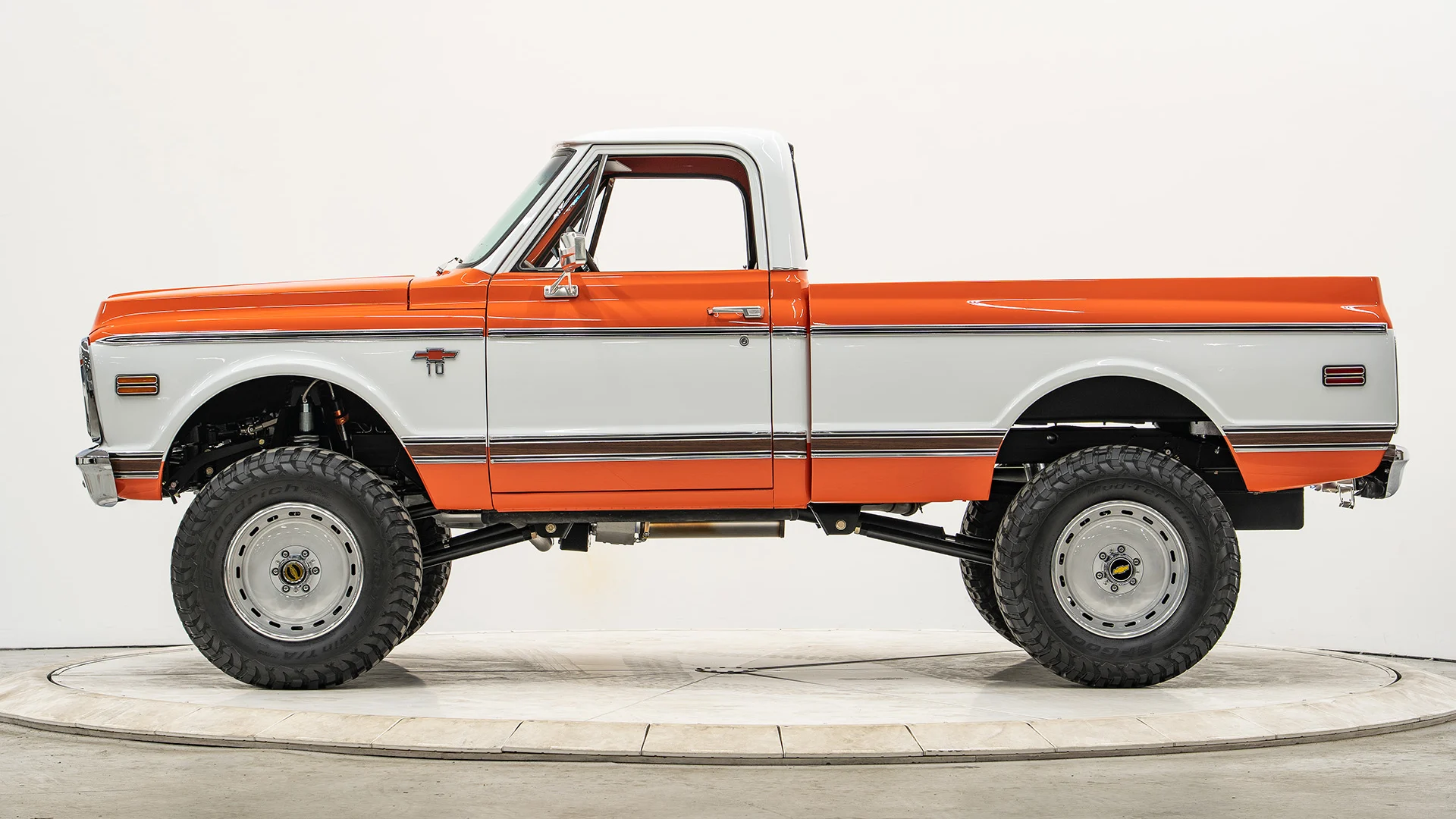
Beds and wheelbases decide the truck's purpose. Short-bed pickups ride on the short wheelbase — 115 inches on the Action Line, 117.5 inches on the Square Body — with a 6.5-foot bed, and they are the trucks the collector market wants: handier off-road, and the ones bought as second vehicles rather than pure tools. Long-bed trucks — 127 inches on the Action Line, 131.5 inches on the Square Body, with an 8-foot bed — carried the loads, and survive in working condition more often than in pretty condition. Fleetside (GMC Wideside) is the slab-sided bed with a flat floor; Stepside (GMC Fenderside) is the narrow bed with separate rear fenders, a step, and a wooden or steel floor depending on year. Neither is better; they rot differently, as the problem-areas section maps, and the Stepside's fenders are at least bolt-on replaceable where a Fleetside bedside is a welding job.
Trim is furniture, not mechanics — but the market prices it as if it were mechanics. The ladder runs from the base truck (painted grille, vinyl bench, rubber mat) through Custom and Custom Deluxe, to Cheyenne on the Action Line and Scottsdale and Silverado on the Square Body, with Cheyenne Super as the 1971–1972 flagship. Top trims bring a padded dash, carpet, extra brightwork, two-tone paint and, commonly, the options that make a truck pleasant today: power steering, power brakes, air conditioning and a V8 automatic. Verify trim from the Service Parts Identification label — the SPID in the glovebox on 1967 and later trucks lists every option by code — not from badges, which are cheap and migrate between trucks. The SPID and the VIN are the truck's own testimony.
The specification traps. Three catch buyers regularly. First, big-block power: Chevrolet did not offer the 396/402 big-block in the K10 — under-hood and front-axle clearance kept the four-wheel drives to small-blocks, so a big-block K10 is an engine swap, whatever the listing says, and should be priced and inspected as one. Second, badge swaps between C and K: a converted two-wheel drive, built by adding a front axle and transfer case to a C10, is not a factory K10 — the VIN settles it, because the second character of the VIN on later trucks and the series prefix on earlier ones encode two- versus four-wheel drive from the factory, and a conversion's value, geometry and parts needs are all different. Third, the 1987 name: a 1987 truck badged V10 is not a different model and does not have a ten-cylinder engine — V is simply the new series letter Chevrolet applied to the carried-over Square Body four-wheel drives when the new 1988 trucks took the C/K names, and K10 knowledge, parts and values apply to it unchanged.
Engines and gearboxes
The sixes: 230, 250 and 292
The base engine for most of the K10's life is Chevrolet's third-generation inline-six, and it is the toughest, simplest powerplant ever fitted to the truck. The 230 (1963–1965, with the earlier 235 still found in the first 1960–1962 trucks) and the 250 that replaced it share the same architecture: seven main bearings, overhead valves, a single Rochester Monojet one-barrel carburettor and a distributor you can service with hand tools. The 292 is the truck version — a taller block deck, a longer stroke, heavier internals and a reputation earned in farm and industrial service. It makes its torque low, pulls a loaded K10 without complaint, and is the six to choose if you actually intend to work the truck. None of the sixes is fast: a 250 in a lifted K10 on oversize tyres is working hard at modern freeway speeds, and gearing, not tuning, is the honest cure.
Judge a six on oil pressure, blow-by and neglect, not on drama. These engines tolerate abuse for years and then present as a bundle of small bills: a Monojet that floods or flat-spots because its float has sunk or its idle circuit is full of varnish, perished vacuum hoses upsetting the distributor advance, a cracked exhaust manifold (a ticking that fades as the engine warms is the classic tell), and valve cover and side-cover leaks that coat everything below in oil. A compression test tells you most of what you need: figures even across all six cylinders matter more than the absolute number, and one low cylinder that rises with a squirt of oil is rings, while one that does not is a valve. An in-frame refresh — rings, bearings, gaskets, timing set — is a realistic home-workshop job in the $800–1,800 range with machining extra; a full professional rebuild runs roughly $3,000–5,000. Ask why you are doing it: a good used 250 or a V8 swap is often the rational money, which is why so many six-cylinder trucks no longer carry a six.
The small-block V8s: 283 to 400
The small-block Chevrolet V8 is the K10's defining engine, and the list runs in the order you will meet it: the 283 in the early trucks, the 307 and 327 through the Action Line years, the 350 from 1969 onward as the engine the market wants, the 305 from the mid-1970s as the economy V8 of the emissions era, and the 400 — the large-bore, siamesed-cylinder small-block — offered in Square Bodies in the second half of the 1970s. All share the same basic virtues: hydraulic lifters, a timing chain at the front, a Rochester carburettor (a two-barrel on the lesser engines, the four-barrel Quadrajet on most 350s and 400s), and parts support so deep that a water pump, a starter or a full gasket set is a same-day purchase anywhere in America.
A healthy small-block starts cleanly, idles without a miss and shows no smoke except, perhaps, its signature fault: a puff of blue at start-up after sitting, which is oil running down worn valve stem seals. That job — seals, done with the heads in place — is a $400–900 repair and should not scare you off a truck. Smoke that continues under load is rings and bore wear, and that is a rebuild conversation at $4,000–7,500 professionally done. The middle faults are the ones to price. The nylon-toothed timing gear fitted to many period engines sheds its teeth with age; a slack chain needs a timing set at $600–1,200 fitted. Flat cam lobes, especially on smog-era 305s and 350s, present as popping back through the carburettor under load — a cam and lifters job runs $1,200–2,500 fitted. Quadrajets deserve respect: a good one is economical on its small primaries and strong on the secondaries, but the throttle shaft wears in its bores and leaks vacuum, and the well plugs under the bowl weep and drain it overnight, giving hard starting after standing until they are epoxy-sealed during a rebuild. A specialist rebuild, bushed and sealed, runs roughly $450–850 — money well spent, and a documented one is a selling point.
Read the emissions equipment as a condition report, not just a legal question. Points ignition gave way to High Energy Ignition — HEI, with the coil in the distributor cap — from 1975, and an HEI truck that misfires under load is often just a failing module or a worn cap and rotor, though you should carry a spare module in any HEI truck you tour in. Air injection pumps seize when unused, EGR valves carbon up and cause a part-throttle stumble, and the 1981-onward Computer Command Control trucks run a computer-managed Quadrajet with an oxygen sensor: when the mixture solenoid or the sensor fails the truck runs rich, smells of fuel and fails any emissions test your state applies. Do not let a seller tell you a check-engine light on a computer truck is a bulb problem. Finally, the swap question, because many K10s no longer carry their born engine: a tidy, documented 350 in place of a tired 305 is an improvement, a properly engineered modern swap is a different truck at a different price, and a half-finished swap — dangling wires, an electric fan on a toggle switch — is a project you are being asked to adopt. Price swaps on installation quality, never on the seller's parts total.
The diesels and the final-year injection
Two diesels were offered, and they are not alike. The 1978–1981 Oldsmobile-derived 5.7-litre diesel V8, converted from a petrol design, gave diesel a bad name with a generation of buyers; survivors exist, but parts and expertise are thin and you should buy one only deliberately, at a price that reflects it. The 6.2-litre Detroit diesel fitted from 1982 is a different proposition: designed as a diesel from the start, economical and long-lived if its injection pump and glow-plug system are maintained, and slow in the way all period diesels are slow. Its bills are predictable — an injection pump rebuild at roughly $900–1,600, glow plugs as consumables, harmonic balancer rubber that must be caught before it takes the crankshaft with it — and its inspection is a cold-start test: a healthy 6.2 starts on the glows without ether, idles evenly and does not lay a haze at cruise.
The last Square Body year closes the carburettor era. The 1987 V10 trucks received throttle-body injection on the 305 and 350, and it transforms daily usability: clean cold starting, no choke behaviour, no bowl to drain overnight, and self-diagnostics of a simple period kind. It also introduces the faults of any early injection system — a tired in-tank or frame-rail pump, a throttle-body base gasket leaking vacuum, sensors at the end of their lives — all diagnosable with a manual and a multimeter, and all cheaper than the folklore suggests. If your plan is to use a Square Body regularly, the injected 1987 is the easiest truck in this whole guide to live with, and the market knows it.
Gearboxes and the four-wheel-drive system
Manual K10s use truck gearboxes, and the one you want is the SM465 four-speed: a Muncie-built box with a 6.55:1 first gear so low it is marked L on the knob and used for starting under load and creeping off-road, with second as the everyday start-away gear. It is famously strong and famously slow to shift; worn examples show tired synchromesh on second and third. The earlier three-speed column-shift boxes suit gentle use only. Clutches are conventional and long-lived, and a juddering take-up on a truck that has ploughed snow is usually a heat-checked flywheel and a worn disc together — budget $900–1,600 for a clutch job with the flywheel resurfaced.
Automatics dominate the later trucks and most of the market. The Turbo Hydra-Matic 350 is the standard fitment through the Action Line and most Square Body years: strong, simple and cheap to rebuild at $1,800–3,200, with honest faults — delayed engagement when cold from hardened seals, flaring on the 2–3 shift, fluid that smells burnt because towing without an auxiliary cooler cooks it. The heavier TH400 appears in heavier specifications and is stronger still. From 1982 the 700R4 overdrive arrived with a split verdict: early units earned their weakness reputation in truck service, the overdrive makes a Square Body a relaxed freeway truck, the throttle-valve cable adjustment is critical — a misadjusted cable burns the box up in short order — and a later or properly rebuilt unit with the updates fitted is a good gearbox. Judge any automatic on fluid colour, shift quality hot, and a cooler-line check, in that order.
The transfer case is what makes a K a K, and there are four to know. The Rockwell T221 in the 1960–1968 trucks is a gear-driven, part-time case with a reputation for noise and leaking, and the thinnest parts support of the four. The New Process 205, fitted from 1969 and the connoisseur's case, is gear-driven in a cast-iron housing, part-time, and close to unbreakable in K10 service; its faults are seals and linkage slop, and a full rebuild at $900–1,800 is cheap insurance. The NP203, fitted to most full-time Square Bodies of 1973–1979, is chain-driven with a differential in the case that lets the truck run in four-wheel drive on dry pavement; its chain stretches and slaps, and many have been fitted with part-time conversion kits of varying quality — a converted 203 that clunks on turns needs attention. The NP208 from 1981 is a light, chain-driven, aluminium-case part-time unit that works well and leaks at its seals with age. On any truck, work the case through every range on the test drive, including low range on a loose surface, and never accept a case you were not allowed to engage.
Axles and hubs complete the system. The front axle is a Dana 44 in most trucks through 1977, replaced by the GM 10-bolt front axle thereafter; both are sound designs whose enemies are dry universal joints, worn ball joints, bent housings and water — an axle that has forded hub-deep and never had its oil changed will show milky lubricant and pitted bearings. Rear axles are the GM 12-bolt through the early 1980s and the 10-bolt thereafter, with ratios commonly around 3.07, 3.73 and 4.11; check the ratio against the tyre size, because a truck lifted on large tyres with highway gearing overheats its automatic and will not crawl. Manual hubs should turn with firm, even resistance; automatic hubs on later Square Bodies are a known wear point that can leave a truck in two-wheel drive while the lever says otherwise, and a manual-hub conversion at $250–500 in parts is the standard cure. In our photo checks of 29 trucks in the current pool, leaks were noted on 3 and visible damage on 8 — small numbers next to the rust figures that follow: the running gear usually survives; the body is what the years eat.
Problem areas
Everything in this section follows one rule: on a K10, condition is priced from the frame up and from the cab corners out. The mechanical systems in the previous section are all rebuildable at published prices by any competent truck shop in America. A rotted frame, a cab that has lost its mounts, or a bed that has been filled and painted over rot will cost more than any engine job in this guide, and will still be a repaired truck when you are done. In the photo sets we examined for 29 trucks currently listed, rust was noted in 14 — essentially half — and that sample flatters the breed, because dealer photographs avoid undersides and cab corners as a matter of habit. Assume rust until a truck proves otherwise, in the order below.
Rust: the map
Work the map in this order, because the order is the order of expense.
Frame first. The K10 frame is a riveted ladder frame, and its killing grounds are consistent: the rear horns and spring-hanger areas where salt and mud sit, the rails under the cab where the fuel tank straps hold moisture against the steel, the crossmembers, and, on Square Bodies, the area around the steering box, covered below. Surface scale is normal on a working truck. Perforation, lamination that flakes away in layers when you prod it, and cracks radiating from rivets or hangers are defects. A frame repair done properly — cut out, plated or sectioned, welded by someone who does frames — runs from about $800 for a localised hanger area to $3,500 and up for rail sections, and a frame perforated in three places is a frame swap or a walk-away. Bring a torch, a small hammer and a screwdriver, tap along both rails, and listen: sound steel rings, rotten steel thuds and crunches.
Cab corners, rockers and cab mounts. This is the Square Body and Action Line signature failure, and it is structural in effect if not in name. Water and mud thrown by the front wheels pack behind the cab corners and into the rocker panels; the cab mounts — rubber cushions on steel brackets bolted through the floor — sit in the same splash zone, and the floor supports rot with them. The progression is always the same: bubbles at the bottom of the cab corner, a rocker that feels soft to a thumb press, a door that has dropped because the cab has settled on a collapsed mount, and shut lines that no longer meet. Press hard along both rockers, open both doors and look at the corner behind them, then get under the truck and look up at the mounts and the floor braces with a torch. Cab corners and rockers are available as reproduction panels and a fitted, painted corner-and-rocker job runs roughly $1,200–2,800 a side at a body shop; add floor sections and mounts and a full cab-floor rescue is a $3,000–6,000 conversation. Fresh black underseal blown over the cab underside the week before a sale is a cover-up until proven otherwise — honest underseal is patchy, chipped and dirty at the edges.
Floors and the windshield frame. Windshield rubbers perish, the seal channel rusts, and water runs down inside the pillars and under the floor mat, where it sits against sound-deadening and rots the floor from the top down. Lift the mat on both sides of every truck, without exception. Wet matting, a damp smell and orange staining at the floor seams are the early stages; holes at the toe boards and around the seat mounts are the late ones. The windshield frame itself is the expensive version of the same fault: rust in the channel means glass out, metal repair and a new seal, roughly $1,000–2,400 done properly, and bubbles along the top of the windshield on a Square Body should be priced as frame repair, not paint. Rear window seals leak the same way into the back of the cab and, on Suburbans, into the rear floor and wheel tubs, which rot invisibly under carpet and trim.
Bed, tailgate and front clip. Fleetside beds rot at the floor — especially over the rear wheels and at the front panel where water stands — at the arch lips and at the lower bedsides behind the wheels. Wooden-floor beds rot the wood and the steel strips and sills beneath it; a bed-wood kit fitted runs $700–1,500, and the cross-sills underneath are where the real bill hides. Tailgates bend from loads rested on them and rot along the bottom edge, and good originals are hunted parts. At the front, inner fenders go first — the battery tray leaks acid and the tray, the fender beneath it and the radiator support corner rot as one unit — then the lower rear of the front fenders and, on Square Bodies, the cowl sides. A battery tray is a $150 panel and an afternoon; a radiator support and both inner fenders is a front-clip strip at $1,500–3,000 with paint. None of these panels kills a truck alone; together they tell you whether it lived dry or lived wet.
Frame, steering and suspension in service
Beyond rust, the chassis has three faults you must test for on every truck, because all three are safety items disguised as character traits.
The Square Body steering-box frame crack. The steering box bolts to the outside of the driver's frame rail, and on 1973–1987 trucks the rail flexes at those bolt holes until it cracks — hard use, big tyres and a lift kit all accelerate it. The symptoms are a wander the alignment shop cannot cure, a creak or pop on steering input at a standstill, and play you can watch at the box. Have a helper rock the steering wheel while you watch the box itself with a torch: the box should not move on the rail. Crack repair is a weld-and-plate job, with reinforcement kits widely sold, at roughly $600–1,400 fitted; a rail cracked through and elongated at the holes is fabrication work priced per truck. Check it on every Square Body, including pretty ones — restored trucks crack here too.
Springs, shackles and stance. K10s ride on leaf springs at both ends, and fifty years of loads leaves springs sagged, leaves broken (usually the second leaf, hidden inside the pack), bushings perished and U-bolts corroded thin. Read the stance from twenty feet away: a truck down at one corner has a spring, shackle or frame story, and a truck lifted on blocks deserves special suspicion — front lift blocks in particular are an unsafe shortcut no reputable shop fits. A full set of stock springs, bushings and U-bolts fitted runs roughly $1,200–2,400. Judge any lifted truck by its steering correction, because a lift without a corrected steering arm or drop pitman arm will bump-steer and wander no matter how new its tyres are.
Steering and brakes. Saginaw steering boxes wear and leak at the sector seal, idler and pitman arms wear, and the rag joint in the column coupling perishes into visible cracks — a $40 part whose failure is total, so look at it. Kingpin-era early front axles and ball-joint later axles both telegraph wear as a shimmy and a knock over bumps; a full front-end refresh — joints, tie-rod ends, bushings — runs $900–1,800 fitted with alignment. Brakes divide by year: all-drum early trucks stop adequately when every cylinder is free and every shoe is adjusted, and poorly in every other state; front discs from 1971 transform the truck and are the single best usability upgrade in the whole range. On any truck, budget for the standing-car package if it has sat: seized calipers or wheel cylinders, perished flex hoses, a master cylinder bypassing internally (pedal sinks slowly at a light), and rust-banded discs — $800–2,000 for a full hydraulic refresh with labour covers most of it, and it is not optional money.
Four-wheel-drive wear and previous abuse
A K10's drivetrain records how it was used more honestly than its odometer does. Snowplough trucks — identifiable by plough-frame holes in the front horns, a patched transmission tunnel or wiring splices at the front — have lived the hardest life a K10 can live: the front axle carried the plough, the automatic reversed a thousand times a season, and the frame took the shocks. A plough history is not an automatic refusal, but it halves your tolerance for every other fault and must be priced in. Hard off-road use shows as dented differential covers, bent tie rods and silt in the frame rails. Check both differentials' oil on any serious candidate: milky oil means water entry and bearing risk, metallic oil means wear in progress, and either is a $600–1,400 axle rebuild per end if the gears are damaged.
Transfer cases and hubs were covered as systems in the previous section; as faults, the short list is this. An NP203 that has been run with its differential locked on pavement wears its chain and its differential together. An NP205 that jumps out of gear under load usually has worn shift forks or linkage, not a broken case. An NP208 with a cracked rear housing has usually been run dry or struck from below. Automatic hubs that fail to engage are the most common reason a late Square Body is secretly a two-wheel drive. And universal joints — two in the front driveshaft including a double-cardan joint at the transfer case on many trucks, two in the rear — are cheap parts whose neglect destroys yokes and, at speed, much more: any vibration that changes with load, any clunk on taking up drive, starts with the joints, at $300–700 for a full set fitted with the cardan joint rebuilt.
Cab, interior and electrics
Interiors divide by generation. First-generation cabs are simple and durable. Action Line interiors introduced the padded dash that cracks across its speaker perforations and seat foam that collapses on the driver's side first. Square Body interiors are the most car-like and the most perishable: dash pads crack, plastic trim chalks and crumbles in sun states, headliners sag, and the seat splits at the driver's bolster where fifty thousand entries have slid across it. Judge a truck from the driver's seat, literally: sit in it, feel for the frame through the pad, and price accordingly. A bench re-cover with new foam runs roughly $600–1,200; a full interior rescue runs $2,500–5,000 in reproduction parts and trim labour — which is why a sun-baked but rust-free Western truck and a solid-interior truck are priced so differently.
Heating and air conditioning decide whether a truck gets used. Heater cores leak into the passenger footwell — sweet smell, misting windshield, damp mat — and on air-conditioned Square Bodies the core is a long dashboard job at $900–1,600 fitted, against half that on a non-air truck. Factory air that blows warm is usually a compressor, a damaged condenser, or a half-converted refrigerant swap; a full recommission runs $1,200–2,500. Test every blower speed: a blower that works only on high is telling you its resistor pack has failed.
Electrics fail at connections, grounds and previous owners' additions, in that order. The fusible links at the starter, the bulkhead connector on the firewall, and the ground straps between engine, cab and frame account for most no-charge, dim-light and wandering-gauge complaints — cheap parts, slow diagnosis. What is not cheap is undoing a bad alarm, a trailer-brake installation wired with household connectors, or a stereo fitted by cutting the dash and harness together. Gauges deserve a specific check: a fuel gauge reading full forever is usually a sender or its ground, and a Square Body cluster with several dead functions often needs its printed circuit repaired rather than five separate fixes. A truck where everything electrical works has almost always been used and maintained rather than stored and forgotten — one of the most reliable signals in this entire guide.
How to inspect one
Allow ninety minutes, bring a torch, a magnet wrapped in cloth, a small hammer and a helper if you can. Inspect cold, in daylight, where you can get underneath — and if the truck passes you, pay for a lift inspection before money changes hands, because the frame and cab-mount checks that decide a K10's fate are lift checks. Stop early if the truck fails an early step: there is no cheap version of a rotten frame.
- Paperwork and identity first. Match the VIN to the title. On 1960–1966 trucks look at the plate on the driver's door jamb and kick-panel area; on 1967–1972 trucks check the driver's door jamb plate and the glovebox SPID label; on Square Bodies read the VIN plate at the base of the windshield on the driver's side and the SPID in the glovebox or on the inner fender. Confirm the VIN encodes four-wheel drive from the factory — a conversion is a different truck at a different price, as the models section explains — and decode the SPID option codes for engine, axle ratio and trim. A missing SPID is not a refusal, but it removes your best evidence, so price the uncertainty.
- Cold start. Insist the engine is cold when you arrive and stand behind the truck for the first start. A puff of blue that clears is valve stem seals; smoke that stays is rings. A six should settle to an even idle, a carburetted V8 should take choke and come off it cleanly, a 6.2 diesel should start on its glow plugs without ether, and a 1987 injected truck should start and settle with no pedal at all. Listen for timing-chain rattle, exhaust manifold ticking and lifter clatter that does not fade.
- Frame, with the hammer. Torch and tap both rails end to end, the crossmembers, the spring hangers and the rear horns, exactly as the rust section directs. On a Square Body, add the steering-box check: watch the box while your helper rocks the wheel, and look for cracks at the bolt holes. Perforation in rails or hangers, or a cracked steering rail that has been smeared over, ends the inspection for most buyers. Note plough-frame holes or brackets at the front horns and price a plough history accordingly.
- Cab corners, rockers and mounts. Press both rockers hard along their full length, look behind both cab corners, then get under the truck and inspect all the cab mounts and floor braces. Operate both doors: a door that must be lifted to close is a cab sitting on collapsed mounts until proven otherwise. Lift both floor mats and look for water tracks from the windshield frame and damp sound-deadening.
- Bed and tailgate. Lift any bed mat or liner — sellers hide floors under both. Check the bed floor over the rear wheels, the front bed panel, the arch lips and, on a Stepside, the wood, the steel strips and the fender joints. Work the tailgate: it should latch evenly on both sides without being slammed, and a bowed gate tells you about the loads the truck has carried.
- Body, gaps and the magnet. Run the magnet over the cab corners, rockers, lower fenders, arch lips and door bottoms — filler announces itself by the change in pull. Check the battery tray and the metal under it, the radiator support corners and the cowl. Even, consistent panel gaps and original spot welds are good signs; wavy lower panels in fresh paint are a question the seller answers with invoices or not at all.
- Under the hood, in systems. Check every fluid for level and story: engine oil (thin and fuel-smelling suggests flooding and dilution), coolant (oil film suggests head gaskets; plain water suggests neglect), brake and power steering fluid. Judge the quality of previous work — correct hoses and clamps versus twisted wire and sealant used as a gasket. Verify the engine by its casting and stamping details if originality is part of the price, remembering that no K10 left the factory with a big-block.
- Engage the four-wheel drive. On a loose surface, work the transfer case through every position, including low range. Lock manual hubs and confirm they engage; on automatic-hub trucks, drive forward and reverse to engage and disengage them. Drive a slow, tight turn in part-time four-wheel drive and feel for binding and clunking — then do not repeat the test on dry pavement, where wind-up damages cases.
- The road test. Twenty minutes minimum, including a freeway stretch and a rough road. A manual truck should take second gear synchromesh cleanly; an automatic should shift firmly without flaring, engage drive and reverse without a long pause, and a 700R4 should hold overdrive without hunting. Note vibration that changes with load (universal joints), wander (box, rail, joints), shimmy at one speed (tyres, then front-end wear) and pulling under braking.
- Brakes, heat and electrics under load. Brake firmly from speed twice: straight stops, no judder, no sinking pedal at the following stop light. Let the truck idle hot and watch temperature and oil pressure. Then work everything electrical — lights, wipers on both speeds, blower on every speed, horn, every gauge — and, if fitted, confirm the air conditioning blows cold at idle and at speed, not just one of the two.
- Stance and underside, standing back. Park the truck level and walk around it from twenty feet. It should sit even corner to corner, with both front hubs centred in their arches. A low corner or a lean points at the spring and mount checks in the problem-areas section. Take a side photograph: stance faults you talked yourself out of in person are obvious in a picture.
- Interior and history last. Sit in the driver's seat and judge the pad, the bolster and the pedal rubbers against the claimed mileage. Smell for damp and fuel. Then read the file: title history, work invoices, a documented transfer-case or automatic rebuild, and evidence of regular use. A K10 in regular use with a thick file beats a lower-mileage truck that has sat for a decade, because sitting fills brake cylinders, seals and fuel systems with the bills in this guide.
Values
The build appends the current market block beneath this guide — the trucks listed now and the recorded sales — so this section teaches you how to read those figures rather than repeating numbers that would date before the ink dried. Read the K10 market as three overlapping markets that happen to share a badge, because a figure that makes sense in one is nonsense in another.
The first market is the collector market for Action Line trucks, above all short-bed 1967–1972 V8 trucks in Cheyenne or Cheyenne Super trim with factory air conditioning. Here originality is the currency: a matching engine, an intact SPID label, correct trim and documented history separate the strong results from the ordinary ones, and a colour change or an undocumented swap each take a visible slice off what a buyer will pay. Restomod trucks — period bodies over modern engines and upgraded running gear — trade in this market too, but on build quality rather than originality, and the spread between a professionally built truck and a home-assembled one wearing the same parts list is the widest in the whole K10 world. Judge a restomod by invoices and the standard of its wiring and cooling, never by the seller's total of parts receipts.
The second market is the usable-classic market for Square Bodies, and it is the deepest and most honest of the three. Here condition and specification trade in a predictable order: rust-free structure first, then a 350 over a 305, an overdrive automatic or a healthy injected 1987 at the top of the daily-use ranking, working air conditioning, and trim last. Lifted trucks cut both ways — a well-engineered lift adds appeal for the buyer who wants it and subtracts it for everyone else, so a lifted truck sells to a narrower audience and should never be valued as if the lift were universally worth its cost. Suburbans trade at a discount to equivalent pickups despite their rarity, because the audience is smaller.
The third market is the working and project market, and it obeys different rules entirely. Here a truck is worth its frame, its cab, its title and its four-wheel-drive system, and very little else. The project-versus-driver gap is the defining feature of the whole K10 market at every level — the distance between a running, structurally sound truck and a non-runner with the same specification is far larger than the cost of the mechanical work that separates them, because the non-runner also carries unknown brakes, an unknown transfer case, perished seals and a fuel system full of varnish. Sellers price projects by adding up what the truck could be; buyers price them by subtracting everything that cannot be verified. Expect asking prices to sit above achieved prices across all three markets, most extremely at the collector end where a single exceptional listing can distort a small sample, and treat any median built from a handful of trucks as orientation rather than evidence. There is no cheap K10 that stays cheap: the inexpensive trucks share rust, storage or an unfinished conversion, and the honest money is always in the soundest structure your budget reaches.
Parts and ownership
The K10 is one of the best-supported classic trucks in America: Chevrolet built the C/K line in the millions, the mechanicals were shared across pickups, Blazers and Suburbans for decades, and the aftermarket followed the numbers. For Square Bodies the support is close to total. Action Line support is nearly as deep. First-generation 4x4-specific parts are the only genuinely thin area, and even there the shared C10 catalogue covers the cab and much of the chassis.
Easy: every service item, filters, ignition parts for both points and HEI, carburettor kits, water pumps, radiators and hoses, brake discs, drums and hydraulics, universal joints, ball joints, springs and bushings, steering wear parts, cab corners, rockers, floor sections and bed panels in reproduction steel, bed-wood kits, weatherstripping, glass and most trim for the two later generations. Order today, fit this weekend, at prices close to modern-truck money.
Harder and dearer: Rockwell T221 transfer-case internals, early first-generation 4x4-only steering and axle pieces, NP203 chains and differential parts in good condition, correct date-coded engines and Quadrajets for the collector who needs numbers rather than function, good original tailgates and uncut dash panels, first-generation bright trim, 6.2 diesel injection pumps in rebuilt form (a rebuild runs roughly $900–1,600, as noted earlier) and the Oldsmobile diesel's shrinking expertise base. None of it is unobtainable; all of it rewards joining the marque community and buying at swap meets and specialist breakers rather than at retail under time pressure. A quality repaint on a truck — more area, more masking, a bed to do inside and out — starts well into five figures at a professional shop, which is why this guide's mantra is to buy structure and originality and fix mechanics.
Running costs and living with one. A sorted K10 is a realistic regular-use classic: fuel consumption in the low-to-mid teens for a carburetted V8, worse for a full-time NP203 truck and better for an overdrive or injected one, and servicing any good independent truck shop can handle. The budget line that catches new owners is the first year. Catching up deferred maintenance on a running truck — fluids in both axles and the transfer case as well as the engine and box, brakes inspected end to end, perished hoses and belts renewed — honestly costs $1,500–4,000 before you improve anything, and recommissioning a truck that has sat for years runs $3,500–7,500 at a shop. Transfer-case and axle oils are the fluids previous owners forget, and they are the cheapest insurance in this guide. Buy a truck in regular use over one that has been asleep, even at a higher price, and keep it in use: a K10 exercised monthly, with its transfer case engaged on a loose surface, stays a working four-wheel drive.
Which one to buy
- The all-rounder: Square Body 350 with a healthy automatic. Power steering, disc brakes, parts everywhere and a cab you can use daily. A 1982-onward truck adds the overdrive option; check the 700R4's shift quality and cable adjustment as the inspection directs, and the truck will do every job in this guide.
- The collector buy: 1971–1972 Action Line short-bed V8, Cheyenne or Cheyenne Super. Disc brakes, the best-developed Action Line specification and the strongest following. Verify with the SPID label and the engine stampings, pay for originality and structure, and walk away from a badge without paperwork.
- The value buy: a long-bed Action Line or early Square Body six or 307/305 truck. The market pays for short beds and 350s, so the honest long-bed worker in sound structural condition is the cheapest route into a good K10 — and the 292 six is a better truck engine than its price suggests.
- The daily driver: the 1987 V10. Throttle-body injection, the last and most developed Square Body specification, and the easiest cold starts and manners in the range. Buy it on the same structure checks as every other truck here; the injection does not excuse a rotten cab.
- The family buy: K10 Suburban. The same chassis, axles and inspection as the pickups, with enclosed space the pickups cannot offer, usually priced below an equivalent pickup. Give the rear floor, wheel tubs and tailgate or barn-door areas the extra time the longer body demands.
- The traditionalist's buy: a first-generation K10. The rarest ownership experience in the range, bought deliberately by people who want the early cab and accept thinner 4x4-specific parts support. Condition matters even more here.
And the rule that overrides all of the above: buy the soundest frame and cab you can find, in the generation you can live with. Engines, gearboxes, transfer cases, brakes and interiors are all fixable at prices you can plan for from this guide. A rotten frame or a collapsed cab costs more to put right than the finished truck will be worth — and on a vehicle bought to work, to carry and to go where two-wheel drives cannot, structure is not one consideration among many. It is the truck.
See the 36 K10 cars currently listed.