
Chevrolet Impala buyer's guide
Chevrolet Impala -- the model's own buyer's guide: variants, values and what to check.
Years listed: 1958-2004 · Series: Impala
Overview and history
The Chevrolet Impala is not one car. It is a name Chevrolet kept returning to for nearly five decades, applied to a succession of big, mainstream, rear-drive sedans, coupes and convertibles that shared a showroom, a badge and very little else. A 1958 Impala, a 1964 Impala SS and a 1996 Impala SS have the same job — carry a family in comfort, look expensive doing it, cost less than the Cadillac in the next showroom — and they do it with completely different frames, suspensions, engines and rust patterns. This guide is a cross-generation orientation: it teaches you how to sort the generations, how to tell a genuinely valuable variant from a badge, and where each era of Impala hides its expensive problems. Read it before you fall for a single car, because the first Impala decision is never which example to buy. It is which Impala you actually want.
The name arrived for 1958 as the top trim of the Bel Air line: a sport coupe and a convertible, lower and longer than the regular Chevrolets, with a sculpted rear deck, triple taillights on each side and the new 348-cubic-inch W-head V8 available under the hood. It was a one-year body, expensive to build, and it sold — about 181,000 cars — which promoted Impala to a full series in its own right for 1959. From there the arc is the arc of the American full-size car itself. The flamboyant 1959–60 cars traded fins for the jet-age batwing rear. The clean 1961–64 cars became the performance years, when the Super Sport package, the 409 and the four-speed manual turned the family Chevrolet into a genuine street and strip weapon. The 1965 redesign — curved side glass, a proper perimeter frame, coil springs all round — produced the best-selling Impala of all: the 1965 series alone cleared a million sales, a figure no full-size American car has matched since. After that came growth (the vast 1971–76 cars, the largest Impalas ever built), strangulation by emissions rules, downsizing for 1977, a quiet death in 1985, and one famous resurrection: the 1994–96 Impala SS, a blacked-out, LT1-powered B-body that turned the taxi-spec Caprice into a modern muscle sedan. Chevrolet revived the name again for 2000 on a front-drive W-body sedan, built through to 2004 in the years covered by our listings. Those cars are competent modern transport and a different proposition entirely; this guide covers them briefly and spends its depth where the collector market lives, on the rear-drive cars of 1958–96.
Our own listings tell you where that market concentrates. We currently track 314 Impalas, and the year distribution is a spike, not a spread: 1964 leads with 43 cars, followed by 1962 with 35, 1966 with 31, 1963 with 29, 1961 with 28 and 1965 with 23. The 1958–68 cars together account for the overwhelming majority of everything offered, the 1971–85 cars appear in single figures per year, and the 1994–96 SS shows up as a small, distinct second cluster — eight 1996 cars in the current pool. Body styles follow the same pattern: coupes, hardtops and convertibles dominate, plain sedans are the minority, and automatics outnumber manuals by roughly five to one — which is exactly why the genuine factory four-speed cars command the attention they do. Colours are the period palette: red first, then blue, black and white.
Two truths hold across every generation and organise everything that follows. First, the Impala was built in enormous numbers from ordinary materials by a company selling on price, so survival was never designed in the way it was at Mercedes or Cadillac: these cars rust, their interiors sun-rot, and their saving grace is that almost every part was shared with cheaper Chevrolets and is reproduced today. Second, value lives in specification, not in the badge. A six-cylinder 1964 sedan and a documented 1963 409 convertible share a name and almost nothing else, including their inspection priorities. Learn to read the trim tag, the VIN and the engine stampings, and the whole range becomes legible. Skip that homework and the Impala market will happily sell you a story.

The models
Every Impala sits in one of eight broad generations, and within each generation the hierarchy is the same: plain Impala, Impala Super Sport where offered, and — from 1965 — the Caprice above it, which began life as an Impala option before becoming a series of its own. Body styles across the classic years are the two-door sport coupe (a pillarless hardtop), the four-door hardtop, the four-door sedan, the convertible and the station wagon. The table below is the orientation map. Outputs are period gross ratings for the classic cars and net ratings where the industry had switched by the 1970s; production figures are given only where they are firmly documented.
| Model | Years | Engine | Output | Built | Character |
|---|---|---|---|---|---|
| Impala (first generation) | 1958 | 348 W-head V8, Tri-Power | 315 hp | about 181,000 | One-year flagship; coupe and convertible only |
| Impala (batwing cars) | 1959–1960 | 348 W-head V8 | up to 335 hp | not reliably totalled here | Jet-age styling over the new X-frame |
| Impala SS 409 | 1961–1964 | 409 W-head V8 | 340–425 hp | SS package: 453 cars in 1961 | The performance legend; verify everything |
| Impala SS (small-block) | 1962–1967 | 327 small-block V8 | 250–300 hp | volume seller | The balanced classic: quick, simple, supported |
| Impala SS 396 / SS 427 | 1965–1969 | 396 / 427 Mark IV V8 | 325–425 hp | SS 427 a small minority | Big-block muscle in a full-size suit |
| Impala (fifth generation) | 1971–1976 | 454 V8 (early), 350/400 later | 365 hp gross falling yearly | volume seller | The largest Impalas; cruisers, not racers |
| Impala (downsized B-body) | 1977–1985 | 305 V8, 350 diesel option | 145–170 hp | volume seller | Square, honest sedans; the last of the line |
| Impala SS (B-body revival) | 1994–1996 | 5.7 LT1 V8 | 260 hp net | 6,303 in 1994; low tens of thousands after | The modern muscle sedan; one spec, three colours |
1958: the one-year wonder. Sold only as a sport coupe and convertible, with the 235 six, the 283 small-block or the new 348, up to a Tri-Power 348 with three two-barrel carburettors and 315 hp. Everything about the body is unique to the year, which makes completeness the whole game: a 1958 missing its specific trim is a parts hunt, not a weekend fix.
1959–60: the batwings. Impala became a full series, adding four-doors and a wagon. The 1959 wears the famous horizontal batwing fins and teardrop cat-eye taillights; the 1960 is the same car tidied, with round triple lamps restored. Both ride the X-frame introduced in 1958, and both rust and flex in the ways the problem section describes. The 348 remained the top engine, joined late by the first high-performance solid-lifter versions.
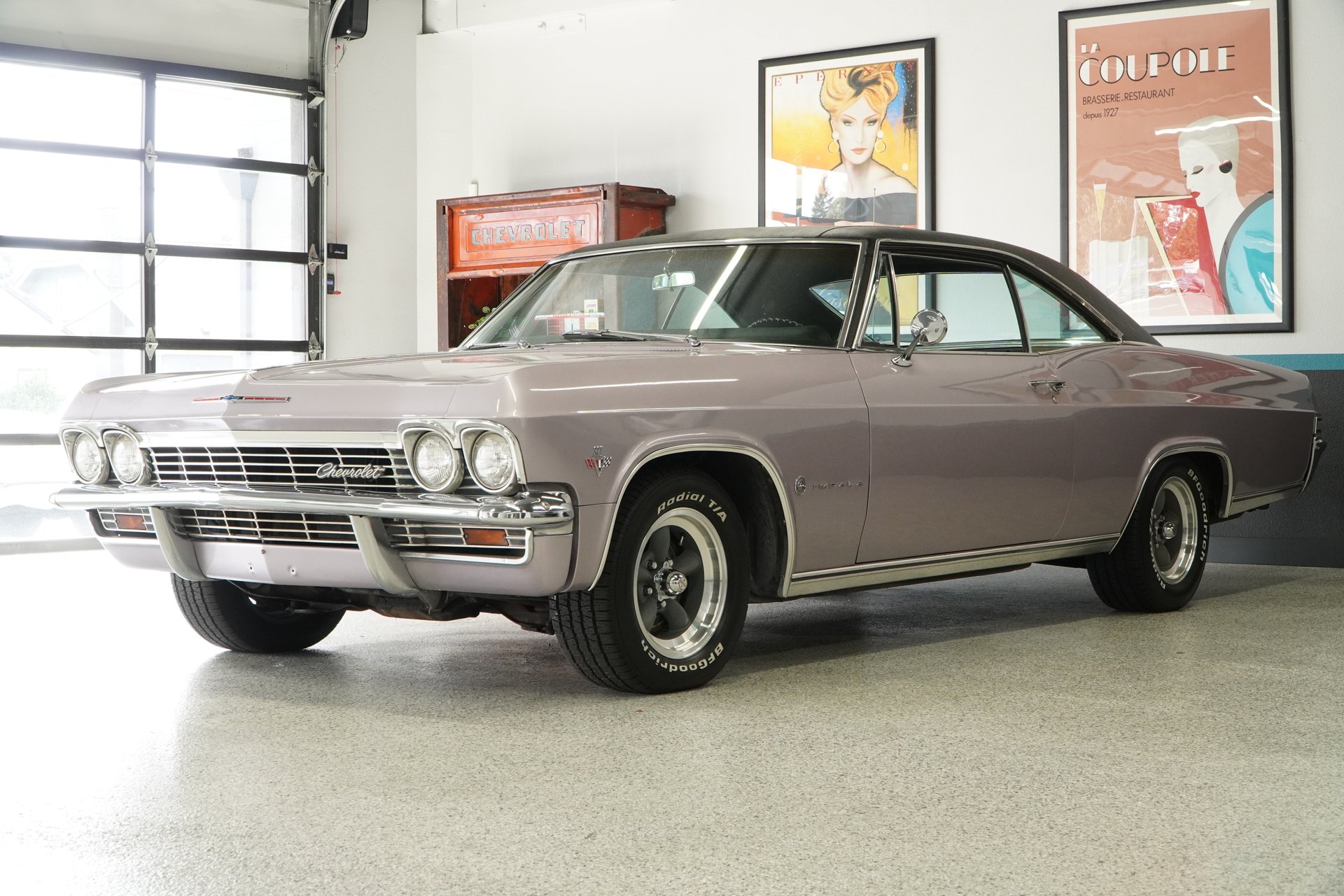
1961–64: the performance years. The 1961 restyle is the crisp one — no fins to speak of, and the pillarless bubble-top coupe that collectors chase. The Super Sport option debuted mid-1961 on any Impala body: bucket seats, a console, special trim and, crucially, eligibility for the new 409. Only 453 SS cars were built in 1961, which is why real ones are documented obsessively and faked cheerfully. For 1962 the SS became a proper Impala sub-series and the 409 reached its famous dual-quad 409 hp form; the 327 small-block arrived the same year and is the thinking buyer’s engine. The 1963 car is the sharpest-styled of the run, and the home of the rarest factory Impala of all, the Z11 — a lightweight, 427-cubic-inch drag package of which 57 were built, almost all now accounted for in collections. The 1964, the single most-listed year in our pool with 43 cars, is the last of the X-frame cars and the most reproduced: every panel, trim piece and SS badge is available, which helps restorers and cloners equally.
1965–70: the mainstream peak. The 1965 redesign is the most complete in the nameplate’s history: new perimeter frame, full-coil suspension, curved frameless side glass on hardtops, and a fastback sport coupe silhouette that defined mid-sixties America. The SS continued with small-blocks and the new Mark IV big-blocks — 396 for 1965, then the 427 from 1966 — and from 1967 to 1969 Chevrolet sold a dedicated SS 427 model, identified by its own trim and domed hood, which is the sleeper of the range: rarer than the folklore 409s, cheaper to buy, and brutally effective. The Caprice, launched as a 1965 Impala hardtop option, steadily took the luxury end of the market, and by 1969–70 the Impala was the middle child — still handsome, still available with a 427 and a four-speed, but no longer the flagship. Hidden headlamps on 1968–69 cars, endless option lists and annual facelifts make originality checking on these cars a trim-tag exercise.
1971–76: the giants. The 1971 B-body was the biggest Chevrolet ever to that point, and it grew heavier as engines shrank under emissions rules: the 454 that opened the era at 365 gross horsepower was a shadow of itself by 1975, joined by the 400 and 350 small-blocks doing work they were barely geared for. Convertibles lasted to 1975 (as Caprices), coupes wore a formal roofline, and the wagons had the disappearing clamshell tailgate. These are presence cars — bought for cruising, priced gently, and expensive only when the vast body needs paint or rust work.
1977–85: the downsized farewell. The 1977 car lost roughly 700 pounds and a foot of length overnight and became a better car for it: square, roomy, simple, with the 305 V8 the default and the Oldsmobile-built 350 diesel a period curiosity to avoid unless you specifically collect them. The Impala name ended after 1985, the Caprice carrying the B-body on alone. Survivors are mostly sedans, often ex-fleet, and condition varies from time-warp to taxi-worn.
1994–96: the SS revival. Chevrolet took the Caprice B-body, lowered it, fitted 17-inch wheels, four-wheel discs, a limited-slip axle and the 260 hp LT1 from the Corvette line, deleted the chrome, and sold it only in black for 1994. Dark Cherry and Dark Grey Green metallic joined for 1995; 1996 added a floor shifter, analogue gauges and OBD-II. Just 6,303 were built in the short first year, with production in the low tens of thousands across 1995–96. Every one is a four-door sedan, every one is an automatic, and the fakes — rebadged Caprices — outnumber the honest mistakes, so the VIN and the trunk-lid option label are the car’s passport.
2000–04: the W-body namesake. Front-wheel drive, V6 power (3.4 and 3.8, with a supercharged SS for 2004), a unibody shell and modern safety kit. These appear in our listings up to 2004 and are bought as cheap, comfortable transport with a famous name, not as classics; the inspection logic is modern-car logic — service history, transmission behaviour, rust in the rocker panels and rear quarters — and nothing in the classic sections below should be applied to them beyond the rust discipline.


Engines and gearboxes
The sixes and the small-blocks: 235, 283, 327, 350 and their kin
The baseline Impala engine for 1958–64 is the Blue Flame 235-cubic-inch overhead-valve six, a sturdy, understressed unit that moves a two-ton car adequately and no more; from 1963 the thinner-wall 230 and later 250 Turbo-Thrift sixes replaced it, and from 1977 the six-cylinder role passed to V6s. Six-cylinder cars are the cheapest Impalas to buy and the slowest to sell, and many have been V8-swapped — check the VIN’s engine code against the block before paying a V8 price for a six-cylinder shell, because the swap itself is easy and the paperwork trail is usually absent.
The small-block V8 is the Impala’s natural engine. The 283 (1958–67) came in two-barrel form at around 185–195 hp and in livelier four-barrel and fuel-injected forms in the early years, though injection is a Corvette and passenger-car rarity you will almost never meet in an Impala. The 307 replaced it as the base V8 for 1968–73 — adequate, unloved, and often tired. The engine that matters is the 327 (1962–68): the L30 four-barrel at 250 hp is the sweet spot of the whole classic range, the L79 at 300 hp (and 350 hp in its hottest passenger-car tune elsewhere) adds a hydraulic performance cam and real pace, and both are tough, cheap to rebuild and happy on modern fuel with hardened valve seats fitted. The 350 that followed from 1969 became the default V8 for two decades — two-barrel economy versions, the L48 four-barrel at 300 gross hp in 1969–70, then a long emissions-era decline through the 1970s, and a recovery of sorts in the 1994–96 LT1, which is a different engine in detail: reverse-flow cooling, sequential injection, an aluminium-headed Corvette cousin with iron heads in the B-body, rated at 260 hp net, and famous for the OptiSpark distributor mounted on the front of the engine behind the water pump, which is its one genuine weak point and is covered in the problem section. The 305 (1976 onward) and the 400 small-block (1970–76, siamesed bores, external balance, a tendency to run hot if the cooling system is neglected) fill out the later cars. Judge any small-block the same way: cold start without smoke, steady hot oil pressure, no lifter clatter that outlasts warm-up, and a cooling system that holds temperature in traffic. A standard small-block rebuild, machine work included, runs roughly $3,500–6,500 at a general shop, which is why engine condition matters less on these cars than on almost any other classic — and why sellers know it.
The W-heads and the Mark IV big-blocks: 348, 409, 396, 427, 454
The 348 of 1958 was Chevrolet’s first big-block: a W-head design, named for the scalloped combustion chambers formed by the flat head face and the shaped piston crown, with the spark plugs angled through the rocker covers. In single four-barrel form it made 250–280 hp; the Tri-Power with three Rochester two-barrels made 280–315 hp, and late solid-lifter versions reached 335 hp. It is a torquey, charismatic engine with two ownership truths: parts cost more than small-block parts, and the Tri-Power linkage and progressive throttle setup need a specialist’s patience to keep sweet. Budget $1,200–2,000 for a proper Tri-Power carburettor overhaul and set-up across the three units.
The 409 (1961–65) is the 348’s bored-and-stroked heir and the most mythologised engine in this guide. Launch form was a single four-barrel at 360 hp; the 1962 dual-quad version made the famous 409 hp, and the final 1963–65 range ran from a hydraulic-cam 340 hp torque engine to the solid-lifter dual-quad at 425 hp. The Z11 427 of 1963 — a stroked 409 with a two-piece high-rise intake and cowl induction, built for drag racing — is a museum engine; if one is offered to you in a normal sale, assume it is a story until a historian says otherwise. Real 409 ownership is about verification and valve gear: solid-lifter cars need their clearances set, all W-heads are now old enough that a rebuild is a specialist job at roughly $8,000–14,000, and the engine number pad and casting dates are the difference between a valuable car and an expensive tribute. The stamp sits on the pad at the front of the right-hand deck; learn the suffix codes for the year you are viewing, and remember that a correct-code block is necessary but not sufficient — restamps exist precisely because the premium does.
The Mark IV big-block replaced the W-heads for 1965 and is the easier performance engine to live with. The 396 came as the 325 hp L35 (the volume SS engine), the 360 hp L34 and the 375 hp solid-lifter L78. The 427 (1966–69) repeats the ladder: the hydraulic L36 at 385 hp is the great road engine, the L72 at 425 hp with solid lifters and a Holley is the collector piece, and the SS 427 cars of 1967–69 are mostly L36s. The 454 (1970–76) opens strong — 390 gross hp in LS5 form for 1970 — and is then progressively detuned through the seventies, ending as a low-compression torque motor that still pulls a 1975 wagon without complaint. All Mark IVs share the same ownership profile: immense torque, real thirst (expect 8–12 mpg), exhaust manifolds that crack and warp, and a cooling load that punishes a silted radiator. A Mark IV rebuild runs roughly $6,500–11,000 depending on specification, and a documented L72 or L78 specification is worth a meaningful premium over a dressed-up L35 — which is, again, a stampings-and-paperwork question, not a badge question.

Gearboxes: Powerglide, Muncie, Turbo-Hydramatic and the late automatics
The default classic Impala gearbox is the two-speed Powerglide automatic: aluminium-case from 1962 (the earlier cast-iron case unit is heavier and less loved), almost indestructible, and defined by its single shift — it pulls away in top-gear range and steps down once, which feels like slowness until you remember the V8 torque underneath it. A Powerglide that engages drive and reverse promptly, shifts once, cleanly, at light throttle and does not slip under load is a good one; a full rebuild is roughly $1,500–2,800, cheap by classic-automatic standards. Avoid the rare Turboglide continuously variable automatic offered 1957–61 unless the car is priced as a curiosity: parts and knowledge are both scarce. The three-speed Turbo-Hydramatic 350 and 400 (from the mid-1960s, standard behind big-blocks as the TH400) are stronger, more conventional and equally well supported, at roughly $1,800–3,200 for a rebuild. Three-speed manuals were the base fitment nobody ordered; the gearbox that matters is the Muncie four-speed — M20 wide-ratio behind small-blocks, M21 close-ratio and the heavy-duty M22 rock-crusher behind big-blocks and high-output 327s. A genuine factory four-speed SS is the most desirable drivetrain combination in the classic range, and the most cloned: the transmission’s date codes, the floor hump’s factory stamping and the trim tag together make the case. Worn second-gear synchromesh, a whine in first through third that vanishes in direct-drive fourth, and a linkage full of slop are the normal findings; a Muncie rebuild runs roughly $1,200–2,200 plus clutch. Later cars simplify: the 1977–85 cars use the TH350, the metric TH200 in some applications (weaker — check which is fitted) and the overdrive TH200-4R and 700R4 in the eighties, while the 1994–96 SS uses the electronic 4L60-E, a good gearbox whose life is set by fluid changes and by how often the LT1’s torque has been used in full. On any automatic, judge the fluid first: bright red and sweet is maintained, brown and burnt is a rebuild negotiation.
Problem areas
Everything in this section follows the same order a professional inspection follows: structure first, because structure decides whether the car is a purchase at all, then the systems that decide what it costs to make right. Our own photo examination underlines the priority. Of the 188 Impalas in our pool whose photo sets we have examined in detail, rust was noted in 50 cars and visible damage or deterioration in 53 — roughly one car in four showing corrosion on a seller’s own photographs, which are the most flattering record a car ever gets. Leaks, by contrast, were noted in only 2 of the 188, which tells you less about dry engines than about how rarely sellers photograph an underside. Assume the photographs are the highlight reel and inspect for the full match.
Rust and the frame: the map
Start with the frame, because the Impala changes frame design mid-range and each design fails differently. The 1958–64 cars ride the X-frame: a central cruciform with no full-length side rails, chosen for a low floor and criticised ever since for its weakness in side impacts and its torsional flex. Its inspection points are the centre X junction itself, where mud and water sit in the box sections; the front and rear horns where the bumpers and suspension mount; and the body-mount outriggers, whose rubber pads perish and let the body settle and crack the floor at the mounting points. Surface rust on an X-frame is cosmetic. Perforation at the X junction or a horn is structural fabrication, and a car that has had its frame patched with plate over rot — look for fresh black paint localised to one area of an otherwise honest chassis — needs a lift, a probe and a price that reflects frame work at roughly $2,500–6,000 for proper section repairs, more for a frame swap. The 1965–96 B-body cars use a full perimeter frame, a much stronger ladder with side rails, and the rust moves to predictable addresses: the rails under the front footwells where road spray collects, the kick-up over the rear axle, the rear rails behind the axle to the bumper, and the body mounts, especially the two under the trunk floor. On the 1994–96 cars add the floor pans themselves, which were thinly protected and rot from inside under wet carpet. In all years, prod with a screwdriver, with permission, and distrust any frame that has been freshly steam-cleaned and blown over in black for the sale.
The body rust map is common to every classic generation, in this order. First, the trunk floor and spare-wheel well: the rear window seal and the trunk weatherstrip leak, water ponds under the mat and in the well, and the floor rots outward from the lowest seams. A replacement trunk floor fitted and painted runs roughly $900–2,200, and trunk rust on a 1958–64 car should send you straight to the frame mounts beneath it. Second, the floor pans, front footwells first: the windshield seal and the cowl plenum drains are the water sources, the drains block with leaves and sealant, and the cowl sides themselves rot on 1960s cars — a repair that is dashboard-deep and priced at $1,500–3,500 a side done properly, which is why a dry cowl is worth more than a shiny respray. Third, the lower rear quarters behind the rear wheels, the classic Impala scab: the inner wheelhouse and the quarter share a seam that traps everything the tyre throws up, and bubbles at the bottom rear edge of a quarter mean the inner structure is already involved. Fourth, the rocker panels and door bottoms: rockers carry the convertible’s strength and the hardtop’s door alignment, doors fill with water when their drain slots block, and both announce themselves late, as paint bubbles over metal already thin. Fifth, the small traps that price a restoration: the battery tray and the inner fender beneath it, the headlamp buckets, the bottom of the front fenders behind the wheels, the windshield surround, and — on 1959–60 cars — the elaborate rear deck and batwing seams, where period lead work and filler hide under most surviving paint. Convertibles add their own structural clause: the top frame, the header bow and the reinforced rockers and body mounts are the car, and a convertible with soft rockers twists visibly — check door gaps with the car on its wheels, then on a jack at one corner, and walk away from gaps that move.
Paint and filler are the camouflage over all of it. Run a cloth-wrapped magnet along quarters, rockers and door bottoms; read the car in raking light for ripples over the long rear quarters, which are the hardest panel on the car to keep straight and the first place a cheap restoration shows. A quality repaint on a full-size Impala, with its acreage of panels, starts around $8,000–15,000 at a reputable shop before any metal work — which is the arithmetic behind this guide’s repeated advice to buy structure and originality and forgive mechanical faults.


Suspension, steering and brakes
The 1958–64 cars use unequal-length A-arms in front with coil springs, a live rear axle on coil springs located by control arms and — a detail that matters — a single upper control arm on many years, which allows the axle behaviour that period drivers called the Chevrolet shuffle over broken surfaces. The 1965 redesign brought the four-link rear axle and full-coil ride that made these cars famous for comfort, and the layout then served, revised, to 1996. The wear list is universal and cheap by classic standards, which is precisely why neglect is inexcusable and diagnostic: ball joints, control-arm bushings, tie-rod ends, the idler arm and the centre link all wear, and a car that wanders, clunks over bumps and wears its front tyres on one edge is advertising a front-end rebuild at roughly $900–2,000 in parts and labour for a full refresh with alignment. Sway-bar links snap, rear control-arm bushings let the axle steer the car under power — felt as a squirm when you lift off — and sagging springs drop the nose or tail an inch or more below the factory stance, which you judge from the trim height at the rocker. Power steering on classic cars is the Saginaw recirculating-ball box and a pump that whines when low and leaks from the front seal and the high-pressure hose; play at the steering wheel is box wear and linkage wear added together, and a rebuilt box runs roughly $350–650 exchanged. The 1994–96 cars add modern wear points: the same B-body front end, by then well understood, plus electronic ride variations none of which the SS uses — the SS is steel springs, Bilstein-type dampers and a limited-slip axle whose clutches chatter on tight turns when the oil is old or the friction modifier has been omitted, cured in most cases by an oil change with the correct additive at roughly $120–250.
Brakes divide the range in two. Cars to the mid-1960s were delivered with four-wheel drums — single-circuit hydraulics on the earliest cars — and front discs became available from 1967 and standard-fit thinking by 1971, with the 1994–96 SS on four-wheel discs. A drum-brake Impala in modern traffic is a period experience: adequate when perfectly maintained, frightening when the self-adjusters have seized and one rear drum is doing the work. Budget $600–1,400 for a full hydraulic refresh — master cylinder, wheel cylinders or calipers, hoses, lines where corroded — on any car that has sat, and treat a front-disc conversion kit (roughly $700–1,500 in parts) as a safety upgrade you price into a drum car you intend to drive, not a modification to apologise for. On stored cars of every era, the pattern repeats: seized calipers or wheel cylinders, perished flex hoses that balloon under pressure, a master cylinder that sinks slowly at a stoplight, and fluid that has absorbed enough water to corrode the system from inside. The pedal tells you most of it before the wheels come off.
Engines, cooling and the age faults that strand you
Mechanical failure on an Impala rarely means a worn-out engine; it means a support system has aged out around a sound one. Cooling is first. These are big engines in engine bays designed before modern traffic, cooled by radiators that are now sixty years of silt and solder repairs old. A car that creeps up in temperature at idle but cools on the move has a flow or fan-clutch problem; a car that heats under load has a radiator capacity or head-gasket problem, and the two diagnoses differ by thousands. A recored or quality replacement radiator runs roughly $450–900, and on a 409 or a big-block it is the cheapest insurance in the car. Fuel systems suffer the modern-fuel disease: ethanol attacks period rubber, swells needle valves and leaves varnish in tanks and Rochester and Holley carburettors that have sat, so a long-stored car needs the tank inspected, the rubber lines renewed end to end and the carburettor rebuilt — roughly $350–700 per carburettor, three times over on a Tri-Power — before any tuning verdict means anything. Ignition is points on everything classic: a worn distributor shaft gives a wandering dwell and a misfire no plug change cures, and the vacuum advance canister is perished on most unrestored cars, costing the part-throttle smoothness these engines are praised for. Oil leaks are the background condition — rear main seals, valve-cover gaskets and the intake’s rear china-wall seal on small-blocks — and are priced as gasket work ($400–900 for the common set with labour) unless the leak is accompanied by low oil pressure or bearing noise, which changes the conversation entirely.
Era-specific traps deserve naming. The 348 and 409 W-heads run their spark plugs through the rocker covers and use a distinctive valve gear; burnt exhaust valves on unleaded fuel without hardened seats is the standard top-end job, at roughly $1,800–3,200 for a pair of heads rebuilt properly. The Mark IV big-blocks crack exhaust manifolds and snap their studs on removal, turning a gasket job into a machine-shop job. The Oldsmobile 350 diesel in 1979–85 cars — head bolts, injection pump, glow-plug system — is a specialist hobby, not transport. And the LT1 in the 1994–96 SS has the OptiSpark: a distributor driven off the camshaft, sealed in theory, killed in practice by the water pump weeping directly above it. A misfire, a hard start and a car that dies hot and restarts cold is the classic presentation; replacement runs roughly $450–900 in parts depending on brand, plus the water pump you replace at the same time, and a vented later-spec unit is the fix that lasts. On the same cars, check the rear axle pinion seal, the window regulators and the digital dash segments, all of which age on schedule.
Interior, trim and electrics
Interiors are where Impala restoration budgets go to be surprised, because the cars are wide, the trim is year-specific and the soft parts perish in sunlight. Vinyl splits along its stitched seams, seat foam and the underlying burlap collapse so you sit on the spring frame, and the padded dash cracks in a map pattern on sun-belt cars. A full professional retrim of a classic Impala interior — seats, door cards, headliner, carpet — runs roughly $4,500–9,000 in vinyl to driver-plus standard, more in the correct grain and colour from the specialist suppliers, and convertible interiors add a top: a quality top with pads and a new rear window, fitted, is roughly $1,800–3,500, with a tired top frame or a dead hydraulic pump and rams adding $600–1,500. Judge a car’s interior by its rarest piece, not its average: 1958 door cards, SS console trim, 1961 bubble-top headliners and one-year seat patterns are the hunts, while carpet and seat covers for a 1964 are catalogue items. Brightwork follows the same law — bumpers re-chromed at roughly $600–1,100 each, pot-metal trim that pits from inside and cannot be polished back, and stainless that survives well but dents. In our photo examination, damage and deterioration mentions ran at 53 of 188 cars, and interiors and trim are where most of that deterioration lives.
Electrics are the honest system on these cars: a simple 12-volt layout, an external regulator and generator on the earliest cars, alternators from 1963, and faults that concentrate at grounds, bulkhead connectors and switches rather than in the looms. Dim headlights and a fuel gauge that lies are ground faults until proven otherwise. The expensive electrical items are specific: the convertible top circuit and its relays, the power-window motors and the brittle wiring in the door jambs on loaded 1960s cars, the hideaway-headlamp vacuum-and-electric system on 1968–69 cars, and on the 1994–96 cars the body electronics of a modern car — window regulators, the instrument cluster, door modules — all available, all priced as modern parts. Air conditioning, fitted to a large share of surviving cars, is its own budget line: a system that has sat open needs a compressor, receiver-drier, hoses and a conversion or correct refrigerant charge, roughly $1,200–2,500 to recommission properly, and a seller’s “just needs a charge” should be priced as exactly that full figure until a gauge set proves otherwise.

How to inspect one
Allow two hours for a classic Impala, bring a torch, a cloth-wrapped magnet, a screwdriver for prodding with the seller’s permission, a tyre-pressure gauge and a notebook, and insist on a cold start and a drive of at least twenty minutes. If the car passes you, pay for an hour on a lift before money moves — on a car whose value lives in its frame and floors, it is the best money in the whole purchase.
- Paperwork and identity first. Match the VIN plate to the title, then decode it: the VIN gives you the year, the assembly plant and, on the classic cars, whether the car began life as a six or a V8. Find the trim tag on the firewall and decode the style, trim and paint codes. An SS, a big-block or a four-speed claimed without tag and stamping support is a trim level you are being asked to imagine — price the car as the plain Impala the paperwork proves.
- Cold start. The engine should be stone cold when you arrive. Watch the exhaust for the first ten seconds: a puff of blue that clears is valve-stem seals, continuous blue is rings or bores, white that smells sweet and persists is coolant, and black soot is a rich carburettor or a choke stuck on. Listen for lifter clatter that outlasts a minute and for any deep knock under light load.
- Engine stampings before road impressions. On any car priced for its engine — every 409, every big-block, every L79 327 — read the pad stamping and the casting dates now, in good light, and photograph them. The stampings section of the engines chapter is the reference. A car can charm you on the drive; it cannot charm a wrong suffix code into a right one.
- Under the car: frame first. Torch the full length of both frame rails or, on a 1958–64 car, the X junction, horns and outriggers described in the rust section. Prod the body mounts and the rails at the rear kick-up. Perforation in the frame or at a mount ends the inspection at performance-car prices; the same car at project prices is a different conversation, held with your eyes open.
- Trunk and floors. Lift the spare wheel and the trunk mat and look for water lines, scale and daylight. Inside, lift every carpet you are allowed to lift, press the front footwells hard, and smell for the mustiness that means the cowl drains have been feeding the floor. Trunk rust plus floor rust plus a blocked cowl is one water story told in three places.
- Body and magnet work. Walk the long quarters in raking light, run the magnet over quarters, rockers, door bottoms and fender heels, and open and close every door twice — once for the latch, once to feel for drop on the hinges. On a convertible, repeat the door-gap check with one corner jacked, as the rust section describes. Count the trim pieces that are missing or wrong for the year and price the hunt, not the hope.
- Suspension and steering by hand. With the front raised, rock each wheel top-to-bottom and side-to-side and separate ball-joint play from bearing play by watching the joints as a helper rocks. Bounce each corner and count the rebounds. On the ground, measure the stance against the rocker line and look for the sag the problem section describes.
- The test drive, in the right order. Town first, for steering weight, brake pull and low-speed gearbox behaviour — a Powerglide should shift once, a Turbo-Hydramatic cleanly twice, a Muncie without a crunch into second. Then a highway stretch: a healthy V8 Impala settles at speed without wander or driveline vibration, holds temperature, and shows strong, steady oil pressure. Brake firmly from speed twice; the second stop is the one that tells you about fade on a drum car.
- Heat soak and restart. Park, let the car idle for five minutes, switch off, wait five minutes and restart. The hot restart exposes vapour lock, a tired starter, a heat-soaked coil and a Tri-Power or dual-quad setup that floods — the faults a cold start and a gentle drive are designed by sellers, consciously or not, to hide.
- Electrics and equipment, everything, once. Every window, the blower on all speeds, wipers and washers, lights high and low, indicators, horn, radio, gauges against reality, and the air conditioning compressor clutch engaging. On a convertible, cycle the top fully twice and watch the frame fold evenly; on a 1994–96 SS, add the limited-slip check — a slow, tight turn should be silent — and look hard for OptiSpark symptoms on the hot restart you have just done.
- Interior last, sitting in every seat. Sit in the driver’s seat for a full minute and feel for the spring frame through collapsed foam. Check the headliner seams, the dash pad in raking light, and the one-year trim pieces your generation is known for. A sound original interior on a classic Impala is the hardest component to replace at any price, so weight it as the rust section weights the frame.
- Decide by the rule, not the drive. Add the car up as structure, identity, interior, then mechanics — in that order, because that is the order of replacement cost. A mechanically tired car with a sound frame, honest stampings and a good interior is the buy. The reverse combination, however sweetly it drives, is the car the next owner will pay you less for.
Values
The market block beneath this guide carries the current numbers — what is listed now, and what recorded sales have achieved — and it is refreshed as the market moves, so this section deliberately teaches you how to read those figures rather than repeating any of them here. Read them with four Impala-specific cautions.
First, the spread inside a single year and badge is the widest in the American classic market, because the badge covers a six-cylinder sedan and a documented big-block convertible in the same search result. Never read a median for “1964 Impala” as a statement about the car in front of you. Read it as two or three separate markets wearing one name: plain cars, whose value is set by condition alone; SS and big-block cars, whose value is set by condition multiplied by proof; and the small set of genuinely rare specifications — a real 1961 SS, a documented 409, an SS 427, a 1996 SS with low miles — whose value is set by how many documented cars exist at all.
Second, proof is the premium. On the plain cars, money follows structure and interior, in the order the inspection chapter uses. On the performance cars, money follows paper: a matching-numbers drivetrain, a legible trim tag that agrees with the car, period documentation and an unbroken story are worth a substantial fraction of the car’s price, and their absence is not a haggling point but a different, cheaper car. Sellers of cloned SS and re-stamped big-block cars price them as the real thing and negotiate as if proof were a detail. It is the whole car. Walk the price back to the specification the evidence supports, and be willing to walk away from the gap.
Third, asking prices and achieved prices part company predictably on these cars. Dealer-presented, freshly detailed cars at the top of the listings are priced for the buyer who wants the search to end today, and the auction record — the market block’s recorded sales — is the corrective: compare like specification with like, allow for the exceptional documented car selling beyond the range, and treat any single spectacular result as evidence about that car, not about yours. Project cars deserve the same discipline in reverse: the gap between a project and a finished driver, on a full-size Chevrolet, is consumed by paint, chrome and interior before the mechanical recommissioning is counted, so the cheap car is cheap for reasons you can price from the problem section — and if the arithmetic does not close with room to spare, it is not a bargain, it is a subscription.
Fourth, the generations move on different clocks. The 1958–64 cars are the established collector market, liquid and well understood. The 1965–70 cars follow them closely, with the SS 427 the connoisseur’s corner. The 1971–76 giants and the 1977–85 sedans are value-for-money cruising, bought on condition and unlikely to reward speculation. The 1994–96 SS is a modern-collectible market of its own — mileage, originality and the three-colour, three-year story set prices, and modified cars fall back toward the Caprice they began as. Buy the car whose market you understand, at the condition end of it you can verify, and let the block below do the arithmetic.
Parts and ownership
The Impala’s great ownership advantage is scale. Chevrolet built these cars by the million alongside Bel Airs, Biscaynes, Caprices and wagons that share their bones, and the American reproduction industry has spent fifty years serving them. For the 1958–70 cars especially, assume a part exists until you have proven otherwise — then check whether the part that exists is any good, because reproduction quality, not availability, is the modern Impala problem.
Easy and cheap: service items for every engine in this guide, small-block and Mark IV internals, brake components for both drum and disc systems, suspension wear parts and bushings, steering rebuild components, Powerglide and Turbo-Hydramatic rebuild kits, Muncie internals, glass for the volume body styles, weatherstripping, carpets and seat-cover kits for the popular years, and sheet metal for the 1962–66 cars down to full quarter panels and floor pans. Order today, fit this weekend, at prices that make European classics look like a rumour.
Harder, dearer or quality-critical: W-head engine internals and correct 409 castings, Tri-Power carburettors and linkage, one-year 1958 trim and sheet metal, 1959–60 rear-end pressings, convertible top frames and hydraulic components, pot-metal trim in rechromable condition, correct-grain interior materials for the less popular years, big-block exhaust manifolds, and — on the 1994–96 cars — the OptiSpark in a quality brand, B-body-specific trim that the Caprice trade did not reproduce, and the SS’s wheels and interior pieces in unmodified condition. The rule for reproductions is to buy the panel or trim piece for the most popular year your car shares parts with, trial-fit before paint, and keep every original component you remove, however tired: original metal repairs better than new metal fits, and original trim is the pattern the next owner will want.
Running one. A sorted classic Impala is among the easiest classics in this guide series to live with: any competent general mechanic can service it, the knowledge base is bottomless, and club and forum support for every generation is deep. Fuel consumption runs from the mid-teens miles per gallon in a small-block cruiser to single figures in a big-block used as intended. The budget lines that catch new owners are the recommissioning of a stored car — fuel system, brakes, tyres, hoses and belts before the first real drive — and the first paint or interior bill, either of which exceeds the mechanical spend on most cars. Insure on an agreed value that reflects the specification the paperwork proves, keep the documentation file growing with every invoice, and drive the car: every system on an Impala, from the Powerglide to the convertible hydraulics, lasts longer in monthly use than in storage.

Which one to buy
- The all-rounder: 1962–64 Impala SS with the 327. The balanced classic of the range — real pace, the best parts support, a four-speed if you hunt for one, and a market deep enough to buy well and sell honestly. Buy the best-documented car, not the shiniest.
- The value buy: 1965–66 Impala SS small-block. The million-seller’s glamour, the perimeter frame and coil ride, and prices that still follow condition rather than folklore. A sorted 327 or 350 car is the cheapest route into a genuinely good classic Impala.
- The connoisseur’s car: 1967–69 SS 427. The L36 car especially — 385 hp, hydraulic lifters, a full-size suit and a fraction of the 409’s entry price. Verify the stampings ruthlessly and the market will reward you for it.
- The showpiece: 1958 or 1961. The 1958 for its one-year sculpture, the 1961 for the bubble top and the first SS. Buy completeness above all: the missing trim piece is the price of the car, deferred.
- The cruiser: 1971–76 coupe or convertible. Maximum presence per unit of money, bought purely on body condition and interior survival. Go in knowing paint and chrome on a car this size are the budget.
- The modern classic: 1994–96 Impala SS, the 1996 first. Floor shifter, analogue dash, the LT1’s effortless pace and modern brakes and air conditioning. Original, documented, unmodified — or priced as the Caprice underneath.
- The honest transport: 1977–85 sedan. Square, simple and cheap to run, for the buyer who wants the B-body experience without the collector market attached.
And the rule that overrides all of the above: buy the structure and the paperwork, and let the mechanics be tired. On an Impala, engines rebuild, gearboxes rebuild and brakes renew at prices you can plan for — but a rotten frame, a rotted cowl and a performance identity the stampings do not support are the three bills that never stop arriving, and no shine on the day you view it changes any of them.
See the 268 Impala cars currently listed.