
Chevrolet Impala Convertible buyer's guide
Chevrolet Impala Convertible -- the model's own buyer's guide: variants, values and what to check.
Years listed: 1958-1971 · Series: Impala
Overview and history
The Impala Convertible is the open-top flagship of Chevrolet's full-size line for thirteen model years, and for most of that run it was simply the biggest, brightest convertible you could buy from the biggest-selling brand in America. It arrived in 1958 as the top trim of the Bel Air line — a one-year-only body with heavy brightwork and an options list borrowed from cars costing twice as much — and it became a series in its own right for 1959. From then until 1970 every full-size Chevrolet range was topped by an Impala ragtop, and in the Super Sport years it overlapped the muscle-car era so completely that the same showroom would sell you a six-cylinder convertible for summer cruising or a 425-horsepower 409 with a four-speed, in the same body, off the same order form.
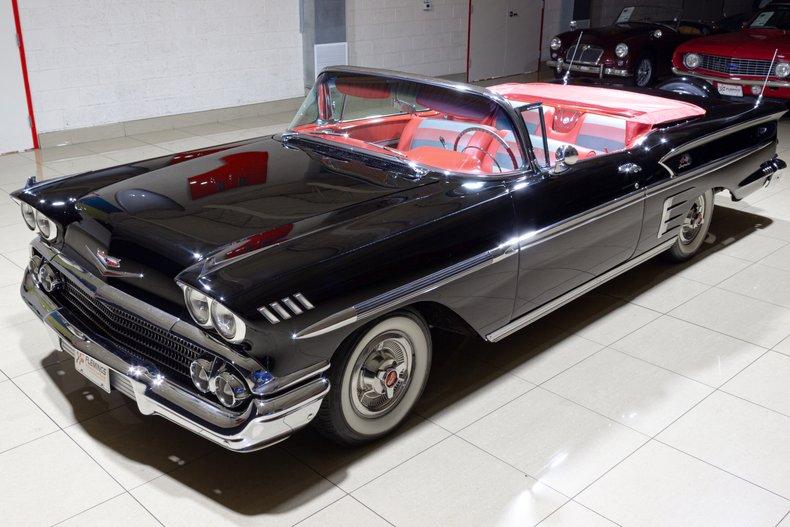
That breadth is what defines the car today. An Impala Convertible is not one car but four distinct generations sharing a name: the X-frame cars of 1958 to 1964, styled first with fins and then with the crisp lines of the early sixties; and the perimeter-frame cars of 1965 to 1970, bigger, quieter and more formal, which carried the model through the big-block years and out the other side. The 1965 redesign was the commercial peak — Chevrolet built more than a million Impalas of all body styles that year, a record for the nameplate — while the 1958 is the collector peak, a single-year design that shares almost no sheet metal or trim with anything else.
The convertible mattered to Chevrolet out of proportion to its sales. It was the image car, the one in the advertisements and the showroom window, specified accordingly: power top as standard equipment in most years, the longest options list in the division, and access to every engine Chevrolet made. Buyers ordered them heavily optioned, which is why a well-preserved example feels like a much more expensive car than it was.
Production of the Impala convertible ended after 1970. For 1971 the full-size Chevrolet convertible moved to the Caprice name, and that single fact is the most useful dating check in this whole guide: there is no such thing as a factory 1971 Impala Convertible, whatever a listing claims. Cars advertised as one are almost always a Caprice misdescribed in the advert, a paperwork error, or a rebody — and each explanation has a very different effect on what the car is worth. We currently track 20 Impala Convertibles for sale or recently sold in the US, spanning 1958 to the disputed 1971 cars, and the spread of that sample — one-year 1958s at one end, late-sixties drivers in the middle, project cars underneath — is the whole market in miniature.
These were not garaged toys when new. They were family cars, driven until something expensive failed and then parked. That history is what you are buying now: the mechanicals are simple, strong and almost entirely rebuildable, and the difference between a good Impala Convertible and a money pit is the condition of the body, the top frame and the trim — in that order.
The models
Every Impala Convertible is a two-door, five- or six-seat open car on the full-size Chevrolet chassis — the B-body, in General Motors language. What changes across the years is the frame underneath it, the styling over it, and whether the Super Sport package turned it into a separate model. Read the range by generation, not by individual year, and the market makes sense.
| Model | Years | Engine | Output | Built | Character |
|---|---|---|---|---|---|
| Impala Convertible (first generation) | 1958 | 235 six, 283 V8, 348 V8 | 145–315 hp | 55,989 convertibles | The one-year flagship; heaviest trim, strongest collector following |
| Impala Convertible (second generation) | 1959–1960 | 235 six, 283 V8, 348 V8 | 135–335 hp | 72,765 convertibles in 1959 | The fin cars; dramatic styling, X-frame manners |
| Impala and Impala SS Convertible | 1961–1964 | 230/250 six, 283, 327, 409 V8 | 140–425 hp | 453 SS cars in 1961, all bodies | The 409 era; SS arrives, bucket seats and console |
| Impala and Impala SS Convertible | 1965–1966 | 250 six, 283, 327, 396, 427 V8 | 155–425 hp | Over 1 million Impalas in 1965, all bodies | The perimeter-frame cars; the sales peak and the big-block arrives |
| Impala and Impala SS / SS427 Convertible | 1967–1968 | 250 six, 307, 327, 396, 427 V8 | 155–425 hp | SS427 in the low thousands each year | Coke-bottle styling; disc brakes arrive as an option |
| Impala Convertible | 1969–1970 | 250 six, 327/350, 396/402, 427/454 V8 | 155–425 hp | Falling; convertible ends after 1970 | The last cars; SS ends after 1969, size peaks |
(Outputs are period SAE gross figures, strongest engine against base six in each range — best used to compare cars within the range, not against modern cars.)
1958: the one-year car. The Impala began as the most expensive Bel Air, and Chevrolet spent the money where you could see it: standard power top, crossed-flag emblems and a cabin trimmed a clear step above the rest of the range. Underneath sat the new X-frame and coil springs all round in place of the old ladder frame and leaf springs. The 348 cubic inch V8 — the first Chevrolet big-block — was the headline engine, topped by the Tri-Power version with three two-barrel carburettors. Everything about the car is 1958-only, which cuts both ways: it is the most distinctive Impala convertible ever built and the hardest to restore correctly, because almost nothing is reproduced in the depth the later cars enjoy.
1959–1960: the fin cars. Impala became its own series for 1959 and the styling went to the famous horizontal batwing fins and teardrop tail lamps, toned down for 1960. The X-frame and the engine range carried over, with the 348 now available up to 335 hp in high-compression Tri-Power form. These are big, soft, theatrical cars that drive exactly as they look: light steering, gentle roll, and a ride tuned for boulevards. Originality matters more here than performance; most were sixes and small V8s, and a genuine factory 348 car needs its paperwork.
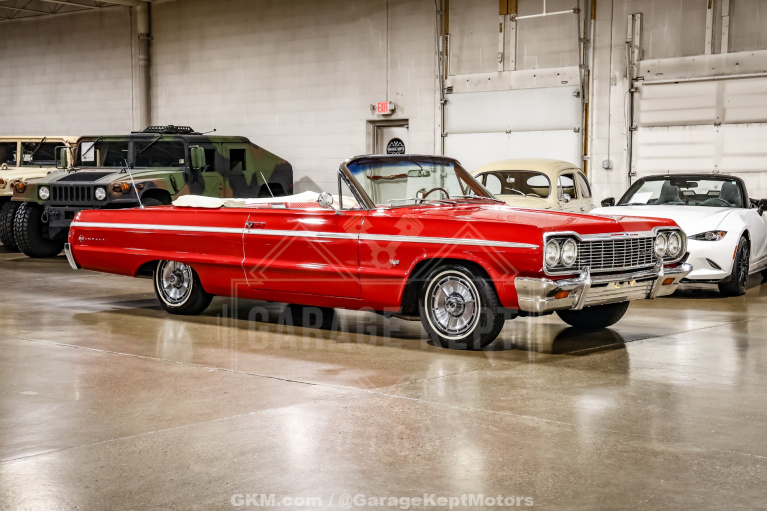
1961–1964: the SS and the 409. The 1961 restyle cleaned the fins away and introduced the Super Sport: an appearance and handling package with bucket seats, a centre console, heavy-duty springs and special trim, available only on the Impala coupe and convertible. Just 453 SS cars were built in 1961 across both bodies, which makes a documented 1961 SS convertible one of the rarest cars in this guide. The reason the package matters is what arrived with it — the 409 cubic inch V8, offered from 360 hp up to 425 hp with dual four-barrel carburettors in 1963 and 1964. From 1964 the SS was a separate series with its own VIN sequence, which settles most authenticity arguments on the later cars. The ordinary convertibles of these years — 283 and 327 cars with Powerglides — are the sweet-natured cruisers of the range, and far more numerous.
1965–1966: the perimeter frame and the sales peak. The 1965 cars were all-new: a full perimeter frame replaced the X-frame, curved side glass cleaned up the styling, and the convertible gained a glass rear window in place of plastic. The Super Sport was now a series of its own, and the engine list ran to the new 396 big-block, joined by the 427 for 1966. These are the most usable early Impala convertibles — better body control, better parts support, and the same visual drama in a more grown-up suit.
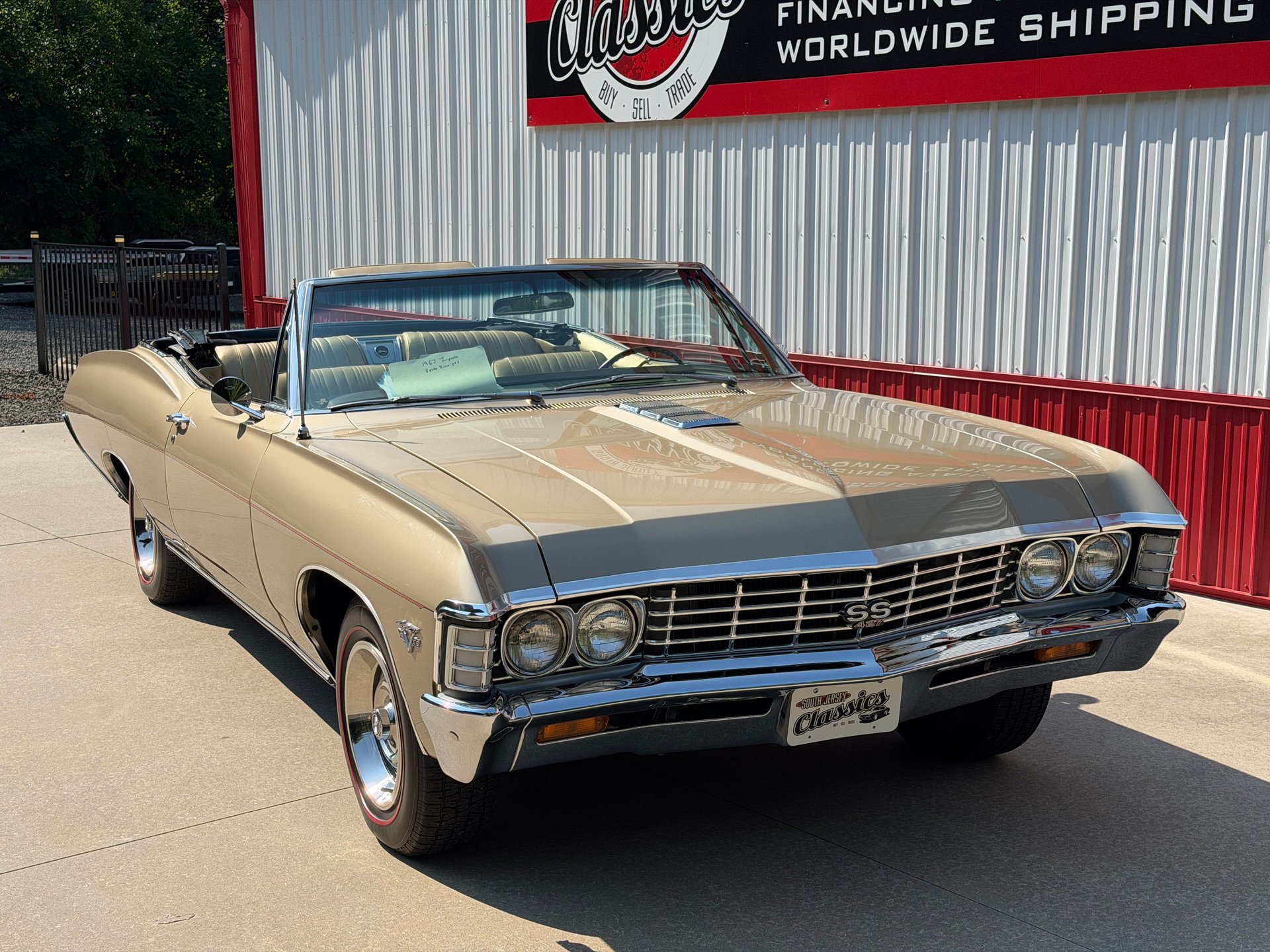
1967–1968: the SS427. Styling went to the flowing coke-bottle rear quarters for 1967, and the Super Sport story split in two: the ordinary SS, increasingly a trim exercise, and the SS427, a dedicated performance model with the 427 under a domed hood, heavy-duty suspension and its own badges. Front disc brakes appeared on the options list for 1967 — worth having, and worth checking for, because most cars still carry drums. A genuine SS427 convertible is a rare car by any measure.
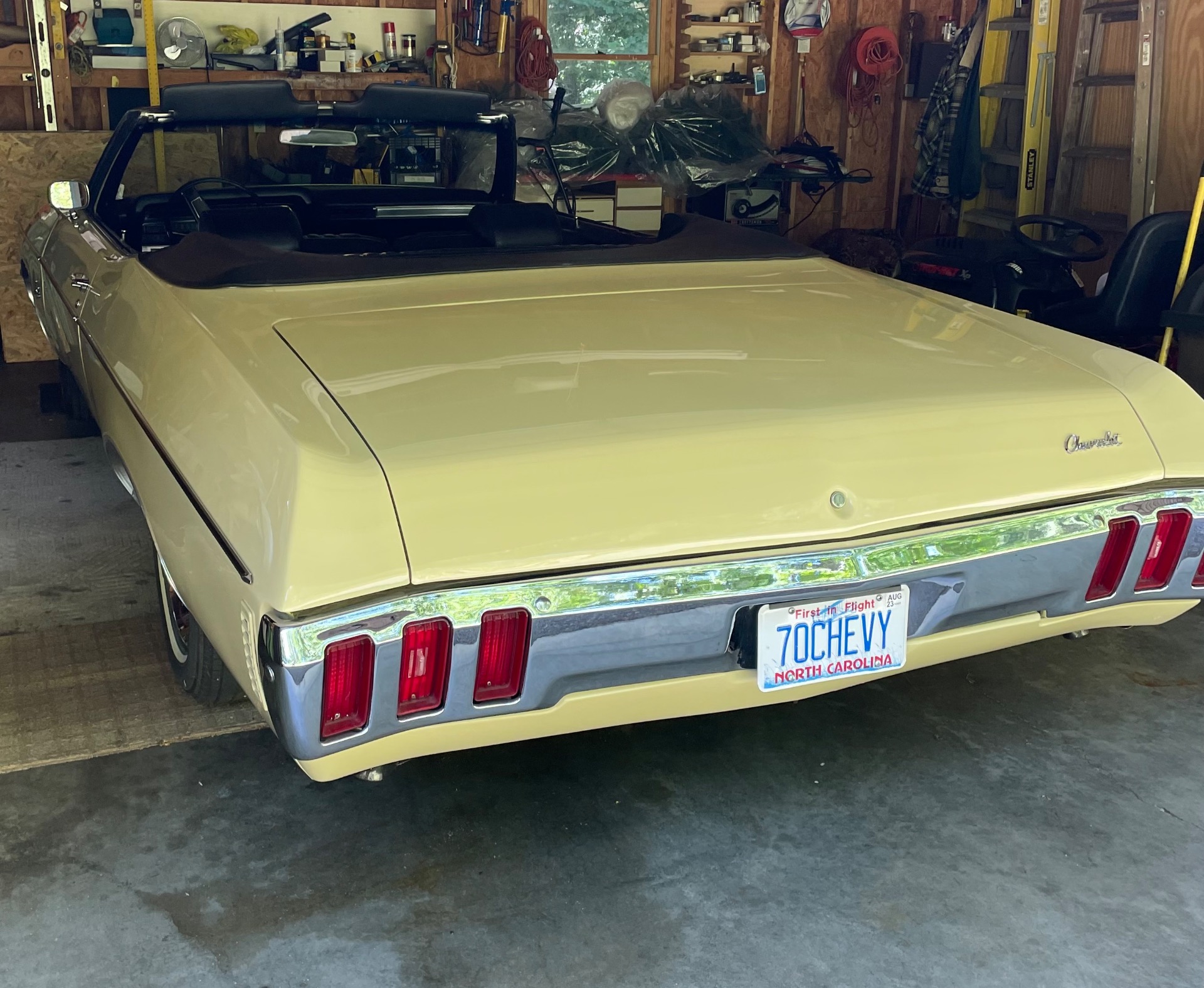
1969–1970: the last cars. The final restyle made the biggest Impalas yet. The SS427 ran one last year in 1969, and for 1970 there was no Super Sport at all — but the convertible soldiered on with engines up to the new 454. A 1970 convertible is the end of the line: the last open full-size Impala, and the last year before the name moved to Caprice for 1971. Buy these on condition and specification rather than rarity; a well-optioned 1970 with the 454 and air conditioning is a genuinely luxurious car.

Engines and gearboxes
Chevrolet offered the Impala Convertible with everything it made, which means the engine bay is where the money is — and where the stories are. The range divides into three families: the sixes and small-block V8s that power nine out of ten survivors, the W-series 348 and 409 that made the early cars famous, and the Mark IV big-blocks — 396, 427 and 454 — that carried the later cars. Every one of them can be identified beyond argument by the stamped code on the pad at the front of the block, in front of the right-hand cylinder head. That pad carries the assembly date, the suffix code that identifies the engine's original specification, and on later and high-performance cars a partial VIN that ties the engine to the car it was born in. Learn to read it before you learn anything else: on a car whose value rides on its engine, the pad is the price.
The sixes and the small-blocks: Turbo-Thrift, 283, 307, 327 and 350
The base engine for most of the run was a six — the 235 cubic inch Turbo-Thrift in the early cars, replaced by the thinner-wall 230 and then the 250 — and it is a better engine than its reputation suggests: seven main bearings from 1963, hydraulic lifters, and a tolerance for neglect that borders on indifference. A six-cylinder convertible is slow in modern traffic and the market prices it accordingly, but as a top-down cruiser it is honest, economical and almost free to maintain. Check for a cracked exhaust manifold (the sixes cook them) and oil weeping from the side covers. Parts are cheap and everywhere.
The small-block V8 is the default Impala engine and one of the most durable engines ever built. The 283 (1958 to 1967) came in two-barrel form at 185 to 195 hp, four-barrel form at 220 to 230 hp, and — in 1958 only for this line — with Rochester fuel injection at up to 290 hp, a specification so rare in a convertible that any claimed example needs factory paperwork, not enthusiasm. The 327 (1962 to 1968) is the pick of the small-blocks: 250 hp with a four-barrel in its common form, 300 hp with the larger-port heads and Carter AFB carburettor, smoother and stronger everywhere than the 283 for no extra running cost. The 307 that replaced the 283 for 1968 is a smog-era economy engine — durable, dull, and cheap to buy. The 350 that arrived for 1969 is the modern owner's friend: the best parts support of any engine in this guide and enough torque to move a two-ton convertible without complaint.
Small-block failure modes are few and well mapped. Valve stem seals harden with age and give the classic puff of blue smoke on start-up after sitting, clearing within seconds — a cheap fix, not a rebuild, and the test that separates it from ring wear is simple: stem seals smoke at start-up and on the overrun, rings smoke under load. The nylon-toothed timing gear on later smog-era engines crumbles with age and can jump a tooth; any 307 or 350 that has never had a timing set should get one on suspicion. Rear main seals weep, and a damp bellhousing is normal rather than alarming. Camshaft wear is the modern trap: these engines were designed for oils with high levels of zinc anti-wear additive, and flat-tappet cams run on current low-zinc oil without a supplement can wipe a lobe in a few thousand miles. Ask the seller what oil the car runs and what additive goes in it; a blank look is information. Carburation is Rochester two- and four-barrels and Carter AFBs — all rebuildable, all happier with fresh fuel than with the ethanol blends that swell old needle tips and rot rubber accelerator-pump cups. A car that has sat will need the carburettor rebuilt and the tank cleaned as a matter of course; budget for it rather than discovering it.
The W-series and the big-blocks: 348, 409, 396, 427 and 454
The 348 of 1958 was Chevrolet's first big-block, and you can spot it at ten paces: the W-series engines carry distinctive scalloped valve covers, because the combustion chamber is in the block rather than the head. In the convertible it came at 250 hp with a four-barrel, 280 hp with Tri-Power — three Rochester two-barrels on a progressive linkage — and 315 hp in the high-compression Tri-Power special tune. Tri-Power is the specification everyone wants and the one most often added later: a genuine factory installation has the correct intake casting, the correct carburettor tags and, ideally, paperwork, because the parts alone have been bolt-on jewellery for fifty years. The 348 is a torque engine rather than a revver; sustained high rpm in a two-ton car is not what it was built for.
The 409 (1961 to early 1965) is the legend — the engine of the Beach Boys song, and the reason early SS convertibles carry the prices they do. Single four-barrel versions made 360 to 380 hp; the dual-quad cars made 409 hp in 1962 and 425 hp for 1963 and 1964, with solid lifters that need periodic valve adjustment. The 1963 Z11 was a 427 cubic inch lightweight drag package that was never sold in a convertible — any Z11 convertible claim is a fabrication, full stop. W-series ownership is specialist territory now: the heads, blocks and intakes are unique to the family, good castings are hunted, and a rebuild belongs with one of the small number of shops that know the oiling system. Price a 409 car on its stamp pad, its casting dates and its documents, in that order, and treat an unstamped or restamped pad as a core engine for value purposes until proven otherwise.
The Mark IV big-block replaced the W-series during 1965 and is a completely different, much more modern engine — canted-valve heads, a deep-skirt block, and the architecture that Chevrolet big-blocks kept for decades. The 396 came at 325 hp in its convertible-friendly form and 375 hp with solid lifters and a Holley in the high-performance tune; the 427 (1966 to 1969) at 385 hp with a single four-barrel and 425 hp in the L72 solid-lifter version; the 454 (1970) at 360 hp in the LS4 form offered in the full-size line, a low-revving torque engine perfectly matched to a big automatic convertible. These are strong, well-supported engines with two characteristic weaknesses. The first is cooling: a big-block in a heavy convertible with air conditioning works its radiator hard, and marginal radiators, tired fan clutches and silted blocks show up as a temperature gauge that creeps in traffic — usually a cooling-system service away from health, but check for warped heads on a car that has been boiled repeatedly. The second is the same flat-tappet cam and modern-oil issue as the small-blocks, sharpened on the solid-lifter engines, which also need their valve clearances checked as routine service. A big-block that ticks loudly when warm is telling you the clearances have been skipped.
Gearboxes
The automatic story has three chapters, and the first is a warning. The Turboglide, offered from 1958 to 1961, was Chevrolet's continuously variable answer to Buick's Dynaflow — smooth, complicated, weak and expensive to put right. Survivors are rare because so many were replaced with something else; a Turboglide car that still works is a curiosity, and one that does not is a conversion project. The two-speed Powerglide that replaced it as the standard automatic is the opposite in every way: an aluminium-case two-speed from 1962 (cast iron before that), nearly unbreakable, cheap to rebuild, and so simple that its faults are a short list — a band adjustment for flare on the 1–2 shift, a worn modulator or a vacuum leak for harsh or late shifts, and leaks from the front pump seal and the shifter shaft. It gives you exactly two ratios, so a Powerglide convertible is a relaxed cruiser and nothing else; accept that and it will never trouble you. The Turbo Hydra-Matic three-speeds — the 350 from 1969 and the 400 behind big-blocks from 1965 — are the best automatics in the guide: strong, smooth, with a proper kickdown (an electric switch on the 400, a cable on the 350) whose failure is the first thing to check on a car that feels reluctant to change down. A rebuild of any of the three mainstream automatics is routine work for any transmission shop in America.
Manuals divide into the standard three-speed, column-shifted and unremarkable, and the four-speeds that transform the cars. The four-speed is a Muncie from mid-1963 (Borg-Warner T-10 before that): the wide-ratio M20 is the right box for a street convertible, the close-ratio M21 suits the high-revving solid-lifter engines, and the heavy-duty M22 belongs to the top 427 cars and is priced like the jewellery it is. Judge a four-speed on second-gear synchromesh on a fast downchange, on whether it jumps out of gear on the overrun, and on clutch judder from a stop, which on these cars is as often tired mounts as a worn clutch. Four-speed convertibles are a small minority of production and the market pays a clear premium for genuine ones — which is why the gearbox, like the engine, has to be verified against the stamp pad suffix and the car's paperwork rather than the seller's description.
Problem areas
Everything in this section follows from one fact: a convertible is a hardtop with the roof cut off, and the roof was doing structural work. Chevrolet compensated with reinforced rocker panels, extra crossmembers and, on the X-frame cars, a heavier centre section — which means the structure of an Impala Convertible is more specialised than the coupe's, and it rots in more specialised places. We currently track 20 of these cars, and for nine of them we have gone through the sellers' photo sets in detail. Visible damage of some kind was noted in five of those nine cars, while rust was explicitly visible in only one — a gap that tells you more about how these cars are photographed than about how they have survived. The places that decide an Impala Convertible's value are underneath it, inside its trunk and under its rear seat, and they are the places the photographs skip. Assume the examination has to be done by you, in person, and be pleased when a car passes it.
Rust: the map
Work through the car in the order the water does.
The frame. The 1958 to 1964 cars sit on the X-frame: a central cruciform with perimeter rails that are shallower than a ladder frame's and famously flexible even when new. It rots at the rear kick-up over the axle, at the cruciform junctions where mud sits in the seams, and along the side rails behind the rear wheels. The 1965 to 1970 cars sit on a full perimeter frame that is stronger and simpler to judge, with the same rear kick-up as the rot hotspot. On either design, perforation in the kick-up or at a body mount is fabrication work, not a patch — a frame repair done properly means the body off or at least lifted, and the bill runs with the hours. Surface scale is normal at this age and treatable; a frame that flakes in sheets when you prod it is a car to walk away from unless the price assumes a frame swap, and a frame swap on a convertible is a full restoration wearing a disguise. Learn the honest look of an old frame — patchy factory coating, stone chips, dirt in the seams — and distrust the uniform fresh black coat blown over everything the week before the sale, brake pipes and body mounts included. Nobody undercoats a sound car for your benefit.
Floors, rockers and the convertible structure. The floor pans rot from the inside out, fed by water that comes past the windshield seal, through the cowl vents and — the convertible speciality — down past the top mechanism into the rear quarters and under the rear seat. Lift every carpet you can and prod all four footwells; replacement pans are available, but floors rarely rot alone. The rocker panels matter more on a convertible than on any other body style, because on the open car the reinforced rockers are a primary structure: they carry the bending loads the roof used to carry. A convertible with rotten rockers has been flexing on what is left — check the door gaps with the car on its wheels and again with one front wheel raised, and watch whether the gaps move. Doors that drop on their hinges and a top that no longer meets the header evenly are the visible symptoms of a car whose middle has gone soft. Rocker and torque-box reconstruction on a convertible is specialist structural work, easily into five figures done properly with paint, and it is the repair that separates a viable project from a parts car.
Trunk floor and rear quarters. The trunk floor and the spare wheel well collect everything the trunk seal and the rear window let in. Lift the spare and the mat on every viewing. The lower rear quarters behind the wheels rot from trapped mud on every year, and the big sculpted quarters of the 1959, 1960 and 1967 to 1970 cars are expensive panels to make right. Check the drop-offs at the sides of the trunk floor, where the quarter meets the floor: they go first and they are invisible from outside until the quarter bubbles.
Windshield frame, cowl and the front clip. The convertible windshield frame is a structural hoop unique to the open car, and it rots at its base and around the header where the top latches pull against it. Surface rust on the header is common; perforation at the base of the A-pillars is structural and expensive. The cowl sides and the firewall around the heater box trap leaves and water — wet front carpets in a car that has supposedly been garaged are the tell. At the front, check the core support, the inner fenders around the battery tray, and the bottoms of the front fenders behind the wheels. Door bottoms fill with water when the drain holes block; run a fingertip along the lower edge of every open door and feel for bubbling under the paint.
The convertible top: frame, hydraulics and weather gear
No other system on the car separates a good example from a frustrating one as completely as the top, and no other system is as routinely misdescribed in adverts. Power top means the frame is raised and lowered by a hydraulic pump and rams — it does not mean the top fits, seals or stays latched.
The frame. The folding frame is a linkage of bows and side rails that must fold symmetrically and land evenly on the windshield header. Years of being forced against a stiff cover or a seized pivot bend the side rails, and a bent frame announces itself as a top that latches easily on one side and fights you on the other, uneven gaps along the side windows, and a header that sits high in the middle. Operate the top through its full cycle at least twice on any viewing, slowly, and watch both sides in turn. Straightening a frame is patience and skill rather than parts; replacing one is a hunt for a donor car. The header latches wear and lose their bite — a top that lifts at speed or rattles over bumps needs its latch hooks and receivers judged before you blame the frame.
The hydraulics. The pump lives behind the rear seat, feeding two rams through flexible hoses. The failure pattern is age, not use: ram seals weep, hoses perish and chafe, and the reservoir runs low until the top goes up in a series of jerks or stops halfway. The evidence is written in the car — fluid stains in the trunk and under the rear seat, a top that sags back down overnight under its own weight. A ram reseal and a set of hoses is a few hundred dollars in parts and a day of careful work; the expensive version is the car where the leak was ignored for a decade and the fluid has been quietly rotting the floor under the rear seat the whole time. Check what fluid the system carries before you top it up — period systems were filled with brake fluid, later practice is automatic transmission fluid, and mixing the story up damages seals.
The cover, the window and the boot. Top fabric — vinyl on most cars — lasts ten to fifteen years in sun before it shrinks, splits at the folds and pulls away from the rear bow. A shrunken top is not an adjustment problem: it will never latch without a fight, and forcing it bends the frame you have just finished checking. A quality replacement top, fitted by a trimmer who knows these frames, is a four-figure job in most markets, and the rear window is part of the decision: glass from 1965, which folds on a hinged panel that must work, plastic before that, which yellows, cracks and goes opaque — price a plastic-window top as a top that needs replacing. The tonneau boot that covers the folded top is the most commonly missing trim item on the car; an original in the right colour and grain is worth having. Finally, water management: a convertible is not expected to be submarine-tight, but it is expected to drain. The quarter-panel drains and the well behind the rear seat must be clear. A car with a damp rear seat base, a musty well and tide marks on the rear trim has been storing water, and stored water is the floor and quarter rust in the section above, photographed a year early.
Suspension, steering and brakes
The chassis hardware is conventional American practice of the period — independent front suspension on coil springs, a live rear axle on coils (from 1958, in place of leaf springs), recirculating-ball steering with power assistance on most convertibles, and drum brakes all round until discs joined the options list. None of it is fragile, and all of it wears.
Front suspension and steering. Ball joints, control-arm bushings and tie-rod ends are the wear list, judged by play at the wheel and by the knock-and-wander pattern on the road. The X-frame cars add their own flavour: the frame's flexibility means worn body mounts show up as creaks, shifting door gaps and a car that never quite tracks straight, and perished mounts on a perimeter-frame car produce the same symptoms in milder form. A full front-end refresh with quality parts is a known, moderate bill; the trap is the car that needs it twice because the first rebuild reused the worn steering box. The box itself wears at the straight-ahead position — free play at the wheel with the engine off, centred, is the test — and a rebuilt box transforms these cars more than any other single part. Power steering should be evenly light in both directions and should return to centre; a car that pulls has usually got a tyre, alignment or brake story rather than a steering story, so work through them in that order. Saginaw pumps whine when low or tired and leak from the reservoir and hoses — untidy, cheap, and not a reason to reject a car.
Brakes. This is the system where the years matter most. Cars before 1967 carry a single-circuit hydraulic system: one failed hose or wheel cylinder can empty the whole system, which is why a dual-circuit conversion is the first upgrade most experienced owners make to an early car, and why the hoses, lines and cylinders on a single-circuit car deserve a harder look than any other service item. Drums all round was standard throughout; front discs were optional from 1967, in a four-piston fixed-caliper design for 1967 and 1968 whose pistons pit and leak with age, replaced by a simpler single-piston sliding caliper for 1969 and 1970. A disc car stops straighter and resists fade; a drum car in perfect order stops perfectly well once, and the difference on a test drive is in the second and third hard stops. Power assistance was near-universal on later convertibles; a hard pedal on a power car is usually a failed booster or its vacuum supply, not the brakes themselves. Judge the steel lines along the frame rail as carefully as the hydraulics — lines rot from the outside in the same mud traps as the frame.
Interior, trim and electrics
Seats and trim. Super Sport cars carry bucket seats and a console; standard convertibles carry a bench, split-back from the mid-sixties. The vinyl itself is tough, but the foam and burlap beneath it collapse, and the driver's cushion tells the truth about the mileage whatever the odometer says. Sit in the driver's seat and feel for the frame through the pad. Reproduction seat covers in the correct grains and patterns are available for the popular years — the 1965 to 1968 SS interiors are the best served — while 1958 trim, with its one-year patterns and fabrics, is the hardest and dearest to put right, and an original 1958 interior in good order is a genuine asset. Door panels warp at their lower edges where the water in the doors has reached them, which ties the interior back to the drain holes in the rust section.
Brightwork and pot metal. The chrome and stainless on an Impala is a major part of its look and its restoration budget. The die-cast pot-metal pieces — grilles, tail-lamp housings, emblems, the heavy rear-quarter trim on a 1958 — pit from within as the casting ages, and pitting cannot be polished out; it can only be repaired and re-plated by a specialist, at specialist prices, piece by piece. Count the pitted pieces on any car and price them individually before you fall for the paint. Bumpers re-chrome at a known price per piece; it is the one-year and model-specific castings that carry the risk, because a badly pitted 1958 or SS427-specific piece has no reproduction fallback.
Electrics. The wiring itself rarely fails; the connections do. Dim headlamps, a wandering fuel gauge and intermittent accessories are earth points and corroded terminals, tedious rather than expensive. The bigger items are the power accessories these cars were loaded with: window motors and their switches, the power seat mechanism, and the top switch and its circuit breaker. Work every one of them on a viewing, twice. Cars before 1963 carry a generator rather than an alternator, with output that barely covers a night drive with the heater running — normal for the system. Air conditioning, common on the later cars, is a system of its own: the big A6 compressor is durable, the hoses and seals are not, and a system that has sat empty for years is a recommissioning job rather than a recharge. Test it on every viewing, whatever the weather.
How to inspect one
Allow two hours, not one — a convertible has a whole extra system to exercise — and bring a torch, a cloth-wrapped magnet, a screwdriver for prodding with the seller's permission, and a friend to work the top switch while you watch the frame. If the car passes you, pay for a lift inspection before money changes hands: on a car whose structure hides under trim and carpet, it is the best money in the purchase.
- Start with the identity, not the car. Match the VIN plate — on the front door hinge pillar on the earlier cars, on a plate at the base of the windshield from 1968 — to the title. Read the cowl tag on the firewall for the body style, trim and paint codes: the style code must say convertible, and the paint and trim codes must match what is in front of you or be explained by a documented repaint and retrim. On a Super Sport of 1964 to 1968, the VIN series code itself proves the SS; on a 1961 to 1963 or a 1969 SS427, the package was an option, so only paperwork proves it. And apply the dating check from the history section: a car sold as a 1971 Impala Convertible is not a factory car, because the 1971 full-size convertible was a Caprice. Stop and resolve that before anything else matters.
- Read the engine pad. Find the stamped pad in front of the right-hand cylinder head, clean it if the seller allows, and read the suffix code against the engine the car is being sold as. A 409, a 427 or a Tri-Power 348 lives or dies on this pad and on casting dates that precede the car's build date. An unstamped pad, or a suffix that belongs to a different engine entirely, reprices the car on the spot — politely, and by a lot.
- Cold start. Insist the engine is cold when you arrive. A healthy small-block or big-block starts on a few turns, settles to an even idle, and shows a brief puff of blue only if its valve stem seals are old — the start-up test from the engine section. Listen for a deep knock in the first seconds (bottom end) and a top-end rattle that does not fade (cam and lifters, and remember the modern-oil question).
- The structure, underneath. On the lift or on stands, work the rust map in order: frame kick-ups and body mounts, floor seams, trunk floor and drop-offs, and above all the rocker panels and torque boxes that carry a convertible's structure. Prod with the screwdriver where the seller allows. Perforation in a rocker or a torque box is not a cosmetic deduction; it is the five-figure conversation from the problem areas, and it decides whether you continue at all.
- Door gaps, twice. With the car on its wheels on level ground, check every gap and open and close both doors. Then raise one front wheel on the car's own jack and check them again. Movement is normal in small measure on the X-frame cars; doors that bind or gaps that close up with a corner raised mean the middle of the car is flexing on weakened rockers. This five-minute test reads the structure more honestly than any photograph.
- Run the top, twice, and watch. Full cycle down and up, twice, standing where you can see both side rails. It should move evenly, without jerking or one side leading the other, and land on the header squarely, latching on both sides without being forced. Note every stain in the top well and under the rear seat while the top is down — that is where the hydraulic story is written. A top the seller prefers to demonstrate already down, or already up, is a top you have not seen work.
- Water, past and present. Lift the carpets you can, the trunk mat and the spare. Look for tide marks, silt, surface rust under paint and the musty smell of a car that stores water. Check the rear seat base, the well behind it and the front footwells. Then check the drains: door slots clear, quarter drains clear. A dry car with blocked drains is a wet car waiting for its first rainstorm in your ownership.
- Body and brightwork. Run the magnet over the lower quarters, the rockers, the door bottoms and the fender bottoms — filler announces itself by its silence. Read each flank in a low light for ripples. Then count the pot-metal: grilles, lamp housings, emblems and year-specific castings, and price the pitted ones individually, because on a 1958 or an SS427 those pieces have no cheap replacement.
- The test drive. Twenty minutes, including a stretch at highway speed and a rough surface. A Powerglide car should pull away smoothly and make its single change without flare; a Turbo Hydra-Matic should change up cleanly and kick down when asked — test the kickdown, because a dead switch hides it. A four-speed is judged on second-gear synchromesh on a brisk downchange and on staying in gear on the overrun. Wander plus a knock over bumps is the front-end rebuild from the problem areas, priced into your offer.
- Brakes, honestly. From speed, brake firmly three times in succession. A sound drum car stops straight and true the first time; what you are testing is the second and third stops, where fade and a pull appear. On a pre-1967 car, remember you are driving a single-circuit system and examine the hoses and lines with that in mind when you are back. A hard pedal on a power-brake car is a booster or vacuum question, not a verdict on the brakes.
- Heat, electrics and accessories. Let the car idle hot after the drive. Watch the temperature gauge for the creep that betrays a marginal cooling system, especially on a big-block with air conditioning. Then work everything: windows up and down twice, power seat, heater and blower on every speed, air conditioning if fitted, washers, lights, horn, radio. Dead accessories on these cars are usually cheap parts in expensive places, and the time to find them is now.
- Interior and trim last. Sit in the driver's seat and feel for the frame through the cushion; sit in the back and do the same. Judge the trim for completeness before condition — a worn but complete interior can be improved in stages, while a shiny one missing its year-specific pieces has the harder problem. Finish by asking for the boot cover for the folded top, the spare, the jack and any paperwork file, and weigh a thick history file as the asset it is.
Values
The build of this page appends the current market figures beneath this guide — the cars listed now and the recorded sales — and those numbers are the ones to trade on, because this market moves with the seasons. What follows here is how to read them: the structure of Impala Convertible values, which is durable, rather than this month's level, which is not.
The first driver is the generation, and the spread between generations is wider than the spread between conditions within one. The 1958 sits in its own tier, priced as a one-year design object as much as a car, and a correct Tri-Power 1958 with its trim complete stands apart from everything else in the range. The 1959 and 1960 fin cars follow on style. The early-sixties cars split by engine rather than by year: an ordinary 283 convertible is a cruiser priced as a cruiser, while a documented 409 car — above all a dual-quad four-speed — trades in a different market altogether. The perimeter-frame cars of 1965 onwards are the volume of the market and the most honestly priced, with the SS427 convertibles of 1967 to 1969 again stepping out of the general run on rarity. The 1969 and 1970 cars close the range as the value end: big, comfortable, well-equipped convertibles that the collector market has not yet repriced.
Within any year, condition does the heavy lifting, and on a convertible the condition that matters is structural. The gap between a project car and a sound driver is wider here than on a hardtop, because the project's bill includes the rocker, floor and top-frame work that a driver has already had done — or never needed. A cheap convertible that needs its structure rebuilt is not a cheaper version of the good car; by the time the welding, the top and the paint are paid for, it is usually the more expensive one, bought in instalments. The gap between a sound driver and a genuinely excellent car is narrower, and is mostly paint, chrome and interior: real money, but plannable money.
Specification premiums are consistent enough to plan around. A genuine Super Sport outvalues the equivalent standard convertible in every year it was offered, by a margin that grows with the strength of the proof — which is why the VIN-series cars of 1964 to 1968, provable at a glance, hold their premium more calmly than the option-package years, where the premium rides on paperwork. Big-blocks outvalue small-blocks, four-speeds outvalue automatics, and factory air conditioning adds value on the later cars because it is usable value. Colour moves these cars more than most: red is the colour buyers ask for first — it is the most common colour across the cars we currently track — and a colour change to red does not earn the same premium as a born-red car. The cowl tag settles which one you are looking at.
Two cautions complete the picture. Asking prices in this market are an opening position, not a result: the recorded sales appended below routinely land a clear step below the asking figures for comparable cars, and the gap is widest on the cars that have sat longest, which are usually the cars with a structural or authenticity story the photographs are not telling. And the clone problem is priced in by experienced buyers even when a seller has not priced it in himself: an SS or big-block car without its proof is valued as the car it can be shown to be, not the car it is badged as. Buy the proof, or buy the discount.
Parts and ownership
The Impala Convertible is one of the best-supported American classics you can own, for the simple reason that Chevrolet built full-size cars by the million and the aftermarket followed the volume. The support is not evenly spread, though — it follows the popular years.
Easy: almost everything mechanical. Small-block and big-block service parts, rebuild kits, gaskets, water pumps, radiators and brake components are available from any good parts store, usually off the shelf. Suspension wear parts, weatherstripping, glass and standard interior soft trim for the volume years are reproduced in depth. A full brake hydraulic refresh with labour sits in the hundreds rather than the thousands, and a Powerglide or Turbo Hydra-Matic rebuild is routine work at a predictable price.
Harder and dearer: the W-series engines, whose blocks, heads and intakes are unique, hunted and priced accordingly — a proper 409 rebuild by a specialist is a five-figure job when the castings need work. Convertible-specific structure is labour rather than parts, and labour is the expensive half of every structural repair, with rocker and torque-box reconstruction on an open car running well into five figures fitted and painted. Top work sits in between: a quality replacement top, supplied and fitted by a trimmer who knows these frames, is a four-figure job, and hydraulic rams, hoses and pumps are available as reproductions or rebuilds at moderate cost. Pot-metal brightwork is the slow bleed — re-plating pitted castings is specialist work priced per piece, and a full brightwork restoration on a trim-heavy 1958 can rival the cost of a repaint, which itself starts in the low five figures for quality work on a car this size.
Running costs. A sorted Impala Convertible is a realistic regular-use classic in season: fuel consumption in the low-to-mid teens for a small-block automatic, worse for a big-block, and servicing that any competent independent shop can handle — these are simple cars with generous access and no exotic procedures. The budget line that catches new owners is the first year. Catching up deferred maintenance on a running car — fluids, hoses, belts, brakes gone through properly, the fuel system cleaned of the varnish and perished rubber that modern ethanol fuel leaves in a car that has sat — honestly costs a few thousand dollars before you improve anything, and recommissioning a car that has slept for years runs well beyond it. Insurance through a classic policy is modest for the value, and the club scene — the National Impala Association and the big national Chevrolet meets — provides the technical knowledge and the trim-hunting network that make the scarcer cars practical to own. Buy the car that has been in regular use over the one that has been asleep, even at a higher price: on a convertible, use is what keeps the top working, the seals supple and the water draining where it should.

Which one to buy
- The all-rounder: 1965–1966 Impala or Super Sport, 327 or 396. The perimeter frame, the glass rear window, the best parts support in the range and the deepest market to buy from. If you want one to drive everywhere, this is it.
- The value buy: 1969–1970 convertible with the 350 or 454. The last cars are the cheapest way into a big, honest open Chevrolet, and a well-optioned 1970 with air conditioning is a luxury car the market still prices as a cruiser.
- The style buy: 1959–1960 convertible. Nothing else looks like them. Buy the most original car you can find, trim complete, and accept the X-frame manners as part of the theatre.
- The collector car: 1958 Tri-Power. The one-year flagship, priced like one when it is right. Verify the Tri-Power as factory equipment with paperwork, count the pot-metal twice, and remember that completeness is worth more here than shine.
- The performance car: 1963–1964 SS 409, or a 1967–1969 SS427. The dual-quad 409 four-speed and the L72 SS427 are the muscle-era peaks of the line. Both live on their stamp pads and their documents — buy the proof first and the car second.
- The gentle cruiser: any small-block Powerglide car, 1962–1968. The cheapest route to the full Impala Convertible experience, and the easiest to live with. A sorted 283 or 327 automatic asks nothing of you but fuel and somewhere to go with the top down.
And the rule that overrides all of the above: buy the soundest structure you can find, in the specification you can prove. Engines, gearboxes, brakes and top hydraulics are all fixable at prices you can plan for. Rotten rockers and torque boxes on a car with no roof cost more to put right than the finished car will be worth, and a badge without paperwork is a story, not a specification.