
Chevrolet Corvette buyer's guide
Chevrolet Corvette -- the model's own buyer's guide: variants, values and what to check.
Years listed: 1953-2019 · Series: C1
Overview and history
The Corvette is the one American car that has never had to explain itself. Chevrolet launched it in 1953 as a fibreglass-bodied two-seat roadster — Harley Earl's show car made real — and it has stayed a front-engined, rear-driven, two-seat sports car through seven generations covered by this guide, from the 1953 C1 to the last front-engined cars of 2019, the end of the C7. No other nameplate in the store asks you to learn so much before you buy, because no other nameplate changed so completely while keeping the same promise. A 1954 car and a 1996 car share a badge, a body material and almost nothing else: not the chassis, not the suspension, not the way the engine makes its power, and not the faults that will cost you money.
That is why this guide is organised the way it is. Its job is not to replace the per-generation series guides, which carry the deepest detail on each generation, but to orient you across the whole run and route you to the right generation first. Get the generation right and most other decisions — engine, gearbox, body style — fall into place behind it. Get it wrong and you will spend your ownership trying to turn a cruiser into a sports car, or a competition-bred coupe into a relaxed tourer, and blaming the car for your mistake.
The arc, briefly. The C1 (1953–62) began as a six-cylinder automatic roadster with drum brakes and a solid rear axle, and ended as a 327-cubic-inch, fuel-injected, four-speed sports car. The C2 Sting Ray (1963–67) added independent rear suspension, disc brakes from 1965, a coupe body with the one-year split rear window of 1963, and the big-block 427s. The C3 (1968–82) is the longest run and the widest spread: it starts with chrome-bumpered big-block cars of real violence, and finishes with catalysed cars whose virtues are shape, comfort and value rather than speed. The C4 (1984–96, no 1983 model year was sold) rebooted the car as a modern, handling-first machine with fuel injection throughout and the Lotus-engined ZR-1. The C5 (1997–2004) moved the gearbox to the back as a transaxle and introduced the all-aluminium LS family. The C6 (2005–13) sharpened that formula, with the 505 hp Z06 and supercharged 638 hp ZR1. The C7 (2014–19) closed the front-engined story with direct injection, a seven-speed manual, and a 755 hp ZR1.
The pool behind this guide reflects where the classic market lives. In our store the Corvette is one of the largest single-model holdings of any marque, and the weight sits in the early cars: the C1 is the largest generation group, the C3 next, and the C4 third, with the year distribution peaking at 1962. Manual gearboxes outnumber automatics by a wide margin — unusual for an American car, and a clue to how these cars are bought: as driver's cars. Red is by far the commonest colour, ahead of black, white and blue.
One structural fact governs every inspection in this guide. The body is fibreglass, and fibreglass does not rust. Buyers raised on steel cars hear that as freedom from corrosion, and it is the single most expensive misunderstanding in the Corvette world. Under the plastic sits a steel frame, and on C2 and C3 cars a steel cage around the cockpit — the birdcage — that can rot as thoroughly as any steel bodyshell while the fibreglass over it looks perfect. Our own photo examination underlines the point: across more than 2,500 Corvette listings whose photo sets we have examined in detail, explicit rust mentions are rare and damage mentions far commoner, because seller photographs show the fibreglass, not the frame. The absence of rust in the pictures tells you nothing. You have to look underneath, in person, with a torch.

The models
Think of the Corvette not as one model but as seven cars sharing a name, each with its own ladder of engines and options. The table below is the map. Production totals are period Chevrolet figures, rounded where factory accounting varies, and outputs are period ratings — gross before 1972, net after, which is why near-identical 1971 and 1972 engines wear very different numbers. Never compare a gross rating with a net rating and conclude one car is faster.
| Model | Years | Engine | Output | Built | Character |
|---|---|---|---|---|---|
| C1 | 1953–62 | 235 six, then 265/283/327 small-block V8 | 150–360 hp | about 69,000 | Roadster only; from boulevardier to genuine sports car |
| C2 Sting Ray | 1963–67 | 327 small-block, 396/427 big-block | 250–435 hp | about 118,000 | Coupe or convertible; the collector core of the range |
| C3 | 1968–82 | 327/350/305 small-block, 427/454 big-block to 1974 | 165–435 hp | about 543,000 | The long run: chrome-bumper muscle to catalysed cruiser |
| C4 | 1984–96 | 350 small-block: Cross-Fire, L98, LT1, LT4, LT5 | 205–405 hp | about 358,000 | Modern handling reboot; coupe, convertible from 1986, ZR-1 |
| C5 | 1997–2004 | LS1/LS6 all-alloy 5.7 V8 | 345–405 hp | about 249,000 | Transaxle layout; coupe, convertible and fixed-roof Z06 |
| C6 | 2005–13 | LS2/LS3, LS7 7.0, LS9 supercharged | 400–638 hp | about 215,000 | Sharper C5; Z06 and ZR1 flagships, Grand Sport breadth |
| C7 | 2014–19 | LT1 direct-injected, LT4/LT5 supercharged | 455–755 hp | about 189,000 | Last front-engined cars; Stingray, Grand Sport, Z06, ZR1 |
C1 (1953–62). Roadster only — there is no factory C1 coupe — with a detachable hardtop as an option from 1956. The first 300 cars of 1953 were all Polo White with red interiors, six-cylinder engines and two-speed Powerglide automatics. The V8 arrived in 1955 and transformed the car; a three-speed manual came the same year and a four-speed in 1957. Buyers divide the cars into the upright-grille originals (1953–55), the handsome redesign (1956–57), the quad-headlamp, chrome-heavy cars (1958–60) and the ducktail-rear cars (1961–62) whose styling previews the C2. The 1957 fuel-injected car and the 1962 327 are the performance peaks; the 1953 is the collectible peak; the 1956 and 1961 cars are often the sweet spots of looks against money.
C2 Sting Ray (1963–67). The generation most buyers picture first. Two body styles, coupe and convertible, independent rear suspension, hidden headlamps, and a ladder from the mild 250 hp 327 to the tri-power 435 hp 427 of 1967. The 1963 coupe's split rear window is a one-year feature and carries a one-year premium; dealers famously offered to convert split windows to the 1964 full window when the cars were new, so verify a split-window car's originality with particular care. Disc brakes arrived in 1965, along with the first big-block, the 396. The 1967 car, with cleaner flanks and the L71 427/435 option, is the consensus pinnacle. The big-blocks, the fuel-injected small-blocks (offered to 1965) and low-production options carry the premiums — and for exactly that reason this generation has the highest proportion of re-stamped engines and invented histories in the market. Identity checking matters more here than anywhere else.
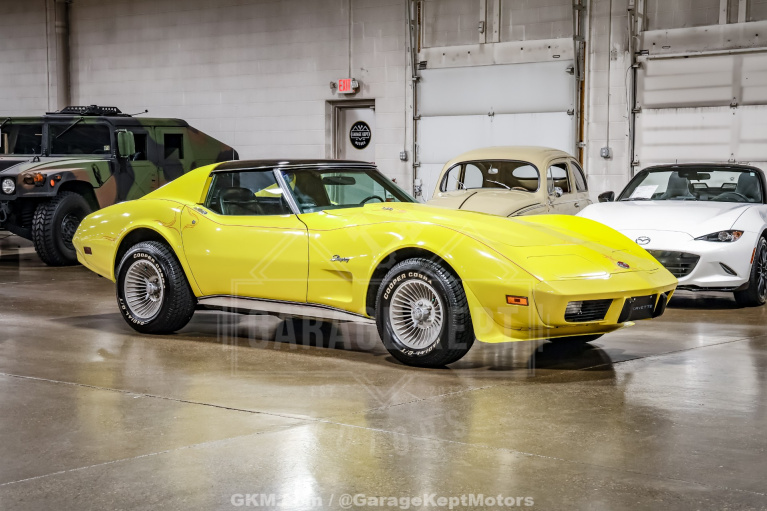
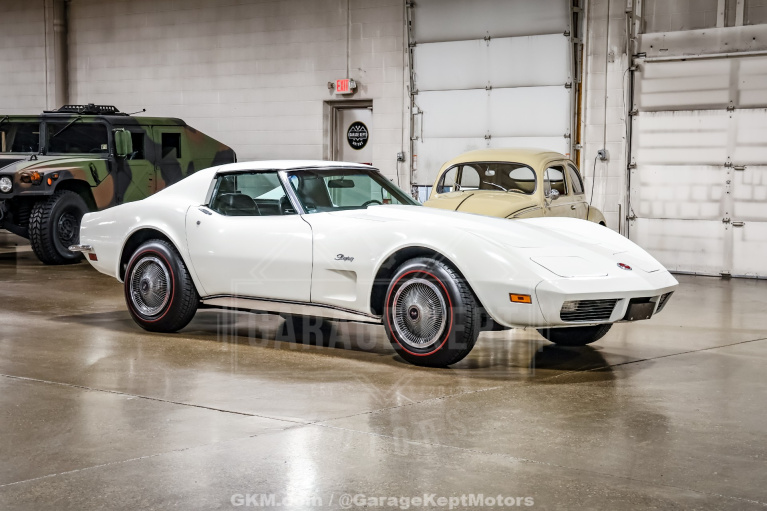
C3 (1968–82). Mechanically a C2 underneath — the chassis carried over almost unchanged — wearing Bill Mitchell's dramatic coke-bottle body. T-top coupes dominate; convertibles ran only to 1975. The generation splits in three. The chrome-bumper cars (1968–72; the front bumper became urethane during 1973) hold the big-blocks and high-compression small-blocks, including the solid-lifter LT-1. The middle cars (1974–77) lost the big-block after 1974, gained catalysts in 1975, and traded speed for civility. The late cars (1978–82) gained fastback rear glass in 1978, pace-car and anniversary editions, the California-only 305 in 1980, and for 1982 only the Cross-Fire engine and a standard four-speed automatic. The edition cars were stored in numbers as instant collectibles, so low mileage on a late C3 proves little: a stored C3 still ages its rubber, brakes and vacuum system.
C4 (1984–96). A clean-sheet car: new chassis, transverse fibreglass leaf springs, rack-and-pinion steering, and a clamshell bonnet that opens the whole front of the car. Coupe first, convertible from 1986. The ladder runs from the 205 hp Cross-Fire car of 1984 through the tuned-port L98 (1985–91), the 300 hp LT1 (1992–96) and the 330 hp LT4 of 1996, with the 32-valve LT5 in the ZR-1 (1990–95) apart from everything. Early cars ride harshly; the 1988-onwards cars and above all the LT1 cars are the developed product.
C5 (1997–2004). The gearbox moved to the rear as a transaxle, the chassis became a stiff hydroformed structure, and the LS1 brought an all-aluminium pushrod V8 lighter and stronger than anything before it. Coupe first, convertible in 1998, and a fixed-roof coupe from 1999 that became the Z06 in 2001 with the 385 hp, then 405 hp, LS6. These are fast, usable cars — old enough now that their electronic modules, not their engines, set the inspection agenda.
C6 (2005–13). An evolution of the C5 with exposed headlamps for the first time since 1962 and more power everywhere: LS2, then the 430 hp LS3 from 2008. The Z06 returned with a 7.0-litre LS7 and an aluminium frame; the ZR1 added a supercharged LS9; the Grand Sport of 2010 onwards paired the wide Z06 body with the LS3 and became the volume enthusiast choice.
C7 (2014–19). The last front-engined generation: direct injection on the LT1, cylinder deactivation on automatic cars, an available seven-speed manual with rev-matching, and magnetic ride control. The Z06's supercharged LT4 made 650 hp and exposed the car's cooling limits in sustained track use in its early years; the 2019 ZR1 answered with a 755 hp LT5 and serious cooling. The C7 was designed as an open car from the start, and the convertible is fully respectable structurally.


Engines and gearboxes
The small-block: Blue Flame six to the LT-1
Every Corvette story starts with an engine that was not a V8 at all. The 1953–54 cars use Chevrolet's 235 cu in Blue Flame six, a sturdy overhead-valve straight six with triple side-draft carburettors in Corvette tune, making about 150 hp and driving through a two-speed automatic. It is smooth, torquey enough at town speeds and hopelessly out of its depth as a sports car engine — and it is also correct, rare and increasingly valued in the earliest cars. Do not pay V8 money for a six, but understand that a 1953 or 1954 car is 1950s Americana to be driven gently, not a performance car. Parts for the 235 are ordinary Chevrolet sedan parts, which keeps running one cheap.
The small-block V8 arrived in 1955 at 265 cu in and grew through the classic sequence: 283 (1957), 327 (1962), 350 (1969), with the 305 appearing only as the California-market engine for 1980. This is the most developed and best supported engine family in the classic world, and its Corvette history is a ladder of induction systems. At the bottom, single four-barrel carburettors — Carter, Rochester Quadrajet, Holley on high-performance cars. In the middle, multiple carburettors: dual quads on the late-1950s cars, and the famous tri-power setup of three two-barrel Holleys on the 1967–69 big-blocks. At the top, from 1957 to 1965, Rochester mechanical fuel injection — the Fuelie.
The Fuelie deserves its reputation in both directions. The Rochester Ramjet system is a continuous-flow mechanical injection unit, driven from the distributor, metering fuel against airflow with a sophistication carburettors could not match. A correctly set-up injected 283 or 327 is sharp, clean and economical, and the 1957 rating of 283 hp from 283 cu in — one horsepower per cubic inch — was honest. But the system is intolerant of dirt, heat and inexpert adjustment: the metering unit's seals perish, the spider lines and nozzles clog with old fuel, and few general mechanics today can set one up from first principles. Budget for a specialist rebuild, realistically $1,500–3,000, and treat a Fuelie that starts instantly hot and cold as a car whose previous owner has spent that money for you. The identity trap runs both ways: units were removed in period and carburettors fitted, and units have been added since. The engine stamp and paperwork settle what it was born as; the unit on top settles only what it is now.
Within the small-blocks, know these peaks by name. The solid-lifter 327s of the C2 era, the L76 (365 hp) and the fuel-injected L84 (375 hp), are high-revving, cammy engines that dislike traffic and reward commitment. The LT-1 of 1970–72, a 350 with solid lifters and 370 hp gross in 1970, is the last of the classic high-performance small-blocks and the C3 engine connoisseurs choose. The L82 (1973–80) is the later performance option, and the L48 the standard low-compression workhorse fitted to most C3s: unstressed, tolerant and slow by modern standards. Judge a seventies small-block on health, not badge: compression evenness across all eight cylinders tells you more than any option code.
The big-block and the modern V8s: 396 to LT5
The big-block arrived in mid-1965 as a 396 rated at 425 hp and grew to 427 for 1966, then 454 for 1970. The Mark IV is a different driving experience from any small-block: heavier, lazier at low revs in mild tune, and overwhelming when the performance versions are opened up. The names that carry money are the L71 (427 with three two-barrel carburettors, 435 hp, 1967–69), the L88 (a racing engine sold for the road, 1967–69, aluminium heads, rated at a deliberately understated 430 hp and built in tiny numbers), the single-year ZL1 all-aluminium 427 of 1969, of which two production Corvettes are documented, and the LS6 454 of 1971 at 425 hp. Forgeries and tributes vastly outnumber real L88s and ZL1s; the correct posture for any claimed ultra-rare big-block is polite disbelief until factory documentation proves it. Ordinary big-blocks — the hydraulic-lifter 390 and 400 hp cars — are wonderful road engines and much better value, with two cautions: they run hotter than small-blocks in the same bay, and their extra weight over the front wheels is weight the chassis was not designed around.
Emissions law, not engineering failure, defines the next decade. Compression fell from 1971, ratings switched from gross to net in 1972, catalysts arrived in 1975, and by the late 1970s the standard engine made its power low down and ran out of breath early. These engines are not fragile — a low-compression 350 is understressed by definition — but they are strangled, and the fix owners apply is breathing and ignition work, not internal surgery. Check what has been done and whether it was done coherently.
The C4 restarted performance with electronics. The 1982 and 1984 Cross-Fire engine (L83) used two throttle-body injectors on a cross-ram manifold; it is reliable, modest at 200–205 hp, and sensitive to vacuum leaks and to the balance between its two throttle bodies. The L98 of 1985 brought tuned-port injection — long runners that make real low- and mid-range torque — and stayed to 1991, growing from 230 to 245 hp; its weaknesses are ageing injectors and intake gasket leaks. The LT1 of 1992 (no hyphen, and not the 1970 engine) brought reverse-flow cooling and 300 hp; the LT4 of 1996, manual-gearbox Grand Sport and Collector Edition cars only, made 330 hp. Standing apart is the LT5 of the ZR-1: a 5.7-litre, all-alloy, 32-valve, four-cam engine designed with Lotus and built by Mercury Marine, making 375 hp, then 405 hp from 1993. It is famously durable, and its costs live in its ancillaries and vacuum-operated secondary throttles. A ZR-1 that has lost its secondary system to a vacuum leak feels like a 250 hp car with a heavy nose; the fault is usually hoses and a pump under the plenum, not the engine.
The C5's LS1 and the engines that followed return to pushrods with modern everything: aluminium blocks, coil-near-plug ignition and sequential injection. The LS1 (345–350 hp) and LS6 (385, then 405 hp) are the C5 pair; the C6 added the LS2, the 430 hp LS3, the 7.0-litre LS7 of the Z06 (505 hp, dry-sump lubrication) and the supercharged LS9 (638 hp). The C7's LT1 added direct injection for 455–460 hp, the LT4 supercharged it to 650 hp, and the 2019 ZR1's LT5 combined a larger supercharger with both direct and port injection for 755 hp. Two cautions belong here. The LS7 has a documented pattern of exhaust valve-guide wear that can, in the worst case, drop a valve; a seller who can show guide work by a known specialist has spent real money (a full head correction typically runs into the low thousands of dollars), and a car with no evidence and a noisy top end deserves a specialist's wiggle test before money moves. And the supercharged C7 Z06 can overheat in sustained track running, particularly early automatic cars; road use is unaffected, but a car sold as a track tool should be judged on its cooling package and year.
Gearboxes
Manual gearboxes outnumber automatics in our pool by a wide margin, and the manual story is a good one. Early C1s offered a three-speed manual from 1955 and a Borg-Warner T-10 four-speed from 1957; the Muncie four-speed replaced the T-10 during 1963 and served through the C2 and into the C3, in wide-ratio M20, close-ratio M21 and heavy-duty M22 forms. The M22, the famous Rock Crusher, earned its name from the whine of its straighter-cut gears — a car that whines in the indirect gears and is quiet in top is behaving normally for an M22, while an M20 or M21 that whines like that has wear to explain. The Borg-Warner Super T-10 took over during the later 1970s. All of these boxes are strong, rebuildable for broadly $1,200–2,500, and judged the same way: second-gear synchromesh goes first, so test a fast, warm change down into second.
The C4 began with the Doug Nash 4+3 (1984–88), a four-speed manual with an automatic overdrive unit on the top three gears. It is now the gearbox buyers most fear, mostly through unfamiliarity: the overdrive unit needs its own fluid and filter service, its solenoids and wiring age, and a unit that engages and drops out erratically usually wants electrical diagnosis before mechanical condemnation. From 1989 the ZF six-speed transformed the C4; it is strong, heavy in its change and paired with a dual-mass flywheel whose failure presents as a rattle at idle and on shutdown — a reason many cars now run single-mass conversions that add gear rattle of their own. The C5 and C6 use rear-mounted Tremec six-speeds as part of the transaxle; the C7 offers a seven-speed Tremec with rev-matching. A vague change on a C5 onwards is often linkage and bushings, not the gearbox itself.
Automatics span the two-speed Powerglide of the C1 (the only gearbox on the earliest cars and a pleasant period piece, provided you accept period performance), the three-speed Turbo Hydra-Matic 350 and 400 of the C2 and C3 years, and the four-speed overdrive 700R4 — later 4L60 and 4L60-E — from 1982 through the C4 and C5. The C6 moved to the six-speed 6L80, and the C7 to the eight-speed 8L90. Judge any automatic on fluid colour and smell, on the delay engaging drive and reverse from cold, and on whether it hunts or flares between ratios under load. The C7 eight-speed's torque-converter shudder, a judder under light load like driving over a rumble strip, is a fluid-and-converter conversation, not a walk-away — but it must be priced, not ignored.
Problem areas
Everything in this section applies the same discipline: separate the faults that cost hundreds from the faults that cost the price of the car again, and learn the test that distinguishes them before you view. On a Corvette the expensive faults hide under a body that cannot rust, behind engines that almost never wear out, and inside vacuum and electronic systems whose symptoms imitate much worse diseases.
Frame, birdcage and structure: the steel under the fibreglass
This is the section that decides whether you buy the car at all. A Corvette frame is a conventional steel ladder or perimeter frame, and it rusts the way steel does — from the inside, where water and road salt collect, and worst where you cannot see without a lift, a torch and a screwdriver to prod with.
On C1 cars the frame is simple and inspectable, and the weak points are the rear crossmembers, the spring-mount areas and any section that has sat in wet grass or a damp barn. The C1 has no birdcage — the body is a fibreglass tub on the frame — so its structural story is frame and body mounts, both honestly assessable on a lift. Frame repair is ordinary fabrication; budget in the low thousands of dollars for localised section repairs, and walk away from a frame perforated in several places at once, because the repair becomes a body-off restoration whether you planned one or not.
The C2 and C3 add the birdcage: a steel structure forming the windshield frame, door hinge and lock pillars, rocker channels and cabin surround, to which the fibreglass panels are bonded. It rusts from the windshield frame downwards. Water gets past the windshield seal, runs inside the pillars, collects in the rocker channels and at the pillar bases behind the kick panels, and rots the cage while the outer fibreglass stays immaculate. The tells: rust staining at the windshield pillar bases; doors that drop on their hinges because their pillars have lost stiffness; rust flakes in the footwells when you pull the kick panels (two screws — ask, and do it); and a musty interior no cleaning explains. The frame concentrates its rust at the kick-up ahead of the rear wheels, the trailing-arm pockets and the rear crossmember. Prod there specifically. A seller who will not allow a lift inspection is telling you the result.
Repair economics are brutal and asymmetric. Localised frame work — a rear section, a crossmember — is fabrication in the $1,500–4,000 range depending on access. A rotted birdcage is a body-off, specialist, many-months job that routinely runs well into five figures and can exceed the finished value of all but the most collectible cars. That is the whole rule: on a C2 or C3, birdcage and frame condition is the price of the car. Everything else is negotiation.
The C4's steel uniframe and the hydroformed rails of the C5 onwards rust far less: check C4 floor sections, the rails around the battery tray, where acid accelerates everything, and look for accident damage on every generation — panel waviness in raking light, mismatched gaps, overspray on rubbers and disturbed bonding seams are the giveaways. A magnet is useless here; use your eyes down each flank.
Fibreglass, paint and weather sealing
Fibreglass fails differently from steel, and reading it is a learned skill. Stress cracks — fine, star-shaped or linear cracks in the gelcoat — appear at predictable load points: around the headlamp openings on C2 and C3 cars, at the bonnet-opening corners, around door handles and bumper mountings. They are cosmetic until they are not: a crack that has opened the laminate, feels soft under thumb pressure or shows filler feathered over a wide area will come back through new paint. Paint blisters on fibreglass for a reason steel never gives you: contamination or moisture in the laminate pushes the paint off from beneath, in bubbles that return after repainting unless the panel is stripped, dried and sealed. A full repaint to a lasting standard is one of the largest cheques in Corvette ownership — five figures at a specialist for show quality — which is why original paint with honest flaws beats fresh paint with no story.
Panel fit is your other witness. Corvettes left the factory with gaps that were good, not perfect. A car whose panels sit notably better than factory on one side and badly on the other has had work; a car whose T-tops or roof panel rocks, whistles or leaks has usually lost the adjustment battle to worn or incorrect weatherstrips rather than to body damage. Weatherstripping is a whole-car consumable: a full quality set for a C3 or C4, fitted, runs into the high hundreds of dollars, and cheap reproduction rubber that is too hard makes doors need slamming, which then cracks fibreglass at the mounting points. Convertible tops on C1 to C3 cars are simple frames with canvas; budget a four-figure fitted job if the canvas is torn or the rear window opaque, and always fold and raise the top on a viewing — a bent frame announces itself only in motion.
Urethane bumper covers on the 1973-onwards C3 and all C4 cars age by waving, cracking and losing paint adhesion, and original covers are now brittle enough that a parking tap can split one. On C4s the clamshell bonnet is a huge single moulding — check its edges and inner structure for cracks, because replacement and paint is a major cost. On C5 and C6 cars, headlamp lenses craze and yellow; on the C6 they are not cheaply separable, so price the whole lamp unit if they are bad.
Vacuum, electrics and the systems that imitate disaster
The C3 in particular runs on vacuum. Engine vacuum operates the headlamp doors, the wiper door on 1968–72 cars, the heater controls and assorted emissions devices, through a reservoir tank, colour-coded hoses, relays and actuators. When it leaks — and after forty-plus years, it leaks — the symptoms are theatrical: headlamps that rise slowly, one at a time, or wink up at idle; a wiper door that opens late; heater flaps that will not move. None of this is expensive in parts: hoses, seals and diaphragms are tens of dollars each; the cost is diagnosis time, and the test is systematic — a hand vacuum pump on each circuit in turn, isolating hose, relay or actuator. A car whose vacuum systems work crisply has been maintained by someone who understood it; a car with its headlamps propped open has been maintained by someone cutting corners you will meet again elsewhere.
The C2's hidden headlamps are electric, driven by motors whose limit switches and gears wear; slow or non-rising lamps are usually rebuildable motors and switches, not wiring disasters. On all classic generations the electrical pattern is the same: the wiring survives, the earths and connectors fail — dim lights and lazy gauges are earth-point work, cheap and tedious.
The C4 brought electronics to the foreground and they are now its defining problem area. The 1984–89 digital instrument cluster fails by LCD segment loss, fading backlights and power-supply solder joints; rebuilt clusters are an established trade, in the region of a few hundred dollars exchanged. The Bose speakers each carry their own amplifier and fail individually, giving you one hissing or silent corner at a time. Pop-up headlamp motors on the C4 and C5 share a famous cheap fault: three small plastic drive pellets inside the gear mechanism crumble with age, the motor runs but the lamp does not rise, and the repair is a few dollars in parts and an hour of your time — learn this one, because sellers price the symptom as a motor and you should not.
On the C5, the electronic brake control module develops solder-joint failures that light the ABS and traction warnings and disable those systems while the brakes themselves remain hydraulic and sound; specialist module repair is a few hundred dollars against a four-figure replacement. The steering column lock on early C5s can fail in the locked state — a car that cannot be steered is a tow, not a drive home — and most cars have had a bypass fitted; ask. C6 and C7 cars move the agenda to harmonic-balancer wobble (a wobbling crank pulley and chirping belt, shared with the C5), and on C7 automatics the 8L90 shudder already mentioned, plus active fuel management lifter failures that present as a tick, a misfire and a collapsed lifter — a cam-and-lifter job in the thousands, and a reason to listen to any AFM car carefully at idle.
Engines, cooling and the OptiSpark question
The pushrod V8s themselves — small-block and big-block, iron and alloy — are the strongest part of almost any Corvette. They wear slowly and announce real trouble plainly: bearing knock, low oil pressure hot, heavy breathing from the oil filler, blue smoke under load. The faults that fill workshops are ancillary. Cooling is first. A Corvette engine bay is tight, the radiators are low and, on C3s especially, easily starved of air by a missing chin spoiler — that small plastic air dam under the nose is a cooling component, not a trim piece, and its absence is a common cause of a car that creeps hot in traffic. Radiators silt, electric fans fail on C4 onwards, the C4 and C5 collect debris between radiator and condenser where you cannot see it without looking from underneath, and big-blocks run hot as a matter of character that owners chase with larger radiators when the real fault was ignition timing and a clogged core. The test is decisive: warm it fully, idle it ten minutes, then run at speed, watching whether the temperature stabilises or climbs.
The LT1 and LT4's OptiSpark deserves its own paragraph because it prices C4s. The distributor sits at the front of the engine, driven from the camshaft, directly under the water pump. When the pump's weep hole leaks, coolant falls straight into the distributor, and the optical sensor and cap fail with misfires, hard starting and stalling that come and go. Early units (1992–94) are unvented and more vulnerable; the 1995–96 vented design lasts better. The distinguishing signs: symptoms that worsen in wet weather, and coolant staining below the pump. Replacement is a several-hundred-dollar part with several hours of labour, and the professional answer is to replace the water pump at the same time. A late C4 that runs cleanly to its redline, hot, with no stumble, has passed the test that matters.
Fuel systems age by generation. Carburettor cars hate standing: ethanol-blended fuel attacks old rubber, varnish blocks jets, and the Rochester Quadrajet fitted to most seventies cars wears its throttle-shaft bushes, leaking air and ruining the idle. The Cross-Fire cars add throttle-body balance; the tuned-port L98 adds ageing injectors. A car that has sat for years needs tank, lines and filters treated as a system before it is run hard — recommissioning end to end is typically a $800–2,500 shop exercise, and skipping it converts a cheap car into a breakdown schedule.
Suspension, steering, brakes and tyres
The C1 rides on kingpin front suspension and a solid rear axle on leaf springs — pre-war architecture, honest and durable, maintained with a grease gun and judged by kingpin play and steering-box wear. Criticise slop beyond its design, which shows as wander no alignment cures. Drum brakes on all C1s demand the usual inspection: pull, fade, uneven wear, weeping cylinders.
The C2 introduced independent rear suspension — a transverse leaf spring with half-shafts that double as upper links — and it, with detail changes, served the C3 as well. Its wear points are the half-shaft universal joints, the trailing-arm front bushes, whose replacement is a specialist job because the shims and bolts seize solid, and the differential side yokes, whose wear shows as end-float and clunks on taking up drive. Disc brakes from 1965 brought a famous fault: the four-piston fixed calipers corrode in their bores, and slight disc run-out pumps air past the lip seals, giving a pedal that goes spongy weeks after bleeding. The permanent fix is stainless-steel sleeved calipers with O-ring pistons — roughly $600–1,200 for a set fitted — and a car that already has them has had an owner who fixed things properly. The steel leaf sags and can crack at its centre mount; fibreglass replacement leaves ride differently, which is a preference, not a defect.
The C4 and later cars use transverse fibreglass leaf springs; the leaves can delaminate or splinter at their ends after kerb strikes or jacking on the spring — never jack on a composite leaf — and the C4's Bilstein FX3 adjustable dampers and their actuators are a known cost when the warning light stays on. Wheel bearings from the C4 onwards are sealed hub units, replaced whole. Tyres deserve a warning: Corvettes wear wide tyres in staggered sizes on later cars, a full set is a four-figure purchase on C5 onwards, and old tyres on a low-mileage stored car are a safety item, not a saving — check date codes, not tread depth.
How to inspect one
Allow two hours for a serious viewing, bring a torch, a magnet for the frame (it works on the steel, just not on the body), a hand vacuum pump if the car is a C3, and a friend to work lights and pedals while you watch. Insist on a cold engine and, for any C2 or C3, a lift. The walk-away faults come first.
- Paperwork and identity first. Match the VIN plate to the title. On C1 cars the plate is on the driver's door hinge pillar; on C2 and C3 cars it is at the base of the windshield pillar, with a trim tag that decodes build date, trim and paint. Then check the engine stamp pad — the machined pad at the front of the right-hand cylinder bank carries the assembly stamp and, from the late 1950s onward, a derivative of the VIN. On a claimed matching-numbers, fuel-injected, big-block or LT-1 car, this stamp, the casting dates and the paperwork are the value; a re-stamp or a dressed-up base car is the commonest expensive fraud in this market, and no photograph settles it.
- Cold start. From stone cold, the car should start promptly — carburettor cars after the correct choke ritual, injected cars at once. A puff of blue on start-up that clears is valve stem seals; continuous blue under load is rings or guides. Listen for lifter clatter that does not fade (solid-lifter cars are noisy by design — judge them against another, not against silence) and for bottom-end knock before oil pressure rises.
- Frame and, on C2 and C3, birdcage. On the lift, work the frame front to back with torch and screwdriver: rear kick-ups, trailing-arm pockets, crossmembers, body mounts. Pull the kick panels and look at the birdcage pillar bases. Perforation in the cage, or a frame perforated in more than one zone, ends the inspection for all but the rarest cars — this is the structural test from the problem areas, and it outranks everything below it.
- Fibreglass and gaps. Walk the car in raking light, looking down each flank for waves and repair ripples. Check stress cracks at the headlamp openings, bonnet corners and door handles; press suspect areas for softness. Open and close every panel, raise the headlamps, fold the top on a convertible, fit the T-tops or roof panel. Check bumper covers for waves and splits, and look for overspray on every rubber.
- Cooling system, standing still. With the engine fully warm, let it idle ten minutes. The temperature should stabilise. Check the chin spoiler is present on C3 and later cars, look for debris packed ahead of the radiator on C4 and C5 cars, confirm electric fans cut in, and inspect hoses for softness or ballooning. A car that climbs steadily hotter fails here, however well it drove.
- The vacuum test (C3 especially). Work the headlamps up and down twice: they should rise together, promptly, and hold. Run the heater through every mode. Slow, uneven or sinking lamps mean vacuum leaks — price the diagnosis time, and use your hand pump on the reservoir circuit if the seller allows. On a 1968–72 car, cycle the wiper door too.
- Electrics sweep. Every gauge, window, blower speed, washer, horn and light. On a C4, study the digital dash for missing segments; on a C5, note any ABS or traction warnings (module repair, priced in the problem areas) and ask what column-lock bypass has been fitted. On an LT1 or LT4 C4, ask directly about the OptiSpark and water pump, and look for coolant staining beneath the pump.
- Under the bonnet, engine health. Pull the dipstick: level, colour, smell of fuel. Look into the oil filler for mayonnaise emulsion — short-trip condensation mimics head-gasket failure, and the distinguishing test is whether it clears on a long hot run while the coolant stays clean and stable. Check coolant and fluid colours, and the general standard of clips and wiring: a tidy bay is evidence, a scruffy one a warning.
- Suspension and steering on the lift. Rock each wheel top-to-bottom and side-to-side. On C2 and C3 cars, check half-shaft universal joints, trailing-arm bushes, differential yoke end-float and the transverse leaf for sag or cracks. On a C1, judge kingpin play against the design's tolerance, not a modern car's. Spin every wheel and listen for hub-bearing growl on C4 onwards.
- Brakes. Check disc condition and, on C2 and C3 cars, ask whether the calipers are stainless-sleeved; a firm pedal today on original calipers may still be the air-pumping fault from the problem areas, so ask when they were last bled and why. On a C1, budget for a full drum inspection. Test the parking brake — on disc-brake cars it is a separate small drum inside the rear disc, and often the most neglected brake on the car.
- The test drive. Twenty minutes minimum, town and fast road. A manual car should take a quick warm downchange into second without baulking; an automatic should engage drive and reverse without a long pause and change without flare. Feel for the C7 automatic's converter shudder at light throttle, and listen to any automatic C7 at idle for the tick of a failing AFM lifter. Note steering wander, brake pull and driveline clunks on and off the power.
- Heat, soak and restart. Park, switch off for ten minutes — the heat-soak test that finds vapour-lock, tired starters and Fuelie hot-restart faults — then restart. A car that will not restart hot has told you something its cold start concealed.
- Interior and weather sealing. Sit in both seats; C3 and C4 seat foam and bolsters collapse, and re-trimming is real money. Check carpets for damp (leaks plus birdcage suspicion on a C2 or C3), and price a full weatherstrip set if the doors need slamming. On stored late-C3 cars, remember that low mileage does not preserve rubber, brake hydraulics or fuel systems.
- Price the faults, then decide. List what you found in the order of the problem areas — structure, body, systems, engine ancillaries, chassis wear — with the job costs from those sections against each item. A Corvette with a sound frame and cage, honest paint and a list of small faults is a good buy at the right allowance. A beautiful car with a rotten cage is not a buy at any allowance you are likely to be offered.
Values
The Corvette market is really seven markets wearing one badge, and the first skill in reading it is refusing to average them. A price that would be suspiciously cheap for one generation is strong money for another, and a single exceptional car — a documented L88, a genuine 1953 — tells you nothing about the ordinary car in the next listing. Read the computed market block beneath this guide for the current figures, generation by generation where the listings allow, and use what follows to understand what those figures are made of.
Condition spread is wider on Corvettes than on almost any steel-bodied classic, for the structural reason this guide has repeated: the visible body cannot rust, so a car can photograph like a good car while carrying a frame or birdcage that makes it a project. That produces a long tail of apparently cheap cars that are cheap for cause, and it means the gap between a project and a sorted driver, and again between a driver and an excellent car, is larger than the listings make it look — because the listings sort by what photographs, and what matters does not photograph. When two apparently similar cars are priced far apart, assume the dearer car's seller is pricing steel you cannot see, and go and see it before deciding he is wrong.
Originality drives the second spread, and it is generation-specific. On C1, C2 and early C3 cars, matching numbers, correct casting dates, factory documentation and rare options — fuel injection, big-blocks, the LT-1, side exhausts — carry heavy premiums, and the market pays for proof, not claims. On late C3 cars the premiums attach to editions and preserved original cars. On C4 cars the ZR-1 and the 1996 editions stand apart. From the C5 onwards, specification, mileage, colour and history matter more than originality, and modifications usually narrow the next owner's market.
Asking prices and achieved prices part company most visibly at the top of each generation's range, where a seller prices the car he believes he owns — the tribute priced as the real thing — and the car waits. Auction results, which our market block records alongside listings, are the corrective, and the distance between a long-running asking price and a fresh auction result for a comparable car is the most honest negotiation document you can bring to a viewing.
The project-versus-driver gap follows the repair economics in this guide. A car needing birdcage or major frame work, or a full repaint over failed previous repairs, is not worth a sorted car minus a round sum — it is worth a sorted car minus the full, specialist-priced cost of that work, and minus a further allowance for the work you will find while doing it. Conversely, the faults that frighten casual buyers — vacuum leaks, caliper sleeving, an OptiSpark with a water pump, a digital dash rebuild — are bounded, priced jobs, and a car discounted heavily for them is where value hides. Buy the structure and the paperwork at full price; buy other people's small, diagnosable faults at a discount; and never pay a premium for low mileage on a stored car until you have priced the recommissioning storage always implies.
Parts and ownership
The Corvette is, by the standards of classic cars, an exceptionally well-supported machine — Chevrolet built them in the hundreds of thousands, the aftermarket is an industry in its own right, and for most generations you can buy everything from a screw to a complete chassis. The ownership skill is knowing where that support runs out, because it runs out in specific, predictable places.
Easy and cheap: service items for every generation; small-block and big-block engine internals, gaskets and rebuild parts; carburettors and their rebuild kits; suspension wear parts, universal joints, brake discs, pads and hydraulics for the classic generations; stainless caliper sleeving as an exchange service; weatherstrip and interior trim in reproduction for C1 to C4 cars; C5 and C6 service and wear parts through ordinary motor-factor channels. For a small-block car especially, you can keep the engine in perfect health for ordinary-car money indefinitely.
Harder and dearer: Rochester fuel-injection units and the specialists who rebuild them; correct, date-coded components for high-value C1 and C2 cars, where the price is set by scarcity, not function; birdcage sections and the labour to fit them; quality fibreglass panel work and paint; LT5 ancillaries and the vacuum system under its plenum; C4 digital clusters, Bose amplifiers and FX3 actuators (all rebuildable, none cheap enough to ignore); C5 electronic brake modules, where repair services now matter more than new-old-stock; C7 carbon-fibre and aluminium structural parts, which belong to a different cost world from the classic cars. The pattern is consistent: mechanical parts are plentiful, generation-specific electronics and correct cosmetic parts are where money and patience go.
Running a car. A sorted Corvette of any generation is a realistic regular-use classic — that was always the point of the car — but the first year with a neglected one has a shape you should budget for honestly. Catching up deferred maintenance on a running classic-generation car — brakes, hoses, belts, fluids, tyres by date, the vacuum and weatherstrip list — typically runs into the low thousands of dollars before you improve anything; recommissioning a stored car properly costs more again, and the problem areas give you the per-job shape of it. Fuel consumption tracks the generation: gentle teens for a big-block, high teens to low twenties for a small-block classic, and genuinely frugal motorway figures from the C5 onwards, whose overdrive gearing makes them the cheapest Corvettes to run ever built. The Corvette club scene is large and knowledgeable, and joining it is the best ownership investment after the purchase itself, because the person who has already solved your exact fault lives there.
Buy storage into your thinking too. A Corvette dislikes damp storage (the steel under it again) and old fuel, and rewards being driven: seals, brakes, vacuum systems and air conditioning all live longer in use, and a car exercised monthly will cost you less than one revived annually.
Which one to buy
- The first classic: a late C1, 1961–62. The most developed early cars — 327 power, four-speed manual, the prettiest rear styling of the generation — in a simple, inspectable package with no birdcage to fear. A 1956–57 car is the connoisseur's version of the same advice.
- The collector core: a C2, 1965–67. Disc brakes, the full engine ladder from sweet 327 to 427 big-block, and the strongest long-term following in the range. Buy the best-documented small-block you can afford before you stretch for a big-block with a story.
- The value muscle car: an early C3, 1968–72. Chrome bumpers, high-compression engines, the LT-1 if you can find a real one — at money that still reflects the generation's huge production. The cage and frame decide everything.
- The honest cruiser: a late C3, 1978–82. The shape, the comfort and the T-top experience at the gentlest prices in the classic range. Buy a used, maintained car over a stored low-miler, and spend the saving on brakes, vacuum and weatherstrips.
- The modern bargain: a late C4, 1992–96. LT1 power, a six-speed manual if you choose it, real handling and working air conditioning — the most performance per pound in this guide. The LT4 and Grand Sport cars are the keepers; the ZR-1 rewards an owner who wants exactly that specialism.
- The all-rounder: a C5 Z06 or a C6 Grand Sport. Genuinely fast, genuinely usable, economical on a run and supported by a modern parts trade. If you want one Corvette to do everything, it is one of these.
- The final statement: a C7, Stingray to ZR1. The last front-engined cars, and the most complete. A manual Stingray or Grand Sport is the driver's pick; the Z06 and ZR1 are supercars and should be bought with a supercar's inspection budget and cooling questions asked.
And the rule that overrides all of the above: buy the frame, the cage and the paperwork, and let the engine and the shine follow. Small-block Chevrolet engines can be rebuilt in any town in America; a rotten birdcage and an invented history cannot be fixed at any price that leaves you whole. The right generation, honestly bought, is the Corvette you will keep.
See the 1,358 Corvette cars currently listed.