
Chevrolet Corvette Coupe buyer's guide
Chevrolet Corvette Coupe -- the model's own buyer's guide: variants, values and what to check.
Years listed: 1963-2004 · Series: C2
Overview and history
The Corvette coupe is the closed half of America's sports car, and for long stretches of the car's life it was the better half to buy. From 1963 to 2004 — the span covered here — every Corvette generation offered a coupe alongside the convertible, and the coupe consistently gave you more: more structural stiffness from the fixed roof, more weather protection, more luggage security, and, in the later cars, a removable roof panel or a lift-off hatch that recovered most of the open car's appeal without its leaks and scuttle shake. If you are shopping the closed cars, you are shopping the sensible Corvettes — which is not the same as saying they are simple cars to buy well.
The story starts with the C2, the Sting Ray of 1963–67, designed under Bill Mitchell with Larry Shinoda's hand in the shape and Zora Arkus-Duntov insisting on the engineering underneath: independent rear suspension on a transverse leaf spring, four-wheel disc brakes from 1965, and a ladder frame that carried a fibreglass body. The coupe was new for 1963 — the first closed Corvette — and it arrived with the most famous styling accident in American car history, the split rear window, a centre spine that Mitchell loved and Duntov hated because it blocked the view out. It lasted one year. That single decision created the most collected Corvette coupe of all, and it also created the verification problem this guide returns to repeatedly: a 1963 split-window is worth so much more than a 1964 coupe that faked, converted and misdescribed cars are a permanent feature of the market.
The C3 followed for 1968–82, the longest-lived Corvette of all. The early chrome-bumper coupes of 1968–72 carried the big-block era to its peak — the 427 and then the 454, including the near-mythical L88 racing engine — and from 1968 the coupe came with removable roof panels and a removable rear window, the T-top arrangement that defined the model. After 1973 the bumpers went urethane, power fell through the emissions years, and the car settled into a long, comfortable cruise: the 1978 restyle added a fastback glass hatch area (a fixed glass back until the opening hatch arrived for the 1982 Collector Edition), and production volumes were enormous. A C3 coupe is therefore two different purchases depending on the year — an early big-block car is a collector object, a late car is an affordable classic you buy on condition alone.
The C4 of 1984–96 was a clean-sheet car: a one-piece removable roof panel on the coupe, a clamshell hood, aluminium suspension arms, and electronic engine management throughout its life. It matured from the cross-fire injected 1984 car through the tuned-port L98, the 1990–95 ZR-1 with its Lotus-designed, Mercury Marine-built LT5 quad-cam V8, and the LT1 and LT4 of the final years, closing with the 1996 Grand Sport and Collector Edition. The C5 of 1997–2004 moved the gearbox to the rear as a transaxle, put the LS1 and then LS6 V8 on an aluminium-intensive structure with hydroformed rails, and offered the coupe in two forms: the targa-roofed hatchback coupe and, from 1999, the fixed-roof coupe — first the cheaper hardtop, then the Z06, the stiffest and lightest C5 of all.
Across all four generations the buying logic is the same, and it is the reverse of most classics. The fibreglass body does not rust, so sellers say "rust-free" as if that settles the car. It does not. The steel frame, the steel birdcage structure inside the fibreglass, the suspension and the running gear all corrode, wear and age exactly like any other old car — they just hide it better. Buy a Corvette coupe on its frame, its identity numbers and its mechanical condition, in that order, and let the shiny fibreglass be the last thing that persuades you.
The models
Every coupe in this guide is a two-seat closed Corvette, but the badge on the nose tells you very little — the same body shell carried engines from a mild 250 hp small-block to a solid-lifter big-block that Chevrolet deliberately underrated. What follows is the map. Outputs are period gross ratings for the C2 and early C3 (net ratings from 1972 onward read lower for the same engine), and production figures are coupe totals where they are reliably recorded; treat any seller's rarity claim beyond this table as a claim to be verified against the trim tag and the build records, not repeated.
| Model | Years | Engine | Output | Built | Character |
|---|---|---|---|---|---|
| Sting Ray coupe (C2) | 1963–1967 | 327 small-block V8 | 250–375 hp | about 49,000 coupes | The design icon; 1963 split-window is the blue-chip car |
| Sting Ray big-block coupe (C2) | 1965–1967 | 396 / 427 big-block V8 | 325–435 hp | included above | The muscle Corvette; L88 and L71 cars are the summit |
| Corvette coupe (C3, chrome bumper) | 1968–1972 | 327 / 350 small-block, 427 / 454 big-block | 300–460 hp (gross) | about 90,000 coupes | Last of the chrome; T-tops from the start |
| Corvette coupe (C3, urethane bumper) | 1973–1982 | 350 small-block (305 in California 1980) | 145–230 hp | about 260,000 coupes | The volume classic; buy on condition, not rarity |
| Corvette coupe (C4) | 1984–1996 | 5.7 V8: L83, L98, LT1, LT4 | 205–330 hp | about 240,000 coupes | The modernising car; LT4 and Grand Sport are the picks |
| Corvette ZR-1 coupe (C4) | 1990–1995 | 5.7 LT5 quad-cam V8 | 375–405 hp | 6,939 | The exotic; a Lotus engine in a Chevrolet |
| Corvette coupe (C5) | 1997–2004 | 5.7 LS1 / LS6 V8 | 345–405 hp | about 148,000 hatch coupes | Targa hatch or fixed roof; Z06 is the driver's car |
| Corvette fixed-roof coupe / Z06 (C5) | 1999–2004 | 5.7 LS1 (1999–2000), LS6 (Z06) | 345–405 hp | about 32,000 | Lightest, stiffest C5; no removable panel to leak |
The C2 coupe (1963–67). The 1963 car is unique beyond the window: it is the only C2 with that rear treatment, drum brakes were still standard-fit thinking early in the run, and one-year-only parts run through the car. From 1964 the window became one piece, 1965 brought four-wheel disc brakes and the first big-block (the 396, replaced by the 427 for 1966), and 1967 — the last and most refined year, with its cleaner flanks and five-louvre wings — is the connoisseur's default. Small-block cars divide by tune: the base 327 is a sweet, usable engine, the fuel-injected 327 (the Rochester mechanical injection "fuelie") is the collector's small-block, and the solid-lifter 340 and 360/375 hp versions want an owner who enjoys valve adjustments. Side exhausts, knock-off style wheels and big-block bonnets were all options that later cars have acquired in the aftermarket — assume nothing bolted on is original until the paperwork says so.
The C3 coupe (1968–82). The 1968 car is the rawest C3, with one-year details and teething troubles; 1969 is the sorted early car. The performance summit is the big-block line: the L71 427 with triple two-barrel carburettors, the aluminium-head L89 option over it, the L88 — a barely disguised racing engine sold in tiny numbers (216 built across 1967–69, coupes and convertibles together) with an aluminium head 427, a huge Holley, no radio and a factory warning about pump fuel — and the LS6 454 of 1971, the last of the high-compression monsters. The LT-1 small-block of 1970–72 is the thinking driver's early C3: solid lifters, a high-rise manifold and the best balance of any of them. The ZR1 package of 1970–72 (not to be confused with the later C4) paired the LT-1 with heavy-duty brakes, suspension and gearbox for a few hundred cars. After 1972, power and compression fall year by year; the 1975 car is the slowest C3, and the interest in late cars is in special editions (1978 Pace Car and Silver Anniversary, 1982 Collector Edition with its opening hatch) and in honest, unmodified survivors.
The C4 coupe (1984–96). There is no 1983 Corvette for the public. The 1984 car is cross-fire injected and best bought as a period piece; the 1985 tuned-port L98 transformed drivability, and the L98 improved steadily to 1991. The LT1 of 1992–96 is the better engine again — more power, reverse-flow cooling — and the 1996 LT4, manual-gearbox only, with the Grand Sport's flared rear arches and hash marks, is the collector C4 alongside the ZR-1. Convertibles returned in 1986, but the coupe with its one-piece targa panel remained the volume car and the stiffer shell.
The C5 coupe (1997–2004). Two coupes, two characters. The hatchback coupe has the removable targa panel and the big glass hatch — the practical tourer. The fixed-roof coupe of 1999–2000 was the budget, lightest C5, and from 2001 the same shell became the Z06: LS6 engine, thinner glass, titanium exhaust, uprated FE4 suspension and no targa option at all. A 2002–04 Z06 is the performance bargain of this entire guide in capability terms, and the one most likely to have been driven as intended — inspect accordingly.


Engines and gearboxes
The small-blocks: 327, 350, L98, LT1, LT4 and LS
The Chevrolet small-block is the most supported classic engine on earth, and in the Corvette it appears in more states of tune than anywhere else. The C2's 327 (5.4 litres) came at 250, 300, 340 and 365 hp in carburetted form and up to 375 hp with Rochester fuel injection — the differences are camshaft, compression, heads and induction, all of them verifiable from casting numbers and the stamped pad at the front of the right-hand block face, which carries the assembly date and suffix code for the original application. That pad is the first identity check on any premium-priced early car: a correct suffix does not prove originality (pads can be restamped), but a wrong one disproves it instantly.
The Rochester injection itself deserves respect rather than fear. It is a continuous-flow mechanical system driven from the distributor, metering against airflow through its air meter; when it is set up by one of the few specialists who still calibrate them, a fuelie starts cleanly, idles and pulls hard. When it is wrong, the symptoms are rich running, fuel smells, hot-start flooding and hesitation — and the causes are usually wear and dirt in the spill plunger and nozzles, perished diaphragms, or decades of amateur adjustment, not the design. Budget a specialist calibration into any fuelie purchase; a full rebuild and calibration by a recognised name runs roughly $2,500–4,500, and a car with a recent invoice from one is worth a clear premium over a car "converted to a carburettor for reliability" — a conversion that also deletes a large part of the car's value.
The 350 that replaced the 327 for 1969 carried the C3 through every phase: high-compression LT-1 with solid lifters and a Holley on an aluminium high-rise (1970–72), then progressively detuned L48 base engines and L82 higher-output versions through the seventies, single-carburettor and throttle-body cross-fire (the L83 of 1982 and 1984, twin throttle bodies on a cross-ram manifold), then tuned-port injection on the L98 (1985–91), where long intake runners give the C4 its fat mid-range. The LT1 of 1992 reversed the cooling flow — coolant to the heads first — and added the Optispark distributor on the front of the engine, driven off the camshaft. The Optispark is the LT1's defining service item: it lives low at the front, directly under the water pump, and coolant from a weeping pump or oil from a tired front seal enters the unit and kills the optical trigger. Misfires, high-rpm breakup and sudden no-starts on an LT1 are Optispark until proven otherwise; a replacement unit fitted with the pump done at the same time is a $900–1,600 job at a shop, and you should ask when it was last done on any LT1 car. The LT4 of 1996 answered with higher compression, better heads and 330 hp — and the same Optispark caveat.
The LS1 of the C5 (1997) is a different engine entirely: all-aluminium, coil-near-plug ignition, a composite intake and deep-skirt block, and it is famously durable. The LS6 (Z06) adds a higher-lift cam, better heads, sodium-filled exhaust valves and a freer exhaust for 385 hp in 2001 and 405 hp from 2002. LS service points are covered under Problem areas, but the headline is good news: these engines do not wear out at mileages that would finish an early small-block, and their failure modes are electronic and accessory-led rather than fundamental.
The big-blocks and the LT5
The Mark IV big-block — 396 for 1965, 427 for 1966–69, 454 for 1970–74 — is why early coupes carry the money they do. In road tune (L36 427, L68, LS5 454) it is a hydraulic-lifter torque engine that pulls from idle and is no harder to live with than a small-block. The solid-lifter cars — L71 (427 with three two-barrel Holleys), L72, L78, L89 aluminium heads, LS6 454, and above all the L88 — are a different ownership proposition: valve lash to set, a taste for fuel, and values that rest entirely on documentation. The L88 in particular was underrated at 430 hp to discourage road use; it has aluminium heads, a 12.5:1 compression ratio, a radical cam and an 850 cfm Holley, and it left the factory without a radio or heater in most cases. Fewer than a handful of specialists can authenticate one, the supporting paper trail (tank sticker, build sheet, protect-o-plate, original window sticker) is the value, and an undocumented "L88" should be priced as what it provably is: a big-block coupe with a story.
The LT5 in the C4 ZR-1 (1990–95) is the outlier of the whole range: designed with Lotus, built by Mercury Marine in Stillwater, Oklahoma, an all-aluminium 5.7-litre quad-cam 32-valve V8 with a two-stage intake and a valet key that switches between full power and a restricted mode by disabling the secondary intake runners and injectors. At 375 hp (1990–92) and 405 hp (1993–95) it revs to 7,000 rpm and is, in service, remarkably robust — the bottom end almost never gives trouble. Its known costs are secondary-injector and vacuum-system faults under the plenum (a nest of vacuum lines and actuators whose failure shows as a car that will not make full power, often with the secondary system simply never opening), coil packs, and the sheer scarcity premium on LT5-specific parts. A ZR-1 that makes clean full power on the key, with evidence the plenum has been off and the vacuum system renewed, is worth more than a lower-mileage car with no such evidence.
Gearboxes
Manuals dominate the early cars and the enthusiast end of the later ones. The C2 and C3 use the Muncie four-speed — M20 wide-ratio, M21 close-ratio and the heavy-duty M22 "rock crusher" with its straight-cut whine, fitted to the big solid-lifter cars — and the Muncie is a strong, rebuildable box whose enemies are worn synchromesh on second and third and sloppy external linkages that make a good box feel like a bad one. Always price linkage adjustment before gearbox surgery: a Muncie rebuild runs roughly $1,500–2,800, while a linkage bush kit is pocket money. Base C3s also came with a Saginaw three-speed early on and a Borg-Warner Super T-10 four-speed from the mid-seventies; both are honest boxes, neither is a value feature. Automatics on early cars are the two-speed Powerglide (to 1967) and then the three-speed Turbo Hydra-Matic — TH400 behind big-blocks, TH350 behind most small-blocks — both tough, both cheap to rebuild ($1,800–3,000 fitted) relative to the car's value, and both should engage drive and reverse promptly and shift without flare.
The C4 manual story has a trap in it. From 1984 to 1988 the manual option is the Doug Nash 4+3: a four-speed with an automatic overdrive unit on the back, controlled electronically. When serviced it works; neglected, the overdrive unit fails and parts and knowledge are thin — many cars have been converted to later boxes, which is a drivability gain and an originality loss. From 1989 the ZF six-speed is a superb, strong gearbox with one known cost: it was designed around a dual-mass flywheel, and when that flywheel fails or is replaced with a solid conversion, gear rattle at idle appears — noise, not damage, but sellers rarely explain it well. The C4 automatic is the 700R4/4L60 family, a four-speed overdrive box that lives or dies on fluid changes and correct TV cable adjustment on the early version — a misadjusted cable burns the box up in short order, so a C4 automatic that flares on the 2–3 shift needs a careful answer about its service history.
The C5 moved the gearbox to the rear: a Borg-Warner/Tremec T56 six-speed manual transaxle or a 4L60-E automatic transaxle, with the torque tube carrying drive from the engine. The T56 in the Z06 (M12) has shorter ratios. Manual C5s use a remote shifter whose feel degrades with worn linkage and tired transaxle mounts — again, cheap causes first. Clutch replacement on a C5 is a transaxle-out job and priced accordingly, roughly $2,000–3,000 at a shop, so a slipping clutch is a negotiation item, not a surprise to discover afterwards.

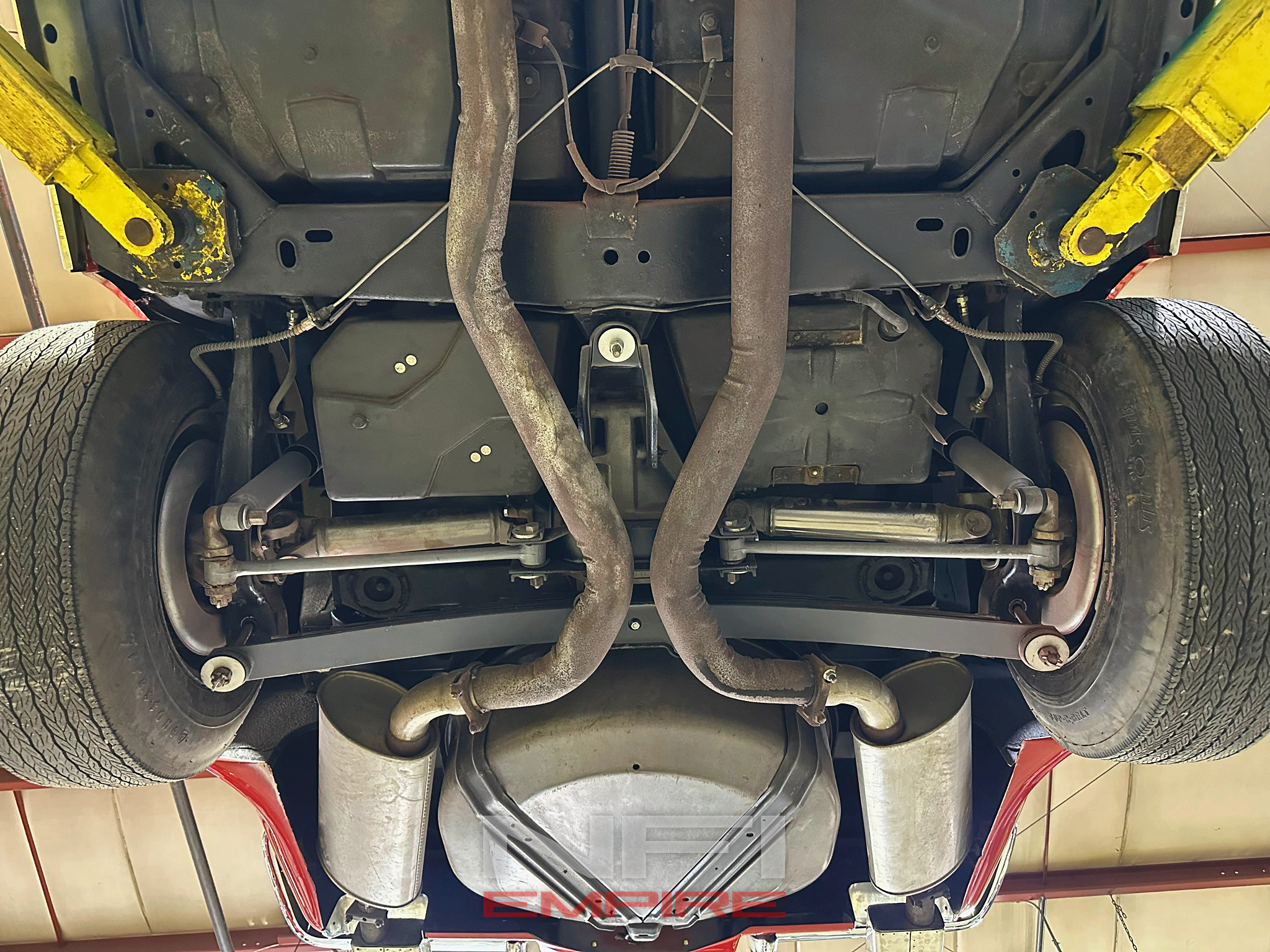
Problem areas
Everything in this section follows one principle: on a Corvette the body lies and the structure tells the truth. In our own store's photo-checked pool for this model — 1,923 cars examined — rust is mentioned in only 21 photo notes, leaks in 6 and visible damage in 30. Read that correctly: it does not mean these cars do not rust. It means sellers' photographs almost never show you the places where they do. The frame and birdcage checks below are the whole game on the steel-chassis cars, and on the later cars the equivalent discipline is electronics, roof seals and accident history.
Frame, birdcage and fibreglass: the rust the body hides
A C2 or C3 sits on a perimeter steel ladder frame, and the body tub is wrapped around a welded steel skeleton — the birdcage — that forms the windscreen frame, the door pillars, the sills and the structure around the cabin. Both rust, and the birdcage is the worse of the two to fix because the fibreglass has to come apart to reach it.
The frame. Work from the back: the rear crossmember and the sections just ahead of the rear wheels — the kick-up rails over the axle — are the classic rot points, fed by road spray and trapped mud. Prod the rails with a screwdriver, look for flaking scale inside the rail sections, previous patch plates and wavy, swollen metal. The front crossmember under the radiator and the areas around the suspension pick-ups follow. Surface rust on a frame is normal and treatable; perforation in the kick-ups or around suspension mounts is structural welding, and a frame-off repair on a C2 or C3 is a five-figure decision — realistically $8,000–15,000 and up once the body is off and everything disturbed is renewed, which is why a rotten frame on a mid-value car is a walk-away, not a discount.
The birdcage. The windscreen frame and A-pillars rust from water sitting in the header and running down the pillars; the sill sections rust from below. The tells, in order: rust staining or bubbling at the base of the windscreen pillars and around the windscreen seal; a windscreen that has been resealed repeatedly; water in the footwells after rain; doors that drop or catch because the structure around the hinges has softened; and, on a lift or with the sill covers off, flaking at the cage's lower rails. Shine a torch up behind the kick panels and look at the number 2 body mount area behind the doors — a known trap on C3s. Birdcage repair is specialist fibreglass-and-steel work priced per car, routinely $5,000–12,000 for pillar and header work done properly, and it is the single most common way a "rust-free fibreglass car" becomes an economic write-off. If you check nothing else on a C2 or C3 coupe, check this.
The fibreglass itself. Fibreglass does not rust but it ages: stress cracks radiate from mounting points and around the headlamp openings and door handles; old repairs telegraph through paint as ripples and mismatched panel texture; and paint blisters from moisture and stripper damage in past repaints. A full quality repaint on a Corvette is a major cost — $12,000–25,000 for strip, repair and paint to a high standard — so original, tired paint is often worth more to you than fresh, cheap paint hiding fresh filler. C4 and C5 panels are SMC (sheet moulding compound) rather than hand-laid fibreglass and crack differently — sharp impact cracks rather than crazing — but the rule is identical: price the paint honestly before you fall for the shape.
C4 and C5 structure. The C4 uses a steel perimeter structure with a bonded and bolted body; check the floor pans (steel on early C4s, and they do rust), the frame rails for accident straightening and the hood and door apertures for panel gaps that say the car has been hit. The C5's hydroformed rails are strong and resist rot well; the check is accident history — look for replaced rails, non-factory welds and overspray, and read the car's electronic fault history as part of the same conversation.
The coupe roof: T-tops, targa panels, hatches and the fixed roof
This is the coupe-specific section, and it is where closed Corvettes spend their owners' money quietly, year after year.
C3 T-tops (1968–82). Two removable glass or fibreglass panels over a centre T-bar. The failure chain is always the same: the weatherstrips harden and shrink with age and sun, the panel latches wear and let the panel sit fractionally low or crooked, and then water finds the path — first a drip at the front corners onto the occupants' knees, then a steady leak that runs down the A-pillars and into the footwells, quietly feeding the birdcage rust described above. A T-top leak is never just a leak; it is a rust delivery system. Test with a hose, not with optimism: five minutes of water over the roof of a car with tired seals will show drips at the header, the T-bar and the rear of the panels. A full weatherstrip set for a C3 is a few hundred dollars in parts ($250–450) and a weekend to fit carefully; the skill is in adjusting the latches and shims so the panels compress the new seals evenly. Glass T-tops (standard later, and the mirrored aftermarket-style panels) crack if dropped and are getting expensive to replace; check the edges and the bonding of the latch hardware to the glass. Also check the storage bags and the rear compartment — panels that have lived unbagged carry scratched, chipped edges. The 1968–77 cars also have a removable rear window: its frame and seals are another leak path and another check, and the window should be present, un-cracked and latching.
C4 targa panel (1984–96). One large panel, acrylic or fibreglass, bolted at four points with a dedicated ratchet tool. Three faults dominate. First, the acrylic panels craze and delaminate — a milky, cracked appearance that is the panel itself dying, not dirt; a replacement panel is $800–1,400. Second, the weatherstrips (a single expensive set around the whole aperture, roughly $400–700 in parts) perish and the car leaks at the A-pillars and header exactly like a C3. Third, the panel and its mounts creak and flex if the four bolts are unevenly torqued or the mounting brackets are cracked — and a coupe driven hard with the panel out flexes noticeably, which is why the factory sold a targa brace and why persistent squeaks deserve a look at the brackets rather than a shrug. Always remove and refit the panel on a viewing: seized bolts, crossed threads and a panel that does not sit flush are all bargaining facts, and check the car comes with the ratchet tool.
C5 targa and hatch (1997–2004). The hatch coupe's panel latches rather than bolts, and its seals last better, but the same hose test applies, with one addition: the big rear hatch. Check the hatch glass for delamination at the edges and a working demister, the struts (a hatch that will not stay up is a $60–120 pair of struts and a five-minute fit, but it tells you about maintenance), and above all the water channels around the hatch aperture — leaves and debris block the drains and water then enters the rear compartment, where on a C5 it finds electronics. The fixed-roof coupe and Z06 delete all of this, which is a genuine part of their appeal: no panel, no seals, no leaks — but check the fixed roof's bonding and the headliner for sagging, and remember the trade: you cannot open it, ever, so buy one only if you have made peace with that.
Headliners and interior roof trim, all generations. Coupe headliners sag when the foam backing of the fabric dies of heat — on a T-top C3 the trim panels around the aperture also warp and crack, and on C4s the panel's own headliner pad and the halo trim age the same way. A sagging headliner is a $300–700 retrim; warped or cracked T-top trim panels are a parts hunt. Look up on every viewing — most buyers never do.
The 1963 split-window, specifically. The centre division is fibreglass and glass, and conversions exist in both directions: 1964 cars converted to split-window to chase the premium, and genuine 1963 cars converted to one-piece glass in period when owners tired of the blocked view (some were later converted back). The verification is layered: the VIN must be a 1963 coupe VIN (the coupe body style code in the VIN, and the car must fall in the 1963 sequence); the trim tag under the glovebox door must agree on year, coupe body and trim; and the fibreglass around the rear aperture should be examined for the seams and layering of a conversion — a factory split-window surround is one moulding, a conversion shows its joins to a practised eye and often to an unpractised one under the headliner and trim. Any doubt at all means an independent NCRS-experienced inspection before money moves. The premium is too large for trust.
Suspension, steering, brakes and wheels
C2/C3 front suspension is double wishbones with coil springs and a well-earned appetite for wear parts: ball joints, control-arm bushes and the idler arm. The steering is recirculating ball, with power assistance by a ram system (control valve and cylinder) that leaks from the valve and hoses as a matter of age — a damp ram and valve is normal seepage, a drip is a rebuild ($600–1,100 for valve, cylinder and hoses done together). Play at the wheel is usually a chain of small wears — rag joint, box adjustment, idler — rather than one big one. The rear is the famous independent layout: a transverse nine-leaf steel spring (or the optional monoleaf on later C3s) with half-shafts that double as suspension links, so universal joints and the differential side yokes are suspension components: worn UJs and end play in the yokes show as clunks and wandering camber. Trailing-arm bushes and, above all, the trailing-arm mounting pockets in the frame rot and wear together. A C3 that clunks over bumps and tramlines is usually trailing-arm and yoke wear, and a proper rear rebuild (trailing arms rebuilt with new bearings, bushes, UJs) is $2,500–4,500 at a shop — price it in.
Brakes, C2/C3. Four-wheel discs from 1965 (drums were standard on the earliest 1963 cars, discs optional thinking that became standard for 1965) with a famous flaw: the fixed four-piston calipers flex and, with any rotor run-out, pump air past the seals — the "air pumping" that gives a long pedal after a drive. The permanent fix is calipers sleeved in stainless steel with O-ring pistons; a car already sleeved is worth more. Lip-seal calipers also leak after sitting, so a car fresh from storage with a low pedal and damp calipers is showing you its first recommissioning bill: a full sleeved-caliper set fitted with hoses runs $900–1,600. C4/C5 brakes are modern sliding-caliper systems and give modern service; the C4's parking brake (a lever that pretends to be a racer's fly-off handle) and the C5's drum-in-hat parking brake both seize through disuse.
C4/C5 suspension specifics. C4s ride on transverse composite leaf springs front and rear; the front spring can delaminate at its pads, and the FX3 adjustable dampers (where fitted) fail expensively — check the system cycles and budget ordinary dampers as the fallback. Wheel bearings on C4s are sealed hub units, replaced whole. The C5 uses double wishbones and composite springs again, with the well-known harmonic balancer wobble on the LS engine (see below) more likely to strand you than anything in the suspension. On both cars, budget for tyres by size and age, not tread: wide, low-profile rubber in Corvette sizes is a four-figure set, and ten-year-old tyres with full tread are still ten years old.
The LS harmonic balancer (C5). The crank pulley's rubber-bonded outer ring separates and the pulley walks forward or wobbles — visible at idle as a wobbling pulley face, audible as chirping belts. Left alone it damages the front cover and steering rack. A replacement with the later-style bolt and pinning runs $700–1,200 fitted. It is the first thing to look at in a C5 engine bay.
Electrics, electronics and air conditioning
C2/C3 electrics are simple and age simply: fuse boxes corrode, the bulkhead connector at the firewall corrodes, earth straps rot, and the result is dim lights, lazy wipers and gauges that lie. The fibre-optic lamp monitoring on 1968–71 cars is a curiosity that rarely survives intact and proves nothing either way. Vacuum does the work electrics do elsewhere: the pop-up headlamps on C3s (and the C2's rotating buckets, which are electric and whose motors and limit switches are the check) run on engine vacuum through a reservoir, actuators with perishable diaphragms and a small forest of hoses. Slow, uneven or winking headlamps are almost always vacuum leaks and actuator seals — a hose-and-seal renewal is $150–400 in parts and patience — not the motors. The same vacuum system runs the wiper door on 1968–72 cars and the heater controls, so one split hose can present as three faults.
C4 electronics are the car's defining ownership theme. The digital dashboard of 1984–89 fades, loses segments and goes dark from failed power supplies and backlight bulbs — rebuilt clusters are an exchange industry ($400–800). The Bose audio system's amplifiers (one per speaker) fail individually and hiss or fall silent; budget per corner. The C4's climate control heads, the anti-theft VATS system (a resistor pellet in the key whose contacts wear until the car will not crank — a no-start with a good battery and a security light is VATS until proven otherwise), and the early ABS all need function checks on a viewing: everything electrical, worked, one by one. The LT1's Optispark (covered above) is the other C4 no-start classic.
C5 electronics centre on the column lock and the grounds. The steering column lock recall saga means many cars carry a bypass; a car that still locks its column and shows "Service Column Lock" can strand you where you stand — ask what has been fitted. The C5 has a network of chassis ground points whose corrosion produces a carnival of unrelated electrical faults; cleaning grounds is the first fix in every C5 electrical diagnosis and costs nothing but time. The electronic brake control module (EBCM) on 1997–2000 cars fails with solder-joint faults and the early module is not supported the way the 2001–04 unit is — a "Service Active Handling" message on an early car is a specialist conversation, not a bulb. Air conditioning on all generations: C2/C3 systems are simple and leak at every seal after decades ($800–1,500 to recommission properly with a conversion to modern refrigerant done right); C4/C5 dual-zone controls and blend actuators fail in ways that need dash work. Cold air on the test drive, verified at the vents with the car hot, is the only acceptable evidence.
Interiors generally. Vinyl and leather on C2/C3 seats splits at the seams and the foam collapses; a full seat rebuild with covers and foam is $1,200–2,200 a pair fitted. C3 door panels warp at the top, C4 door panels crack at the armrest and the C4's rubberised interior coatings go sticky with age. C5 seats rock on worn track bushings — a known, cheap fix that sellers present as character. Carpets tell the leak story: damp or musty carpet in any coupe means water has been coming in, and on a C2/C3 that sends you straight back to the birdcage.


How to inspect one
Allow two hours for a steel-chassis car, ninety minutes for a C4 or C5, and bring a torch, a magnet in a cloth, a screwdriver for prodding (with permission), a hose if the seller will allow it, and a code reader for the later cars. If the car passes you, pay for a lift inspection by a Corvette specialist before money moves — on a C2 or C3 it is the best money in the whole purchase.
- Identity before everything. Match the VIN plate to the title. On a C2 the VIN is on a plate spot-welded to the steering column support bar under the glovebox; on a C3 it is on the driver's windscreen pillar, visible through the glass; C4 and C5 carry the standard dash plate plus door labels. Then the trim tag (under the glovebox on C2, on the driver's door pillar on C3) for build date, body, paint and trim codes — the codes must agree with the car in front of you. On any premium car, check the engine pad stamp and suffix against the claimed specification, and on a 1963 split-window apply the full verification from the roof section: VIN year and coupe code, trim tag agreement, and the fibreglass around the rear aperture.
- Paperwork and provenance. Build sheet (on a C3, often still on top of the fuel tank — the "tank sticker"), window sticker, protect-o-plate, NCRS or Bloomington judging sheets where claimed, and invoices. Documentation is worth real money on big-block, fuel-injected, ZR-1 and split-window cars and almost nothing on a 1979 base coupe — weight your effort accordingly.
- Cold start. Insist the engine is cold. A small-block should start cleanly and settle; watch for blue smoke at start-up (valve stem seals) and under load on the drive (rings), listen for lifter clatter that does not fade (cam wear on a flat-tappet engine run on modern low-zinc oil), and on a solid-lifter car expect mechanical noise — learn its normal before judging it.
- Frame and birdcage (C2/C3). Torch along both frame rails, prod the kick-up sections ahead of the rear wheels, the rear crossmember and the front crossmember. Then the birdcage: staining at the windscreen pillar bases, the header behind the trim, the number 2 body mounts behind the kick panels, and the sill sections. Perforation in the cage or kick-ups ends the viewing unless the price already assumes a frame-off car. This is the step the rust section exists to prepare you for — do not shorten it.
- The roof, with water. Remove and refit the T-tops, targa panel or hatch as applicable; check panel condition, latch operation and seal compression. Then hose the roof and hatch area for five minutes and look inside: header, T-bar, A-pillars, hatch channels. Drips now are leaks forever, and wet carpets afterwards send you back to step 4 on a steel-chassis car.
- Underneath on a lift. Suspension wear (ball joints, bushes, trailing-arm bearings and yokes on C2/C3), brake calipers for leaks and sleeving on early cars, frame condition you could not reach on the ground, exhaust, and every fluid leak traced to its source rather than its drip point. On a C5, look at the harmonic balancer face for wobble while an assistant starts the engine.
- The test drive. Twenty minutes minimum, mixed roads. A manual should engage every gear without crunching (second gear synchromesh is the test), an automatic should shift without flare and engage reverse promptly. Note steering play and wander (trailing-arm and yoke wear on early cars), brake pull and pedal feel after a few stops (air pumping on early calipers), and whether a ZR-1 makes full power with the power key on — if the secondaries never open, the vacuum system under the plenum is your first bill.
- Heat and electrics. Idle the car hot. Work everything: pop-up headlamps up and down twice (vacuum health on a C3), wipers and the wiper door, every gauge, windows, locks, the digital dash on an early C4 through all its modes, climate control hot and cold at the vents, and on a C5 read the onboard diagnostic codes through the dash display and note every one. A no-crank moment with a security light on a C4 is VATS; a column-lock message on a C5 is a walk-away-until-explained item.
- Body and paint. Magnet over the lower panels and around the wheel arches for filler depth, panel gaps at the doors and hood (C4 clamshell alignment is a whole conversation), stress cracks at the headlamp openings and handles, and on SMC cars the sharp cracks of impact damage. Price paint as the paint section sets out — original and tired usually beats fresh and hiding something.
- Interior and water evidence. Sit in both seats, feel for collapsed foam, check seat tracks (C5 rocking), carpets lifted where you can for damp and smell, headliner and roof trim looked at directly, and the rear compartment of a hatch car for water staining around the electronics. The interior is the car's diary: read it.
- Numbers again, calmly. With the car warm and the drive done, re-check the engine pad, the gearbox and differential codes if the car's price depends on them, and the date codes on big components. Fakes and swaps are discovered at this stage, not after the wire transfer.
- The decision rule. Add up what you have found as priced jobs — seals, calipers, trailing arms, Optispark, balancer, cage work — and compare the total honestly with the premium a sorted car commands. The Corvette market is deep enough that there is always another car; the exception is a genuinely documented rare specification, where the paperwork, not your enthusiasm, makes the decision.
Values
The build below this guide carries the live market — what coupes are listed at now and what recorded sales have achieved — and that block, refreshed at every build, is where the numbers live. What belongs here is how to read them, because the Corvette coupe market punishes skimmers more than almost any other classic market.
Start with the condition spread, which is wider than the model spread. Within a single year and engine, the distance between a tired, undocumented driver and a fresh, judged, documented car is routinely a multiple, not a percentage — and the listings mix both without labelling them. A cheap early coupe is almost never cheap for innocent reasons: the frame, the birdcage and the paint are the three five-figure conversations on a steel-chassis car, and a low asking price usually means at least one of them is waiting for you. Conversely, the top of each segment belongs to cars whose value sits in paperwork and originality — matching numbers, build sheets, judging awards — as much as in condition, and those premiums evaporate if the documentation does not survive scrutiny. Read every premium car as two purchases: the car, and the evidence.
Asking prices and achieved prices part company predictably. Auction results — the recorded-sales block is your guide — are the honest market for documented collector cars, and they consistently show sellers of ordinary drivers asking ahead of what the room will pay, then quietly meeting it. The project-versus-driver gap is the other structural feature: a non-running or long-stored coupe is not a driver minus a discount, it is a driver minus a recommissioning programme (fuel system, brakes, seals, tyres, everything rubber) whose cost surprises every first-time buyer, and the market prices projects accordingly — harshly, and usually correctly.
Variant premiums follow a stable logic. Within C2, the split-window carries its one-year premium, big-blocks sit above small-blocks, fuel injection above carburettors, and 1967 above its neighbours for equal specification. Within C3, the chrome-bumper cars — and among them the solid-lifter and big-block specifications — hold the collector premium, while the long urethane-bumper run trades on condition alone, with the recognised special editions (Pace Car, Collector Edition) carrying modest, specification-bound premiums that depend on the car still wearing its edition equipment. In C4, the ZR-1 and the 1996 Grand Sport and LT4 cars are the collected end and the base automatics the value end; in C5, the Z06 has been climbing out of the ordinary used-car trough on the strength of being the driver's car, while standard hatch coupes remain the cheapest route into genuine modern performance in this whole guide. Matching numbers matter in proportion to the car's place in that hierarchy: decisive on an L88 or a fuelie, a modest factor on a 1981 base car.
Negotiation reality: sellers of documented rare cars know exactly what they have and the room to move is small; sellers of mid-market drivers have usually priced in a negotiation whether they admit it or not; and the strongest lever you hold on any coupe is a priced list of the jobs from your inspection — cage work, a roof reseal, an Optispark, a balancer — presented as arithmetic rather than opinion.
Parts and ownership
The Corvette is the best-supported classic in America, full stop. Chevrolet built these cars in the hundreds of thousands, the reproduction industry is enormous — Corvette Central, Zip, Eckler's and a dozen specialists — and almost everything for a C2 or C3, from trim clips to complete interior kits to reproduction body panels, can be ordered today. The small-block and big-block engines are supported to a depth no other classic engine matches: every wear part, several quality tiers of it, and machine shops in every state that know them by heart.
Easy: all service items, brake components (including sleeved calipers on exchange), suspension wear parts, weatherstrip kits, interior soft trim, glass, exhausts, and for the C5 most mechanical parts including LS engine components, which share the vast LS aftermarket. Harder and dearer: correct date-coded components for judged cars (the premium is in the date, not the part), Rochester injection components and the calibration knowledge to go with them, LT5-specific parts for the ZR-1 (a small, dedicated supply chain — join the ZR-1 registry community early), 1963 one-year-only pieces, C4 FX3 damper components, early C5 EBCM modules, and good original chrome and stainless for the early cars. The standing costs: tyres in Corvette sizes are a real budget line on every generation; insurance is ordinary classic insurance for the early cars and surprisingly reasonable for C4 and C5 cars; and the first-year catch-up on a neglected car — fluids, rubber, brakes, seals, the jobs the inspection found — should be budgeted as a programme, not a surprise.
Running one is straightforward with two disciplines. Flat-tappet early engines need oil with adequate zinc (ZDDP) or a camshaft becomes a consumable — use a classic-formulation oil and change it on time. And drive the car: Corvettes deteriorate by sitting — calipers seize, seals dry, vacuum hoses crack, C4 and C5 electronics corrode at their connectors — faster than they wear out by use. A coupe in regular use is the cheapest Corvette to own, whatever its odometer says.
Which one to buy
- The all-rounder: C3 LT-1 coupe (1970–72). Solid-lifter small-block, chrome bumpers, T-tops, the best balance of performance, value and usability in the early cars — if you want one classic Corvette coupe to drive, this is the centre of the target.
- The blue-chip car: 1963 split-window coupe. Buy it as an investment-grade object: verified VIN, trim tag and fibreglass, documented history, judged if possible. Nothing else in this guide appreciates on mythology the way this car does — and nothing else is faked as often.
- The driver's classic: 1967 small-block coupe. The most developed C2, disc brakes, the sweet 327, and none of the 1963 premium. A fuel-injected car if the budget and the paperwork both stretch.
- The value buy: late C3 coupe (1978–82). Enormous supply, every part available, comfortable and honest. Buy the best-condition car you can find, ignore rarity talk entirely, and enjoy the cheapest classic Corvette motoring there is.
- The modern classic: C4 LT4 or Grand Sport (1996). Real pace, modern manners, the collected end of the C4 — or a ZR-1 if you want the exotic engine and accept its specialist ecosystem.
- The performance bargain: C5 Z06 (2002–04). The stiffest, lightest, fastest car in this guide, fixed roof, no leaks, LS reliability — the most capability per unit of money here by a wide margin, provided the balancer, clutch and column-lock history check out.
- The tourer: C5 hatch coupe. Targa panel for summer, a real luggage hatch, transaxle balance and LS economy on a run. The thinking person's everyday classic.
And the rule that overrides all of the above: buy the structure and the paperwork, and let the paint be the last thing that persuades you. On a steel-chassis car that means frame and birdcage before everything; on a later car it means electronics, roof seals and accident history. Engines, gearboxes, brakes and seals are all fixable at prices you can plan for — a rotten birdcage or a split-window that is not one cannot be fixed at any sensible price, and no shine on the fibreglass changes that.
