
Chevrolet Corvette Convertible buyer's guide
Chevrolet Corvette Convertible -- the model's own buyer's guide: variants, values and what to check.
Years listed: 1963-2003 · Series: C2
Overview and history
The Corvette convertible is not a coupe with the roof cut off. From 1963 to 2004 it is the open version of America's sports car, built on the same chassis and with the same engines as the coupe, but with its own body structure, its own failure modes and, in the market, its own logic. A buyer who shops for one as if it were a coupe will miss the things that actually decide what it is worth: the steel structure under the fibreglass, the folding top and its frame, the seals, and what water has been doing, quietly, for decades.
The story starts with the second generation, the C2 of 1963 to 1967 — the Sting Ray, offered as a convertible with a folding soft top that disappeared under a flush deck panel, plus an optional removable hardtop. The C3 that followed for 1968 kept the same chassis and idea, and the full convertible continued to 1975. Then it vanished: from 1976 to 1985 there is no factory Corvette convertible at all — any open C3 of those years is a conversion, and it must be priced and judged as one.
The convertible returned in 1986, in the middle of the C4 generation, launched as the Indianapolis 500 pace car replica and then as a regular production model to 1996. It returned again, after a one-year gap in which the new C5 was coupe-only, for 1998 to 2004. Those later cars are different in kind: power tops become normal, the C5 top is fully lined and insulated with a heated glass rear window, and the open car is engineered from the start of the programme rather than adapted. But the buying discipline does not change. The fibreglass body does not rust. Almost everything that holds it up, seals it and folds over it does.
That is why this guide spends so much of its length on structure and weather sealing. Our own store pool runs from 1963 to 2004, weighted to the early cars — C2 largest, then C3, then C4, with C5 at the younger end — and manual gearboxes dominate, red is the commonest colour, and a large share reach the market through auctions. Condition, not year, is the spread: two 1967 convertibles can be entirely different propositions, and the difference is rarely the engine. It is the birdcage, the frame, the top and the interior water reached first.
Buy the structure and the top first, the engine second. The rest of this guide is how to tell them apart.

The models
Every car in this guide is a two-seat convertible with a front-mounted V8, a fibreglass body on a separate steel frame — the C5 keeps a steel structure, with hydroformed rails — and rear-wheel drive. What changes across forty years is the generation, the engine family and how serious the factory was about weather protection. Read the table by generation first and by engine second; trim badges on a Corvette tell you far less than either.
| Model | Years | Engine | Output | Built | Character |
|---|---|---|---|---|---|
| Corvette Convertible (C2, small-block) | 1963–1967 | 327 cu in V8, carburettor or fuel injection | 250–375 hp | Part of about 72,400 C2 convertibles | The original Sting Ray roadster; the core of the early market |
| Corvette Convertible (C2, big-block) | 1965–1967 | 396 / 427 cu in V8 | 390–435 hp | A minority of C2 convertibles | Heavy, violent and valuable; identity checks are everything |
| Corvette Convertible (C3, chrome bumper) | 1968–1972 | 327 / 350 small-block, 427 / 454 big-block | 300–435 hp gross, falling to net ratings | Part of about 70,600 C3 convertibles (1968–1975) | Long-hood drama; early cars the purest, last of the high-compression engines |
| Corvette Convertible (C3, soft bumper) | 1973–1975 | 350 small-block, 454 big-block to 1974 | 145–275 hp net | The closing years of the C3 convertible | Softer, slower, cheaper; the last open Corvettes for a decade |
| Corvette Convertible (C4) | 1986–1996 | 5.7-litre L98, then LT1, LT4 for 1996 manuals | 230–330 hp | Tens of thousands across eleven model years | The convertible returns; a modern driver at classic money |
| Corvette Convertible (C5) | 1998–2004 | 5.7-litre LS1 | 345–350 hp | Tens of thousands across seven model years | Lined top, glass rear window, real refinement; the usable tourer |
(Outputs are period ratings: gross to 1971, net from 1972, so similar road performance can carry very different headline numbers across that line. Production totals are rounded convertible totals per generation; where a figure is not genuinely separable by engine, the table says so rather than inventing one.)
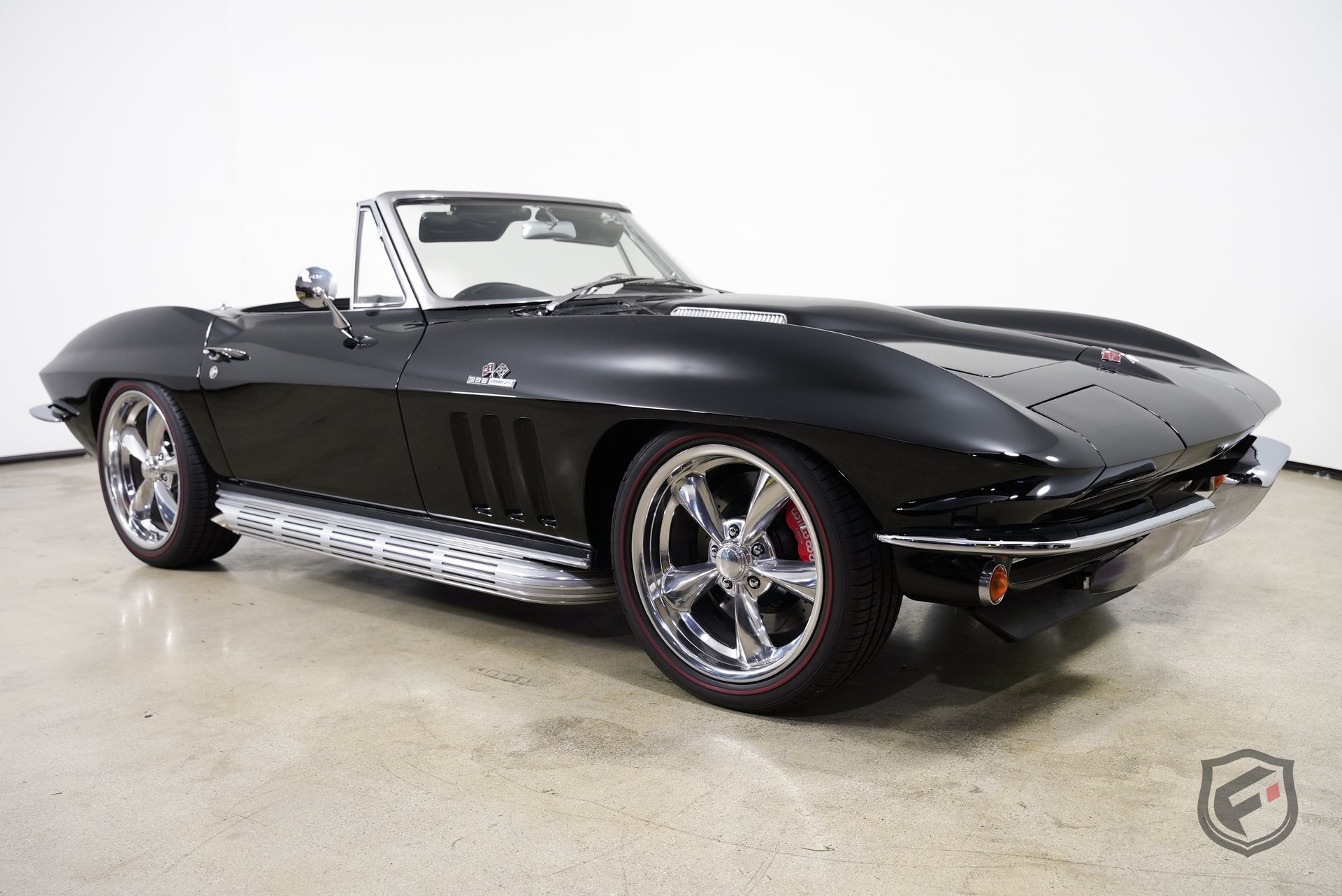
The C2 (1963–1967). The Sting Ray convertible is the car most buyers picture: concealed headlamps, four-wheel disc brakes from 1965, independent rear suspension throughout. The split rear window that makes 1963 coupes famous does not exist on a convertible, so do not let a seller price a 1963 open car off split-window coupe values. The sweet spot for most drivers is a 327 car — the L79 327/350 of 1965 to 1967 is light, revs freely and suits the open body. Big-block cars — 396, then 427s up to the tri-power L71 427/435 and the aluminium-head L88 — are collector cars first and drivers second, covered under identity checks below because the premium rides entirely on originality.

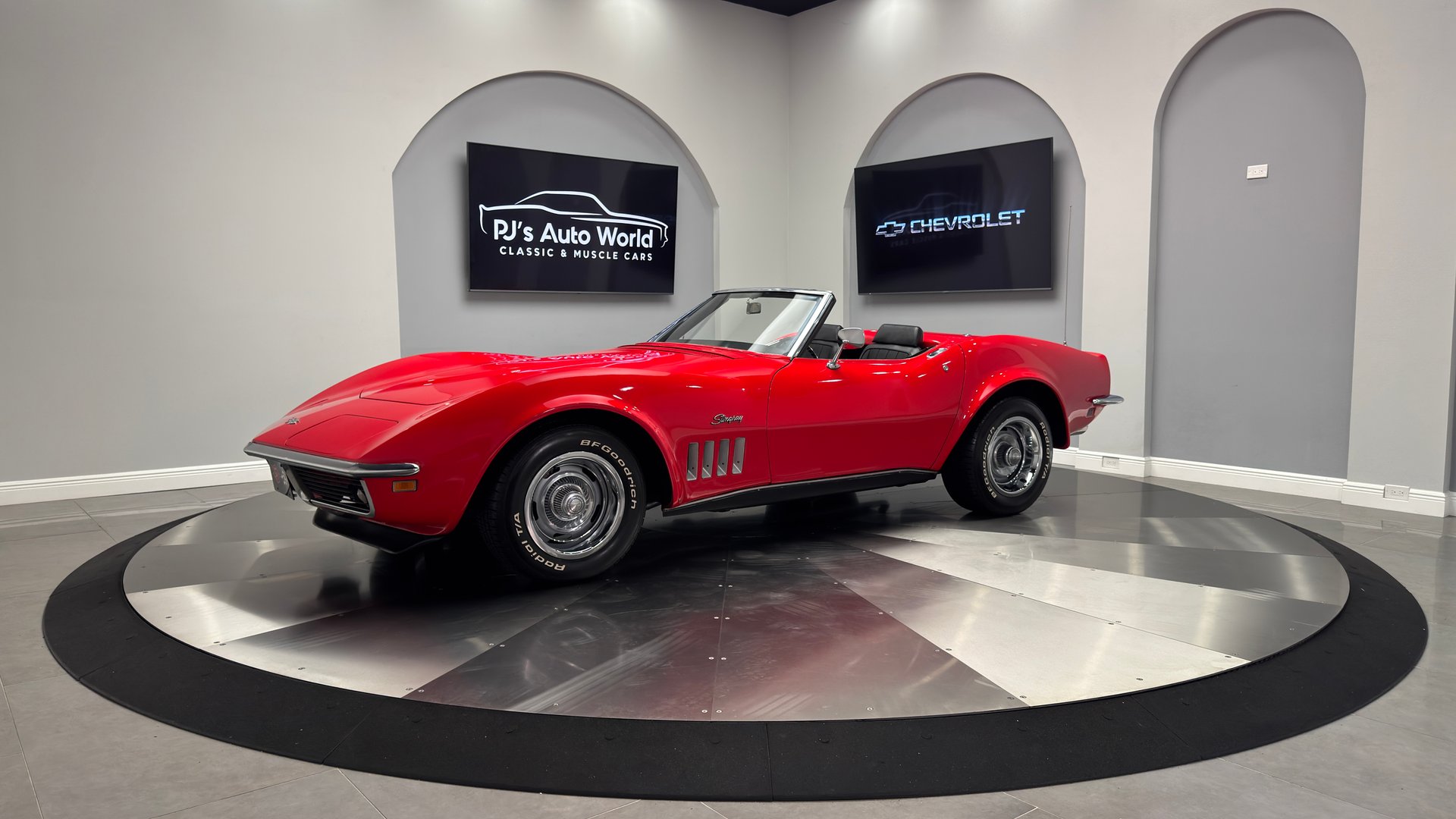
The C3 (1968–1975 as a convertible). The Mako Shark-styled C3 kept the C2 chassis under a longer, more dramatic body. Chrome bumpers mark 1968 to 1972 (the front went urethane for 1973, the rear for 1974). Early cars offer the full menu: small-blocks, big-blocks, the LT-1 350 of 1970 to 1972 and the 454s, LS5 and the rare LS6 of 1971. Then emissions controls, low compression and catalytic converters pull performance down year by year. A 1975 convertible — the last of the line — is a cruiser, not a muscle car, and often the cheapest honest way into an early open Corvette.
The gap (1976–1985). There is no such thing as a factory convertible in these years. Conversions exist, some done well by recognised firms and many done at home with a saw. A conversion loses the factory deck structure, usually loses torsional stiffness, and its top, if it has one, is a bespoke item with no parts support. Unless a conversion is documented, rare and priced far below a factory car, walk past it.
The C4 (1986–1996). The relaunch car was a yellow 1986 Indianapolis pace car replica, and every 1986 convertible was sold as one. The open C4 was engineered with extra underbody bracing — the X-brace bolted beneath the car is the visible sign. Engines track the coupe: tuned-port L98 to 1991, LT1 from 1992, LT4 for manual cars in 1996. One myth to bury: there is no factory ZR-1 convertible — the LT5-powered ZR-1 was coupe-only, and a convertible wearing its badges is a dressed-up LT1 or L98 car. From 1989 a factory removable hardtop was offered again.
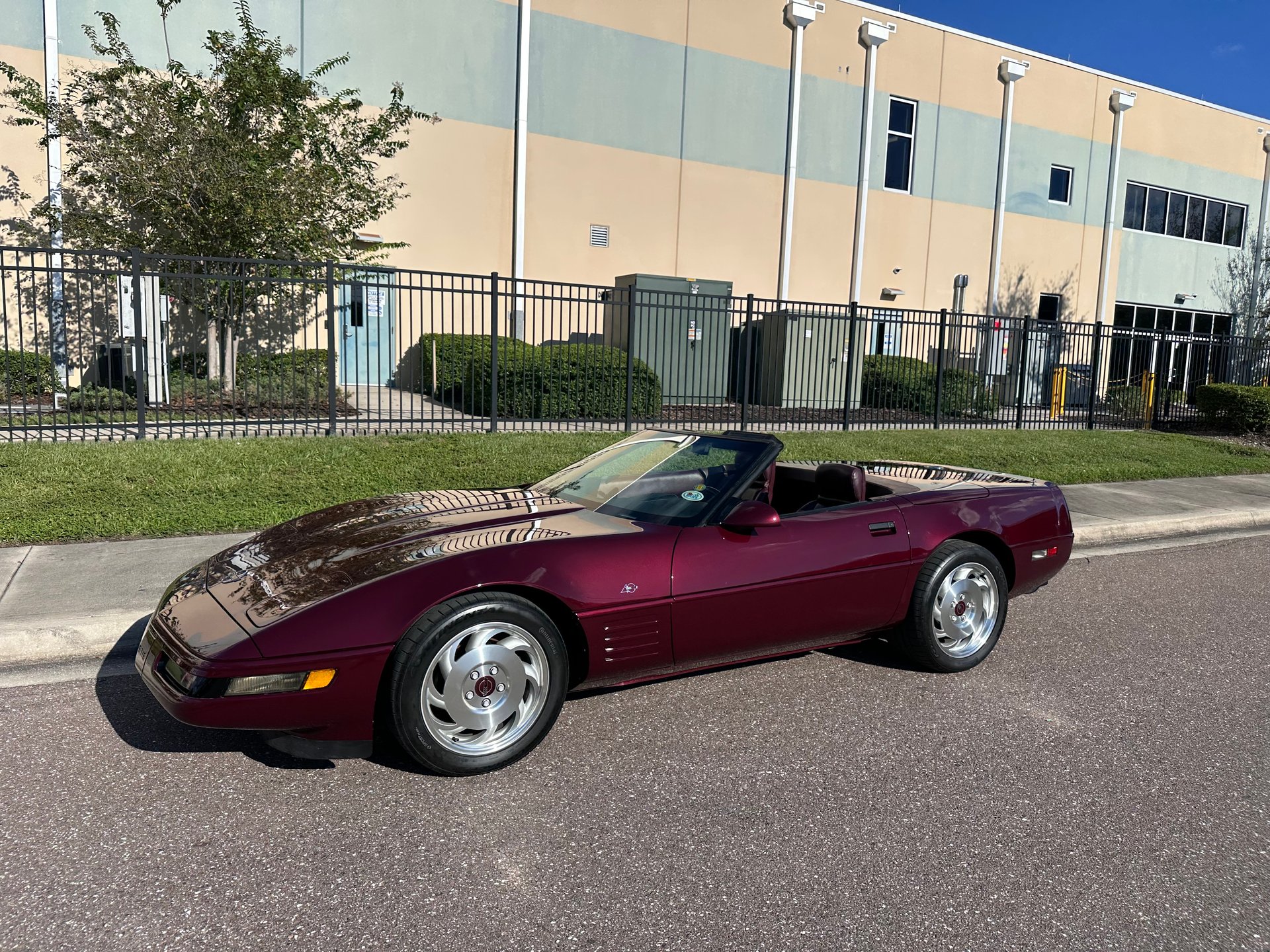
The C5 (1998–2004). The C5 convertible arrived a year after the coupe, on a structure stiff enough to need far less added bracing, and it shows on the road. The top is the big step: fully lined, insulated, with a heated glass rear window, folding manually (the fully powered top is a C6 feature — do not pay a C5 seller for a power top the car never had). All C5 convertibles use the LS1; the LS6 was reserved for the fixed-roof Z06, so again, badges lie and stampings do not.

Engines and gearboxes
The small-blocks: 327, 350 and the tuned-port and LT cars
The small-block Chevrolet V8 is the default Corvette engine for almost the whole period of this guide, and its reputation for toughness is earned. It is a cast-iron block and heads (with exceptions noted below), overhead valves, a single camshaft in the block and hydraulic lifters on most versions. A healthy one starts easily, holds steady oil pressure, pulls without hesitation and does not smoke. What kills them is rarely the bottom end. It is heat, neglect, old fuel systems and, on the later cars, the electronics and seals around an otherwise strong core.
The 327 (1963–1968). In the C2 the 327 came in a ladder of outputs that is really a ladder of camshafts, compression and fuel systems. The base 250 hp and 300 hp cars use a single four-barrel carburettor, mild cams and hydraulic lifters; they are flexible, quiet and the easiest early Corvettes to live with. The 340 and 365 hp cars add a solid-lifter cam, higher compression and a larger Holley carburettor; the 360 and 375 hp cars use Rochester mechanical fuel injection — the famous Fuelie unit. The L79 327/350, offered 1965 to 1967, is the connoisseur's small-block: a hydraulic cam that still revs, strong mid-range, none of the injection complexity. Judge a 327 on oil pressure hot at idle, on lifter noise that does not fade as it warms (a solid-lifter car is mechanically noisy by design — learn the sound before condemning it), and on the suffix stamped on the pad at the front of the right-hand block deck, ahead of the cylinder head. That pad carries the assembly stamp and, on an original car, the last part of the VIN. A pad that has been decked smooth during a rebuild has lost that evidence forever, which is why matching-numbers premiums evaporate on a skimmed block.
The Rochester fuel-injection unit attracts its own mythology. It is a continuous-flow mechanical system driven from the distributor, metering fuel against airflow. Set up by one of the few specialists who still understand it, a Fuelie starts cleanly and pulls harder than any carburettor car. When it is wrong: hard hot starting, a rich idle and percolation in summer heat — modern ethanol fuel makes hot restart worse than in period. The failure is seldom the unit itself; it is worn drive cables, a tired fuel meter and decades of well-meaning adjustment. A specialist rebuild and calibration is roughly $2,500–4,500, so a Fuelie with a recent invoice is worth a real premium and one that "just needs a tune" should be priced as needing the full job.
The 350 (1969–1996 in several lives). The 350 replaced the 327 for 1969. In high-compression form it made up to 370 hp gross in the solid-lifter LT-1 of 1970 to 1972 — aluminium intake, Holley carburettor, a cam that wants revs, and no air conditioning on early LT-1s. Then compression fell and cam timing softened, and by the mid-1970s the base L48 was a low-output emissions engine and the L82 the warmer option. Those later engines are weak in tune, not in structure: smoke on start-up is valve stem seals, smoke under load is rings, and a flat, asthmatic feel is more often a blocked catalytic converter or a Quadrajet needing a rebuild than a worn engine. A Quadrajet rebuilt properly — throttle-shaft bushes included, because worn shafts leak air and ruin the idle — is roughly $500–900.
The C4 gave the 350 two more lives. The L98 (1985 to 1991 in coupes, and in convertibles from 1986) uses tuned-port injection: long intake runners, strong low and mid-range torque, a ceiling at higher revs that is a design trait, not a fault. Its known costs are leaking intake and valve-cover gaskets, tired injectors — a full set of modern replacement injectors is roughly $400–800 in parts — and the general ageing of 1980s wiring and vacuum hose. The LT1 (1992 to 1996) is a different engine in detail: reverse-flow cooling, aluminium heads, sequential injection and 300 hp. It is stronger everywhere, and it carries one famous liability, the Opti-Spark distributor, mounted low on the front of the engine behind the water pump. When the water pump weeps, coolant runs straight into the Opti-Spark; when its seals age, oil and moisture follow. The presentation is a misfire, a stumble under load or a no-start that owners routinely blame on plugs, leads or the coil. The distinguishing test is diagnostic, not guesswork: check for the Opti-Spark codes and for coolant staining below the water pump weep hole before buying ignition parts. A replacement unit fitted with the pump is roughly $900–1,800 in parts and labour. The LT4 of 1996 — manual-gearbox cars only, including the Grand Sport — adds revised heads, a hotter cam and 330 hp, and it is the C4 small-block to have if you find a genuine one.
The LS1 (1998–2004). The C5's LS1 is an all-aluminium 5.7 with none of the small-block's period vices: it should start instantly, idle cleanly and pull hard to the redline. Its known issues are different in kind: a harmonic balancer whose outer ring walks and wobbles — watch it at idle for run-out, because a failed balancer takes the belts and then the front cover, a job at roughly $800–1,500 fitted; piston slap on some cold engines, a light knock that fades as it warms and is usually noise, not damage; oil consumption on some 2001 cars; and ageing knock sensors under the intake manifold. Parts support is excellent, but do not let a seller present an LS1 as maintenance-free — its rubber, sensors and balancer age like anyone else's.
The big-blocks: 396, 427 and 454
The big-block — the Mark IV — arrived mid-1965 as the 396 cu in L78 at 425 hp and grew to 427 for 1966 and to 454 for 1970. In a convertible it makes a car that is nose-heavy, hot, thirsty and, in period trim, genuinely fast. It also makes the car where originality is worth the most money, so this section is as much about evidence as about mechanics.
The ladder matters. The hydraulic-lifter cars — L36 427/390, L68 427/400 with three two-barrel carburettors, LS5 454/390 and later 454s — are torquey road engines. The solid-lifter cars — L72 427/425, L71 427/435 with tri-power, LS6 454/425 for 1971 — are the high-compression, high-rev machines. Above them sits the L88 (1967 to 1969): aluminium heads, a single large Holley, a rated 430 hp that everyone in period understood to be a deliberate understatement for racing classification, no radio, no heater on early cars, and a production run in the low hundreds across all body styles. A convertible L88 is among the most valuable production Corvettes of all. It is also the most faked class in the hobby.
So: never buy a big-block convertible on badges or a story. Buy it on the pad stamp and suffix, the casting numbers and dates at the back of the block, the trim tag, and paperwork that reaches back — tank stickers (the build sheet glued to the fuel tank on C3 cars), protect-o-plate booklets, dealer invoices. Casting dates must precede the car's build date; an engine cast after the car was built cannot be original, whatever the stamp says. Restamped pads are a known trade, which is why serious buyers photograph the pad under raking light and have it read by a marque judge before money moves.
Mechanically, a big-block should be judged on cooling and oil. The aluminium radiator and expansion arrangements on early cars, the clutch fan and shroud, and the sheer heat the engine sheds into a small engine bay mean a big-block that runs hot in traffic is describing a system — blocked core, missing shroud seals, a tired fan clutch — not a character trait to accept. Big-blocks also cook their starters: heat soak giving a slow or dead crank when hot, cured by a heat shield or a modern high-torque starter, is a classic. Tri-power cars add linkage and centre-carburettor idle behaviour to the list; only the centre carburettor idles, so a tri-power car with a rough idle is adjusted at the centre unit, not at all three.

Gearboxes
Manuals are the market's preference — in our listings manual cars outnumber automatics by a wide margin — and for the C2 and early C3 the manual is the Muncie four-speed: the wide-ratio M20, the close-ratio M21, and the heavy-duty close-ratio M22, the famous Rock Crusher, named for the noise its straight-cut-leaning gearset makes. An M22 whines; that is correct, not wear. Judge any Muncie on second-gear synchromesh (the first to go), on jumping out of gear on the overrun, which points to worn engagement teeth rather than synchros, and on linkage adjustment before condemning the box itself — the external rod linkage wears at its bushings and produces a vague, baulky change that a linkage kit at roughly $150–350 in parts largely cures. A full Muncie rebuild is roughly $1,200–2,500. From the mid-1970s the Borg-Warner Super T-10 takes over in C3s, a strong box with the same synchromesh checks. The clutch on any manual is a wear item with a price: a replacement fitted is roughly $900–1,600, and judder pulling away, a high biting point and a noisy release bearing are the tells.
The C4 manual story has a trap: from 1986 the manual option was the Doug Nash 4+3, a four-speed with an automatic overdrive unit on the back. When the overdrive fails it is specialist and expensive, roughly $2,000–3,500, and many cars were converted. From 1989 the ZF S6-40 six-speed replaced it — strong, slightly notchy, its dual-mass flywheel the cost item: clutch and flywheel work can reach $1,800–3,000, and a rattle at idle that stops when the clutch is pressed is often that flywheel. The C5 uses a rear-mounted Tremec T56 transaxle joined to the engine by a torque tube: torque-tube bearings and couplers wear and rattle, and clutch replacement is a bigger labour job, roughly $1,800–3,000 fitted.
Automatics. The two-speed Powerglide was the C2's automatic to 1967 — simple, durable, slow, and correct only on base-engine cars. The Turbo Hydra-Matic 400 from 1968 is one of the strongest automatics ever fitted to a production car; judge it on fluid colour, firm prompt shifts and engagement delay (hardening seals; a rebuild is roughly $1,800–3,000). Later C3s use the lighter TH350. The 700R4 four-speed becomes the C4 automatic, and its critical adjustment is the throttle-valve cable: a misadjusted TV cable drops line pressure and burns the box, so a soft or stacked shift pattern is a stop-and-adjust item, not a drive-it-and-see item. The C5's 4L60-E is generally durable, judged on shift quality and fluid history. A car that has sat will often leak from every seal for the first weeks and then improve; budget for seals before a rebuild.
Problem areas
One principle governs this section: on a Corvette convertible, water is the enemy and fibreglass hides its work. Body panels look sound on a car whose steel skeleton is rotten and whose carpets have been wet for twenty years. Work in this order — structure, top, seals and water paths, running gear — because that is the order in which the bills grow. Our own photo evidence underlines it: across the photo sets we examined for 2,050 cars in this model's store pool, rust was noted in only 26, damage in 44 and leaks in just 5. That is not evidence these cars do not rust. It is evidence that the rust that matters does not show in photographs of a fibreglass body.
Rust and structure: the frame and the birdcage
Start with the myth, because it costs buyers more money than any other on this car: fibreglass does not rust, but a Corvette is not made only of fibreglass. Under the panels sits a full steel perimeter frame on C2 and C3 cars, and inside the body sits a steel reinforcement structure — the birdcage — that forms the windshield frame, the cowl, the door hinge and latch pillars, the sills under the fibreglass rocker panels and the structure around the cockpit and rear bulkhead. The birdcage is the car's skeleton. Rust there is structural, it is hidden by the panels it supports, and repairing it means removing bodywork to reach steel, which is why a birdcage-rotten car can cost more to put right than the finished car is worth.
The frame (C2 and C3). Get the car on a lift. The rot map is consistent: the rails just ahead of the rear wheels, where they kick up over the suspension and trap dirt and water; the rail end caps; the crossmembers; and the body-mount points, where mount, cushion and frame hold water together. Body mounts number 2, at the cowl, and number 3, ahead of the rear wheels, tell the story — a car whose number 3 mounts have collapsed sits visibly down and its doors bind. Prod and tap along the rails: sound steel rings, rotten steel is dull and flakes. Surface rust is normal; perforation at the kick-ups or a mount is fabrication work, and a frame-off repair runs well into five figures. Price a rotten one as a parts car with a good title.
The birdcage. You cannot see most of it, so read its symptoms. Rust in the windshield frame — the commonest failure, fed by a leaking windshield seal — shows as bubbling at the base of the pillars, rust streaks on the inner pillar trims, a windshield resealed repeatedly, and damp at the outer ends of the dashboard. Open both doors: surface rust on the hinge and latch pillars is common; soft or holed metal at the base of either is a structural verdict. Torch under the dashboard at the cowl. On a C3, peer behind the kick panels if allowed — the body mount number 2 area there is the single most informative hidden view on the car. Birdcage repair means glass out, interior out and often the front clip loosened; think several thousand dollars before paint, and walk away from a cheap car that needs it unless the numbers still work.
C4 and C5 structure. The later cars change the problem rather than removing it. The C4's rot points are the floor pans (steel on early cars), the frame around the battery tray — acid plus water is its own corrosion cell, so inspect the tray and the frame and wiring below it — and the convertible's X-brace, whose bolts seize. The C5's hydroformed rails are far better protected and structural rust is uncommon, but check the rocker panels for jack damage — careless jacking cracks the composite rockers — and under the battery for acid damage to wiring and the computer in that neighbourhood, a leak there causes electrical faults that look entirely unrelated.
Fibreglass itself. Panels crack, craze and delaminate: stress cracks radiate from mounting points and headlamp openings, and star cracks over a wheel arch are stone strikes coming through from below. Old accident repair is the bigger item — look inside the wheel wells and under the nose for patched panels and filler where a bonding seam should be. A front clip replaced with factory panels is a history note; one held together with mat and filler is a price cut. A quality strip and repaint is specialist work starting around five figures, which is why shiny new paint over an unexamined birdcage is the most dangerous combination in this market.
The top: frame, canvas and rear window
The convertible-specific system, and the one most often photographed folded away so you cannot see it. Insist on operating it yourself, twice, up and down, whatever the seller's routine is.
The frame. On C2 and C3 cars the top frame is a steel and cast-alloy linkage that folds into the well behind the seats. Its failure modes are mechanical, not mysterious: pivot rivets and bushings wear, so the frame goes out of square and the top sits crooked, one latch engaging before the other and the side rails not seating evenly on the windshield header; the cast front header bow corrodes and, on C3 cars, the header panel itself rusts because it is steel and it catches every drop the header seal misses; bows bend when a stiff frame is forced — and a frame that needs force is a frame that needs lubrication and adjustment, not strength. Work it slowly and watch each side: both sides should fold at the same rate, the bows should stack without fouling the rear window, and the frame should not need a shove at any point in its travel. A bent or worn-out frame rebuilt with new pivots, a header bow and alignment is roughly $1,000–2,500 before canvas; a replacement frame, where you can find one, is dearer. On a C4 the frame is lighter and the mechanism simpler, with the top released from the windshield header and the rear bow lifting from the deck; check the rear-bow latching and the decklid tonneau release, because a C4 top that will not latch at the back is usually a cable or latch adjustment, while one that will not release strands you. On the C5 the frame is the best of the lot, but check the tonneau hinges and struts and that the top stacks flat enough for the tonneau to close without pressure.
The canvas. Original C2 and C3 tops were vinyl; replacements come in vinyl or Stayfast-type canvas, and C4 and C5 cars use better-insulated canvas-type materials. Judge a top by four things. Shrinkage: vinyl pulls short with age — latches needing two people, seams under strain. Stitching: thread rots before the material, and opened seams mean water inside even when the material looks sound. Fold wear: chafe over the bows shows as shiny, thinned patches that will be holes next winter. Fit: a badly fitted cheap top wrinkles at the rear quarters and drums at speed, and no adjustment fixes it. A new top fitted properly by a trimmer who knows Corvettes is roughly $1,800–3,500. Price any car with a tired top as if you are paying that, because you are.
The rear window. C2, C3 and C4 convertibles use a flexible plastic rear window, zipped or sewn into the top. Plastic windows yellow, cloud, go brittle and crack — cracking happens in cold weather, when a window that would flex in summer is folded stiff, which is why the rule is never to fold a plastic-window top below about 50 degrees Fahrenheit without warming the cabin first. A cloudy window can sometimes be polished back to usable; a cracked or split one means a new window sewn in at roughly $400–800, or it tips an ageing top into full replacement. The zip on zip-in windows corrodes and separates. The C5's heated glass window removes almost all of this — check instead that the glass is not delaminating at its bond to the canvas, that the demister grid works and that its wiring, which flexes with every fold, has not chafed through.
Storage damage. More tops are ruined in garages than on roads. A top folded wet mildews within weeks; one left folded for years takes a set, its window creased permanently and its pivots stiff. Mice nest in folded tops. And the well the top folds into collects water when seals fail, so lift the folded top and read the well floor: staining, rust on the lower pivots and a musty smell are the record of every leak the car has had. On a long-stored car, assume the top is a replacement candidate until a summer of use proves otherwise.
The auxiliary hardtop. A factory option on the C2 and C3 (option C07 on the C3), returning on the C4 from 1989. A genuine hardtop adds value and winter usability, with its own checklist: its weatherstrips perish like the soft top's and are harder to find; the rear window and, on C4 hardtops, its demister; the headlining, which sags; and the latches and, on the C4, the mounting brackets and tools that came with it — a hardtop without its brackets is a display item. Check fit on the car, not beside it: a badly stored hardtop can warp. Check paint match honestly, and price the chafed paint where its seals bear on the deck and header as normal wear.
Weather sealing and where the water goes
A new Corvette convertible leaked a little in period; an old one with perished seals leaks a lot, and the damage is never the drip itself — it is where the water ends up. Follow the water.
The seal circuit. The top seals to the body at the windshield header (the header seal, compressed by the latches), down both windshield pillars, along the top of the door glass — the side glass seals against the top's side rails, which is why window adjustment is part of top adjustment — and at the rear, where the top's rear bow seals against the deck. Every one of those rubbers hardens, shrinks and takes a compression set. C4 weatherstrip is the famous bill: the C4 uses large, moulded latex-type seals that degrade into a sticky, crumbling mess, and a complete quality weatherstrip set for a C4 convertible, fitted, is roughly $1,500–2,500. C2 and C3 seal sets are cheaper in parts but just as labour-hungry to fit and adjust well. The test is not visual alone: with the top up and latched, close a strip of paper in each seal in turn and pull — you should feel even drag all round. Gaps at the header corners and at the top of the pillars are where the water and the wind noise both get in.
The water paths. Header and pillar leaks run down inside the pillar — straight into the birdcage on a C2 or C3, which is why this guide's top and rust sections are the same story told twice — and onto the footwell carpets. Rear-bow and deck leaks fill the top well and, on a C2 and C3, the compartments behind the seats: on a C3 the battery lives behind the driver and the jack behind the passenger, and both collect water and hide corrosion. Always open them. Door and window leaks wet the carpets at the sill, rotting the birdcage sill and seat and seatbelt anchorages on the early cars and the floors on a steel-floor C4. The visible tells are tide marks, a musty smell air freshener is fighting, misted instruments and corroded fuse-box terminals. A car that smells damp has been damp: price the seals, the carpets and a birdcage inspection.
Cowl and plenum drains. The cowl plenum ahead of the windshield drains through passages that block with leaves and debris, most quickly on cars stored under trees. Blocked drains hold water against the cowl — birdcage again on the early cars — and overflow into the heater and ventilation system and the footwells. On a C4 and C5 the same drains, plus the air-conditioning evaporator drain, wet the passenger footwell when blocked, and on a C5 a wet passenger floor is also an electrical warning because of the electronics in that area. Clearing drains is free; not clearing them is how sound cars start the rust clock.
What sealing work costs. A full reseal — top seals, door seals, deck and compartment seals, with adjustment — is roughly $800–2,000 in parts and labour on a C2 or C3, more on a C4 for the reason above. It is among the best money you can spend on one of these cars, and a car with a recent, invoiced reseal by a Corvette specialist is worth a premium over a car with a new top and old seals, because the top is what you see and the seals are what keep the structure alive.

Chassis, steering and brakes
The C2 and C3 chassis has two Corvette-specific items that price cars. The first is the rear suspension: a transverse leaf spring with half-shafts doubling as links, located by trailing arms whose bushings and alignment shims live in pockets that rust. A seized trailing-arm bolt in a rusted pocket turns a bushing job into cutting and fabrication, and trailing-arm bearings are a specialist rebuild at roughly $600–1,000 a side exchanged — rear bearings are set up with shims and the right tools, not a casual driveway job. The second item is the spring itself: steel springs delaminate and sag, and many cars carry aftermarket composite springs, a preference item, not a defect. At the front, ball joints, idler arm and the ram-assisted steering are the wear points; the control valve and ram leak with age, roughly $500–900 the pair resealed, and a wandering C3 is usually alignment, rear bushings and steering-box wear combined.
Brakes divide by generation. C2s to 1964 use drums; from 1965 four-wheel discs are standard, and the fixed four-piston calipers of 1965 to 1982 are famous leakers — the cure is sleeved calipers at roughly $150–250 a corner exchanged. A C2 or C3 with a low pedal and damp calipers needs the whole hydraulic system budgeted, roughly $1,200–2,200 done properly. C4 and C5 brakes are modern and cheaper to keep; on a C5, a failed electronic brake control module shows as ABS and traction warnings, and specialist module repair is roughly $500–1,000.
Vacuum systems deserve a paragraph on the C3, because the headlamps and the wiper door on 1968 to 1972 cars are vacuum-operated, and the heater controls use vacuum throughout the C3's life. Perished hoses, a leaking reservoir tank and tired actuator seals produce the classic symptoms — one headlamp rising slowly, lamps creeping up at idle, a wiper door that will not open. None of it is expensive in parts; all of it is methodical fault-finding, and the distinguishing discipline is a hand vacuum pump, testing each actuator and check valve in turn rather than replacing the system piece by piece on suspicion. The 1968 car is its own case: one-year-only parts throughout the car, including wiper and vacuum details, so a 1968 needs a seller who knows that and paperwork to match.
Interior, electrics and the generation systems
Interiors on the early cars are simple, durable and increasingly expensive to restore correctly: a full refresh — seat covers and foams, carpets, door panels — fitted properly is roughly $3,000–6,000 on a C2 or C3, and leather costs more and shows sun damage sooner. The convertible-specific item is sun and water together: dashboards crack from ultraviolet through an open top, seat vinyl splits on its top surfaces first, and repeatedly wet carpet loses its backing. Check the tops of the seats and the dash pad before the faces everyone photographs. Missing convertible-specific trim is a hunt, not an order.
On the C4 the interior is an electronics story: the digital cluster on 1986 to 1989 cars fails by segments and backlighting, a specialist rebuild at roughly $400–800; Bose amplifiers fail one speaker at a time, each roughly $150–300 rebuilt. Work every switch on the viewing and count the failures as a budget line. On the C5 the list sharpens: the column-lock fault that can strand the car, oil-pressure senders failing to a pegged gauge, headlamp gears stripping (a brass gear kit is roughly $100–200 in parts) and seat rock from worn track bushings. None is a walk-away; together they tell a maintained C5 from a deferred one.
Electrics on the early cars fail at earths and connections, as on any car of the era, with two Corvette twists: the fibreglass body means every circuit needs its own earth lead, so a cluster of unrelated electrical faults is usually one corroded earth point serving them all; and the ammeter and charging system on a C2, and the fusible links on later cars, are the places a previous owner's repairs hide. A car where everything electrical works — lamps up and down together, wipers, washers, heater fan on all speeds, instruments steady — has been used and maintained, and on a convertible that correlation is the best single predictor that the top and seals have been looked after too.
How to inspect one
Allow at least an hour, bring a torch, a magnet wrapped in cloth, a strip of paper for the seal test and a screwdriver for prodding, with the seller's permission. Inspect with the top up first, then operate it, then drive. If the car passes you, pay for a lift inspection before money changes hands — on a C2 or C3 it is the best money in the whole purchase.
- Paperwork and identity first. Match the VIN on the title to the plate on the car — on a C2 and C3, the tag on the driver's windshield pillar and the stamping on the frame; on a C4 and C5, the dash plate and door labels. On any claimed big-block, Fuelie, LT-1, LT4 or LS6 car, read the engine pad stamp, suffix and casting dates as set out in the engines section. Numbers that do not agree end the viewing here.
- Cold start. Insist the engine is cold. Watch for blue smoke at start-up (valve stem seals), smoke under load later (rings), and listen for lifter noise that does not settle and, on an LS1 car, balancer wobble at idle.
- The top, up. With the top raised and latched, judge the canvas for shrinkage, stitching and fold wear, the plastic rear window for clouding and cracks, and the frame's squareness — both latches should engage with equal effort, as in the top section. Do the paper-strip test at the header, pillars and rear bow.
- Operate the top twice. Raise and lower it slowly, watching both sides move together, the bows stack without fouling the window, and no point in the travel needing force. On a C4, test the rear-bow latch and tonneau release; on a C5, that the tonneau closes over the folded top without pressure.
- Follow the water. Open the compartments behind the seats and, on a C3, the battery and jack compartments. Lift the carpets in both footwells. Look in the top well. Tide marks, staining or a musty smell mean the water paths in the sealing section have been active — and what they feed is the birdcage.
- Birdcage symptoms. Open both doors: check the hinge and latch pillars, look for bubbling at the base of the windshield pillars, rust streaks on the inner pillar trims, and damp at the ends of the dashboard. Torch under the dash at the cowl, and behind the kick panels on a C3 if allowed — the body mount number 2 area settles the question.
- Underneath on a lift. Frame kick-ups ahead of the rear wheels, rail end caps, crossmembers and body mounts number 2 and 3, as mapped in the rust section. Perforation at a kick-up or mount is structural. On a C4, check the X-brace and the frame below the battery; on a C5, the rockers for jack damage.
- Body and fibreglass. Magnet and knuckle along the bonding seams, nose and wheel arches: star cracks over the arches, filler where a bonding strip should be, patched panels inside the wheel wells. Count the accident evidence and price it as paint and panel work, not as character.
- Suspension and steering. Rock each wheel for bearing and joint play; on a C2 or C3, ask what is known of the trailing-arm bushings and rear bearings — a seized trailing-arm bolt in a rusted pocket is the bill in the chassis section. Check the transverse rear spring for delamination and sag.
- The test drive. Twenty minutes, mixed roads. A manual should engage second cleanly and stay in gear on the overrun; an automatic should shift firmly and promptly — and on a 700R4 car, treat a soft or stacked shift as the TV-cable warning from the gearboxes section, not a quirk. Brake hard from speed: straight, no pull, a firm pedal. On a C3, work the vacuum headlamps and wipers.
- Heat and electrics. Idle it hot. Temperature steady, oil pressure healthy, heater fan on every speed, every window, lamp, washer and instrument working. On a C4, count the dead Bose speakers and cluster segments; on a C5, check the column lock history, the oil-pressure reading and the headlamp gears.
- The hardtop, if there is one. Fit it to the car. Check its seals, headlining, rear window and fixings, and the paint where its seals bear on the deck and header. A hardtop that does not seal on this car is a cost, not a bonus.
- Interior last. Sit in both seats, check the tops of the seats and the dash pad for sun damage before the faces, and feel for wet carpet backing. A sound, dry, original interior is the hardest thing on a convertible to recreate, so weight it heavily.
Values
The market for these cars is really several markets wearing one name, and the first skill is knowing which one you are in. A C2 big-block convertible with verified numbers is a collector asset, traded on paperwork and judged against other verified cars. A small-block C2 or chrome-bumper C3 is a driver's market, where condition moves the price far more than specification. The soft-bumper C3, the C4 and the C5 are use-and-enjoy cars whose values are set by mileage, maintenance and how much deferred work travels with them. Never price a car from a different one of those markets than its own.
Within any one market, condition spreads prices wider than year or engine does. The drivers of that spread are exactly the subjects of this guide: structural honesty in the frame and birdcage, a top that fits and seals, an interior that has stayed dry, and an engine whose identity and health are documented rather than described. Originality premiums are real but narrow — they attach to verified matching numbers, documented rare options and original colours proved by the trim tag, and they evaporate when any link in that chain is a story instead of a stamp. A repaint into a fashionable colour, a restamped pad or an undocumented rare engine should be valued as what can be proved, not what is claimed.
Asking and achieved prices part company most on the cars with the biggest stories. Auction results are the honest cross-check for the early cars, because they record what a room full of buyers actually paid on a day, while dealer asking prices record optimism. Project cars deserve the coldest arithmetic of all: add the structural, top, paint and interior costs in this guide to the asking price before comparing it with a finished car, because on a convertible those four bills routinely exceed the gap between a project and a good driver. The cheapest car in any generation is usually the most expensive way to own one.
Parts and ownership
Support for these cars is among the best in the classic world. Chevrolet built them in volume, the American aftermarket is deep, and for the C2 and C3 almost everything — panels, trim, top frames, weatherstrip, suspension and brake parts — is reproduced. The C5 sits at the other end of the curve: mechanical parts are plentiful, but electronic modules and some body and interior items are discontinued, and the specialists who repair modules are becoming part of the ownership plan.
Easy: service items, filters, belts and hoses, brake hydraulics including sleeved calipers for the early cars, suspension wear parts, carburettor and ignition parts, weatherstrip sets, top canvas and plastic windows, and most LS service parts.
Harder and dearer: birdcage and windshield-frame sections and the labour to reach them, Rochester fuel-injection calibration, correct dated components for a documented big-block car, C4 latex weatherstrip and Bose and cluster repairs, LT1 Opti-Spark diagnosis done properly, C5 brake and body modules, and convertible-specific trim in the correct year pattern.
Running costs. A sorted car is a realistic regular-use classic. Budget honestly for the first year: catching up deferred maintenance on a running car, and recommissioning one that has sat — fuel system cleaned end to end, every brake component inspected, seals, hoses and tyres renewed — costs more than most new owners allow, and storage is part of the running cost on a convertible: a dry garage, a top stored up or properly supported rather than folded damp, and a battery kept on a maintainer. Buy a car in regular use over one that has been asleep, even at a higher price.
Which one to buy
- The all-rounder: a small-block C2, ideally an L79 327/350 car. The classic shape, an engine that suits it, the deepest parts support and the strongest resale. Buy the driest, straightest one, not the rarest badge.
- The value buy: a soft-bumper C3, 1973 to 1975. The same open-car experience at the lowest entry cost in the early generations — bought as a cruiser, with the birdcage and top checks done ruthlessly.
- The collector car: a verified big-block C2 or chrome-bumper C3. L71, LS6 or, if the budget exists, L88 territory. The premium is paperwork; pay it only for paperwork you have had read independently.
- The modern driver: an LT1 or LT4 C4. Real performance, real weather equipment by early-car standards and the cheapest cost per mile here — with the weatherstrip and electronics budgets from the problem areas allowed for.
- The tourer: a C5. The lined top, glass window and LS1 make it the only car in this guide you would cross a continent in without planning around it. Buy on maintenance history and module health.
And the rule that overrides all of the above: buy the least rusty structure and the driest interior you can find, in the generation you can live with. Engines, gearboxes, tops and seals are all fixable at prices you can plan for. A rotten birdcage is the one thing about a Corvette convertible that can never be made original again.