
Chevrolet Corvair buyer's guide
Chevrolet Corvair -- the model's own buyer's guide: variants, values and what to check.
Years listed: 1961-1968 · Series: Corvair
Overview and history
The Chevrolet Corvair is not one car. It is one name, one mechanical idea and two quite different automobiles, built across a single decade, and the first job of any buyer is to work out which of the two you are actually looking at. From 1960 to 1964 the Corvair is an upright, chrome-trimmed compact with swing-axle rear suspension, drum brakes and an economy-car face. From 1965 to 1969 it is a sleek, pillarless hardtop with a fully independent rear suspension borrowed in spirit from the Corvette, a longer and lower body, and the manners of a small grand tourer. The engine sits behind the rear axle in both, cooled by air rather than water, and drives through a transaxle in both — but the driving experience, the rust map, the parts picture and the money are different enough that shopping for a Corvair without first choosing a generation is shopping blind. This guide is the cross-generation orientation: what changed, when it changed, and how to place any individual car — a 1961 Rampside pickup, a 1963 Spyder convertible, a 1965 Corsa coupe — inside the whole story before you judge its condition.
The idea came from Ed Cole, Chevrolet's general manager and the engineer behind the small-block V8, who wanted a compact with genuine engineering novelty rather than a shrunken Impala. What Chevrolet launched in October 1959, for the 1960 model year, had no American precedent in volume: a unit body with no separate frame, a flat floor because there was no propeller shaft, a trunk in the nose, and behind the rear seat a horizontally opposed six — the Turbo-Air 6 — cooled by a belt-driven fan. There is no radiator, no coolant and no water pump. Cabin heat is drawn from air passed over the hot engine and ducted forward, charming when the ducting is sound and a serious matter when it is not, as the problem areas explain.
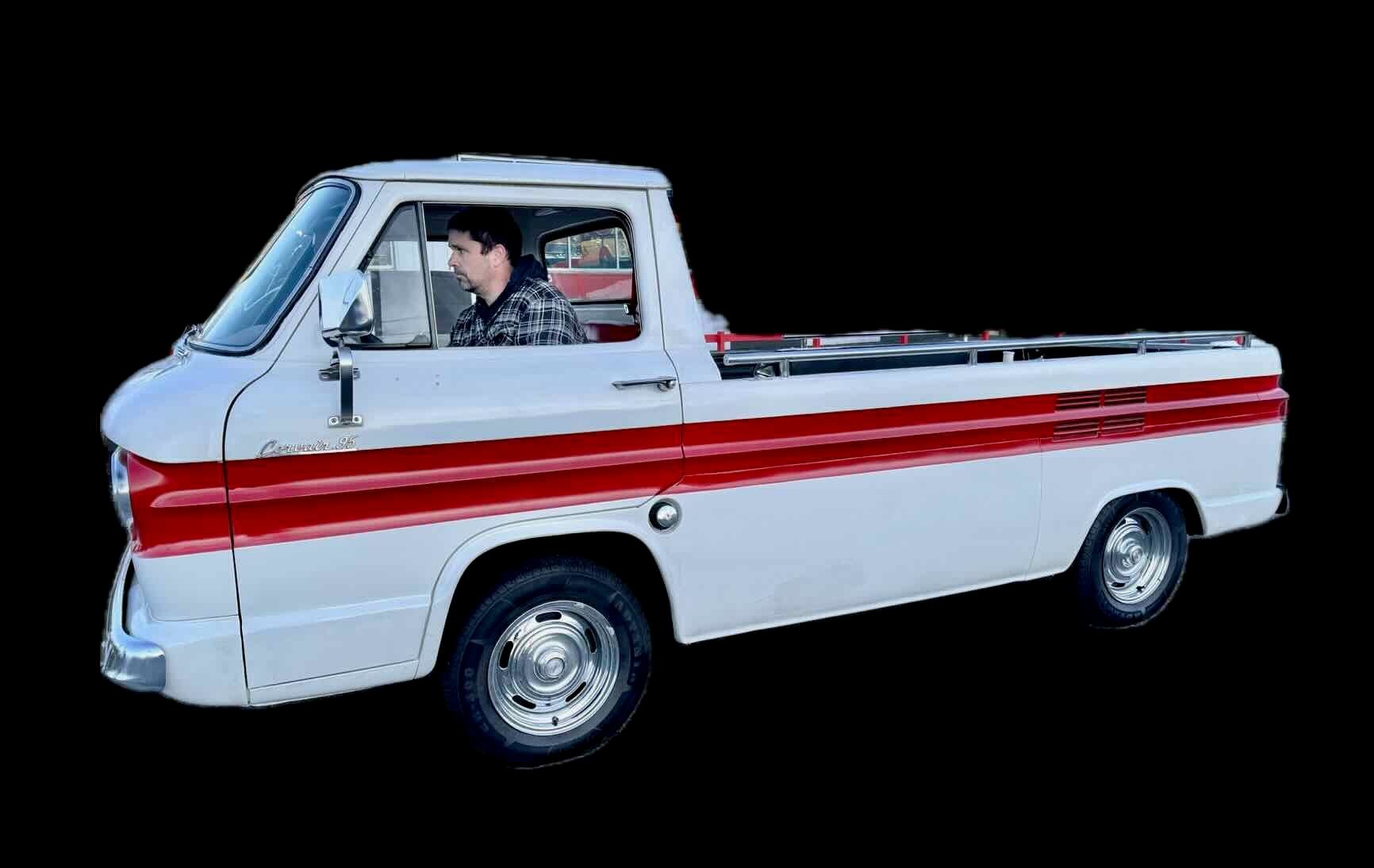
The range grew fast. The Monza coupe, added during 1960 with bucket seats and a floor shift, turned an economy car into a personal car and became the volume seller. For 1961 came the Lakewood wagon and the forward-control Corvair 95 line — Greenbrier van, Corvan panel van, Loadside and Rampside pickups, driver over the front axle, engine under the rear of the bed. A convertible arrived for 1962, and that May Chevrolet put a turbocharger into volume production in the Monza Spyder, beating the Oldsmobile Jetfire by weeks; between them they were the first turbocharged production cars.
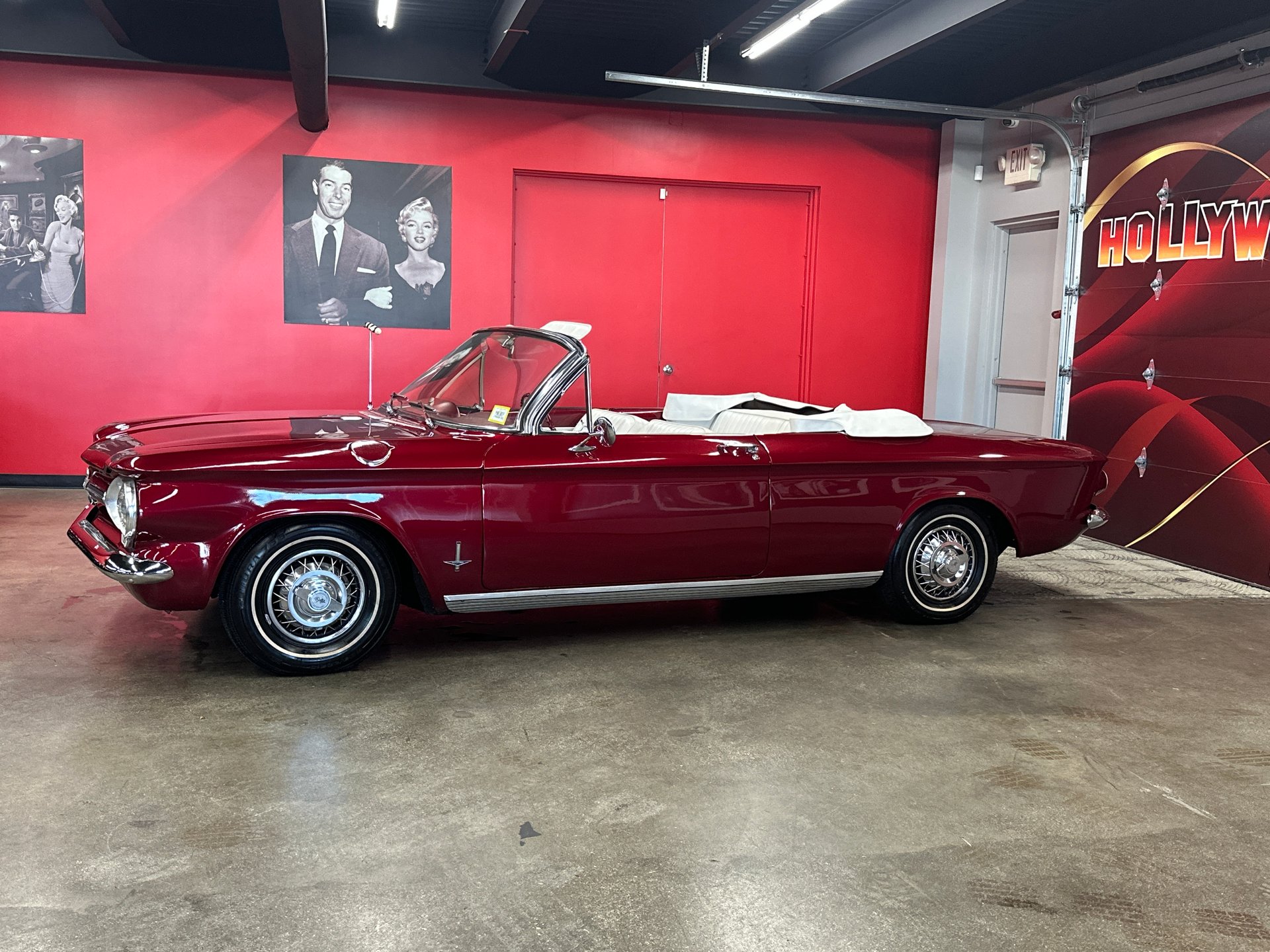
The second generation, launched for 1965 under Bill Mitchell's styling direction, kept the mechanical layout and replaced almost everything you can see or feel. The body is one of the most admired American shapes of the decade — long, clean, Coke-bottle hips, pillarless hardtops, no trace of the early car's upright stance. Underneath, the swing axles were replaced by a fully articulated independent rear suspension in the Corvette manner. The Spyder name was retired; the performance car became the Corsa, 140 hp four-carburettor standard or 180 hp turbo optional. Wagons and forward-control trucks did not make the transition, so from 1965 the Corvair is coupes, hardtop sedans and convertibles only.
What happened next explains the market you shop in today. Ford's Mustang, launched in April 1964 on inexpensive Falcon mechanicals, took the youth market the Monza had created and did so far more profitably than the costly, complicated Corvair could. In November 1965 Ralph Nader published Unsafe at Any Speed, whose opening chapter attacked the handling of the 1960 to 1963 swing-axle cars. The attack landed on cars already superseded: the 1964 models had gained a front anti-roll bar and a transverse camber-compensating leaf spring at the rear, and the 1965 car had the new suspension altogether. A federal study reported in 1972 that the 1960 to 1963 Corvair's handling and stability were comparable to its contemporaries. None of that repaired the name. Chevrolet froze Corvair development after 1966, let the Camaro take the sporting role, dropped the Corsa and the turbo, and wound production down from roughly 236,000 cars in 1965 to just 6,000 in 1969. The last car, a Monza coupe, left the Willow Run plant in Michigan on 14 May 1969. Total production across the decade was 1,786,243, cars and forward-control trucks together — enough that survivors are plentiful, parts support is real, and no buyer ever has to settle for the wrong car out of scarcity.


The models
Read the range as a ladder climbed twice — once in early form, once in late form — plus a commercial branch that only exists in the early years: 500 at the bottom, 700 as the early mid-trim to 1964, Monza as the bucket-seat mainstream where most of the market lives, and a flagship on top, Spyder from 1962 to 1964 and Corsa for 1965 and 1966. Early bodies run to sedans, coupes, a convertible from 1962, a wagon for 1961–62 only, and the forward-control vans and pickups; late cars simplify to coupe, hardtop sedan and convertible. Badges are only a starting point: engines swap in an afternoon, and the only reliable identity is the body tag and the stamped engine code, both covered in the inspection section.
| Model | Years | Engine | Output | Built | Character |
|---|---|---|---|---|---|
| 500 and 700 sedan and coupe | 1960–1964 | 140/145 cu in flat-six | 80–84 hp | Volume production; with the Monza, the bulk of early output | The honest early car; bench seat, plain trim, least to go wrong |
| Monza, early | 1960–1964 | 145 cu in flat-six | 98–102 hp | The best-selling early trim | Bucket seats and bright trim; the car that invented the personal coupe |
| Monza Spyder | 1962–1964 | 145/164 cu in turbo flat-six | 150 hp | Low tens of thousands across three years | First-generation turbo flagship; coupe and convertible only |
| Lakewood and Monza wagon | 1961–1962 | 145 cu in flat-six | 80–98 hp | Two seasons only | Rarest early body; engine under a raised rear load floor |
| Corvair 95: Greenbrier, Corvan, Rampside, Loadside | 1961–1965 | 145/164 cu in flat-six | 80–110 hp | A small fraction of total production | Forward-control vans and pickups; working survivors are scarce |
| 500, late | 1965–1969 | 164 cu in flat-six | 95 hp | Shrinking volumes through to 1969 | The basic late car; rubber mats, bench seat, the fine late chassis |
| Monza, late | 1965–1969 | 164 cu in flat-six | 95–140 hp | The core late-model range | The default late buy; coupe, hardtop sedan and convertible |
| Corsa | 1965–1966 | 164 cu in flat-six, four-carb or turbo | 140 or 180 hp | About 36,000 across two years | The performance flagship; full instruments, quick steering, the collector car |
| Yenko Stinger | 1966, plus later conversions | 164 cu in flat-six, tuned | 160–220 hp in stages | About 100 in 1966 | Don Yenko's SCCA racer; verify everything, priced as a race car |
Outputs are period SAE gross figures. Engine sizes run with the years: the 1960 engine displaces 140 cubic inches, about 2.3 litres; 1961 to 1963 cars use the 145 cubic inch, 2.4 litre version; everything from 1964 onward, early and late alike, uses the longer-stroke 164 cubic inch, 2.7 litre engine. That single fact is the most useful sorting tool in this guide — a 1964 early car has more in common mechanically with a 1966 late car than with a 1961 early car, whatever the body suggests.
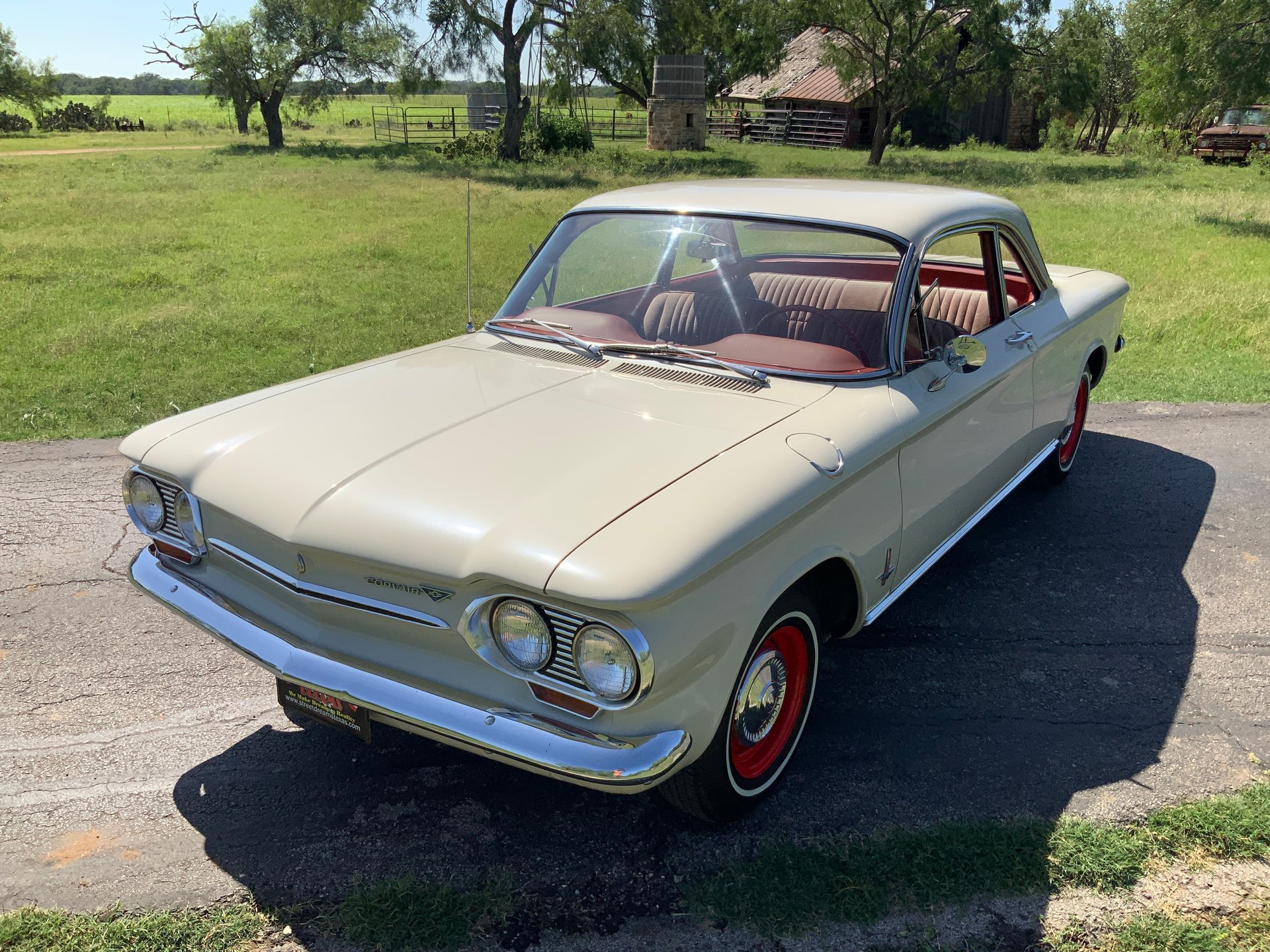
The early cars in detail, 1960 to 1964. The 1960 car is a sub-species of its own: the smallest engine, a concave front panel where later early cars are convex, a petrol-fired heater as the standard cabin heat on many cars, and a long list of one-year-only parts that make a correct 1960 a commitment. From 1961 the range settles. The 500 is the fleet car — rubber floor mats, painted rather than chromed trim, the 80 hp engine, a three-speed manual or Powerglide automatic — and survivors tend to be honest and tired in equal measure, which is no bad starting point if the shell is sound. The 700 adds cloth trim, brightwork and better door cards for a little more money when new and usually no more money now. The Monza is where to focus: bucket seats, full carpeting, a padded dash, the higher-output engine when a manual gearbox is fitted, and from 1961 the four-speed manual option that transforms the car from transport into entertainment. The Spyder, an option package on the Monza in 1962 and a separate model from 1963, adds the turbo engine, a brushed-metal instrument panel carrying a tachometer, a boost gauge and a cylinder-head temperature gauge, and script badges. Pay the Spyder premium only for a car whose body tag and engine suffix prove it; badges prove nothing at all.
The wagons and the forward-control 95s. The Lakewood of 1961, renamed Monza wagon for 1962, places the engine under a raised rear load floor: you lose load height and gain a flat, characterful car almost nobody else at a show will have brought. The 95s are a world apart — Greenbrier windowed van seating up to nine, blind-sided Corvan, the tailgate-only Loadside (a commercial failure when new, genuinely rare now) and the Rampside with its fold-down side ramp. All run car mechanicals with lower gearing under a truck's working history, and all should be assessed as commercial vehicles sharing a car's engine, not as cars with a bed or a box.
The late cars in detail, 1965 to 1969. The 1965 and 1966 range is the fullest and, for most buyers, the sweetest. The 500 keeps bench seat and rubber mats but gains the new body and suspension — a quietly excellent driver's car. The Monza adds buckets, carpet and trim, with the full engine ladder from 95 hp through 110 to 140. The Corsa sits on top for two years only: 140 standard, 180 turbo optional, a proper instrument cluster, quicker steering and the full-width rear panel. From 1967 the range contracts — Corsa and turbo gone, the 140 an increasingly rare Monza option and effectively gone by 1968 as emissions equipment arrived, convertible volumes falling to a few thousand a year. A 1969 Monza is among the rarest regular-production Corvairs by volume, but the market pays for specification and condition before low production in a plain car.
Specials. Don Yenko built about a hundred Stingers for 1966 SCCA racing from Corsa stock, in four states of tune to 220 hp; genuine cars carry Yenko serialisation and registry paperwork, and a claimed Stinger without documents is a Corsa wearing stickers, priced as one. John Fitch's Sprint conversions are delightful documented period pieces. Crown's mid-engined V8 conversion is a hot rod built from a Corvair — buy and price it as exactly that.

Engines and gearboxes
One engine in three sizes: the Turbo-Air flat-six
Every Corvair runs the same basic engine: an air-cooled, horizontally opposed six, with a cast-iron barrel per cylinder, aluminium heads, and overhead valves worked by pushrods from a central camshaft. A large fan on top, driven by a long belt that turns two right angles from the crankshaft pulley, blows air down through the finned barrels and heads; thermostatic bellows open rear flaps to regulate temperature. There is no coolant at all. Three consequences follow for a buyer. The engine is light, which is what allows it to hang behind the rear axle. It is sealed by an unusual number of joints — pushrod tubes with O-rings, rocker covers, a crankcase in halves — and therefore weeps oil as a tendency, the question being how much and from where. And its cooling depends entirely on moving air and clean fins and shrouding, so an engine bay full of oily dirt or missing sheet metal is not untidiness; it is a cooling defect in progress.
The three displacements are a stroke story, and knowing it lets you date and judge any engine in front of you. The 1960 engine displaces 140 cubic inches and makes 80 hp. For 1961 the stroke lengthened to give 145 cubic inches: 80 hp in base tune, 84 hp from 1962, and in the higher-compression tune fitted with manual gearboxes and in Monzas, 98 hp for 1961 and 102 hp for 1962 and 1963. For 1964 the stroke lengthened again to 164 cubic inches, and that engine, in several tunes, powers everything from a 1964 500 to the final 1969 Monza: 95 hp as the base engine, 110 hp as the mainstream performance option, 140 hp in four-carburettor Corsa tune, and 150 or 180 hp turbocharged. Prefer the 164 in any car that offers it. It has the strongest crankshaft of the three, the torque the smaller engines lack at American road speeds, and the deepest parts support. In an early car it also marks 1964 — the year with the improved rear suspension springing — as the early car to hunt.
Engines swap between years and models with an ease that helps owners and traps buyers. A 1962 Monza wearing a 1965 110 hp engine is a better car to drive and a less original one to sell, and neither the badge nor the seller's memory settles which engine you are looking at. The stamped code does. It sits on the crankcase at the rear of the engine, near the oil filler and the generator or alternator pedestal, and its two-letter suffix encodes the engine's original application, tune and gearbox pairing. Clean it, read it, and decode it against any standard Corvair reference before you pay a premium for a rare specification, and apply the same discipline in reverse: a base car carrying a later, stronger engine is a legitimate pleasure if it is priced as what it is.
Carburation is by Rochester single-barrel carburettors, one per bank, each feeding three cylinders through a log manifold cast into the head. They are simple, inexpensive to rebuild and intolerant of disagreement: a Corvair that idles roughly, stumbles off idle or runs hotter on one side is very often suffering two carburettors out of synchronisation, and the cure is linkage adjustment and a synchronising gauge, not a rebuild. Check the balance tube first — a steel crossover pipe sealed by short rubber elbows that split with age and lean one bank; the elbows cost almost nothing and are missed constantly. Automatic chokes account for most cold-running complaints. Budget roughly $300–600 for a proper pair rebuild with on-car synchronisation, and treat a seller with that invoice as having saved you a weekend.
The 140 four-carburettor engine and the turbocharged engines
The 140 hp engine, standard in the Corsa and optional elsewhere for 1965 to 1967, fits two Rochester carburettors per bank: a primary that does the everyday work and a secondary that opens on a progressive linkage at wide throttle, breathing through larger intake ports in special cylinder heads with a freer exhaust. Sorted, it is the sweetest Corvair engine of all — smooth at a cruise, willing at the top end, and genuinely quick by the standards of a 1960s American compact. Its failure mode is the mirror of its design. On gently driven cars the secondaries sit unused for months at a time; throttle shafts gum, linkage rods bend or get disconnected during other work, and the engine quietly becomes a 110 that feels strangled at full throttle, or a flat-spotted nuisance if one secondary opens late and the other not at all. The test costs nothing: a full-throttle run in a high gear, where a healthy 140 pulls noticeably harder past half throttle with no step, stumble or pause. Those big-port heads also run hotter around the exhaust valve seats, which connects directly to the dropped valve seat warning in the problem areas; the 140 is the engine most likely to present it, and a 140 with a documented cylinder-head rebuild, seats properly staked or replaced, is worth a real premium over a mystery engine.
The turbocharged engines are the Corvair's party trick and its most specialised machinery. The 1962 and 1963 Spyder runs the 145 cubic inch engine at 150 hp. The 1964 Spyder and the 1965 and 1966 Corsa turbo run the 164, at 150 hp for 1964 and 180 hp for the late cars. A single turbocharger draws through one Carter YH sidedraft carburettor, a unit borrowed from marine practice that meters fuel adequately and delights nobody. There is no wastegate in the modern sense; maximum boost is set by the sizing of the turbine and the exhaust system, which makes the installation simple, durable in concept and slow to respond by modern standards — power arrives as a swelling shove from around 3,000 rpm rather than a step. A healthy turbo car idles like a normal Corvair, pulls cleanly off boost, and then gathers speed with a rising whistle and an unmistakable extra push. Black smoke under boost, oil misted through the intake tract, a turbo that never seems to arrive, or blue smoke trailing after a hard run point at turbocharger seals and bearings or at a flooding YH; either is specialist money, roughly $1,200–2,500 to rebuild the turbocharger properly and $400–800 to have the Carter sorted by one of the few people who know it. Heat is the turbo car's tax on everything nearby — exhaust hardware, engine seals and the paint above the rear deck all live harder lives — so a turbo car that has been run hot repeatedly shows it in its leak pattern and its head history. Buy the documented car, and budget as if the turbo will need attention even when the seller says it will not.

Gearboxes, the transaxle and the Powerglide with no Park
Gearbox and final drive are a single transaxle bolted to the engine at the back of the car, and the choice defines the car's character as surely as the engine does. The standard manual is a sturdy three-speed, floor-shifted, with an unsynchronised first gear on early cars — serviceable, but not the gearbox the car deserves. The optional four-speed, from 1961, transforms a Monza or Corsa with closer ratios; for 1966 it was replaced by a stronger, fully synchronised Saginaw-built unit, the most desirable manual of all. Every manual shifts through a long linkage running the length of the car, and worn bushings or a stretched cable make a sound gearbox feel worn. Judge synchromesh on the second-gear downchange, then price the linkage before the gearbox: bushes and adjustment run to tens of dollars in parts, while a transaxle-out rebuild is a $1,500–3,000 specialist job. The cable clutch shares the theme; a clutch that drags and will not clear first at a standstill is adjustment or cable stretch until proven otherwise, and the bite should sit in the upper half of travel without judder.
The automatic is Chevrolet's two-speed Powerglide, adapted to the transaxle and, unusually, selected by a small lever on the dashboard of most cars rather than on the column or floor. It is a tough and simple transmission that suits the torquier 164 engines well and noticeably blunts the smaller ones, particularly the 80 hp early cars. Two facts every buyer must carry into a viewing. First, the Corvair Powerglide has no Park position. The selector offers Reverse, Neutral, Drive and Low, and the car is held stationary by its handbrake alone — which makes the handbrake a safety item to test on a slope, not a formality to note. Second, Powerglide faults are usually external before they are internal: a failed vacuum modulator, tired linkage or burnt and low fluid account for most delayed engagement, harsh shifting and slipping under load, and a modulator is an inexpensive part. A full Powerglide rebuild, when it really is needed, runs roughly $1,800–3,200 fitted. On any transaxle, manual or automatic, look underneath for leaks at the axle seals and the selector shaft, listen for differential whine that rises and falls with road speed rather than engine speed, and remember that transaxle oil neglect is the one form of neglect these units do not forgive.
Problem areas
A Corvair fails in its own ways, and almost none of them are the ways a front-engined Chevrolet fails. There is no coolant to lose and no head gasket drowned in antifreeze, but there is a fan belt whose loss stops the cooling entirely, a heater that breathes the engine's own cooling air, valve seats that can drop out of overheated aluminium heads, and a unit body whose rust map runs from the front trunk floor to the rear quarters with the rocker panels as its structural spine. Read this section with the generation split in mind throughout: the rust and the engine are shared, the rear suspension is not. A note on our own evidence before the detail. On Classic Listings we track 42 Corvairs, and for 16 of them we have examined the sellers' photo sets in detail; rust was noted in 2 of those 16 cars and visible damage in 3. Treat that as a floor, not a verdict — sellers' photographs systematically avoid undersides, rocker seams and the inside of the front trunk, exactly the places this section sends you, and a sample of 16 is small. The absence of rust in a listing's photos is evidence of nothing except the photographer's framing.
Rust: the unit-body map, front to back
The Corvair has no frame to save it. The welded unit body is the structure, so rust in the wrong panel is not cosmetic, and the wrong panels are specific. Work from the front, because the front is where buyers forget to look on a car whose engine is at the back.
The front trunk, its floor and the front crossmember area. The luggage trunk occupies the nose, and its floor, the panels around the headlamps and the seams where the front panel meets the fenders all trap road water and leaf litter. Lift the trunk mat and any spare or tools, and prod the floor seams and the low corners. Surface rust here is a clean, treat and seal job you can do yourself; perforation at the seams is welded repair, typically $600–1,500 a side done properly with paint, and it rarely travels alone.
Rocker panels and sills. The structural heart of the car, as on any unit-body design, and the single most important rust check on either generation. The rockers carry the body's bending stiffness between the wheels, they collect mud and salt thrown up along their full length, and they rot from the inside outward, so paint bubbles on the outer skin mean the inside is worse. Press hard along the full length of both sides, look up at the pinch-weld seam from underneath, and be suspicious of fresh underseal, fresh paint confined to the rockers, or trim covers fitted over them. A rocker cut out, welded and painted runs roughly $800–2,000 per side, and the honest car with one scabby rocker and sound metal everywhere else is a far better buy than the shiny car with both rockers freshly blown over.
Floor pans. Water enters past the windshield seal, cowl vents and heater ducting, then sits under carpets that hold it against the steel. Lift the carpets in all four footwells, and the full floor length on a Greenbrier. Look for water tracks from the cowl, bubbling along the seams, and the soft, crunchy feel under a prod that means thin metal even where it is not yet holed. A pan fitted and painted is roughly $500–1,200 a side, but floors are a marker: a car rotting there has usually started in its rockers and quarters too, so price the pattern, not the panel.
Rear quarters, arches and the engine compartment. Rear quarters and arch lips collect what the rear wheels throw, on late cars over a larger and more expensive panel. The engine compartment deserves a rust check too: its perimeter rails and the battery area suffer acid and heat together, and perforation around the engine mountings is structural, not tidiness. Door bottoms block their drains and fill with water on both generations — run a fingertip along every door's bottom edge and check the drains are clear. On convertibles add the windshield header and top well; on the 95s add bed seams, the Rampside ramp frame, van door tracks and the cab floor.
The air-cooled engine: oil, heat, the fan belt and valve seats
Oil leaks, and how to grade them. A Corvair that leaves no spot at all has usually just been cleaned for sale. Pushrod tubes seal with O-rings that harden with heat and age, rocker covers weep, and crankcase and oil-cooler seals all live in hot, oily air. Grade by volume and destination. Light misting and the odd drip is a reseal job — Viton O-rings and fresh gaskets, a few hundred dollars in parts, or roughly $600–1,200 at a shop with the tin off and cleaned. Oil dripping onto the exhaust, pooling overnight or misted across the bay matters beyond mess: oil on the cooling fins and inside the shrouding insulates the cylinders and chokes airflow, so a badly leaking Corvair runs hotter, feeding every other failure in this section. A reseal and a proper clean are cooling maintenance, not cosmetics.
The fan belt. The Corvair's famous failure. One long belt leaves the crankshaft pulley vertically, turns through guides and idlers, and drives the cooling fan and the generator or alternator horizontally on top of the engine. If it stretches, frays, flips or throws — a tired belt, a misaligned guide or a worn idler all invite it — cooling and charging stop together, and an air-cooled engine with no fan overheats in minutes, not miles. The generator warning light doubles as your belt alarm: if it lights while driving, stop. Carry a spare belt and the tools to fit it; a seller showing you a fresh, correctly tensioned belt with sound guides is showing you someone understood the car. Repeated throwing is a diagnosis, not bad luck — pulley alignment, guide position and belt quality, in that order.
Overheating and dropped valve seats. An air-cooled engine has no steam and no drama; it simply gets hotter than its aluminium heads can tolerate, and the classic result is a valve seat — a steel insert pressed into the head — loosening and dropping as the head expands, then being hammered by piston and valve. The presentation is sudden: loud clatter, a dead cylinder, sometimes a destroyed piston. The 140 heads, with larger ports and a hotter exhaust side, are the most prone, and any engine run with missing cooling tin, a slipping belt, a debris-filled shroud or dirt-caked fins has spent time in the danger zone. Prevention is the whole cure: complete sheet metal, clean fins, working thermostat bellows and flaps, correct timing. A head rebuild with seats properly addressed runs roughly $800–1,800 per head before any piston damage, so documented head work is valuable paper, and an unexplained top-end rattle deserves a compression test before money moves.
Suspension, steering and brakes: where the generations part company
Early rear suspension, 1960 to 1964. The early car rides on swing axles: each rear wheel pivots at the differential, cambers strongly through its travel, and in a hard, lifted-throttle corner can tuck under and provoke abrupt oversteer — the behaviour Nader's book made famous. Driven with ordinary sympathy, braking done in a straight line and no sudden mid-corner lifts, an early Corvair is pleasant and safe, and the 1964 revisions — front anti-roll bar, transverse camber-compensating rear leaf spring — measurably tame the trait. Inspect condition, not theory: worn joints and bearings, sagging springs leaving excessive negative camber at rest, perished bushings, dead dampers. A full refresh runs in the $800–1,800 range, and a car sitting tail-down with its rear wheels tipped in at the top is telling you its springs need that money.
Late rear suspension, 1965 to 1969. The late car's fully independent system locates each rear wheel properly through its travel and removes the early car's vice altogether — the single strongest mechanical reason to choose a late car for fast road use. Its wear items are conventional: trailing-arm and strut-rod bushings, half-shaft universal joints, wheel bearings and dampers. Clunks over bumps, a rear end that steers the car under power changes and uneven rear tyre wear are its vocabulary. A bushing and joint refresh sits in the same broad $800–1,800 fitted range as the early car's, with a genuinely modern-feeling rear end as the reward.
Front suspension, steering and brakes, both generations. The front end is a conventional independent design whose ball joints, tie-rod ends and idler and pitman components wear on the usual schedule; the steering itself is unassisted on almost all cars, light because the nose carries no engine, and accurate when the joints are tight. Vagueness, a knock over broken surfaces and a wheel that will not self-centre point to joint and bushing wear, priced as a front-end refresh rather than a catastrophe. Brakes are drums all round on early cars, with front discs never offered on the Corvair at all — even late cars are drum-braked, self-adjusting from 1963 in most applications, and entirely adequate when the hydraulics are sound. What sixty years does to drum systems is seize wheel cylinders, perish hoses and rust lines, so budget a full hydraulic refresh — cylinders, hoses, master cylinder and fluid — at roughly $600–1,400 fitted on any car without recent invoices, and judge a pulling or spongy pedal as that bill arriving early rather than as a negotiating mystery.
The heater that breathes engine air, electrics and trim
The heater. Corvair cabin heat is engine cooling air, blown over the hot engine and ducted forward into the cabin. When the system is sealed and clean, it works well. When exhaust joints leak, pushrod seals weep oil into the airstream or the ducting and its seals perish, the cabin receives heat flavoured with exhaust fumes and oil vapour — at worst, carbon monoxide, which is why this is a safety section and not a comfort footnote. Test the heater on full heat on every viewing, whatever the weather, and smell it: any exhaust or burnt-oil taint in the heated air means the exhaust system and the heater duct seals need work before the car is used closed-up, and a car whose heater has been disconnected entirely is telling you its previous owner found exactly that problem and chose the cheap answer. Early 1960 cars with the petrol-fired heater replace this risk with a different one — a small combustion heater that needs its own service history — so ask which system a 1960 car carries and whether it works. Heater and duct resealing is mostly labour and seals, typically $400–1,000 at a shop depending on how much exhaust work travels with it.
Electrics. The Corvair's wiring is simple and its failures are the usual fifty-year-old ones, concentrated at connections: dim lamps, intermittent accessories and wandering gauges are earth points and corroded terminals until proven otherwise. Two generation notes matter. Early cars charge through a generator, late cars through an alternator; either is rebuildable, and the warning light, as noted, doubles as the fan-belt alarm, so a car with its warning light disconnected or its bulb removed has had its most important instrument deliberately silenced — ask why. The starter lives in the heat at the back and its solenoid connections corrode; a hot-start reluctance that vanishes when cold is that connection, not a dying starter, until tested.
Interior and trim. Most Corvairs wear vinyl that survives well; what fails underneath is the padding, which crumbles and leaves you sitting on the spring frame — the tell is a hammock-shaped driver's cushion and dust under the seats. Sit in the driver's seat, always. Re-padding runs roughly $300–600 a seat before any re-covering, and a full retrim is four-figure money, so a sound original interior is worth a premium. Convertible tops are the other interior-scale bill: a quality top fitted is a four-figure job, and a top that moves evenly on a straight frame beats a new top on a bent one. Count missing bright trim and flagship gauges piece by piece — small bright parts are where a cheap Corsa stops being cheap.

How to inspect one
Allow at least an hour, bring a torch, a cloth-wrapped magnet and a screwdriver for prodding with the seller's permission. Insist the engine is cold when you arrive. If the car passes you, pay for a lift inspection before money changes hands — on a unit-body car whose structure hides under trim and underseal, it is the best money in the purchase.
- Paperwork and identity first. Match the vehicle identification number on the title to the plate on the car — in the front trunk area and door jamb locations depending on year — and then decode the body tag, which records the build date, body style, trim and paint as the car left the factory. On a Spyder or Corsa, the tag and the specification must agree; on any car, a tag that describes a different trim, colour or body than the one in front of you means the car's story needs rebuilding before its price does.
- The engine code. Clean and read the stamped suffix on the crankcase at the rear of the engine, near the oil filler and generator or alternator pedestal. Decode it for year, tune and original gearbox pairing. A base engine in a flagship car, or a later 164 in an early car, is not automatically a rejection — it is a repricing, and only the stamp tells you it has happened.
- Cold start and the belt. From cold, the engine should start readily, idle evenly on both banks and show no blue smoke beyond a brief puff. Look at the fan belt before you run the engine long: correct belt, sound guides and idler, no fraying, no flipped twist. Watch the generator warning light prove itself at key-on and go out with revs — a light that never lights has been silenced, and on this car that light is also the cooling alarm.
- Oil, graded. Run a finger under the pushrod tubes and rocker covers, look down into the engine tin and shrouding for pooled oil and dirt caked on the fins, and check underneath after the engine has run. Light weeping is a reseal conversation; oil dripping onto the exhaust, smoking, or coating the cooling fins is a cooling defect as well as a leak, and prices accordingly.
- Rockers, floors and the front trunk. Prod both rockers along their full length, lift the carpets and prod the pan seams, then empty the front trunk and prod its floor and low corners. Perforation in any of the three is structural money; in all three, a different car than the one advertised. The magnet, run over arches, lower doors and quarters, maps the filler prodding cannot reach.
- The generation check underneath. Confirm which rear suspension the car actually has and judge its condition list, not the other generation's: swing-axle joints, springs and compensator spring on a 1964 car, or bushings, strut rods and half-shaft joints on a late car. Look at brake hoses, fuel lines and the transaxle for leaks while you are under there, and read the underseal as you go — thin, patchy and honest is factory age; a fresh, uniform black coat over seams, lines and fasteners alike is a question, not an answer.
- The heater test. Run the heater on full heat for several minutes with the cabin closed, whatever the weather outside. Breathe deliberately. Any exhaust or burnt-oil smell in the heated air fails the car for closed-cabin use until the exhaust and heater duct seals are repaired — and a disconnected heater is a fail by confession. On a 1960 car, establish whether it carries the petrol-fired heater and whether that unit works and has been serviced.
- The test drive, carburettors and boost. Fifteen minutes minimum, including a sustained higher-speed stretch. The twin Rochesters should pull cleanly from idle with no stumble; on a 140, demand a full-throttle run and feel for the secondaries arriving smoothly past half throttle; on a turbo car, feel for the swelling push from around 3,000 rpm with no black smoke or oil smell. A car that will not be driven hard on a viewing has answered the question.
- Gearbox and handbrake. On a manual, test the second-gear downchange at speed for synchromesh, and separate linkage slop from gearbox wear in your pricing — bushes before boxes. On a Powerglide, check engagement into Drive and Reverse without long delay or a thump, remember there is no Park, and test the handbrake holding the car on a slope as the safety item it is. On any car, listen for differential whine that follows road speed.
- Brakes and steering. Brake firmly from speed, more than once. The car — drum-braked on every year — should stop straight and repeatably, with a firm pedal that does not sink or pump up. Pulling, sponginess or a pedal that changes between stops is the hydraulic refresh arriving early. The steering should be light, accurate and free of knocks; vagueness plus a knock over bumps is a front-end refresh priced into the offer.
- Stance and handling feel. Stand back. Both generations should sit level, without an early car's rear wheels tipping conspicuously in at the top. Corner an early car with sympathy — no provoked mid-corner lifts — and it should feel stable and predictable; a late car should feel planted in a way that makes the generational difference obvious within a mile. A car sitting down at one corner is describing its springs, not its character.
- Interior, top and the small bills last. Sit in every seat and feel for collapsed padding under sound vinyl; work every window, lamp, wiper and gauge; on a convertible, run the top through a full cycle and watch the frame move evenly. Count missing bright trim, flagship gauges and small fittings, and price them individually — the only major costs you can see in full from the driver's seat.
Values
The build beneath this guide carries the live market — the cars listed now and the recorded sales — refreshed at every build, and that block is where the numbers live. This section teaches you how to read it, because on a Corvair the spread inside any one badge is wider than the gap between badges, and a buyer who reads the market by badge alone will overpay for the wrong car and walk past the right one.
Start with the condition spread, which on this car is a structure spread. Two Monzas of the same year, engine and colours can sit at opposite ends of the market because one has sound rockers, floors and quarters under honest paint and the other has fresh paint over filler — and nothing in a listing description distinguishes them; the inspection does. Read every asking figure as a claim about structure first and specification second. Asking prices also run ahead of achieved prices here, because many sellers are private owners pricing from attachment rather than recorded sales. The sales side of the block is therefore the anchor: where asking and achieved figures diverge, believe the sales, and expect a negotiation gap on all but the best-documented cars.
Generation and specification set the premium ladder. At the top sit the flagships with proof: a documented 1965 or 1966 Corsa, four-carburettor or turbo, with its body tag, engine code and instruments agreeing, and a turbo Spyder of 1962 to 1964 in the same documented condition just behind it. Convertibles carry a premium over coupes in equivalent condition in both generations, and the late hardtop coupe is the volume collector car — the shape most buyers picture, with the deepest market to buy from and sell into. The forward-control 95s price on a different logic altogether: rarity and novelty are high, the buyer pool is thin, and condition dominates completely, so a sound Greenbrier or Rampside can outrun a coupe while a rough one can sit unsold at project money for months. Wagons behave similarly in miniature. At the bottom of every ladder sit the plain cars — early 500s, late 500s, Powerglide cars with the smaller engines — and there the discount buys you the same structure and, in a late 500, the same fine chassis as the flagships, which is why the value in this market so often hides under a plain badge.
The project-versus-driver gap inverts the usual temptation. Mechanical recommissioning of a stored car — fuel system cleaned, brake hydraulics renewed, engine resealed, cooling tin cleaned and completed — is comparatively inexpensive and well understood. Structural welding, paint and interior are not, so the gap between a sound driver and a stored project is mostly body money, routinely larger than the price difference between the two cars. A cheap Corvair with a rotten shell is the most expensive Corvair there is. Buy on structure and documentation, negotiate on everything else, and let the recorded sales below tell you what the last buyer in your position actually paid.
Parts and ownership
The Corvair is one of the best-supported American cars of its era, for a simple arithmetical reason: Chevrolet built more than 1.78 million of them, the enthusiast base organised early and stayed organised, and dedicated specialists — Clark's Corvair Parts above all, alongside a healthy trade in good used parts — have kept the catalogue alive in a way owners of lower-volume orphans can only envy. The Corvair Society of America and its local chapters are the other half of the support system: technical knowledge for these cars lives in the club literature and in specialists' hands, and joining the club is the cheapest parts decision a new owner makes.
Easy and inexpensive: service items, filters, plugs and ignition parts; Rochester carburettor rebuild kits; fan belts, guides and idlers; pushrod tube O-rings and engine gasket sets; brake shoes, wheel cylinders, hoses and hydraulic parts; suspension bushes, ball joints and dampers for both generations; clutch cables and linkage bushes; glass rubbers and weather seals for the common bodies. Most of this is order-today, fit-this-weekend, at prices close to ordinary classic-car money, and much of it is cheaper than the equivalent for a contemporary European car.
Harder, dearer or specialist: turbochargers and the Carter YH carburettor, where the knowledge is concentrated in few hands and a proper turbo rebuild is the four-figure job described in the engines section; cylinder heads rebuilt with valve seats properly addressed, the other four-figure staple; Spyder and Corsa instrument clusters and their gauges; convertible top frames as opposed to top fabric; forward-control body panels, Rampside ramp hardware and Greenbrier door and trim pieces, where the production was small and the working attrition high; correct early 1960 one-year-only parts; and bright trim in genuinely good order for any year. None of it is unobtainable. All of it rewards buying a complete car over completing an incomplete one.
Running one. A sorted Corvair is a realistic regular-use classic, returning low-to-mid twenties miles per gallon in gentle use. Servicing suits any good independent, provided they understand that cooling is airflow — engine tin, seals and clean fins are service items — and that the belt-and-guides check belongs in every service. The rhythm is short: oil and filter on schedule, valve clearances and carburettor synchronisation checked as a pair, belt at every service, heater duct seals before every winter, and a spare belt living permanently in the front trunk. The budget line that catches new owners is the first year — catching up deferred maintenance honestly costs in the low thousands, and recommissioning a long-stored car runs higher still. Buy a car in regular use over one that has been asleep: on an air-cooled car, seals worked weekly weep less than seals left to harden.
Which one to buy
- The all-rounder: a late Monza, 1965 or 1966. The fine late chassis, the 110 or 140 engine, bucket seats and the deepest choice on the market. If you want one Corvair to drive everywhere and enjoy, this is it.
- The value buy: a late 500. The same body, the same independent rear suspension and the same steering as the flagships, under a plain badge with a bench seat. The cheapest route into the best Corvair chassis ever built — buy the soundest one, not the cheapest one.
- The early-car pick: a 1964 Monza or Spyder. The 164 engine, the anti-roll bar and the camber-compensating spring make 1964 the early car to hunt, in coupe or convertible. A documented Spyder is the early flagship; a Monza four-speed is the early sweet spot.
- The collector car: a 1965–66 Corsa. Four-carburettor or turbo, full instruments, two years only. Verify the body tag, the engine code and the gauges agree, because the premium rides on originality and copies are everywhere.
- The character buy: a Rampside or Greenbrier. Nothing else at a show does what these cars do. Buy on floors, seams and completeness, and accept the thin market when you sell.
- The open car: a Monza or Corsa convertible. The premium over the coupe is real, and so is the pleasure. Inspect rockers, header rail and top frame, in that order.
And the rule that overrides all of the above: buy the least rusty car you can find, in the generation and specification you can live with. Engines reseal, carburettors synchronise, belts and bushes renew, even a cylinder head can be rebuilt at a plannable price. A rotten unit body costs more to put right than the finished car will be worth — and the shell is the one part that was never interchangeable.
See the 26 Corvair cars currently listed.