
Chevrolet Chevelle Coupe buyer's guide
Chevrolet Chevelle Coupe -- the model's own buyer's guide: variants, values and what to check.
Years listed: 1964-1972 · Series: Chevelle
Overview and history
The Chevelle coupe is the Chevelle most people mean. Sedans carried families and wagons carried lumber, but the two-door carried the muscle era — and it is the body style the market kept. In our own store we track 613 Chevelle coupes, 232 for sale and 381 recorded sold, and the year spread tells you where the demand sits: 1970 alone accounts for 146 cars, then 1969 with 89, 1967 with 85, 1966 with 65, 1971 with 64, 1972 with 59, 1968 with 53, 1965 with 38 and 1964 with 13, with a single 1973 car at the tail. You will mostly be offered a 1966 to 1972 hardtop.
Chevrolet launched the Chevelle for 1964 as the new intermediate, slotted between the compact Chevy II and the full-size cars on General Motors' new A-body platform, shared with the Pontiac LeMans, Oldsmobile Cutlass and Buick Skylark. The coupe came in two distinct forms from the start, and confusing them is the first beginner's mistake. The two-door sedan — the post coupe — has a fixed B-pillar and framed door glass, and it sat in the plain Chevelle 300 and later 300 Deluxe lines. The Sport Hardtop — the coupe everybody pictures — has no B-pillar at all: wind the front and rear side glass down and the side of the car is one open span, with frameless door glass that seals against the roof rail and the rear quarter window. The hardtop cost more new, flexes more now, leaks in more places, and is worth more in every year of the run. A listing that just says coupe can be either. Ask which, and look for the pillar in the photographs, before you price anything.
The arc divides cleanly. The first generation, 1964 to 1967, rides a 115-inch wheelbase in every body style: upright, flat-sided cars for 1964 and 1965, then a smoother restyle for 1966 and 1967 with stacked headlamps and, on the hardtop, the famous tunnel-back roof — broad sail panels sweeping down to the quarters around a recessed rear window. The second generation, 1968 to 1972, is the Coke-bottle car: long hood, swelling rear quarters, a semi-fastback hardtop roof, and a split wheelbase — 112 inches for two-doors, 116 for four-doors and wagons. The third generation arrived for 1973 as the Colonnade: a pillared coupe again, larger and heavier, with federal bumpers — a comfortable seventies cruiser, not a muscle car in the 1970 sense. In our pool it is represented by that single 1973 car, so this guide treats it as a coda and concentrates on 1964 to 1972.
Two facts govern every coupe purchase. The first is specification spread. Chevrolet built these cars in the hundreds of thousands, with sixes and four V8 families, three-speed manuals, Muncie four-speeds, Powerglides and two Turbo Hydra-Matics, and — from 1966 — the big-block SS. Almost any combination you can imagine exists, which means almost any combination can also be assembled later from parts: engines were swapped, SS hoods and badges added, and tribute cars built, in period and ever since. Originality is therefore a spectrum you place a specific car on with its VIN, cowl tag, engine stampings and paper — not a quality you take from the badge on the fender.
The second fact is construction. The A-body is a body-on-frame car: a separate perimeter frame, rubber body mounts, and a shell bolted on top. That changes inspection completely compared with a unibody classic. A coupe can wear excellent paint over rotten floor braces, trunk drop-offs and rear frame rails, and it can equally have ugly lower quarters over a sound frame. The hardtop adds its own twist: with no B-pillar, door fit and window alignment are structural tells rather than cosmetic niggles, and a hardtop that has sagged or been hit shows it first in glass that will not seal. Sorting the honest car from the dressed one — and a real SS from a Malibu in SS clothing — is most of the work that follows.

The models
Chevelle badging names the trim, not the engine. From the bottom, the ladder runs Chevelle 300 and 300 Deluxe (the post coupes), Malibu (the volume coupe and the basis of nearly every desirable later car), Malibu SS for 1964 and 1965 only, and then the big-block SS396 and SS454 — a separate series in 1966 to 1968, an option package (RPO Z25) on the Malibu from 1969 onward. That single change is the most consequential fact in this market: a 1966 to 1968 SS carries its proof in its VIN, a 1969-onwards SS does not, and the price difference between a documented and an undocumented car is the market pricing that paperwork, not the car.
| Model | Years | Engine | Output | Built | Character |
|---|---|---|---|---|---|
| Chevelle 300 / 300 Deluxe two-door sedan | 1964–1969 | 194, 230 or 250 six; 283, 307 or 350 V8 | 120–250 hp | Volume line | The post coupe: plainer, stiffer, cheaper then and now; the sleeper and the bargain |
| Malibu Sport Hardtop | 1964–1972 | Six, 283–350 small-block; big-block only with SS | 120–330 hp by year and engine | The core coupe of every year | The all-rounder: best trim, widest choice, the car most listings actually are |
| Malibu SS hardtop | 1964–1965 | 283 or 327 small-block | 195–350 hp | About 76,800 in 1964 and about 101,500 in 1965, all bodies | Bucket-seat sport trim around small-block power; the 327 L79 is the jewel, not a big-block car |
| SS396 coupe | 1966–1968 as its own series; 1969–1970 as RPO Z25 | 396 big-block (402 from late 1969 build) | 325, 350/360 or 375 hp | 72,272 in 1966; 63,006 in 1967; 62,785 in 1968, all bodies; option counts thereafter | The defining muscle coupe; the 138-series VIN proves the 1966–68 cars |
| SS454 coupe | 1970–1972, as SS option content | 454 big-block, LS5 or LS6 | LS5 360 hp in 1970, 365 in 1971, 270 net in 1972; LS6 450 hp, 1970 only | LS6 production about 4,475 cars in 1970, all bodies, within total SS output | LS5 is the great street car; LS6 is the king of the range and priced like it |
| COPO coupe | 1969 | 427 big-block, L72 | 425 hp | About 323 built, including the Yenko-ordered cars | A dealer end-run around the factory displacement limit; documentation is the whole car |
| Heavy Chevy coupe | 1971–1972 | 307, 350 or 402 V8 | 200–330 hp gross, then net | About 6,700 in 1971 and about 9,500 in 1972 | SS looks and stripes without SS insurance or the SS price; Malibu-based, honestly sold as itself |
| Laguna coupe | 1973 | 350 or 400 small-block, 454 big-block | 145–235 hp net by engine | The top line of the new Colonnade range | The coda car: urethane nose, pillared coupe, seventies cruiser rather than muscle car |
Production figures above are the widely documented factory totals, and outputs are period gross ratings to 1971 and net ratings from 1972 — which is why a 1972 SS can read 100 hp down on a 1970 car that is barely slower. The ruler changed in 1972, not just the engines.
The first-generation coupes, 1964 to 1967. The 1964 and 1965 cars are the lightest and simplest: thin pillars, flat glass, and an SS that meant buckets, console and trim around a small-block — never a big-block, whatever a seller implies. The engine that matters here is the 327 L79, 350 hp in its hottest tune, a high-compression small-block that makes an early coupe a genuinely quick, balanced car. The 1966 restyle brought stacked lamps and the hardtop's tunnel-back roof, whose broad sail panels are beautiful and, as the problem section explains, a designed-in water trap. For 1966 the SS396 became its own 138-series model, big-block only, through the refined 1967 car, which added a dual-circuit brake master cylinder and available front discs. A documented 1967 SS396 hardtop is the first-generation collector car; a 1966 or 1967 small-block Malibu hardtop is the first-generation car to drive.
The second-generation coupes, 1968 to 1972. The 1968 car is all new and still carries the SS396 as a separate 138-series model — one last year of VIN proof. The 1969 car keeps the shell and makes the fateful change to SS-as-option, in the same year dealers discovered the Central Office Production Order route to the 427. The 1970 car is the peak and the market's centre of gravity — 146 of our 613 coupes — with its one-year face, the optional cowl-induction hood, the 402 sold as both SS396 and Turbo-Jet 400, and the 454 in LS5 and LS6 form. The 1971 and 1972 cars share a single-headlamp face-lift, fall under net ratings, and are mechanically much closer to the 1970 car than their paper figures suggest. Judged as road cars, a good 1971 or 1972 SS454 is most of a 1970 for noticeably less money, which is why the value section returns to them.
Post coupe versus hardtop, in every year. Do not let the market's hardtop bias decide for you. The post coupe is stiffer, quieter at speed, sealed by framed glass that still works when the rubbers age, and — because cloners and collectors ignored it — far more likely to be an honest, unmolested car with its original engine. The hardtop is prettier, airier and worth more, and it demands the window, seal and alignment checks in the inspection section. A small-block post coupe in original paint is one of the most under-priced ways into this family; an SS post coupe — they exist, including genuine big-block cars — rewards the buyer who knows the body codes.


Engines and gearboxes
The sixes and the small-blocks
Most coupes left the factory with neither drama nor a big-block, and those cars are the honest drivers of the range. The base engine was Chevrolet's overhead-valve inline six — 194 cu in in the cheapest early cars, then 230, and from 1967 the longer-stroke 250 — a seven-main-bearing engine with a single one-barrel carburettor. It will not make a coupe fast. It will make it simple and cheap to rebuild completely, and a six-cylinder coupe with its original engine is now rarer than production suggests, because so many were pulled for V8 swaps. Judge it as any old six: even compression, no bottom-end knock under load, no chronic overheating from a silted block, and an exhaust manifold that is not cracked — a ticking that fades as the engine warms is the classic tell. On any coupe presented as an original V8 car, check the VIN engine digit before you credit the engine now in it.
The small-block V8 is the coupe's natural engine. The ladder runs 283 cu in for 1964 and 1965, the 327 as the step-up through 1968, the 307 replacing the 283 as the base V8 from 1968, the 350 arriving for 1969 and becoming the engine the range lived on, and a 400 small-block in the early-seventies mix. All are the classic Chevrolet small-block: iron block and heads in Chevelle service, hydraulic lifters except in the hottest tunes, a Rochester two-barrel on the mild cars and a Quadrajet four-barrel on most stronger ones. Three deserve naming. The 327 L79, 350 hp in its mid-sixties tune, is a high-compression, high-revving engine with a character no big-block duplicates; verify it by the suffix code stamped on the pad at the front of the right-hand head and by its components, because an L79 claim on an ordinary 327 is the small-block version of the SS clone problem. The 350 L48 and its successors are the sweet spot of the later cars: torquey, understressed, Quadrajet-fed, with the best parts supply of any engine in this guide. The 400 small-block, with siamesed bores, runs hotter by design; its heads carry steam holes that must match the block, and a 400 that overheats after a head swap usually needs that mismatch found, not a bigger radiator.
Judging any small-block is a short script, and the mechanisms matter more than the symptoms. A puff of blue smoke at a cold start that clears within seconds is valve stem seals — the rubber hardens, oil pooled in the head drains past the guides overnight, and the job is budgetable, done in the car for roughly $400–800 at a shop. Smoke that persists under load is rings and bore wear, and that is a rebuild conversation at roughly $4,500–8,000 for a complete, quality small-block rebuild. A stretched timing chain — and on the quieter factory engines, a nylon-toothed cam sprocket whose teeth are now fifty years old — shows as a scattered timing-light mark; it is a $600–1,200 job, and a skipped one eventually jumps teeth. The Quadrajet attracts more wrong diagnoses than any other part on the car. A bog as the secondaries open is usually the air-valve spring tension or a perished vacuum break (the choke pull-off that also meters the air valve), not a bad carburettor; the fuel well plugs underneath the main body weep with age and cause a hard hot start and an empty bowl every morning, cured by sealing them during a rebuild; and the divorced choke depends on a small coil in an intake-manifold well that rusts away quietly, after which no adjustment will make the car start cleanly cold. A specialist Quadrajet rebuild, $400–800, transforms cars their owners had blamed on ignition. Finally, flat-tappet camshafts: modern oils carry far less anti-wear additive than these cams were designed for, and a freshly rebuilt engine run on the wrong oil can wipe a cam lobe in its first thousand miles. Ask what oil a rebuilt car runs; a seller who knows is a good sign about everything else.
The big-blocks: 396, 402 and 454
The Mark IV big-block is why the coupe matters. It arrived for 1966 as the 396, in three tunes that structure the whole SS market: the L35 at 325 hp, hydraulic lifters, a Quadrajet, the strong and civilised street engine most SS cars actually carry; the L34 at 350 hp, later rated 360, with a Holley and a hotter cam; and the L78 at 375 hp, solid lifters, an aluminium intake, big-port rectangular heads and an 11:1 appetite for premium fuel — the connoisseur engine, and the one most often claimed and least often present. From the autumn of 1969 the 396 was bored 0.030 in over to 402 cu in, but Chevrolet went on selling it as the SS396 and also, in non-SS form, as the Turbo-Jet 400 — a name that collides head-on with the unrelated 400 small-block. The casting and the suffix code settle which 400 a car has; the badge never will. The 454 arrived for 1970 in two forms: the LS5, 360 hp, hydraulic lifters, Quadrajet, the great all-round street big-block, available with air conditioning and an automatic; and the LS6, 450 hp, 1970 only — solid lifters, 11.25:1 compression, big-port heads, an aluminium intake and a 780 cfm Holley, offered only with the heavy-duty four-speed or the Turbo Hydra-Matic 400, and not with air conditioning. The LS6 is the most valuable coupe in this guide by a wide margin, which is precisely why its identity checks — casting numbers, casting dates that precede the car's build date, suffix stamp, and paper — are non-negotiable. The 1969 COPO 427, the L72 at 425 hp, sits outside the regular range: a handful of documented cars, priced on provenance alone.
On the road, a healthy big-block starts cleanly, idles with a lope appropriate to its cam (an L35 is smooth; an L78 or LS6 is not, and a seller who presents a dead-smooth idle as an LS6 trait has it backwards), and pulls without detonation on modern premium fuel. A valvetrain tick that comes and goes on a hydraulic engine is often a lifter bleeding down or a rocker stud pulling from the head — early big-blocks used press-in studs, and a lifted stud shows as one rocker sitting higher than its neighbours. A ticking loud cold and quiet hot is usually a manifold gasket or a cracked manifold, not a lifter. Overheating in traffic is the standard complaint, and the causes stack: a silted radiator, a missing fan shroud (functional, not trim — without it the fan pulls air around the radiator instead of through it), a slipping fan clutch, and retarded timing from a perished vacuum-advance diaphragm. Test the advance unit with a hand vacuum pump: it must hold vacuum and move the plate. Oil pressure strong cold and thin hot, with a knock on a throttle blip, is bearings, and a complete big-block rebuild is roughly $7,000–12,000 — price any such car as a core plus a rebuild. And on any claimed L78, L89 or LS6 car: verify the engine, not the fender badge. A correct-date, correct-suffix engine with a build sheet beats a story every time.
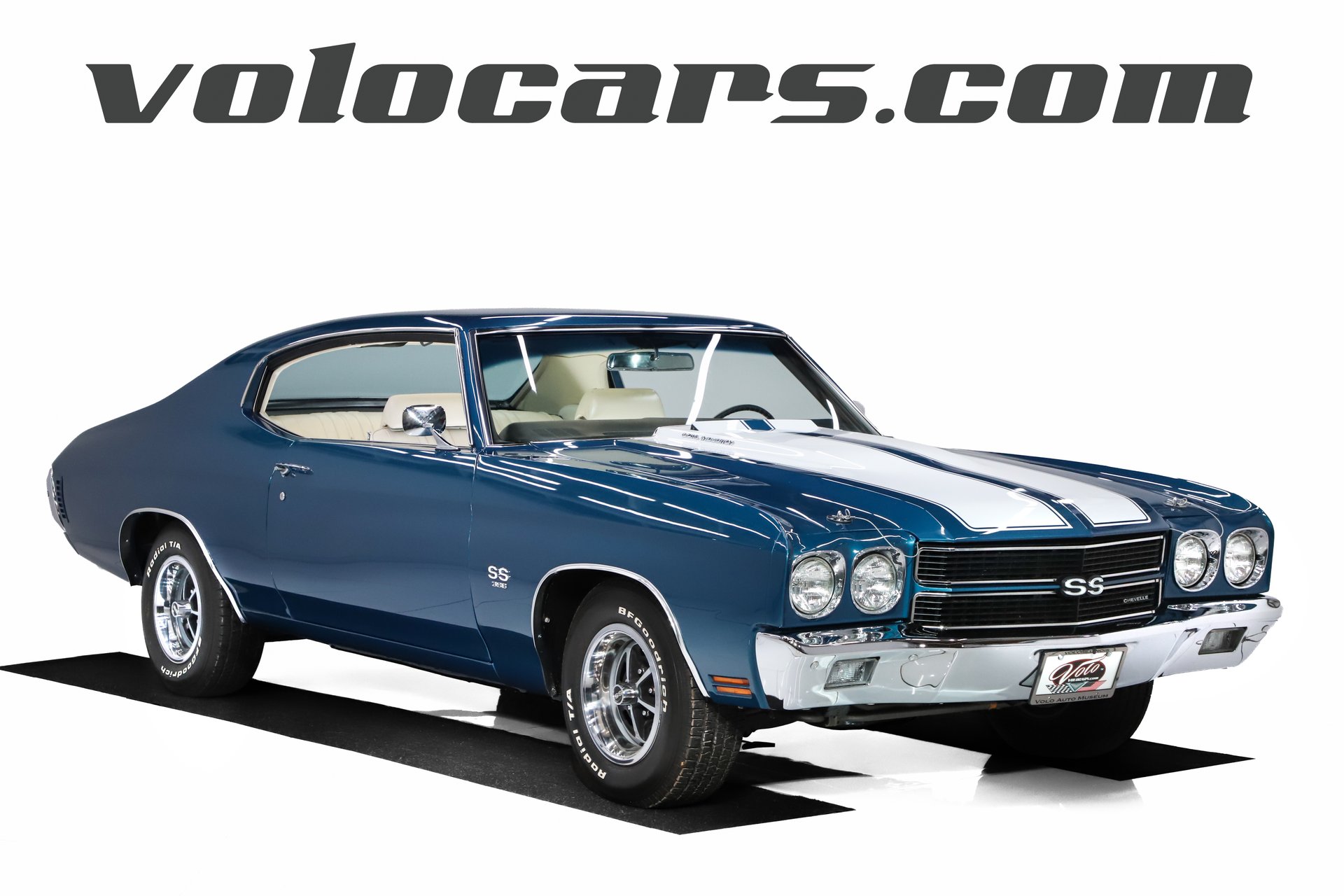
Gearboxes, axles and the running gear
The manual ladder runs from the column-shifted three-speed (Saginaw, the standard box on plain cars) to the Muncie four-speeds that define the muscle coupe: the M20 wide-ratio, the M21 close-ratio, and the M22 — the Rock Crusher, with straighter-cut gears that whine audibly, built for the strongest engines and now valuable enough that an M22 claim needs the same scepticism as an LS6 claim. Muncies are aluminium-cased; the cheaper Saginaw four-speed fitted to milder cars is iron-cased and weaker, and telling them apart from underneath is a standard check on any four-speed car priced as an M21 or M22. Judge any manual on second-gear synchromesh on a fast downshift (second wears first), and on shifter slop, which is usually worn linkage bushings and a Hurst shifter in need of a $150–300 rebuild kit rather than a gearbox fault. A full Muncie rebuild runs roughly $1,200–2,200. Clutch judder on take-up is an oil-contaminated or heat-checked plate and flywheel, a $900–1,600 job with the box out.
The automatics split by strength. The two-speed Powerglide is near-unbreakable, dull, and correct in sixes and mild small-blocks; it was never offered behind the strongest big-blocks, so a claimed factory LS6 Powerglide car is wrong by definition. The three-speed Turbo Hydra-Matic 350 serves small-blocks and mild big-blocks; the Turbo Hydra-Matic 400 is the heavy-duty box behind most SS automatics, with an electric kickdown switch rather than the TH350's cable — a TH400 that will not kick down has usually lost that switch or its wiring, not its internals. Both Turbo boxes should engage promptly when warm; a long delay, or flaring between second and third, means a rebuild at roughly $1,800–3,000 fitted. Our store's split underlines the pool's breadth: 301 cars recorded as automatic and 267 as manual, with a handful of modern overdrive swaps in restomod listings, to be judged as modified cars, on the quality of the conversion.
At the back sits either the 8.2-inch 10-bolt axle or the 8.875-inch 12-bolt, the heavy-duty unit fitted to SS and high-performance cars. Positraction — Chevrolet's clutch-plate limited-slip — was an option on either and is near-essential on a big-block car; test it by the behaviour of the car, not the tag, because tags and whole axles swap. Worn Positraction clutches chatter on tight, slow turns, cured first by the correct limited-slip additive; a full 12-bolt rebuild runs roughly $1,500–2,800. Ratios ran from economy 2.73 and 3.07 gears to 3.31, 3.55, 3.73 and 4.10 performance gears — a car that screams at highway speed is telling you its ratio, and a ratio change is a plannable cost, not a defect. Suspension is conventional and strong: coils and unequal-length arms in front, a live axle on four links and coils behind, with the SS package adding a rear anti-roll bar, boxed lower rear arms and, under RPO F41, heavy-duty springs and shocks. The wear items are ball joints, the idler arm and centre link, and above all the rubber rear control-arm bushings, whose failure is the mechanism behind the classic Chevelle wheel-hop under hard acceleration — the axle winds up, the bushings deflect, the tyres unload and grab in cycle. New bushings are a known job at roughly $600–1,200 for the rear set. Brakes: drums all round on early cars, front discs optional from 1967 (the early four-piston calipers leak at their bores and want stainless sleeving, $800–1,400 a pair rebuilt), a dual-circuit master cylinder standard from 1967, and power front discs standard on the SS by 1971–72. Budget $800–2,000 for a full hydraulic refresh on any car that has sat.
Problem areas
Start with a warning about our own evidence, because it teaches the central lesson of this section. For this guide's brief we examined the photo sets of 588 of the 613 coupes in our store in detail, and rust was noted in only 6 of them, leaks in 1, and smoke in none. Read that correctly: it does not mean Chevelle coupes do not rust. It means the pool is dominated by auction cars — 567 of the 613 records come from Bring a Trailer — photographed after preparation, by sellers who choose their angles. The A-body rust map below is one of the best-documented in the hobby, and every car you view in a driveway should be assumed to be hiding something on it until you have checked. Listing photographs are where a coupe looks its best; the underside, the drop-offs and the rear window channel are where it tells the truth.
Rust: the map
Rust on a Chevelle coupe follows the water, and the coupe's styling writes the itinerary. Work through it in this order.
The rear window channel and the tunnel-back roof, 1966–67 above all. The recessed rear window of the 1966 and 1967 hardtop sits in a channel that collects water and leaf litter, the seal perishes, and the channel rots through into the package shelf and the tops of the inner quarters. On any coupe with a vinyl roof covering — fitted to a large share of Malibus — add the whole roof skin to the suspicion list: vinyl traps moisture against the steel, and bubbling at the base of the sail panels or around the rear window frame under vinyl is structural news, not a trim issue. Press along the sail-panel bases, look up at the package shelf from inside the trunk, and treat a fresh vinyl roof on an unrestored car as a question. Repair means glass out and the channel rebuilt: roughly $1,500–3,500 done properly, more if the shelf has gone.
Trunk floor, extensions and drop-offs. The trunk floor rots from above and below at once: water past the rear window channel and trunk seal from above, road spray at the seams from below. The critical areas are the two drop-offs — the vertical extensions at each side of the trunk floor, behind the rear wheels, where mud sits against the seam between trunk floor, quarter and wheelhouse. Drop-offs rot early, are invisible in listing photographs, and are labour-heavy repairs. Lift the mat, remove the spare, and get a torch into both rear corners. Fitting a floor with both extensions and paint is roughly $1,200–2,500, and trunk rust never travels alone — it indicts the rear window channel above it and the quarters beside it.
Floor pans and floor braces. The floors rot where water enters at the windshield channel and cowl and sits under carpets, and where the braces trap mud against the pan. Lift every carpet: surface scale is treatable, perforation at the seat mounts or toe boards is a panel job. The braces matter as much as the pans — a new pan over rotten braces is a cosmetic repair on a flexing shell, and on a hardtop floor integrity is door alignment. Full floor and brace work runs roughly $2,000–4,500 in parts and labour. Prod the pans along every brace line, and be most suspicious where fresh underseal is thickest.
Quarters, wheel lips and lower fenders. The rear quarters rot at the wheel lip (where the inner and outer skins sandwich road salt), at the bottom behind the wheel (the drop-off zone again, seen from outside), and in front of the wheel where the quarter meets the rocker. Front fenders rot at the bottom behind the wheel, where the inner brace traps debris against the skin. Run a cloth-wrapped magnet over the lips and lower quarters: thick filler over a rotted lip is a quarter replacement deferred, not avoided. A full replacement quarter, fitted and painted, is roughly $2,500–5,000 a side. Door bottoms follow the era's rule — the drain slots block, the door fills, the seam bubbles — and a bubbling door needs its skin or lower section, not a skim.
Rockers, cowl and the core support. Rockers on a body-on-frame car are less structural than on a unibody, but they carry the door openings and rot from inside; check the full length and the ends. The cowl sides and plenum at the base of the windshield leak into the front footwells and rot the cowl shoulders — wet front carpets in a car with sound floors are pointing here, and at the windshield channel itself, where glass-out repair is the only honest fix. At the front, the core support rots at its lower corners and under the battery tray, where acid does the work from above: lift the battery, and price the tray as trivial and the surrounding metal as the real question.

Frame, body mounts and the underside
The perimeter frame is the coupe's skeleton and its most under-photographed part. The rails rot in predictable places: the rear rails where they kick up over the axle, collecting mud on their upper faces; the side rails at the body-mount holes, where the rubber cushions hold moisture against the steel until the mount punches through; the front horns and steering-box area on hard-used cars; and the crossmembers. A frame perforated at a mount or over the axle is fabrication work — sections can be welded and donor frames exist, but a frame swap on a finished car is a body-off project at $5,000–10,000 in labour, and it reprices the car as a project whatever the paint says. Body mounts perish too: crushed, split rubber drops the body unevenly, door gaps wander, and on a hardtop the glass alignment goes with them. A mount set is a few hundred dollars in parts; fitting it means lifting the body off bolts that snap in their cages on a rusty car, turning a weekend job into a $1,500–3,000 shop bill. That is why sellers do not do it, and why a coupe that sits level, with even gaps and sealing glass, is telling you something good about its mounts and frame together.
Read the underside coating as evidence. Factory finishes and honest age look patchy: thin at the edges, chipped where stones hit, surface-rusted at the seams. A uniform coat of fresh black underseal blown over everything — frame, braces, brake lines, the lot — is a cover-up until the seller proves otherwise, because nobody re-underseals a sound underside for your benefit. Ask for lift photographs on any car you cannot inspect in person; the absence of a single underside image across a large photo set is itself information.
Hardtop glass, seals and water management
The hardtop's pillarless design is its glory and its maintenance bill. Each door glass is frameless and must seal against the roof-rail weatherstrip at the top, the pillar seal ahead of it, and the rear quarter glass behind it — three seals meeting at one corner, aligned by a door hung on hinges that wear and a body that flexes. Worn hinge pins let the door drop, the glass meets the roof rail low and late, wind noise rises and water enters at the top rear corner of the door, runs down inside the quarter, and rots the quarter and trunk drop-off from inside — the hardtop's signature rust path, and the reason quarter rust on a hardtop indicts the window alignment as well as the panel. The fixes are mechanical: hinge pins and bushings (a $100–250 parts job per door), regulator rollers cleaned and greased, quarter-window regulators freed (they seize from disuse, and forcing them bends the tracks), and a full seal set at roughly $300–600 in parts. Judge a hardtop by sitting inside with the glass up while someone runs a hose over the roof rail — or by the water stains on the rear seat and package shelf, the tide mark that tells you the weather has already run the test. A post coupe skips almost all of this, which is the mechanical core of its bargain case. A hardtop with perished mounts and worn hinges also rattles over a rough surface in a way a sound one does not — the short drive separates the two more honestly than any stationary prodding.
Interior, trim and electrics
The cabin is where coupe costs hide in plain sight. The Strato bucket seats fitted from 1966 — standard in SS cars, optional in Malibus — crack along their seams, split at the driver's entry bolster, and collapse as their foam ages. A quality seat-cover set in correct grain vinyl runs roughly $600–1,200 in parts for a pair of buckets, with foam and fitting on top; a full professional retrim — seats, door panels, headliner, carpets — is a $4,000–8,000 conversation, which is why a sound original interior is worth real money and why the driver's seat is the one to judge from. Headliners sag and split at their seams; dash pads crack across the speaker grille and defroster outlets. Coupe-specific trim is the scarcity: the hardtop's rear seat side panels, sail-panel boards and quarter-window trim, and the post coupe's plain sedan trim in the other direction — rarely reproduced, and priced by rarity when found. Chrome and pot-metal pit with age, and re-plating a full set of brightwork is a serious four-figure bill; count the pitted pieces and price them individually rather than waving at shiny photographs.
The heater is the interior's expensive trap. The core lives in a box at the firewall, and on air-conditioned cars its replacement is a long, dashboard-deep job; a $100–200 part can carry $800–1,500 of labour, and a car with its heater hoses looped together at the firewall — the classic bypass — is a car with that bill already scheduled. Test heat on every viewing, whatever the weather, and smell for the sweet antifreeze note in the cabin with the fan running. Blower motors fail and are merely tedious; both are negotiation points, not walk-aways.
Electrics fail at connections, as on every car of the period: engine-to-body ground straps corrode and produce a catalogue of haunted symptoms — dim lights, a wandering fuel gauge, a starter that clicks when hot — for the price of a $15 strap and an hour. The engine harness cooks above the exhaust manifolds, fusible links are too often replaced with plain wire after doing their sacrificial job (find one and you have found a previous electrical fire's repair, done wrong), and the printed-circuit dash cluster of the later cars loses its ground and its gauge accuracy together. None of this is expensive part by part; all of it rewards the car where everything electrical demonstrably works, because that car has been used and maintained, which remains the best single predictor of everything else.
How to inspect one
Allow at least an hour, bring a torch, a cloth-wrapped magnet, a small screwdriver for prodding (with the seller's permission), and a hand vacuum pump if you can borrow one. If the car passes you, pay for a lift inspection before money changes hands — on an A-body coupe, where the frame and the drop-offs decide the real price, it is the best money in the whole purchase.

- Start with the paperwork and the numbers. Match the VIN on the title to the plate at the base of the windshield (on the door pillar on early cars) and to the partial VIN stampings where fitted. Read the cowl tag on the firewall: build date, body style code, trim and paint codes. A 13637 code is a Malibu V8 sport hardtop; a 13837 on a 1966 to 1968 car is an SS396 hardtop and settles the SS question for those years. From 1969, no code settles it, and you are looking for a build sheet (on top of the fuel tank, under the rear seat, behind door panels), a Protect-o-Plate, or Canadian factory documentation for an Oshawa-built car. Check the paint and trim codes against the car — a match is evidence; a mismatch is a question.
- Cold start. Insist the engine is cold when you arrive — a warmed car hides the start, the choke and the cold noises. A healthy engine fires promptly, the choke holds a fast idle that steps down as it warms, and the exhaust shows at most a brief puff of blue (valve seals, budgetable). Persistent smoke or a knock that rises under a throttle blip reprices the engine on the spot.
- The engine identity checks. Read the suffix stamp on the pad at the front of the right-hand cylinder head and the casting number and date at the back of the block; the date must precede the car's build date, and the suffix must match the claimed engine — L78, LS6 and L79 claims live or die here. Check the supporting details: the right intake material, the right carburettor (Quadrajet on an L35 or LS5, Holley on an L34, L78 or LS6). A wrong engine in a plain Malibu is a price adjustment; a wrong engine in a car priced as a matching-numbers SS is a walk-away or a full reprice to clone money.
- Under the car, frame first. Torch along both frame rails: the kick-up over the rear axle, the body-mount holes, the front horns and steering-box mount, the crossmember ends. Perforation at a mount or over the axle is fabrication or a frame conversation, not a patch. Read the underseal as you go — patchy and honest is factory age; a fresh uniform black coat over everything is a question, not an answer. This step decides whether you continue.
- Floors, braces and mounts from below, then floors from above. Prod the floor pans along every brace line and around the seat mounts; check the braces themselves, not just the pans. Then lift the carpets and look for water tracks from the windshield base and cowl, perforation at the toe boards, and the tide marks of old leaks. A body sitting unevenly on crushed mounts explains wandering door gaps better than accident history does.
- Trunk and rear window. Lift the spare and the mat. Get the torch into both drop-off corners, inside and underneath, and look up at the underside of the package shelf for the rear window channel's verdict. On a 1966 or 1967 car, or any vinyl-roof car, press the sail-panel bases and treat bubbling under vinyl as structural.
- Body, gaps and the magnet. Run the magnet over the wheel lips, lower quarters, rocker ends, lower fenders and door bottoms. Check hinge play by lifting each door at its rear edge — drop means hinge pins, and on a hardtop it also means glass that cannot seal. Sight down each flank for ripples, and count the pitted chrome pieces individually, pricing them as you go.
- Hardtop glass and seals — the coupe-specific step. Wind every window fully down and up, front and rear quarters: they should travel evenly, without tipping or grinding. With the glass up, check the meeting of door glass, quarter glass and roof rail along the whole span, and look for daylight, perished rubbers and water staining on the rear seat and package shelf. On a post coupe, do the shorter version: framed glass, door seals, vent windows. Glass that will not align is telling you about hinges, mounts or shell distortion — diagnose which before you price it as a seal set.
- Suspension, steering and brakes at rest. Rock each front wheel top-to-bottom and side-to-side: top play is ball joints, side play is tie-rod ends, idler or wheel bearings, and each has a different price. Bounce each corner and watch it settle in one movement. Check the rear control-arm bushings for cracking and extrusion — they are the wheel-hop mechanism. Judge brake discs by their faces, look for weeping calipers and perished flex hoses, and confirm the handbrake holds on a slope.
- The test drive. Fifteen minutes minimum, including a highway stretch and a rough surface. A manual car should take second gear on a brisk downshift without grinding; an automatic should engage promptly, change without flaring, and kick down (on a TH400, a dead kickdown is usually the electric switch, not the box). A big-block should pull hard without detonation; a small-block should pull cleanly to 4,000 rpm — a bog at the secondaries is the Quadrajet air-valve story from the engine section, priced as a rebuild, not an engine. Brake hard from speed: straight, no judder, no pull. Listen over bumps for the hardtop's rattle verdict.
- Heat, idle and electrics, hot. Let it idle hot and watch temperature stability and oil pressure. Run the heater and blower on every speed, whatever the weather, and smell for antifreeze in the cabin — looped heater hoses at the firewall have already answered this question the expensive way. Work every window, the washers, lights, horn and radio. Test the vacuum advance with the hand pump: it must hold vacuum and move the plate.
- Interior last, and stance from twenty paces. Sit in every seat, driver's first, and feel for collapsed foam and broken springs; check headliner seams and the coupe-specific rear side panels that are hard to replace. Then stand back: level stance, even arch gaps, no list. A coupe that sits wrong is reporting its springs, mounts or frame, and a photograph from exactly this distance shows faults you talked yourself out of in person.

Values
The build's market block beneath this guide carries the current numbers, and this section teaches you how to read it — because on a Chevelle coupe the spread inside a single model year is wider than the spread between years, and condition and documentation, not the badge, explain most of it.
The first driver is the documentation gradient, and it is steepest exactly where the money is. A 1966 to 1968 SS396 proves itself with its VIN, so its premium is comparatively secure. From 1969 the SS is an option, and the market prices the paper: a car with a build sheet or Protect-o-Plate tying the SS package and the original engine to that shell trades in a different class from an identical-looking car with no paper, which trades as a Malibu with SS equipment — because that is, on the evidence available, what it may be. At the top of the range the gradient becomes a cliff: a documented, matching-numbers LS6 is the most valuable coupe in this guide, while an LS6 tribute, however well built, is a modified Malibu with a strong engine. Sort the market block by evidence before you sort by year: documented cars, claimed cars and tribute cars are three markets wearing one name.
The second driver is condition, expressed as the project-to-driver-to-finished spread, which on these cars is dominated by body and frame work rather than mechanics. A coupe needing quarters, floors and a frame repair carries those labour bills in full, and they routinely exceed the finished car's premium over a sound driver — which is why the cheapest listed coupes are so often the most expensive to own, and why a solid, presentable driver with tired paint is usually the value point of the whole market. Numbers-matching matters most on the rare engines (L78, L79, LS6) and least on a 307 Malibu, where a well-chosen replacement engine honestly disclosed costs the car little. Colour works the same way: a change to a fashionable hue subtracts on a documented car, while an original, desirable colour supports the documented premium rather than creating one.
Year hierarchy is real but smaller than folklore says. The 1970 car carries a premium for its one-year styling and peak-power engines, and within 1970 the LS6 sits alone. The 1969 car follows, helped by the COPO halo. The 1971 and 1972 cars are the value end of genuine SS454 ownership — mechanically close, net-rated, and standard-equipped with power front discs. In the first generation, documented 1966 and 1967 SS396 cars lead, the L79 cars are the connoisseur's premium, and plain Malibu hardtops and post coupes are the affordable entry — with the post coupe and the six-cylinder survivor perennially under-priced against their rarity in honest condition.
Asking and achieved prices part company predictably. Auction results — which dominate our recorded sales — are achieved prices on prepared cars, and they flatter condition; dealer asking prices carry negotiation room that varies with how long the car has sat; private project cars are routinely advertised at driver money by sellers pricing the car they intended to build. Read the recorded-sales block as your anchor, and remember that the correct response to a high price on an undocumented SS is not an argument — it is an offer at Malibu money, with the evidence gap named as the reason.
Restomods are their own market: our pool includes pro-touring and overdrive-swapped coupes, and their value lives in the quality of the build, not in originality. A well-built restomod can fairly out-price a tired original driver; it will never carry the documented-original premium.
Parts and ownership
The Chevelle coupe is one of the best-supported American classics ever built: Chevrolet built the A-body in the millions, the same shell served four GM divisions, and the muscle-car aftermarket grew up around this exact car. Almost everything that wears, breaks or rusts is reproduced, and most of it well enough to use without apology.
Easy: service items, filters, plugs and ignition parts for every engine; small-block and big-block internal parts, gaskets, water pumps and radiators; carburettor kits and specialist Quadrajet and Holley services; brake discs, drums, calipers, hoses and master cylinders; ball joints, bushings, springs, shocks and steering linkage; exhaust systems; glass, weatherstrips and roof-rail seals; floor pans, trunk floors, quarter panels, fenders and rockers as reproduction sheet metal; seat covers, foam, door panels, carpets and headliners in correct grains for the popular years. Order today, fit this month, at prices that make European-classic owners wince.
Harder and dearer: coupe-specific and year-specific trim — the one-year 1970 grille and tail panel, 1966 and 1967 tunnel-back rear glass trim, hardtop quarter-window regulators and tracks, sail-panel trim, post-coupe brightwork, and correct SS die-cast in show quality. NOS and correctly dated components for documented cars — date-coded carburettors, distributors, alternators, glass and the correct-casting engine parts an LS6 or L78 restoration demands — are hunted and priced accordingly. Correct Muncie cases and 12-bolt housings in the desirable ratios are thinner on the ground than the standard parts. A quality repaint, with the panel work these cars usually need first, starts around $10,000 and rises steeply with the standard of finish; budget the metal work separately and first, because paint over deferred quarters is the most expensive cosmetic mistake in this market.
Running costs. A sorted coupe is a realistic regular-use classic: fuel consumption from the high teens in a mild small-block to single figures in enthusiastic LS6 use, and servicing within the competence of any good muscle-car specialist. The budget line that catches new owners is the first year: catching up deferred maintenance on a running car — brakes, bushings, seals, a carburettor rebuild, tyres aged out rather than worn out — honestly costs $2,000–5,000 before you improve anything, and recommissioning a car that has sat for years, fuel system cleaned end to end and every brake component inspected, runs $4,000–8,000 at a shop. Buy a car in regular use over one that has been asleep, even at a higher price: use is maintenance, and storage is a slow invoice.
Which one to buy
- The all-rounder: a 1969 to 1972 Malibu hardtop with a 350. The developed shell, the sweet-spot small-block, the deepest parts support and the widest choice of honest cars. If you want one coupe to drive, this is it.
- The value buy: a 1971 or 1972 SS454. Genuine big-block SS ownership, mechanically close to the 1970 car, net-rated figures that undersell it — usually for meaningfully less than the equivalent 1970. Verify it like any post-1968 SS: paper first, badge last.
- The collector car: a documented 1970 LS6. The peak of the range and priced like it when it is right. Verify originality ruthlessly — suffix, castings, dates, build sheet — because an undocumented LS6 is worth a fraction of a correct car.
- The first-generation pick: a 1966 or 1967 SS396 with the 138 VIN. The one SS whose proof is built into the car, in the prettiest shell of the run. Check the tunnel-back rear window channel before you fall for the roofline.
- The connoisseur's car: a 327 L79 Malibu, 1965 to 1967. The high-revving small-block coupe the big-block story overshadows: lighter, keener, and rarer in genuine form than production suggests. The suffix code is the car.
- The sleeper bargain: a post coupe — 300 or 300 Deluxe, small-block or even six. Stiffer, quieter, framed glass, almost never cloned, and perennially under-priced.
- The cruiser: a 1973 Laguna coupe. Buy it as itself — a comfortable, distinctive seventies coupe at a seventies-cruiser price — not as a cut-price substitute for a 1970 car.
And the rule that overrides all of the above: buy the soundest frame, floors and documentation you can find, in the specification you can live with. Engines, gearboxes, brakes and interiors are all fixable at prices you can plan for. A rotten frame, a shell full of filler, or an SS story with no paper behind it cannot be fixed at any sensible price — and they are also the three things the photographs will never volunteer.