
Chevrolet Caprice Classic Sedan 4D buyer's guide
Chevrolet Caprice Classic Sedan 4D -- the model's own buyer's guide: variants, values and what to check.
Years listed: 1960-1996 · Series: Impala
Overview and history
The Chevrolet Caprice is the top of the full-size Chevrolet line for three decades, and the clearest expression of what the American full-size car was for: six people, a V8, a soft ride, and enough trim to make you feel you had arrived without paying Cadillac money. It began as a trim package, became a separate series within a year, and outlived almost everything around it — surviving the 1970s fuel crises, the great downsizing of 1977, and the final rear-wheel-drive era at General Motors, before production ended in December 1996. Our current pool runs from a 1966 wagon to a 1996 sedan, with the 1977–90 cars the most numerous — and that spread is not one car. It is four distinct generations sharing a name, a body-on-frame layout, and a job description.
The Caprice story starts in mid-1965. Chevrolet took the Impala four-door hardtop, fitted a formal roofline with a thicker C-pillar, added woodgrain interior trim, heavier seat foam, unique wheel covers and a black-accented grille, and sold it as the Caprice Custom Sedan — an answer to Ford's LTD, launched the same year, and an immediate success. For 1966 the Caprice became a full series in its own right — coupe, sedan, hardtops and a wagon with simulated woodgrain sides — sitting above the Impala, which in turn sat above the Bel Air and Biscayne. A Caprice was never a separate platform. Every Caprice is a B-body, the full-size rear-drive chassis Chevrolet shared with the Impala, and the two names were built on the same line with the same engines, differing in trim, roofline details and standard equipment. Our own store files all 32 Caprice records under the Impala series for exactly that reason, and you should search both names when you hunt: sellers, estates and even dealers routinely advertise a Caprice as an Impala and vice versa.
Four generations cover the classic years. The first, 1965–70, is the muscle-era luxury car: big-blocks up to 454 cubic inches, four-speed manuals on the order sheet, Coke-bottle curves. The second, 1971–76, is the biggest Caprice ever built — long, low cars that gained weight and 5-mph bumpers as the decade turned, lost power to emissions tuning, and finished with the last full-size Chevrolet convertible in 1975. The third, 1977–90, is the famous downsized car: roughly 700 pounds lighter and nearly a foot shorter than the 1976, yet with as much or more interior room — the upright, formal box that served as family car, taxi and police cruiser for fourteen years, and the car most people picture at the word Caprice. The fourth, 1991–96, restyled that same chassis with rounded aero bodywork, and in 1994 received the LT1 V8 that turned the last Caprices, and their Impala SS sister, into genuine performance cars.
Two later chapters sit outside this guide's pool, but you will meet the names in searches: from 2000 the Caprice name was used on Holden-based export cars built in Australia, and from 2011 to 2017 on a police-only US import, the Caprice PPV. Neither shares parts or character with the classic B-body cars covered here.
What unites the four classic generations is a set of virtues that age unusually well. The structure is a separate perimeter frame with a steel body bolted to it, and the mechanicals are the simplest in the classic hobby: pushrod V8s (with sixes and one unhappy diesel at the margins), automatic transmissions you can have rebuilt in any town in America, a live rear axle, and coil-spring suspension. These were also working cars — taxis, fleet cars and, in 9C1 police-package form, the default American patrol car for two decades. That cuts both ways. Parts support and knowledge are bottomless, but a large share of survivors have lived hard, been modified, or both: our pool includes a lifted custom on oversize wheels, several formal Florida sedans that look like time capsules, and everything between. The difference between a good Caprice and a bad one is rarely the badge or the year. It is rust in the frame and floors, the state of a forty-year-old automatic, and whether the last three owners maintained the car or merely decorated it.


The models
Every Caprice is a full-size B-body, but the range inside the name is wide: two-door coupes, two- and four-door hardtops in the early years, four-door sedans throughout, station wagons in every generation, and one convertible run, 1971–75. Trim language shifts across the years and sellers use it loosely, so learn the ladder. In the 1960s, Caprice sits alone at the top. From 1973 the standard car becomes the Caprice Classic, the name that dominates our listings, and from 1977 to 1985 the range runs Caprice Classic at the top with the Impala below it. In 1986 the Impala name was dropped and the line was reorganised as Caprice (base), Caprice Classic and Caprice Classic Brougham, with the LS Brougham at the very top from 1987, identified by its padded Landau vinyl roof. For 1991–96 the sedan is simply Caprice or Caprice Classic, and the performance sister car is sold as the Impala SS — mechanically a Caprice variant, covered in the last rows of the table because no buyer of a 1994–96 Caprice can avoid cross-shopping it.
Two special designations matter more than any trim name. The first is the wagon naming of the early years: from 1969 to 1972 the Caprice wagon was sold as the Kingswood Estate, and in 1966–68 as the Caprice Custom wagon with woodgrain sides, so a period-correct search uses all three names. The second is RPO 9C1, the police package, offered across the 1977–96 generations. A genuine 9C1 carries heavy-duty cooling, suspension, brakes, electrical and interior equipment from the factory, and on 1994–96 cars it is the easiest route to the LT1 engine. It is also a car that has, by definition, been worked. Section by section below, treat 9C1 as a specification to verify on the SPID label — the service parts identification sticker in the trunk or glovebox — never as a seller's adjective.
| Model | Years | Engine | Output | Built | Character |
|---|---|---|---|---|---|
| Caprice Custom Sedan | 1965 | 283/327 V8 | 195–250 hp | Launch trim on Impala hardtop | The original: formal roof, woodgrain cabin |
| Caprice coupe, sedan, hardtops | 1966–1970 | 327/396/427/454 V8 | 250–425 hp | Volume luxury line; big-blocks a small minority | Muscle-era flagship; the collector generation |
| Caprice / Kingswood Estate wagon | 1966–1972 | 327/350/400/454 V8 | 250–390 hp | Steady family seller | Woodgrain sides; nine-passenger versions prized |
| Caprice Classic, incl. convertible | 1971–1976 | 350/400/402/454 V8 | 145–270 hp net | High volume early, falling with the fuel crises | The biggest Caprices; 1975 convertible is the last ragtop |
| Caprice Classic (downsized) | 1977–1985 | 305/350 V8, sixes, diesel | 115–170 hp | Several hundred thousand a year combined with Impala | The box: lighter, roomier, the fleet standard |
| Caprice Classic Brougham / LS | 1986–1990 | 305 V8, 307 wagon | 140–170 hp | The bulk of late-box production | Formal vinyl roof, plush trim; the time-capsule cars |
| Caprice / Classic sedan and wagon | 1991–1993 | 305/350 V8 (TBI) | 170–180 hp | Full-size volume in a shrinking segment | Aero body on the old chassis; soft and simple |
| Caprice 9C1 (police) | 1994–1996 | 5.7 LT1 V8 | 260 hp | Fleet production, tens of thousands | The performance buy — if the service life was kind |
| Caprice sedan (retail LT1) | 1994–1996 | 4.3 V8 base, LT1 optional | 200/260 hp | Falling yearly; line ended Dec 1996 | Sleeper specification; verify the engine, not the badge |
| Impala SS | 1994–1996 | 5.7 LT1 V8 | 260 hp | 6,303 (1994), 18,376 (1995), 41,941 (1996) | The famous sister car; sets the LT1 price ceiling |
(Outputs are period figures — gross to 1971, net thereafter — for each engine's common tune. Chevrolet reported full-size production largely as a combined line, so documented figures are given where they exist and the rest are described rather than invented.)
The first generation, 1965–70. These are the cars collectors mean by an early Caprice: the 1966–67 cars with their clean, formal lines, the heavier 1968–70 cars with big-block power at its peak. Body choice is widest here — the two-door hardtop coupe is the beauty of the range, the four-door hardtop the most Caprice-like in spirit, and the wagons the rarest survivors. Our pool holds three 1966 cars, two 1968s and a 1970 Kingswood wagon, a fair reflection of what surfaces: these cars were used as family transport and most were consumed. A genuine big-block car — 396, 427 or the 1970-only 454 — is a different price class from a 327 car and is verified by paperwork and stampings, never by badges, because the swap is an afternoon's work and has been done for fifty years.
The second generation, 1971–76. The 1971 redesign made the Caprice one of the largest production cars ever sold in America, and the early 1971–72 cars, before the federal bumper standards arrived in stages, are the handsome ones. From 1973 the bumpers grow, power falls year by year, and by 1975–76 the range is a 350 or 400 small-block world with the 454 hanging on at the top. The 1975 Caprice Classic convertible — the final year, after which GM cancelled all its full-size ragtops — is the collectible of the generation. Wagons of this era carry the Glide-Away disappearing tailgate, a mechanism that needs to work, because parts for it are a hunt. Two 1971 cars sit in our pool, both customised, which is typical: stock survivors of this generation are scarcer than the production numbers suggest.
The third generation, 1977–90. The downsized car is the heart of the Caprice market and of our listings — the 1984–90 cars alone account for most of the pool, including the white 1989 and 1990 Miami sedans. The formula barely changed across fourteen years: sedan, coupe (to 1987) and wagon, a 305 V8 in most sedans, an Oldsmobile-built 307 in the late wagons, and trim climbing from Caprice Classic to Brougham to LS Brougham. These cars were bought new by older private owners in large numbers, garaged, and driven gently — which is why survivors skew to low-mileage formal sedans in pale colours. The coupe is the enthusiast pick of the box years, the wagon the utility pick, and the 1988–90 throttle-body sedans the easiest to live with.
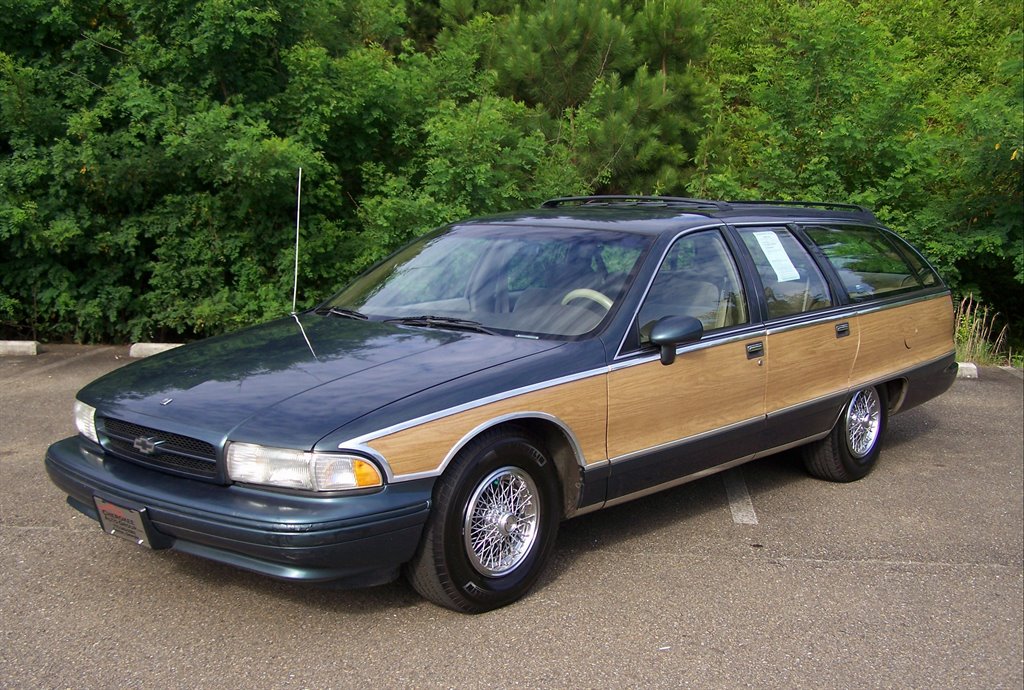
The fourth generation, 1991–96. The rounded body divided opinion new and still does, but mechanically these are the best-developed B-bodies of all: the same frame and suspension, better aerodynamics, and from 1994 the LT1. Split the generation at 1994 without hesitation. The 1991–93 cars run the older throttle-body 305 and 350 — smooth, simple, slow — while the 1994–96 cars offer the LT1 (with a 4.3-litre V8, the L99, as the base engine you must check for, because an L99 car looks identical and is worth far less). The 1994–96 LT1 wagons have a cult following of their own. One 1996 sedan represents the generation in our pool; nationally, 9C1 police cars and Impala SSs dominate the LT1 supply.


Engines and gearboxes
The Caprice engine story is the Chevrolet engine story, told at full size. With two brief detours — an Oldsmobile V8 in the late wagons and an Oldsmobile diesel that is best treated as a historical exhibit — every Caprice runs a Chevrolet pushrod engine, most of them V8s, and the family tree is what you are actually buying. Learn to identify what is in front of you rather than trusting the badge or the listing: the casting and stamping checks are in the inspection section, and they matter because these engines interchange so easily that a fifty-year-old Caprice may carry almost anything.
The small-block V8s: 283, 327, 350, 305 and the rest
The small-block Chevrolet, introduced in 1955, is the default Caprice engine in every generation, and its virtues are the car's virtues: cheap parts, total knowledge, and a tolerance for neglect few engines of any era approach. In the first-generation cars the common engines are the 283 (195 hp) and the 327, offered at 250 and 300 hp. From 1969 the 350 takes over as the volume engine, in tunes from 255 to 300 gross hp, and it remains available, in ever-softer states of tune, all the way to the 1993 throttle-body L05 at 180 hp. The 400 small-block — siamesed bores, and a reputation for running warm — served in the 1970–76 cars and is the pick of the smog-era engines for torque. The 305, introduced in 1976 and standard across the box years, is the engine in most of the cars in our pool: 145 to 170 hp depending on year and induction, adequate in a 3,800-pound car, and unfairly maligned — a healthy 305 in a light-option sedan is a pleasant thing, while a tired one in a loaded Brougham feels exactly as slow as you fear. The 267 of 1979–82 (115 hp) is the one small-block to actively avoid in a full-size car; it makes a Caprice genuinely underpowered.
Induction divides the small-blocks more than displacement does. Carburetted cars run a Rochester Quadrajet four-barrel in most V8 applications, and from 1981 the Quadrajet gains the Computer Command Control system — an oxygen sensor, a mixture-control solenoid clicking away inside the carburettor, and electronic spark control — which makes the car run well when maintained and mysteriously when not: a CCC car should idle evenly, pull cleanly from cold, and show no check-engine light tricks such as a bulb removed. From 1988 the sedans move to throttle-body injection (the L03 305 and the L05 350), the simplest, most robust fuel system ever fitted to the car — two injectors in a unit that looks like a carburettor, with almost nothing to go wrong beyond a tired fuel pump or perished vacuum lines. A TBI car that starts instantly, hot or cold, is telling you its whole fuel and ignition story in ten seconds.
Failure modes are shared across the family and are mostly age, not design. The nylon-toothed timing chain sprocket fitted to many 1960s and 1970s engines sheds its teeth with age and heat — a chain that slaps at idle, wandering ignition timing, or plastic teeth in the oil pan means the set is due, and a steel replacement set (roughly 400 to 800 dollars fitted) should be treated as scheduled maintenance on any unrestored car. Valve stem seals harden and give the classic puff of blue smoke on start-up after sitting — cheap to fix, and not a verdict on the engine; smoke that continues under load is rings or bores and is a rebuild conversation. Rear main seals weep, exhaust manifold bolts seize and snap, and the harmonic balancer's rubber ring perishes until the outer ring slips and your timing marks lie to you. Oil pressure on a healthy small-block is strong; knock under load at any point ends the conversation.
The big-blocks and the sixes
The big-block — Chevrolet's Mark IV — is the first-generation car's glamour engine: the 396 at 325 or 375 hp (sold as a 402 from 1970), the 427 at 335, 385 or 425 hp, and for 1970 only, the 454 at 360 or 390 hp. In the second-generation cars the 454 survives to 1976, falling through the net ratings to around 230–270 hp but keeping its torque, which is what moves a 4,800-pound car. These are strong, simple engines whose problems are the small-block's plus heat: the big-block runs hotter, cooks its starters, and cracks exhaust manifolds more readily. Their real risk is identity. A 396 or 427 Caprice is worth a multiple of the same car with a 350, the engines swap without trace at a glance, and the fender badges unscrew. The stamping pad on the block deck in front of the right-hand cylinder head carries the assembly code and a partial VIN on original installations, and that pad — plus paperwork — is the only evidence that counts. Treat any undocumented big-block Caprice as a small-block car with a story, and price it that way.
At the other end of the range, Chevrolet sold six-cylinder Caprices in most years: the 250 inline six, the 229 V6 in 1980–84, and the 262 (4.3) V6 in 1985–86 sedans. They exist because fleet buyers and fuel scares existed; today they are curiosities — smooth, simple, and slow. The Oldsmobile 307 V8 in the 1986–90 wagons deserves its own warning label: a good engine in the wrong support ecosystem, with Oldsmobile-specific parts, a CCC Quadrajet, and a forest of vacuum hoses. The Oldsmobile 350 diesel (LF9), offered 1979–85 and famous for head-gasket, injection-pump and crankshaft failures, is the one Caprice engine to walk away from unless the car has already been converted to petrol — many were, and a converted car is judged as its new engine dictates.
The LT1 and L99: 1994–96
The last chapter is the best one. For 1994 the B-body received the second-generation small-block: the 5.7-litre LT1, derived from the Corvette engine but built for the big cars with iron heads, a milder camshaft and 260 hp with 330 lb-ft of torque. It transforms the car — a 1994–96 LT1 Caprice is a genuinely quick sedan by any era's standard — and it introduces the generation's one notorious component, the OptiSpark distributor, mounted on the front of the engine behind the water pump. OptiSpark failure presents as high-rpm misfire, hard starting, or a sudden no-start, and it is usually killed by its neighbours: a weeping water pump drips directly onto it, and a failed vent harness lets moisture build inside it. A documented OptiSpark and water pump replacement together is the service pairing you want to see in the file; parts and labour for the pair run roughly 800 to 1,500 dollars. The LT1 also runs reverse-flow cooling, which must be bled correctly after any cooling work or the engine overheats with a full radiator.
The trap of the generation is the base engine. Most retail 1994–96 sedans were built with the 4.3-litre L99 V8 — a small-bore member of the same family, visually near-identical, making 200 hp. There is nothing wrong with an L99 car except its price relative to an LT1, and sellers do not always know or say which they have. The eighth character of the VIN settles it: P is the LT1, W is the L99. Check it on every 1994–96 car, before the test drive, and let it set the price bracket the car is negotiated in.
Gearboxes
Almost every Caprice is an automatic, and the boxes follow a clear lineage. The two-speed Powerglide served the mildest early cars to 1973 and is tougher than its reputation — but a Powerglide Caprice is a slow car. The Turbo Hydra-Matic 350 and the heavier Turbo 400 are the standard 1969–81 boxes: strong, simple, and rebuildable anywhere for roughly 1,200 to 2,500 dollars. The overdrive era starts with the 700R4 (later renamed 4L60): the early 1982–86 units have a genuine internal weakness and a reputation earned the hard way, while the 1987-on boxes are substantially improved — on an early overdrive car, a documented rebuild with updated parts is a selling point, not a worry. The 200-4R appears in some mid-1980s applications, including the Oldsmobile-engined wagons. For 1994 the 4L60E adds electronic control; it is durable in stock use, and its faults are usually electronic — solenoids, wiring, a tired torque-converter clutch shuddering at light throttle around 40–50 mph — rather than mechanical collapse. Judge any of them the same way: fluid red and sweet-smelling, shifts prompt and consistent hot and cold, no flare, no delay engaging drive or reverse. Brown, burnt-smelling fluid plus a delayed engagement is a rebuild being announced.
Manual gearboxes are a first-generation footnote: a three-speed column-shift was the base transmission in the 1960s, and a four-speed floor shift could be ordered with the stronger engines. Genuine four-speed Caprices are rare, documented cars are collectible, and conversions are common — again, the paperwork decides which you are looking at. On any manual car, second-gear synchromesh and clutch judder are the tests, exactly as on any other period Chevrolet.
Problem areas
Everything in this section is drawn from the cars themselves. Our current pool holds 32 Caprices, and for 8 of them we have worked through the sellers' photo sets in detail. Rust was noted in 3 of those 8 cars and visible damage in 2 — a small sample, skewed to dealer-presented cars, so read it as a floor, not a ceiling: on a model line where the youngest classic example is thirty years old and most were working cars, assume the full inspection below is necessary and be pleased when a car passes it. What kills Caprices is corrosion of the frame and floors, the slow decay of everything rubber and vinyl, and hard prior use — fleet miles, customisation, or simple neglect. Work through it in that order.
Rust and the frame: the map
A body-on-frame car rusts in two places that matter differently. Body rust is expensive and unsightly. Frame rust is structural, and on a Caprice it concentrates where the design traps road salt and water. Start underneath, at the rear.
Rear frame rails and the rear crossmember. The single most important check on any 1977–96 car, and nearly as important on the earlier generations. The frame rails sweep up over the rear axle and run back to the rear bumper, and the section behind the rear wheels — plus the crossmember at the very back — collects everything the tyres throw at it. Perforation here is common on northern cars, hard to see without a lift or a thorough crawl, and rarely photographed by sellers. Prod with a screwdriver (with permission) around the rear body mounts and along the bottom face of the rails. Surface scale is normal and treatable; flaking, holed or soft metal is fabrication work, priced per car, and on a late sedan it can exceed the value of the car. This is the walk-away zone: a Caprice with a rotten rear frame is a parts car, whatever the paint says.
Floor pans and trunk floor. Water enters past the windshield and rear window seals, past the cowl, and through perished door seals, then sits under carpets and the trunk mat. Lift the carpets in all four footwells and the mat in the trunk; look in the spare wheel well and the two low pockets either side of it. The box-era cars rust their front footwells and the area under the rear seat; the wagons add the load floor and the well for the third seat. Replacement floor sections are available and a side fitted and finished runs roughly 500 to 1,500 dollars, but floors, like the frame, rarely rot alone — treat floor rust as a marker for the whole shell's life, and price the car as the car the floors describe.
The vinyl roof trap, 1977–90. The formal Brougham and LS Brougham sedans that dominate our pool wear padded vinyl roofs, and the padding holds moisture against the steel roof skin and the rear window channel for decades. The announcement is bubbling at the base of the C-pillar, staining or lifting at the vinyl's rear edge, and rust creeping out from under the rear window trim. A car can present beautifully — clean paint, straight flanks — while the roof is perforating under the vinyl. Press gently along the C-pillar base and around the rear window; crunching or give under the pad is rust, and the honest repair is vinyl off, metal repaired, vinyl replaced: roughly 1,000 to 2,500 dollars done properly. Budget it the moment you see the first bubble, and never let a seller call it cosmetic.
Doors, quarters and the 1991–96 wheel skirts. Door bottoms fill with water when their drain slots block, and the skin bubbles from inside out — run a fingertip along every door's lower edge. Rear quarter panels rust behind the wheels on all generations, and the dogleg where the quarter meets the sill is a mud trap. The 1991–96 cars add a generation-specific fault: the rear wheel openings wear partial skirts, and the skirt and the quarter lip behind it trap dirt against the metal; check the lip with the skirt in place by hand and eye, and look for bubbling at the skirt's top edge. Battery trays rot under the battery on every generation, and the acid track runs onto the inner fender below — a small job alone, a marker of general underhood neglect in company.
What honest looks like. Factory undercoating on these cars is patchy, thin at edges, and long gone in places. A uniform, fresh black coating blown over the frame, floors, brake lines and mounts in the week before sale is a question, not an answer — nobody restores an underside cosmetically for your benefit. Ask for lift photographs of any car you cannot inspect in person, specifically of the rear rails and the floors; a refusal to supply them is itself information.
Suspension, steering and brakes
The Caprice suspension is conventional to the point of being a teaching aid: coil springs and unequal-length control arms in front with an anti-roll bar, a live rear axle on coil springs located by four links (the wagons and some early cars vary in detail), and recirculating-ball steering, power-assisted on nearly all cars after the early 1970s. Everything wears, everything is available, and almost nothing is expensive — which means a Caprice that drives badly is a Caprice nobody maintained, and the drive is one of your best character tests.
Front end. Ball joints, tie-rod ends, the idler arm and the centre link wear together, and the classic presentation is wander at highway speed, a knock over bumps, and feathered front tyres. The idler arm is the most common single culprit and the cheapest. A full front-end refresh with quality parts and an alignment is roughly 800 to 1,800 dollars fitted — real money, but a known quantity, and a car that has had it drives like a new one. Sway-bar links snap and are trivial. Front springs sag with age and miles; measure the car side to side, because a one-corner sag is a spring or a bent component, while an even, low stance on an old car is usually springs and tired body mounts together. Body mounts themselves perish and collapse across all generations, giving door-fit changes, squeaks and a general looseness that owners misdiagnose as suspension wear; a mount set is cheap parts and a dirty day's labour.
Rear axle. The ten-bolt (and on some big-block and 9C1 cars, heavier) rear axle is durable; its bearings whine before they fail, pinion seals weep, and the limited-slip differential fitted to some 9C1 and Impala SS cars chatters on turns when its clutch packs wear or its additive is spent — fresh fluid with the correct additive is the first test, and it usually cures it. On the 1971–76 wagons, add the Glide-Away tailgate mechanism to the list: cables, guides and latches wear, and a gate that will not disappear or will not latch is a specialist hunt for parts.
Steering. The power steering pump whines when low or worn, the hoses weep at this age as a matter of course, and the box develops on-centre play that adjustment only partly cures. Judge it on the drive: light, consistent assistance, no groaning at parking speeds, a wheel that self-centres. A late car that steers like a boat usually wants an idler arm and an alignment, not a box.
Brakes. Discs in front throughout (standard across the line from 1971, widely fitted earlier), drums at the rear except on the 1994–96 9C1 and Impala SS, which carry rear discs. The standard recommissioning list after long storage is seized calipers, perished flexible hoses, a corroded master cylinder and rust-banded rotors — a full hydraulic refresh runs roughly 800 to 2,000 dollars with labour. Two period specifics: the proportioning and metering valves on early disc cars are often bypassed or seized, giving odd pedal feel that bleeding will not fix; and a 1994–96 car with the ABS lamp disabled rather than repaired is telling you about its last owner. Pull up firmly from speed: straight stop, firm high pedal, any judder priced into the offer.
Interior, trim and electrics
The cabin is where the Caprice's luxury mission lives, and where the bill for a tatty car quietly grows. The good news is that the most common trim material — vinyl, in bench and split-bench seats — wears well and cleans up. The bad news is everything around it.
Seats and soft trim. Bench seats sag as their foam and springs age; the driver's outer bolster wears first, and a sitting position like a hammock means pads and possibly spring repair, roughly 300 to 700 dollars per bench for pads and labour before covering. The Brougham and LS cars' pillowed velour splits and fades, and matching period velour is a trimmer's hunt. Door panels warp at the tops, the pull straps break, and the armrest pads crack. None of it stops a car being used; all of it costs to make right, and a genuinely clean original interior is the hardest part of a Caprice to recreate — weight it accordingly, especially on the formal sedans where the interior is half the appeal.
Headliners, dashes and plastics. Sagging headliners are universal on the box and whale generations — the foam backing disintegrates and the cloth drops; a replacement fitted is a few hundred dollars and transforms the cabin. Dash pads crack in the sun belt (and our pool is Florida-heavy, so look closely), and the 1991–96 dash and door plastics go brittle with age and heat, cracking around fasteners. A crack-free dash in a southern car is a garaging certificate; a cracked one is normal, priced, and livable.
The vinyl and the brightwork outside. Beyond the roof rust covered above, vinyl tops crack and split at the seams, and the opera lamps and Brougham badging vanish or break. Chrome on the early cars pits and re-plating is priced per piece; the later cars substitute plastic and stainless trim that fades and peels instead. Count the damaged pieces and price them individually — trim is the one area where Caprice parts support thins out, because the mechanicals were shared with trucks and fleets while the Caprice-specific brightwork was not.
Electrics and accessories. Fifty-year-old Chevrolet electrics fail at connections and switches rather than in looms, and the pattern is generation-specific. On 1970s cars: fusible links, printed-circuit dash clusters with wandering gauges, and power window motors that slow to a crawl. On box-era cars: the Computer Command Control system, power seat tracks, and the vacuum-operated climate controls, whose perished hoses give a car that only blows air at the windshield. Air conditioning on any pre-1994 car was built for R12 refrigerant; a converted R134a system that blows cold is a plus, a dead system is a compressor, hoses and receiver job in the 800 to 1,800 dollar range, and a seller's "just needs a charge" is a leak being described politely. On 1994–96 cars the known items are the OptiSpark and its vent harness, power window regulators — the nylon rollers break and the glass drops — and pass-key and cluster faults. The rule for all of it: work every switch on the viewing. A Caprice where everything electrical works has been used and maintained, which is the best single sign there is.
Fleet, custom and stored cars: the three prior lives
Caprices come to market from three prior lives, and each leaves its own evidence. Fleet and police cars — taxis and 9C1s — accumulate huge mileages and idle hours, wear their interiors at the driver's seat and rear door, and were maintained on schedule while in service, then often run cheaply afterwards. Verify a claimed 9C1 on the SPID label, expect holes from equipment mounting, and value the heavy-duty hardware against the life it has lived. Custom cars are a major strand of Caprice culture: the box and whale sedans are the classic platform for lifted cars on very large wheels — our pool's green 1971 car is advertised exactly that way — and the work ranges from reversible bolt-ons to cut inner fenders and altered suspension geometry. Judge a custom car as a custom car: the value is in the build quality and your taste, not in originality, and check the frame and steering with extra care on any lifted car. Stored cars — the estate sedan, the inherited Brougham — present the opposite risk: low miles, original everything, and every rubber, fluid and seal aged out. A car that has sat for years needs the fuel system cleaned end to end (modern ethanol fuel attacks old rubber and leaves varnish in tanks and carburettors), the brakes gone through completely, and all fluids changed before it is driven any distance; recommissioning at a shop runs roughly 2,000 to 5,000 dollars on top of the purchase, and it is not optional money. Buy the car in regular use over the one that has been asleep, unless the sleeping car is priced as the project it is.


How to inspect one
Allow at least an hour, bring a torch, a magnet wrapped in cloth, a small screwdriver for prodding (with the seller's permission) and a tyre pressure gauge. If the car passes you, pay for a lift inspection before money changes hands — on a Caprice the rear frame rails alone justify the fee, and they are the one thing you cannot judge properly from a driveway.
- Start with the paperwork and the plates. Match the VIN on the title to the plate on the dash (driver's side, through the windshield on later cars; on the door pillar or in the engine bay on early ones). On a 1994–96 car, read the eighth character now: P is the LT1, W is the 4.3 L99, and that one letter sets the price bracket. Find the SPID label — trunk lid or glovebox on the later cars — and check for the codes that matter: 9C1 if police service is claimed, G80 for the limited-slip axle, and the engine code the car was born with.
- Check the engine's identity against the badge. On a claimed big-block early car, read the stamping pad on the block deck ahead of the right-hand head and compare the partial VIN there with the car's. On any car, note what is actually fitted — carburettor or throttle-body, CCC wiring present or stripped — and judge the car as the specification in front of you, not the one in the advertisement.
- Cold start. Insist the engine is cold when you arrive; a warmed-up car is hiding its starting story. A TBI or LT1 car should fire at once and settle to a steady idle. A carburetted car should start with the choke's fast idle and come off it cleanly. Watch for a blue puff (valve stem seals, cheap) versus continuing smoke (engine wear, expensive), and listen for timing-chain slap and lifter clatter that does not fade.
- Under the car: the frame decides. Torch along both rear frame rails, behind the rear wheels to the back crossmember, and prod the rail bottoms and the rear body mounts. Perforation here is structural and, on a sedan, usually terminal for the car's value. Continue forward: floor seams, front frame horns, and the condition of the undercoating — patchy and honest is factory, a fresh uniform black coat over everything is a question. This step decides whether you continue at all.
- Floors and trunk inside. Lift all four carpets and look for water tracks and perforation; lift the trunk mat, remove the spare, and check the well and both side pockets. On a wagon, check the load floor and the third-seat well. Damp in a dry-stored car means leaking seals and rust already started.
- The vinyl roof test. On any Brougham or LS sedan, press gently along the base of the C-pillars and around the rear window, feeling for crunch or give under the pad, and look for bubbling at the vinyl's edges. Price any finding as the vinyl-off repair from the problem areas section, because that is what it is.
- Body, gaps and the magnet. Run the magnet over the rear quarters, door bottoms and the doglegs behind the doors — filler announces itself. On a 1991–96 car, check the rear wheel-skirt lips by hand. Check door bottoms for bubbling, the battery tray for acid damage, and panel gaps for accident history. Count pitted chrome and broken trim pieces and price them one by one.
- Front end and steering. With the car on the ground, rock each front wheel top-to-bottom and side-to-side for play, and have a helper turn the wheel while you watch the idler arm and centre link for lost motion. On the drive, the steering should be light, consistent and free of groans; wander plus a knock is a front-end refresh priced into the offer, not a surprise for later.
- The test drive. Fifteen minutes minimum, including a highway stretch. The automatic should engage drive and reverse promptly, shift consistently, and — on an overdrive car — lock up its converter without shudder at light throttle. A 305 car should pull cleanly if unspectacularly; an LT1 should pull hard. Brake firmly from speed: straight stop, firm pedal, no judder. Let the car idle hot afterwards and watch temperature and oil pressure.
- Heat, air and every switch. Whatever the weather, run the heater and the air conditioning, the blower on all speeds, every window, the seat, the washers, the lights and the radio. On a CCC carburetted car, confirm the check-engine light comes on with the key and goes out running — a missing bulb is a hidden fault being sold with the car.
- Stance and ride. Stand back and look: a Caprice should sit level side to side, with the rear at a sensible height. One low corner is a spring or mount; a generally sagging car is springs and body mounts together. Photograph the car in side profile from a distance — stance faults you talk yourself out of in person are obvious in a picture.
- Interior last, and honestly. Sit in every seat, feel for collapsed foam, and look at the headliner, dash pad and door tops in daylight. On a formal sedan the interior is half the car's value and the hardest part to recreate — a sound original cabin outweighs shiny paint over a tired one, every time.
Values
The market block beneath this guide carries the current figures from our own listings — what is for sale now, and the recorded sales behind it — refreshed as the market moves, so read the numbers there and use this section to learn how to read them. The Caprice market is not one market. It is at least four, stacked by generation and specification, and the single most common buying mistake is pricing a car by the wrong one.
Start with the condition spread, which on this model is wider than the specification spread through most of the range. These were working cars, built in enormous numbers and used until they were finished, so the bottom of every generation's market is populated by rusty, tired or heavily customised cars that are cheap for structural reasons, while the top is held by a thin layer of garaged, original, low-mileage formal sedans — the kind of Florida Brougham that dominates our own current pool. Between those poles, the honest driver-quality car is where most transactions happen, and it is the condition of the frame, the floors and the interior, far more than mileage, that places a given car in the stack. A low odometer reading on a car with a rotten rear frame is worth nothing; a high reading on a maintained, rust-free fleet car can be the value buy of its generation.
Specification premiums are real but specific. Big-block power in the 1965–70 cars carries the largest premium in the whole Caprice world, and it is paid only for documented cars — the stampings and paperwork described in the inspection section — because the conversion is easy and common; an undocumented big-block car trades at small-block money, and should. The 1975 convertible carries its own scarcity premium. In the box years, the coupe and the wagon, built in smaller numbers and used harder, now command more than the common sedan in equal condition, while the LS Brougham's premium is paid for interior and roof condition rather than specification. In the final generation the premium is a single engine. LT1 cars — retail sedans so equipped, 9C1s, and above them the Impala SS, which sets the ceiling for the whole LT1 market — trade in a different bracket from the visually identical L99 cars, and the gap between asking and achieved prices is widest exactly there, where sellers price an L99 car by LT1 listings. Verify the VIN character, then negotiate in the correct bracket.
Asking and achieved prices diverge on Caprices in a predictable pattern. Private sellers of formal sedans often anchor on the best advertised example of the year, regardless of condition, while the auction record — the place where condition is photographed underneath as well as on top — consistently clears honest cars for less than the classifieds ask. The project-versus-driver gap is correspondingly large: a running, driving, presentable car is worth a strong multiple of the same car as a non-running project, because the recommissioning bill for brakes, fuel system and tyres is a fixed cost that lands on the project buyer in full. That gap is your negotiating map. Price the specific car's faults from the job costs in this guide — the front-end refresh, the vinyl-roof repair, the brake overhaul — present them as a list, and you are negotiating from evidence rather than opinion. Finally, originality is appreciating and modification is not, except within the custom scene itself, where a well-built car is valued by that community on its own terms. Buy the car whose market you understand, at the condition its frame and floors support, and let the computed figures below this guide confirm the bracket — never the other way round.
Parts and ownership
The Caprice is one of the best-supported classics in America, for a simple reason: it shares its mechanical life with the Impala, with GM's other B-bodies, and in large part with the Chevrolet truck lines, and it was built by the million and serviced everywhere for thirty years. The factory heritage channel and the reproduction trade both cover the car, and the knowledge base — manuals, forums, specialist shops in every state — is effectively bottomless.
Easy: everything serviceable. Filters, plugs, ignition parts, brake discs, pads, calipers and hydraulics, suspension wear parts including ball joints and idler arms, springs, water pumps, radiators, exhaust systems in standard form, glass rubbers and weatherstrips for the common body styles, and small-block and LT1 service parts of every kind. Order today, fit this weekend, at prices close to modern-car money. The throttle-body and LT1 fuel systems are serviced by the same trade that keeps the trucks running.
Harder and dearer: Caprice-specific trim. Chrome for the early cars (priced per piece to re-plate), Brougham and LS vinyl roof mouldings and opera lamps, correct velour and pillow-top seat materials, crack-free dash pads, wagon-specific parts including the 1971–76 Glide-Away tailgate mechanism, Oldsmobile 307-specific components, and diesel parts for the few LF9 cars that remain diesel. None of it is unobtainable; all of it rewards patience and club knowledge over a credit card at midnight. A quality repaint costs what a quality repaint costs on any full-size car, which is why this guide's mantra is to buy the body, the frame and the interior, and fix the mechanics.
Running costs. A sorted Caprice is a realistic regular-use classic. Fuel consumption is in the low-to-mid teens for the carburetted V8 cars, better for the overdrive and injected cars, and the LT1 cars are the most economical of all on a highway run. Servicing is within the ability of any competent general shop; nothing on the car requires marque-specific tooling outside the OptiSpark and the CCC carburettor, and both are well understood. Insurance sits in line with other classics of similar value. The budget line that catches new owners is the first year: catching up deferred maintenance on a running car honestly runs into the low thousands before you improve anything, and recommissioning a long-stored car costs more again. Buy a car in regular use, keep it in regular use, and the Caprice repays you with the cheapest miles in the hobby.

Which one to buy
- The all-rounder: 1988–90 Caprice Classic sedan. Throttle-body injection, the improved overdrive automatic, the full formal trim, and the deepest supply of garaged original cars. If you want one Caprice to drive and enjoy, this is it.
- The value buy: a high-mileage, rust-free box-era sedan. Fleet-maintained or family-owned, mechanically honest, priced by its odometer while its frame and floors say otherwise. Condition beats mileage on these cars more than on almost anything else.
- The collector car: 1966–69 big-block coupe or hardtop, documented. The muscle-era flagship, priced like one when the stampings and paperwork agree. An undocumented car is a small-block purchase at small-block money, whatever is under the hood today.
- The open car: 1975 Caprice Classic convertible. The last of the full-size Chevrolet ragtops and the one second-generation car with a genuine scarcity story. Buy the best body you can find; the mechanicals are the easy part.
- The performance buy: 1994–96 LT1 car. A 9C1 with a kind service history, a retail LT1 sedan, or the Impala SS if the budget reaches — the quickest, most economical Caprices ever built. Verify the VIN's P code, and look for the OptiSpark and water pump already done together.
- The family wagon: 1986–90 Caprice wagon, or a 1994–96 LT1 wagon. Nine seats, a load floor like a runway, and a cult following that keeps good ones findable. On the late box wagons, budget for the Oldsmobile 307's vacuum-hose archaeology.
- The custom: a built box or donk-era car, bought as a custom. Judged on build quality and your own taste, never on originality — with the frame, steering and brakes checked harder than on any stock car.
And the rule that overrides all of the above: buy the least rusty car you can find, in the specification you can live with. Engines, gearboxes, brakes and front ends are all fixable at prices you can plan for, from parts stacked on shelves across the country. A rotten rear frame or a perforated roof under a vinyl top costs more to put right than the finished car will be worth — and on a car built by the million, there is always another one. Wait for it.