
Chevrolet Camaro Coupe buyer's guide
Chevrolet Camaro Coupe -- the model's own buyer's guide: variants, values and what to check.
Years listed: 1967-1969 · Series: Camaro Gen 1
Overview and history
The first-generation Camaro coupe is the car Chevrolet built in a hurry to answer the Mustang — announced in September 1966 as a 1967 model — and it turned out to be far more than a reply. Where the Mustang was a Falcon underneath, the Camaro was a clean-sheet design on GM's new F-body platform, shared with the Pontiac Firebird: a steel unibody shell with a bolt-on front subframe carrying the engine and front suspension, leaf springs at the rear, and a long-hood, short-deck shape that still defines what a pony car looks like. Every car covered by this guide is a first-generation coupe, built for the 1967, 1968 and 1969 model years at Norwood, Ohio, and Van Nuys, California. Our own records track 838 of these coupes, and the shape of that pool tells you the shape of the market: 389 are 1969 cars, 232 are 1968s and 217 are 1967s, because the 1969 model year ran long — the all-new 1970 car was delayed, so 1969 production stretched on while Chevrolet kept selling the car buyers wanted.
The coupe was the Camaro. The convertible gets the magazine covers, but the fixed-roof car was the volume seller, the racer's choice and — this matters to you now — the stiffer, quieter, drier car to own fifty-five years later. A coupe's roof is not decoration: the steel roof panel, its bows, the A-pillars running down into the cowl, the C-pillars flowing into the rear quarters and the package shelf behind the rear seat together close the top of the unibody box, and a first-generation coupe is measurably more rigid than the convertible, which needed extra bracing and still flexes and leaks in ways a coupe simply does not. That rigidity is why the Trans-Am racers, the drag racers and the COPO cars were coupes.
Three model years, three distinct personalities. The 1967 is the purest shape — vent windows in the doors, no side marker lights, round parking lamps in the grille. The 1968 lost the vent windows to Astro Ventilation, gained federally required side markers and staggered rear shock absorbers on performance cars. The 1969 was a genuine reskin below the roofline: broader, lower-looking, with squared wheel arches, a creased line pressed into the quarters and doors, a new grille and dashboard — but the same roof, glasshouse and basic structure underneath, which is why so much of this guide applies across all three years. One coupe myth to bury at the start: there was never a factory T-top on a first-generation Camaro. The removable-panel roof belongs to later generations, outside the pool this guide covers. Any first-generation coupe with cut-in roof panels has been modified after the fact, and the cutting removed exactly the structure that makes a coupe a coupe — walk away, or price the car as a modified shell and nothing more.
The range ran from a six-cylinder commuter coupe to the ZL1, an aluminium-block 427 built in tiny numbers through the Central Office Production Order back door. Between those poles sit the Rally Sport appearance package, the SS performance package, the Z/28 Trans-Am special, and an options list long enough that two cars with the same badge can be entirely different machines. That breadth is the coupe's blessing and its trap: because badges, stripes and hoods unbolt, the market is full of tributes, clones and honest cars wearing borrowed jewellery. Everything in this guide — trim-tag decoding, partial-VIN checks, casting-date logic — exists to help you tell which one you are standing in front of.
These cars were cheap, fast and everywhere, so most were driven hard, modified, parked outside and eventually restored — sometimes superbly, sometimes with filler and hope. The mechanicals are some of the toughest Chevrolet ever made. What kills a first-generation coupe is rust in the structure, and a paper identity that does not match the metal. Buy the shell and the story first. The engine is the easy part.

The models
Every first-generation Camaro coupe left the factory as a Sport Coupe; what separates one from another is the engine line and the option packages layered on top of it. The VIN codes the basics: the third digit is 3 for a six-cylinder car and 4 for a V8, and the fourth and fifth digits are 37 for the coupe against 67 for the convertible — so a V8 coupe reads 12437 and a six-cylinder coupe 12337. Learn those numbers, because a car advertised as an original V8 coupe whose VIN carries the six-cylinder code started life with a six, whatever is under the hood today.
| Model | Years | Engine | Output | Built | Character |
|---|---|---|---|---|---|
| Sport Coupe, six | 1967–1969 | 230 or 250 cu in straight six | 140–155 hp | The bulk of roughly 699,000 first-generation Camaros | The honest commuter; light, simple, increasingly rare unmodified |
| Sport Coupe, V8 | 1967–1969 | 327, then 307 and 350 cu in small-block | 200–275 hp | Very large numbers across all three years | The default classic Camaro; the driver-quality sweet spot |
| Rally Sport (RS) | 1967–1969 | Any engine, six included | As the engine fitted | An appearance package, not a model | Hidden headlamps and trim; stackable with SS and, in effect, with anything |
| SS 350 | 1967–1969 | 350 cu in small-block (L48) | 295 hp, 300 hp in 1969 | Part of an SS total of roughly 34,000–35,000 in 1967 and 1969 | The balanced SS; torque without big-block weight |
| SS 396 | 1967–1969 | 396 cu in big-block (L35, L34, L78) | 325–375 hp | The remainder of the SS totals; L78 cars a small fraction | The heavy hitter; nose-heavy, thunderous, the clone-magnet badge |
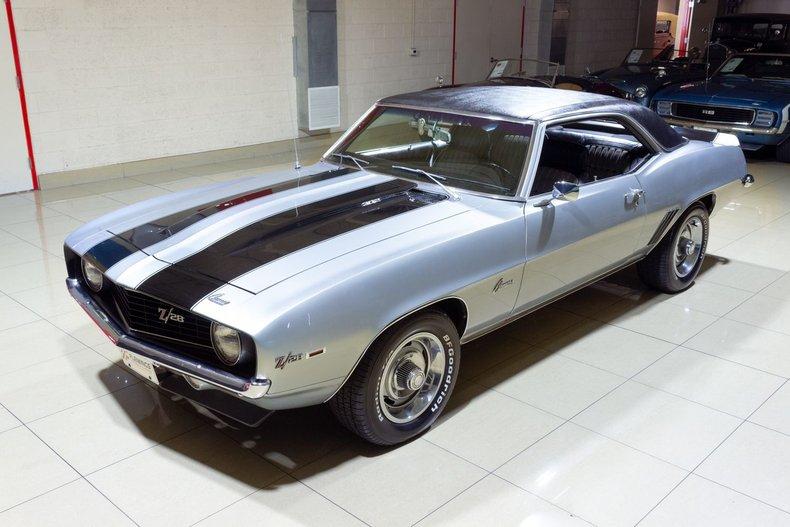
| Z/28 | 1967–1969 | 302 cu in small-block, solid lifters | 290 hp advertised | 28,103 in total: 602 in 1967, 7,199 in 1968, 20,302 in 1969 | The Trans-Am special; high-revving, manual-only, no air conditioning |
| COPO 427 | 1969 | 427 cu in big-block (L72 iron, ZL1 alloy) | 425–430 hp advertised | About 822 iron-block COPO 9561 cars; 69 ZL1s | Factory drag weapons ordered through a fleet-order back door |
(Outputs are period SAE gross ratings — optimistic by modern net standards, and in the 302's case deliberately understated for racing classification. The Z/28 and COPO figures above are the well-documented ones; Chevrolet published package totals rather than clean per-engine coupe splits for the SS lines, so treat any source quoting an exact SS 350 coupe count with suspicion.)
The base coupes. The six-cylinder Sport Coupe was the volume car: a 230 cu in six in 1967–68, joined in buyers' affections by the torquier 250, with a three-speed manual or a two-speed Powerglide if you paid extra. The base V8 was the 327 for 1967–68 in 210 and 275 hp states of tune, joined for 1969 by the economy 307 and the 350 in mild forms. These cars are where driver-quality value lives — in our records, manuals and automatics run close to even across the 838 coupes — and they are also the raw material for almost every clone, because a base coupe plus an SS hood, stripes and badges is an afternoon's work. Buy a base car as a base car, pay base-car money, and enjoy the fact that nothing about it needs proving.
The Rally Sport. RS — Regular Production Option Z22 — is appearance only: hidden headlamps behind grille doors, revised tail lamps with the reverse lights moved to the rear valance, extra bright trim and RS badges. It could be ordered on any Camaro, six-cylinder cars included, and combined freely with SS. Two consequences follow. First, an RS badge tells you nothing at all about the engine. Second, the headlamp mechanism changed by year and is a running-cost item: vacuum-operated doors for 1967, electric motors for 1968–69, both covered in the problem areas below. A non-RS grille on a car claimed to be an RS is not a detail — check the tail lamps and valance lights before accepting the story.
The SS. The Super Sport package, Z27, was the performance flagship sold openly in the showroom: a 350 small-block for 1967 (the 350 debuted in the Camaro SS before anywhere else at Chevrolet), or the 396 big-block in 325, 350 or solid-lifter 375 hp form, with a simulated-scoop hood, SS badging, multi-leaf rear springs, power front discs mandatory on big-block cars, and the 12-bolt rear axle. For 1969 the 350 was rated 300 hp. The SS is where clone money concentrates, because the premium over a base coupe is large and the visible differences are bolt-on. The defences are in the inspection section: X-codes on late 1969 Norwood cars, the 12-bolt axle, engine-pad suffixes and casting dates that precede the car's build date by a sane margin.
The Z/28. Built to homologate a sub-5-litre Camaro for SCCA Trans-Am racing, the Z/28 paired a unique 302 — a 327 block with the 283's short-stroke crankshaft — with solid lifters, a big Holley on an aluminium intake, a mandatory close-ratio four-speed, quick steering, multi-leaf springs, staggered rear shocks from 1968, and power front discs. No automatic, no air conditioning, and in 1967 almost no badges, which is one reason genuine 1967 Z/28s — just 602 — are the hardest of all to authenticate. Chevrolet won the Trans-Am manufacturers' championship in 1968 and 1969 with Penske-run coupes, and the road car earned its reputation: it is the driver's Camaro, and the market knows it.
The COPO cars. Central Office Production Orders were a fleet-ordering channel, and in 1969 dealers such as Yenko, Berger and Fred Gibb used COPO 9561 to order coupes with the iron-block L72 427 — an engine Chevrolet officially did not sell in a Camaro — and COPO 9560 for the all-aluminium ZL1, of which 69 were built. A COPO claim without paperwork, dealer documentation or registry confirmation is a story, not a car. Yenko's roughly 201 SYC conversions for 1969 sit in the same territory — real ones are documented to the VIN.

Engines and gearboxes
The sixes and the small V8s: 230, 250, 307, 327 and 350
The six-cylinder cars use Chevrolet's third-generation straight six — 230 cu in (rated 140 hp) as the standard engine, with the longer-stroke 250 (155 hp) as the upgrade — fed by a single-barrel Rochester carburettor, with hydraulic lifters and a seven-main-bearing crankshaft. These are not consolation engines. The six is light, which keeps the nose honest, it is almost impossible to kill with oil in it, and its period weaknesses are mundane: the Rochester's choke and idle circuits gum up on modern fuel, and the side-cover gaskets weep. Because the engine is so often swapped out, a surviving original six-cylinder coupe with its numbers intact is now genuinely uncommon — check the pad on the block ledge by the distributor for the suffix stamp before assuming any six is original.
The small-block V8s are the heart of the range, all descendants of the 1955 265: thin-wall cast-iron blocks, overhead valves, hydraulic lifters in road tune, and a parts supply so deep that a full rebuild is a routine machine-shop job anywhere in America. The 327 came as the 210 hp L30 with a two-barrel Rochester 2GC and the 275 hp L30 variant — same code, different tune — with a four-barrel and higher compression; for 1969 the 307 (200 hp, two-barrel) became the economy V8 and a mild 350, the LM1 at 255 hp and the L65 at 250 hp, filled the middle. The 350 is the engine the SS launched with: the L48, 295 hp in 1967–68 and 300 hp for 1969, with a Rochester Quadrajet, hydraulic camshaft and 10.25:1 compression in early form. A healthy small-block starts on the choke, idles at a lumpy-but-even 600–700 rpm, shows 30–45 psi of oil pressure hot at cruise and pulls without blue smoke. Smoke at start-up that clears is valve stem seals — a known, cheap, top-end job. Smoke under load is rings or bores, and that is a rebuild conversation at roughly $4,500–8,000 for a quality small-block rebuild with machine work, more if the block needs sleeves or the crank is hurt.
The Quadrajet deserves its own paragraph because it is the most misdiagnosed part on these cars. A Quadrajet that bogs on acceleration is usually accused of being worn out; the common causes are a perished accelerator-pump cup (modern ethanol fuel hardens the original material), a secondary air-valve spring set too loose so the huge secondaries flop open and the engine falls on its face, or a warped air horn leaking vacuum. The distinguishing test is mechanical: watch the air valve while an assistant snaps the throttle — it should open progressively against spring tension, not slam. A Quadrajet rebuilt by someone who knows them runs $450–900 and transforms a car; a cheap exchange carburettor usually does not.
The 302 and the big-blocks: Z/28 and Mark IV power
The 302 exists for one reason: the Trans-Am rulebook capped engines at 5.0 litres, so Chevrolet combined the 327's 4.00-inch bore with the 283's 3.00-inch stroke to make 302 cu in of short-stroke, oversquare small-block that lives to rev. Forged crankshaft and pistons, 11:1 compression, solid-lifter camshaft (the famous "30-30" Duntov grind, named for its .030-inch lash settings), an aluminium high-rise intake and a 780 cfm Holley 4053. The advertised 290 hp was a classification figure; a healthy 302 pulls hard to 7,000 rpm and makes its real power up there. Below 3,000 rpm it is flat and unhappy, the solid lifters need lash checks as routine service, and the car demands the close-ratio four-speed it was sold with. Identity is everything: the 1967 and 1968 engine code is MO, and the 1969 is the famous DZ stamp on the pad at the front of the right-hand block face. A 1969 Z/28 without a DZ block — or with a pad decked smooth and restamped — is a car whose value argument has already collapsed; the inspection section walks through reading that pad. Correct 302-specific parts are hunted items, and a correct, complete 302 rebuild by a specialist runs well into five figures.
The big-block is Chevrolet's Mark IV, the 396, in three road tunes: the hydraulic-cam L35 at 325 hp, the L34 at 350 hp, and the solid-lifter L78 at 375 hp, with the L89 aluminium-head version of the L78 as a rare option for 1968–69. The 427s in COPO cars are the same architecture stretched: the iron L72 at 425 hp and the all-aluminium ZL1, advertised at 430 hp, the most valuable engine ever fitted to this body. Big-blocks run Quadrajets in L35 form and Holleys on the hotter engines. What to check is cooling and oil: a Mark IV in a Camaro engine bay is a tight fit that marginal radiators cannot serve, so a big-block car that creeps toward hot in traffic is showing you a clogged core, a wrong fan shroud or a slipping fan clutch before it shows you a head gasket — test with a steady idle after a hard run. Oil consumption on a solid-lifter L78 that has been revved for fifty years is a bore-wear question, settled by a compression and leak-down test, not by the seller's optimism. A quality big-block rebuild runs roughly $7,000–12,000.
Cooling and charging are shared across the range. Original Harrison radiators clog from the bottom up; aluminium replacements cool better and cost originality points. A charge light glowing faintly at idle is usually regulator points or a tired diode trio, not a dead alternator. And if a car runs better from a remote fuel can than from its own tank, believe the can — a tank that sat with ethanol fuel grows rust and varnish no new pump will cure.
Gearboxes, clutches and rear axles
Four transmissions cover the range, and our records show the coupe pool split closely between them — manuals slightly ahead of automatics across the 838 cars. The base manual is a Saginaw three-speed, column- or floor-shifted; the four-speeds that matter are Muncies: the wide-ratio M20, the close-ratio M21, and the M22 "Rock Crusher," named for the whine of its straighter-cut gears, fitted to Z/28s, L78s and COPO cars. A Muncie is identified by its casting numbers and the partial VIN stamped on the case from 1968 onward, and it is judged by its second-gear synchromesh — the synchro that wears first — and by whether it jumps out of gear on the overrun, which means worn engagement teeth, not adjustment. A Muncie rebuild with new synchros, bearings and seals runs roughly $1,200–2,500 at a specialist; an M22 premium is real, so verify the gearbox before paying it, because an M20 in an M22's clothing is a classic swap. Clutches are 10.4-inch on small-blocks and 11-inch on big-blocks and high-performance cars; judder on take-up is usually oil on the disc from a leaking rear main seal or a warped flywheel, both visible once the inspection plate comes off.
The automatics are the two-speed Powerglide — tougher than its reputation, and correct in plenty of base and SS cars — and the Turbo Hydra-Matic: the TH350 behind small-blocks and the TH400 behind big-blocks and, from 1969, small-blocks too. Judge any of them on fluid colour and smell first (bright red and sweet is service; dark and burnt is a rebuild at roughly $1,800–3,500), then on shift quality: a Powerglide has one shift and it should be clean; a TH400 that flares on the 2–3 change or delays reverse engagement when cold is telling you its seals have hardened. Kickdown linkage and vacuum modulators cause more "gearbox faults" than gearboxes do — a TH400 that will not kick down is usually a disconnected switch, a ten-minute check before a four-figure quote.
Rear axles split cleanly by performance level, and the split is an identity tool. Base cars carry the 8.2-inch 10-bolt; SS, Z/28 and COPO cars carry the 8.875-inch 12-bolt, identified by its irregular twelve-bolt cover and the bulge for the larger ring gear. Positraction (G80) was optional on either. Ratios ran from lazy 2.73:1 highway gears to 4.10:1 and deeper in Z/28 and COPO service, stamped as a code on the front of the right-hand axle tube. A 12-bolt under a claimed SS is supporting evidence; a 10-bolt under one is a question that needs an answer. On the road, a whine that changes with throttle is ring-and-pinion wear or set-up; a clunk on take-up in a Positraction car is often just the clutch pack wanting the correct limited-slip additive — the cheapest fix in this guide, and the one most often misdiagnosed as a failing axle.

Problem areas
Start with an honest word about our own evidence, because it cuts against instinct. We have photo-checked 742 of the coupes in our records in detail, and the resulting notes mention rust in only 5 of those cars and visible damage in 10, with no mentions at all of smoke or leaks. Read that correctly: it does not mean first-generation coupes do not rust — they rust enthusiastically, in the places mapped below. It means the pool is dominated by auction-presented cars, photographed washed, lit and angled to sell, and that photo notes record what a listing shows rather than what a lift reveals. On these cars the camera is the seller's witness, not yours, and every check in this section assumes you will make it in person, underneath, with a torch.
Rust and the coupe shell: the map
A first-generation Camaro is a unibody: there is no separate chassis frame to save a rotten shell, only a bolt-on front subframe. The coupe's roof closes the structure, which makes the roof system — skin, bows, drip rails, pillars and rear glass channel — structural in a way a convertible's folding top never is. Work the water paths, because rust on this car follows water exactly as it does on any steel shell of the period.
The roof, drip rails and vinyl tops. The roof skin is spot-welded over bows and edged by drip rails that channel water off the sides. The rails trap leaves and road film against a seam that was barely painted at the factory, and they perforate from inside the seam outward — probe both rails with a fingertip and a magnet, and treat bubbling paint on the rail as perforation until proven otherwise. The vinyl roof covering is the coupe's single most treacherous feature: the vinyl and its padding hold moisture against the roof skin and around the rear window, and a car can carry a handsome, taut vinyl top over a roof that is holed at the seams. Press along every vinyl seam, around the rear window moulding and at the base of the C-pillars; a soft, crunchy or bubbled feel under vinyl is rust, and patching a roof plus a new vinyl top runs roughly $2,000–4,500 done properly. A painted-roof coupe shows its roof honestly, which is worth something at purchase time.
Rear window channel, package shelf and sail panels. The rear glass sits in a channel that collects everything the roof sheds. When the channel perforates — and on a car that has lived outside, assume it has started — water runs inside the C-pillars, across the package shelf and down into the trunk, rusting all three on its way. The visible tells are staining or bubbling at the lower corners of the rear window, a warped or water-marked package shelf inside, and rust at the front corners of the trunk floor. The sail panels — the broad C-pillar surfaces that give the coupe its shape — bubble at their bases where the quarter, the pillar and the window channel meet, and filler in a sail panel is both common and structural-adjacent: press hard, use the magnet, and remember that a coupe's pillar is a load path, not a styling flourish. Rear window channel repair, with glass out and new steel let in, is roughly $800–2,000 before paint; it is also the repair whose absence rots the trunk floor below it.
Rear quarters, wheelhouses and trunk. The rear wheel arches and the lower quarters behind them are the coupe's classic rust portrait: road spray lives inside the lip, the inner wheelhouse rusts with the outer skin, and the drop-offs at the sides of the trunk floor perforate and let water into the trunk from below as well as above. Lift the trunk mat and the spare, and look at the floor seams, the wheel tubs and the area under the fuel filler. Trunk floor replacement is a known job with reproduction panels available, roughly $1,200–2,800 fitted and painted, but trunk rust that has reached the rear frame rails is a different conversation: the rails carry the leaf-spring hangers, they rust from inside around the shackle mounts, and rail repair is fabrication, priced per car, that can exceed the value of a base coupe.
Floors, cowl and firewall. The windshield channel leaks like the rear one, and the water lands on the front floor pans and toe boards, under carpet that hides it for years. Lift every carpet. The cowl sides — the plenum chamber ahead of the doors, fed by the grille panel at the base of the windshield — fill with leaves, hold water, and rust out at the bottom, which then leaks onto the floors and rots the cowl-to-floor joint; a musty smell and wet front carpets after rain is this, until proven otherwise. Floor pans are reproduced and a side fitted runs roughly $700–1,500, but floors are a marker: a coupe needing floors, a rear window channel and quarters is a shell restoration, and the arithmetic in the Values section applies.
Front subframe, mounts and the smaller traps. The bolt-on front subframe itself is heavy steel and usually survives; what fails is where it bolts on. The body-mount pockets — at the firewall and the core support — sit in rubber bushings over captured nuts in the floor and cowl structure, and those pockets rust. A subframe hanging on rotten mounts makes the whole front of the car feel loose and misaligns every panel ahead of the doors; mount-pocket repair is structural welding, roughly $800–2,000 a side with the subframe dropped. Smaller traps, each cheap alone and diagnostic together: door bottoms (drain slots block, doors fill, bottoms bubble — run a fingertip along every door's lower edge), the battery tray and the inner fender beneath it, the heels of the front fenders behind the wheels, and rocker panels along their full length. A coupe whose doors drop when opened and whose gaps wander is telling you about hinges, pins and possibly mount structure — in that order, cheapest first.
Suspension, steering, brakes and stance
The front suspension is a short-and-long-arm layout with coil springs, carried on the subframe; the rear is a Hotchkiss drive axle on leaf springs — mono-leaf on base cars, multi-leaf on SS, Z/28 and heavy-duty applications. Front ball joints and control-arm bushings perish and crack; the test is a pry bar and a rocked wheel, not the seller's assurance. The centre link and idler arm wear and give the vague, wandering steering these cars are unfairly famous for — a sorted F-body steers precisely, so vagueness is wear, priced at roughly $600–1,400 for a front-end refresh of joints, bushings and alignment. Subframe bushings, covered above, mimic suspension wear exactly; check them before condemning hard parts.
At the rear, the famous fault is wheel hop under hard acceleration, caused by the leaf springs winding up — the reason Chevrolet staggered the rear shock absorbers for 1968 on performance cars, mounting one ahead of and one behind the axle. A 1967 performance car that hops is period-correct; a 1968–69 performance car that hops has tired springs, dead shocks or both. Sagging mono-leafs on a base car drop the rear and change pinion angle, which shows up as a driveline vibration at cruise that owners misdiagnose as a gearbox fault — check ride height at all four corners before chasing the driveline.
Brakes split by specification. Most base cars left with drums all round; front discs were optional across the range and mandatory with the big-block SS, and the 1969 Z/28 could be ordered with the rare JL8 four-wheel disc package. Judge a drum car on its own terms — even pull-up, no grabbing — and budget a disc conversion only if you want one, at roughly $900–1,800 for a quality front kit fitted. On any car that has sat, the standard recommissioning list applies: perished flex hoses, seized wheel cylinders or calipers, a master cylinder bypassing internally (a pedal that sinks slowly at a stop is the tell) — a full hydraulic refresh runs roughly $700–1,600 in parts and labour. The single-reservoir master cylinder on 1967 cars works, but a failure anywhere is a failure everywhere, which is why many owners fit the later dual-circuit system and why you should ask whether it has been done.
Interior, headliner and glass: the coupe-specific costs
The coupe cabin has one component no convertible shares in the same form: the bow-type headliner. Vinyl headlining is stretched over steel bows that clip into the roof rails, tucked and glued at the windshield, rear window and sail panels. Age makes the vinyl shrink and the stitching let go, and the liner sags onto rear passengers' heads — the classic first-generation coupe tell. A headliner replacement is not expensive in materials but is fiddly labour, roughly $500–1,100 fitted, and doing it properly means the rear glass often comes out, which is the moment to inspect and repair that rear window channel from the rust section: the two jobs are one job, and a seller who has fitted a new headliner without touching a rusty channel has spent your money in the wrong order. Check the sail-panel trim boards for water staining while you look up — they are the inside witnesses of channel leaks.
Seats are foam over spring frames in standard trim, with the Custom (deluxe) interior bringing different patterns, moulded door panels and extra brightwork; the foam crumbles with age and sun, and the driver's outer bolster wears first. Sit in the driver's seat: once you can feel the frame, the job is foam and covers together, roughly $400–800 per front seat in parts with fitting on top. The optional fold-down rear seat is rare and worth checking for function rather than assuming it. Dash pads crack in the sun belt — a reproduction pad is a few hundred dollars and an afternoon — and carpets hide the floors, which is why the inspection has you lifting them rather than admiring them.
Glass and weather sealing decide whether a coupe is a dry car or a mobile greenhouse. The windshield and rear window leak at the corners as their seals age; side glass runs in felt channels that wear and let the glass rattle, and the coupe's quarter windows pivot and seal against the door glass — misaligned quarter glass whistles and leaks, and adjustment usually cures it. Door, roof-rail and trunk seals are all reproduced, a full set fitted at roughly $400–900 in parts; a coupe that stays dry inside through the hose test in the inspection has passed a test many restored cars fail.
Electrics and the RS headlamp doors
F-body electrics are simple — a fuse box, a few harnesses, and earth straps — and fail the way all period electrics fail: at connections. Dim lamps, a wandering fuel gauge and intermittent accessories are earth faults until proven otherwise, and the engine-to-body earth strap is the first suspect on any car with a cluster of unrelated gremlins. The fusible links at the starter and horn relay protect the main feeds; a car whose failed link has been "repaired" with plain wire has an unfused harness and a fire risk — look for exactly that bodge on any car with electrical history.
The RS hidden headlamps are the marque-specific system, and they differ by year. For 1967 the doors are vacuum-operated from an under-hood reservoir and actuator pods, and the failure mode is perished vacuum hose and split actuator diaphragms: doors that open slowly, unevenly, or sigh shut overnight. For 1968–69 the system is electric, with motors and limit switches at each door, and the failures are corroded switch contacts and tired motors — a door that needs a helping hand, or that stops half-open, is usually a switch clean and adjustment before it is a motor. Either way, test both doors through several cycles and price a system that does not work as a system: individual parts are available, full correct kits for a missing RS front end are not cheap, and a standard grille swapped onto an RS car to hide the problem is a deduction, not a fix. Beyond the RS, check the horn, the reversing lamps (in the valance on RS cars, in the tail lamps on standard cars — a quick RS cross-check), the heater blower on all speeds, and the wipers.
Identity: trim tags, partial VINs and the clone traps
Because a coupe's value swings so widely on specification, identity checking is a problem area in its own right. The tools, in order of authority: the VIN, the trim (cowl) tag on the firewall by the brake booster, the partial VIN stamps, and the casting dates. The VIN plate sits on the driver's door jamb on 1967 cars and moved to the driver's side of the dashboard, visible through the windshield, for 1968–69. The partial VIN — the last digits of the car's own VIN — is stamped on the engine pad of original engines from 1968 onward (and on many 1967 high-performance engines), on the Muncie main case, and in hidden locations on the shell, including under the blower-motor area of the firewall. An original engine in a documented car carries a partial VIN that matches; a "matching numbers" claim you cannot demonstrate with the pad is a claim, not a fact.
The trim tag is where year-by-year knowledge pays. The 1967 tag is the most informative: option groups stamped along its bottom rows can confirm equipment including the SS and Z/28 packages and four-speed fitment. The 1968 tag went quiet — it carries build date, style, trim and paint but does not code the performance packages, so a 1968 SS or Z/28 stands or falls on the engine pad, the axle, the components and the paperwork. The 1969 Norwood tag regained its voice part-way through the year: from around December 1968, Norwood cars carry X-codes — X11 and X55 associated with SS350 applications (X11 also covers style-trim cars, so read it with care), X22 and X66 for SS396, X33 and X77 for Z/28 — while Van Nuys cars never received X-codes at all, so their absence on a California car proves nothing either way. Paint and trim codes on every tag record the car's original colours: a car wearing Hugger Orange over a tag that decodes to a brown car has been repainted, which is fine — unless the price assumes originality it does not have.
The traps, by generation. On 1967 cars: fake Z/28s built on the 602-car rarity, defended against only by the tag codes, the MO engine and paperwork, because the cars carry almost no badging to check. On 1968 cars: SS and Z/28 tributes with no tag evidence at all, where the 12-bolt axle, the engine suffix and casting dates do the work — a correct block must be cast before the car's build week, by days to a few weeks, and a block cast after the car was built is a replacement, whatever the pad says. On 1969 cars: X-code tags swapped or restamped, DZ pads restamped onto 350 blocks, and COPO claims without documentation. A restamped pad usually shows disturbed broach marks, stamp fonts that wander, or a pad surface at the wrong height because it was decked. None of this makes every tribute dishonest — a declared tribute bought at tribute money is a perfectly good car. It makes undocumented premium claims the thing you never pay for.
How to inspect one
Allow two hours, and bring a torch, a cloth-wrapped magnet, a notebook and a friend to work lights and pedals while you watch. Insist on a cold engine and a dry car, and arrange lift time if the car passes your first pass — on a unibody car, the underside is where the money is decided.
- Paperwork and identity first. Match the VIN on the title to the plate — door jamb on a 1967, dashboard through the windshield on a 1968–69 — and read the style digits: a V8 coupe reads 12437. Decode the trim tag for build week, paint and trim, and apply the year rules from the identity section: option groups on a 1967, silence on a 1968, X-codes on a late Norwood 1969. Photograph both plates; every later check hangs off them.
- The engine pad. On a V8, read the pad at the front of the right-hand block face: suffix code, assembly date and, on 1968-on cars, the partial VIN. It must match the car's VIN, and the block's casting date at the rear of the block must fall before the car's build week. On a claimed Z/28 you are looking for MO or DZ; on any premium claim, a disturbed, decked or restamped pad ends the premium conversation on the spot.
- Cold start. From stone cold, the car should start on the choke, fast-idle, and come off the choke cleanly. Blue smoke at start-up is valve seals; smoke that persists under load later is rings. Listen for a solid-lifter 302's honest mechanical chatter — and for anything knocking low in the block, which is not chatter.
- The roof circuit. Before the body sides, do the coupe circuit from the rust section: fingertips and magnet along both drip rails, pressure along every vinyl-roof seam if fitted, the lower corners of the rear window, the bases of both sail panels, and the package shelf inside for water marks. Look up at the headliner for sag and staining. Roof and channel rust found here reprices the car before you have admired anything else.
- Trunk and rear structure. Lift the mat and spare. Check the trunk floor seams, wheel tubs and drop-offs, then get under the rear and examine the frame rails around the spring shackles for scale and movement. Trunk rust with sound rails is a panel job; trunk rust with rotten rails is a walk-away on a base car and a fabrication budget on a rare one.
- Floors and cowl. Lift all the carpets. Prod the front pans and toe boards, look for water tracks from the cowl, and check the cowl sides for leaf debris and perforation. Wet front carpets plus a musty smell is the cowl-and-windshield circuit from the rust section, leaking exactly where it always leaks.
- Subframe mounts and underside. On the lift, inspect the four subframe mount pockets, the rocker panels, the floor seams and the brake and fuel lines. Read the underside coating as evidence: honest, patchy factory protection is reassuring; a fresh, uniform coat of black over everything, applied for the sale, is a question the seller needs to answer with photographs of what is underneath it.
- Gaps, doors and the RS test. Doors should open without dropping and close without a lift. Run the magnet over quarters, sail panels, door bottoms and fender heels. On an RS car, cycle the headlamp doors repeatedly — vacuum on a 1967, electric on a 1968–69 — and confirm the reversing lamps sit in the valance where an RS keeps them.
- Suspension and steering. Rock each front wheel for ball-joint and bearing play, pry the control-arm bushings, and check the centre link and idler arm. Stand back and read the stance: a coupe should sit level, and a sagging rear on a leaf-sprung car is springs first, as the suspension section explains — not a driveline fault until ride height is ruled out.
- The test drive. Twenty minutes, mixed roads. A small-block should pull cleanly without a Quadrajet bog — if it bogs, apply the air-valve test from the engines section before accepting a carburettor verdict. A 302 should feel flat low down and come alive above 4,000 rpm; one that feels strong everywhere from idle is probably not a 302. Judge a Muncie on second-gear synchromesh and staying in gear on the overrun; an automatic on fluid colour, one clean Powerglide shift or a TH400 that kicks down and does not flare.
- Brakes, heat and electrics. Brake firmly from speed: straight stop, no judder, and a pedal that does not sink at the next red light. Let the car idle hot after the run and watch the temperature — a big-block that creeps is showing you its radiator and shroud first. Work every electrical item: blower on all speeds, wipers, horn, lamps, gauges, and the RS doors again, hot.
- The hose test and the interior last. With the seller's permission, run a hose over the windshield, roof rails, rear window and trunk seal, then look inside for water at the cowl, package shelf and trunk. Finish in the cabin: sit in the driver's seat and feel for the frame, check the headliner and sail boards, work the quarter windows, and confirm the fold-down rear seat if the car claims one. A dry, sound-shelled coupe with a tired interior is a good buy; the reverse is not.
Values
The build's market block beneath this guide carries the current numbers for these coupes — what is listed now, and what recorded sales have achieved — and this section exists to teach you how to read them, because on a first-generation Camaro coupe the spread inside a single badge is wider than the spread between badges.
Condition is the first driver, and on a unibody car condition means shell. Two coupes wearing the same SS badges can sit at opposite ends of the market because one carries its original floors, quarters, rear window channel and subframe mounts and the other carries reproduction panels and filler over repaired rails. The market pays for original sheet metal and discounts repaired structure even when the repair is competent, because the next buyer will. Originality is the second driver, and it is graded, not binary: a documented, numbers-matching drivetrain in a Z/28 or SS396 is the top of the tree; a correct-type but non-original engine costs a real but survivable slice; a tribute built from a base coupe is worth what a good base coupe plus its visible parts is worth, and no amount of correct badging changes that arithmetic. Expect the gap between asking and achieved prices to be widest exactly on tributes, whose sellers ask as if the middle grade applied.
Specification premiums follow documentation, not rarity alone. The Z/28 carries the strongest sustained premium of the regular-production cars because its identity can be checked — pad, tag, components — and because the driving experience backs the badge. Big-block SS cars follow, with the solid-lifter L78 ahead of the hydraulic cars; COPO and ZL1 cars trade in a documented-provenance market where registry confirmation and dealer paperwork move the number more than condition does. RS equipment adds a modest premium when the hidden-headlamp system is complete and working, and very little when it is not. The vinyl roof cuts both ways: period-correct on the right car, but buyers discount for the inspection uncertainty it creates. Colour changes cost in proportion to the car's grade — trivial on a driver, material on a matching-numbers car — because the trim tag makes the original colour a matter of record.
The project-versus-driver gap is the widest in this market relative to the car's worth. A non-running coupe with a rotten shell is worth its identity and its reusable components, because restoring a unibody shell costs what it costs regardless of the badge it wears; a running, dry, honest driver is worth a multiple of the project because it can be improved in stages while it is enjoyed. Modified and restomod coupes — a large share of the pool — price as individual builds: engineering quality, finish and the receipts file matter, factory originality does not, so compare them against other builds rather than stock cars. Finally, these are emotional cars sold by people who have usually spent more than the car will return; asking prices carry that hope, and the documented, honestly described cars are the ones that clear close to ask while the story cars wait. Buy the evidence, and the price usually takes care of itself.
Parts and ownership
The first-generation Camaro is one of the best-supported American classics ever made — hundreds of thousands built, an enormous reproduction industry, and mechanical kinship with the Nova, the Firebird and the wider Chevrolet range that keeps both new and used parts flowing. Ownership difficulty on this car is rarely about finding a part; it is about choosing between the cheap reproduction and the good one.
Easy: everything service-related — filters, plugs, points, belts, hoses, water pumps, alternators and regulators; brake hydraulics, drums, discs and pads; suspension wear parts, springs and shocks; exhaust systems; glass, weatherstrips and seals; headliners, seat covers and foam; sheet metal including quarters, floors, trunk pans and fenders; and small-block and big-block engine internals down to the last bearing shell. A sorted coupe can be maintained by any competent general shop, and most of it by a capable home mechanic with a factory service manual.
Harder and dearer: correct, date-coded components for documented cars — the 302's Holley 4053 and aluminium intake, DZ and MO blocks with undisturbed pads, L78 and L72 components, ZL1 anything; RS headlamp systems complete and correct for the year; the JL8 four-wheel disc components; M22 gearboxes and genuine 12-bolt axles in the right codes and dates; 1969 dash components and other one-year trim; and NOS brightwork. None of it is unobtainable, but all of it is hunted, priced accordingly, and — for the identity-bearing parts — increasingly reproduced or restamped, which loops back to the inspection discipline above.
Running costs. Budget the first year honestly. A running coupe that has been maintained needs fluids, tyres with dates you can read, brake hydraulics inspected and probably refreshed, and the deferred small jobs every old car carries — a four-figure catch-up in parts and labour at shop rates, and roughly double that recommissioning a car that has sat for years, once the fuel system is cleaned end to end and every rubber component in the brake and fuel systems renewed. Fuel consumption is period: mid-teens miles per gallon from a small-block driven gently, single figures available on request from a big-block driven as intended. Insurance through a classic policy with an agreed value is straightforward, and the agreed value should follow the documented grade of the car — insuring a tribute at matching-numbers money buys you nothing but a larger premium and a harder conversation later.
Which one to buy
- The all-rounder: a small-block Sport Coupe, 327 or 350. The full first-generation experience — the shape, the sound, the parts support — with nothing to prove and nothing to authenticate. The deepest pool to buy from, and the easiest car in this guide to sell on.
- The value buy: a six-cylinder coupe, kept a six. Light, honest and still undervalued because the market chases badges. Buy the best shell you can find, resist the V8 swap, and own the coupe the range was built around.
- The driver's car: the Z/28. If you drive for the driving, nothing else in the range comes close — but buy the pad, the tag and the paperwork, in that order, because the premium lives entirely in the proof.
- The heavy hitter: an SS 396, L34 or L35. Big-block torque and the full muscle-car theatre, at a gentler entry point than the solid-lifter L78 and with hydraulic lifters to live with. Verify the 12-bolt and the engine suffix before paying the SS premium.
- The project for the brave: a documented COPO or a rare car with a tired shell. Only with provenance in hand and a fabrication budget honestly counted. A rare identity can justify restoring a shell that would sink a base car — an undocumented one cannot.
And the rule that overrides all of the above: buy the shell and the evidence, in that order, and let the badge come third. Floors, rails, channels, pillars and mount pockets decide what a coupe costs to own; pads, tags and paperwork decide what it is. Engines, gearboxes, headliners and headlamp doors are all fixable at prices you can plan for — a rotten unibody wearing a borrowed identity is the one purchase no later spending can put right.