
Chevrolet Camaro Convertible buyer's guide
Chevrolet Camaro Convertible -- the model's own buyer's guide: variants, values and what to check.
Years listed: 1967-1969 · Series: Camaro Gen 1
Overview and history
The first-generation Camaro convertible is the open version of the car Chevrolet built to answer the Ford Mustang, and for three model years — 1967, 1968 and 1969 — it was the only factory Camaro convertible of the classic era. The second-generation car that followed was never offered as a convertible at all, so if you want a classic Camaro with a folding top, this short, sharp first generation is the whole field. Chevrolet announced the Camaro on 29 September 1966, built it at Norwood, Ohio and Van Nuys, California on the new F-body platform it shared with the Pontiac Firebird, and offered the convertible from the first day of sale alongside the coupe.
The context explains the car's character. The Mustang had created the pony-car market in 1964 and Chevrolet's first answer, the rear-engined Corvair, could not match it. The Camaro was the conventional, deliberate response: front engine, rear-wheel drive, an options list that let a buyer build anything from a six-cylinder commuter to a big-block street car, and styling that still reads as one of the cleanest shapes of the decade. Chevrolet's period line was that a Camaro was a small, vicious animal that eats Mustangs — and the convertible was central to the pitch, the image car in the advertisements.
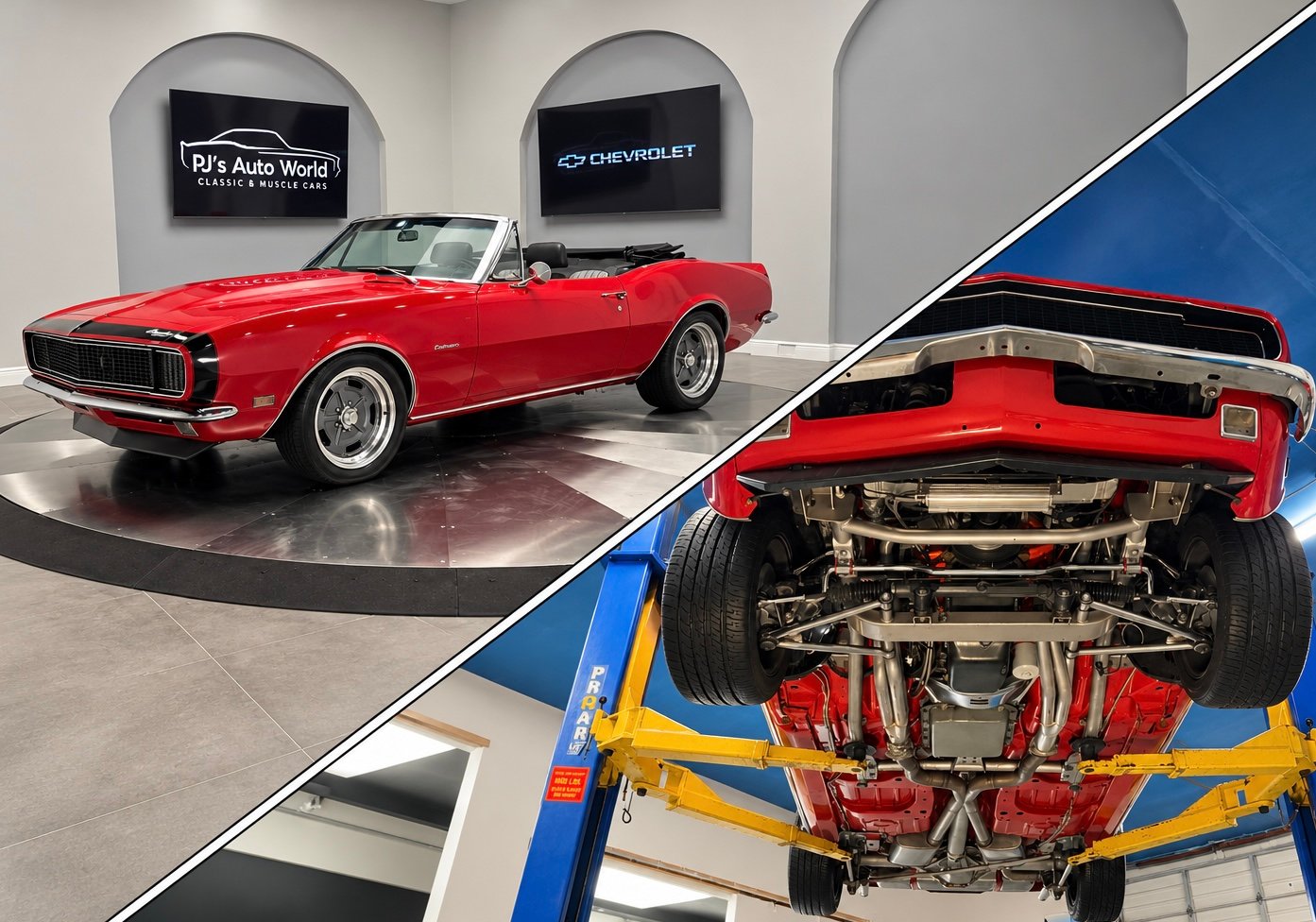
Underneath, the car is a steel unibody with a separate front subframe bolted on through rubber mounts, carrying the engine, front suspension and steering. That architecture is simple and easy to work on, and it is also where the convertible differs from the coupe in ways that decide what a car is worth today. A coupe gets much of its stiffness from its roof. A convertible has no roof, so Chevrolet gave the open car substantially heavier rocker panels, extra bracing, and vibration dampers at the corners of the body — fluid-filled canisters, universally nicknamed cocktail shakers — to absorb the shake and cowl flex an open unibody otherwise suffers from. Those rockers are structural in a way a coupe's are not, and their condition is the single most important fact about any convertible you inspect.
Production of the convertible fell steadily across the three years even as the car's reputation grew: about 25,141 convertibles in 1967, about 20,440 in 1968 and about 17,573 in 1969, out of roughly 700,000 first-generation Camaros in total. Every one of the 341 Camaro convertibles we currently track is a first-generation car, split almost evenly across the three years — 101 from 1967, 105 from 1968 and 135 from 1969. The market's centre of gravity is the 1969 car: the most traded, and the most imitated.
The three years are easy to tell apart once you know the tells, and you should learn them before you look at a listing photograph, because the year shapes the price, the parts list and the traps. The 1967 car has vent windows and no side marker lights. The 1968 car deleted the vent windows for Astro Ventilation and gained the side markers federal law now required. The 1969 car was reskinned over the same structure — longer and lower-looking, with a crease sweeping from each wheel arch, a deep V grille, simulated louvres ahead of the rear wheels and a new dashboard. The 1969 model year also ran long, into November 1969, because the second-generation car was late, which is one reason 1969 survival numbers are so strong.
These cars lived hard lives in period — bought to be enjoyed, driven in all weathers by second and third owners, parked outside once values fell — and then, from the 1990s on, values rose far enough to justify restoring almost any shell. That double history defines today's market. The mechanical side is among the best supported of any classic car in the world. The dividing line between a good convertible and an expensive lesson is the open body itself: its rockers, its windshield frame, its top mechanism and its paperwork, because the most desirable badges in this range are also the easiest to fake.
The models
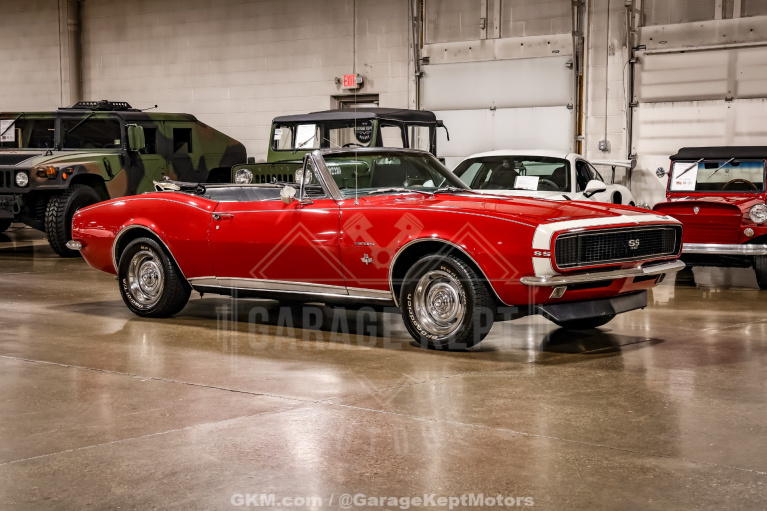
Every first-generation Camaro convertible left the factory as one mechanical specification — six-cylinder or V8, manual or automatic — dressed by option packages, and it is the packages, layered on top of each other, that create the model range. This is the first thing to understand, because it is the opposite of the European system: there is no separate SS model line with its own body or chassis, there is a base convertible to which Chevrolet added the Rally Sport appearance package, the Super Sport performance package, or both. A car can be an RS, an SS, or an RS/SS, and the badges alone prove nothing, because every badge, stripe and hood in the range is reproduced and can be fitted in a weekend.
| Model | Years | Engine | Output | Built | Character |
|---|---|---|---|---|---|
| Base convertible, six | 1967–1969 | 230 or 250 six | 140–155 hp | Within 63,154 convertibles | The honest cruiser; simple, light, cheapest to run |
| Base convertible, V8 | 1967–1969 | 327 or 307 V8 | 200–275 hp | Within 63,154 convertibles | The driver's default; most survivors live here |
| RS convertible | 1967–1969 | Any engine | As base car | Split by body style not published | Appearance package; hideaway headlights, trim |
| SS 350 convertible | 1967–1969 | 350 V8 | 295–300 hp | Split by body style not published | The balanced SS; torque without big-block weight |
| SS 396 convertible | 1967–1969 | 396 big-block V8 | 325–375 hp | Split by body style not published | The heavy hitter; documentation decides the value |
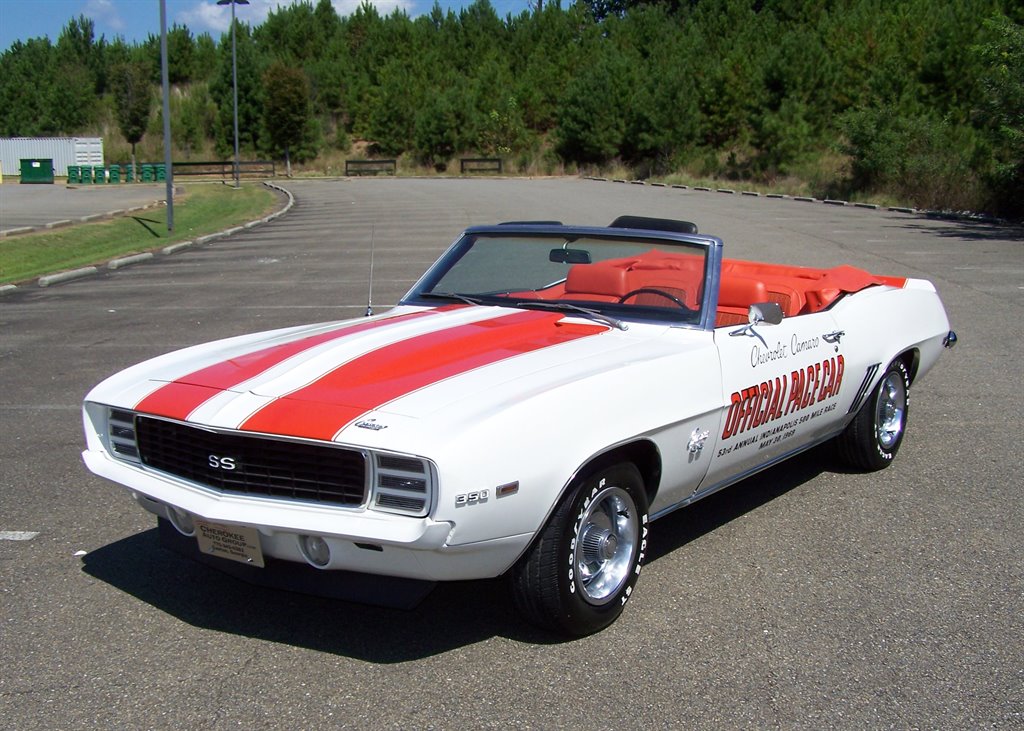
| Pace Car convertible | 1967, 1969 | 350 or 396 V8 | 295–375 hp | Very small numbers | RS/SS replicas of the Indianapolis 500 pace cars |
(Outputs are period SAE gross figures, as Chevrolet published them at the time; modern net ratings would be lower. Convertible production by year — about 25,141 in 1967, 20,440 in 1968 and 17,573 in 1969 — is genuinely documented. Chevrolet published option totals across all body styles, not convertible-only splits for RS and SS, so any source quoting an exact convertible SS production figure is inventing it.)
The base cars. Most convertibles were built as straightforward six-cylinder or small-block V8 cars, and there is no shame in them — a handsome open body, a torquey engine and a simple drivetrain is exactly what the car was designed around. The six is sweeter than you expect and keeps the front end light; the 327 V8, and the 307 that replaced it as the base V8 for 1969, give the soundtrack and pace most buyers picture. Base cars were also the most likely to be ordered with air conditioning, power steering and an automatic, which makes a well-kept base V8 one of the most usable classics of the era.
The RS package. Rally Sport, option code Z22, was pure appearance: hideaway headlights behind grille doors — electrically operated in 1967, vacuum operated for 1968 and 1969 — plus revised tail lights, extra bright trim and RS badging. It could be ordered with any engine, including the six. Because it changes how the whole front of the car looks, the RS is the package that transforms a convertible's presence, and because the headlight doors are a mechanism, it is also the package that adds a system to inspect, as the problem areas section explains.
The SS package. Super Sport, option code Z27, was the performance route: either the 350 small-block or the 396 big-block, a simulated-scoop hood, heavy-duty suspension, stripes and SS badging. An SS could also be an RS — the RS/SS, with the SS specification behind the full-width RS grille, is the most sought-after regular-production specification of all, and therefore the most cloned. The 350 car is the balanced one. The 396 car, in 325, 350 or 375 hp form, is the muscle car of the range, and a genuine documented big-block convertible sits in a different market from everything else in this guide.
The cars that were not convertibles. Two famous names need clearing away, because sellers borrow their glamour. The Z/28 — the 302-powered Trans-Am homologation car — was a coupe programme. Chevrolet built exactly one Z/28 convertible, a 1968 car prepared for a GM executive, so any other Z/28 convertible offered as a factory car is a tribute, however well built. The same applies to the 1969 COPO 427 cars, the iron-block COPO 9561 and the aluminium-block ZL-1: coupe programmes, needing factory paperwork in convertible form, not a story. Price every such car as the tribute it almost certainly is.
The Pace Cars. Camaro convertibles paced the Indianapolis 500 in 1967 and 1969, and Chevrolet sold replicas of both. The 1969 replica is the recognisable one — an RS/SS in Dover White with Hugger Orange stripes, orange houndstooth interior and a cowl-induction hood — and genuine replicas carry identifying codes on the trim tag of Norwood-built cars. The 1967 replicas are plainer, rarer and harder to authenticate. In both years the premium rides entirely on proof, which is why the inspection starts with the trim tag, not the engine.

Engines and gearboxes
The sixes: 230 and 250 Turbo-Thrift
The base engine for all three years was Chevrolet's overhead-valve straight six, in 230 cu in form rated at 140 hp, with the 250 cu in version rated at 155 hp available as the step up and increasingly common in later cars. Both are seven-main-bearing engines fed by a single Rochester Monojet carburettor, and both are far better than their position at the bottom of the range suggests: smooth, torquey at the speeds a convertible is actually driven, and famously durable. A healthy six starts readily, idles almost silently and pulls the car along at highway speed without strain. What it will not do is sound or accelerate like a V8, and most of the six-cylinder convertibles you meet today have either been cherished as survivors or converted to V8 power by a previous owner — a conversion that is easy in this engine bay and hard to detect if it was done thoroughly, which is why the VIN matters: the third digit of the VIN records the engine the car was born with, 3 for a six and 4 for a V8, whatever is under the hood now.
Six-cylinder faults are modest and mostly about age. The Monojet's automatic choke and accelerator pump cause the familiar flat spot and hot-start grumble, and a carburettor rebuild is a small job, typically $300–600 done properly. Valve stem seals harden and give a puff of blue smoke on start-up that clears as you drive — cosmetic on a six, and fixable without removing the head. Exhaust manifolds crack with heat cycles. None of this is structural money. The trap with a six is not the engine, it is paying V8 money for a converted car whose paperwork still says six.
The small-blocks: 307, 327 and 350
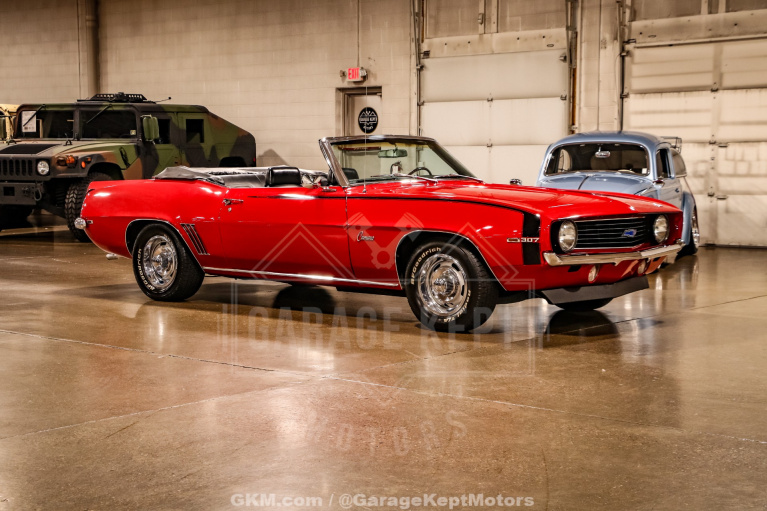
The small-block V8 is the heart of the Camaro story, and in the convertible you will meet three displacements. The 327 was the base and mid-range V8 for 1967 and 1968, most commonly the L30 version rated at 275 hp with a four-barrel Rochester Quadrajet, with milder two-barrel versions below it and the rare, high-compression L79 at 325 hp above it. For 1969 the base V8 became the 307, a deliberately mild 200 hp engine on a two-barrel carburettor, while the 350 — introduced with the Camaro in 1967 as the SS engine, the L48, rated at 295 hp and at 300 hp for 1969 — became the range's workhorse, also sold in tamer LM1 form at 255 hp in 1969. A word on the 302: the Z/28's high-revving small-block, advertised at 290 hp and universally understood to make more, belongs to the coupe story told above. If a convertible has a 302 in it, it is a transplant, and it should be priced as one.
These engines share one architecture and one set of virtues: a compact iron block and heads, hydraulic lifters on everything you are likely to buy, a timing chain at the front and a distributor at the back driven from the camshaft. They are tolerant, torquey and supported by the deepest parts network in the classic car world. They also share one set of age faults, and you should learn to read them in order. Blue smoke in a puff at start-up, clearing within seconds, is valve stem seals — a known job, roughly $600–1,200 with the heads in place, and not a reason to walk away. Blue smoke under sustained load is rings or bores, and that is a rebuild conversation. A rattle from the front of the engine at start-up that lasts a second is the timing chain and its nylon-toothed cam sprocket; original sprockets shed teeth with age, and a chain set is a few hundred dollars in parts, but a jumped chain on an interference-free small-block usually means a tow, not a destroyed engine. Rear main seals weep — two-piece seals on early engines, and a damp bellhousing is normal at this age, while a drip that marks the driveway is a job to price in. Oil pressure should be strong hot at speed; a small-block that holds pressure, does not smoke under load and does not overheat is a sound engine, because these units rarely fail in ways that hide.
Fuel and ignition decide how most small-blocks actually run. The Quadrajet is excellent when its well plugs are sealed and its choke is set, and a misery of hesitation and rich running when it is not: worn throttle shafts leak air, the choke pull-off fails, and owners blame the engine. Budget $500–900 for a proper specialist rebuild rather than a generic replacement, because the original carburettor is part of a documented car's value. Points ignition is simple and adequate; many cars now run an electronic conversion inside the original distributor, a sensible driver's modification. Finally, cooling: a convertible driven in summer traffic with air conditioning asks a lot of a period radiator and fan, so judge the car by its temperature gauge on the test drive, not by the seller's assurance.
The big-blocks: 396 Turbo-Jet
The SS 396 put Chevrolet's Mark IV big-block into the Camaro in three states of tune: the L35 at 325 hp, the hydraulic-lifter L34 at 350 hp, and the solid-lifter L78 at 375 hp, the last also available with aluminium heads as the L89. These are heavy, immensely torquey engines that change the convertible's whole character — the nose feels fuller, the steering heavier, the acceleration effortless in a way no small-block matches — and they carry the strongest values and the strongest fakes in the range. The 396 in a Camaro is actually 396 cu in for 1967 to 1969 in these applications, built on the same block family as the 427, which is precisely the identity trap: blocks, heads and intakes interchange across the family, stampings can be restamped, and a 396 badge over a 350 is the oldest trick in this market. The engine's assembly stamp and suffix code on the pad at the front of the block, the casting numbers and dates at the back, and — on a matching-numbers car — the partial VIN stamped on the block are the evidence, and the inspection section walks through them in order.
Mechanically the big-block is as tough as the small-block and thirstier in every sense: more fuel, more cooling demand, more load on the front suspension. Solid-lifter L78 cars need their valve lash checked on schedule and sound mechanically busy at idle — that is correct, not wear. Hydraulic cars that tick loudly hot are usually low on oil pressure or running worn lifters. Exhaust manifolds crack, and the big-block's extra heat makes every hose, the radiator and the fan shroud a first-order check. A documented L78 convertible is a genuinely rare car. An undocumented one is a small-block-priced car until the paperwork says otherwise.
Gearboxes
Four transmissions cover almost every convertible you will see, and our tracked cars split closely between them, with automatics and manuals in near-equal numbers. The two-speed Powerglide automatic was the base automatic for sixes and small-blocks: only two ratios, a long-legged feel, and a reputation for being unbreakable that it has earned — a Powerglide that shifts once, cleanly, and does not slip or whine is a good gearbox, and its simplicity makes it the cheapest automatic to rebuild, roughly $1,200–2,200. Big-block automatics used the three-speed Turbo Hydra-Matic 400, a far stronger box with a distinctive firm shift and an electric kickdown switch on the carburettor linkage whose failure is the usual cause of a TH400 that will not kick down. The Turbo Hydra-Matic 350 joined the range for 1969 small-blocks and is the sweet spot of the automatics: three ratios, light, and well understood by every transmission shop in America.
Manual cars used a three-speed Saginaw as standard, a Saginaw four-speed in low-power cars, and the Muncie four-speed behind anything serious: the wide-ratio M20, the close-ratio M21, and the straight-cut, whining M22 Rock Crusher behind the strongest engines. Judge a Muncie on its second-gear synchromesh, which goes first, on whether it jumps out of gear on the overrun, and on the shifter — cars built before about May 1968 used a Muncie shifter that wears vague, later cars a Hurst unit that stays precise, and a sloppy linkage is a linkage job, not a rebuild. A full Muncie rebuild runs roughly $1,500–2,800. The clutch works through a mechanical bell-crank linkage, the Z-bar, whose worn pivots make the pedal heavy and the bite point wander; it is cheap parts and an afternoon's labour, and it transforms a car sellers describe as needing a clutch. On 1969 manual cars, also check the back-drive linkage to the steering column — missing pieces there explain both a missing reverse light and a key that will not come out.
Problem areas
Everything in this section follows from one fact: a first-generation Camaro is a simple, well-supported car wearing an open body that concentrates its structural risk in a handful of places. Read our own photo evidence with that in mind. We have photo-checked 313 of the Camaro convertibles we track, and rust was mentioned in the notes for only 4 of those 313 cars, with accident damage mentioned for 3. Do not read that as proof these cars do not rust. Read it as proof of selection: most tracked cars reach the market through curated auction listings, where rusty convertibles have already been restored, filtered out or photographed kindly. The unrestored cars surfacing through dealers and private sellers are where this section earns its keep — a convertible that has lived outside in a wet or salted state can be as rotten as any British sports car of the age, hidden under a bigger, better-painted body.
Rust and structure: the convertible map
Work through the body in the order the water and the loads travel, and start where a convertible is not a coupe.
Rockers and torque boxes. The rocker panels on a convertible are deep, heavy structural box sections, because with no roof they carry bending and torsional loads the coupe shares with its top. They rot from the inside out: road water and mud enter, sit against the inner faces, and perforate the section long before the outer skin bubbles. Press and prod the full length of both rockers, underneath as well as on the painted face, and look hardest at the ends, where the section meets the torque boxes — the reinforcing boxes that tie the rockers to the floor and the rear structure. A coupe with tired rockers is a welding bill. A convertible with rotten rockers and torque boxes is a car whose doors will not shut true, whose gaps wander and whose body shakes, and the repair is structural fabrication, realistically $2,500–5,000 a side done properly with the body braced, because the car must be held in shape while its spine is cut out. Fresh black underseal blown uniformly over both rockers on a car offered for sale is a question, not an answer, exactly as it is on any unibody of this age.
The windshield frame. The convertible's windshield frame and A-pillars are the front hoop of the open body, and they rot at the base, where the frame meets the cowl, and along the top rail under the header seal. This is the most expensive rust on the car, because the frame carries the top latches, the sun visors and the rear-view mirror, it must stay dimensionally true for the top to seal, and repair sections are limited — much of this work is hand fabrication. Bubbling at the corners of the windshield, a header seal that will not sit, or a top that latches unevenly side to side all point here. Price windshield-frame work per car, expect four figures even for localised repair, and treat advanced rot here the way you would treat rotten rockers: as a reason to buy a different car.
Cowl, floors and trunk. The cowl plenum under the windshield vents takes in every leaf and every gallon of wash water, and its side drains block. Water then enters through the fresh-air vents, sits under the carpets and rots the floor pans from the top down, while the cowl sides perforate behind the front wheels. Lift every carpet. Surface scale on a floor pan is a clean, treat and seal job; holes are panel work, roughly $800–1,800 a side fitted, and floor rust in a convertible is a marker for the rockers behind it, because the same water has been travelling through the same structure. In the trunk, lift the mat and spare and check the pan, the drop-off panels where the quarters drain, and the rear frame rails and spring shackle mounts. The rear cocktail shakers live in the trunk quarters and their mountings trap water against the inner panels, so check around them specifically.
Subframe, quarters and the rest. The bolt-on front subframe rots at its mounting points and around the body bushings, and perished bushings are near-universal: the car sits fractionally down on its mounts, the steering and panel gaps go subtly wrong, and a bushing set is cheap parts — about $150–300 — with fitting at $600–1,100, after which the car must be realigned. Rear quarter panels rust at the wheel arch lips and along the lower edge behind the wheel, door bottoms fill with water when their drains block, and the tail panel rusts around the lights. None of these alone kills a car. Together they date its life, and because reproduction panels for this car are excellent and cheap by classic standards, the honest calculation is labour: every panel is a cut, weld, fill and paint operation, and a car needing quarters, floors and rockers is a restoration, not a driver with cosmetic needs.

The convertible top: frame, hydraulics and seals
The top is a complete system, usually serviced piecemeal over fifty years, which is why you test it as a system. The folding frame wears at its pivots: a slack frame folds unevenly, sits crooked when raised and pulls the fabric out of shape, and while bushings and adjustment cure some of it, a bent frame — usually from being forced against a seized pivot or a failed ram — is specialist work. Run the top up and down twice on any viewing. It should travel evenly, without one side leading or groaning, and land squarely on the header so both latches engage with the same effort.
Power tops, which most V8 convertibles have, are driven by an electric motor and pump mounted behind the rear seat, working two hydraulic cylinders through lines that run along the body. The system was filled with automatic transmission fluid or, on early cars, brake fluid, and the two must never be mixed. The failure pattern is age in the rubber: cylinder seals weep, lines go brittle, and the pump runs longer and louder as it works against leaks. A damp well liner behind the rear seat, a sweet or oily smell in the trunk, or a top that creeps down from part-raised overnight are the tells. Cylinders rebuild at roughly $250–450 each, lines are a kit, and a pump motor is a few hundred dollars — none of it ruinous, all of it invisible unless you cycle the top, which is why sellers of cars with tired hydraulics will offer to demonstrate the car with the top already down.
The fabric, the window and the seals decide whether the car is weatherproof, which on a convertible is the difference between a car you use and a car you apologise for. Original-style tops are vinyl with a plastic rear window; the window yellows, cracks at the fold and eventually splits, and it is replaceable separately from the top on these cars, which is the cheaper job. A complete new top fitted, with pads and a well liner, runs roughly $1,800–3,500 depending on material — canvas costs more and looks better than the original vinyl — and a badly fitted new top is worse than a sound old one, so a recent invoice from a trim shop that knows these frames is worth more than the word new in a listing. The weatherstrips are a full set of moulded rubber around the header, the side rails and the quarters; perished rail seals are the usual source of the wind roar and the drip onto the front seats that owners accept as character. A seal set is a few hundred dollars and a weekend, and it transforms the car. Finally, the boot that covers the folded top and the well liner beneath it: a missing boot is normal, a rotted well liner means water has been sitting in the well, and the well floor itself belongs on your rust list.
Suspension, steering and brakes
The front suspension is a conventional double-wishbone layout on the subframe, with coil springs, an anti-roll bar on most V8 cars and steering by a recirculating-ball box, manual or power assisted. Everything in it is a wear part with a known price, which makes the front end the most honest part of the car to judge: worn ball joints, idler arm and tie-rod ends announce themselves as play you can feel rocking the wheel and vagueness you can feel on the road, and a full front-end refresh with quality parts is roughly $1,200–2,500 fitted and aligned. Springs sag, and a convertible sits lower at the front than its photographs suggest it should — compare the arch gaps side to side, because a one-sided sag is a spring or a subframe mount, not a spring pair. Power steering boxes weep from the pitman seal and wander when the box itself is worn; a rebuilt box is a few hundred dollars. The single most common steering complaint on these cars, a dead, over-light feel with no return to centre, is usually alignment and perished subframe bushings together, not the box.
At the rear, leaf springs carry a live axle — multi-leaf on SS and big-block cars, a single mono-leaf on many base cars, with staggered shock absorbers on 1968 and 1969 performance cars to control axle tramp. Sagging leaves drop the tail and ruin the stance; broken leaves hide inside the pack; and the spring eye bushings and shackles are both a ride problem and a rust inspection point, as the rust section noted. Axle tramp under hard acceleration is the design's known limit — a 396 convertible is a cruiser with a loud pedal, not a drag car.
Brakes divide by year and option. Drums all round were standard, front discs were optional and became near-universal on SS cars: 1967 and 1968 discs use four-piston fixed calipers that seize and leak with age and are the dearer system to overhaul, while the 1969 single-piston sliding caliper is simpler and cheaper to live with. The rare JL8 four-wheel disc option belongs to the coupe racing story, and a convertible claiming it needs the same paperwork discipline as a Z/28 claim. Whatever the specification, a car that has sat needs its hydraulics treated as guilty — perished hoses, a tired master cylinder, contaminated fluid, $600–1,500 for a full refresh with labour — and the test is a hard stop from speed on the drive, not a firm pedal in the driveway.
Interior, trim and electrics
The interior is where a convertible's life in the sun shows. Ultraviolet destroys the top of the dashboard pad, the tops of the seats and the parcel area behind the rear seat first, and it fades the optional houndstooth and comfortweave fabrics unevenly, which matters because correct reproduction fabrics exist for the common trims and not for all of them. Standard interiors are plain vinyl and fully reproduced; deluxe interiors add moulded door panels, extra trim and different seat patterns, and a deluxe car stripped back to standard panels by a cheap restoration has lost value the badges will not tell you about. Seat frames crack at the hinges, the foam and burlap under the covers collapse so you sit in the seat rather than on it, and a pair of front seats rebuilt with new foam and covers is roughly $800–1,500 at a trimmer. Sit in the driver's seat on every viewing; it is the one that prices the interior.
The dashboard changed completely for 1969, and with it the fault list. The 1967 and 1968 cars have a simple layout with an optional console gauge package and the famous Tick-Toc-Tach, which combined tachometer and clock and now fails as either or both. The 1969 dash is more styled, more plastic, and its pads crack across the top in the sun. Heater blowers and their resistors are the usual electrical casualties — cheap parts, awkward access. Air conditioning was a factory integrated system and a genuine comfort in a convertible; budget for a full recommission on any car where it does not blow cold, roughly $800–2,000, and treat working factory air as a real value point on a driver.
Electrics are period GM: robust wiring, weak earths. The convertible adds two systems of its own. The RS hideaway headlight doors are the first: electric motors with limit switches in 1967, a vacuum system with a reservoir, actuators and hoses in 1968 and 1969, and in both cases doors that open unevenly, droop at rest or refuse entirely are the norm on unrestored cars — a vacuum overhaul is hoses, actuators and patience at a few hundred dollars, and a car whose doors work crisply has been maintained by someone who cared, which is evidence about the whole car. The second is the power top switch and its wiring, covered above. Beyond those, work everything on the viewing: windows, wipers, washers, horn, every light. A car where everything electrical works has usually been used and kept up, which remains the best single predictor of a good Camaro.
How to inspect one
Allow ninety minutes, bring a torch, a cloth-wrapped magnet and a friend to work the controls while you watch. Inspect in this order, which kills bad cars cheapest: paperwork first, structure second, top third, mechanics after — because on this car the expensive things are identity and metal, both settled before the engine ever starts.
- Start with the VIN and the trim tag. The VIN plate sits on the driver's door jamb for 1967 and on the dashboard, visible through the windshield, for 1968 and 1969. A convertible's VIN carries 67 as the body style digits, and the third digit records the original engine family, 3 for a six and 4 for a V8. Match it to the title exactly. Then read the Fisher Body trim tag on the firewall: build date, body style, trim and paint codes and, on Norwood cars, the accessory codes — including, from December 1968, the X codes that help authenticate SS specification. A trim tag that looks new, is riveted differently from factory practice, or whose codes contradict the car ends the inspection until it is explained.
- Check the engine's numbers against the claim. On the pad at the front of the block you will find the assembly date and suffix code identifying the engine's original application, and on a matching-numbers car a partial VIN that must match the car's own. Casting dates should predate the car's build date by a sensible margin. This is where SS 396 and Pace Car money is made or lost: an undocumented big-block is priced as a small-block car, however good the story sounds.
- Cold start. Insist the engine is cold when you arrive, and be suspicious of a car that is warm. A healthy small-block or six fires readily, settles to an even idle and shows a puff of blue at most from the tailpipe. Watch for the start-up smoke pattern from the engines section — a puff that clears is stem seals, smoke that continues under load is a rebuild — and listen for timing-chain rattle and, on a solid-lifter L78, the correct mechanical clatter that should be even, not a single loud tick.
- Cycle the top, twice, and latch it. Raise and lower the power top twice from the switch, watching for one side leading, hesitation, groaning or a pump that runs on after the top has landed. Latch it to the header and check both latches take equal effort, then sight along the side rails: gaps should be even, and the fabric should be drum-tight without wrinkles pulling to one side. Look in the well behind the rear seat for damp, fluid and a rotted liner — the top section's hydraulic tells, in the metal.
- The rocker and floor examination. This step decides whether you continue. Get under the car, or better, pay for lift time. Prod both rockers along their full length and underneath, the torque boxes at their ends, the floor pans, the trunk drop-offs and the rear frame rails at the shackles. Perforation in rockers or torque boxes is structural in the full sense — the car has lost its spine — and it prices as fabrication with the body braced, not as patching. Read the underseal as you go: patchy and honest is factory age; a fresh, uniform coat over everything is a question the seller must answer.
- The windshield frame and cowl. Work a fingertip around the base of the windshield frame and along the top rail under the header seal, feeling for bubbling and lifted paint, and check the cowl sides behind the front wheels. Then pour a jug of water into the cowl vents and watch where it goes: it should drain behind the front wheels, not into the footwells. Wet carpets after this test mean blocked drains and the floor rust of step 5 arriving on schedule.
- Body, gaps and the magnet. With the top up and the doors shut, check that both doors close with the same sound and sit flush — on a convertible, door fit is a structural readout, and a door that must be lifted to latch is telling you about rockers and hinges together. Run the magnet over the rocker covers, arch lips, lower quarters and door bottoms. Check for the cocktail shakers: the heavy canisters should be present at the front corners and in the trunk quarters, and missing shakers on a car that shakes at speed explain themselves.
- Front end and steering. Rock each front wheel top to bottom and side to side for ball joint and bearing play, then bounce each front corner and watch it settle in one movement. On the drive that follows, the steering should be free of a dead band at centre; vagueness plus knocks is the front-end refresh from the problem areas section, priced into the offer, and a one-sided sag is a spring or subframe mount, not an alignment.
- The test drive. Fifteen minutes minimum, including a highway stretch with the top down and a slow section with it up. The Powerglide should shift once, cleanly; the TH350 and TH400 firmly, with a working kickdown. A manual should take second gear hot and cold without a crunch and stay in gear on the overrun. Accelerate hard once: axle tramp in a big-block car is period behaviour, a slipping clutch or a flaring automatic is not. Brake hard from speed — straight, no judder, no pull — and note the temperature gauge's whole story, because a car that overheats in traffic has failed its cooling test.
- Electrics and the RS doors. Work everything: lights, indicators, wipers, washers, horn, heater blower on every speed, windows, courtesy lights, and the air conditioning if fitted. On an RS car, cycle the hideaway headlights several times and leave them closed while you talk — doors that creep open at rest are leaking vacuum, and crisp doors are the maintenance evidence the problem areas section described.
- Stance and shake. Stand back with the car on level ground. A first-generation convertible should sit level, arch gaps even, with no twist visible down the flank. Then, on the drive, find the speed at which the cowl shakes — every open unibody has one — and judge whether it is a tremor or a shudder. A pronounced shudder at low speed, with tired subframe bushings and missing shakers eliminated, points back to the structure of step 5.
- Interior and paperwork, last. Sit in every seat, feel for collapsed foam, check the driver's seat hardest, note the sun damage on the dash and seat tops, and confirm the trim matches the code on the tag from step 1. Then weigh the history file: invoices for top, hydraulics, structural welding and engine work are worth real money, and a documented car at a higher price is cheaper than a story at a lower one, every time.
Values
The market block beneath this guide carries the current numbers — what is listed now, at what asking prices, and what recorded sales have achieved — and it is refreshed at every build, so this section teaches you how to read it rather than repeating figures that would date. Read it with the structure of this particular market in mind, because the Camaro convertible market is really four markets wearing one name.
The widest force is the condition spread, and on a convertible it is wider than on the coupe because the expensive work is structural and cosmetic rather than mechanical. Two 1969 convertibles with the same engine can sit at opposite ends of the recorded range because one has sound rockers, a true windshield frame and a top that seals, and the other needs all three — work whose cost approaches the price difference between the cars. Learn to sort any listing by structure and documentation first and by specification second, and the spread stops looking arbitrary.
Documentation is the second force, and it works asymmetrically. A base or RS convertible gains a little from a thick history file. An SS, and above all a big-block SS or a Pace Car, gains a great deal, because the specification itself cannot be read off the car — it lives in the trim tag codes, the engine stampings and the paperwork, and the market pays for proof and discounts its absence savagely. Expect the gap between asking and achieved prices to be widest exactly there: sellers ask documented money for undocumented cars, and the auction record, where bidding is public, is the honest referee. The recorded-sales block is therefore the part of the market data to trust most on the rare cars, and the asking figures the part to trust most on the common ones, where volume makes them meaningful.
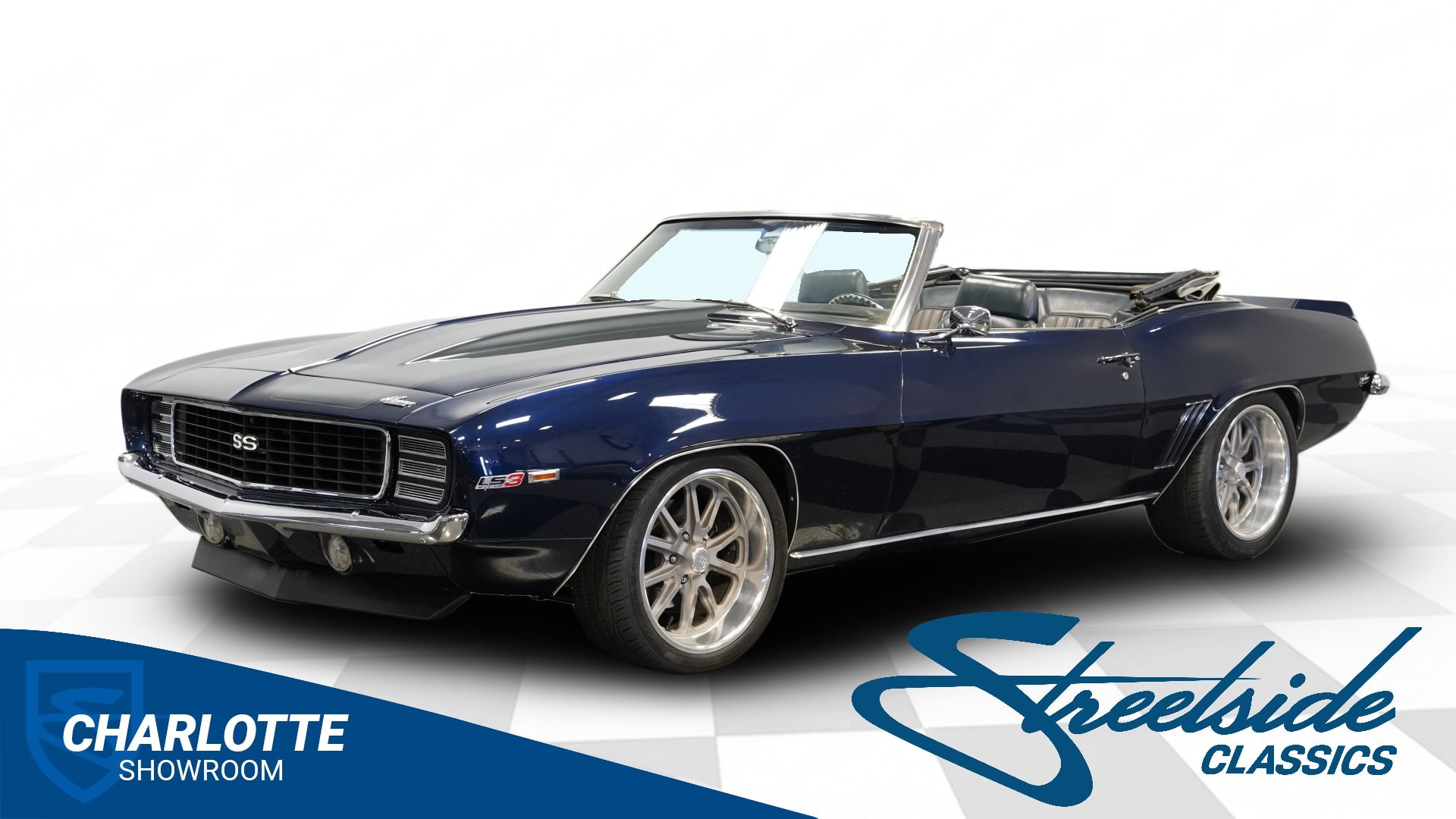
Originality premiums follow the same logic. Matching numbers — the engine the car was born with, proved by the stampings — carries a real premium on SS and Pace Car cars, a modest one on a 350 driver, and almost none on a base six, where condition is everything. Colour works the same way: a car in its correct factory colour, proved by the paint code, out-earns a colour-changed car of equal condition. Which brings up the fourth market: the restomods. A well-built LS-powered convertible is not a failed original, it is a different product, bought for drivability, and it should be valued on the quality of the conversion — cooling, brakes, chassis, wiring, finish — not by adding its parts cost to a standard car's price. Bad restomods are worth less than the honest standard cars they were built from, because undoing a conversion costs more than doing one.
The project-versus-driver gap is the last lesson. A non-running project looks cheap until the restoration is itemised — structure, top, trim, chrome, paint — at which point it usually exceeds the price of the finished driver, which is why the finished driver, bought after the inspection in this guide, is the rational purchase at almost every level of this market. Negotiate on evidence, not enthusiasm: rocker photographs, the trim tag decode and the stampings are arguments a seller cannot answer with adjectives.
Parts and ownership
No classic car is better supplied with parts than the first-generation Camaro, and the convertible shares almost everything with the coupe, built in far larger numbers. A deep bench of specialists — Classic Industries, Heartbeat City, Rick's Camaros, National Parts Depot and dozens more — between them reproduce or stock nearly every panel, trim piece and mechanical component, and the Camaro Research Group's decades of decoding work means the knowledge base is as deep as the parts base. Ownership difficulty is never finding the part. It is finding the labour, and judging reproduction quality, which varies from excellent to approximate.
Easy and cheap: every service item, brake components for the common specifications, suspension wear parts, subframe bushing kits, leaf springs, exhaust systems, glass and most rubber seals, standard interior trim, top fabric in the original vinyl, and small-block and six-cylinder engine parts down to complete crate engines. Order today, fit this weekend, at prices that undercut most European classics by a wide margin.
Harder and dearer: correct dated and coded components for a documented SS or Pace Car — the right carburettor, distributor, alternator and exhaust manifolds with the right dates are hunted parts and priced like it. Four-piston 1967 and 1968 brake calipers in rebuildable order. Deluxe interior fabrics in the less common colours and the 1969 orange houndstooth. Windshield frames and convertible-specific structural pressings, where reproduction coverage is thinner than for coupe panels and fabrication fills the gap. RS headlight components for the 1967 electric system. Cocktail shakers, which are heavy, unloved and frequently thrown away during restorations, and which a correct car needs. A quality repaint, as on any large classic, starts in five figures done properly — which is why the standing advice for this car is to buy the body, the top and the paperwork, and fix the mechanics.
Running costs. A sorted small-block convertible is a realistic regular-use classic: fuel consumption in the mid-teens miles per gallon in mixed use, less for a big-block driven as a big-block invites, servicing that any competent American-car specialist can handle, and insurance in line with other cars of similar value, with agreed-value cover essential on a documented car. The budget lines that catch new owners are the first-year ones. Catching up deferred maintenance on a running car — hydraulics, hoses, bushings, brake refresh, a carburettor rebuild — honestly runs $2,000–5,000 before you improve anything. A car that has sat needs the fuel system cleaned end to end, because modern ethanol fuel attacks period rubber and leaves varnish in tanks and lines, every brake component inspected, the top hydraulics flushed, and all fluids renewed: recommissioning at a shop runs $4,000–8,000. Convertible-specific care is simple and non-negotiable — store the car with the top up, never folded wet, keep the drains at the cowl and quarters clear, exercise the top monthly so the seals stay alive, and garage the car if you possibly can, because ultraviolet and standing water are the two enemies this body cannot fight.
Which one to buy
- The all-rounder: a 1969 SS 350 convertible. The strongest year, the balanced engine, the deepest market to buy from and sell into. With documentation and sound rockers, this is the convertible to own if you own one.
- The value buy: a base or RS small-block V8 car, 1967 or 1968. The same body and top-down experience for driver money, especially an RS, whose hideaway headlights give the look without the SS premium — provided the structure passes step 5 of the inspection.
- The cruiser: a six-cylinder or 307/327 automatic. Light, simple, cheap to run and entirely in the spirit of the original pony car. The Powerglide and TH350 cars are the easiest classic convertibles of the era to live with.
- The collector car: a documented 1969 RS/SS Pace Car or SS 396. The top of the market, bought on paperwork alone — trim tag, stampings, history — never on badges. Verified, these are the cars auctions fight over.
- The purist's car: a 1967 RS convertible. The first year, vent windows and all, visually the purest of the three and still overlooked beside the 1969. A correct, unmolested 1967 is a connoisseur's buy.
- The driver's restomod: a well-built LS conversion. Buy the workmanship, not the parts list: cooling, brakes, chassis and wiring done as a system, on a shell that passed the same structural inspection as any original car.
And the rule that overrides all of the above: buy the convertible with the soundest rockers, the truest windshield frame and the best paperwork, in the specification you can live with. Engines, gearboxes, tops and hydraulics are all fixable at prices you can plan for. A rotten open shell and an invented specification are the two things no amount of money makes original again.