
Chevrolet 3500 Crew Cab Long Bed buyer's guide
Chevrolet 3500 Crew Cab Long Bed -- the model's own buyer's guide: variants, values and what to check.
Years listed: 1988-1995 · Series: C/K Trucks
Overview and history
The Chevrolet C3500 is the one-ton at the top of the GMT400 truck range — the heaviest pickup General Motors sold in the 1990s, built to carry, tow and work rather than to commute. The GMT400 platform arrived for the 1988 model year as a clean-sheet replacement for the long-running Square Body trucks: a new cab with flush glass and proper aerodynamics, independent front suspension on the two-wheel-drive cars, and a frame and running gear scaled in three steps — half-ton 1500, three-quarter-ton 2500, and this car, the 3500. The C in the badge means two-wheel drive; the four-wheel-drive twin is the K3500, covered by its own material. Everything in this guide is about the C: the payload hardware, the dual-rear-wheel option, the big axles and brakes, and the commercial lives these trucks have usually led.
That last point is the one that shapes the whole purchase. A C1500 was often somebody's only vehicle. A C3500 was usually bought as a tool — by a contractor, a landscaper, a horse owner with a gooseneck trailer, a rental fleet, a municipality — and it earned its keep. The specification tells you so. Gross vehicle weight ratings run from around 9,000 lb on a single-rear-wheel pickup to 10,000 lb on a dually, and the separate 3500HD chassis cab, sold from 1991, was rated at a full 15,000 lb — deep into medium-duty territory, on a straight channel frame with 19.5-inch wheels. Engines were chosen for torque and indifference to abuse: the 5.7-litre small-block V8 as standard, the 7.4-litre big-block as the tow option, and a 6.5-litre diesel — naturally aspirated at first, turbocharged from 1994 — for buyers counting fuel bills. Gearboxes were the heaviest GM made: the 4L80-E automatic and NV4500 five-speed manual, with the old Turbo 400 and SM465 in the early years.
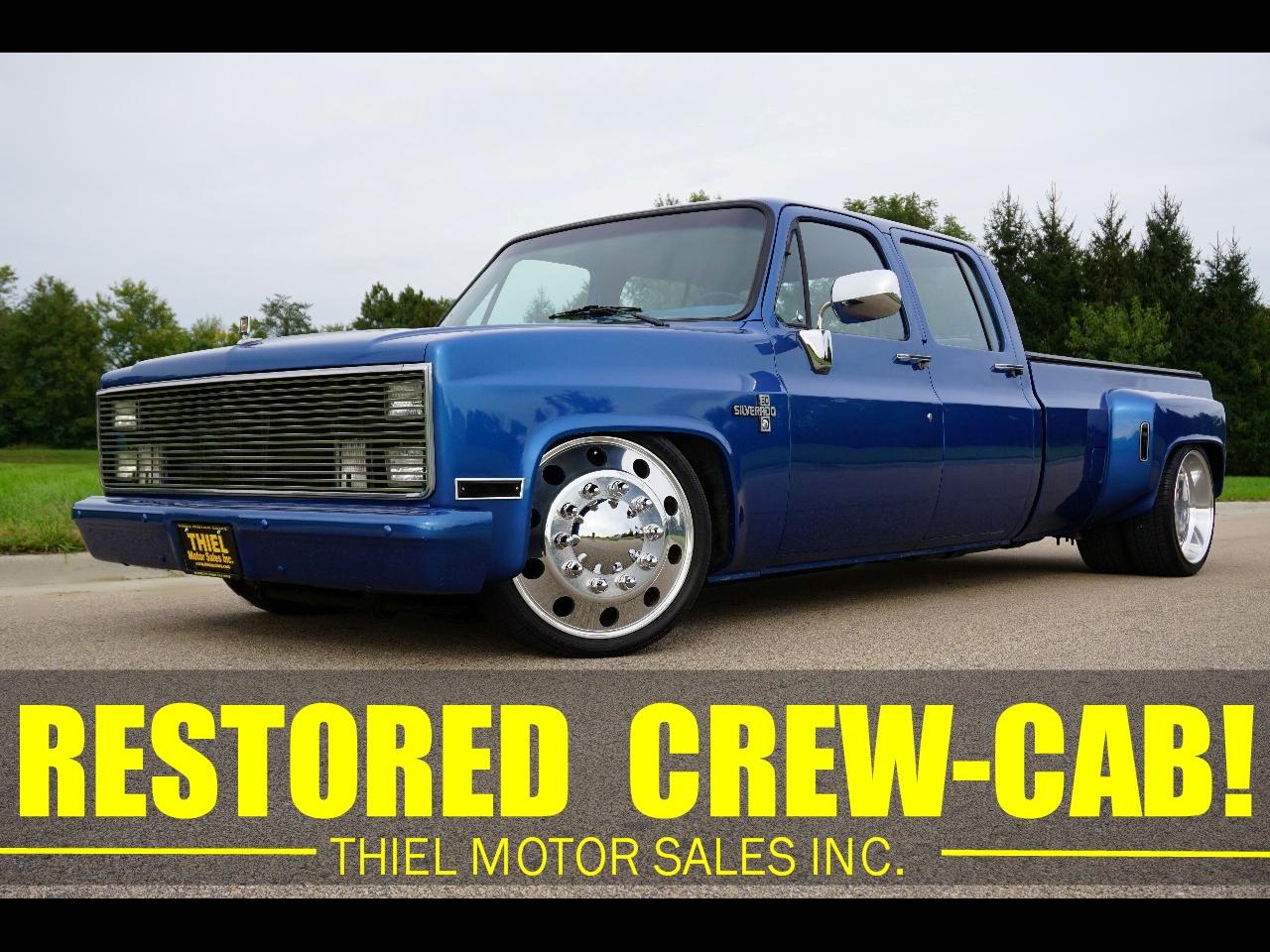
There is one identity trap at the start of the run, and it catches buyers out constantly. The GMT400 cab was phased in: regular and extended cabs went new-style for 1988, but the crew cab, the Suburban and the heaviest chassis work stayed on the old Square Body shell — sold as the R/V series — through 1991. So a 1988, 1989, 1990 or 1991 C3500 crew cab is legitimately a Square Body truck wearing a 3500 badge, with the old cab, the old interior and the old parts book, while a 1992-on crew cab is a true GMT400. Neither is wrong, but they are different trucks to buy, to value and to source parts for, and listings rarely volunteer which one you are looking at. The blue crew cab pictured in this guide is exactly that case: a 1988-model dually on the carry-over shell. Check the cab, not the year on the title.
The range evolved in two clear steps. The 1995 model year brought a completely new interior — new dash, new seats, a driver's airbag — which makes the later trucks far nicer places to spend a working day. The 1996 model year brought the Vortec engine programme: new cylinder heads and sequential injection that lifted the 5.7 from 210 to 255 hp and turned the 7.4 into the Vortec 7400, the strongest gasoline engine GM had ever put in a pickup. Production of the classic GMT400 C3500 ran to 2000, when the GMT800 Silverado HD line took over; the 3500HD chassis cab lingered a little longer, to 2002, because fleet buyers hate change.
What survives today is a cross-section of working America. We currently track 17 C3500s for sale, all of them offered as running trucks rather than sold history, and the spread of years — with 1988 and 1989 the joint-commonest years in the set, and nothing in the current listings newer than 1995 — tells you this is a market of early trucks and honest workers, not yet a polished collector scene. Fourteen of the 17 come through private Marketplace sellers and three through dealers. White, the fleet colour, accounts for six of the 17. Automatics dominate, as they did when new: 12 of the trucks with a recorded gearbox are automatic against three manuals. We have examined the photo sets of seven of the listed trucks in detail, and rust appears in four of those seven — a fair warning, on a small sample, that even on a truck built like a bridge, the body and frame are where you spend your inspection hour. The mechanicals are some of the toughest GM ever built. What kills C3500s is rust, deferred brake and tyre work, and the accumulated wear of a life spent loaded. Buy accordingly.
The models
Every C3500 is built on the same recipe — a heavy ladder frame, independent coil-spring front suspension, a leaf-sprung full-floating rear axle and brakes sized for the gross weight — and varied by cab, bed and rear tyres. Four decisions define any individual truck: the cab (regular, extended or crew), the rear wheels (single or dual), the back end (pickup bed or bare chassis cab), and whether it is the standard truck or the separate, heavier 3500HD. Learn to read those four things off a listing photograph and you can sort the whole market.
| Model | Years | Engine | Output | Built | Character |
|---|---|---|---|---|---|
| C3500 regular cab, single rear wheel | 1988–2000 | 5.7 V8; 7.4 V8 or 6.5 diesel optional | 210–290 hp | The volume work truck | The standard one-ton; 8 ft bed, the landscaper's and contractor's default |
| C3500 regular cab dually | 1988–2000 | 5.7 V8; 7.4 or 6.5 diesel optional | 210–290 hp | Smaller share of the run | Dual rear wheels, wide rear fenders; the gooseneck and fifth-wheel tow rig |
| C3500 extended cab ("Bonus Cab") | 1988–2000 | 5.7 V8; 7.4 or 6.5 diesel optional | 210–290 hp | Steady seller | A half-cab behind the seats for crew or kit; long bed as a dually, short bed single-wheel |
| C3500 crew cab | 1988–2000 (Square Body shell 1988–91) | 5.7 V8; 7.4 or 6.5 diesel optional | 210–290 hp | Low volume | Four full doors and an 8 ft bed on the 168.5-inch wheelbase; the family tow rig and the collector favourite |
| C3500 chassis cab | 1988–2000 | 5.7 V8; 7.4 or 6.5 diesel optional | 210–290 hp | Fleet volume | No bed from the factory — flatbed, utility, dump and box bodies fitted by upfitters; judge it by the body it carries |
| C3500HD chassis cab | 1991–2002 | 5.7 V8 (rare); 7.4 V8 or 6.5 diesel usual | 230–290 hp | Fleet and municipal staple | A different, heavier truck: 15,000 lb GVWR, straight frame, Dana 80 axle, 19.5-inch wheels |
(GM did not publish a clean production split by C3500 variant, so the Built column describes each variant's place in the range honestly rather than inventing figures. Outputs are the period ratings across the run — the same badge spans the 210 hp throttle-body 5.7 of 1988 and the 290 hp Vortec 7400 of 1996–2000, which is why the year matters as much as the model.)
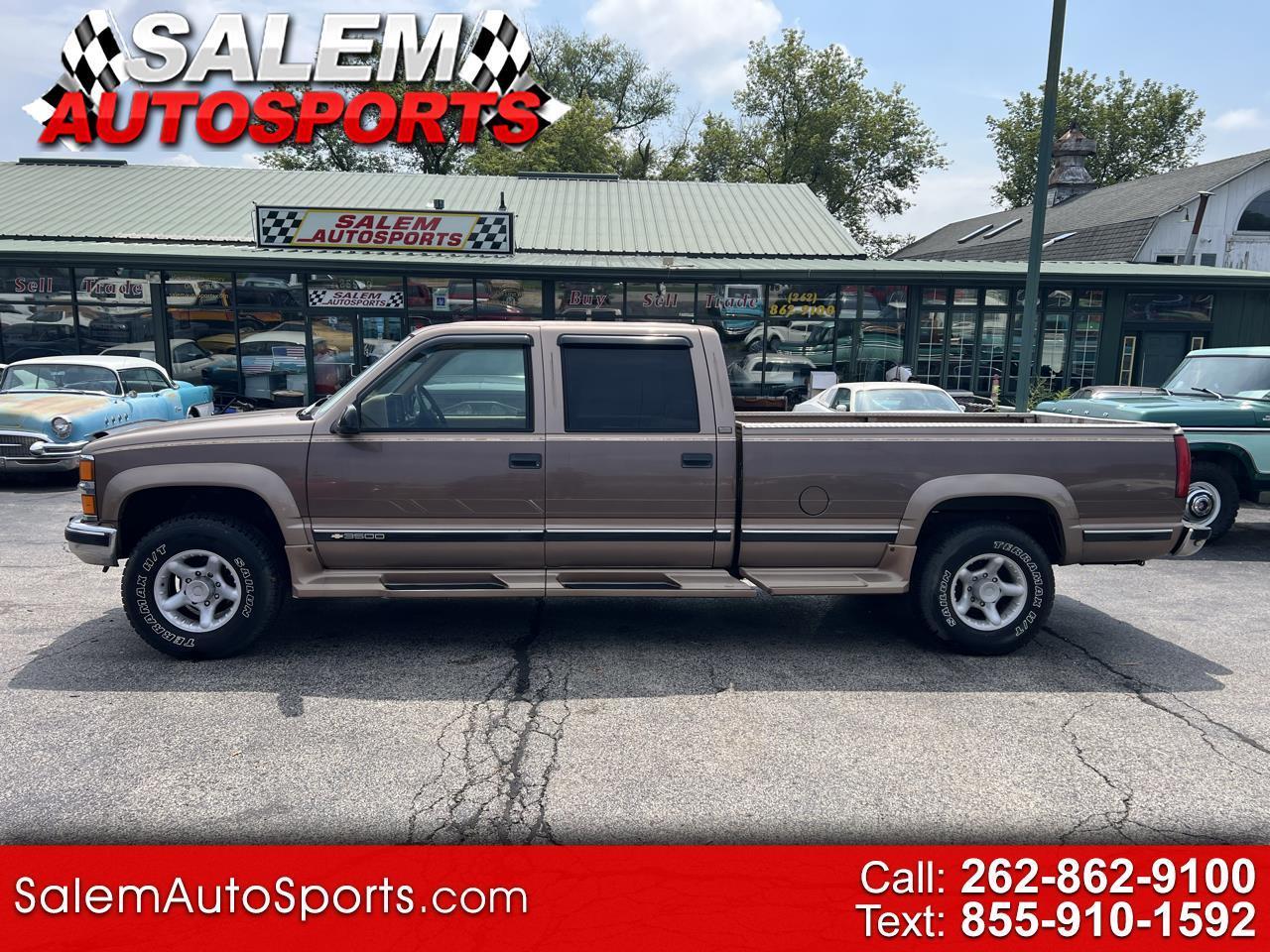
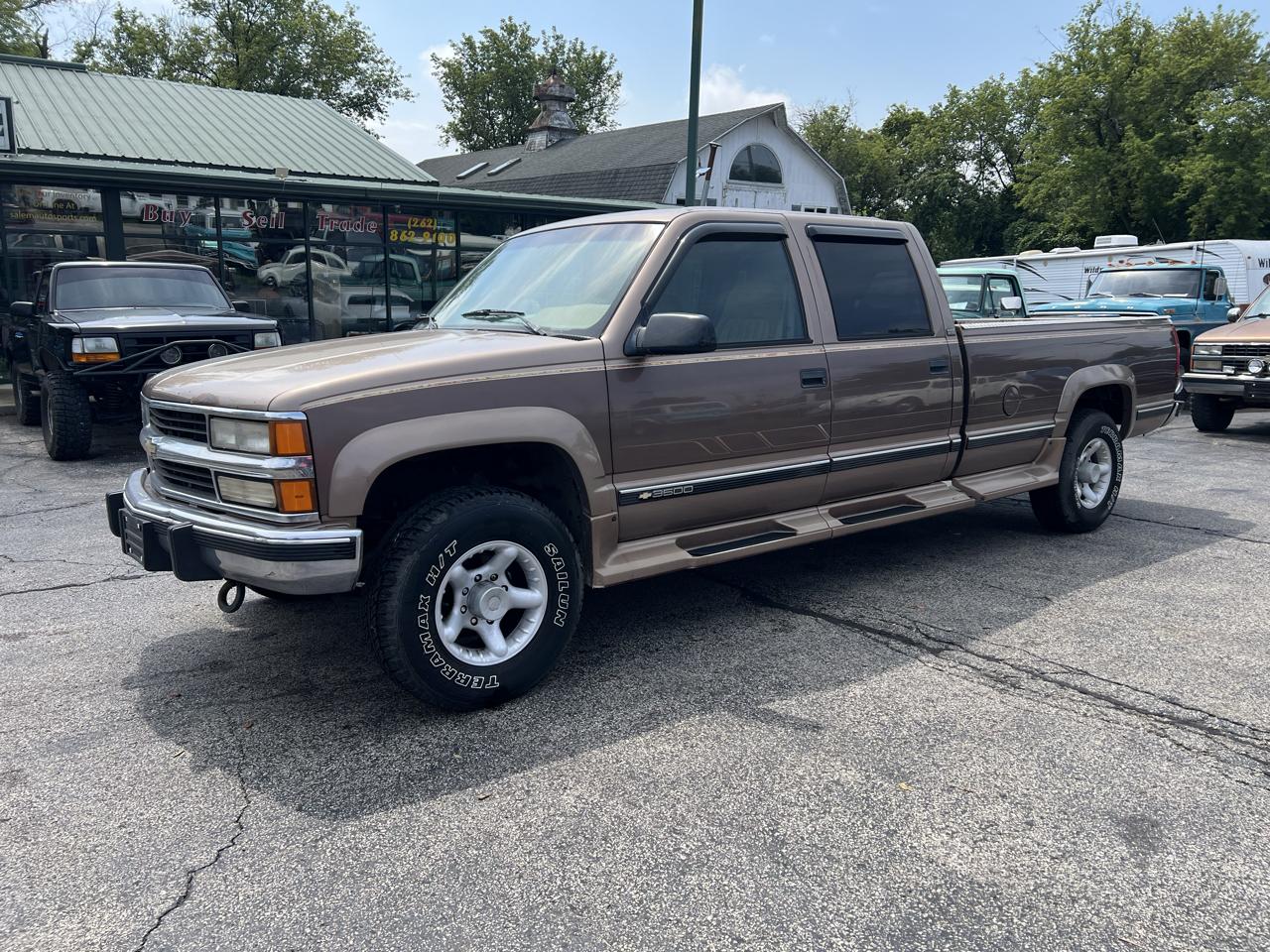
Cab and bed. The regular cab with the 8 ft bed is the truck in its purest form, and the commonest survivor. The extended cab — Chevrolet called it the Bonus Cab in early marketing — adds a small rear bench and a lot of usefulness; as a dually it comes with the long bed, as a single-wheel truck usually with the short bed. The crew cab is the one the market has woken up to: four doors, six seats, the long 168.5-inch wheelbase when paired with the 8 ft bed, and a genuine double life as family transport and tow vehicle. Remember the split personality — Square Body shell to 1991, GMT400 shell from 1992 — and price the two generations as the different trucks they are.
Single or dual rear wheels. This is the C3500's defining option. Dual rear wheels — DRW, "dually" — spread a heavy pin or payload weight across four tyres, add stability with a tall load, and come with the wide fibreglass rear fenders on pickup beds. They cost you parking width, two extra tyres at every change, and some traction on loose surfaces when empty. Single-rear-wheel trucks are easier to live with and cheaper to run, and still carry far more than any half-ton. Neither is better; they are answers to different questions, and the problem areas section prices the dually's running costs in full.
Chassis cabs and the 3500HD. A chassis cab left the factory with nothing behind the cab but frame rails, and what it carries now — flatbed, service body, dump body, ambulance or box — was fitted by an upfitter, to a standard that varies from excellent to alarming. The 3500HD is more than a trim level: it is a heavier chassis altogether, with a straight, flat frame (easy for upfitters, and a giveaway identifier), a Dana 80 rear axle, four-wheel disc brakes on most, 19.5-inch wheels and tyres, and gearing chosen for work, not cruising. HDs were bought almost exclusively by fleets, rental companies and municipalities, so their histories are written in idle hours and maintenance schedules rather than mileage. Treat an HD as a small commercial vehicle that happens to wear a pickup cab, and inspect it that way.
Trim. Cheyenne was the work trim — vinyl, rubber mats, steel wheels — and Silverado the plush one, with cloth or leather, carpet, chrome and options like cruise and power windows. Scottsdale sat between them in the early years. Trim matters less on a one-ton than condition and specification, but a Silverado crew cab is the combination the enthusiast market wants, and a Cheyenne regular cab is the one working buyers want. Both are right.

Engines and gearboxes
Three engines cover the whole C3500 range, and all three were chosen for the same job: moving a heavy truck, a heavy load, or both, for a long time, on indifferent maintenance. None of them is fragile. Each has one or two well-documented failure points that dominate its ownership story, and a buyer who learns those points can price any truck in the market with confidence. The split that matters most is 1996: before it, throttle-body injection and simpler electronics; from it, the Vortec engines with more power and a few new failure modes of their own.
The 5.7 V8: throttle-body first, Vortec from 1996
The standard engine is the 350-cubic-inch small-block, the L05, rated at 210 hp and 300 lb-ft of torque in one-ton tune. It is fed by throttle-body injection — two injectors in a unit that looks like a carburettor — and it is one of the most forgiving engines ever fitted to a truck. It starts in any weather, tolerates neglect, and every parts store in America stocks everything it needs. It is also, honestly, working hard in a one-ton: a loaded dually on a grade will keep a 5.7 busy, and these engines have usually lived at higher throttle openings than the same engine in a half-ton. Judge condition, not the design.
TBI faults are cheap and diagnosable. A lumpy idle and hesitation usually trace to a worn throttle-body shaft, a failed throttle-position sensor, a lazy EGR valve or perished vacuum hoses — all driveway jobs. Fuel pressure matters and is testable: the system wants roughly 9–13 psi, and a tired in-tank pump that falls short gives a truck that idles fine and falls on its face under load, which sellers describe as "needs a tune-up". The ignition module and pick-up coil inside the distributor fail with heat and age and cause the classic hot no-start that fixes itself when the engine cools; a quality module is a small-money part, and a truck with a documented recent one is ahead. Exhaust manifolds crack and their bolts snap — listen for a ticking that fades as the engine warms.
From 1996 the L31 Vortec 5700 replaced it: new high-flow heads, sequential port injection through the central "spider" injector assembly, and 255 hp with 330 lb-ft. It is a noticeably stronger, smoother engine and the one to have for towing with a single-wheel truck. Its signature faults are two. The lower intake manifold gaskets leak — coolant into the lifter valley or out at the front and rear of the manifold — because the original plastic-and-silicone gaskets degrade; the fix is a gasket set and a day's labour, roughly $600–1,200 at a shop, and it only needs doing once with the updated parts. And the spider's poppet injectors clog, especially on trucks that sat or ran poor fuel, giving a misfire under load and a check-engine light; a replacement updated injector assembly runs $300–600 in parts. Distributor caps on Vortecs also suffer cross-firing as the internal venting clogs — a misfire that moves cylinders is the cap until proved otherwise.
The 7.4 V8: the big-block, and the Vortec 7400
If the truck tows, this is the engine the first owner paid extra for, and the one today's buyers pay extra for too. The 454-cubic-inch big-block, the L19, made 230 hp and a defining 385 lb-ft of torque in throttle-body form — the peak number undersells it, because the torque arrives low and stays. It pulls a gooseneck up a grade at part throttle where the 5.7 is flat out, and it does it for hundreds of thousands of miles if the oil has been changed. The costs are fuel — expect single figures to low teens mpg depending on load — and heat: a big-block working hard in a heavy truck is a cooling-system examination, and the cooling section below is written with this engine in mind.
The TBI 7.4 shares the small-block's fuel and ignition systems and their cheap faults, and adds two of its own: exhaust manifolds that crack and warp (budget $500–1,500 a side if studs snap and the head has to be drilled), and a thirst for fuel pumps when tanks have rusted internally. From 1996, the L29 Vortec 7400 transformed it: port injection, better heads, 290 hp and 410 lb-ft. It is the strongest and most desirable engine in the range, full stop. It keeps the intake-gasket weakness of the Vortec 5.7 — same inspection, same fix — and adds a fondness for burning a little oil past the valve guides on high-mileage examples, which is tolerable if consumption is modest and the plugs are not fouling. A Vortec 7400 crew cab dually is the flagship specification of the whole C3500 line, and the market knows it.
The 6.5 diesel: read the pump driver before anything else
The diesel story has three chapters. The 1988–91 trucks used the old 6.2-litre Detroit diesel — simple, mechanical, economical and slow, at around 140–150 hp in a truck that can weigh three tons empty; most have been retired or re-engined, and a survivor should be bought as a curiosity with a strong chassis. The 6.5 that replaced it in 1992 was naturally aspirated for two years, then turbocharged from 1994, rated around 180–195 hp and up to roughly 430 lb-ft in the later high-output tune. In period it was the economy-and-longevity choice; today it is the engine that demands the most knowledge, because of one component.
From 1994 the 6.5 uses the Stanadyne DS4 electronic injection pump, and the pump's electronic driver — the PMD, pump-mounted driver, also sold as the FSD — is mounted on the side of the pump, in the valley of the engine, where it is baked by engine heat on every drive and heat-soaked again at every shutdown. Heat kills its transistors progressively. The symptoms are the most misdiagnosed in the whole C3500 world: stalling at idle or at speed, a no-start when hot that recovers when cold, surging or "fish-biting" under cruise, and eventually a dead truck. Sellers blame the pump itself, quote a pump rebuild at $1,500–2,500, and discount the truck — when the established fix is a remote PMD relocation kit, a new driver on a heat sink mounted away from the engine (behind the bumper or on the inner fender), at roughly $250–450 in parts. The test on a viewing is simple and is written into the inspection: a 6.5 that stalls, or has ever stalled unexplained, is a PMD suspect until the driver has been relocated and proved. Equally, a truck with a documented relocation and a spare PMD in the glovebox — many experienced owners carry one — is a truck whose owner understood it.
The rest of the 6.5 is conventional diesel discipline. The crankshaft's harmonic balancer and its separate belt pulley both have rubber elements that perish; let them fail and the unbalanced crank can crack — inspect the rubber for cracking and wobble, and treat replacement as preventive maintenance at $150–350 in parts. Glow plugs and their controller decide cold starting; a truck that needs ether to start has a glow system fault and possibly damaged rings from the ether. The engine-driven lift pump and the oil-pressure switch that powers it fail and starve the injection pump. Oil cooler lines weep and then burst at their crimped fittings — an engine-ending failure if it happens at speed, and a known one: braided replacement lines are the permanent fix. None of this makes the 6.5 a bad engine; it makes it an engine whose cheap trucks are cheap for identifiable, priceable reasons — and whose good ones are genuinely economical, long-lived tow vehicles.
Gearboxes and axles
Four gearboxes appear across the run. The earliest trucks use the Turbo 400 three-speed automatic (badged 3L80) and the SM465 four-speed manual with its crawler first gear — both effectively unbreakable, both crude, and the automatic's lack of overdrive means a big-block early truck is turning real revs at highway speed. From 1991 the 4L80-E became the standard automatic: an electronically controlled four-speed overdrive box derived from the Turbo 400, and one of the strongest automatics GM has ever built. It suits the truck completely. Its failures are usually electronic or ancillary — a torque-converter clutch fault, a chafed internal harness, tired shift solenoids — before they are mechanical, and a full rebuild at a competent shop runs roughly $2,500–4,000. Judge it on fluid colour, shift quality hot, and overdrive engagement; a 4L80-E that shifts cleanly when fully warm is rarely about to die.
The manual from 1992 is the NV4500 five-speed: a heavy iron-case box with a granny-low first and an overdrive fifth, and the connoisseur's choice behind the diesel and big-block. Its one famous fault is fifth gear: the nut retaining fifth on the mainshaft can back off, especially on diesels that tow in fifth at low revs, leaving the truck with no fifth gear. The fix ranges from an updated nut and a day's labour ($800–1,500) to a rebuild if the splines are damaged ($2,000–3,500), so a manual truck that pulls cleanly in fifth under load has passed a real test. The NV4500 also demands its specific synthetic fluid — the wrong oil attacks the carbon synchro rings and ruins shift quality — so ask what is in it.
Underneath, the rear axle is a full-floating design on every C3500: the GM 14-bolt with its 10.5-inch ring gear under most pickups, a Dana 70 under many duallies, and the Dana 80 under the 3500HD. All are massively over-specified for road use and fail mainly through neglect — low or contaminated oil after a water crossing or a leaking pinion seal — or through the wheel bearings that carry the truck's weight on a full-floater. Gear ratios run from 3.73 to 4.10 on pickups and 4.63 or 5.13 on the HD; a low-geared truck tows beautifully and cruises loudly, and no ratio is a defect — just match it to your use. Front suspension on the two-wheel-drive trucks is independent, with coil springs and upper and lower control arms; ball joints, idler and pitman arms and tie-rod ends are the wear items, all cheap, all testable, and all covered in the problem areas.

Problem areas
Everything in this section follows from one fact: a C3500 is a commercial vehicle that has usually been owned commercially. The failure pattern is not the classic-car pattern of age and storage; it is the fleet pattern of rust in the load-bearing places, brakes and tyres deferred because the truck still stopped and still rolled, cooling systems asked to work at full load for decades, and wear in every place a driver, a load or a trailer touches. Our detailed photo examination covered seven of the trucks currently listed, and rust was recorded in four of them, visible damage in two, and smoke and fluid leaks in one each — a small sample, but exactly the distribution an experienced truck buyer would predict. Work through the truck in this order: structure first, then the running gear that makes a one-ton expensive, then the evidence of how it earned its living.
Rust: frame, cab and the places that carry weight
A GMT400 rusts like the truck it is: from the bottom up and from the inside out, worst where road salt and mud sit against steel that never dries. Start with the frame, because on a one-ton the frame is not a detail — it is the truck. The rear frame rails around the spring hangers and shock mounts trap mud between rail and bracket and perforate there first; the crossmembers under the bed collect debris at their ends; and the fuel tank straps and the tank's own top surface rust unseen until the tank weeps. A surface-flaky frame is normal and treatable. Perforation at a spring hanger, a cab mount or a crossmember end is structural fabrication work — priced per truck, realistically $1,000–3,000 per area done properly — and two or more structural areas on one truck usually ends the conversation.
The cab follows the water. Cab corners — the small panel behind each door, below the bed line — are the signature GMT400 rust spot: the corner is a closed box that fills with wet debris from inside, and it rots from within, so bubbling paint at a cab corner means a hole, not a blemish; a corner replaced and painted runs roughly $400–900 a side. Rocker panels go the same way, and on crew cabs there are four doors' worth of lower skins, drains and seals to check instead of two. The cab mounts deserve a prod as well as a look: the rubber cushions perish and the steel mount brackets on the cab floor rust, and a cab that sits visibly crooked on its frame, or doors that have dropped and been adjusted to compensate, are often mount problems, not hinge problems. Inside, lift the mats: floor pans rust from wet boots, leaking heater cores and a windshield seal that gave up years ago, and on work trucks the driver's floor takes the worst of all of it.
The bed is a consumable on a working truck and should be priced as one. Wheel-arch lips bubble, the floor dents and waves under decades of loads, and the front bed panel rusts where debris sits against the cab. None of that is fatal — a bed is a bolt-on panel — but check the bed mounts and the frame beneath while you are there, and on any truck that has carried a gooseneck or fifth wheel, look at the bed floor and the frame rails under the hitch for cracking and amateur welding. The 3500HD's straight frame rusts in the same places, with one addition: the long flat rails hold standing water and scale on their top flanges under whatever body is fitted, invisible until the body comes off — another reason an HD is bought on its maintenance file, not its paint.
Two rust items are safety-critical and cheap to miss. Steel brake lines run the length of the frame and corrode, worst where they clip to the rail; a line that weeps under pedal pressure is a truck you do not drive home, and a full line set in modern nickel-copper, fitted, is $600–1,200. And the spare-tyre winch and carrier under the bed seize and rot — check the spare exists, holds air, and can actually be lowered.
Dual rear wheels: tyres, brakes and the cost of four across the back
The dually's running costs are its defining ownership fact, and they are routinely understated by sellers. Six tyres, not four, and the four rears must match — same size, same type, closely matched tread depth — because mismatched duals overload the taller tyre of each pair and cook it. A full set of load-range E tyres in the stock 225/75R16 size, fitted, is realistically $1,200–2,000; on the 3500HD's 19.5-inch wheels, $2,000–3,200. Check the date codes, not just the tread: a work truck that sat can wear six tyres with deep tread and eight-year-old sidewalls, and that is a full set to budget on day one. Look between the duals for stones wedged in the tread gap — a classic dually killer that chafes the inner sidewalls — and check the inner tyres at all, which requires getting your head under the truck: the inner rear tyre is the most neglected tyre in the entire vehicle parc, and flat or bald inners are routine on fresh purchases. Rotation is limited (the steel wheels and offsets restrict what can go where), valve access on the inners is awkward without extensions, and all of this is simply the price of the configuration — know it before you buy, not after.
Brakes follow the same pattern of size and consequence. The front discs are large and the parts cheap; the rear drums on a dually are enormous, and servicing them means pulling the hub with the drum on a full-floating axle — which disturbs the hub seals and bearings, so a rear brake job done properly includes seals and a bearing inspection, and runs $600–1,200 an axle against a few hundred for a half-ton. Judge the brakes as a system: pedal feel, straight-line stopping, and above all the parking brake, which on a truck that tows is a safety item, not a formality — stretched cables and contaminated shoes are the usual faults. Many diesels and heavier specifications use Hydroboost brake assistance, powered by the power-steering pump instead of engine vacuum: a hard pedal with a whining pump, or a pedal that kicks back, points at the pump, the hoses or the booster unit ($400–900 fitted), and a steering-and-brakes complaint on a Hydroboost truck is one system, not two. Finally, look at the rear axle seals: oil on the inside of a rear wheel means the hub seal has gone, the brake shoes on that side are soaked and scrap, and the bearing behind the seal needs judging before it takes the axle shaft with it.
The commercial life: reading a truck's work history
A C3500's past is written on it more legibly than any car's, and reading it is a skill worth having. Start with the bed and the hitch evidence. A gooseneck ball, fifth-wheel rails, or the holes and witness marks where they were mounted, tell you the truck towed heavy — which is what it was built for, and no disgrace — but then the rear springs, the hitch-area frame and the transmission's service history all matter more, and a truck that towed with no auxiliary transmission cooler and no fluid changes has spent its gearbox's life for you. An auxiliary cooler, a transmission temperature gauge and a folder of fluid-change receipts are the marks of the owner you want to buy from.
Then read the idle evidence. Fleet and utility trucks accumulate engine hours at idle that the odometer never shows: a 150,000-mile truck that idled at job sites for a decade can have the engine wear of a 300,000-mile highway truck. There is no hour meter on most GMT400s, so read the proxies — a driver's seat and pedal rubbers worn out of proportion to the mileage, a shiny steering wheel, soot and heat staining around a diesel's engine bay. Ex-fleet trucks also carry the archaeology of their equipment: holes drilled in the dash and roof for radios and light bars, auxiliary wiring of variable quality, holes in the frame from swapped bodies, and — on chassis cabs — the standard of the upfitter's work, which is now part of the truck you own. None of this is a reason to walk away; fleets also change oil on schedule. It is a reason to price the truck in front of you rather than the mileage on its title.
Suspension wear on a one-ton is honest and progressive. Front ball joints, control-arm bushes, idler and pitman arms and tie-rod ends all wear, and a truck that wanders, follows road camber or wears its front tyres on one edge is asking for a front-end refresh — $800–1,800 for the full set of wear parts fitted and aligned, less if you do the labour. Rear leaf springs sag, crack leaves (look along each pack for a leaf that ends early), and the shackles and hangers wear their bushes oval. A truck that sits level and drives straight has usually been maintained; a truck that leans is telling you which side carried the load. Shock absorbers on work trucks are replaced late or never, and a set of four quality units ($250–500 in parts) transforms a tired truck's manners more than any other single spend.
Cooling, electrics and the cab
The cooling system is where hard work collects its debt. A big-block or a diesel towing at gross weight on a summer grade is using all of the radiator GM fitted, and the system has no margin left for a half-blocked core, a tired fan clutch or a soft hose. The fan clutch is the classic silent failure: the truck runs cool around town and creeps up only under sustained load, which is exactly the use you are buying it for — so the inspection includes a proper loaded or hill drive, not a loop of the block. Radiators silt and their plastic tanks crack with age ($300–600 fitted), water pumps weep from the tell-tale hole, and the heater core — a dashboard-out job on the later interior, $800–1,500 fitted — announces itself with a sweet smell and a misting windscreen. On the 6.5 diesel, add the cooling system's known marginality when towing: a diesel that runs hot under load needs its radiator, fan and clutch proved before it needs its engine condemned.
Electrics are the GMT400's better side, but age collects its toll in specific places. The multi-function switch (indicators, wipers, cruise, main beam in one stalk) wears and fails piecemeal. Window regulators and door lock actuators tire, especially on crew cabs with four of everything. The blower motor and its resistor pack fail — cheap parts, and on the pre-1995 dash, easy access. Alternators work hard on diesel and fleet trucks and are a wear item, not a surprise. Air conditioning matters more on this truck than on most classics, because a crew cab is a family vehicle now: the R134a system on later trucks is straightforward, the earlier R12 cars need a proper conversion, and a full system resurrection — compressor, condenser, drier, lines — runs $1,200–2,500. A truck with cold air has been maintained by someone who spent money where it does not show, which is the best character reference a seller can offer.
Inside, judge the truck by its driver's seat, exactly as you would a car: the cushion foam collapses and the cover splits at the entry edge, and on a work truck the vinyl or cloth will show the life plainly. Seat work is comparatively cheap ($300–700 for a driver's seat rebuilt with new foam and cover) and transforms the truck, so treat it as a budget line rather than a defect. Dash tops crack in the sun on the early interior; the 1995-on dash is better but its plastics go brittle, and grab handles and door pulls snap. Headliners sag on extended and crew cabs. All of it is available, all of it is priced in the parts section — the cab is the cheap end of this truck to fix, and the frame, brakes and tyres are the expensive end. Keep that order in mind and you will not misprice one.
How to inspect one
Allow a full hour, bring a torch, a tyre pressure gauge, a tread-depth gauge and a magnet, and arrange the viewing so the engine is cold and the truck can go on a lift or at least over a pit before money moves. A one-ton hides its expensive problems underneath, and it is too heavy to forgive guesses.
- Start with the identity, not the truck. Match the VIN on the title to the plate at the base of the windshield and the sticker on the driver's door jamb — the jamb sticker also carries the GVWR and axle ratings, which settle what the truck actually is. Read the cab against the year: a crew cab dated 1988–91 should be the Square Body shell, a 1992-on crew cab the GMT400 shell, and either wearing the other's face is a question. Count the wheel lugs (eight is correct) and look for the 3500HD's tells — straight frame rails, 19.5-inch wheels — on any truck sold as an HD.
- Cold start, and watch the tailpipe. A gasoline truck should fire at once and idle clean; a diesel should start on its glow plugs without ether, cranking evenly on all cylinders. Blue smoke at start-up that clears is valve seals; smoke that stays is wear. On a 6.5, note exactly how it starts cold, because you will compare it hot in step 10 — the PMD's favourite trick is a truck that starts cold and will not restart hot.
- Frame and structure, on the lift. Torch along both rails: spring hangers and brackets, crossmember ends, cab mounts, tank straps. Prod suspect areas — perforation at a hanger or mount is structural, per the rust section, and two structural areas end the viewing. Read the underseal as you go: patchy and honest is factory; fresh black coating over everything, applied for the sale, is a question. Check the frame around any gooseneck or fifth-wheel mounting for cracks and welded repairs.
- Cab rust, in the known order. Cab corners first — press hard, and treat bubbling as a hole. Then rockers, door bottoms on every door (four on a crew cab), floor pans from inside with the mats lifted, and the windshield surround. A sound cab on a rusty-bumpered work truck is common and fine; the reverse is the trap.
- The dually check, if it has duals. Get underneath and look at the inner rear tyres: tread, sidewalls, pressure. Check all six date codes and confirm the four rears match in size and type. Look between the duals for wedged stones, and at the inside of each rear wheel for axle-seal oil — oil there means soaked brake shoes, as the problem areas section explains. Price six tyres, not four, if the dates say so.
- Brakes, standing and moving. Firm pedal, no sink. On a Hydroboost truck, listen for pump whine and feel for pedal kickback. Check the steel lines along the frame rail for weeping and heavy corrosion. On the drive, brake hard from speed: straight, no judder, no pull. Test the parking brake on a slope and mean it — on a tow truck it is a safety system.
- Front end and steering. Rock each front wheel top-to-bottom and side-to-side for ball-joint and bearing play, then have a helper work the steering while you watch the idler arm, pitman arm and tie-rod ends for lost motion. On the road the truck should track straight, return to centre, and ignore road camber; wandering plus uneven front tyre wear is the front-end refresh from the problem areas, priced into your offer.
- Engine under load, not around the block. Fifteen minutes minimum, including a sustained hill or a loaded-feeling highway pull. Watch the temperature gauge throughout — the fan-clutch failure in the cooling section only appears under sustained load. A TBI truck that falls flat under power wants its fuel pressure tested (9–13 psi) before anyone sells you a rebuild; a Vortec with a misfire under load is the intake gaskets or the spider injectors until proved otherwise; a big-block should pull from low revs without complaint.
- Gearbox, hot. An automatic should engage drive and reverse promptly, shift firmly without flaring, and find overdrive and converter lock-up at cruise. On an NV4500 manual, load fifth gear at low revs — fifth-gear nut failure from the engines section announces itself here — and ask what fluid is in the box. A diesel-automatic that shudders at lock-up is a converter conversation, not a fluid change.
- The diesel hot-restart test. On a 6.5, after the full drive, switch off, wait ten minutes, and restart. A stall anywhere in the drive, a hot no-start, or surging at cruise puts the PMD at the top of the list — and a truck with a documented relocated driver and a spare in the glovebox passes this step on paperwork alone. While you are there, inspect the harmonic balancer's rubber and the oil cooler lines' crimps, the two failures that can kill the engine outright.
- Read the work history on the truck. Gooseneck or fifth-wheel evidence, dash and roof holes from fleet equipment, frame holes from swapped bodies, seat and pedal wear against the odometer, service stickers and receipts. Decide which life it lived — private tow rig, contractor, fleet — and check that the wear, the paperwork and the seller's story all describe the same truck.
- Stance, tyres and the walk-around last. Stand back: level side to side, no lean, no cracked spring leaves visible, arches even. Read all tyre wear patterns as a summary of the suspension and alignment story. Then sit in the driver's seat, work the air conditioning, windows, blower and lights, and finish where the cab section says value hides: a truck that is cold in the cab, straight underneath and honest in its paperwork is the one to buy, whatever its mileage.
Values
The C3500 market is really three markets wearing one badge, and the first skill in reading it is knowing which one a given truck belongs to. The working market prices a truck as a tool: a sound frame, a strong engine, brakes and tyres with life in them, and a specification that matches a job — these trucks are valued against the cost of the newer used truck that would replace them, and condition spreads are wide but rational. The tow-rig market prices the same truck as leisure equipment: crew cabs, big-blocks and Vortec diesels with private histories, cold air and tidy cabs draw buyers who are comparing the truck with a camper holiday, not a contract, and they pay for presentation and paperwork in a way fleet buyers never do. The custom market — lowered duallies, Square Body crew cabs on big wheels — prices style and build quality, and a truck can be worth a great deal there while being worth very little as a worker. A seller quoting one market's money for another market's truck is the commonest pricing fault in the listings; the truck in front of you belongs to exactly one of the three.
Within any of the three, the same drivers move the money. The frame and cab structure come first, because they are the only parts of a C3500 that cannot be economically replaced; a rust-free truck from a dry state carries a premium over an identical northern truck that no amount of low mileage cancels out. The engine badge comes second: the Vortec 7400 big-block is the flagship and is priced like one, the 6.5 diesel trades at a discount unless its pump driver has been relocated and documented — in which case knowledgeable buyers treat it as sorted and the discount largely disappears — and the 5.7 is the honest middle, valued on condition alone. Configuration comes third: crew cabs ahead of extended cabs ahead of regular cabs for private buyers, duallies ahead of single-wheel trucks for towers and behind them for everyone else, and the 3500HD priced purely as commercial equipment, where a documented fleet maintenance history is worth more than any cosmetic virtue.
Expect the asking-to-achieved gap to follow the seller, not the truck. Dealer trucks are presented, warranted to a degree and priced at the top of their band; the private Marketplace sellers who make up most of this market range from realistic to hopeful, and the hopeful ones are identifiable by the same tells as always — a work truck described in collector language, modifications priced as if they were options, and the cost of six tyres, a brake overhaul and an air-conditioning resurrection quietly left for the buyer to discover. That deferred-maintenance stack is the real negotiation on a one-ton: it is legitimate, itemisable and often comparable to the gap between a project and a driver. Price the truck, then price the stack from the problem areas section, and negotiate the sum. The computed market figures beneath this guide — what is listed now, and what has actually sold — will tell you where any individual truck sits; your job is to decide which of the three markets it truly belongs to before you believe its number.
Parts and ownership
The GMT400 was one of the best-selling truck lines in the world, the C3500 shares the great majority of its parts with the 1500 and 2500, and the result is parts support as good as any vehicle of its age anywhere. Engines, gearboxes, suspension and brakes are served by every level of the trade, from the dealer counter to the salvage yard, and the one-ton-specific hardware — the heavy axles, the dually brakes, the HD's 19.5-inch tyres — is commercial-grade equipment that truck suppliers still stock because the working fleet has not finished with these trucks yet.
Easy: every service item, TBI and Vortec fuel and ignition parts, water pumps, radiators and fan clutches, ball joints and steering wear parts, brake discs, pads, drums and hardware, leaf springs and shackles, glass, seals, window regulators, seat covers and foam, and the PMD relocation kits that fix the 6.5's famous fault. Order today, fit this weekend, at prices that will make a European classic owner weep.
Harder and dearer: correct dually rear fenders and un-cracked early dash tops, crew-cab-specific trim and rear door parts, 3500HD-specific brake and wheel components (available, but through truck channels at truck prices), the Stanadyne DS4 pump itself if yours truly needs rebuilding, and quality rust-repair panels for cab corners and rockers — available and cheap as panels, with the cost in the welding and paint, as the rust section prices it. Chassis-cab buyers should remember that the body behind the cab is an upfitter product: its parts come from the body builder, not from Chevrolet, and a folder identifying the body and its maker is worth keeping with the truck.
Running costs. Fuel is the headline and honesty is required: a 5.7 working truck returns low-to-mid teens mpg unloaded and less loaded, a big-block lives in single figures to low teens, and the 6.5 diesel is the economy choice at mid-to-high teens in gentle use. Tyres are the second headline on a dually — six at a time, as the problem areas section sets out — and insurance is unremarkable for a classic truck on a limited-use policy, though a truck in genuine commercial use belongs on a commercial policy and should be insured as what it is. Servicing is simple, frequent and cheap: oil and filters on schedule, transmission fluid treated as a consumable on any truck that tows, coolant and brake fluid changed on time rather than on failure. The first-year catch-up is the budget line that catches new owners, exactly as it does on any working classic — tyres, brakes, fluids, cooling and the deferred list from your inspection will typically run into the low thousands before you improve anything — and a truck bought with those jobs already done and receipted is worth the premium it asks. Buy the structure, buy the paperwork, and let the parts counter handle the rest: no C3500 in sound order has ever been kept off the road by a part nobody could find.
Which one to buy
- The all-rounder: crew cab, 1995-on, 5.7 or 7.4, single rear wheel. The later interior, four doors, an 8 ft bed and running costs a family can live with. If you want one C3500 to do everything — tow, haul, carry people — this is it.
- The tow rig: crew or extended cab dually with the Vortec 7400. The strongest engine in the range, the stability of dual rear wheels, and the specification the fifth-wheel world was built around. Buy it on frame condition and tyre dates, and budget the six-tyre set without flinching.
- The value buy: regular cab Cheyenne with the 5.7. The same frame, axles and brakes as the flagship trucks, in work trim, at working-truck money. A rust-free Cheyenne with a service history is the most capability per dollar in the entire GMT400 range.
- The economy choice: 6.5 turbodiesel, 1994-on — with the PMD already relocated. Documented driver relocation, a sound balancer and braided oil cooler lines turn the diesel's reputation into your discount. Without that paperwork, price in the fixes or walk to the next one.
- The character buy: a 1988–91 Square Body crew cab dually. A different truck from the GMT400 that shares its badge — older cab, older parts book, and a following of its own. Buy it as the Square Body it is, not as a cheap GMT400.
- The serious tool: 3500HD chassis cab with a documented fleet history. Fifteen thousand pounds of GVWR and commercial hardware throughout. Buy the maintenance file, judge the upfitted body as part of the truck, and do not pay leisure money for a commercial vehicle.
And the rule that overrides all of the above: buy the frame, the cab structure and the paperwork — the least rusty truck with the most honest history, in the configuration that fits your work. Engines, gearboxes, brakes, tyres and pump drivers are all fixable at prices you can plan for. A perforated frame, a rotted cab and a truck whose story does not match its wear are the three things no budget makes right.