
Chevrolet C20 buyer's guide
Chevrolet C20 -- the model's own buyer's guide: variants, values and what to check.
Years listed: 1964-1985 · Series: C/K Trucks
Overview and history
The Chevrolet C20 is the three-quarter-ton, two-wheel-drive pickup in Chevrolet's C/K truck line — the working truck of the range, and for a long time the one America actually bought to do work with. Where the half-ton C10 became the cruiser and eventually the collector's darling, the C20 was bought by farmers, contractors, municipalities and camper owners who needed to carry and tow real weight, and who specified it accordingly: heavier springs, bigger brakes, eight-lug wheels and, very often, a big-block V8 or a stump-pulling manual gearbox. That working past is the single most important fact about buying one today. A C20 has almost certainly earned its living, and the guide that follows is written around that reality.
The badge decodes simply. In Chevrolet's system the letter is the drive — C for two-wheel drive, K for four-wheel drive — and the number is the weight class: 10 for half-ton, 20 for three-quarter-ton, 30 for one-ton. The C20 name arrived for 1960, when Chevrolet replaced its Task Force trucks with an all-new line using independent front suspension and far more car-like cabs. The three-quarter-ton's rated gross vehicle weight sat roughly in the 6,700 to 8,600 lb band depending on year and specification — against around 5,000 lb for a C10 — and that gap was not marketing. It was springs, axles, brakes and tyres, all a size up.
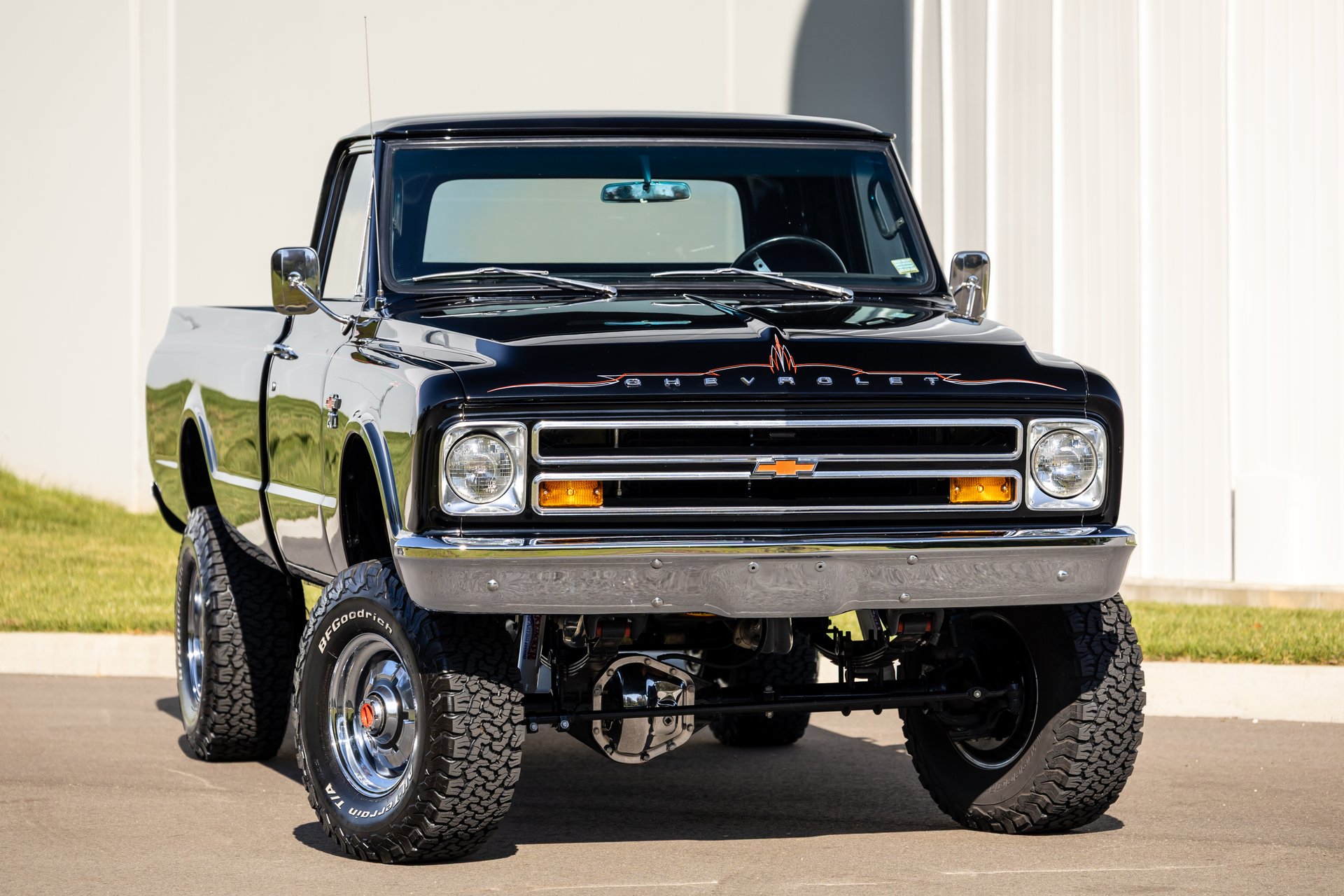
Four generations of C20 matter to a buyer today, and our listings map onto the middle three of them. The first generation (1960–66) introduced the formula: torsion-bar independent front suspension at first, coil springs from 1963, and a cab that rusted enthusiastically wherever water sat. The second generation (1967–72) — the Action Line — is the design high point: clean styling, coil-spring rear suspension on most two-wheel-drive models, front disc brakes from 1971, and the full spread of small-block and big-block power. The third generation (1973–87), the Square Body, ran for fourteen years: the trim ladder became Cheyenne, Scottsdale and Silverado, the 454 arrived as a regular option, the Oldsmobile-built 5.7-litre diesel episode ran 1978–81, and the much better 6.2-litre Detroit diesel followed from 1982. A fourth, GMT400 generation followed from 1988, but the classic C20 story belongs to the first three.
The years in our current listings tell that story plainly. We track 33 C20s, 20 of them for sale and 13 recorded sold, spanning 1964 to 1985. The two biggest single years are 1969 and 1977, with five trucks each — the heart of the Action Line and the heart of the Square Body — followed by 1970, 1972 and 1983 with three apiece. Blue is the commonest colour in the pool, then yellow and green, which is exactly the palette of working trucks ordered from a fleet chart rather than chosen from a showroom. Eleven of the trucks sit in Oregon, most of them with one Sherwood dealer who clearly specialises in these. Dealers account for 24 of the 33 records, Facebook sellers for seven, with single cars from eBay and Bring a Trailer.
Why buy the three-quarter-ton at all, when the half-ton is prettier and more fashionable? Three reasons. First, capability: a C20 will legally and comfortably carry and tow loads that would put a C10 over its rating, and if you intend to use a classic truck as a truck — camper, car trailer, firewood, boat — the C20 is the honest tool. Second, equipment: because buyers ordered them to work, C20s are far more likely than C10s to carry the desirable hardware — the 350 and big-block V8s, the heavy four-speed manual, factory air on Camper Specials, dual fuel tanks on Square Bodies. Third, value logic: the C20 has historically traded in the C10's shadow, so the same money buys a more original, less messed-about truck — though the gap has been closing as buyers work out that a long-bed three-quarter-ton rides better laden, tows straighter and is rarer in good order.
Set against that, the honest warning: these trucks were used, and used hard. High mileage is normal, beds are dented, and the photo evidence in our own pool backs the point — of the 13 C20s we have photo-checked in detail, six show rust somewhere in the pictures and two show visible damage. None of that disqualifies a truck. It just means the buying discipline in this guide — verify the running gear, map the rust, audit the wear — matters more here than on any garage-kept classic car.

The models
A C20 is not one truck but a matrix: three generations, two wheelbases, several cab styles, four trim levels and a long options list, assembled over twenty-seven years. The badge on the fender tells you the trim, not the substance — two trucks wearing the same badge can differ by a big-block engine, a camper package and a heavier rear axle. Learn the matrix and you can read any listing in seconds.
Wheelbase and bed. Most C20s are long-bed trucks: the standard three-quarter-ton wheelbase is 127 inches in the 1967–72 generation (against 115 for the short-bed half-ton) and 131.5 inches in the Square Body era, carrying an 8-foot Fleetside or Stepside bed. The long bed is not a styling choice — it is the point of the truck, sized for plywood sheets, slide-in campers and fifth-wheel work. Short-bed C20s exist but are rare; a claimed one deserves a wheelbase measurement and a data-plate check before you pay a rarity premium. Chassis-cab trucks were also sold without a bed for service bodies and flatbeds, and many survive as exactly that.
Cabs. The standard cab is the overwhelming majority. From 1973 Chevrolet added the crew cab — the "3+3" in period brochure language — a four-door, six-seat cab on an even longer wheelbase, bought by work crews and by families towing big trailers; genuine crew-cab C20s are uncommon and increasingly sought after. The C20 badge also sat under one other body entirely: the Suburban — a C20 chassis under a full wagon body, with the same axles and brakes and a tow rating no half-ton wagon could match. One appears in our own listings, a 1972 Custom Deluxe in yellow, and it belongs in this guide because mechanically it is a C20 in every way that costs money.
Trim levels. The language changes by generation. In 1967–72 the ladder runs from the base C20 through the Custom to the CST (Custom Sport Truck), with trim, carpet, brightwork and seat materials marking the steps; the Cheyenne and Cheyenne Super arrived for 1971–72 at the top. In the Square Body years the ladder is Custom Deluxe at the bottom, then Scottsdale, then Cheyenne, then Silverado at the top — and our listings are full of Scottsdales and Silverados, because by the late seventies even working trucks were being ordered with cloth seats, air conditioning and two-tone paint. Trim matters less than condition, but it matters at resale: a genuine Silverado or Cheyenne Super with its options intact is worth more than a base truck dressed up to look like one, and the SPID label below is how you prove which it is.
The Camper Special. The most important C20 option package of all. Chevrolet sold the Camper Special (option code Z81 in the Square Body era, with earlier equivalents) as a factory package for slide-in camper duty: heavier rear springs, a larger alternator, heavy-duty cooling and battery, camper wiring, and on many trucks stabiliser bars and the auxiliary fuel tank. In our own pool there is a 1976 Silverado Camper Special — the package in its fullest form, top trim plus the heavy hardware. The significance today is twofold. A Camper Special's chassis and springs were specified for sustained heavy loads, so the truck has usually lived a more predictable life than one that was overloaded without the equipment. And the package is provable or disprovable from the SPID label — which matters, because "Camper Special" is the most casually claimed and least casually verified phrase in C20 listings.
The SPID label. From the late 1960s Chevrolet stuck a Service Parts Identification label — in the glovebox on 1967–72 trucks, on the inner fender or door jamb area on Square Bodies — listing the truck's RPO option codes as built. This is the C20 buyer's data card: engine code, axle ratio, trim, paint, and packages like Z81 all appear as three-character codes. Photograph it on every viewing. A truck whose SPID matches its badges, engine and equipment is an honest truck; a truck whose SPID has been removed, or whose codes contradict the hardware, is a story you are being asked not to check.
| Variant | Years | Typical engines | Character |
|---|---|---|---|
| First-gen C20 (long bed) | 1960–66 | 283/327 V8, 292 six | The originator; torsion-bar front end to 1962, coils after |
| Action Line C20 Fleetside | 1967–72 | 307/350/396–402 V8, 250/292 six | The design classic; coil rear springs, discs from 1971 |
| C20 Camper Special | 1967–87 | 350/400/454 V8 | Factory heavy springs, cooling and wiring for slide-in campers |
| C20 Suburban | 1967–87 | 350/402/454 V8 | The ¾-ton wagon; heavy axles and brakes, serious tow rating |
| Square Body C20 | 1973–87 | 350/305/454 V8, 6.2 diesel | The long runner; Scottsdale/Silverado trim, dual tanks |
| C20 Crew Cab "3+3" | 1973–87 | 350/454 V8 | Six seats, longest wheelbase; rare and climbing |


Engines and gearboxes
The C20's engine story is Chevrolet's truck line in miniature: durable sixes at the bottom, the small-block V8 as the default, the big-block as the heavy-duty answer, and two diesels — one to avoid, one to respect — at the end. Because these trucks were ordered to work, the bigger engines are far commoner here than in the half-ton line, and the engine a C20 carries is the largest single driver of what it is like to own.
The sixes: 250 and 292
The base engines are Chevrolet's third-generation inline sixes: the 250 cubic inch (4.1-litre) as the standard fitment in most years, and the taller-deck 292 (4.8-litre) as the heavy-duty six, with a longer stroke, more torque low down and a reputation among truck people as close to unkillable. Both are simple, pushrod, seven-main-bearing engines with a single-barrel carburettor in most applications (later 250s gained an integrated head with a two-barrel). They suit the C20 better than their modest outputs suggest, because a three-quarter-ton working at legal loads spends its life at low revs, where the 292 in particular pulls with a diesel-like indifference.
What goes wrong is age and neglect rather than design. The integrated-head 250s (1975 on) crack heads and are harder to source parts for than the earlier removable-manifold engines — if you are choosing between two six-cylinder trucks, the earlier head design is the safer bet. Exhaust manifolds crack, especially the combined intake-exhaust casting on integrated-head cars; valve stem seals harden and give the classic puff of blue smoke on start-up after sitting; and the single-barrel Rochester carburettors wear their throttle shafts and idle badly. None of it is expensive — a carburettor rebuild is a few hundred dollars, a manifold is a breaker's part — but a six-cylinder C20 is a slow truck by modern standards, and no amount of tuning changes that. Buy one for character and simplicity, not pace.
The small-blocks: 283, 307, 327, 305 and 350
The default C20 engine across all three generations is the Chevrolet small-block V8, and in practice that means the 350 cubic inch (5.7-litre) version for most of the trucks you will actually find, including the majority of our listings, where automatic V8 trucks dominate the transmission counts. Earlier trucks carry the 283 and 327; the 307 filled the base V8 slot in 1968–73; the emissions-era 305 (5.0-litre) appears in Square Bodies from the late seventies. All share the same architecture — cast-iron block and heads, hydraulic lifters, a Rochester Quadrajet four-barrel on most four-barrel applications — and the same ownership profile: cheap parts everywhere, knowledge everywhere, and failures that announce themselves politely.
The wear pattern to audit is consistent. Timing chains stretch and retard the cam timing, making a tired 350 feel lazier than it is — a chain set is a modest job, a few hundred dollars in parts. Hydraulic lifters tick when oil changes have been skipped; a tick that quiets as the engine warms is usually tolerable, one that stays is a cam-and-lifters conversation, and flat cam lobes were a genuine period problem on late-seventies small-blocks, showing as a rhythmic miss and a puffing back through the carburettor under load. Rear main seals weep, valve covers weep, and the Quadrajet — a superb carburettor when right — suffers worn throttle-shaft bores and leaking well plugs that cause hard hot starting and rich running; a proper rebuild by someone who bushed the shafts runs a few hundred dollars and transforms a truck. The 305 deserves one specific warning: it is a fine engine that was never meant to haul a loaded three-quarter-ton, and a 305-powered C20 that has towed heavy all its life will be a tired one. In a C20, the 350 is the engine the chassis was balanced around, and the one to choose if you intend to work the truck.

The big-blocks: 396, 402, 400 and 454
The C20 is where the big-block Chevrolet earns its keep. The Mark IV big-block arrived in the truck line as the 396, grew to a nominal 402 (often still badged and sold as a 396 or a "400" depending on year and market — a period muddle that still confuses listings today), and from 1973 the Square Body's heavy option was the 454 (7.4-litre). The 400 cubic inch small-block also appears in mid-seventies C20s and is a different engine entirely from the 402 big-block despite the near-identical displacement — check which one a "400" truck actually has, because parts, value and character all differ.
In a three-quarter-ton the big-block is not a performance indulgence; it is the correct tool. The torque peak arrives where a loaded truck lives, the engine is understressed at ratings the small-block reaches with effort, and a 454 C20 with the right axle ratio is still a genuinely capable tow vehicle today. The costs are fuel — plan on single figures to low teens per gallon depending on load and gearing — and heat: big-blocks in truck engine bays run hot, radiators and fan clutches are consumables, and exhaust manifolds crack and their bolts snap on removal, turning a gasket job into a machining job. Oil consumption on a working big-block is normal to a degree that would alarm a car owner; judge it by compression consistency and plug condition across all eight cylinders, not by the dipstick alone. A documented 454 or 402 in a C20 is the strongest value signal in this whole guide after a rust-free cab — these are the trucks buyers are hunting, and the ones most often misrepresented, so verify the casting numbers and the SPID rather than trusting the air-cleaner decal, which is a fifteen-dollar part.

The diesels: 5.7 and 6.2
Two diesel chapters, opposite verdicts. The 1978–81 5.7-litre diesel is the Oldsmobile-derived V8, an engine converted from a petrol design and never strong enough for the job in a truck application: head bolts, head gaskets and injection pumps fail, and its reputation was deserved. In a C20 — a truck bought to work — it is the one engine in this guide to walk away from unless the truck is priced as a shell for a conversion and you have priced the conversion.
The 6.2-litre diesel fitted from 1982 is a different matter: a Detroit Diesel-designed engine built from the start as a diesel, indirect-injection, naturally aspirated, and tuned for economy and durability rather than power. It is slow, loud and entirely adequate — it drives like the 292 six with better fuel economy — and its failure points are knowable: the Stanadyne injection pump wears and causes hard starting and hunting, glow-plug systems fail plug by plug until a cold morning exposes all of them at once, and harmonic balancers delaminate with age and can take the crankshaft's nose with them if ignored. Check the balancer on any 6.2 you view; a wobbling crank pulley is a stop-and-price-it finding, not a detail. A well-kept 6.2 C20 is a charming, economical classic truck. A neglected one is a diesel specialist's invoice.
Gearboxes
Four gearboxes cover nearly everything. The base manual is a three-speed column-shift on early trucks — adequate, unloved, and usually swapped or worn. The manual that matters is the SM465: Muncie's heavy four-speed with a very low first gear (the "granny" gear, around 6.55:1) fitted from 1968 onward, identifiable by its cast-iron case, top cover and a shift pattern with first at the far left and down. The SM465 is one of the strongest gearboxes ever fitted to a pickup, its weaknesses are worn synchromesh on second and jumping out of third under load, and a rebuild is straightforward truck-shop work. If you intend to tow with a manual C20, this is the gearbox you want, and its presence is a mark in a truck's favour.
The automatics are the Turbo Hydra-Matic family: the TH350 in lighter-duty applications and the TH400 in most big-block, Camper Special and heavy C20s — the TH400 being the heavy box, recognisable by its pan shape (a distinctive irregular outline against the TH350's square pan with a clipped corner) and by a kickdown operated electrically rather than by cable. Our listings reflect the market: automatics outnumber manuals by roughly three to one among the trucks whose transmissions are recorded. Both automatics are strong, and their failure mode is almost always age — hardened seals causing delayed engagement on a cold morning (it drives away after a minute's warm-up, then behaves) long before any hard part fails. Price a reseal-and-service in the high hundreds to low thousands of dollars; a full TH400 rebuild is a known quantity at any truck transmission shop. Square Bodies from 1981 also offer the TH700R4 overdrive automatic in lighter C20 applications — the overdrive makes a real difference to highway cruising, but early 700R4s behind big-blocks and towing loads had a shorter life, so ask what it has towed. Finally, axle ratios matter as much as the gearbox: C20s were geared from tall economy ratios to deep towing ratios around 4.10 and beyond, and the SPID's axle code tells you which truck you are really buying.
Problem areas
Everything in this section follows from the C20's job description. A three-quarter-ton truck fails differently from a classic car: less from storage and cosmetics, more from load, mileage and water — water carried in the bed, thrown at the cab, and standing in seams designed before rustproofing was a serious discipline. In our own photo-checked sample of 13 trucks, six show rust in the pictures, two show visible damage and one shows a leak — and sellers' photographs flatter, so treat those as floor figures, not ceilings. Work through the truck in this order: cab rust, frame and running gear, the bed, then the systems.
Rust: the cab map
The cab is the C20's value, and the cab is where the rust is. The pattern is consistent enough across all three generations that you can walk it like a checklist.
Rocker panels and cab corners. The classic failure, and the first place to look. The rockers rot from the inside out: road water and mud enter the seam, sit against the inner panel, and perforate the outer skin last — so the visible bubble is the end of the process, not the start. Press hard along the full length of both rockers, and get your fingers behind them from underneath. The cab corners — the small panels behind the doors at the rear of the cab — trap mud thrown by the rear wheels and rot in the same inside-out pattern; on a long-bed truck they hide behind the bed's front panel, so crouch and look from behind the cab, not just from the side. Repair panels for rockers and cab corners are cheap and every panel supplier stocks them, but the welding is the bill: a rocker and corner done properly, one side, with paint blended, runs in the region of $800–2,000 at a body shop, and both sides plus corners is a four-figure conversation on any truck. Fresh black underseal along the rockers on an otherwise honest truck is a question, not an answer — ask what is under it.
Cab floor and cab mounts. Water enters past the windshield seal and the cowl, runs down inside the A-posts and sits under the floor mat or carpet, where it rots the floor from the top down — the reverse of what buyers expect, and the reason a truck can look sound underneath and be perforated inside. Lift the mats in both footwells on every viewing. The floor matters doubly on a C20 because the cab mounts live under it: the cab sits on rubber mounts bolted through the floor structure, and when the floor and mount pockets rust, the cab settles, door gaps change and the doors start to catch. A cab that sits visibly low at the back, or doors that need a lift to close, is often mount-and-floor rust, not hinge wear. Floor sections are available and the job is well understood, but it is cab-off or cab-tilted work to do properly — price it as such, in the low thousands fitted, not as a patch.
The cowl, windshield frame and drip rails. The cowl plenum — the chamber under the vent panel ahead of the windshield — collects leaves and silt through its intake grille, holds them wet against the seams, and rots the cowl sides and the lower windshield frame. The symptoms are water on the floor after rain (the leak everyone blames on the windshield seal) and rust bubbles at the bottom corners of the windshield opening. Square Bodies add the roof drip rails to the list: the rail seam sealer cracks, water sits in the rail channel, and the roof edge perforates from inside the seam outward. Repairs here are fabrication rather than panel-swapping and are priced per truck; a perforated windshield frame on a truck that also needs rockers is how a cheap C20 becomes an expensive one.
Fenders, doors and the bed. Front fenders rot at the bottom rear corner, behind the wheel, where mud packs between the fender and the cowl — prod it, because it is structural to the fender if not the truck. Door bottoms fill with water when their drain holes block, exactly as on any car of the era: run a fingertip along the bottom edge and feel for bubbling. The bed is the C20's working surface and wears its life openly: the bed floor dents and waves, the wheel tubs rust where they meet the floor, and the front bed panel rusts where it traps debris against the cab. Wood-floor beds on early Stepsides rot their boards and the steel strips between them. None of this is hidden, and that is the point — a bed's condition is the most honest odometer a C20 has. A forty-year-old three-quarter-ton with a perfect bed floor has either lived gently, been restored, or had the bed swapped; work out which before you pay for the first explanation.
Frame, suspension, steering and brakes
The C20 frame is a heavy ladder frame and it rusts where frames always rust: at the rear, around the spring hangers and shock mounts, and anywhere road salt has sat against it. Surface rust is normal and cosmetic. Perforation at a spring hanger, a cracked frame rail behind the steering box (a known Square Body stress point, worse on trucks that have run oversize tyres), or a bent rail is a different order of problem — frame work is specialist work, and a cracked or perforated frame on a truck you intend to load is a walk-away unless the price truly reflects it. Check the front frame horns for accident straightening, and look for the witness marks of a fifth-wheel or gooseneck hitch in the bed: a gooseneck truck has worked harder than a bumper-pull truck, and its rear springs, axle and gearbox have the hours to prove it.
Springs and suspension. The front is independent throughout — torsion bars on 1960–62 trucks, coils thereafter — and the wear items are ball joints, control-arm bushes and shocks, all cheap and all testable: rock the front wheel top-to-bottom and side-to-side and feel for play, and bounce each corner to judge the dampers. The rear is where the generations split. Most two-wheel-drive Action Line trucks ride on coil springs with trailing arms — a supple, car-like layout whose trailing-arm bushes and coil seats wear and rust; leaf springs were the heavy-duty option and standard on many C20s. Square Bodies are leaf-sprung throughout at the rear. On a leaf-sprung C20, read the spring pack like a document: a main leaf cracked at the eye, a pack that has flattened or gone negative in its arch, or helper springs and air bags added later all tell you the truck has carried weight — possibly more than it should. Sagging is cheap to fix (a re-arched or replacement pack is a few hundred dollars a side); a truck sitting level on original springs at this age is the exception, so budget for it rather than being surprised.
Steering. Manual steering on early base trucks is heavy at parking speeds — a character trait, not a fault. Power steering (Saginaw recirculating-ball box) is common from the late sixties and near-universal on Square Bodies. The box wears at centre, giving play the alignment shop cannot remove; the test is free play at the wheel rim with the engine running — a couple of inches is tired, more is a box rebuild or exchange, a few hundred dollars. The idler arm and tie-rod ends wear first and are cheap; judge the whole system on the test drive by whether the truck tracks straight hands-light on a level road or needs constant correction.
Brakes. Front discs arrived on the C/K line for 1971, standard on C20s thereafter, with drums before — so a pre-1971 truck stops the way 1960s trucks stop, and a disc conversion is a legitimate, common upgrade rather than a deviation to penalise. The three-quarter-ton systems are hydraulic with a dual circuit from 1967, and the wear audit is simple: pedal height and firmness, even pulling under a firm stop, and the condition of the steel lines along the frame, which rust from the outside in salt country and fail at the clips. A full hydraulic refresh — hoses, lines where needed, calipers or wheel cylinders, master cylinder — is a four-figure shop job at the outside and usually less; seized rear adjusters and tired drums are the normal findings. The parking brake cables seize on trucks that have lived with an automatic and never used it — test it, because you will need it on a hill with a trailer.
Work wear: the audit nobody does on a car
This is the section that separates a C20 inspection from a C10 one. A working truck accumulates a specific wear signature, and reading it tells you how the next ten thousand miles will go.
The bed and tailgate. Dents are honest. What matters is distortion: a bed floor pushed down between the crossmembers means sustained point loads; a tailgate bowed outward means loads against it. Check the tailgate latches and chains — a gate that will not latch is a safety item, not a cosmetic one.
The driveline under load. Rear axles on C20s are serious hardware — the semi- and full-floating axles fitted across the years (the full-floating eight-lug axles on most heavy specifications are identifiable by the hub that protrudes through the wheel centre with its ring of bolts) — and they wear audibly before they fail: a whine on the overrun, a clunk taking up drive, or backlash you can feel by rocking a rear wheel against the transmission in gear. Pinion seals weep; a wet pinion plus low oil is the neglect signature. Universal joints on the two-piece driveshafts (long-bed trucks) wear at the centre bearing first — a vibration at road speed that comes and goes with throttle is usually the centre bearing or a U-joint, a modest job, rather than the axle.
Clutch and gearbox wear on manuals. An SM465 truck that has towed will show it in the clutch: a high bite point, judder pulling away with a load, and second-gear synchromesh that crunches on a fast downchange. The gearbox itself is nearly unbreakable; the clutch is the consumable, and a clutch job on a two-wheel-drive truck is a day's labour at a shop — price it in the low thousands fitted if the bite point is at the top of the pedal.
Interior, electrics and the small systems
The C20 cabin is a simple place, and its problems are simple too. Bench seats collapse on the driver's side — sit in it, and if you can feel the frame through the cushion, a re-foam and re-cover is a few hundred dollars for a bench in vinyl, more for the Silverado's cloth and velour. Square Body dashboards crack across the top in sun states — and note that Florida and California trucks appear in our listings alongside the Oregon majority, so sun damage and rust damage divide by geography in this pool: the desert truck has the cracked dash and the sound rockers, the northern truck the reverse. Window regulators wear and slow; heater cores leak into the passenger footwell (a sweet smell and a misting windshield are the tells, and on an air-conditioned truck the core is a longer job); and the fuel gauge senders — one per tank, two on dual-tank Square Bodies — fail so routinely that a working pair of gauges is a genuine selling point. Dual-tank trucks add their own failure: the selector valve sticks or fails, leaving one tank unusable or cross-feeding between tanks, a modest part and an annoying diagnosis if you do not know to look for it.
Electrics are the least of a C20's problems: an alternator, a starter, simple wiring and fusible links. The failures are connection failures — earth straps between engine, cab and frame corrode and cause every symptom from slow cranking to wandering gauges, and the fix is a wire brush and an hour, not a loom. Air conditioning, where fitted (and Camper Specials and Silverados often carry it), will need the usual recommissioning after years idle: seals, a receiver-drier and a refrigerant decision, since the systems were built for R12. Budget it as a known job, in the high hundreds to low thousands depending on the compressor's health, and treat working factory air on a viewing as a real plus — it means somebody maintained the truck as a system.
How to inspect one
Allow ninety minutes, because a C20 inspection is two inspections: the classic-truck one and the working-vehicle one. Bring a torch, a magnet in a cloth, a screwdriver for prodding (with permission), and your phone for photographs — starting with the SPID label.
- Paperwork and identity first. Match the VIN on the title to the plate on the driver's door jamb (and the dash plate visible through the windshield on later Square Bodies). Then photograph the SPID label — glovebox door on the 1967–72 trucks, inner fender or jamb on Square Bodies — and decode the headline codes on the spot: engine, axle ratio, trim, and Z81 if the truck is claimed to be a Camper Special. A truck whose identity checks out in five minutes is a truck you can spend the other eighty-five on.
- Cold start, from outside. Insist the engine is cold. Stand at the exhaust for the first start: a puff of blue that clears is valve seals (normal, budgetable); continuous smoke is rings or, on a 6.2 diesel, pump and injector wear. A diesel should start on the glow plugs without extended cranking — long cranking on a warm day is the injection pump telling you its age. Listen for lifter tick that does not fade and for the SM465's gear rattle at idle in neutral, which is normal for that box and should quieten with the clutch down.
- The cab rust walk. Work the map from the problem section in order: press both rockers along their full length, look at the cab corners from behind the cab, lift both floor mats and prod the footwells, check the lower windshield corners and, on a Square Body, the drip rails. Then open and close both doors — a door that needs lifting into its latch on a truck with rusty floors is the cab settling, and it prices the floor job into the deal.
- Underneath: frame and mounts. Torch along the frame rails, spring hangers and shock mounts; look for perforation, cracks behind the steering box on Square Bodies, and repairs you were not told about. Check the cab mount rubbers where the cab meets the frame — perished or missing mounts confirm what the door gaps suggested. Prod the bed's underside crossmembers while you are there.
- Springs, stance and tyres. Stand back and sight the truck level: a C20 should sit near level or fractionally nose-down unladen. Read the rear spring packs for cracked leaves and flattened arch, check the front ball joints by rocking each wheel, and read the tyres — eight-lug C20s should carry light-truck tyres of a load range appropriate to the truck, and car tyres on a three-quarter-ton are a sign the last owner did not understand what he owned. Uneven front wear points at ball joints and alignment; feathered rears at axle or spring problems.
- Engine bay audit. On a V8, pull the dipstick and the oil filler cap: mayonnaise under the cap on a truck that does short trips is condensation; on one that has just driven twenty miles it is a head-gasket conversation. Check the coolant's colour, the radiator fins' strength, the fan clutch's resistance by hand, and every hose for the cooked hardness of camper duty — trucks that carried campers lived at full load for hours, and silted radiators and freewheeling fan clutches are their signature. On a big-block, look hard at the exhaust manifolds for cracks — the bolts' condition decides whether that is a gasket or a machine shop.
- The bed as evidence. Read the bed floor, wheel tubs, tailgate and stake pockets as the truck's service record. Look in the bed for hitch witness marks — gooseneck ball holes or fifth-wheel rail bolt patterns — and ask the towing question directly. A seller who tells you plainly what it towed is worth more than a perfect bed with no story.
- Gearbox and driveline, stationary. Manual: clutch bite point (high is worn), and with the engine off, work through the SM465's gate feeling for slop. Automatic: check the fluid — it should be red and sweet-smelling, not brown and burnt — and note any delay engaging drive or reverse from cold, which is seals ageing and is priceable, not fatal. Rock a rear wheel against the driveline and feel the backlash; a heavy clunk is pinion and U-joint wear to price.
- The test drive, loaded with questions. Fifteen minutes minimum, including a highway stretch and, if the seller allows, a hill. The truck should track straight, stop straight (a firm stop from speed tells you about discs, drums and lines at once), and hold its temperature at the gauge's normal mark under load. An automatic should shift firmly without flaring; a TH400's kickdown is electric, so a box that will not kick down may be a switch, not a rebuild. Listen for axle whine on the overrun and centre-bearing vibration at cruising speed.
- Systems sweep. Heater on full (you are testing the blower, the core and the controls), air conditioning if fitted, wipers and washers, every light, the fuel gauge on both tanks of a dual-tank truck and the selector valve between them, the parking brake on a slope. On a Camper Special, ask to see the camper wiring and check the auxiliary battery tray and isolator if fitted — the package's value is in its hardware all being present.
- Numbers against the story. Compare what you found with what the listing claimed: engine code against the SPID, Camper Special hardware against the claim, mileage against the bed, the pedal rubbers and the driver's seat. Odometers are five-digit for most of the run — every C20 has been around the clock at least once unless documented otherwise, so judge condition, not the number, and treat any mileage claim without paperwork as decoration.
- Price the findings before you negotiate. List the jobs in three columns — safety (brakes, tyres, steering), structure (cab rust, frame), and cosmetics — and total the first two from the ranges in this guide. That total, added to the asking price, is the truck's real price, and it is the only honest basis for the conversation that follows.
Values
The market block beneath this guide carries the current numbers — what C20s are listed at now, and what recorded sales have achieved — refreshed as listings change. What follows is how to read that market: what actually moves a C20's price, and where buyers consistently overpay or underpay.
The condition spread on a C20 is wider than on almost any classic car, because the range runs from a worn-out farm truck worth its weight in parts to a restored big-block Camper Special that cost its owner more than the result. The middle of the market — honest, running, presentable trucks — is where most transactions happen and where the asking-versus-achieved gap is most instructive: sellers price from the best truck they have seen advertised, buyers pay for the truck actually in front of them, and the difference between the two is usually the rust map and the work-wear audit from this guide. Expect dealer trucks to carry the firmest asking prices and private sales to close softer; our own pool is dealer-heavy, which flatters the asking side of the picture.
Within the model, the premiums have a clear logic. Generation matters first: the Action Line trucks of 1967–72 carry the styling premium, the first-generation trucks carry rarity, and the Square Bodies carry usability — the newest, the easiest to live with and the cheapest to run, with values climbing as buyers stop treating them as merely old work trucks. Engine matters second, and steeply: a verified big-block — 402 in an Action Line, 454 in a Square Body — is the single largest specification premium, followed by the 350, with six-cylinder trucks and 305s below and the 5.7 diesel at the bottom of the market entirely, priced by most buyers as a conversion waiting to happen. The 6.2 diesel sits apart: a smaller, knowledgeable audience pays fairly for good ones and ignores the rest. Specification premiums stack on top: a genuine, SPID-proven Camper Special, factory air conditioning, a crew cab, and the Suburban body all add real money — and all are exactly the claims most often made loosely, which is why the verification steps in this guide protect your money twice, once on the way in and once on the way out.
The project-versus-driver gap is the C20's defining value feature. A project truck is cheap for structural reasons — cab rust, a tired driveline — and the arithmetic of fixing them is unforgiving: rockers, corners and floors welded and painted, a driveline refreshed and a brake system renewed will carry a project past the price of the honest driver you passed over, in money and in a year of weekends. The exceptions are the trucks whose value is in their specification rather than their condition: a rusty 454 Camper Special or a crew cab can justify restoration money that a base six-cylinder truck never will. Judge every project by asking whether the finished truck, in that specification, is one the market wants — if it is not, the project is a parts truck wearing a project price.
Two closing realities. First, geography: the Oregon concentration in our listings is a reminder that the Pacific Northwest and the dry Southwest are where the survivors are, and a genuinely rust-free cab from those regions is worth a transport bill — shipping a sound truck costs less than welding a rotten one, every time. Second, momentum: the C20 spent decades as the C10's poor relation, and the market has been correcting that as buyers discover the heavier truck's capability and rarity in good order. That correction rewards exactly the trucks this guide tells you to buy — original, verified, structurally sound — and punishes dressed-up base trucks bought on a badge.
Parts and ownership
The C20 is one of the best-supported classic vehicles in America, full stop. Chevrolet built these trucks in the millions across the C/K line, the mechanicals were shared with the half-tons, one-tons and much of the car range, and the restoration industry — built on the C10 boom — supplies the three-quarter-ton almost by accident, because so much interchanges. If a part exists for a C10 of the same year, check whether the C20 version differs before assuming a problem, because often it does not.
Easy: everything serviceable. Filters, plugs, points and ignition parts, carburettor kits, brake discs, drums, pads, shoes, hoses and calipers, ball joints, bushes, shocks, springs, U-joints, clutch kits, gasket sets, radiators, water pumps, alternators and starters — all available new, much of it from ordinary parts stores, at prices that will make a European-classic owner weep. Panels for the common rust areas — rockers, cab corners, floor sections, fender patches, bed floors and wheel tubs — are pressed by several suppliers and stocked widely. Glass, weatherstrip and trim are reproduced for the Action Line and Square Body generations in depth.
Harder and dearer: the C20-specific heavy hardware is where the half-ton's catalogue stops helping. Eight-lug brake drums and rotors for some years, full-floating axle components, heavy spring packs in the correct rates, and Camper Special-specific items take a truck supplier or a specialist rather than a car-parts counter — still available, but ordered, not grabbed off a shelf. Big-block exhaust manifolds in uncracked condition are hunted. The 6.2 diesel's injection pump is a diesel-shop rebuild, and 5.7 diesel parts are a dead end best avoided with the engine. Crew-cab and Suburban panels and glass are thinner on the ground than pickup parts. None of this is exotic; it is simply the difference between same-day and same-week.
Running a C20. Budget like a truck, not a car. Fuel consumption is the headline: a small-block truck returns economy in the low-to-mid teens per gallon in mixed use, a big-block in single figures to low teens, a 6.2 diesel in the high teens — and towing takes its share from all of them. Tyres are light-truck sizes and priced accordingly; keep the load rating honest, because the truck's capability is only real on tyres rated for it. Insurance on an agreed-value classic policy is straightforward. The first-year budget rule from every experienced owner is the same: a running truck bought honestly will still want the deferred-maintenance catch-up — fluids, hoses, belts, brake hydraulics, a cooling-system refresh — and setting aside a four-figure sum for that first year, over and above the purchase, separates the owners who enjoy these trucks from the ones who sell them in month three. Find your community: the C/K truck forums hold decades of archived diagnosis, the SPID and RPO code lists, and the interchange knowledge that makes ownership cheap. A C20 rewards an owner who uses it — the worst thing you can do to one is park it for five years.
Which one to buy
- The all-rounder: a 1969–72 C20 with the 350 and an automatic. The Action Line styling, front discs on the 1971–72 cars, the best parts support in the range and an engine that does everything. Five of the trucks in our listings are 1969s alone, so the choice is real. This is the C20 most buyers should buy.
- The working classic: a Square Body 454 Camper Special, SPID-verified. If the truck has a job to do — a slide-in camper, a car trailer, a boat — this is the specification Chevrolet built for it, and a verified one (a 1976 Silverado Camper Special sits in our current listings) is the most capable classic pickup in this guide.
- The value buy: a 1973–85 Scottsdale or Custom Deluxe with the 350. The Square Bodies are the newest, the cheapest to run and the least fashion-taxed of the three generations; working-spec trucks like the 1977 Scottsdales in our pool are where the honest value sits.
- The character pick: a 292 six with the SM465 four-speed. Slow, simple, nearly unbreakable, and the most honest expression of what a three-quarter-ton was for. Buy it for the experience and the running costs, and accept the pace as part of both.
- The family hauler: the C20 Suburban. Three-quarter-ton running gear under a wagon body, with tow ratings no half-ton wagon matches — the 1972 Custom Deluxe in our listings is the template. Check the wagon-specific rust (roof gutters, rear glass seals) as hard as the pickup points.
- The economy pick: a 1982-on 6.2 diesel. The frugal, durable diesel in the newest trucks, for the buyer who has read the diesel section and checks the harmonic balancer and injection pump before falling for the fuel economy.
- Avoid, unless priced as a shell: the 5.7 diesel (1978–81). The one specification in this guide whose reputation is earned. Its only rational purchase is as a cheap, rust-free body for an engine conversion you have already priced.
And the rule that overrides all of the above: buy the cab and the frame, and let the engine be the bonus. Engines, gearboxes, brakes and springs are all fixable at prices you can plan for, and on a C20 almost everything mechanical is still on a shelf somewhere. A perforated cab and a cracked frame are the two findings that turn a bargain into a write-off — so the least rusty, straightest truck in the specification you can live with is always the right one.
See the 20 C20 cars currently listed.