
Chevrolet 1500 Regular Cab Short Bed buyer's guide
Chevrolet 1500 Regular Cab Short Bed -- the model's own buyer's guide: variants, values and what to check.
Years listed: 1976-1998 · Series: C/K Trucks
Overview and history
The Chevrolet C1500 is the two-wheel-drive, half-ton pickup of the GMT400 generation — the truck Chevrolet sold from the 1988 model year through 1998, and the truck that quietly rewrote what an American pickup was supposed to feel like from behind the wheel. Read the badge correctly first. C means two-wheel drive. K means four-wheel drive. 1500 means half-ton. A C1500 is not a trim level or a special edition. It is the core version of the most numerous Chevrolet truck generation of the modern era, built as a regular cab and an extended cab, with a short bed or a long bed, with a V6 or three different V8s, and in trim that runs from a vinyl-seat Work Truck with crank windows to a Silverado with carpet, air conditioning and every power accessory Chevrolet could fit in a pickup at the time.
The GMT400 replaced the Square Body C10 and K10 line that had run from 1973 to 1987. Where the Square Body was upright and agricultural in its ride and steering, the GMT400 was lower, rounder, quieter and deliberately car-like: a fully boxed frame section at the front, independent front suspension with coil springs and unequal-length control arms, steering that actually held a line, flush glass, rounded corners and a cab trimmed to a standard no previous Chevrolet pickup had attempted. A 1988 C1500 still looks modern in a way a 1987 C10 deliberately does not, and that is a large part of why buyers now want them.
On our own site the shape of the surviving market is unusually clear. We track 118 C1500s in total, concentrated hard in the GMT400 years: 1994 is the most common year, followed by 1990 and 1995, with 1993, 1992, 1989 and 1991 close behind and a thin tail to the final 1998 trucks. A handful of earlier C/K 1500-badged Square Body trucks appear in the same pool, and some sellers use C1500 loosely for any Chevrolet half-ton of the 1970s or 1980s. Be precise: the truck this guide covers in depth is the 1988 to 1998 GMT400. The earlier trucks are a different platform, with different rust patterns and buying logic, covered in the C10 and C/K guides.
Within its own run the C1500 divides into three chapters, and learning them will save you more money than any single mechanical check. First, the 1988 to 1994 throttle-body trucks: simple, tough and under-stressed, with paint that, on certain colours, would become a famous problem. Second, the single transition year of 1995, which kept the throttle-body engines but received the redesigned, much more modern interior that carried to the end of production — a one-year combination knowledgeable buyers specifically hunt. Third, the 1996 to 1998 Vortec trucks, which kept that interior and gained substantially more powerful and more complicated engines, with a new set of intake-gasket and injector faults the earlier trucks do not have. Same silhouette, three different ownership propositions. Price and judge each truck inside its chapter.
Why has a mass-market work truck become a classic at all? Because it is the last Chevrolet pickup that is still simple in the ways owners value — a pushrod engine you can see all of, a separate frame, a bed you can unbolt, wiring you can trace — because the short-bed regular cab has genuine presence, and because Chevrolet built so many that the aftermarket has adopted the GMT400 completely: almost everything that wears, breaks or rusts is reproduced, upgraded or available used.
That history also defines the risk. These were working trucks, maintained to a budget once the first owner sold them. Odometers roll over without ceremony, and a shiny repaint over a tired chassis is the most common sales presentation in the market. What separates a good C1500 from an expensive one is almost never the badge or the mileage claim. It is frame and cab rust, the state of the automatic gearbox, whether that year's fuel-injection system has been sorted, and whether the truck is honestly the year, engine and trim its badges claim.
The models
Every GMT400 C1500 is a half-ton, two-wheel-drive pickup on the same basic frame, but the range built on that frame is wider than most listings admit. The variables that matter are cab, bed, trim, engine and year chapter — in that order — because cab and bed decide what the truck is for, trim decides what it costs to restore, engine decides how it drives, and year chapter decides which fuel system and interior you are buying. A listing that says only C1500 Silverado has told you a third of the story.
| Model | Years | Engine | Output | Built | Character |
|---|---|---|---|---|---|
| C1500 Cheyenne regular cab | 1988–1998 | 4.3 V6 or 5.0 / 5.7 V8 | 160–255 hp by engine | Not published by variant | The base truck; vinyl, crank windows, the honest work spec |
| C1500 Work Truck (WT) | 1990–1998 | 4.3 V6 or 5.7 V8 | 160–255 hp by engine | Not published by variant | Stripped fleet spec; black grille, single headlamps, built to a price |
| C1500 Scottsdale regular cab | 1988–1991 | 5.0 / 5.7 V8 mostly | 170–210 hp | Not published by variant | Early mid-trim; phased out as Silverado took the top and middle |
| C1500 Silverado regular cab, short bed | 1988–1998 | 5.0 / 5.7 V8 mostly | 170–255 hp | Not published by variant | The core collectible truck; top trim, the deepest market |
| C1500 Silverado extended cab | 1988–1998 | 5.7 V8 mostly | 210–255 hp | Not published by variant | The usable classic; rear seat, long wheelbase, strong demand |
| C1500 Stepside (Sportside) | 1988–1998 | V6 or V8 by order | 160–255 hp by engine | Not published by variant | Flared rear fenders, narrow bed; style over load width |
| C1500 Sport | 1989–1992 approx. | 5.7 V8 | 210 hp | Not published by variant | Colour-keyed trim and decals; verify it is not a dressed-up base truck |
| C1500 454 SS | 1990–1993 | 7.4 V8 (454) | 230 hp (1990), 255 hp (1991–93) | 16,953 total across four years | The muscle truck; regular cab, short bed, black first, then red and white |
Production figures need an honest note, because this is where C1500 guides most often invent numbers. Chevrolet built GMT400 pickups in the millions across the full platform run, but it did not publish a clean split of C1500 production by trim, cab and engine, and any source giving a precise build count for, say, a 1992 Silverado short bed is estimating. The one variant with a genuinely documented total is the 454 SS, at 16,953 built across 1990 to 1993. For every other variant, rarity claims are sales talk until the seller produces a build sheet or a GM Heritage Center invoice for that VIN. The VIN and the Service Parts Identification label in the glovebox — the sticker carrying every option code for that truck — are the identity documents on a GMT400, and they matter far more than production folklore.
Cabs and beds. The regular cab is the classic shape and the lightest truck, sold with a 6.5-foot short bed or an 8-foot long bed. The short bed is what the hobby market wants; the long bed is what worked for a living, and condition, not bed length, should decide between two otherwise equal trucks. The extended cab adds a small rear bench and a longer wheelbase and transforms the truck as regular transport — it is also heavier, and V6 extended cabs are genuinely slow. Crew-cab half-tons badged as C1500s deserve a careful VIN check, because most started life as heavier trucks or later conversions. The Stepside bed, marketed as Sportside, uses separate flared rear fenders and a narrower load floor: it looks superb and carries less, and it will not take sheet material flat between the wheelhouses the way the Fleetside does.
Trim levels. Cheyenne was the base trim: vinyl or plain cloth bench and the minimum of brightwork. The Work Truck, from 1990, went further in the fleet direction, with a black grille and single rectangular headlamps — do not let a seller describe a WT as a rare de-trimmed special without option codes to prove it. Scottsdale sat in the middle in the early years and then faded. Silverado was the top trim throughout: better cloth or optional leather later, carpet, full instrumentation, air conditioning on most trucks, power accessories on many, and the two-tone paint that defines the period look. Because Silverado badges, grilles and interiors swap onto a Cheyenne in an afternoon, trim is the easiest thing about a C1500 to fake, and the SPID label is the antidote: the codes printed for that VIN at the factory outrank anything bolted on since.
The 454 SS. Chevrolet's muscle truck attracts its own forgeries. Sold for 1990 to 1993, regular cab and short bed only, the SS took the 7.4-litre big-block, a heavy-duty automatic, a locking rear axle with performance gearing, Bilstein shock absorbers and a monochrome treatment that was black only in the first year, with red and white added later. It was not, by modern standards, especially fast, and it drank fuel at a rate that makes a small-block owner pause. None of that matters. It is the halo C1500, and the one where originality is worth the most money — which is exactly why ordinary 5.7 trucks wear SS decals. The VIN engine digit, the SPID codes and the running gear settle it; decals settle nothing.
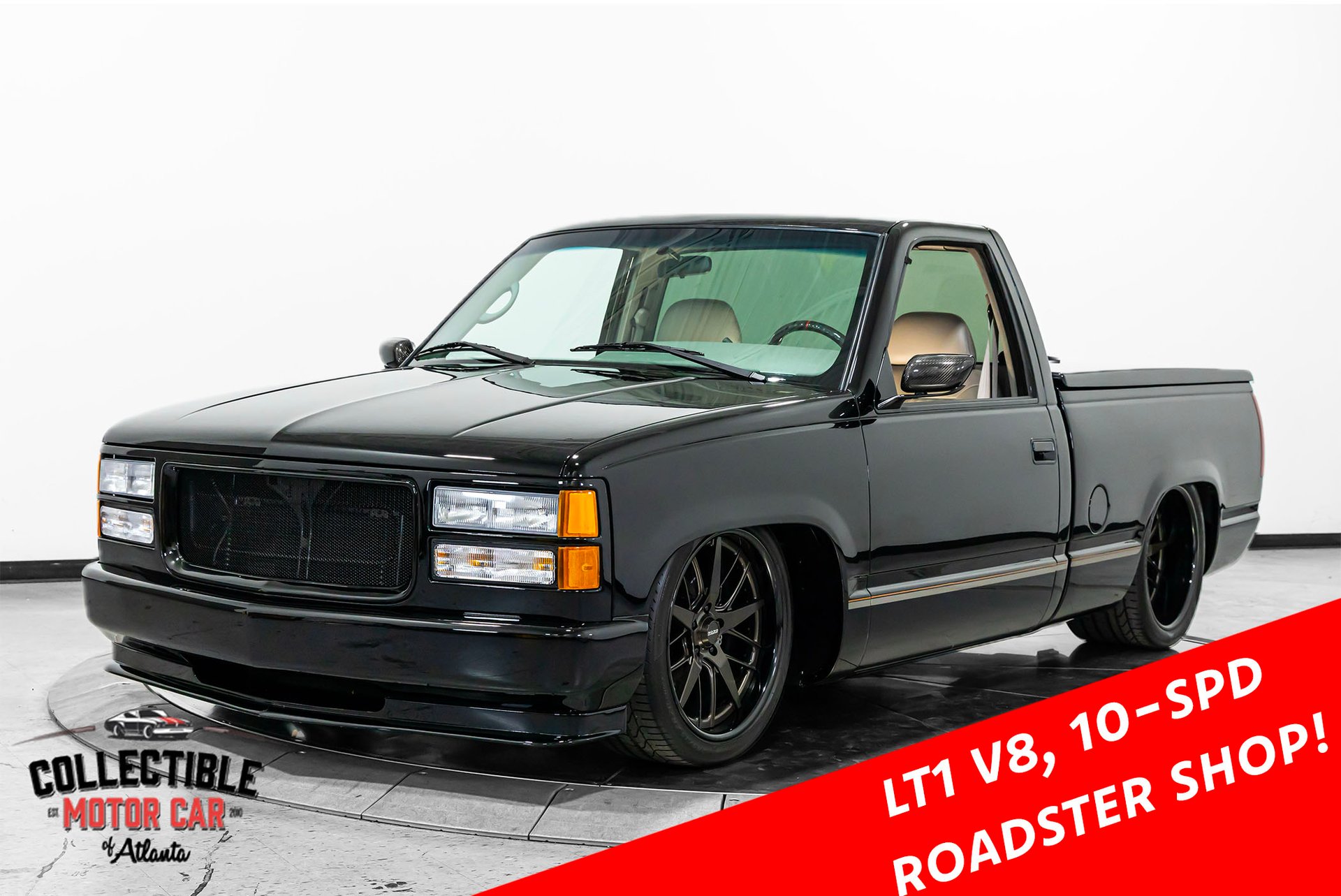
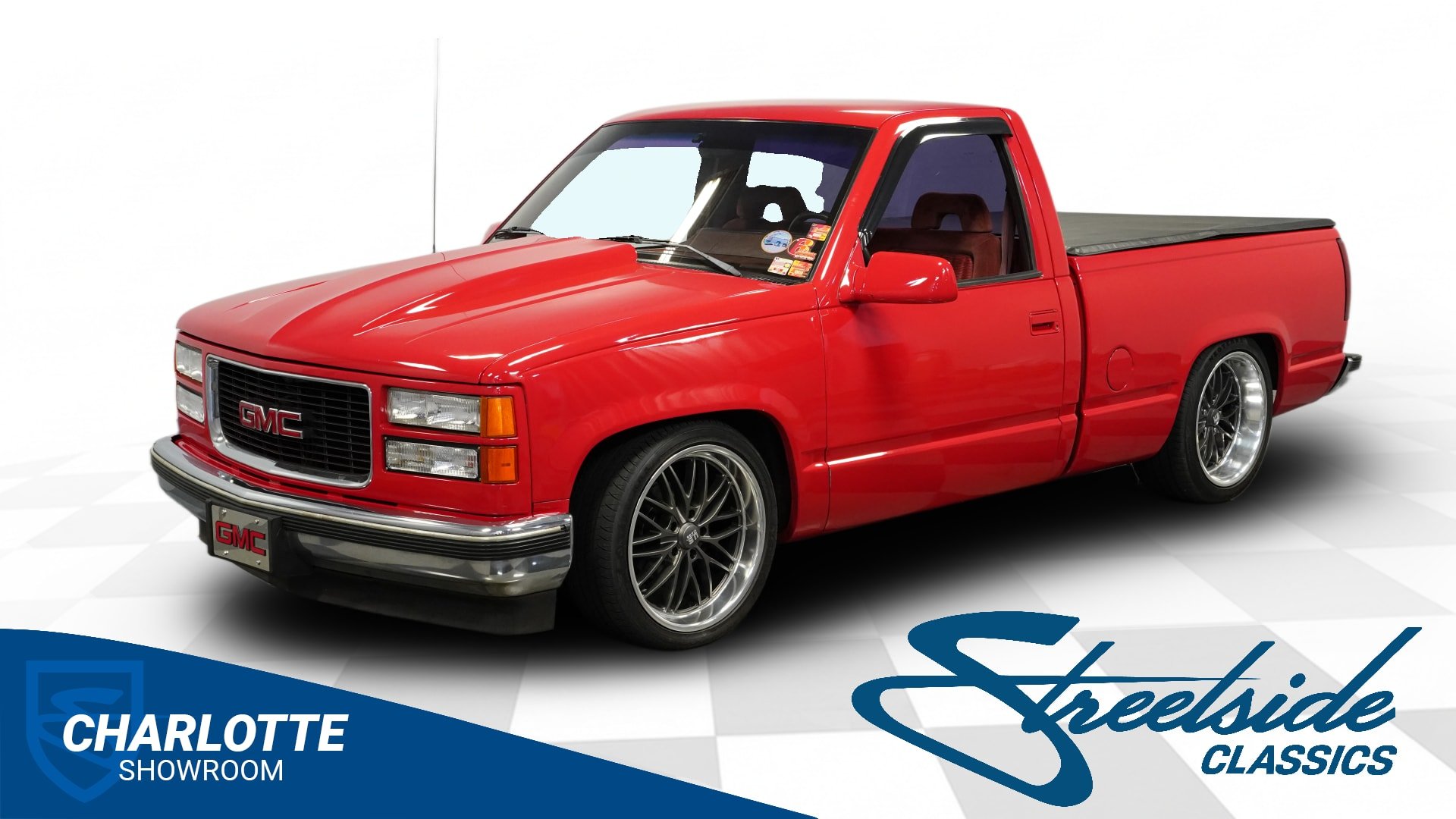
Special, lowered and restomod trucks. A large share of the surviving short-bed market — including several trucks in our own photo pool — is now presented as restomods: lowered suspension, later wheels, resprays, sometimes a later LS-series engine in place of the original small-block. Judge these as individual builds, not as model variants. A well-documented LS swap on a rust-free shell can be the best-driving C1500 you can buy; an undocumented swap on a patched shell is a project wearing finished-truck clothes. The build file, the frame and the wiring tell you everything.

Engines and gearboxes
The C1500 engine story is two fuel systems on the same honest hardware. The bottom ends — Chevrolet's pushrod V6 and small-block and big-block V8s — are among the most durable mass-produced engines ever made: low-revving, torque-first, tolerant of mediocre maintenance, and cheap to rebuild. What changes across the years, and what causes the running faults you will meet on viewings, is the system feeding them. The same symptom — a flat spot, a rich idle, a hard hot start — has completely different causes and repair bills on a throttle-body truck and on a Vortec truck.
The throttle-body engines: 1988 to 1995
From 1988 to 1995 the petrol engines used throttle-body injection, TBI: a single unit on the intake manifold carrying two injectors, managed by a simple computer. It is a modest system and that is its virtue. Fuel pressure is low, around 9 to 13 psi, the injectors rarely fail, the sensors are few and cheap, and a home mechanic with a pressure gauge can diagnose almost all of it. The trade-off is breathing: TBI heads and manifolds were designed for torque and economy, not power, which is why the outputs look low beside the Vortec figures that followed.
The 4.3-litre V6 (LB4, then L35). The 262-cubic-inch V6 is a small-block V8 with two cylinders removed, sharing much of its hardware. In TBI form it made around 160 hp, with torque that arrives early. It is enough for a regular-cab truck used lightly and not enough for an extended cab that tows — a V6 extended cab working hard is a slow, thirsty truck, because the engine lives at wide throttle openings. Buy the V6 on condition and price, and do not pay V8 money for one.
The 5.0-litre V8 (L03). The 305 made around 170 hp in truck TBI tune. It is smooth, durable and unloved, in that order. The market discounts 305 trucks against identical 350 trucks by more than the real difference in how they drive unloaded, which makes a clean 305 Silverado a rational buy — provided you accept that resale will apply the same discount to you. Check the VIN engine digit on any truck sold as a 350: badge-and-air-cleaner swaps are endemic in this market.
The 5.7-litre V8 (L05). The 350 is the default C1500 engine and the one most buyers should target in a TBI truck: around 210 hp, strong low-speed torque, every part available everywhere, and a bottom end that routinely outlives the truck around it. Its vices are age vices. Intake gaskets weep coolant at the corners. The distributor, buried against the firewall, wears its gear and module, and a truck that cuts out hot and restarts cold is describing an ignition fault until proven otherwise. The EGR valve carbons up and causes a light-cruise stumble owners blame on the gearbox. Exhaust manifolds crack, giving a cold-start tick that fades as the metal expands — a negotiating point, not a walk-away.
TBI faults as a system. Three checks sort most TBI trucks. First, fuel pressure: a tired pump or clogged filter drops it below the 9 to 13 psi window and the truck goes lean and flat in a way that mimics ignition failure — measure it before replacing anything. Second, injector spray: remove the air cleaner and watch for a clean conical spray rather than dribbles, keeping hands and loose clothing well clear of the belt drive on a running engine. Third, vacuum: perished hoses and a leaking base gasket lean and raise the idle. A TBI rebuild is a few hundred dollars in parts; a full professional sorting, pump included, typically runs 600 to 1,200 dollars. That cheapness is the TBI truck's whole argument.
The Vortec engines: 1996 to 1998
For 1996 Chevrolet replaced TBI with the Vortec programme: new heads with fast-burn chambers and far better flow, a higher compression ratio, and sequential fuel injection run at full rail pressure of roughly 55 to 62 psi. The gains were real, and a back-to-back drive makes a TBI truck feel a generation older. So does the repair bill when the Vortec-specific parts fail.
The Vortec 4300 V6 (L35) rose to around 200 hp and became a genuinely adequate engine, though it remains the least desired option for resale. The Vortec 5000 (L30), the 305, rose to around 230 hp and closed much of the gap to the 350. The Vortec 5700 (L31), the 350, made 255 hp and is the most wanted engine in the entire range: strong, simple in its bottom end, and supported by an enormous aftermarket. If you buy one Vortec truck, buy an L31 in the best shell you can find.
The spider: central sequential injection and its poppets. The Vortec engines do not use conventional individual injectors at each port. They use a central injector assembly — universally called the spider — inside the intake manifold, feeding each cylinder through a nylon line ending in a poppet nozzle. When the poppets stick, clog or leak, the symptoms are inconsistent: a misfire that moves, hard hot starting, a rich cylinder washing its plug clean, fuel pressure that bleeds down overnight. Diagnosis is pressure and leak-down testing: pressure should reach the high fifties and hold; a rapid fall points to the spider, the regulator inside the manifold, or the pump check valve, and each has a test that separates it. The permanent fix is the upgraded multi-port conversion that replaces the poppets with true individual injectors — roughly 500 to 900 dollars in parts, with a full shop job commonly landing between 900 and 1,600 dollars. A truck with the conversion documented has had the Vortec's signature fault permanently removed, and that paperwork is worth money.
Intake gaskets and Dex-Cool. The second Vortec signature fault is the lower intake manifold gasket. The plastic-and-silicone design, combined with neglected factory long-life coolant, fails and leaks coolant externally at the manifold corners or, worse, internally into the lifter valley and the oil. External weeping shows as crust at the front intake corners and slow coolant loss with no drips. Internal failure shows as emulsion under the filler cap and on the dipstick, and ends in bearing damage if ignored. Check coolant level and colour, intake corners and oil condition on every Vortec viewing. A professional gasket job with the updated design and a full flush typically runs 700 to 1,300 dollars — a bounded cost, but only if the engine has not been run low on coolant or contaminated oil.
The big-block: 454 (L19) in the SS. The 7.4-litre big-block kept throttle-body injection for its whole short run, making 230 hp in 1990 and 255 hp from 1991, with torque that dwarfs every other C1500 engine. Heavy, lazy-revving, nearly unburstable and very thirsty, its faults are heat and age. Verify the cooling system on an SS as carefully as the identity paperwork, because a big-block that has overheated repeatedly is an expensive engine to put right.
Diesel footnote. A small number of half-ton GMT400s were sold with diesel power — the 6.2-litre in the early years and the 6.5-litre turbo diesel later. They are rare in the listings pool, slow, and their injection equipment is a specialist fault with specialist prices. Treat a diesel C1500 as a separate purchase for a buyer who specifically wants one, inspected by a diesel shop before money moves.
Gearboxes
The automatics carry the market. In our listings pool automatics outnumber manuals by a wide margin, and the box you meet depends on year. The 1988 to 1992 trucks use the 700R4, renamed 4L60 in its last years: a four-speed overdrive automatic with no electronic control, whose line pressure and shift timing are governed by a throttle-valve cable — the TV cable. That cable is the most misunderstood part on an early C1500. It is not a kickdown cable you can leave slack. It sets transmission pressure in proportion to throttle, and a misadjusted or disconnected cable lets the box shift soft and early on low pressure, which burns the clutch packs in miles. On any 1988 to 1992 viewing, find the cable and confirm it is connected. A proper 700R4 rebuild typically runs 1,800 to 3,000 dollars fitted; a documented rebuild with the cable set on a pressure gauge is a genuine selling point.
From 1993 the C1500 moved to the 4L60-E, the electronically controlled version. The classic wear story is the 3-4 clutch pack and the reaction sun shell: a box that has lost third and fourth, or second, fourth and reverse, is describing internal failure, not a sensor. Before condemning the internals, check the cheap electronic causes — a failed speed sensor, chafed case-connector wiring or low voltage can force a limp mode with only second or third gear, for tens to low hundreds of dollars. Scan for codes and check the fluid first: bright red is healthy, dark brown and burnt-smelling is a box on borrowed time. Budget 1,900 to 3,200 dollars fitted for a quality rebuild with a warranty. The 454 SS and diesel trucks used the heavier, stronger 4L80-E — one of the SS's hidden ownership advantages.
Manual gearboxes are the minority choice and, on the right truck, a delight. Most carry a five-speed overdrive box — the Getrag-designed HM-290 family and its New Venture NV3500 successor — with a hydraulic clutch. Judge second-gear synchromesh cold, listen for input-shaft bearing whine that changes when you press the clutch, and check the clutch hydraulics for leaks, because they fail more often than the gearbox itself. A clutch replacement is a 700 to 1,200 dollar shop job. A manual V8 truck in good order is a genuinely desirable hobby specification.
Rear axle and gearing. Nearly every C1500 runs the GM 8.5-inch 10-bolt rear axle, whose common faults are worn pinion bearings (a whine that changes between drive and coast), leaking seals, and wear in the optional G80 Gov-Lok locking differential. Axle ratio, printed on the SPID label as a G-code, shapes the truck more than buyers expect: tall economy gearing makes a V6 feel gutless, while the shorter ratios fitted to SS and towing-package trucks wake the vehicle up and cost fuel at highway speed.
Problem areas
Everything in this section follows the evidence pattern of the trucks themselves. Of the 48 C1500s in our pool whose photo sets we have examined in detail, rust was mentioned in the notes for 17 and visible damage for 13, while smoke was not recorded at all and leaks were recorded only once — a distribution that matches the model's character. These trucks rarely arrive with a terminally ill engine. They arrive with rust in specific places, a gearbox of unknown honesty, tired front-end parts, and electrical and interior faults each cheap alone and expensive together. The first two subsections decide whether the truck is worth owning at all; the rest decide what you should pay for it.
Rust and the frame: the map
A GMT400 rusts from the bottom up and from the inside out, and the geography is consistent enough to memorise. The good news is that, unlike a unibody car, the truck separates into frame, cab and bed, and each can be assessed — and in the worst cases repaired or replaced — separately. The bad news is that the frame itself is on the list.
Frame rails, especially the rear half. Start underneath, behind the cab, where salt and mud sit on top of the rails and inside the C-channel sections. The worst areas are the rail tops under the bed, the sections around the rear spring hangers and shackles, the crossmembers and the fuel-tank strap area. Surface scale is normal on a northern truck and treatable. Flaking rust you can push a screwdriver into, perforation around spring hangers, or a rail plated over without explanation is structural, and it reprices or ends the purchase. Proper frame repair — a cut-out and plated section, not a cosmetic patch — typically runs 600 to 1,500 dollars per area, and a frame with multiple perforated areas is a walk-away conversation. A genuinely clean frame is the single most valuable attribute a C1500 can have.
Cab corners, rockers and cab mounts. The classic GMT400 signature. The rear cab corners trap water and mud and rot from inside, bubbling the paint behind each door. Rocker panels follow. Then the cab mounts: the rubber perishes and the brackets and cab floor above them corrode, and the tell-tale is a cab sitting low or crooked relative to the bed — sight along the cab-to-bed body line from behind the truck. A cab dropped on one side is mount and floor work, not a suspension fault. Replacement panels are cheap and universal; professional cut-out, weld and paint-blend work typically runs 800 to 1,800 dollars per side. Bubbling at a cab corner on an original-paint truck is honest wear to price in; fresh paint over both corners with no paperwork is a question to press.
Front fenders, wheel arches and the bed. Front fenders rust at the lower rear edge and along the arch lip. Bed arches rust from inside where mud packs behind the lip — run your fingers inside the arch and feel for roughness and filler edges. The bed floor rusts under drop-in plastic liners, which trap water against the steel for decades: lift the liner, or at least a rear corner of it, on every viewing. A seller who will not let you look under a liner has told you what is under it. Tailgates bend and rust along the bottom seam, and a straight original is worth preserving because reproductions fit variably.
Doors, hinges and the cowl. Door bottoms rust where the drain holes block, and the doors sag because the hinge pins and bushings collapse under the weight of a long truck door. Lift each door by its outer edge: movement at the hinge is pins and bushings, a 30 to 80 dollar parts kit, but years of sagging wears the striker and lets the door leak and whistle, so judge the surrounding damage too. A leaking windshield seal wets the cab floor and starts floor rust; wet carpet, or a brand-new carpet in a tired cab, both deserve a floor inspection with the carpet lifted.
Brake and fuel lines. On any salt-state truck, treat the steel lines as rust items equal in importance to the body. The brake lines along the left frame rail corrode under their coating and fail under a hard pedal application — at the worst possible moment. If the lines show heavy scaling, budget a full replacement, typically 500 to 1,100 dollars fitted for a complete set, and do not accept a single patched section as a system fix. A weeping fuel tank or a strap rusted through is a bed-off or tank-drop job whose labour dwarfs the parts.
Paint failure: the peeling years. Late-1980s and early-1990s trucks in certain colours — white, blue and silver are the notorious ones — suffer factory paint delamination, where the colour coat loses adhesion to the primer and peels in sheets, starting on the hood, roof and fender tops. This is not rust and not neglect; it is a period primer-system failure, and no polish fixes it. The cure is stripping to sound material and repainting, which is why so many early trucks wear one respray already. Judge a respray on its preparation: peeling at panel edges and overspray on rubbers tell you the cheap version was done. A quality full respray starts around 4,000 dollars and rises steeply with bodywork — which is why original, unpeeled paint, even faded, carries real value.

Front suspension, steering and brakes
The two-wheel-drive GMT400 front suspension — coil springs, upper and lower control arms, ball joints, and a steering box with a long linkage — is durable in design and consumable in practice, because most trucks have lived on their original joints far past the design interval.
Ball joints and bushings. Upper and lower ball joints, control-arm bushings, tie-rod ends, the idler arm and the pitman arm all wear, and they wear together. Symptoms are a wander at highway speed, a knock over broken pavement, feathered front tyre wear and a steering wheel that no longer sits straight. The idler arm is the most common single culprit and the cheapest; a full front-end refresh with quality parts, fitted and aligned, typically runs 900 to 1,800 dollars, and a truck that has had it done with paperwork drives like a different vehicle. Test with an assistant rocking the steering gently while you watch each joint for lost motion. Any joint with visible play means pricing the whole refresh, not the one joint.
Steering box and the rag joint. The recirculating-ball box develops play at centre with mileage, and the flexible coupling in the steering shaft — the rag joint — perishes and adds its own slack. Distinguish them: play at the shaft coupling with the engine off is the joint; play inside the box after the shaft moves is the box. A rebuilt box fitted runs roughly 500 to 900 dollars. Variable-effort steering on later trucks adds a speed-sensitive valve whose failure makes the steering intermittently heavy or twitchy at parking speeds — diagnosable, and usually fixable without replacing the box.
Springs, stance and lowered trucks. Rear leaf springs sag and crack leaves, and front coils settle, so stance is data: measure arch-to-tyre clearance side to side. Many hobby trucks are lowered, by methods ranging from proper drop spindles, springs, hangers and a correctly welded frame C-notch, to heated coils and removed leaves. A properly engineered drop with paperwork can be a plus. A butchered one shows as bottoming, a pinion-angle vibration at cruise, tyres rubbing arches, and a notch cut without reinforcement. Put any lowered truck on a lift and look at the notch before you admire the stance.
Brakes and the ABS story. Front discs and rear drums, with rear-wheel anti-lock on most trucks and four-wheel ABS on later ones. The age faults are seized calipers and collapsed hoses causing a pull under braking, weeping rear wheel cylinders, and a master cylinder bypassing internally so the pedal sinks slowly at a stop. ABS warning lights that sellers dismiss as a sensor are sometimes a failed module or corroded sensor wiring. Price an unknown light as a diagnostic job plus parts, typically 200 to 700 dollars, and check at key-on that every warning bulb actually illuminates rather than having been removed.
Interior, electrics and air conditioning
The two interiors. The 1988 to 1994 cabin and the 1995 to 1998 cabin are different worlds. The early dash cracks across its top pad, its clusters develop solder faults, and its door panels loosen as their clips age. The later interior is more modern and durable, but its dash top still cracks, its plastics go brittle, and seat foam and cloth — especially the driver's outer bolster — collapse and split on schedule. A professional retrim of a bench in correct cloth runs roughly 800 to 1,500 dollars. Check the headliner on extended cabs, every window — manual regulators wear, power motors slow and die — and the rear sliding window seals.
Wipers, switches and solder. The wiper motor pulse board is a famous small fault: cracked solder joints make the wipers park wrong or refuse the intermittent settings, and the fix is a board or a re-solder for tens of dollars — a fault that makes a truck look electrically haunted while costing almost nothing. The multi-function column switch fails and takes cruise, wipers and high beam with it in confusing combinations. The blower resistor pack fails, leaving only the highest fan speed. Rear lamp earths corrode, giving one bright and one dim brake light. None is a walk-away; together, unrepaired, they describe an owner who stopped caring, which is information about the maintenance you cannot see.
Air conditioning. Most Silverados carry it, and on a southern truck it is not optional in any practical sense. Early R12 systems will almost all have been converted to R134a — ask for the paperwork and check it was a conversion, not a top-up. A full professional recommission — compressor, accumulator, orifice tube, flush and charge — typically runs 900 to 1,600 dollars. Run the system for the whole test drive: cold at idle, not only at speed. A system described as needing only a recharge needs a leak found first.
Heating and coolant neglect. Heater cores clog and leak into the passenger footwell, and the job is dashboard-deep labour on later trucks. Blend-door actuators click and stick. These are winter faults sold in summer: run the heater to full hot on every viewing, exactly as you run the air conditioning cold.

How to inspect one
Allow ninety minutes, bring a torch, a magnet wrapped in cloth and a screwdriver for prodding with the seller's permission, plus a code reader for a 1996-onward truck. Insist on a cold engine when you arrive — a warmed-up truck is hiding its cold-start behaviour, which on both TBI and Vortec trucks is half the diagnosis. If it passes you, pay for a lift inspection before money changes hands; on a GMT400 the underside is where the money is.
- Start with identity, not paint. Match the VIN on the title to the plate at the base of the windshield. Read the engine digit and confirm the engine in the bay matches the claim — 305 versus 350, and big-block versus small-block on any truck sold as a 454 SS. Then photograph the glovebox Service Parts Identification label: its codes record the factory engine, gearbox, axle ratio, locking differential, trim and paint for that VIN. A truck whose label is missing or contradicted by its hardware needs its price adjusted for doubt, however good the story sounds.
- Cold start and first listen. Start it from cold yourself. A TBI truck should fire promptly and settle to a fast idle that steps down as it warms; a Vortec should start without extended cranking — long cranking points at fuel pressure bleeding down, the spider or pump check valve from the engines section. Listen for manifold ticking that fades warm, lifter noise that should quiet within seconds, and any bottom-end knock, which is a walk-away on a truck priced as good. Watch the exhaust: blue is oil, persistent white and sweet-smelling is coolant, black is rich running.
- Fuel system checks for the chapter. On a TBI truck, watch the injector spray at idle for a clean, even cone rather than dribbles, with the belt-safety caution from the engines section in mind. On a Vortec, check coolant level and colour, inspect the front corners of the lower intake for crusty leaks, and pull the dipstick and filler cap looking for emulsion. Ask directly whether the spider has been converted to the multi-port upgrade and whether the intake gaskets have been done — and ask to see the invoices.
- Underneath: frame first. On the ground with a torch if no lift is available yet, work the frame from the rear spring hangers forward: rail tops under the bed, crossmembers, fuel-tank straps, cab mount brackets. Prod suspect areas with the screwdriver. Perforation at spring hangers, rails or mounts is structural — this step decides whether you continue at all. Read the brake and fuel lines along the left rail in the same pass; heavy scaling there is a full-line replacement priced into the offer.
- Cab corners, rockers and floors. Sight the cab-to-bed alignment from directly behind the truck. Press and tap the cab corners and rockers, run the magnet over corners, arches and lower doors, and lift the carpets — or at minimum a front corner of each — to see the floor and smell for damp. Lift any drop-in bed liner at its rear corners and inspect the bed floor. Check the windshield seal and cowl for the water path that starts floor rust.
- Gearbox honesty test. Check the automatic fluid on the dipstick: level, colour, smell. On a 1988 to 1992 truck, locate the TV cable at the throttle linkage and confirm it is connected and moves with the throttle — remember from the gearboxes section that a disconnected or slack cable is actively destroying the box, not merely detuning it. On the drive that follows, the box must engage drive and reverse promptly without a thump, shift up through all gears including overdrive, and hold its gears under a steady climb without flaring. Loss of third and fourth, or of second and reverse, on a 4L60-E is internal failure until a scan proves a limp-mode cause.
- Front end and steering. With an assistant rocking the wheel, watch the idler arm, pitman arm, tie rods and ball joints for lost motion. Rock each front wheel top and bottom and side to side. Note steering play at centre and separate rag-joint slack from box slack as the problem section describes. Check tyre wear patterns — feathering and inner-edge wear are the front end's written report.
- The test drive. Twenty minutes minimum, including a highway stretch, a rough surface and full-lock parking manoeuvres. The truck should track straight on a level road, brake straight without pull or pedal sink, and ride without knocks. Note axle whine that changes between accelerating and coasting, cruise vibration suggesting pinion angle on a lowered truck, and whether speedometer, cruise and overdrive agree — a dead speed sensor upsets the gearbox as well as the gauge.
- Heat, cold and every switch. Whatever the season, run the heater to full hot and the air conditioning to full cold, at idle as well as at speed. Work every fan speed (only-top-speed means the resistor pack), every window, the wipers on every setting including intermittent (the pulse-board test), washers, lights, horn and radio.
- Doors, tailgate and bed in use. Open and close every door twice; lift each door edge for hinge play; check latch and striker wear. Drop and raise the tailgate and look down each bed side from the rear for ripples. Sagging doors and a bent tailgate are cheap parts and expensive alignment time — price them as labour, not hardware.
- Stance and the lowered-truck check. Stand back and photograph the truck in profile, as in the figures in this guide. Measure arch clearance side to side. On a lowered truck, plan the lift inspection around the frame notch and pinion angle, and ask what components were used — named drop parts with invoices are a feature; cut coils and mystery hardware are a deduction.
- Paperwork last, and weight it properly. Invoices for the gearbox, the Vortec spider and intake gaskets, front-end work and rust repair each retire one of the model's known bills, and are worth real money. A thick file on a cosmetically plain truck beats a thin file on a shiny one, every time, on a model whose faults are this well mapped.

Values
The market content that follows this guide on the page — the current listings summary and the recorded-sales block, refreshed at every build — carries every live number for the C1500, and this section deliberately carries none. Asking figures for these trucks move with season, region and the supply of clean short beds, and a number printed in a guide would be stale before it was useful. What does not go stale is how to read those numbers when you meet them, because the C1500 market has a structure that punishes buyers who compare trucks by year and mileage alone.
The first driver is the condition spread, and on this model it is exceptionally wide. The same year, cab and engine can describe a rusted work truck at the end of its service life and a garaged, original-paint hobby truck. Almost the entire difference between those two trucks lives in four places you have already inspected: frame and cab structure, the honesty of the automatic gearbox, whether the year's signature fuel-system work has been done, and the originality of the paint. When the market block shows a wide range for a variant, that is not noise — it is the spread between structure and cosmetics. Locate a specific truck inside it by its underside, not by its photographs.
The second driver is configuration, in a stable order. Regular-cab short beds lead the hobby market, especially as Silverados with the 5.7 engine. Extended cabs follow closely and are arguably underpriced against their usefulness. Long beds, V6 trucks and base Cheyenne and Work Truck trims trade at a persistent discount that reflects demand, not merit — a clean long-bed work-spec truck is often the most truck per unit of money in the range, provided you buy it to use rather than to resell. The Stepside premium is real but narrow: it appears when two style buyers want the same truck and vanishes when only one does.
The third driver is chapter. Vortec trucks, 1996 to 1998, command a premium over equivalent TBI trucks, justified when the spider and intake-gasket history is documented and fragile when it is not, because the next owner prices in both jobs. The single-year 1995 combination, TBI simplicity with the late interior, has a knowledgeable following that keeps good examples firm. Early trucks trade on condition and originality alone, with the peeling-paint question over every valuation: one needing paint must be valued as a truck plus a professional paint job, in full, not as a truck plus a hope.
The 454 SS stands apart from all of this. Its values are driven by verified originality — VIN, option codes, correct running gear — far more than by condition alone, because a cloned SS is worth ordinary-truck money while a documented original carries the halo premium. Expect the widest asking-versus-achieved gap in the whole C1500 market here, and expect provenance paperwork to move the achieved figure more than any cosmetic preparation. Restomod and LS-swapped trucks form a second separate market with the same logic in reverse: value follows the documented quality of the build — parts invoices, wiring standard, cooling and air conditioning completed rather than deleted — and an undocumented build should be valued as a shell plus an engine of unknown health, however finished it looks.
Finally, negotiation reality. C1500s are numerous, and another one is always coming; that advantage evaporates only on the genuinely scarce configurations — a documented SS, a rust-free original-paint short bed, a manual V8 truck with a file. Sellers of ordinary trucks anchor on the best photographed example they have seen advertised, not on achieved results, so the recorded-sales evidence that follows this guide is your corrective: tie every deduction to a named, inspected item — frame work, a gearbox with burnt fluid, an undone spider — rather than to a general claim that the truck is overpriced.
Parts and ownership
The C1500 may be the easiest classic vehicle in America to keep alive, and that is a considered claim. Chevrolet built the GMT400 in huge numbers across Chevrolet and GMC badges, the engines belong to the most supported families in the industry, and the truck aftermarket treats the GMT400 as core catalogue. Most of what this truck needs can be ordered today and fitted this weekend.
Easy and cheap: service items for every engine; brake discs, drums, calipers, wheel cylinders and complete pre-bent line sets; ball joints, tie rods, idler and pitman arms and complete front-end kits; hinge pins and bushings; wiper pulse boards, blower resistors, window regulators; TBI gaskets and sensors; radiators, heater cores and air-conditioning service parts; exhaust systems; and a remarkable range of reproduction sheet metal — cab corners, rockers, fenders, bed panels and floors — at prices that make structural honesty repairable rather than terminal. Used support is equally deep, because the same components serve the GMC Sierra and the GMT400 SUVs.
Available, at a price: quality gearbox rebuilds, in the fitted ranges given earlier; the Vortec multi-port injector conversion; correct-pattern seat covers and interior trim in common colours; good original tailgates and grilles; and professional paint, the single largest discretionary cost in C1500 ownership.
Harder and dearer: 454 SS-specific trim and verified original components, where the premium is provenance rather than scarcity of metal; big-block ancillaries; diesel injection equipment; early-truck electronic cluster parts; and small trim for the least common cab combinations. None of this blocks ownership. It merely rewards the buyer who chooses a common configuration — a small-block Silverado in a popular colour — with the deepest support in the model.
Running costs and the first-year rule. Budget the first year as a recommissioning year, even on a truck sold as ready. Fluids and filters, brake hoses and an honest look at the lines, front-end wear items, hinge pins, a coolant service — and on a Vortec, confirmation of the intake gaskets and spider status — will typically total 1,500 to 3,500 dollars on a good truck bought well, and double that on a truck bought on its photographs. After that, a sorted C1500 is inexpensive classic transport: fuel consumption in the mid-teens for a small-block driven gently, worse for the big-block by a margin to accept before purchase, and servicing any competent independent shop can handle. Choose a truck in regular use over one that has slept for years: seals, hoses, brake hydraulics and fuel systems all punish storage on this platform.
Use the truck, and keep the underside washed in salt country — the frame and lines that decide this truck's lifespan are decided by what winter leaves on them. Keep the gearbox fluid honest and the TV cable correctly set on an early truck, and a C1500 will outlast most of the modern vehicles parked beside it.
Which one to buy
- The all-rounder: Silverado regular cab, short bed, 5.7 V8, 1996 to 1998. The Vortec 5700, the late interior, the classic silhouette and the deepest support in the range. Buy it on frame condition and documented spider and intake-gasket history.
- The value buy: the same truck in TBI form, 1993 to 1995. You give up Vortec power and, on the earlier cars, the late interior, and in exchange you get the cheapest fuel system in the model to sort and a purchase discount larger than the real difference. The single-year 1995 car, TBI with the late interior, is the connoisseur's version of this pick.
- The user: Silverado extended cab, 5.7 V8, any chapter. The rear seat makes it genuine family and distance transport, the market underprices it against the regular cab, and condition-for-condition it is often the best-maintained population because so many were bought as personal trucks rather than work trucks.
- The working bargain: Cheyenne or Work Truck long bed, 5.7 V8. The least fashionable specification and frequently the most honest trucks left. Buy one to haul and use, and judge it purely on frame, lines and gearbox.
- The collector car: 454 SS, 1990 to 1993. The halo truck, with the only fully documented production story in the range. Verify identity through the VIN and option codes before condition, before colour, before anything — originality is the value, and a clone is an ordinary truck with expensive decals.
- The project to buy deliberately: a rust-free southern shell with a tired drivetrain. Engines and gearboxes for this truck are cheap, known quantities with fixed rebuild prices. A clean frame, cab and bed with a worn 350 is a better foundation than any shiny northern truck, at almost any asking difference.
And the rule that overrides all of the above: buy the frame, the cab structure and the paperwork, in that order, and let the engine and the paint be the things you fix. A perforated frame, rotted cab mounts and a truck whose identity exists only in its decals are the three purchases no rebuild budget reliably redeems — and all three are visible in the first fifteen minutes of the inspection, if you start underneath instead of starting with the shine.
See the 104 1500 Regular Cab Short Bed cars currently listed.