
Chevrolet Apache buyer's guide
Chevrolet Apache -- the model's own buyer's guide: variants, values and what to check.
Years listed: 1955-1959 · Series: 3100 Trucks
Overview and history
The Chevrolet Apache is not a separate truck that replaced something else. It is a name, applied for just two model years in its purest form, to the light-duty end of a truck range that American buyers already knew well. Understanding that distinction is the first thing that keeps you from overpaying for a badge, and from walking past a good truck because its paperwork uses a number instead of a name.
Chevrolet launched the Task Force range in March 1955, as a mid-year replacement for the Advance Design trucks that had carried the division since 1947. The change was total in feel if not in basic layout. Out went the narrow, upright Advance Design cab with its separate fenders and running boards. In came a wider, lower, wraparound-windshield cab, a hood that sat flatter and lower, integrated front fenders, a one-piece curved windshield, and styling that deliberately echoed the new 1955 passenger cars. Underneath the truck stayed honest and simple: a ladder frame, a solid front axle on leaf springs, a live rear axle on leaf springs, and drum brakes all round. Chevrolet was selling modern looks and car-like comfort on a chassis a farmer, a plumber or a fleet mechanic could still repair in a barn with hand tools.
For 1955, 1956 and 1957 the light trucks were sold by number alone. The half-ton short-bed was the 3100, the half-ton long-bed the 3200, the three-quarter-ton the 3600 and the one-ton the 3800. That is worth memorising, because sellers today routinely call any 1955 to 1957 Task Force truck an Apache. Chevrolet did not. No factory Apache badge existed before 1958, and a truck built in 1955, 1956 or 1957 cannot be an original Apache however often the word appears in its listing.
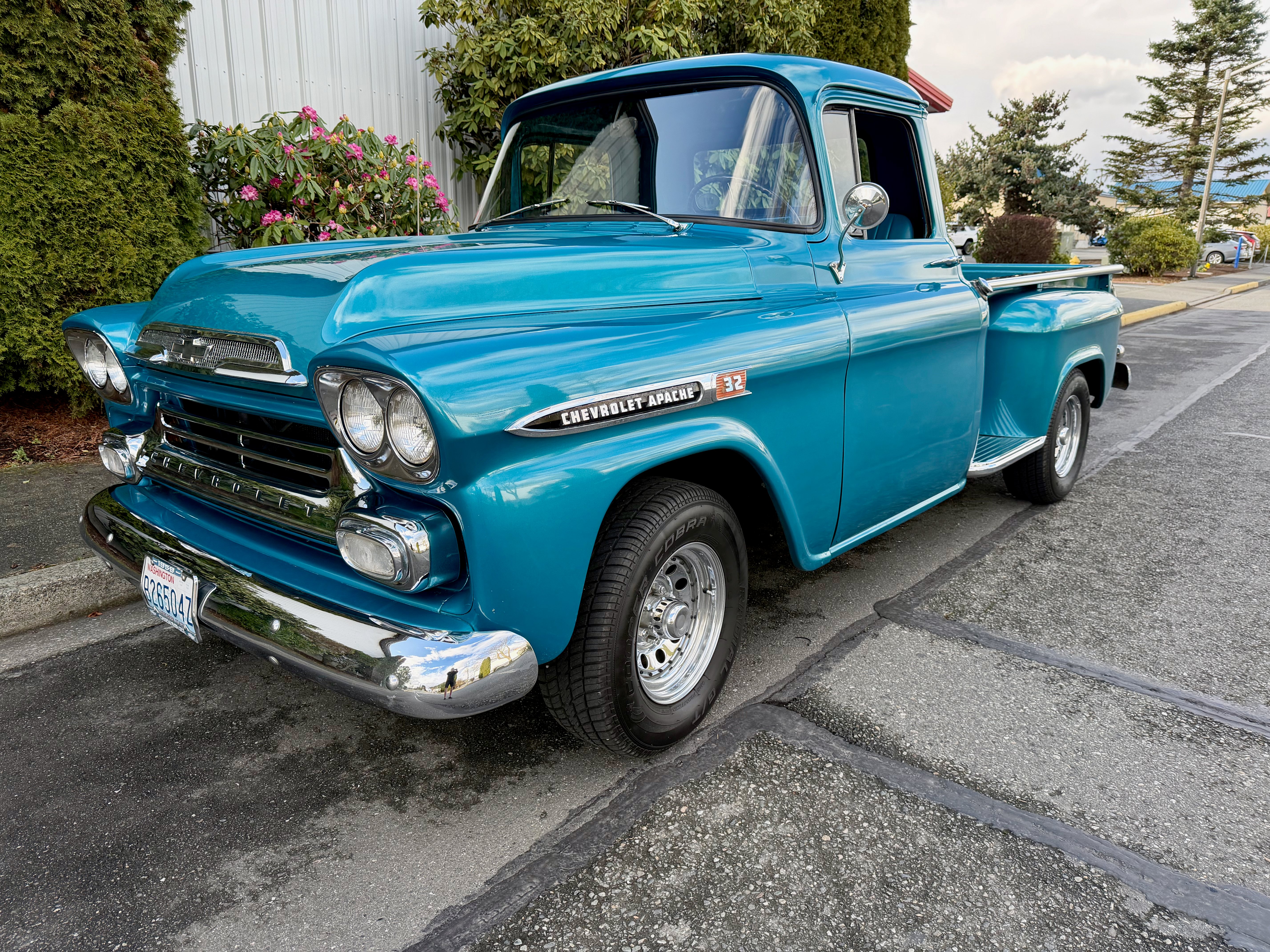
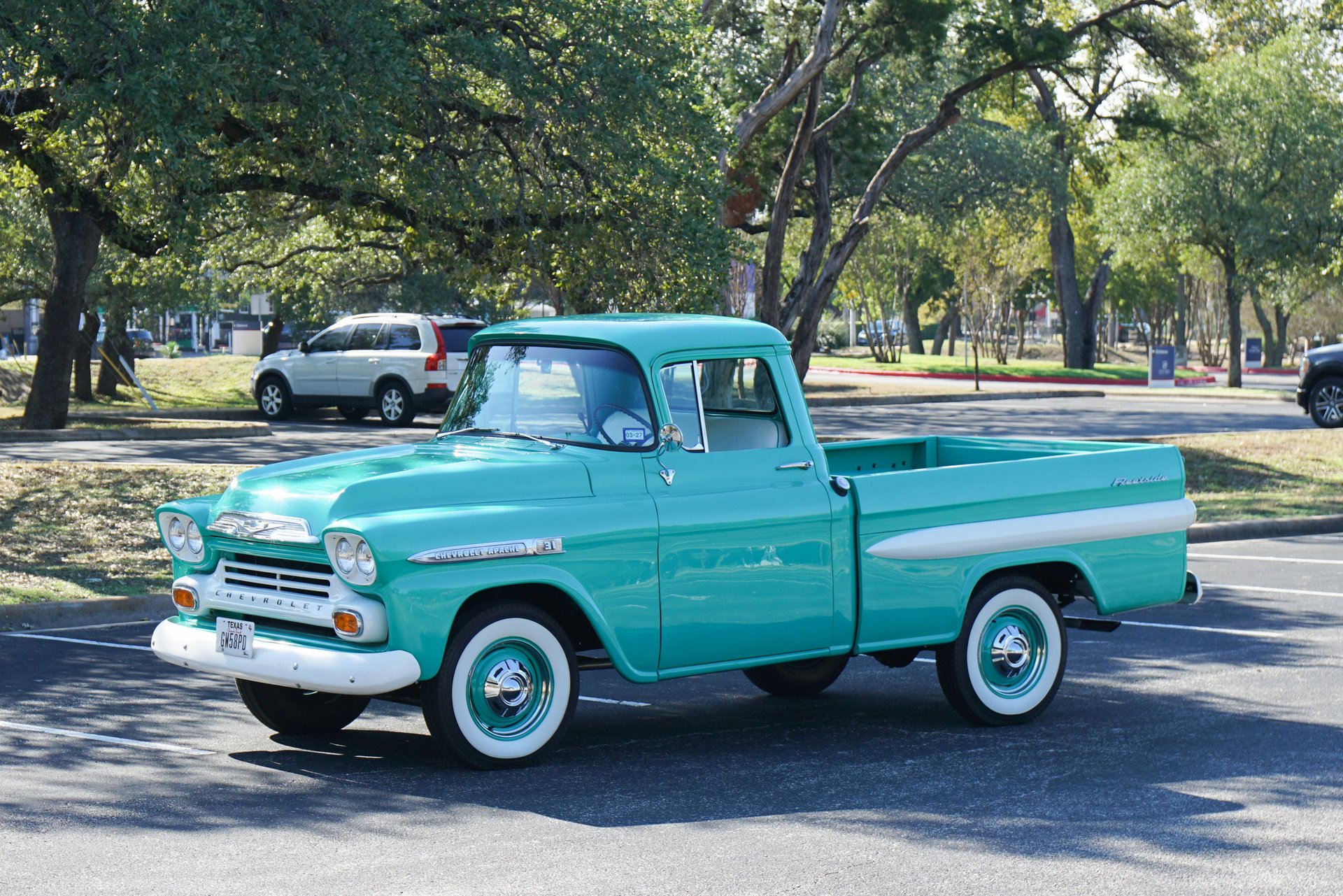
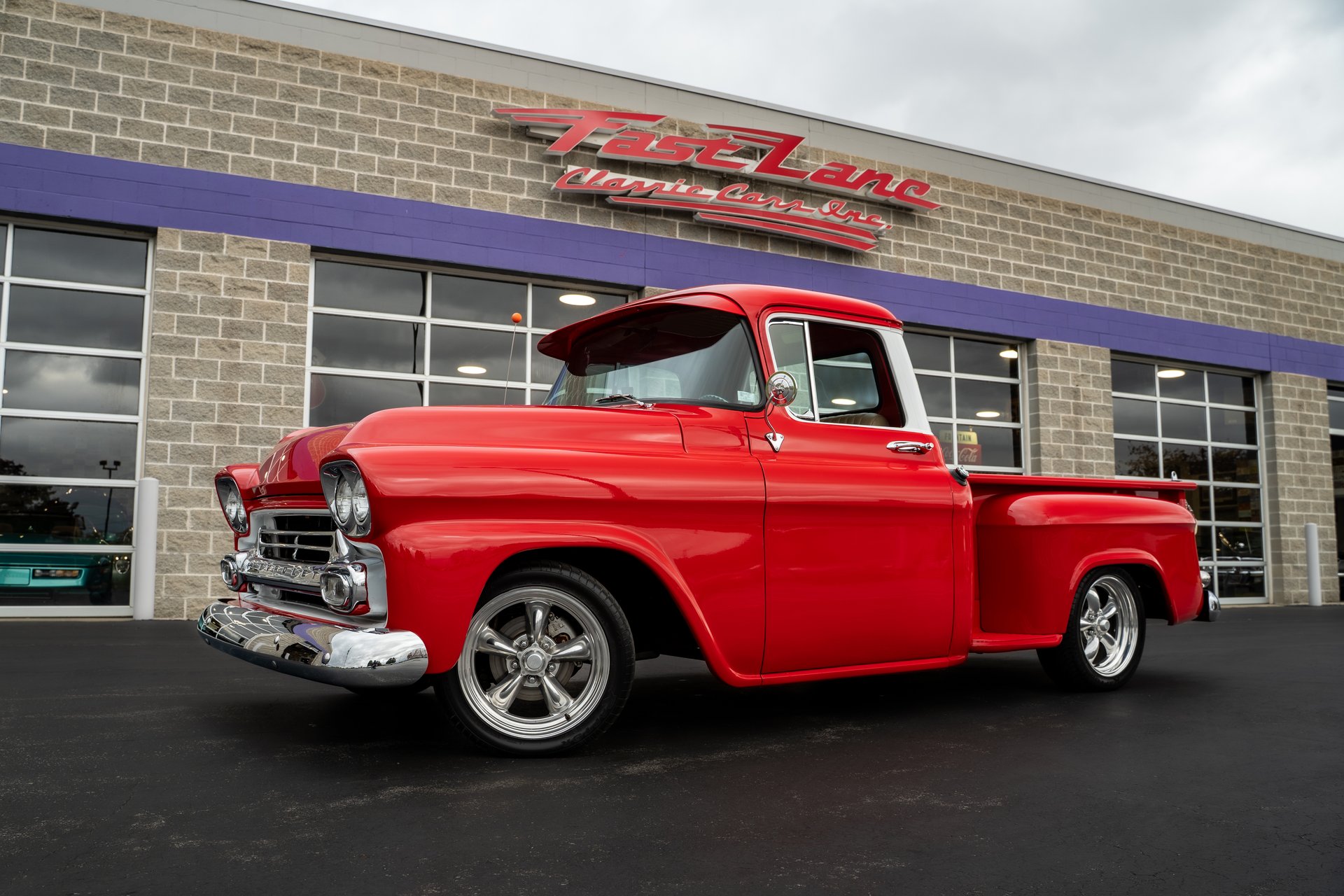
For 1958 Chevrolet reorganised the whole truck line by name as well as by number, and gave the trucks their most distinctive face. Light-duty models became Apache, medium-duty models became Viking and heavy-duty models became Spartan. The numbers stayed underneath the names, so an Apache 31 is the half-ton, an Apache 36 is the three-quarter-ton and an Apache 38 is the one-ton, but the fender badge the buyer actually read said Apache. The same year brought quad headlamps, two per side set into a broad new grille, a reshaped hood, and, most importantly for collectors now, the new Fleetside bed. Until 1958 every Chevrolet pickup bed had exposed rear fenders and a step in front of them, the Stepside in later language, although at the time it was simply the standard bed. The Fleetside gave the truck straight-through bed sides flush with the cab, a wider load floor and a much more modern, car-like profile. It was the future, and buyers knew it, even if working buyers who loaded from the side often still preferred the step.
The 1959 Apache is a gentle revision of the 1958 truck rather than a new one. The quad lamps and the basic cab, frame and beds carry over. Trim, grille detailing, badging and interior appointments were tidied, the model codes and series presentation shifted slightly, and the range settled. If you stand a clean 1958 and a clean 1959 side by side, only an Apache specialist picks them apart at ten paces, and on the road they are the same truck. That is why the market treats them as a pair, and why this guide treats them together as the core Apache: the 1958 and 1959 Task Force light-duty trucks.
What happened next explains the other source of confusion. For 1960 Chevrolet replaced the Task Force with the entirely new C and K series, torsion-bar independent front suspension on two-wheel-drive models, a drop-centre frame and a much lower stance. The Apache name did not die immediately. It survived for 1960 and 1961 as a sub-series name on the new trucks, so a 1960 or 1961 Apache 10 is a genuine factory Apache, but it is not a Task Force truck at all. It drives, rusts and values differently, its parts book is different, and it belongs to a different buying conversation. When you shop under the Apache name you are therefore shopping across a badge that spans two generations. Decide which generation you want before you decide which individual truck you want. Most buyers drawn to the quad lamps, the wraparound glass and the high, upright cab want the 1958 and 1959 trucks, and they should not let a later truck in the same search results blur the picture.
Why does the Apache endure? Partly the face: the four-lamp front is the most recognisable Chevrolet truck front of the 1950s. Partly the timing: these are the last, best-developed Task Force years, with the Fleetside option and widely available power steering and brakes, yet still a solid-axle, leaf-sprung, column-shift machine with no electronics and nothing a competent owner cannot understand. And partly the name itself, which Chevrolet knew exactly what it was doing when it put it on the fender.
The trucks you will actually find reflect a working life. In our current pool of 26 trucks filed under this model, 13 are offered for sale and 13 are recorded as sold, and the year mix tells its own story about the badge problem described above: the centre of gravity is firmly 1959, with a solid group of 1958 trucks, and a tail of earlier and later trucks wearing the name in listings whether the factory put it there or not. A real Apache starts with its year and its VIN plate, not with the word in an advertisement headline. Buy one with your eyes on the cab, the frame and the bed, in that order, because those decide whether the truck in front of you is a pleasure or a three-year project. The engines, as you will read, are the least of your worries.

The models
Every Apache starts as a Task Force number. Learn the numbers and the badges stop mattering, because the number tells you the wheelbase, the capacity and the chassis the truck was built on, while the badge only tells you what Chevrolet marketing wanted the fender to say in 1958 and 1959. The VIN plate and the series code settle identity; the trim on the bed and the badge on the fender do not.
| Model | Years | Engine | Output | Built | Character |
|---|---|---|---|---|---|
| Apache 31, 3100 short-bed | 1958 to 1959 | 235 six or 283 V8 | 145 hp six, 160 hp V8 | Not published as a separate Apache total | The core truck; short bed, half-ton, the market default |
| Apache 31, 3200 long-bed | 1958 to 1959 | 235 six or 283 V8 | 145 hp six, 160 hp V8 | Not published as a separate Apache total | Same cab, longer wheelbase and bed; worked harder, survives less well |
| Apache 36, 3600 | 1958 to 1959 | 235 six, 261 six or 283 V8 | 145 to 160 hp | Not published as a separate Apache total | Three-quarter-ton; heavier springs, axles and brakes; the honest work truck |
| Apache 38, 3800 | 1958 to 1959 | 235 six, 261 six or 283 V8 | 145 to 160 hp | Not published as a separate Apache total | One-ton; longest wheelbase, dual-purpose workhorse, rare as a pickup now |
| Cameo Carrier 3124 | 1958 only in Apache years | 265 or 283 V8 typically | 155 to 185 hp | 1,405 in 1958, the final Cameo year | Fibreglass outer bed sides, car-level trim; the luxury flagship |
| Apache panel and Suburban | 1958 to 1959 | 235 six or 283 V8 | 145 to 160 hp | Not published as a separate Apache total | Panel delivery and Carryall Suburban on the half-ton chassis; niche and devoted following |
A note on the Built column: Chevrolet did not publish clean, verifiable Apache-only totals by model in sources a buyer can check, so sellers quoting a precise, tiny figure for a mainstream variant are usually repeating an unsourced internet number. The final-year Cameo total is the firm exception. Rarity claims for ordinary 3100s should be priced at zero without a factory document; value lives in condition, originality and specification.
The half-tons: Apache 31. The 3100 rides a 114-inch wheelbase with a bed of about six and a half feet; the 3200 rides a 123 and a quarter inch wheelbase with a bed of about eight feet. Both take the same cabs, engines and gearboxes, and both were offered as Stepside and, from 1958, Fleetside. The short-bed has fixed itself as the Apache image, but the long-bed is the better tool if you intend to carry plywood or motorcycles, rides better empty, and is usually cheaper for the same condition because collectors pass it by. A straight, original 3200 Fleetside is a more interesting truck than a tired, much-welded 3100 Stepside at the same money.
Stepside or Fleetside. This is the Apache decision, and there is no wrong answer, only a wrong truck. The Stepside bed is narrower between the wheel boxes, because there are no wheel boxes: the fenders are outside the bed, the floor runs flat and narrow, and the tailgate is narrower too. Bed wood, steel strips and exposed bolts are part of the structure and part of the look. The Fleetside bed is wider, with inner wheel housings, double-wall construction in the sides, a much wider tailgate, and straight sides that take two-tone paint beautifully. Fleetsides look more modern and carry more; Stepsides look more traditional and are simpler and cheaper to repair, because a dented rear fender unbolts, while a dented Fleetside side is a panel-beating or panel-replacement job on a double-skinned structure that traps moisture between its walls. That last point returns in the rust section, and it should weigh with you if you are buying in a wet climate or buying a truck that will live outside.
The three-quarter-ton and one-ton: Apache 36 and Apache 38. The 3600 shares the long wheelbase of the 3200 but with heavier springs, a heavier rear axle, larger brakes and eight-lug or heavier-duty wheel equipment depending on specification. The 3800 stretches to a 135-inch wheelbase and was sold as a pickup, a stake truck, a panel and a chassis for special bodies. As pickups, both are imposing, capable and slow by modern standards, geared for load rather than speed, and their ride empty is firm to the point of comedy on a bad road. That is their charm and their limit. A 36 or 38 that has survived as a pickup rather than being worked to death as a flatbed is worth a long look, because so few have. Verify the chassis is the heavy one and not a half-ton cab swapped onto a tired heavy frame, or the reverse, by matching the VIN series to the wheelbase and running gear in front of you.
The Cameo Carrier. The Cameo deserves its paragraph because it explains the Fleetside. Launched in 1955 under designer Chuck Jordan, the Cameo was Chevrolet trying to sell a pickup as a lifestyle vehicle a decade before the market was ready. Its bed wore smooth fibreglass outer panels that hid the Stepside structure beneath, it carried car-level trim, two-tone paint, a V8 as the expected engine and a price that frightened working buyers away. It sold in small numbers every year and was dropped after 1958, its styling idea absorbed into the steel Fleetside that did the same job more cheaply. An Apache-year Cameo is therefore a 1958-only truck. Its fibreglass panels crack, craze and separate in ways steel does not, its trim is Cameo-specific in places, and originality is everything: a Cameo cab and bed on the wrong chassis, or a standard truck dressed with Cameo panels, is not a Cameo. The VIN series, 3124, settles it.
Panels, Suburbans and four-wheel drive. The Apache chassis also carried the panel truck and the Suburban Carryall, to which the cab, engine and rust lessons in this guide apply unchanged. Factory four-wheel drive did not exist as a Chevrolet-built option: Task Force four-wheel-drive trucks were NAPCO Powr-Pak conversions, with a driven front axle and transfer case fitted when new. A genuine period NAPCO Apache is rare, valuable and heavily faked; the hardware, the documentation and the tall stance must all agree. A modern axle swap under a lifted Apache is a custom truck, not a NAPCO, and should be priced as one.

Engines and gearboxes
The Apache engine bay is the simplest part of the whole buying job, and the most commonly misdescribed. Chevrolet offered the light trucks with one six-cylinder family in two sizes and one V8 family in two sizes across the two Apache years, plus the big-block 348 in the background of the wider truck range. Every one of them is a pushrod, overhead-valve, carburetted engine with points ignition in original form, every one is well understood by any mechanic who works on 1950s American iron, and none of them should frighten you if it has oil pressure, compression and no knocks. What should concern you is identity. Sixty-five years of farm repairs, hot-rodding and engine swaps mean the engine under the hood is frequently not the engine the truck was born with, and on an Apache the swap is often an improvement the seller presents as originality. Check the numbers, decide whether you care, and price accordingly.
The sixes: Thriftmaster 235 and Jobmaster 261
The standard Apache engine is the 235-cubic-inch inline six, marketed in the light trucks as the Thriftmaster: full-pressure lubrication, insert bearings and a single-barrel Rochester or Carter carburettor. Period output is 145 horsepower gross, with about 215 pound-feet of torque arriving low, exactly where a working truck wants it. A good 235 does not feel fast and was never meant to. It feels unburstable, pulls from walking pace in top gear and sits at 50 to 55 miles per hour all day. Ask it for sustained modern freeway speed and you are asking the wrong question of the whole truck, gearing included.
Judge a 235 by four things. First, cold starting and idle. A healthy six on a correctly set choke starts promptly, fast-idles cleanly and settles to an even, slow idle as it warms. Hunting, stalling or a need to nurse the throttle points first to carburettor wear, a vacuum leak at the manifold or base gasket, or ignition points and timing, all cheap, before it points to the engine itself. Second, oil pressure and oil condition. These engines run modest pressure by modern standards; what matters is pressure that is present and stable at a hot idle, oil that is not diluted with fuel from a failing mechanical fuel pump diaphragm, and no milky emulsion under the filler cap from a head gasket or a cracked casting. Third, noise. A light top-end tick that quiets as the engine warms can be lifter or adjustment related depending on specification and history; a deep, rhythmic knock under load is a bottom-end verdict and means the engine is a rebuild, priced at roughly $3,500 to $6,500 for a proper machine-shop rebuild with parts and labour at current specialist rates, not a bargaining chip of a few hundred dollars. Fourth, smoke. A puff of blue on a cold start after standing points to valve stem seals, common and fixable. Continuous blue smoke under load is rings and bores. White vapour that does not clear as the engine warms, with a sweet smell and falling coolant, is a head gasket until proven otherwise.
The 261 is the six to hunt for and the six most often claimed falsely. The Jobmaster 261 was the heavier-duty six, available in the heavier Apache models, with a larger bore, a stronger bottom end and full-flow oil filtration provision. It pulls harder than a 235, tolerates sustained work better and is the basis of almost every serious period six-cylinder performance build. It is also externally similar enough to a 235 that visual identification is a guess. The casting numbers, date code and stamped pad by the distributor settle it. If a seller charges a 261 premium, make the seller show you the numbers with the paint cleaned off.
Carburetion and ignition reward correct setup over originality of parts. A worn single-barrel with throttle-shaft play will never idle cleanly however many kits you throw at it; rebushing the shaft or fitting a correctly specified replacement carburettor, a $250 to $600 parts job, transforms the truck. The siamesed intake and exhaust manifolds carry a heat-riser valve that seizes with age and either cooks the mixture when hot or leaves it cold and flat; freeing it and confirming the manifold gasket is sound cures flat spots owners blame on the carburettor for years. Points ignition is reliable if dwell is set and the distributor advance weights move freely; judge the many electronic conversions you will meet by their workmanship, not their philosophy.
The small-block V8s: 265 and 283, and the 348 question
If the six is the Apache's working heart, the small-block V8 is its soul for most collectors. Chevrolet's small-block, launched in 1955 at 265 cubic inches, had grown to 283 by 1957 and it is the 283 that powers the great majority of V8 Apaches you will meet. In truck tune with a two-barrel carburettor the 283 is quoted at about 160 horsepower gross; the four-barrel versions fitted to Cameos and better-specified trucks run higher, around 185 horsepower in period terms. Those numbers undersell the experience. A 283 Apache is lighter over the front axle than you expect, revs freely, sounds exactly right through a single exhaust and turns the truck from a 50-mile-per-hour vehicle into one that will cruise at 60 to 65 where the gearing and brakes allow, and accelerate with something approaching enthusiasm. It is also the most rebuildable, best-supported old V8 in America. Pistons, bearings, cams, gaskets, water pumps and complete rebuild components are available off the shelf at prices that make European classic owners weep, with a quality rebuild typically running $4,500 to $8,000 depending on machining, specification and labour market.
Identification lives in the casting number at the rear of the block, the casting date and the stamped suffix on the pad at the front of the right-hand deck. Photograph and decode all three before you agree a price on any V8 truck sold as numbers-matching. A correct, documented, original 283 in a Custom Cab Fleetside is a genuinely premium truck. A tired 305 or 350 from the 1970s or 1980s dropped in on worn mounts, which is what a large minority of V8 Apaches actually carry, is a fine running truck and a cheaper one. The sin is not the swap. The sin is charging original-engine money for it.
Small-block failure modes are textbook and testable. Timing chains stretch and retard the cam timing, giving a truck that runs but feels soft and overheats in traffic; a chain and gear set is a $400 to $900 fitted job and restores the edge. Flat-tappet cams wear lobes, especially on modern low-zinc oils run without thought, presenting as a persistent miss and a tick that adjustment will not cure; listen cylinder by cylinder and watch for a rocker that moves visibly less than its neighbours. Rear main seals leak, two-piece in period form, and mark every parking space; budget it as maintenance, not catastrophe, unless the clutch is oil-soaked on a manual truck, when it becomes a gearbox-out job. Exhaust manifolds crack, particularly around the centre ports, and tick loudly when cold, quieting as they expand and seal; a cold tick that fades is a manifold until proven otherwise, a cold tick that stays is valvetrain. Cooling deserves its own sentence on every V8 Apache: the original radiator, often down-flow in Task Force form, marginal when new by desert standards and now sixty years of scale and solder bloom later, is the single most common cause of a good engine being cooked. A temperature gauge that climbs steadily in slow traffic on a warm day is telling you about the radiator, the fan shroud if fitted, the thermostat and the water pump as a system. Price a recore or a correct-pattern replacement radiator, typically $600 to $1,400 depending on route, before you price an engine.
The 348, Chevrolet's W-series big-block of 1958, was never the mainstream light-duty Apache engine, and a claimed factory 348 in a light pickup requires factory documentation, not a seller's memory; most turn out to be later swaps or misidentified small-blocks. Fuel age affects every Apache engine the same way: ethanol fuel attacks old hose, pump diaphragms and carburettor gaskets, and goes stale in the vented steel tank, leaving varnish that blocks the pickup. A truck that has sat needs the tank inspected inside, ethanol-rated lines, the pump tested for fuel leaking into the crankcase, and the carburettor stripped, not merely adjusted. Half the bad-running Apaches in advertisements are good engines breathing through a filthy fuel system.

Gearboxes, axles and running gear
Chevrolet sold the Apache with gearboxes for every kind of buyer, and the choice changes the truck's character more than the choice between six and V8. The standard box is the three-speed manual with column shift, the famous three-on-the-tree, synchromesh on second and top, first unsynchronised. Driven well, with a deliberate pause through neutral and a double-declutch or a near-stop for first, it is pleasant, light and perfectly matched to a 235 used as a truck. Driven with worn linkage, it is a lottery. The column linkage runs through bell cranks, rods and bushes that all wear together; slop at the lever becomes missed shifts, a box that jams between gears at a junction, and a reputation for a bad gearbox that actually lives entirely in the linkage. Rebushing and correctly adjusting the linkage, a $200 to $500 parts-and-labour job at a general shop, is one of the highest-value fixes on any Apache. Judge a three-speed truck by the linkage first, the synchromesh on second second, and only then condemn the box.
The four-speed manual is the working alternative: a heavy truck box with a very low creeper first, the granny gear, for starting loaded on a hill; in normal empty driving you pull away in second. These boxes whine, shift slowly and are exactly right in a 36 or 38. A four-speed that jumps out of gear under load, particularly third, warns of worn engagement teeth and a rebuild, roughly $1,200 to $2,500 for a specialist overhaul, not an adjustment.
Automatics divide by ambition. The two-speed Powerglide gives a smooth, leisurely drive with a pronounced step between its ratios. The four-speed Hydra-Matic is tougher, more complex and now a specialist proposition needing a shop that remembers it. Either in bad order dominates the buying decision: a proper rebuild runs roughly $1,800 to $3,500 for a Powerglide and materially more for a Hydra-Matic, and a truck that slips, flares, delays engagement from cold or produces dark, burnt-smelling fluid has that bill already attached. Check fluid colour and smell, drive it from stone cold, and use every ratio including reverse under load on a slope.
Later gearbox swaps are the norm in driver-grade Apaches: Turbo-Hydramatic three-speeds behind swapped small-blocks, overdrive automatics and five-speed manuals in trucks built for modern roads. Value them on workmanship: correct crossmember and mounts, a truthful speedometer and shift linkage that does not foul the exhaust. A tidy, documented swap is an asset; a swap you discover is a price reduction.
The rear axle is a conventional live axle with ratios chosen for work, which is why an Apache feels eager to 40 miles per hour and busy at 65. Whine that changes on the overrun points to ring and pinion wear; a clunk on taking up drive points to backlash, worn universal joints or perished spring and shackle bushes, in ascending order of cost. Steering play comes from the box, the drag link, the tie-rod ends and the kingpins in combination; isolate it joint by joint with an assistant rocking the wheel, rather than paying for a box rebuild to cure a $60 tie-rod end. A kingpin and bushing job runs roughly $600 to $1,200 a side fitted. Brakes are drums all round, single-circuit in original form; a truck that pulls under braking needs the system overhauled as a system, $800 to $1,800 for cylinders, shoes, hoses, hardware and labour, not the one worst part replaced. Many Apaches now carry a dual-circuit master cylinder conversion, the one modification even an originality buyer should welcome if it is executed tidily.
Problem areas
An Apache does not hide its problems. It rusts in the same places on every truck, it wears in the same joints, its bed rots in the same boards and its electrics fail at the same connections, because every truck lived the same life: work outside, storage outside, maintenance that slowed as the truck's value fell in the 1970s and 1980s, and then, for the survivors, a classic afterlife of either careful rescue or cosmetic disguise. Your job is to tell rescue from disguise. In the small examined sample supplied with this guide's listing pool, 9 trucks had detailed photo notes, rust was mentioned in 3 of them and damage of some kind in 4, which understates the field reality that almost every unrestored Apache needs metal somewhere. Read the sections below as a map, in the order a professional buyer walks the truck, and remember the governing rule: mechanical faults on an Apache are priced in hundreds and low thousands and fixed in weekends; structural rust is priced in thousands and fixed in months. Weight your offer accordingly.
Rust: the cab, the frame and the bed
Start with the cab, because the cab is the Apache. Front sheet metal, engines and even beds can be sourced, swapped and reproduced. A rotten cab is the truck.
Cab corners and the rear of the cab. The single most reliable Apache rust site. Water and mud thrown by the rear wheels, moisture trapped behind trim and in the double-skinned corner, and a drain arrangement that blocks with dirt combine to rot the cab corners from the inside out. Crouch behind the cab, look at the corner from outside, from inside behind the seat, and from underneath, all three. Bubbling at the lower corner is never just bubbling; probe the inner face with a fingertip and feel for scale and softness. A corner repair done properly, cutting out both skins, treating the cavity and welding in a repair panel with paint inside and out, runs roughly $600 to $1,400 a side at a body shop. A corner filled over rust will bubble again within two winters and tells you how the rest of the truck was treated.
Rockers, steps and door bottoms. The Apache cab sits with a step below each door, and the step, the rocker behind it and the lower door skin live in the spray zone and in the path of every boot that ever climbed in carrying grit. Steps dent, split at their mounting edges and rust where the mat or tread covering traps moisture against the steel. Rockers rust from inside, fed by water entering through the cab's seams and drains. Doors rust along the bottom edge where the skin folds over the frame and where the drain holes block; open each door, kneel, and run your hand along the bottom hem. A door that is sound on its outer face and crunchy along the hem is a door in the middle of failing. Replacement and repair panels exist for all of it, which tempts sellers to call it minor. Price the labour, not the panel: a rocker and step repair with paint blending is a $900 to $2,000 a side proposition done to a standard that lasts.
Floor pans, toe boards and cab mounts. Lift every mat. The Apache floor rusts where feet wore the paint, where the windshield seal leaked and ran water down the toe board, where the heater leaked coolant into the passenger footwell, and above all around the cab mounts, where the floor is stressed, double-skinned in effect and exposed to road salt from below. Surface rust with solid metal is a clean, treat and paint job you can do yourself. Perforation at a mount is structural: the cab is moving on the frame, the doors will not align or stay aligned, and the repair is a floor section and mount rebuild, not a patch plate riveted over the hole. Press hard around each mount with the heel of your hand. Crunching is a verdict.
Windshield surround, cowl, fenders and core support. The wraparound windshield gives water a long, curved seal to defeat; seals harden, the channel beneath rusts, and water emerges at the A-pillar bases and toe boards. Firewall rust concentrates on the battery side, where acid attacks the tray area. Front fenders rust at the rear lower edge and around the quad-lamp buckets, and the core support rusts at its lower mounts, letting the whole front clip move and misaligning the hood and fenders in a way owners chase for years by adjusting the wrong panels. Front clip alignment that is bad in several places at once is usually a support or cab-mount story, not a fender story.
The frame. Task Force frames rust slowly and then, in salt states, decisively. Concentrate on the rear half: spring hangers and shackle mounts, crossmembers behind the cab, and the area under the bed where mud and load debris sat for decades. Surface scale on a frame that rings solidly to a hammer tap is cosmetic; laminated rust that has thinned the rail, perforation at a hanger, or a frame plated in one section only is a structural negotiation. Check straightness too: a bent frame shows as uneven panel gaps, a bed that does not sit square on the cab and tires that wear as if the alignment were set by guesswork. Sight along the rails from behind on level ground.
Stepside versus Fleetside bed rust. The Stepside bed rusts at the bed wood and its steel cross sills, at the lower rear fenders where they meet the step, at the tailgate trunnions and at the front bed panel where loads slid forward for forty years. Its virtue is transparency: you can see almost all of it, the fenders unbolt, and a bed wood kit with strips and hardware, roughly $700 to $1,500 in parts depending on wood species and finish, is a satisfying weekend-scale job for two people. The Fleetside bed rusts more secretly. Its double-wall sides trap condensation and road moisture between the skins, and rust starts low, inside, emerging as bubbles along the lower outer side and around the wheel housings when the inner structure is already thin. The Fleetside floor, steel rather than wood in the main, rusts at its seams and above its crossmembers. Prod the lower bed sides from inside the bed as well as looking at them from outside, tap along the bottom edge and listen for the change from a ring to a thud, and treat a Fleetside with fresh, thick underseal or bedliner sprayed over its lower inner walls as a truck asking not to be inspected. Bedliner itself is not a sin; half the honest Fleetsides in dry states wear it. Bedliner applied thick, fresh and only where rust lives is a confession.

Chassis, steering, brakes and suspension wear
A Task Force truck that has worked will have wear in every moving chassis joint, and the total of many small wears is what makes one Apache feel tight and another feel like a collection of suggestions. Work through it systematically.
The solid front axle rides on leaf springs and pivots on kingpins in the axle ends. Kingpin wear is the defining front-end fault. The test is physical: jack the front wheel, grip it at top and bottom and rock it, watching the pin joint rather than the wheel bearings, which produce a similar movement and are the cheaper fault sellers hope you will assume. Excess movement at the pin, a knock over sharp bumps and front tires worn on one edge together confirm it. Steering joints compound it: tie-rod ends, a drag link and a steering box that has been adjusted tight at the centre to hide wear, leaving it binding off-centre, are the classic trio. A box that is loose in the middle and tight at the locks has been adjusted to disguise, not to repair. Leaf springs sag and crack as described in the running-gear section, spring eye and shackle bushes perish and allow axle steer, and shock absorbers, often removed entirely on working trucks or present as dead originals, do nothing at all on many Apaches you will drive. Bounce each corner. A truck that keeps bouncing has no damping, whatever the seller says about new shocks that are visibly decades old.
Brakes fail by accumulation. Wheel cylinders weep, then leak, then contaminate the shoes on one side, so the truck pulls. Flexible hoses perish internally and hold pressure on after a stop, so one drum runs hot and drags. The master cylinder bypasses internally, so the pedal sinks slowly at a long traffic light. Any one fault is a small job; the system as found on a neglected truck is a full overhaul, budgeted as such rather than discovered one component per journey. Original single-circuit hydraulics mean any single leak is a total brake failure, which is why the dual-circuit conversion matters and why hose and cylinder condition is not a detail.
Wheels and tires date and betray a truck. Period steel wheels bend and rust at the bead seat, and heavy-duty wheel fitments on the heavier models demand specialist tire-shop handling. Tire age matters more than tread depth: a set with deep tread and ten-year-old date codes will ride badly, grip poorly in the wet and fail without warning. Read the date codes and budget a set of correct-size tires at roughly $800 to $1,600 depending on size and whitewall choice.

Cab, interior, glass and electrics
The Apache cab is a simple, painted, mostly metal room, and its faults are honest ones. Seat springs sag and break, particularly on the driver's side of the bench, so you sit in a hollow and slide on corners; the vinyl splits along its seams and at the entry edge; foam and padding in later replacement covers collapse. A bench retrim with correct-pattern material and rebuilt padding runs roughly $800 to $1,800 depending on material and region, and a sprung-base repair adds to it. Sit in the truck, in the driver's position, for a full minute. Your back will file the report your eyes miss.
The instrument cluster is simple and repairable: a speedometer, fuel gauge and warning lights in standard form, with fuller instrumentation in better specifications. Faults are usually senders, grounds and voltage regulation rather than the gauges themselves. The fuel gauge is the classic: it reads by resistance to ground through the tank sender, so a bad tank ground gives a gauge that reads full, empty or imaginatively, and the fix is a cleaned ground strap, not a gauge. Test every gauge against reality, the fuel gauge against a known quantity of fuel if the seller permits, the temperature gauge against the behaviour you observed on the drive, and the ammeter or warning lights against a charging test at the battery with a multimeter, where a healthy charging system shows roughly 13.8 to 14.5 volts at a fast idle. Generators on original trucks charge modestly at idle and well at speed; alternator conversions charge everywhere and are common. Either is acceptable if it charges and is wired tidily.
Switches, wiring and lighting fail at connections. The headlamp switch carries full lighting current on period trucks and runs hot, its contacts and its built-in breaker ageing together; dim, flickering or intermittently dying headlamps that recover after a pause are a switch and ground story before they are a lamp story. The floor dimmer switch corrodes in the footwell damp. Rear lamp grounds through the bed and frame are notoriously casual, so indicators that flash the wrong lamp or glow dimly with the brakes are usually a bed ground, curable with a dedicated ground wire in half an hour. Wiring that has been repaired with household connectors, unfused additions and wires run through unprotected holes in the firewall is the one electrical finding that should change your price materially, because rewiring a cab properly, harness sections at roughly $400 to $1,000 in parts plus labour, is the only cure, and because bad wiring is the only Apache fault that can burn the truck down. The heater is a simple coolant-fed box with a fan; its core leaks into the passenger footwell, its valve seizes and its fan motor wears its brushes out. Test it whatever the season, as the inspection section insists, because a leaking core found in summer is a negotiation and a leaking core found in November is an emergency.
Glass and seals are a budget line of their own. Fitting a reproduction wraparound windshield with a new seal is a skilled, two-person job, and a cracked panoramic windshield plus seal plus labour is a $700 to $1,500 event. A truck with new paint and old, cracked rubbers has been painted by someone who stopped halfway. Trim decides the finishing cost: quad-lamp bezels, the wide grille, Apache badges and Custom Cab stainless range from reproduced to unobtainable except used, so inventory the truck piece by piece against a correct example and price what is missing as hunting time, not as a catalogue order.
How to inspect one
Allow two hours. Bring a torch, a magnet wrapped in cloth, a multimeter and a friend to rock the steering while you watch the joints. If the truck passes you, pay for a lift inspection before money changes hands.
- Paperwork and identity first. Match the title to the VIN plate, and confirm the series code agrees with the wheelbase and running gear in front of you. A truck badged as an Apache but built in 1955, 1956 or 1957 is a Task Force 3100 priced under the wrong name. A 1960 or 1961 truck is the later generation wearing the name legitimately. Photograph the plate and decode it at leisure.
- Cold start, from outside. Insist the engine is stone cold. Watch the exhaust for blue smoke at start and on the first blip, listen for timing chain rattle on a V8 or a deep knock on any engine, and note how the choke behaves as it warms.
- Engine numbers and fluids. Photograph the block casting number, date and stamped pad, and decide whether this is the original-type engine or a later swap, because the price follows that fact. Check the oil for fuel smell and emulsion, and the coolant for oil and rust.
- The cab rust circuit. Walk the rust map in order: cab corners from outside, inside and below; steps and rockers; door bottom hems; floors with every mat lifted, pressing hard around the cab mounts; windshield surround and pillar bases; firewall around the battery. Perforation at a cab mount ends the casual phase; from there you are pricing structural work.
- Frame and underside. Torch along both rails, spring hangers, crossmembers and the frame under the bed. Tap suspect areas: a ring is metal, a crunch is a reason to renegotiate or leave. Sight along the rails for bend, and check the bed sits square to the cab.
- Bed, by type. On a Stepside, inspect the bed wood, the cross sills underneath and the tailgate fit. On a Fleetside, prod the lower inner walls and tap the lower outer sides; fresh thick coating exactly where rust lives is a finding, not a finish.
- Kingpins and steering. Jack the front, rock each wheel at top and bottom, and separate wheel bearing movement from kingpin movement by watching the pin joint itself. Have your friend rock the wheel while you watch the box output, drag link and tie-rod ends in turn. The joint that moves late is the worn one.
- Brakes and tires. Hold the pedal hard for a full minute; it must stay firm and at the same height. Check reservoir fluid colour, every flexible hose, and behind each wheel for leaks. Read all four tire date codes and budget tires by date, not tread.
- The test drive. Twenty minutes minimum, including a climb and a stretch at the fastest speed the gearing honestly allows. On a manual, test the column linkage with deliberate shifts and second-gear synchromesh with a brisk downchange. On an automatic, note cold engagement and any delay into reverse on a slope. Vary the throttle at a steady speed and listen for axle whine arriving and leaving with load.
- Braking and stance. Brake firmly on an empty, straight road with a light grip on the wheel; the truck must stop straight. Then stand back and judge stance and bed-to-cab squareness from twenty feet, where faults you talked yourself out of up close become obvious.
- Heat, heater and electrics hot. Idle for five minutes and watch the temperature; a steady climb is the cooling system filing its report. Run the heater on every speed whatever the weather, work every lamp, wiper and gauge, and check charging at the battery, roughly 13.8 to 14.5 volts at a fast idle.
- Interior last. Sit in the driver's seat for a full minute and judge the base with your back. Check glass, vent windows, seals and the trim inventory against a correct truck of the same year. Then make your offer on the cab, frame and bed from steps 4 to 6, not on the shine you saw when you arrived.
Values
Read the market block the build appends below this guide, the listed-now summary and the recorded sales, by separating the two markets wearing one badge. The first is the Task Force market, where a 1958 or 1959 Apache is judged against every other Task Force truck, including the far more numerous plain-numbered trucks of 1955 to 1957. The second is the name market, where a search for one word mixes genuine Task Force Apaches, earlier trucks that never carried the name and later-generation trucks that did. Price each truck inside its real comparison set.
The condition spread is exceptionally wide, because the starting points are. A field truck is worth its completeness as a restoration foundation. An honest driver, solid in cab and frame with maintained brakes and steering, is worth what usability is worth. A restored or exceptionally original truck, documented and correct, Fleetside, Cameo or big-window Custom Cab in a contested specification, sits in a different class altogether, and the gap between driver and top truck is a multiple, not a percentage, explained almost entirely by the metalwork and paint that separate them and that no buyer can do cheaply afterwards. There is no cheap Apache that stays cheap if your destination is a finished truck.
Asking prices price the story: the badge, the bed, the colour in the photographs, the engine the seller believes is fitted. Recorded sales price the cab corners, the frame, the block numbers and the brake pedal. Use the recorded sales as your anchor and the listings as your supply, never the reverse, and negotiate on evidence in cost order: structural metal first, safety systems second, engine identity and cooling third, cosmetics last. A seller with a solid cab, a straight frame and a documented engine can hold a price, and you should expect to pay it.
Parts and ownership
The Apache is one of the best-supported American classics you can own, because it shares its mechanical world with the Chevrolet cars and trucks America built by the million. Service items for the sixes and the small-block are general parts-store stock: filters, plugs, points, belts, hoses, water pumps, fuel pumps and carburettor kits. Brake, clutch, kingpin, bearing and suspension wear parts are standard catalogue items at working-truck prices. Cab corners, rockers, steps, floor sections, door skins, Stepside bed wood kits and Fleetside repair panels are all reproduced, as are the wraparound windshield and a full range of cab rubbers; remember that reproduction panels are a starting point for a skilled fitter, and labour remains the larger half of any metalwork bill.
The difficult shelf is Apache-specific bright trim: correct grilles, quad-lamp bezels, fender badges, Custom Cab stainless, Cameo fibreglass and good original stamped tailgates trade used, at prices set by scarcity and patience. Hydra-Matic expertise and NAPCO components are specialist and hunt-only territory. None of this affects a driver-grade truck, which can be kept on the road indefinitely from catalogues alone.
Running costs behave like a popular old truck: fuel in the low to mid teens in miles per gallon, short oil-change intervals, regular chassis greasing and annual points, valve and brake checks. Store it dry, because a damp Apache deteriorates at the cab corners and Fleetside walls while its owner watches the paint. Budget the first year for brakes, hoses, a fuel system clean if it has sat, tires by date and fluids, before any cosmetic improvement.
Which one to buy
- The all-rounder: Apache 31 short-bed Fleetside, 283 V8. The looks, the bed, the engine and the parts support in one truck. Pay for a solid cab and bed walls over any other virtue.
- The value buy: Apache 31 long-bed 3200. The same cab and face, a better ride and a more useful bed, for less than a short-bed of the same condition.
- The traditionalist: short-bed Stepside, 235 six, three-speed column shift. The purest Task Force experience: unhurried, mechanical and the cheapest specification to keep original forever.
- The worker: Apache 36 three-quarter-ton. Heavier in every component and rarer as a surviving pickup than any half-ton. Verify the heavy chassis is genuine and complete.
- The collector car: 1958 Cameo Carrier. Buy only with the 3124 series verified, and compare its price only with other Cameos.
And the rule that overrides all of the above: buy the least rusty cab on the straightest frame you can find, in the specification you can live with. A rotten cab, a plated frame and a rusted-through Fleetside bed cost more to put right than the finished truck will be worth.
See the 9 Apache cars currently listed.