
Chevrolet 210 buyer's guide
Chevrolet 210 -- the model's own buyer's guide: variants, values and what to check.
Years listed: 1941-1957 · Series: Tri-Five
Overview and history
The Chevrolet 210 is the middle child that became the main event. From 1953 to 1957 it sat in the centre of the Chevrolet range — above the stripped, fleet-minded 150 and below the chrome-laden Bel Air — and for a modern buyer that middle position is exactly the point. A 210 gives you the same body, the same chassis and, in the Tri-Five years, the same small-block V8 as a Bel Air, with less trim to restore, less chrome to re-plate and, usually, a seller pricing the badge rather than the car underneath it. If you want to drive a mid-Fifties Chevrolet rather than polish one, the 210 is very often the smartest way in.
The name arrived for 1953, when Chevrolet renamed its full-size line. The old Styleline Deluxe became, in effect, the new 210, taking its number from its series designation. The 1953–54 cars are the last of the old school: upright, rounded styling, a 235-cubic-inch overhead-valve six as the only engine, an enclosed torque-tube driveline and six-volt electrics. They are honest, simple cars with a loyal following, but a different ownership proposition from what followed — same badge, two distinct eras.
Everything changed for 1955. Chevrolet replaced the car wholesale: an all-new body with a low, wide grille and a wraparound windshield, a new ladder frame with an open Hotchkiss rear drive, ball-joint front suspension, twelve-volt electrics — and, above all, the new 265-cubic-inch small-block V8. The 1955–57 cars, the Tri-Fives, are the ones the market means when it says 210, and they dominate the cars we track: of the 76 Chevrolet 210s in our Classic Listings pool, 67 are Tri-Fives — 38 from 1955, 19 from 1956 and 10 from 1957 — with five from 1953 and two from 1954. The 210 nameplate did not exist before 1953, so anything wearing it from an earlier year is a listing error or a later re-badge, not a factory car, and should be priced and titled as what it actually is.
Within the Tri-Five years the 210 kept its middle brief: two- and four-door sedans, hardtop Sport Coupe and Sport Sedan versions for 1956–57, the Delray club coupe with its upgraded all-vinyl interior, and two wagons — the two-door Handyman and the four-door Townsman, joined for 1957 by a nine-passenger Beauville version. What you could not have was a convertible — Bel Air only, all three years — so any 210 convertible offered to you is a re-badged car until its tags prove otherwise.
The 210 was discontinued after 1957, when the all-new 1958 range replaced the trim ladder with Delray at the bottom, Biscayne in the middle — the 210's true successor — and Bel Air and Impala at the top. That short, five-year life is part of the appeal. Every 210 is either a last-of-the-line early-Fifties six or a Tri-Five, and the Tri-Five 210 has spent decades in the Bel Air's shadow, which is why so many were hot-rodded and restomodded rather than preserved. A stock, unmolested 210 is now genuinely scarce. A modified one is the norm — and, judged on its own terms, often the better car to own.
The models
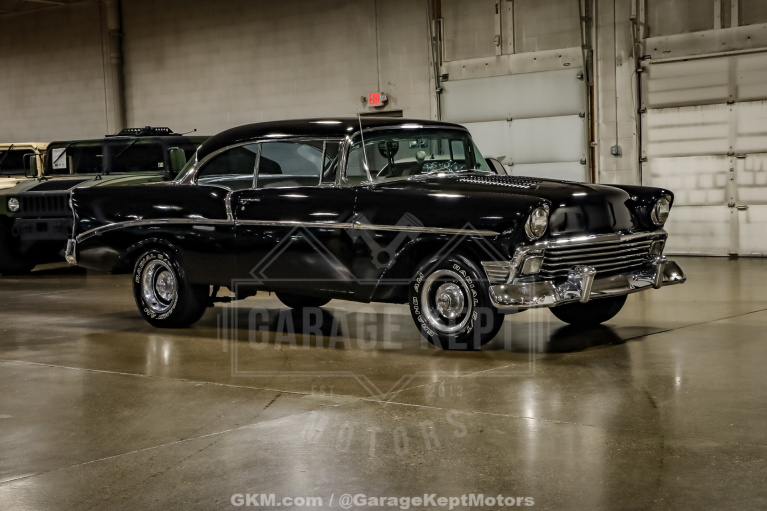
Every 210 is a full-size Chevrolet on the same architecture as its 150 and Bel Air sisters. The badge tells you the trim level, not the mechanical specification: almost any engine and gearbox offered in a Bel Air could be ordered in a 210, which is why a plain-looking 210 can hide the most desirable drivetrain in the range — up to and including, in 1957, fuel injection. Read the car, not the badge.
| Model | Years | Engine | Output | Built | Character |
|---|---|---|---|---|---|
| 210 sedan, coupe and Handyman wagon (six only) | 1953–1954 | 235 six | 108–125 hp | Not stated — see text | Last of the torque-tube cars; simple, upright, six-volt |
| 210 two- and four-door sedan | 1955–1957 | 235 six or 265/283 V8 | 123–283 hp | Not stated — see text | The core Tri-Five 210; the volume buy |
| 210 Delray club coupe | 1955–1957 | 235 six or 265/283 V8 | 123–283 hp | Not stated — see text | Two-door with the upgraded all-vinyl interior |
| 210 Sport Coupe hardtop | 1956–1957 | 235 six or 265/283 V8 | 140–283 hp | Not stated — see text | Pillarless two-door; the best-looking 210 |
| 210 Sport Sedan hardtop | 1956–1957 | 235 six or 265/283 V8 | 140–283 hp | Not stated — see text | Pillarless four-door; rare and undervalued |
| 210 Handyman two-door wagon | 1955–1957 | 235 six or 265/283 V8 | 123–283 hp | Not stated — see text | Utility two-door wagon; the hot-rodder's favourite |
| 210 Townsman four-door wagon | 1955–1957 | 235 six or 265/283 V8 | 123–283 hp | Not stated — see text | Family wagon; six-passenger, Beauville nine-passenger for 1957 |
A note on the Built column: Chevrolet published production by body style within each series, scattered across plants in a way that makes a trustworthy total for each variant above impossible to state without inventing precision, so none is invented here. Period outputs are factory ratings, given engine by engine in the Engines section. The scale is not in doubt: Chevrolet built well over a million cars in each Tri-Five year, and the sedans far outsold the hardtops and wagons — which is why the hardtops and the Handyman are the scarce cars today.
The 1953–54 cars. The first 210s carried the rounded, high-roof styling of the early Fifties, a one-piece curved windshield for 1953, and a grille and tail treatment tidied for 1954. Body styles were the two-door sedan, four-door sedan, club coupe, and Handyman and Townsman wagons; convertibles were Bel Air only in these years too. Interiors were cloth or cloth-and-vinyl in muted tones, the dashboard a painted steel affair with a central speedometer, and power steering, power brakes and air conditioning were unavailable or rare dealer fitments. These cars cruise happily at period speeds and ask period expectations in return. Judge them as early-Fifties cars, because that is what they are.
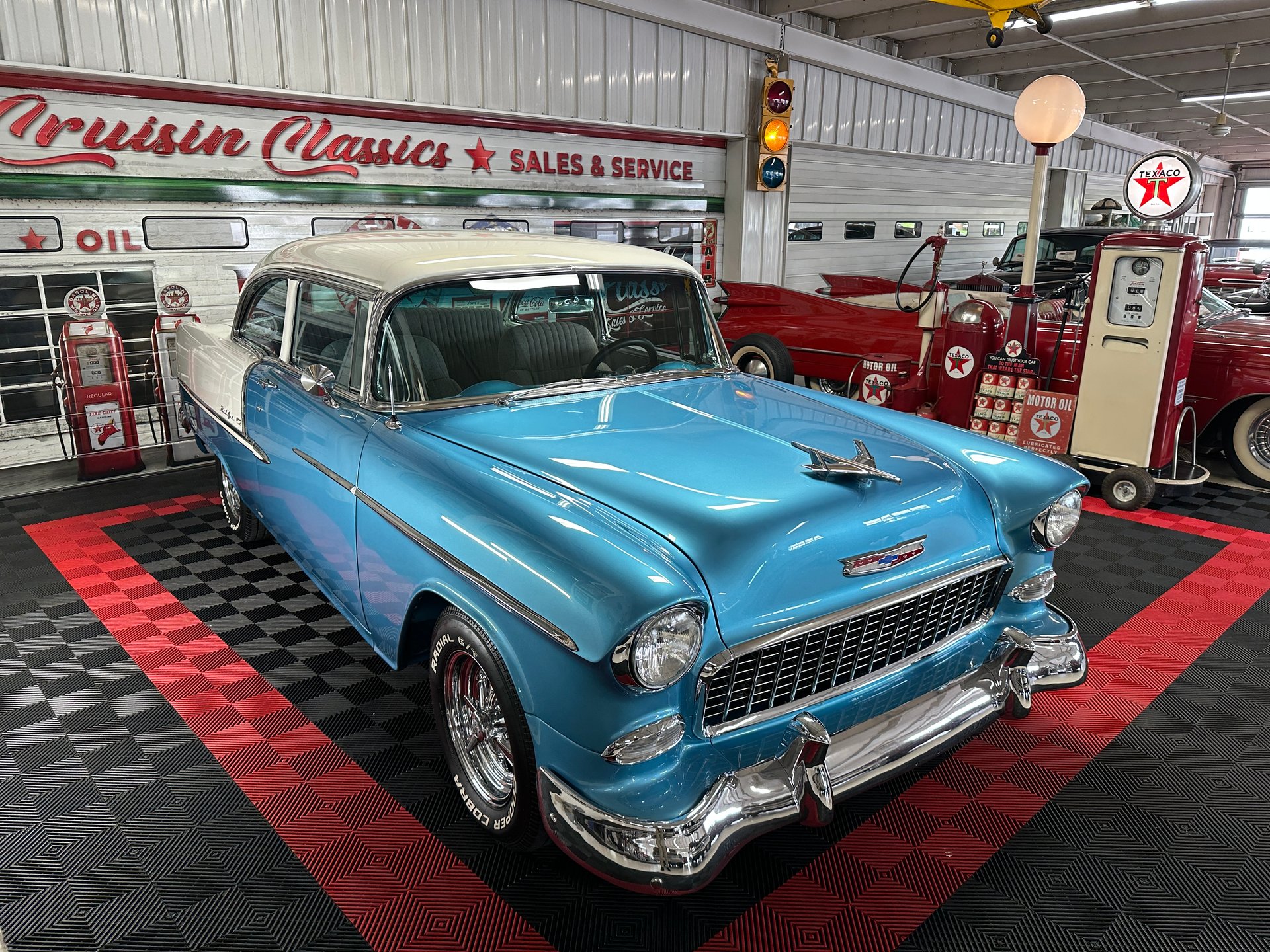
The 1955 cars. The clean-sheet year, and the purest Tri-Five shape: an eggcrate grille, single headlamps in neat pods, minimal side trim — a stainless spear that stops short of the Bel Air's full treatment — and a flat, uncluttered tail. The 210 line offered two- and four-door sedans, the Delray coupe and both wagons; no hardtops yet in this series. The two-door sedan became a drag-racing staple and a gasser donor ever since, so survivors skew heavily modified.
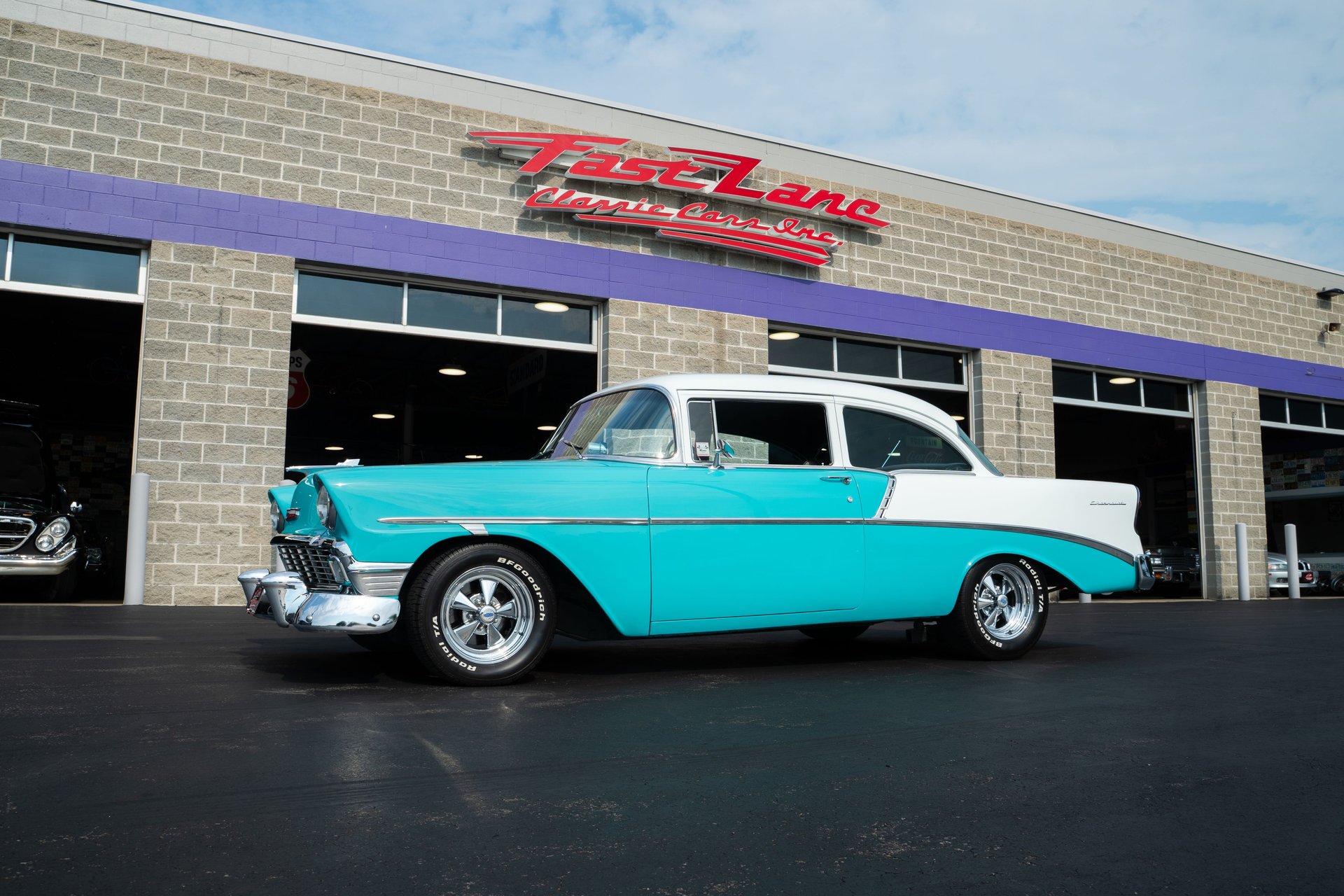
The 1956 cars. A facelift year: a full-width grille, a longer, more sculpted side spear, and new two-tone schemes that flatter the 210's plainer flanks. The big news is the arrival of the hardtops — the Sport Coupe and Sport Sedan joined the 210 range for 1956, giving you the pillarless roofline without the Bel Air price. Outputs stepped up across the board, and the dual-quad 265 made the 1956 210 a genuinely quick car in period.
The 1957 cars. The icon: tailfins, a wide-mouth grille with a heavy bumper, and the new 283 V8, including the fuel-injected versions. The 210's side trim borrows the Bel Air's wedge shape in a plainer finish, which is why 1957 210s are the most commonly passed off as Bel Airs. For most buyers the 1957 is the most desirable year and the 1955 the most honest; the 1956 splits the difference and is frequently the best value of the three.
Trim-tag literacy. Every Tri-Five carries a cowl trim tag recording body style, trim code and paint code, and a VIN whose series letter is the most important character on the car. For 1955–57 the series code is A for a 150, B for a 210 and C for a Bel Air, preceded by a V when the car was factory-built with a V8 — so a genuine factory-V8 210 reads VB, and a six-cylinder 210 reads B. A car trimmed as a Bel Air whose VIN says B is a 210 in costume; a car sold as a factory fuel-injected 210 needs its tag, its engine stampings and its paperwork to agree, because the premium for the real thing is large and the cost of the costume is small. The tags settle every argument. Learn to read them, or pay someone who can, before money moves.

Engines and gearboxes
The 235 Blue Flame six: 1953–1957
The 235-cubic-inch overhead-valve six — the Blue Flame — is the only engine in the 1953–54 cars and the base engine in every Tri-Five 210. It is a long-stroke, low-revving design famous for torque and simplicity, and infamous in its earliest form for splash-assisted lubrication and babbitt connecting-rod bearings that belong to an earlier era of motoring.
Know which 235 you are looking at, because the name covers two meaningfully different engines. The 1953 manual-transmission engine was rated at 108 hp and retained the older low-pressure lubrication character; the 1953 Powerglide engine was rated at 115 hp, with higher compression, hydraulic lifters and the improved full-pressure oiling and insert bearings that became standard for 1954, when outputs rose to 115 hp for the manual car and 125 hp for the Powerglide car. For the Tri-Five years the six settled at 123 hp for 1955 and 140 hp for 1956–57, noticeably livelier than the early cars suggest. All run a single-barrel carburettor — Rochester or Carter depending on year and transmission — simple to rebuild and tolerant of neglect, up to a point.
On the road a healthy 235 pulls strongly from low speed, cruises at 55–65 mph without complaint and returns fuel economy a V8 car will not match. What it will not do is hurry. Failure modes are mechanical and honest: worn valve guides and tired lifters give a top-end clatter that never quite adjusts out; the single-barrel carburettor wears its throttle shaft and draws air, giving an uneven idle owners chase with ignition parts; the cover gaskets weep oil until the engine wears a coat of grime that hides the one leak that matters; and cooling margins are thin in traffic on a scaled radiator. The early babbitt-bearing engines deserve extra respect — listen for a deep knock from cold, check oil pressure hot at idle, and treat low pressure on a 1953 manual car as an engine-out conversation. A full rebuild of a 235 runs roughly $3,500–6,500 depending on year and machining, the early engines at the dearer end — a gap that alone makes the 1954 six an easier buy than the 1953.
The six-cylinder cars also carry a driveline divide. The 1953–54 cars use an enclosed torque tube, which makes a transmission or axle job a bigger, more specialised undertaking than on the later cars. From 1955 the 210 uses a conventional open driveshaft and leaf-sprung live axle — the Hotchkiss layout — familiar to any classic-car shop. Neither layout is fragile, but a torque-tube car with a noisy rear axle needs a specialist's quote before you buy, not after.
The small-block V8: 265 and 283, 1955–1957
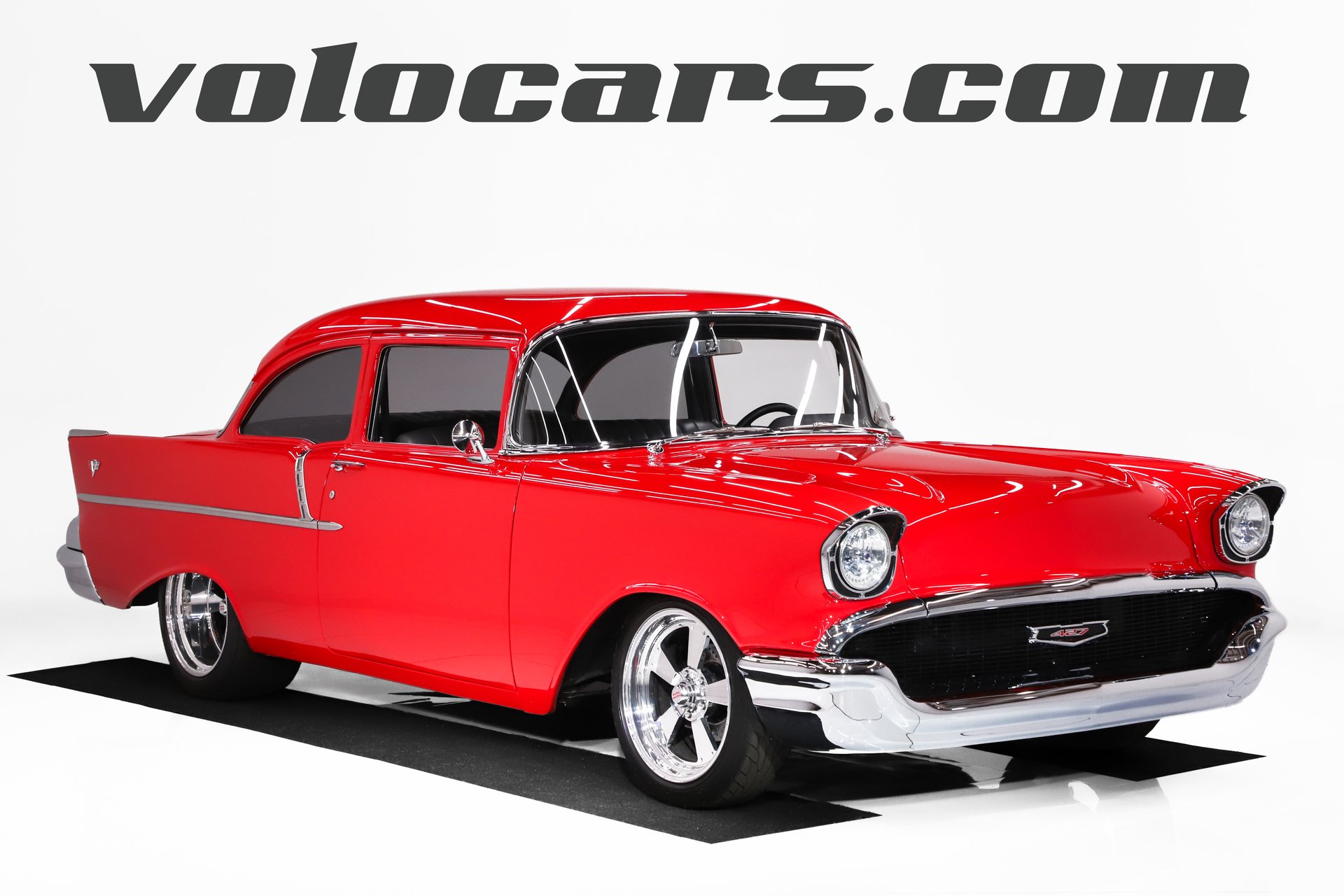
The engine that made the Tri-Five is the small-block V8, offered in the 210 from its first day. The 1955 265 was rated at 162 hp with a two-barrel carburettor and 180 hp in Power Pack form, with a four-barrel, dual exhausts and higher compression. For 1956 the same 265 rose to 205 hp as a Power Pack and 225 hp with dual four-barrel carburettors — the twin-quad engine shared with the Corvette, in a family sedan. For 1957 the engine grew to 283 cubic inches: 185 hp with a two-barrel, 220 hp with a four-barrel, 245 hp and 270 hp with dual quads in two states of tune, and then the fuel-injected cars, covered below. A six-cylinder 1957 210 and a dual-quad 1957 210 share a badge and almost nothing else.
These are among the toughest engines ever put in a production car, and the failure list is short and testable. Oil consumption on a high-mileage small-block is usually valve stem seals and guides first — blue smoke on start-up after sitting, and on the overrun after a long coast, points to the top end; smoke under sustained load points to rings and bores, and that is a rebuild, roughly $4,000–7,500 for a quality shop rebuild of a stock engine. The rear main seal leaks on almost all of them eventually — a two-piece design that weeps with age — and a coin-sized spot overnight is normal old-car behaviour, while a steady drip onto the exhaust is a job to price in. Timing chains stretch and retard the cam timing, giving a car that runs flat and hot with nothing visibly wrong; a sloppy chain you can feel by rocking the crankshaft against the distributor rotor is a chain-and-gears job, a few hundred dollars in parts and a day of labour, that transforms how the car drives. Cooling is the weak margin rather than the engine: the stock radiator and fan arrangement was adequate in 1955 traffic and is marginal in modern traffic, which is why so many cars wear aluminium radiators and electric fans. Judge the conversion on its execution — a well-mounted radiator with a proper shroud and a thermostat still fitted is an upgrade; a fan zip-tied to a core with the thermostat removed to mask overheating is a confession.
Carburetted cars divide by their induction, and each has its own tell. The two-barrel Rochester 2GC cars are the simplest and most forgiving. The four-barrel cars — Rochester 4GC or Carter WCFB depending on year — suffer worn throttle shafts, warped air horns from decades of overtightening, and choke faults that make cold behaviour miserable while hot running stays fine, so always insist on a genuinely cold start. Dual-quad cars add linkage synchronisation to the list, and a twin-carb car that idles sweetly and pulls cleanly to full throttle has had money spent on it recently — ask for the invoice, because a proper rebuild and set-up of a dual-quad pair runs roughly $900–1,800 at a carburettor specialist, and an unsettled pair is the commonest reason these cars are sold as disappointing.
One myth to bury early: many Tri-Five 210s no longer carry their original engine, and on a 210 that matters far less than matching-numbers sellers claim. The small-block was swapped and upgraded as a matter of routine for sixty years; a 350 or a later 283 in a driver is normal, often desirable, and should be judged on condition and installation quality. What is not acceptable is a car priced as an original 265 or 283 that carries a later engine. The casting numbers and the stamped pad at the front of the block settle what the engine is. Check them, photograph them, and price the car you are actually looking at.
Fuel injection: the 1957 Ramjet cars
For 1957 Chevrolet offered Rochester Ramjet mechanical fuel injection on the 283, rated at 250 hp in passenger-car tune and 283 hp in high-lift-cam tune — one horsepower per cubic inch, a figure Corvette made famous. It could be ordered in a 210, and a handful of buyers did, creating one of the great sleepers of the era. Genuine Ramjet 210s are rare, documented cars rarer, and the premium for a verified one is the largest single value swing in this guide.
The Ramjet system meters fuel mechanically against airflow and engine speed, with no electronics anywhere in it. When it is right, the car starts cleanly, idles evenly and pulls with a sharpness no carburetted 283 matches. When it is wrong — hard hot starting, fuel percolation in heat, a rich or hunting idle, flat spots that move with the weather — it requires a specialist who understands the fuel meter and the air meter, and there are very few of those. Many Ramjet cars were converted to carburettors in period by frustrated dealers, and many have been converted back since with incomplete units. Treat any injected car as two purchases: the car, and the injection unit, each needing its own verification. A complete, correct, recently calibrated unit with paperwork from a known rebuilder is a major asset; an incomplete unit is a project priced as a finished car. Budget roughly $3,500–7,000 for a specialist rebuild and calibration of a complete unit, and walk away from any car where the seller resists a cold start and a hot restart in the same viewing — those two tests tell you more about a Ramjet car than an hour of paperwork.
Gearboxes: three-speed, overdrive, Powerglide, Turboglide — and the swaps
The standard gearbox is a three-speed manual with synchromesh on second and third, column-shifted in almost every car. It is strong, simple and slow to shift — judge synchromesh on the change down into second, where wear shows first, and listen for bearing whine in the indirect gears. A Borg-Warner overdrive was offered behind the three-speed for the Tri-Five years and transforms highway cruising; a working overdrive car is worth a premium as a driver, and a non-working overdrive is usually an electrical or solenoid fault rather than a mechanical failure, but confirm which before you pay the premium. Clutches are conventional and cheap; judder is usually oil contamination from the rear main seal, which means the cheap clutch job and the engine job arrive together.
The automatic for 1953–56, and the volume automatic for 1957, is the two-speed Powerglide — in Tri-Five form a cast-iron-case gearbox of legendary toughness and equal leisureliness. It has one forward shift, and the car's character is defined by converter slip at low speed. A good Powerglide engages promptly, shifts once, firmly, and does not flare; leaks from the front pump seal and selector shaft are the standard faults. A full rebuild runs roughly $1,800–3,200 at a transmission shop. For 1957 Chevrolet also offered Turboglide, a triple-turbine continuously variable automatic that was troublesome in period and is scarce now, with thin parts and knowledge; a Turboglide 210 is a curiosity to buy knowingly and cheaply, not a driver to buy hopefully.
Then there is what the listings actually show. In our pool, automatics outnumber manuals by more than two to one among cars whose transmission is recorded, and many of those automatics are not Powerglides at all: Turbo Hydra-Matic 350 and 400 three-speeds and 700R4 four-speed overdrive automatics — the 700R4 appears by name in the pool — are the standard restomod fitments, alongside Muncie and Tremec manual swaps. None of this is a defect: a well-installed 700R4 makes a 210 a better modern driver than any period gearbox. What you are buying is the quality of the conversion — correct crossmember and mount, a speedometer that reads truthfully, and a throttle-valve cable present and correctly adjusted. On a 700R4 a misadjusted TV cable is not a quirk; it is a gearbox being destroyed mile by mile. Ask who did the swap, drive long enough for two full warm-up cycles of shifts, and check the fluid colour and smell before you leave.
Problem areas
The Tri-Five 210's mechanicals are tough and its parts support is the best in the classic-car world; what ends ownership dreams is rust, hidden accident and modification history, and deferred maintenance on a car that still drives well enough to sell. Our own photo evidence points the same way: of the 47 cars in our pool whose photo sets we examined in detail, rust was mentioned in the notes for 18 and visible damage for 12 — roughly four in ten showing rust and one in four showing damage, in sellers' own photographs, the most flattering record a car ever gets. Assume the car in front of you needs a forensic examination, and be pleased when it passes.
Rust and the body: the map
Rust on a Tri-Five follows water, mud and trapped debris, and the 210 suffers in exactly the same places as the Bel Air — the shells are the same pressings. Work through it in this order, because the order is the order of cost.
Floor pans and floor braces. The single most common structural repair on the car. Water enters past the windshield seal, the cowl vents and the heater box, sits under the carpet, and rots the pans from the top down while the underside still looks presentable in photographs. Lift every carpet. Surface scale is a clean, treat and seal job; perforation is panel work, and the pans sit above floor braces and body mounts whose condition matters more than the pans themselves — a new floor welded over rotten braces is cosmetic surgery on a structural problem. A full floor with braces, fitted and finished, runs roughly $2,500–5,500 depending on how much structure goes with it. Prod the braces and mount points with a screwdriver, with permission, and listen for the change from a ring to a crunch.
Rocker panels, inner rockers and the lower body. The rockers trap road mud and rot from the inside. The outer panel is the visible part; the inner rocker is the structural part, and it is the one sellers' photographs never show. Press hard along both rockers, open every door and check the lower A-pillar where the rocker begins, and look at the bottom of the front fenders behind the wheels, the classic mud trap. Fresh, thick underseal on the rockers of an otherwise honest car is a question, not an answer. Rocker replacement, inner and outer, fitted and painted, runs roughly $1,200–2,800 per side, and it is structural work.
Trunk floor, tail pan and rear quarters. The rear window and trunk seals leak, water collects in the spare-wheel well and trunk floor corners, and the tail pan — the valance below the trunk opening — rots from moisture trapped between its skins. Lift the spare wheel and the trunk mat on every car, without exception. Lower rear quarters bubble behind the wheels, and the wheel-arch lips trap a folded seam that rusts from inside the fold, so run a fingertip around the inside of every arch lip and feel for swelling. A trunk floor and tail pan together are a bounded job — roughly $1,500–3,500 fitted and painted — but they rarely travel alone, and trunk rust plus floor rust plus rocker rust is a shell that needs a rotisserie, not a patch.
Cowl, firewall and front sheet metal. The cowl sides and lower windshield frame rot where the vents and seal channel hold water, and the repair is dashboard-out, glass-out work that costs out of proportion to the size of the patch. The battery tray rots invisibly under the battery, and the acid track runs onto the inner fender and firewall below it — lift the battery or rock it and check the tray edges with a torch. Front fenders rot at the headlamp brows — on 1957 cars the eyebrow above the headlamps is a named trap, holding moisture under the trim — at the lower rear corner, and along the top where the inner brace traps dirt. Doors rot at the bottom, from blocked drain holes: feel along the bottom edge of every door for bubbling and check the drain slots are clear. On hardtops add the drip rails and roof-to-quarter seams; on wagons add the tailgate, rear floor and roof gutters, and price wagon-specific panels as scarce, because they are.
The frame. The ladder frame is strong and rarely the first thing to go, which is precisely why frame rot gets missed. Check the rear kick-up over the axle, the body-mount outriggers, the front crossmember and any point where a previous repair has plated over the original steel. A bent frame is the other finding: these cars were drag-raced and occasionally crashed and straightened to period standards. Sight down both flanks for ripples and read the door gaps — a gap that tapers is a story. A car that crabs or wears one front tyre needs a frame measurement on a lift before it needs anything else.
Filler and fresh paint. Bring a magnet in a cloth and run it over the rockers, lower quarters, arch lips and door bottoms. Filler announces itself. A recent repaint over a car with no photographic record of the work is the standard way a rusty Tri-Five becomes a shiny one, and the problem is paying sound-metal money for sculpture. Paint and bodywork to a good standard starts around $10,000 and rises steeply with metalwork — the arithmetic that governs this whole section: buy the shell, and let the mechanics be the project.
Identity, originality and the modified-car problem
No section of this guide will save you more money than this one. The 210 is the Tri-Five most likely to be something other than what it is described as, in both directions, for three structural reasons.
First, the Bel Air costume. The trim difference between a 210 and a Bel Air is bolt-on brightwork, interior fabric and badges. The VIN series letter — B for a 210, C for a Bel Air, with the V prefix for a factory V8 — cannot be bolted on, and neither can the cowl tag's body-style number. Check both, on the car, against the title, before you discuss price. A 210 honestly sold as a 210 with Bel Air trim fitted is a perfectly good car at a 210 price. The same car sold as a Bel Air is fraud at any price, and it happens often enough that the check is step one of the inspection, not a formality.
Second, the engine swap as default history. Sixty years of small-block interchangeability means the engine in the car is a finding, not a given. Establish what it is from the casting number and the stamped suffix on the front pad, and what the car was born with from the VIN. A 210 born a six and now running a healthy 350 is a good driver and a poor investment-grade car; price it as the former. A car born a V8 210 — VB in the VIN — that still carries a period-correct engine is scarcer than the listings suggest, because so many were harvested for their running gear.
Third, the restomod spectrum. Surviving 210s divide into preserved originals, period-style restorations, and modified cars ranging from a disc-brake conversion to full chassis and LS-engine builds. None of these is the wrong car; each is the wrong car at the wrong description and the wrong price. For a modified car you are auditing a build: who did the work, with what components, and how are the details finished — wiring routed and protected rather than draped, brake lines flared and clipped, a cooling system sized for the engine actually fitted? A build's quality shows in its least visible corner. Look under the dash and check the underside of any car whose engine bay impresses you; the bay is the part builders photograph, and the wiring is the part they do not.
Chassis, steering and brakes
The Tri-Five front suspension is an independent double-wishbone design on ball joints — new for Chevrolet in 1955 and modern in feel when in good order. Wear shows as vagueness on centre, knocks over bumps and inside-edge front tyre wear. Ball joints, tie-rod ends, idler arm and bushings are all cheap and replaceable in a home garage; a full front-end refresh in parts runs roughly $600–1,200, and the alignment afterwards makes it feel like a different car. The recirculating-ball steering box — manual on most 210s, power assistance an option — wears free play into its centre position. Some play adjusts out; a box tight at the locks and loose in the middle is worn, and a rebuilt box runs roughly $400–900 fitted. Judge the system together: a car that wanders is usually three small wears adding up, which is good news priced as bad news if you know it.
Rear suspension is leaf springs on a live axle, and its faults are tired springs, worn shackle bushings that let the axle steer the car over bumps, and leaking shock absorbers. A Tri-Five should sit level or fractionally nose-down; a tail-down car needs springs and bushings — a few hundred dollars in parts, not a structural finding, but a fair guide to how the maintenance has gone.
Brakes, as built, are four-wheel drums with a single-circuit master cylinder. In good order they stop the car adequately at period speeds with a firm, high pedal; out of order — glazed shoes, oval drums, perished hoses, a weeping wheel cylinder — they are the least forgiving system on the car, and a full refresh with hydraulics runs roughly $800–1,600 with labour. A single-circuit system means one hydraulic failure is a total failure, and a dual-circuit conversion is the most worthwhile safety modification on the car. Front disc conversions are so common that a disc-braked car is unremarkable — judge the conversion, not the concept: correct booster and proportioning, a firm pedal, hoses routed clear of the exhaust. A car that pulls under braking is describing a sticking caliper or a collapsing hose, not alignment, until you have proved otherwise.
Interior, trim and electrics
The 210 interior is plainer than the Bel Air's by design — cloth and vinyl in two-tone schemes, a lightly trimmed dashboard, rubber floor covering in some sedans where a Bel Air had carpet — and that plainness is now an asset: there is less to restore, and it costs less. The Delray's all-vinyl interior is the exception and the one to prize: it wears better than cloth and presents better today. Seat frames and springs survive; foam and covers are reproduced for every body style. A complete interior kit and professional fitting runs roughly $2,500–5,500 depending on body style and material, with hardtop and wagon interiors at the dearer end. Headliners sag and stain, and on hardtops the bows and clips are a fiddly job best priced as part of a trim-shop visit.
Trim is where the 210's middle position pays you back a second time. The Bel Air's extensive brightwork is the most expensive cosmetic system on a Tri-Five to restore; the 210 carries materially less of it, and most of what it carries is reproduced. What is not reproduced well is the small stuff: year- and body-style-specific clips, wagon trim, hardtop roof-rail weatherstrip channels, and the 1957 210's specific side-trim pieces. Inventory the trim piece by piece against photographs of a correct car, and treat missing 210-specific trim as a search, not a purchase — it will take time rather than money. Re-chroming bumpers runs roughly $600–1,200 per bumper to a good standard, which is why straight, dull original chrome beats shiny, wavy re-chrome.
Electrics split by era. The 1953–54 cars are six-volt, and their faults are dim lamps, slow cranking and connections that have grown resistance for seventy years — all curable with cleaning, correct heavy cables and a healthy battery, and none of it a reason to convert to twelve volts unless you are adding modern loads. Tri-Five cars are twelve-volt with a generator as standard; an alternator conversion is common and worth judging on its wiring rather than its presence. On any car, work every switch — a car where everything electrical works has been used and maintained, and that correlation holds here as everywhere.

How to inspect one
Allow a full hour, bring a torch, a magnet wrapped in cloth and a notebook, and arrange the viewing so the engine is cold when you arrive — a warmed-up car has had its two most honest minutes stolen from you. If the car passes you, pay for a lift inspection before money changes hands; on a Tri-Five the underside is where the money is.
- Start with the tags and the title. Decode the VIN series letter before anything else: B is a 210, C is a Bel Air, A is a 150, and a leading V means the car was built with a V8. Match the VIN to the title exactly. Read the cowl trim tag for body style, trim and paint codes and compare all three with the car in front of you. A mismatch is not automatically a walk-away — engines, colours and interiors change honestly — but every mismatch must have a story, and the price must follow the tags, not the badges.
- Cold start. Start the engine from cold yourself. A six should catch with choke and settle to a steady idle; a carburetted V8 should start with one pump of the throttle and no extended cranking. Watch the exhaust for ten seconds: a puff of blue that clears is valve seals; continuous blue is deeper trouble. Listen for lifter clatter that does not fade, a deep knock under load on an early six, and timing-chain rattle on a V8. On a fuel-injected 1957, note exactly how it starts cold — you will repeat this test hot at the end of the drive, and the pair of results prices the injection unit.
- Under the hood, systematically. Check the oil for condition and level, and the coolant for oil contamination and rust colour. Read the engine stampings on the front pad and write them down. Check the battery tray and firewall below it for acid damage, the radiator for weeping seams, and every hose by squeezing it — a hose that crunches is at the end of its life.
- Under the car. This step decides whether you continue. Torch along both rockers, inner and outer; prod the floor braces and body-mount points; check the trunk floor from below, the frame kick-up over the rear axle, the outriggers and the front crossmember. Perforation in braces, mounts or frame is structural money. Read any underseal as evidence: old, patchy and honest is factory character; a fresh, uniform coat over everything, applied for the sale, is a question the seller must answer with photographs of what is underneath it.
- Trunk and interior floors. Lift the spare wheel, the trunk mat and every carpet you are allowed to lift. Look for water staining, active damp and perforation in the trunk floor corners and the spare-wheel well, and for water tracks down the inner cowl and under the front carpets. Check the rear window and windshield seals from inside — the seals are where the water that rots the floors in the rust section gets in.
- Body, gaps and the magnet. Run the magnet over the rockers, lower quarters, arch lips, door bottoms and fender brows. Sight down both flanks. Check every panel gap for taper, and every door bottom for bubbling with your fingertip. On a wagon, open and close the tailgate twice and check its lower edge and the rear floor; on a hardtop, check the roof-to-quarter seams and confirm every piece of side glass seals as it should — pillarless glass alignment is a trim-shop job, not an adjustment.
- Steering, suspension and stance. Stand back and judge the stance: level, or fractionally nose-down, is correct; tail-down is tired rear springs; a list to one side is a spring or a mount. Rock each front wheel for ball-joint and bearing play, then have a helper turn the steering lock to lock while you watch the linkage for lost motion at the idler arm and tie-rod ends. Free play at the wheel rim beyond an inch or so, with the road wheels still, is a system to price joint by joint.
- The test drive. Fifteen minutes minimum, including a highway stretch if the seller allows it. A manual car should change into second without a crunch on the way up and — the real test — on the way down. An overdrive car must engage overdrive and hold it. A Powerglide must engage promptly, shift once and not flare; a swapped automatic must make every shift, warm, twice. A V8 should pull cleanly to 4,000 rpm. Brake firmly from speed, twice: the car must stop straight, with a firm pedal that does not sink or need pumping. A car that pulls, sinks or pumps has told you its brake budget.
- Heat and electrics. Let the car idle hot at the end of the drive. Watch the temperature gauge at idle — a Tri-Five that only stays cool at speed has a cooling problem that will be yours in the first summer queue. Run the heater and blower on every speed and work every lamp, the wipers, the horn and the fuel gauge. On an injected car, now do the hot restart: switch off, wait two minutes, start it again. A Ramjet car that will not hot-start in front of its seller has priced its own injection work.
- Interior and trim inventory. Sit in every seat, including the back. Feel for collapsed springs and perished foam through the covers, check the headliner, and inventory the bright trim piece by piece against a correct car — on a 210, missing year-specific trim is a search, not an order form, so price what is missing as your time.
- Paperwork and history. Ask for invoices and build photographs, and read them for names and dates rather than totals. A thick, coherent file supports the car's story; a folder of unrelated receipts supports nothing. For any car claiming originality or fuel injection, the paperwork is part of the car and its absence is part of the price.
- Decide on the shell. Add up what you have found in this guide's order: structure first, identity second, mechanics third, cosmetics last. A 210 with a sound shell, honest tags and tired mechanics is a good buy at the right price. A shiny 210 with rotten braces, a costume identity and fresh underseal is not a bargain at any price a seller is likely to accept. Walk away from the second car, however good the test drive felt.
Values
The build below this guide carries the current market numbers for the Chevrolet 210 — the cars listed now and the recorded sales — refreshed at every build, and those figures are the ones to trade on. This section teaches you how to read them, because with the 210 the spread inside a single model year is wider than the spread between years, and a buyer who understands what drives the spread will consistently buy better than a buyer who memorises a number.
Condition is the first driver, and on a Tri-Five it is mostly body condition. The distance between a project needing floors, rockers and a tail pan and a sound, driving car is not a discount, it is a different purchase: the project carries a five-figure body programme before it needs its first mechanical part. Between those poles sits the honest driver — presentable paint, sound structure, working mechanics, visible wear — where most 210s trade and the best value in the range lives.
Specification is the second driver, in a specific order. Body style comes first: hardtops and the Handyman wagon command a clear premium over the sedans, and the four-door sedan — the most useful car in the range as family transport — is consistently the cheapest way into a good Tri-Five 210. Drivetrain comes second. A factory V8 car, V in the VIN, carries a premium over a six-cylinder car and a large premium over a six-cylinder car later converted to a V8, even when the converted car is the better driver. At the very top, a verified fuel-injected 1957 sits in a different market altogether — and verified is doing all the work there, because an unverified injected car should be valued as a carburetted car plus a project.
Year is the third driver, and the weakest. The 1957 cars attract the broadest demand and the 1955 cars the most devoted; in practice a superb 1956 routinely outsells a tired 1957. The 1953–54 cars sit in their own smaller market, valued on charm and simplicity rather than the Tri-Five phenomenon. Do not let a seller price a 1953 car off Tri-Five comparables, or a Tri-Five off a single exceptional auction result for a different body style.
Two gaps define negotiation. The first is asking versus achieved: asking prices are set against the best comparable a seller can find, while achieved prices settle against the car that actually exists, and this guide's inspection findings — structure, identity, injection, brakes — are the legitimate levers between those two points. The second is the build gap on modified cars: a restomod 210 is worth the quality of its build, not the sum of its receipts. Buy at the price of the next best finished alternative.
Finally, the project-versus-driver arithmetic: a project 210 only makes financial sense if you do the metalwork yourself or genuinely want the build as the hobby. Bought at project money and restored at shop rates, a 210 will almost always cost more finished than the same car bought finished — and the finished car was available to drive on the day you bought it. Respect that gap; it never appears in a listing, and it is the most honest number in the market.
Parts and ownership
The Chevrolet 210 — and the Tri-Five above all — enjoys the best parts support of any classic car ever made. The Tri-Five was a million-plus-car programme three years running, the restoration industry has served it continuously for forty years, and between reproduction, new-old-stock and good used parts there is very little on a 210 that cannot be obtained. Ownership difficulty is rarely about availability; it is about choosing the right quality tier, and about the handful of wagon-, hardtop- and year-specific items where the reproduction net has holes.
Easy: everything service-related, for both engines. Filters, plugs, points, belts, hoses, water and fuel pumps, carburettor kits for every factory carburettor, brake shoes, drums, wheel cylinders and master cylinders, ball joints, bushings, tie-rod ends, shock absorbers, leaf springs, exhaust systems, mounts, clutch kits, Powerglide soft parts, glass, weatherstripping for the sedans, and complete interior kits for every body style. Order today, fit this weekend, at prices that undercut most modern cars. The small-block's tuning ecosystem needs no introduction: if it exists for a small-block Chevrolet, it fits a Tri-Five 210 with at most a bracket changed.
Harder and dearer: correct Rochester fuel-injection components and, above all, the calibration knowledge to make them work — the unit is a specialist purchase and a specialist service item for the life of the car. Early-235 parts for the babbitt-bearing 1953 engines are a smaller, older market than the V8 world, and Turboglide parts and expertise are genuinely thin. Wagon-specific sheet metal and trim, hardtop roof and glass hardware, year-specific 210 side trim, and good original chrome for rechroming all reward patience over urgency. Six-volt components for the 1953–54 cars come from the early-Chevrolet specialists rather than the Tri-Five catalogue houses — a fair summary of the early cars' whole position: supported, but by a different and smaller trade.
Running costs. A sorted 210 is a realistic regular-use classic. The six returns fuel economy in the high teens; a stock V8 sits in the mid-teens; a dual-quad or modified car will do worse and not care. Servicing is within the ability of any competent home mechanic and any general classic-car shop — there is no specialist tax on a 210. The budget line that catches new owners is the first-year catch-up: budgeting roughly $1,500–4,000 for that first year is realistic, with a car that has sat for years wanting $3,500–7,000 of recommissioning before it is trustworthy, most of it in the fuel system, the brakes and the tyres. Modern ethanol fuel is the standing enemy of a stored Tri-Five: it attacks period rubber and leaves varnish in carburettors and injection units alike. Drive the car, and treat any car that has sat on old fuel as a fuel-system cleaning job before it is anything else.
Buy the car that has been in regular use over the car that has been asleep, even at a higher price, because everything regular use keeps alive — seals, brakes, carburettor, tyres — is exactly what storage quietly kills.

Which one to buy
- The all-rounder: 1955 or 1956 210 two-door sedan, factory V8. The deepest market to buy from, the best parts support in the classic-car world, and a car you can drive anywhere. If you want one 210 to own, use and eventually sell without drama, this is it.
- The value buy: 210 four-door sedan, any Tri-Five year. The same shell, drivetrains and driving experience as the two-door, in the body style the market consistently prices lowest. As family transport it is the best car in this guide; as value it is not close.
- The stylist: 1956–57 Sport Coupe hardtop. The pillarless roofline without the Bel Air premium. Budget for hardtop-specific seals, glass alignment and trim, and buy the most complete example you can find — completeness is the whole game on a hardtop.
- The character buy: Handyman two-door wagon. The utility body hot-rodders have always chased, with the practicality to earn its keep. Inspect the tailgate, rear floor and gutters twice as hard as the front of the car, because wagon metal is the scarcest metal in the range.
- The purist's car: 1953–54 210 with the 235 six. A different era and a different pleasure — torque, simplicity and early-Fifties charm — at money the Tri-Five market never reaches down to. Buy the 1954 over the 1953 for the improved engine, unless the 1953 in front of you is exceptional.
- The collector car: verified 1957 fuel-injected 210. The rarest and most valuable car in this guide, and the one where verification is not a step in the process but the entire process. Tags, stampings, unit completeness and specialist paperwork, all agreeing — or value it as a carburetted car.
- The driver-build: a well-executed restomod 210. Disc brakes, a modern overdrive automatic, air conditioning and a healthy later small-block make the best modern driver in the range. Judge the build in its hidden corners, price it against finished alternatives rather than its receipts, and drive it without guilt about originality — a 210 was always the working car of the range.
And the rule that overrides all of the above: buy the soundest shell with the most honest identity you can find, in the body style you actually want. Engines, gearboxes, brakes and interiors on a 210 are all fixable at prices you can plan for. A rotten shell and a borrowed identity are the two faults no catalogue cures — and they are the two faults this guide has taught you to find in the first fifteen minutes of any viewing.
See the 53 210 cars currently listed.