
Chevrolet 150 buyer's guide
Chevrolet 150 -- the model's own buyer's guide: variants, values and what to check.
Years listed: 1955-1957 · Series: Tri-Five
Overview and history
The Chevrolet 150 — One-Fifty in the brochures — was the cheapest full-size Chevrolet you could buy, and for decades that was exactly the problem. It was the fleet car, the salesman's car, the utility car bought by people who counted every dollar and specified rubber floor mats instead of carpet because mats were cheaper to replace. Then the Tri-Five years turned it into something else entirely: the lightest, plainest shell wrapped around Chevrolet's new small-block V8, and therefore, in the hands of racers, moonshiners in folklore and hot rodders in fact, often the fastest Chevrolet on the road. This guide covers the whole One-Fifty lineage as it appears in our listings: the 1953–54 cars that introduced the name, and the 1955–57 Tri-Five cars that made it collectible.
Chevrolet introduced the 150 for 1953 as the replacement for the Styleline Special, sitting below the 210 (the old Styleline Deluxe) and the Bel Air, which became a series in its own right that year. The formula was subtraction. Less chrome outside, plainer cloth and vinyl inside, fewer standard fittings, and a lower price at every body style. Underneath, a 1953–54 150 is the last of the pre-Tri-Five Chevrolets: a separate chassis, a torque-tube driveline on manual cars, knee-action-derived independent front suspension, and the long-serving 235-cubic-inch Blue Flame six as the only engine. These are honest, simple, slow cars, and they are covered in this guide because the lineage starts with them — but they share almost nothing except the badge with what followed.
What followed, in 1955, was a clean sheet. The 1955 Chevrolet was new from the frame up: new styling under Harley Earl's studio, a new chassis with ball-joint front suspension and an open Hotchkiss rear axle, 12-volt electrics, tubeless tyres — and, decisively, an optional overhead-valve V8, the 265-cubic-inch small-block designed under Ed Cole. The 150 remained the base series, and that combination — lightest body, least trim, biggest available engine — is the whole story of the Tri-Five 150. A 150 two-door sedan with the Power Pack V8 weighed less and cost less than a Bel Air with the same engine, and went faster. Chevrolet's own competition department understood it perfectly: the famous 1957 Black Widow stock cars, built by Southern Engineering and Development Company (SEDCO) under Vince Piggins' direction, were not Bel Airs. They were 150 Utility Sedans — the cheapest, lightest body in the catalogue, fitted with the fuel-injected 283.
The Tri-Five 150 ran for three visually distinct years: the clean grille of 1955, the full-width grille of 1956, and the finned 1957, the year the 283 arrived and one injected version made one horsepower per cubic inch. For 1958 the name was retired in favour of Delray, which is why this guide stops at 1957.
Be plain about the pool this guide is written against, because it is not a cross-section of period production. We currently track 22 Chevrolet 150s for sale or recently sold: 16 for sale and 6 sold. Thirteen of the 22 are 1957 cars, four are 1955s, four are 1956s, and just one — a 1953 car — represents the pre-Tri-Five years; there is no 1954 car in the pool at all. Twenty-one of the 22 are filed in the Tri-Five series and one in Full Size. Twenty-one came from dealers and one from Facebook. The transmission records tell the second half of the story: alongside period three-speed manuals and Powerglides, the pool carries five-speed and six-speed manuals and three- and four-speed automatics that no 1950s Chevrolet ever left the factory with. This is, in other words, a restomod-weighted market. Most 150s offered today are not preserved fleet cars; they are Tri-Five shells — prized precisely because the trim is simple and the engine bay accepts anything — rebuilt as hot rods, cruisers and pro-touring cars. We examined the sellers' photo sets in detail for 14 of the 22 cars, and that evidence is cited, with its sample size, where it is used below.
That shapes the buying advice throughout. With a Bel Air, originality is the currency. With a 150, the market splits in two: a small, serious trade in correct, stock cars — six-cylinder sedans, Handyman wagons, and above all genuine factory V8 and fuel-injected cars — and a much larger trade in modified cars, where you are buying the quality of a build, not the correctness of a specification. The two are priced, inspected and judged by completely different rules, and confusing them is the most expensive mistake a 150 buyer can make. The second most expensive is simpler, and it is the trap this guide returns to repeatedly: on a Tri-Five, trim is bolted on. A 150 can wear Bel Air side trim, a 210 can be dressed down, and badges prove nothing. The VIN plate and the cowl trim tag settle what a car was born as. Everything else is decoration.
The models
Every 150 is a full-size Chevrolet on the same basic architecture as the 210 and Bel Air of its year. What the badge buys you is less: less brightwork, plainer upholstery, fewer standard features, and — the point that matters now — less weight and, on the Tri-Fives, exactly the same engine options as the flagship. Chevrolet would sell you a 150 with the hottest engine in the catalogue and almost no trim at all, a combination no modern maker would allow.
| Model | Years | Engine | Output | Built | Character |
|---|---|---|---|---|---|
| 150 sedan, 2-door and 4-door | 1953–54 | 235 six | 108–125 hp | — | The original One-Fifty; six only, pre-Tri-Five chassis |
| 150 Handyman wagon, 2-door | 1953–54 | 235 six | 108–125 hp | — | Base wagon; rare then, rarer now |
| 150 sedan, 2-door and 4-door | 1955 | 235 six / 265 V8 | 123–180 hp | — | First Tri-Five; the light V8 shell arrives |
| 150 Utility Sedan, 2-door | 1955–57 | Six / 265 / 283 V8 | 123–283 hp | — | No rear seat; the Black Widow's body |
| 150 Handyman wagon, 2-door | 1955–57 | Six / 265 / 283 V8 | 123–283 hp | — | Two-door base wagon; hot-rod favourite |
| 150 sedan, 2-door and 4-door | 1956 | 235 six / 265 V8 | 140–225 hp | — | The middle year; dual-quad V8 on the option list |
| 150 sedan, 2-door and 4-door | 1957 | 235 six / 265 / 283 V8 | 140–283 hp | — | The icon year; Ramjet injection at the top |
| 150 Sedan Delivery | 1955–57 | Six / V8 | 140–283 hp | — | Panelled wagon for trade use; commercial rarity |
Production figures by body style are left blank where they cannot be given reliably; an invented figure would be worse than a blank. Outputs are period gross ratings — read them for the gaps between engines, not as absolute truth.
The 1953–54 cars. Two-door and four-door sedans, a two-door Handyman wagon, and sedan delivery variants, all six-cylinder, all on the older chassis. The two-door sedan is the shape to have. These cars are bought for charm, simplicity and price, not performance. Survivors are scarce relative to Tri-Fives because nobody preserved base-model fleet cars, and so many were used up as parts sources or early hot rods.
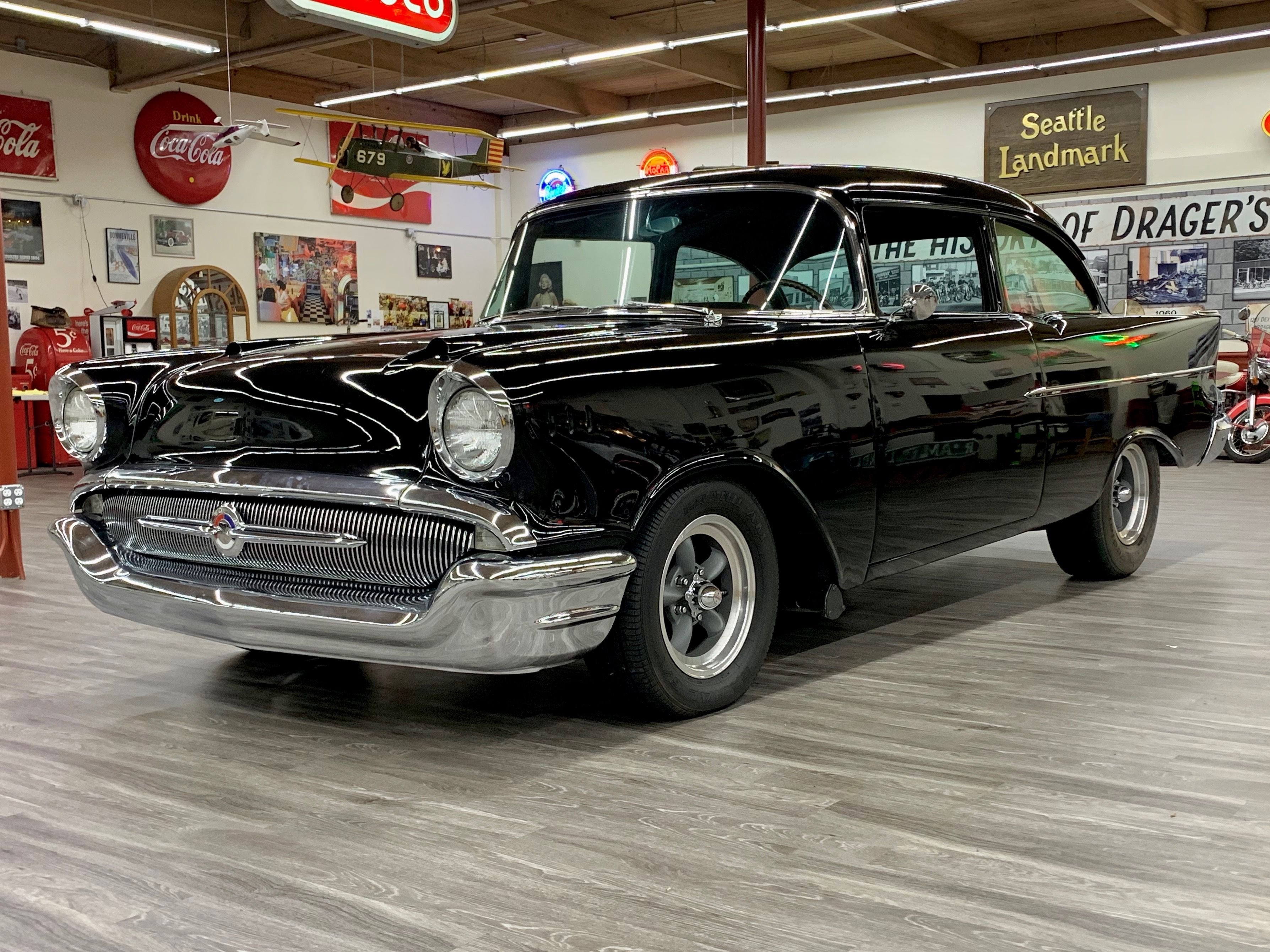
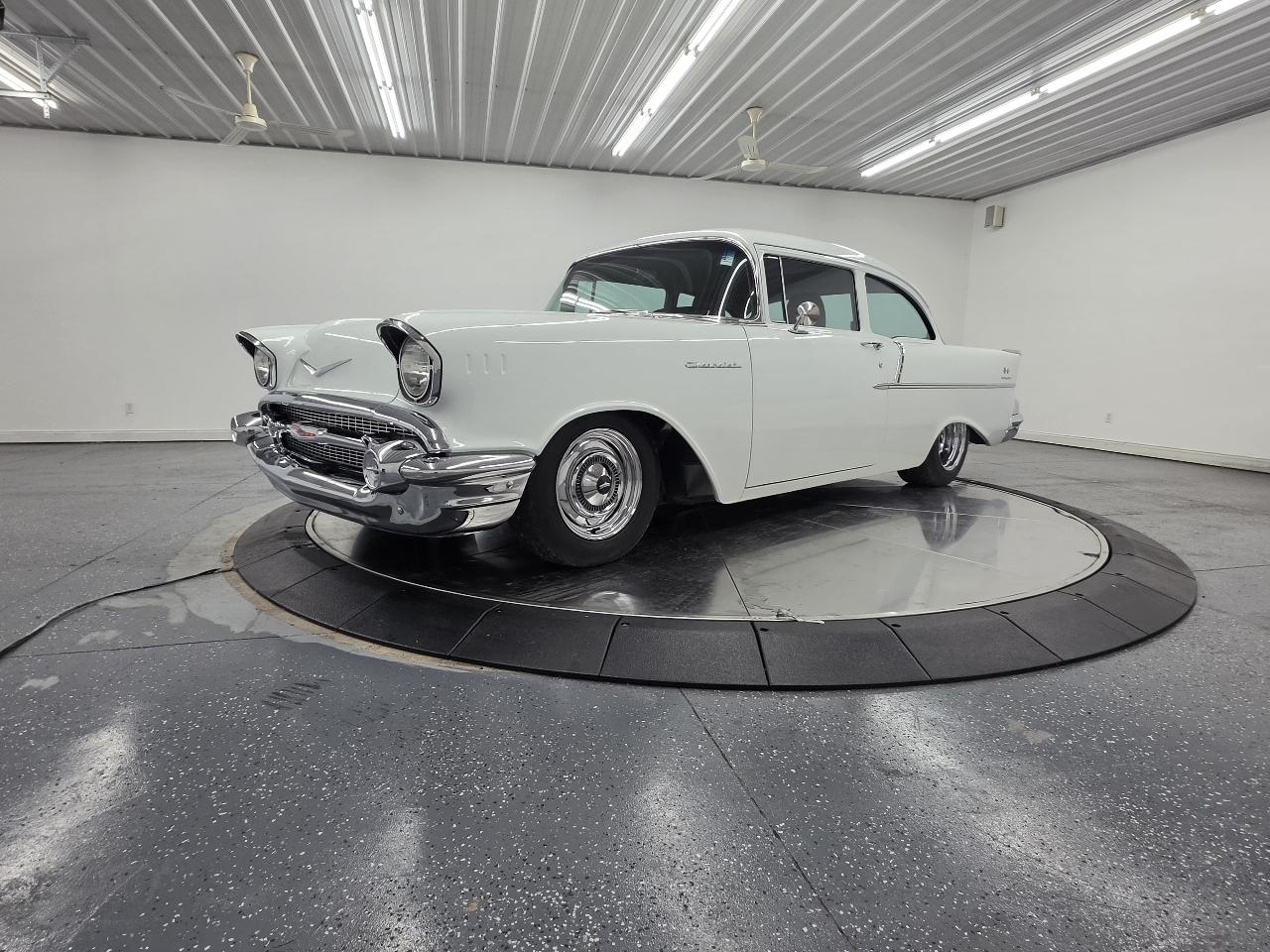
The Tri-Five sedans. The two-door sedan — a true post sedan, with a framed window and a B-pillar, not a hardtop; Chevrolet never sold a 150 hardtop or convertible, which is itself an identity check — is the core of the market and the body the Black Widow made famous. The four-door sedan is the same car with family access, historically cheaper, and increasingly appreciated as the two-doors have climbed. Both were sold in large numbers as working cars, which means original, unmodified survivors are far rarer than the production numbers suggest.
The Utility Sedan. The connoisseur's 150 and the trap for the unwary: a two-door sedan built for travelling salesmen, with no rear seat, a plywood cargo platform in its place, fixed rear side windows and the plainest trim of any passenger model. Because SEDCO chose it for the Black Widow, every Utility Sedan attracts a second look — but Chevrolet sold them to salesmen by the thousand and SEDCO built a handful of race cars. A Utility Sedan is a desirable, scarce body; without paperwork it is not a Black Widow, and no racing premium should be paid on a story alone.
The Handyman wagon. The two-door station wagon on the 150 trim level — Chevrolet's four-door wagons at this level were badged Townsman in the Tri-Five years, so a 150 wagon should have two doors, and a four-door "150 wagon" deserves a trim-tag check. The Handyman is the wagon hot rodders want: lighter and cleaner than a Nomad, with a vast, flat load floor and endless presence. It is also, as the problem areas section explains, the body with the most places for water to sit, and the one where a pretty paint job can hide the most work.
The Sedan Delivery. A Handyman with panelled sides for commercial use. Always rare, often worked to death, and now genuinely collectible in correct form — which is precisely why converted wagons appear. The cowl tag and VIN settle it, as they settle everything on these cars.
One final model note, concerning our own pool. Several listings carry titles such as "150 Custom" and "150 Custom Built" — that word Custom is the seller telling you, honestly, that the car is a build: a 350 V8 where a 265 or 283 belongs, a Muncie four-speed or a modern five- or six-speed, later wheels and brakes. Judge those cars as builds, by the inspection section's standards. Chevrolet never sold a "150 Custom."


Engines and gearboxes
A 150 could be ordered with almost everything Chevrolet made, which means the badge tells you nothing about what is under the bonnet — and seventy years of engine swaps mean the bonnet tells you nothing either, until you read the numbers. This section covers the three factory engine families in order, then the gearboxes, then the swaps you will actually meet in today's listings, because in our pool the swaps are not the exception. They are close to the norm.
The Blue Flame six: 235 cubic inches
Every 1953–54 150, and the base version of every Tri-Five 150, runs the 235.5-cubic-inch overhead-valve straight six — the final development of Chevrolet's long-running stove-bolt line, extensively revised for 1953 with full-pressure lubrication across the range. Period outputs run from 108 hp in the 1953 manual car through 115–125 hp for 1954, 123 hp in the 1955 Tri-Five (more with Powerglide, which brought a higher-lift specification), to 140 hp for 1956–57. A single Rochester or Carter one-barrel carburettor feeds it. Solid or hydraulic lifters vary by year and transmission, which is why a seller's flat statement about valve adjustment should be checked against the specific car.
This is a tough, simple, understressed engine: willing, smooth at a cruise, and slow by any modern measure. Judge one on oil pressure, quiet running and cleanliness, not performance. The wear points are unglamorous. The one-barrel carburettor wears its throttle shaft and draws air, giving a lumpy, unadjustable idle owners blame on tuning. Side-cover gaskets weep oil down the block. Exhaust manifolds crack, and the heat-riser valve seizes — usually shut, cooking the carburettor and causing hot flat spots, or open, giving a car that stumbles cold. Stem seals harden and give a puff of blue smoke on start-up after a sit; smoke that continues under load is bore and ring wear, and that is a rebuild conversation. A six that starts readily, idles evenly and holds clean oil is a good six — provided you accept, before you buy, that it will never be a fast one.
The honest warning about sixes is commercial. A six-cylinder 150 is worth materially less than the same car with a factory V8, and converting one properly costs more than the value it adds. Buy a six because you want a six; our pool underlines how the market votes, leaning overwhelmingly to V8s, factory and swapped.
The small-block V8s: 265 and 283
The engine that changed everything arrived in the 150 in its first year. The 265 (4.3 litres), new for 1955, is the original small-block Chevrolet: compact, light for its output, overhead-valve, with a short stroke that likes to rev. In a 1955 150 it was offered at 162 hp with a two-barrel carburettor, and at 180 hp in Power Pack form — four-barrel carburettor, dual exhausts, higher compression. For 1956 the range stretched: two-barrel cars at 162–170 hp, a four-barrel at 205 hp, and at the very top a dual-four-barrel 265 at 225 hp, shared with the Corvette and vanishingly rare in a 150 — a car claiming one needs paperwork, not enthusiasm.
For 1957 the 265 continued briefly as the base V8 at 162 hp, but the headline engine was its bored-out successor, the 283 (4.6 litres). The ladder matters, because badges and air cleaners lie and casting numbers do not: 185 hp with a two-barrel; 220 hp with a four-barrel Power Pack; 245 hp with dual four-barrels; 250 hp with Rochester Ramjet fuel injection; and 283 hp with injection, the Duntov cam and high compression — one horsepower per cubic inch, the figure Chevrolet advertised all year. A genuine factory fuel-injected 150 is one of the most significant Chevrolets of the decade, and one of the most faked, because an injection unit can be bought and bolted to any 283. The unit's serial plate, the engine's stamped suffix code, the distributor, the specific air cleaner and the car's paperwork together make the case; no single one of them makes it alone.
In running terms, a healthy small-block of either size should start promptly, idle without a shake, pull cleanly without a flat spot and show no smoke. These engines are famously durable, and what kills them is rarely the bottom end. It is the ancillaries and the years. Perished fuel lines and a tired mechanical pump starve the carburettor and mimic carburettor faults — check fuel delivery before paying for a carburettor rebuild. The Rochester and Carter four-barrels wear and leak at the throttle shafts and warp at the air horn, giving rich running and hot-start flooding. Points ignition drifts out of specification and produces exactly the misfire owners blame on fuel. On injected cars, the Rochester Ramjet system is a mechanical metering unit of real sophistication and real scarcity: it needs a specialist, its drive cable and distributor drive wear, its spill valve and enrichment diaphragm age, and a car that runs badly on injection is a specialist bill, not a tune-up — budget accordingly, and value a documented, correctly running injected car accordingly too.
Reading the numbers is the buyer's core skill, and it is not difficult. The engine's identity is in the casting number and date at the back of the block, and in the stamped pad at the front of the block, ahead of the right-hand cylinder head, which carries the assembly plant, date and a suffix code identifying the original application and transmission pairing. A Tri-Five's VIN adds the first great filter: the series letter. On a 1955–57 VIN plate, A denotes a 150 with a six, B a 210 six, C a Bel Air six — and a leading V before the letter (VA, VB, VC) denotes a factory V8 car. So a genuine factory-V8 150 carries VA. A car badged and trimmed as a 150 whose VIN begins VB started life as a 210, whatever it wears today, and a "factory V8" 150 whose VIN begins with a plain A was born a six. That one letter moves money, and checking it takes thirty seconds.
Gearboxes
The standard gearbox across the whole 150 run is Chevrolet's three-speed manual, column-shifted — the famous "three on the tree." It is a sturdy, simple box whose wear shows as tired synchromesh, second gear first, and a sloppy column linkage that makes a sound box feel broken: always separate linkage wear (cheap bushes and adjustment) from gearbox wear (a rebuild) before pricing either. A Borg-Warner overdrive was optional behind the three-speed on Tri-Fives and transforms highway cruising; check that it actually engages and that the kickdown and lockout cable work, because an overdrive that never engages is just weight.
The automatic for 1953–56, and the common one for 1957, is the two-speed Powerglide — in Tri-Fives, a cast-iron-case box of legendary toughness and leisurely manners. It should engage drive and reverse promptly and change once, cleanly. Slipping, flaring or a long delay engaging from cold suggests low fluid, tired seals or a rebuild; check the fluid's level, colour and smell before condemning the internals. The 1957-only alternative was Turboglide, a triple-turbine, continuously variable-feeling automatic with a "Gr" grade-retarder position on the quadrant. It was troublesome when new, most were replaced by Powerglides, and parts and expertise are now scarce. A 150 still running a Turboglide is a curiosity; price the car as if a Powerglide conversion may one day be your problem, because one day it probably will be.
What you will meet just as often in today's listings is none of the above. Our pool's records include Muncie four-speed manuals with Hurst shifters, modern five- and six-speed manuals, and three- and four-speed automatics — 350 V8s with four-speeds are named in the listings themselves. None of this is wrong; a well-built restomod 150 is a better road car than a stock one by almost every measure. But a swapped gearbox changes what you inspect. Identify the box positively (a Muncie, a Borg-Warner T-10, a Tremec five- or six-speed and a Turbo-Hydramatic 350 or 700R4 all have different strengths and different parts), check how the swap was engineered — crossmember, mount, driveshaft length and angle, speedometer drive, clutch linkage or hydraulic conversion — and judge the workmanship, because a swap is a window into the whole build. Neat, documented, properly engineered conversions add value. A box that whines, a clutch that judders and a speedometer that reads fantasy are telling you how the rest of the car was built.

Problem areas
Everything mechanical on a 150 can be rebuilt with parts that are, by classic-car standards, easy to buy. That is not where these cars hurt you. They hurt you in the body, in the identity, and in the quality of seventy years of other people's work — previous repairs, previous swaps, previous owners' budgets. Our photo evidence points the same way. Of the 14 cars in our pool whose photo sets we examined in detail, rust was noted in 6 and visible damage in 4; no car in that sample drew a note for smoke or for leaks. Read that honestly: it is a small, dealer-weighted sample, and sellers' photographs flatter bodies and say little about engines. But the direction is right. Assume the body and the paperwork need forensic attention, and be pleasantly surprised when a car passes.
Rust and body: the map
Rust on a Tri-Five — and on the 1953–54 cars, whose bodies rot in much the same places — follows water and trapped mud. Work through it in this order, because the order is the order of cost.
Rocker panels and floors. The structural heart of the inspection. The rockers rot from the inside out, fed by mud thrown up behind the front wheels, and the floor pans rot from the top down, fed by leaking window seals and wet carpets. Press and prod along the full rocker length, lift every carpet, and look at the floor braces and body mounts from underneath. A car needing rockers, floors and braces is a body-off conversation: quality panel work, fitted and painted, runs into the thousands per side once floors, braces and paint are counted, and it is the single most common way a cheap 150 stops being cheap. Fresh, uniform underseal blown over everything the week before a sale is a question, not an answer — honest seventy-year-old underseal is patchy, chipped and dirty at the edges.
Front fenders and headlamp eyebrows. The Tri-Five signature rust spot. On 1957 cars especially, the tops of the front fenders above the headlamps — the eyebrows — trap moisture between panels and bubble from underneath, and all three years rot at the fender bottoms behind the front wheels and around the headlamp bowls. Eyebrow repair means cutting out and letting in metal on the most visible panel on the car; budget for skilled metalwork and paint blending, not a filler skim, and run a cloth-wrapped magnet over every eyebrow on every car.
Cowl, A-pillars and windshield surround. Water past the windshield seal runs down inside the A-pillars and into the cowl sides and front floors. Look for bubbling at the base of the windshield posts, soft metal in the cowl side panels where the front fenders bolt up, and water tracks inside the front footwells. This is fabrication territory rather than bolt-on panels, and it is routinely hidden by the fenders themselves — which is why a lift and a torch earn their money on these cars.
Doors, quarters and tail. Door bottoms fill with water when their drain holes block; feel along the bottom edge of every door for bubbling and check the drains are clear. Rear quarters rot behind the rear wheels and at the wheel-arch lips. The tail panel below the trunk lid takes weather and exhaust moisture and is often the worst panel on an otherwise sound sedan.
Trunk, wagon floors and tailgates. Lift the trunk mat and the spare wheel on every sedan: the trunk floor and spare-wheel well collect everything the rear window and trunk seals let in. Wagons multiply the problem. A Handyman's load floor, rear wheel tubs, spare well and tailgate aperture all trap water, the lower tailgate itself rots along its bottom edge and hinge line, and the long roof's drip rails channel water into the rear pillars. A wagon with a solid tailgate, a dry load floor and crisp wheel tubs has passed the hardest test its body offers; a wagon with a wavy, filler-heavy tailgate and a patched floor is priced as a project whatever the paint says.
Frame. Tri-Five frames are generally tough, but they rust at the body mounts, at the rear kick-up over the axle, and anywhere mud sits on the rails; the 1953–54 frame deserves the same check. Surface scale is normal; perforation or cracked mounts is structural money, priced per car after a lift inspection, and a legitimate walk-away on a car priced as a driver.
Identity: trim, tags and the Bel Air trap
This subsection exists because the commonest 150 defect is not rust. It is a car that is not what it is described as — usually innocently, sometimes not.
Chevrolet's trim hierarchy was 150 at the bottom, 210 in the middle, Bel Air at the top, and the differences are almost entirely bolt-on: side spears and window brightwork, interior fabrics, badges, wheel covers. In 1955 the 150 carries minimal side trim and plain painted window surrounds where a Bel Air wears a full-length spear and extensive stainless; in 1956 the three series are distinguished by the shape and reach of their side mouldings; in 1957 a Bel Air's spear encloses a ribbed aluminium panel that a 150 never had. Seventy years on, any of it can be added, removed or swapped in a weekend. Restorers dress 150s up as Bel Airs to chase the higher price; hot rodders strip Bel Air trim off and call the result a 150 because the plain look is fashionable. Neither direction is visible from the badges.
The authorities, in order, are these. First, the VIN plate — on Tri-Fives, on the driver's door hinge pillar — whose series letter (A for 150, B for 210, C for Bel Air, with a leading V for a factory V8) states what the car was born as. Second, the cowl trim tag, which carries the style number, body number, trim code and paint code: a 150's style number belongs to the 1500-series range, its trim code is one of the plain 150 cloth-and-vinyl codes, and its paint code should be reconcilable with the car's colours, allowing for a documented repaint. Third, the body itself: a 150 was never a hardtop or a convertible, its Utility Sedan has no rear seat and fixed rear side windows, and its wagon has two doors. A "150 hardtop" does not exist; the VIN will tell you it is a Bel Air or a 210, and the price should follow the VIN, not the story.
Apply the same discipline inside our own listings. Titles in the pool include "150 Base," "150 Custom Wagon" and similar dealer shorthand — harmless as description, worthless as evidence. And note the reverse trap for the stock buyer: a genuine 150 that a previous owner dressed with Bel Air trim is still a 150, worth 150 money plus whatever the trim adds as decoration, and restoring its correct plain trim is a cost, not a bonus. Buy the tag, not the trim.
Chassis, steering and brakes
The 1955 redesign gave the 150 ball-joint independent front suspension, an open rear axle on leaf springs, and recirculating-ball steering — all simple, all rebuildable, all now seventy years old. Worn ball joints, idler arms, tie-rod ends and kingpin-era wear on the earlier cars show as vagueness, knocks over bumps and uneven front tyre wear; a full front-end refresh with quality parts and alignment is a predictable, budgetable job rather than a catastrophe, and a car that wanders is usually a worn front end, not a bent frame — but check for accident repair while you are underneath, because the two are confused constantly. Rear leaf springs sag and their bushes perish, dropping the tail and changing the stance; read a tail-down car as springs and bushes first. Shock absorbers are cheap and often decades old.
Brakes need a paragraph of their own, because they are the safety item. All of these cars left the factory with four-wheel drum brakes and a single-circuit hydraulic system: one failed hose or wheel cylinder can mean no brakes at all. On a stock car, judge the system as a system — pedal feel, pulling to one side, seized adjusters, perished hoses, a tired master cylinder — and budget for a complete hydraulic refresh on any car that has sat, since standing is what kills them. On modified cars, check what the disc-brake conversion actually is: which discs, which calipers, whether a dual-circuit master cylinder and proportioning valve were fitted, and whether the work looks engineered or improvised. A dual-circuit conversion, properly done, is the one modification even originality buyers should welcome. A fast 150 on stock, neglected drums is a car to walk away from until the brakes are sorted, whatever the engine is worth.
Manual steering is heavy at parking speeds and should be smooth lock to lock, without tight spots; optional period power steering adds ram and hose leaks to the checklist. Propshaft joints clunk on take-up when worn and rear axles whine when tired — ordinary, priceable wear, routinely misdescribed by sellers as character.
Interior, electrics and brightwork
The 150's plain interior is its charm and its restoration advantage — with one catch. The catch is that plain does not mean available in every case: correct 150 cloth and vinyl patterns have been reproduced for the Tri-Five years, but a six-cylinder 1953–54 car's trim, and the Utility Sedan's unique rear compartment with its cargo platform in place of a seat, take hunting. Rubber floor mats perished decades ago on most cars and many now wear carpet that was never factory specification — fine on a driver, a deduction on a car sold as correct. Seat frames sag and their padding collapses, headliners stain from the same window-seal leaks that rot the floors, and a damp smell inside any of these cars is not a cleaning issue; it is the rust section announcing itself indoors. Follow the water, always.
Electrics divide by year. The 1953–54 cars are 6-volt, positive-earth-era Chevrolet practice with generator charging: dim lights and slow cranking are normal to a degree, and earth faults account for most real trouble. Tri-Fives are 12-volt with a generator (alternators came later), and the failure pattern is the usual one — connections and earths, not wiring: a wandering fuel gauge, dim lamps and intermittent accessories are almost always a corroded earth or a tired voltage regulator, cheap in parts and tedious in time. Vacuum-operated wipers on the earlier Tri-Fives slow to a stop under acceleration, which is correct behaviour for the system and a reason many cars have been converted to electric wipers; check any conversion's workmanship. On modified cars, audit the wiring as you would the engine swap: a modern loom, properly fused and routed, is an asset; a nest of Scotch-locks and unfused additions under the dash is a fire risk and a verdict on the builder.
Brightwork is where the 150 saves you money — there is simply less of it — but what there is still pits, and 1957 grilles and die-cast trim are expensive to re-plate properly. Count the pitted pieces and price them per piece, rather than waving at "chrome's pretty good" from ten feet away.

How to inspect one
Allow at least an hour, bring a torch, a cloth-wrapped magnet and a screwdriver for prodding (with the seller's permission), and decide before you arrive which kind of 150 you are buying — a stock car to be judged on correctness, or a build to be judged on workmanship — because the inspection below forks at several steps and the two cars pass and fail on different evidence. If a car passes you, pay for a lift inspection before money changes hands. On a Tri-Five it is the best money in the whole purchase.
- Paperwork and identity first. Match the title VIN to the VIN plate on the driver's door hinge pillar, and read the series letter before you look at anything else: A is a 150 six, VA a factory-V8 150, B or C means the car was born a 210 or a Bel Air whatever it wears now — the identity test from the trim section. Then read the cowl trim tag: style, trim and paint codes should describe a 150 in colours the car plausibly wears. A thick history file, build receipts for a modified car, and paperwork for any fuel-injection or racing claim are each worth real money. No paperwork, no premium.
- Cold start. Insist the engine is cold when you arrive. A six or a carburetted V8 should start with choke and settle to an even idle; an injected car should start promptly and run cleanly. Watch the exhaust: a brief puff after a sit is stem seals, continuous blue smoke under load is wear, white sweet-smelling vapour that does not clear is coolant, and any of them reprices the car.
- Engine numbers while it warms. Find the stamped pad ahead of the right-hand head and the casting number and date at the back of the block, and reconcile them with what the seller claims — original small-block, later 283, or the 350 and later swaps our pool is full of. On a claimed fuel-injected 1957, check the injection unit's plate, the distributor and the suffix code together, per the engines section. A seller who will not let you read the numbers has answered your question.
- Under the car: structure before cosmetics. Torch along both rockers, prod the floor braces and body mounts, and work the rust map in order — rockers and floors, cowl sides, frame at the mounts and rear kick-up. Perforation in floors, braces or frame is structural money and decides whether you continue at all. Read the underseal as you go: patchy and honest is age; a fresh uniform black coat over seams, mounts and brake pipes alike is a cover-up until proved otherwise.
- Fenders, eyebrows and gaps. Run the magnet over the 1957 fender eyebrows, the fender bottoms, the lower doors and the rear quarters, exactly where the rust section says filler gathers. Check door bottoms and their drain holes with a fingertip, and sight down both flanks for ripples and uneven panel gaps that speak of old accident work.
- Trunk or load floor. Lift the mat and the spare wheel. Look for water staining, perforation in the well corners and a damp smell. On a Handyman, extend this to the whole load floor, the wheel tubs and the tailgate: open and close it, check its bottom edge and hinges for rot and filler, and look up at the drip rails and rear pillars for the water tracks that explain everything below them.
- Floors from inside, and the damp test. Lift every carpet or mat you are allowed to lift. Wet footwells in a "dry-stored" car mean leaking seals and rust already starting — the interior evidence of the cowl and windshield problem in the rust section. Smell the car with the doors shut. Damp is never just damp on a Tri-Five.
- Front end and steering. Rock each front wheel for ball-joint and bearing play, then drive the judgement: on the road the steering should be smooth lock to lock, without tight spots, and the car should track straight without wander or knocks over bumps. Vagueness plus knocks is the front-end refresh from the chassis section, priced into your offer — after you have confirmed underneath that it is wear, not accident damage.
- The test drive. Fifteen minutes minimum, including a highway stretch. A three-speed manual should engage every gear without baulking, second-gear synchromesh first to fail; a Powerglide should engage promptly and make its one change cleanly; any swapped gearbox — Muncie, Tremec, Turbo-Hydramatic — should be judged as a conversion, for whine, judder, driveline vibration and a speedometer telling the truth. A six should pull evenly and modestly; a V8 should pull cleanly to speed without a flat spot. Note oil pressure and temperature throughout.
- Brakes, hard and straight. From speed, brake firmly: the car should stop straight, without judder, pulling or a sinking pedal. Then ask the single-circuit question from the brakes section — is this a stock drum car whose hydraulics have been refreshed, or a disc conversion with a dual-circuit master cylinder, properly proportioned? A fast, heavy-feeling car on tired stock drums ends the drive and, until sorted, the negotiation.
- Heat, electrics and the small systems. Let it idle hot and watch temperature stability. Work everything: lights, indicators, horn, heater, fuel gauge, and the wipers — remembering that vacuum wipers slowing under acceleration is the system working as designed, not a fault. On a modified car, get under the dash with the torch and grade the wiring as the electrics section directs: fused, routed and neat, or a verdict on the whole build.
- Interior and stance, last. Sit in every seat and feel for collapsed padding and sagging frames; on a Utility Sedan, verify the rear compartment is the factory cargo arrangement and not a sedan with its seat removed — the trim tag from step 1 is the authority. Check the headliner for the staining that betrays seal leaks. Finally stand back and read the stance: level is right, a dropped tail is springs and bushes, and a car sitting oddly after a suspension conversion is telling you to go back to step 4 and look at the work again.

Values
The build appends the current market figures — what is listed now, and what recorded sales have achieved — beneath this guide, refreshed at every build, and those numbers are where prices live. This section teaches you how to read them, because the 150 market punishes a buyer who reads a headline figure without understanding the spread underneath it.
The first thing to understand is that "Chevrolet 150" is not one market but at least four, stacked on top of each other. At the bottom sit project cars and six-cylinder sedans needing bodywork — the cars whose rust bills, as the problem areas section sets out, exceed the value of the finished car, and which are priced, correctly, as sources of parts and potential. Above them sit honest drivers: sound, presentable, mostly stock or lightly modified cars that can be used at once. Above those sit the quality builds — the restomods that dominate our current pool — where value tracks the cost and quality of the build itself: engine, gearbox, brakes, suspension, paint and interior, documented with receipts. And at the top, thin and serious, sit the correct factory cars: genuine VA-series V8s, documented Power Pack and dual-quad cars, real fuel-injected 1957s, honest Utility Sedans and Sedan Deliveries, and unmolested Handyman wagons. A single median across those four markets describes none of them, so always read the appended figures by year, body and specification, never as one number for the model.
Within any one of those bands, condition moves money more than specification does. The spread between a rusty car and a sound one is wider for a 150 than for almost any contemporary, precisely because the mechanical parts are cheap and the body is not: two otherwise identical two-door sedans can sit at opposite ends of the market on floor pans and rockers alone. Year matters too. The 1957 premium is real — the fins, the 283, the injected flagship — with 1955 close behind on the purity of its styling, 1956 historically the value year, and the 1953–54 cars in a separate, quieter market of their own where rarity does not translate into Tri-Five money. Body style moves money in a consistent order: two-door sedans and Handyman wagons lead, four-door sedans trail, and the Utility Sedan and Sedan Delivery command scarcity premiums from the small number of buyers who understand them — which also means they can sit unsold when priced for an audience that is not there.
Asking prices and achieved prices part company predictably. Dealer asking prices, which make up almost all of our pool, are opening positions on cars whose bills are negotiable in proportion to what your inspection found: documented rust, a tired front end, a Turboglide, a dressed-up identity — each is a priced deduction, and the inspection section is written so you can name the job and its cost rather than haggle in the abstract. Auction results, where they exist for comparable cars, are the discipline check: they show what the room paid, not what a seller hoped, and the gap between the two on a 150 is usually the gap between a build's cost and its value. A restomod almost never returns what was spent building it, which is the buyer's opportunity and the seller's sorrow: the best-value 150 in the market, again and again, is the finished, documented build bought for a fraction of its build cost.
Finally, the premiums worth paying and the ones that are not. Pay for: a sound, honestly presented body; a VIN and trim tag that prove a desirable specification; documented engine and injection originality on a car sold as factory-correct; and, on a build, receipts and photographs that prove the work. Do not pay for: Bel Air trim on a 150, a Black Widow story without SEDCO-era paperwork, a fuel-injection badge without the numbers from step 3 of the inspection, or fresh paint over unexamined metal. There is no such thing as a cheap 150 that stays cheap — there are only cars whose bills you have counted, and cars whose bills you have not.
Parts and ownership
The Tri-Five Chevrolet is one of the best-supported classics in the world, and the 150 shares in all of it — with the single, predictable exception of the parts that were unique to being cheap.
Easy: almost everything mechanical. Small-block and six-cylinder service and rebuild parts, carburettors and kits, Powerglide and manual-gearbox parts, suspension and steering wear items, brake hydraulics and drums, leaf springs and bushes, exhaust systems, glass, window rubbers and seals, and the common Tri-Five body panels — floors, rockers, braces, trunk floors, fender repair sections — are all in current reproduction, orderable today at prices close to modern-car money. The scale of the Tri-Five industry is such that complete new steel bodies and chassis are offered by specialist manufacturers, which tells you everything about the depth of support behind the bolt-on parts. The 1953–54 cars are well served too, if less lavishly, through the early-Chevrolet specialists.
Harder and dearer: the 150-specific and the genuinely rare. Correct 150 trim — the plain side mouldings, the correct badges, the plain interior patterns — is reproduced for the Tri-Five years but takes more hunting than Bel Air brightwork, and 1953–54 150 trim is scarcer still. Ramjet fuel-injection components are specialist territory: units, drive cables and correct distributors are hunted parts, and rebuilding an injection system is a job for one of a handful of experts, priced accordingly. Turboglide parts and knowledge are thin. Utility Sedan rear-compartment fittings, Handyman tailgate hardware in good order, and Sedan Delivery-specific panels all reward patience over money. Quality chrome plating, as ever, is priced per piece and never cheap.
Running costs. A sorted 150 is a realistic regular-use classic. The six drinks moderately and the small-blocks return fuel consumption in the mid-teens in mixed use, worse with a dual-quad or a heavy right foot; servicing is within the ability of any competent general classic workshop, and most maintenance is within a home mechanic's reach — these were designed to be serviced by their owners' generation, with grease points, adjustable valves on solid-lifter cars and nothing hidden behind electronics. Insurance sits in line with other cars of similar value, and club support — national Tri-Five and early-Chevrolet clubs, with their technical archives and classifieds — is as deep as the parts trade.
The budget line that catches new owners is the same one the guides warn about on every car of this era, and it deserves repeating in 150 terms: the first year. Catching up deferred maintenance on a running car — hydraulics, hoses, belts, tyres of unknown age, perished bushes, a fuel system full of stale-fuel varnish — is a real four-figure commitment in parts and labour before you improve anything, and recommissioning a car that has sat for years costs more again, because modern ethanol fuel attacks old rubber and leaves deposits throughout the fuel system while brake hydraulics quietly corrode from the inside. Cars that have sat need the tank and lines cleaned end to end, every brake component inspected, and all fluids, seals and tyres renewed. Buy a car in regular use over a sleeping bargain at a higher price, and be suspicious of any car whose recent history is a quick cosmetic preparation for sale: on a 150, fresh paint and a detailed engine bay are the cheapest parts of the whole car, and they are exactly the parts a seller can refresh in a week.
Which one to buy
- The all-rounder: 1957 150 two-door sedan, factory V8. The icon year, the 283, the deepest parts and knowledge support, and a market you can always sell into. In VA-series factory-V8 form, correctly tagged, it is the default choice for a buyer who wants one 150 to drive and keep.
- The value buy: 1956 two-door sedan. The overlooked middle year — the same chassis and engines in spirit, a full-width grille many owners prefer, and a market that still prices it below its 1955 and 1957 sisters. A sound 1956 is the cheapest route into a good Tri-Five 150.
- The builder's car: a documented restomod from our pool's mould. If your driving is modern — distance, traffic, air conditioning — a well-built car with a later small-block or modern V8, an overdrive gearbox and a proper disc-brake conversion is the better road car by every measure, and it will typically cost you less than building it yourself. Buy the receipts and the workmanship, per steps 3, 9 and 11 of the inspection.
- The purist's car: a six-cylinder 1955 two-door sedan. The lightest, simplest Tri-Five Chevrolet, honest in a way no V8 conversion is, and still the cheapest sound Tri-Five to buy. Accept the performance as period charm, buy the best body you can find, and never buy one as a V8-conversion candidate — the arithmetic never works.
- The character pick: Handyman two-door wagon. Presence nothing else at the money matches, a genuinely useful load bay, and a rising market. Buy it on the tailgate, load floor and wheel tubs, in that order, and walk away from filler in any of them.
- The connoisseur's car: Utility Sedan or Sedan Delivery. The Black Widow's body and the tradesman's panel van — scarce, significant and understood by few. Worth a premium with a correct tag and an honest history; worth none at all for a racing story without paperwork.
- The starter classic: 1953–54 150 sedan. The cheapest entry in this guide and a complete 1950s driving experience, with the strongest caveat in it: buy the most solid, most complete car you can find, because the quieter market means restoration costs are recovered even less completely than on a Tri-Five.
And the rule that overrides all of the above: buy the tag and the body, in that order — a car whose VIN and trim tag prove what it is, with the soundest shell you can find, in the specification you can live with. Engines, gearboxes, brakes and interiors are all fixable at prices you can plan for. A rotten shell costs more to put right than the finished car will be worth, and a wrong identity can never be made right at any price — it is the one thing about a Chevrolet 150 that no amount of money turns into the car on the title.
See the 13 150 cars currently listed.