
Cadillac Series 62 buyer's guide
Cadillac Series 62 -- the model's own buyer's guide: variants, values and what to check.
Years listed: 1941-1963 · Series: Full Size
Overview and history
The Cadillac Series 62 is the car that carried Cadillac from the pre-war world into the jet age, without ever being the most expensive Cadillac you could buy. That is why it matters today. The Series 62 was Cadillac's volume luxury car — the car most private buyers actually took home, while the longer Series 75 served fleets and formal hire. Because Cadillac built the 62 in real numbers, in sedans, coupes, hardtops, convertibles and, for its first years, as the Eldorado, you can still find one, still get parts for one, and still use one. The trade-off is the one this guide returns to: survival in numbers also means survival in every condition, from a restored convertible that has never seen rain to a sedan that has sat in a field since the first oil crisis. The badge is the same. The bill to put it right is not.
The name arrived for 1940, with Fisher bodywork on a 129-inch wheelbase, Torpedo-influenced styling, and Cadillac's proven 346-cubic-inch L-head — flathead — V8. A three-speed manual was standard, and for 1941 Cadillac offered the new Hydra-Matic automatic as an option, a radical idea when most luxury rivals still expected the owner, or the chauffeur, to change gear. Production stopped for the war in February 1942, and when it resumed for 1946 the Series 62 that came back was essentially the 1942 car, warmed over. Buy one and understand what you are buying: pre-war engineering, brakes and electrics, and a flathead engine, wearing a fresher face. Charming, honest, slow by modern standards — and not the same ownership proposition as the car that replaced it.
That replacement, for 1948, is a turning point in American design. The all-new 1948 car kept the flathead for one more year but clothed it in a new body whose rear fenders rose into small fins — a detail Harley Earl's studio took from the twin booms of the Lockheed P-38 Lightning. For 1949 Cadillac matched the body with an engine just as significant: an all-new overhead-valve V8 of 331 cubic inches, shorter, lighter and more powerful than the flathead, with a short stroke and high compression that pointed the way for the whole American industry. The 1948 car gave Cadillac its look, and the 1949 car gave it its engine; almost every Series 62 you will consider descends from one or both of those decisions.
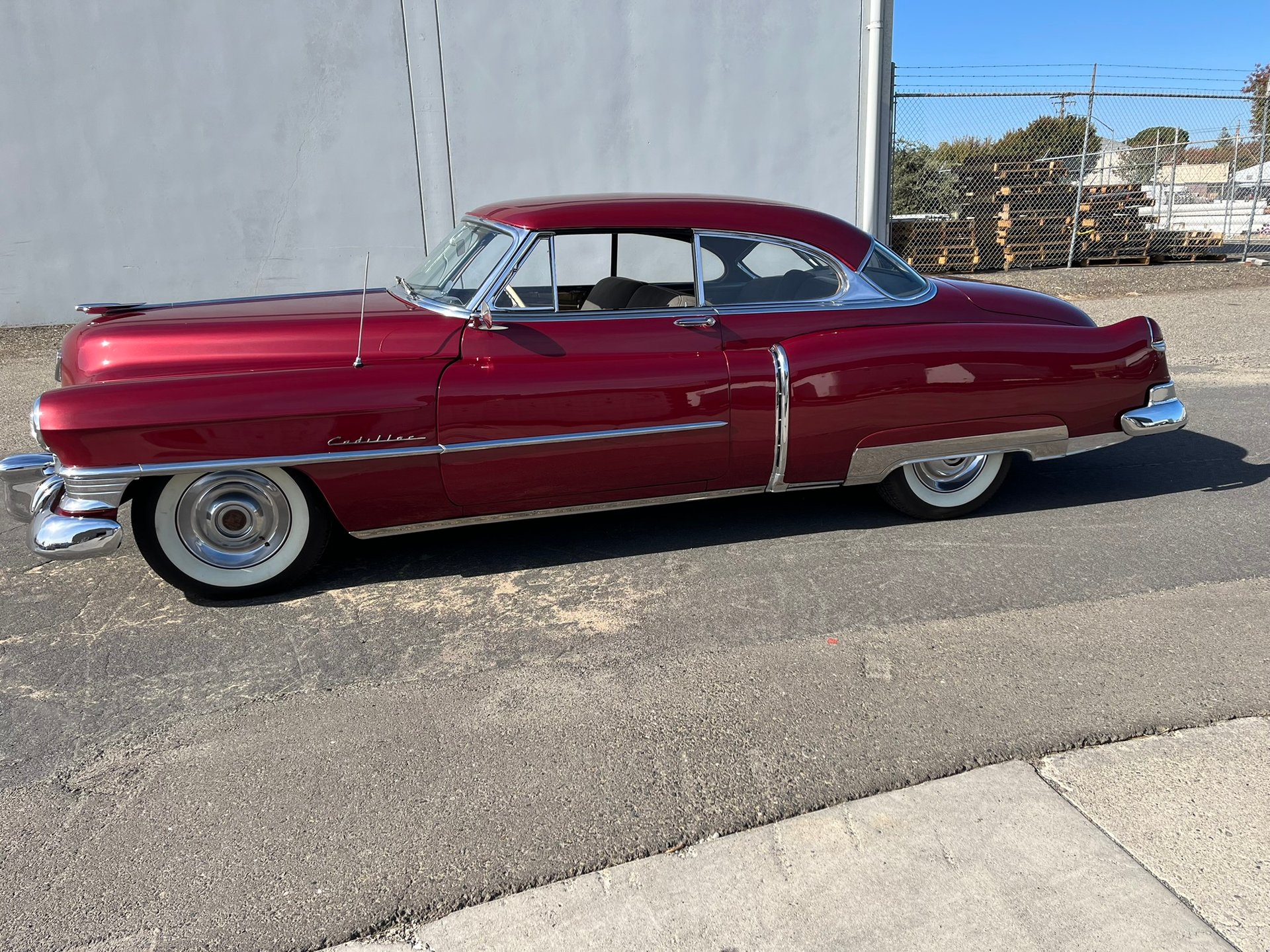
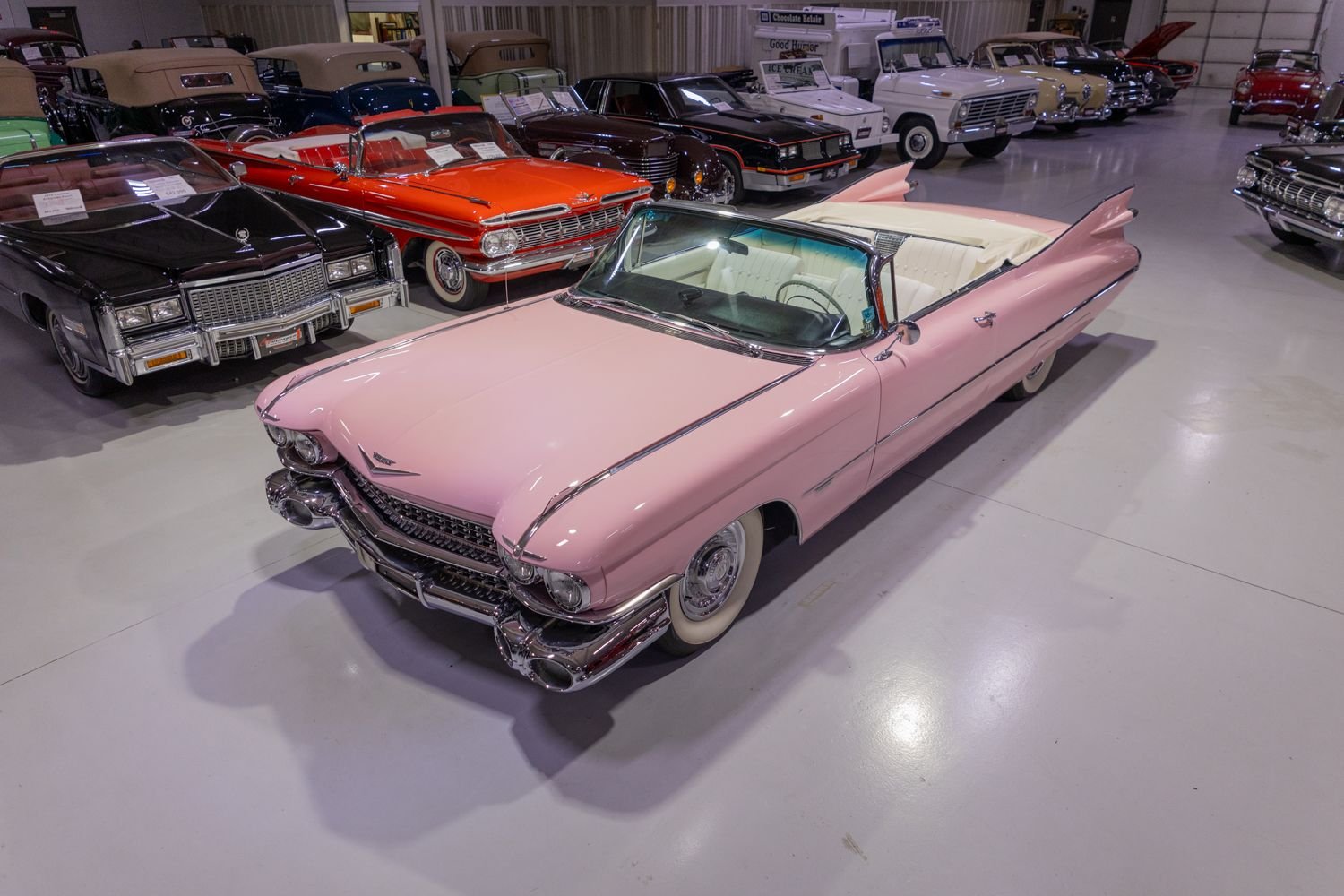
From there the 1950s are a story of annual escalation. Dagmar bumper cones arrived at the front. The Coupe de Ville hardtop, shown as a Series 62 in 1949, helped kill the formal closed coupe as the fashionable body. Power steering, brakes, windows and seats, air conditioning and automatic headlamp dipping all moved from novelty to expectation. Horsepower climbed as the 331 grew into the 365 and then the 390. Styling reached its extreme in 1959, with fins taller than on any production Cadillac before or since and twin bullet tail lamps set into them, then retreated quickly: 1961 and 1962 are visibly calmer, and 1963 is cleaner still, squarer and more formal, with a substantially redesigned engine under a familiar displacement. For 1964 the Series 62 gained the new 429 and the Turbo Hydra-Matic, and after that year the name was retired, its place taken for 1965 by the Calais. The cars in our own listings run from 1941 to 1963 — pre-war, immediate post-war, the finned fifties and the tidier early sixties in one nameplate.
We currently track 50 Series 62 cars for sale or recently sold, 24 for sale and 26 sold, and for 25 we have examined the sellers' photographs in detail. Rust is mentioned in the notes for 12 of the 25 — just under half — and visible damage in 7. That does not mean half of all Series 62s are rusty wrecks; a note records what a photograph shows. It does mean you should assume the body, chrome and underside need a forensic examination, and be pleasantly surprised when a car passes. The difference between a good Series 62 and a money pit is almost never the odometer reading, which at this age is a story unless paperwork proves it. The difference is rust, storage, and whether the systems fitted to make the car feel effortless — automatic, power steering, brakes, windows, air conditioning — have been kept working or left to seize, leak and perish.

The models
Every Series 62 is a full-size, rear-wheel-drive Cadillac on a separate chassis, with a V8 in front and, in the overwhelming majority of surviving cars, an automatic behind it — automatic is by far the dominant transmission recorded across our pool. What changes dramatically across the run is the generation of the body, the generation of the engine, and the body style on the chassis. Learn to place a car in those three dimensions before you think about colour, options or price, because a 1948 convertible, a 1953 sedan and a 1959 convertible share a name and almost nothing else that affects what they cost to own.
| Model | Years | Engine | Output | Built | Character |
|---|---|---|---|---|---|
| Series 62 sedan and coupe, pre-war | 1940–1942 | 346 cu in flathead V8 | 150 hp by 1941 | Low by post-war standards; war ended the run | Torpedo styling, manual gearbox common, Hydra-Matic a rare 1941 option |
| Series 62, immediate post-war | 1946–1947 | 346 cu in flathead V8 | 150 hp | Strong pent-up demand; essentially the 1942 car | The bridge car — pre-war engineering, post-war prices when new |
| Series 62, new body | 1948 | 346 cu in flathead V8 | 150 hp | One-year combination | The first finned Cadillac; new body, old engine |
| Series 62, OHV era begins | 1949–1953 | 331 cu in OHV V8 | 160 hp, rising to 210 hp by 1953 | Volume production; the core early-fifties car | The modern Cadillac arrives — OHV power, Hydra-Matic widespread |
| Series 62 sedan, coupe and convertible | 1954–1956 | 331 cu in, then 365 cu in OHV V8 | 230 hp rising to 285 hp | Volume production | Longer, lower, more power assistance; Eldorado power at the top |
| Series 62 including De Ville bodies | 1957–1958 | 365 cu in OHV V8 | 300 hp, then 310 hp | Volume production | X-frame cars, quad lamps for 1958, air suspension optional |
| Series 62, fin peak | 1959–1960 | 390 cu in OHV V8 | 325 hp | Volume production; 1959 the icon | Tallest fins, most chrome, most recognisable — and most expensive to restore |
| Series 62, fin retreat | 1961–1962 | 390 cu in OHV V8 | 325 hp | Volume production | Cleaner Bill Mitchell styling, skeg fins, same strong engine |
| Series 62, final form | 1963–1964 | 390 cu in redesigned, then 429 cu in | 325 hp, then 340 hp | Final two years of the name | Squarer, more formal; 1964 brings Turbo Hydra-Matic |
(Outputs are period SAE gross ratings, which flatter every engine equally and are not comparable with modern net ratings — treat them as a way of ranking cars within the range. Where a row spans several years, Cadillac raised the rating almost every year, and a seller who quotes the highest number in a range for the earliest car in it should be asked to show the specification for that year.)
The bodies, and why the body is the price. Across most of the run Cadillac offered the Series 62 as a four-door sedan, a two-door coupe or Club Coupe, a convertible coupe, and hardtops once the idea took hold. The naming needs care, because Cadillac spun successful Series 62 bodies into sub-series: the Coupe de Ville began in 1949 as a Series 62 hardtop and became a line of its own, the Sedan de Ville followed from 1956, and the Eldorado began for 1953 as a limited Series 62 special convertible before becoming its own line. Badges migrate and descriptions blur, so a car described loosely as a De Ville or an Eldorado may be genuine, a Series 62 with later trim, or simply a hopeful listing. The body plate and its style number settle the question, not the script on the fender. Price the car the plate says it is.
Sedans are the value in the range and, for most buyers who intend to drive, the sensible buy: same engine, same chassis, same presence as the coupe for materially less money. Learn the four-window and six-window distinction on the 1961–1962 cars — the six-window sedan carries additional rear-quarter glass and a different roofline, and the two are confused constantly in listings. Sedans tend to have led gentler lives than convertibles, but they were also the first to be parked when values fell, so storage damage is the sedan disease.
Coupes and hardtops carry the styling premium. Judge a hardtop on its roof and glass: the big curved screens are expensive, the pillarless opening puts unusual demands on door and glass alignment, and a car whose doors sag and whose windows no longer meet their seals will whistle, leak and annoy on every drive. Open, close and latch everything, twice, on the viewing.
Convertibles sit at the top of the ordinary Series 62 market, Eldorados above them. A convertible adds three systems to inspect — the top and its fabric, the mechanism that powers it, and the bracing that replaces the roof's stiffness — and subtracts the roof that keeps water out. One that has lived outside with a torn top is a floor and interior restoration waiting for a buyer; one that has been garaged, whose top works in one smooth cycle and whose floors are sound, is a genuinely different car from the same model with pretty paint and a wet past, and the price gap should be large.
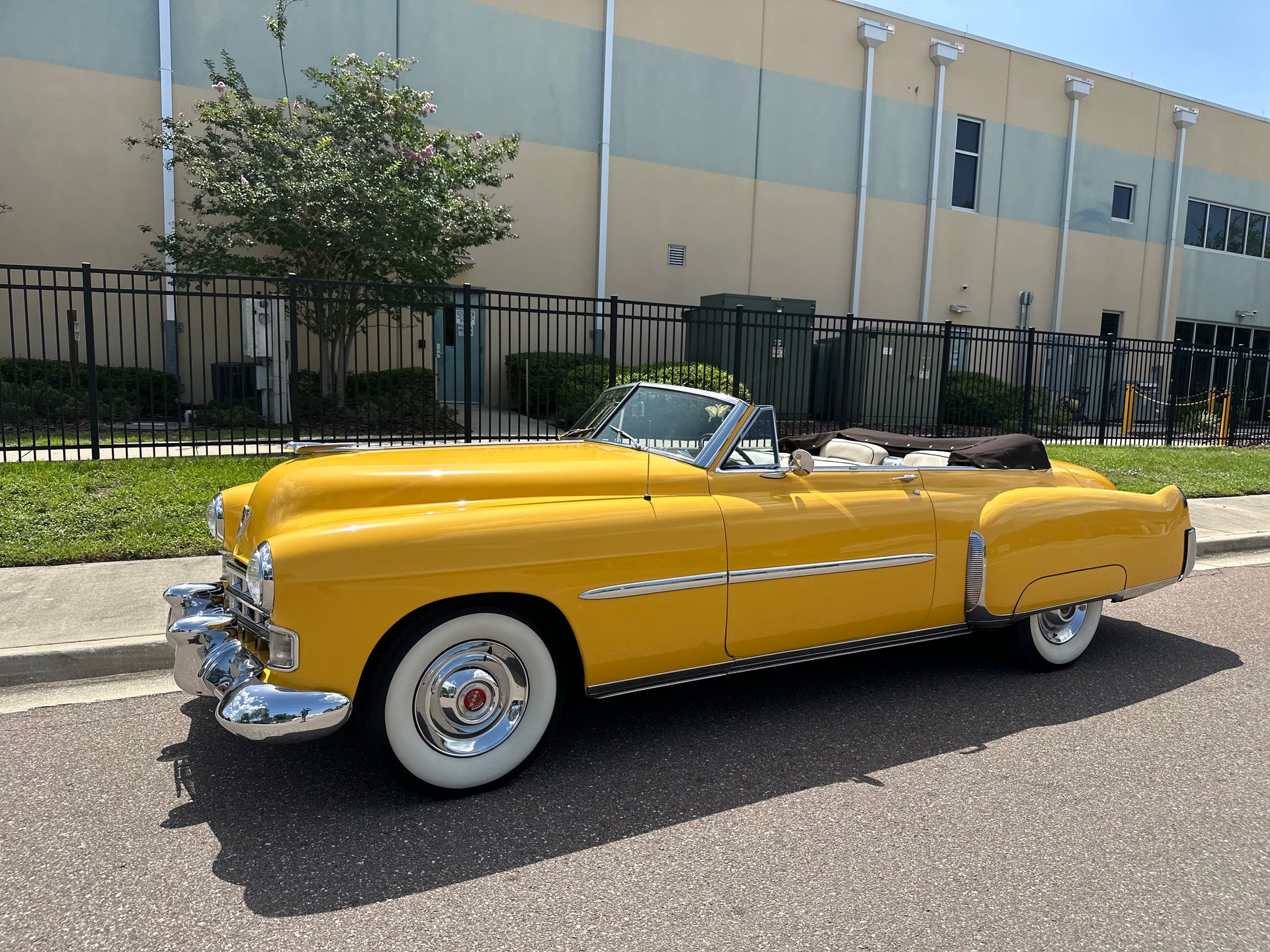
The generations, briefly. Pre-war and immediate post-war cars (to 1947) are vintage cars to own: three pedals are common, parts thinner, cruising speed a negotiation. The 1948 car is a design landmark with an old engine. The 1949–1953 cars are the first modern ones and a sweet spot — OHV power and Hydra-Matic availability in a body still relatively simple. The 1954–1956 cars add size, power and equipment, and start the chrome bill in earnest. The 1957–1958 cars are lower, wider and more complex, on the X-frame, with optional air suspension to interrogate. The 1959–1960 cars are the icons, every restoration cost magnified by trim acreage. The 1961–1964 cars keep the performance, lose the excess, and are often the best drivers of all.
Engines and gearboxes
The flathead: the 346 L-head V8, 1940–1948
The engine in every pre-war and immediate post-war Series 62, and in the landmark 1948 car, is Cadillac's 346-cubic-inch L-head V8 — a flathead, the valves beside the cylinders in the block rather than above them in the head. Developed from the 1930s Monobloc V8, cast in iron, smooth, torquey and deliberately unstressed, it makes 150 hp in final form and was good enough in period to power tanks in a twin-engine installation: tough and tolerant is the summary. What it is not is efficient or powerful by the standards of what followed. Expect relaxed performance, a cruising speed set by gearing and mechanical sympathy, and fuel consumption that reflects 1930s thermal efficiency.
Judge a flathead on the fundamentals. It should start readily, idle with the characteristic flathead smoothness, and pull without a misfire under load. Overheating is the first enemy: a car that boils in traffic is usually telling you about scale, a tired pump or a blocked radiator core rather than a cracked block — but a flathead boiled repeatedly can warp and crack, so ask when the radiator was last cleaned or re-cored, a job that realistically runs $600–1,200. Exhaust manifolds crack with age; a ticking that rises with engine speed and fades as the engine warms is the classic announcement, and manifold replacement can turn into a stud-extraction job, $500–1,500 with broken fixings made good. Oil pressure falls at a hot idle on a worn engine; some fall is age, none at all is a stop. The six-volt system on pre-1953 cars limits cranking speed, so a flathead that is hard to start hot is often a starter, cable and earth problem before it is an engine problem. Do not let a seller blame the electrics for an engine that smokes under load: blue smoke under power is rings and bores, blue smoke after a long idle is valve guides and seals, and either is specialist engine work, typically $6,000–12,000 for a proper rebuild. Parts and knowledge for the 346 exist but are thinner than for the overhead-valve cars. A documented flathead rebuild is worth a real premium; one described as rebuilt with no invoice is an engine of unknown condition with fresh paint.
The overhead-valve revolution: 331, 365 and 390, 1949–1962
For 1949 Cadillac replaced the flathead with an engine that changed the industry: a 331-cubic-inch overhead-valve V8, short-stroke and oversquare, with a compression ratio of 7.5:1 at launch — high for the time, chosen in the knowledge that better fuels were coming. It made 160 hp, weighed less than the flathead, used less fuel, and left room for two decades of development. Output rose to 190 hp for 1952 and 210 hp for 1953; the developed 331 made 230 hp for 1954 and 250 hp for 1955. For 1956 the engine grew to 365 cubic inches and 285 hp, then 300 hp for 1957 and 310 hp for 1958. For 1959 it grew again, to 390 cubic inches and 325 hp, the form that powered the finned icons and the calmer 1961 and 1962 cars. Eldorado versions, with multiple carburettors, made more — up to 345 hp. If a standard Series 62 is advertised with Eldorado power, ask to see the carburetion and the engine number: the difference is hardware, not a tune, and multiple-carburettor hardware is exactly what gets removed, replaced or invented in a listing.
In service these are strong, simple engines: cast-iron block and heads, hydraulic lifters, a single four-barrel carburettor on most standard cars — Carter or Rochester depending on year — and a distributor at the back of the engine. A healthy one starts promptly, idles evenly, pulls cleanly and shows good oil pressure. Listen at start-up for lifter clatter: brief clatter after standing is common, persistent clatter is wear or low oil pressure, and a rhythmic tick that never goes away deserves a rocker and lifter investigation before it becomes a camshaft conversation. Camshaft and lifter wear is the known high-mileage failure on engines that have lived on infrequent oil changes, and the test is behaviour, not mileage claims: uneven idle and a popping back through the carburettor under load point that way.
Carburetion is where most running faults actually live. A Rochester 4GC or Carter AFB or WCFB that has sat in modern ethanol fuel will have a perished accelerator pump, a hardened needle and seat, internal varnish, and a choke that no longer does what the linkage asks. The symptoms — hard hot starting, a stumble on tip-in, flooding after a hot soak, a mid-range flat spot — are routinely blamed on ignition, and just as routinely cured by a proper rebuild, realistically $450–900 for a specialist rebuild of a four-barrel, more for a multiple-carburettor Eldorado set-up that then needs synchronising. Heat soak is a genuine mechanism: fuel percolates in the bowl after a hot shutdown, the car cranks long and smells rich, then clears. What is a mark-down is a cheap modern carburettor swapped on in place of the correct unit with linkage and choke connections improvised — because on a Hydra-Matic car the rod from the carburettor to the gearbox is the gearbox's primary information about engine load. Fit the wrong carburettor, bend the rod, or set it by guesswork and the gearbox shifts at the wrong points, flares, or slips itself to death. Any car with a carburettor swap gets its shift quality examined twice on the test drive.
Oil leaks are a condition of ownership: rocker covers, rear main, timing cover and sender joints all weep. Judge by volume and by what the oil lands on. A misting rocker cover is a gasket and an afternoon; a rear main that leaves a saucer of oil after every run is an engine-or-gearbox-out job, $800–1,800 depending on access and year, and a leak onto exhaust manifolds is a fire risk, not a cosmetic item. Treat a car that runs hot at idle as a cooling system to be diagnosed — fan, shroud, condenser airflow, core condition — not a character trait.

The last engines: the redesigned 390 of 1963 and the 429 of 1964
The 1963 engine keeps the 390 displacement and 325 hp rating and is, underneath, a substantially new engine: lighter, more compact, with revised castings and accessories. For 1964 Cadillac enlarged it to 429 cubic inches and 340 hp. The buying implication is specificity: most of what the trade knows about the 1959–1962 390 transfers in principle, but castings, covers and accessories do not all interchange, and a seller's claim that 390 parts are all the same is a claim to test against the year. The 1963 cars in our listings sit exactly on this hinge. Both engines should behave like the earlier OHV cars — clean start, even idle, strong oil pressure — with the same carburettor, lifter and leak checks.
Gearboxes: manual, Hydra-Matic and Turbo Hydra-Matic
Three gearboxes cover the run. The standard box at the start was a three-speed manual with column change. Judge it on second-gear synchromesh, which wears first and crunches on a hurried downchange, on clutch judder pulling away — oil contamination, a warped plate or tired mountings — and on a noisy release bearing, a cheap part in an expensive place. Manual cars became steadily rarer as Hydra-Matic took over, and rarity does not mean value here: most Series 62 buyers want an automatic, and a manual should be priced as the narrower-market car it is.
The Hydra-Matic defines the model. An option for 1941, back after the war and progressively standardised through the 1950s, it is a four-speed automatic using a fluid coupling rather than a torque converter in its classic form; changes are positive, sometimes firm to a thump on a car whose throttle-valve linkage is mis-set or whose idle is too high. The Dual-Range version from 1952 added driver control over the ranges; the Controlled-Coupling unit from 1956 revised the internals for smoothness. The inspection logic is shared: fluid red to light brown and not burnt-smelling — black, burnt fluid is a gearbox that has been slipping — shifts at sensible speeds without flare or a long slide, reverse engaging promptly, and no refusal to move until warm, which describes seals that harden when cold. A full specialist rebuild is realistically $2,800–5,000, and the shops that genuinely know the early units are few, so documented work from a named specialist is worth a premium. A Hydra-Matic that shifts well, with clean fluid and a recent fluid invoice, is one of the strongest buying signals a Series 62 can give you: the previous owner spent money where it does not show.
For 1964 the Series 62 moved to the Turbo Hydra-Matic, a three-speed with a torque converter, sharing its architecture with the rest of General Motors. It is smoother and the best-supported automatic in this guide, a rebuild typically $2,200–3,800. Do not let anyone sell you a pre-1964 car as a Turbo Hydra-Matic car without paperwork: the gearbox is a year identity check, and a swap changes both originality and the parts you will order for as long as you own it.
Whichever automatic a car has, remember the throttle linkage warning, check for leaks at the pan, rear seal and cooler lines, and confirm the car does not creep violently at idle in gear — idle set too high to mask a poor tune is a common seller's trick, and it makes the gearbox take the blame for the engine's problem.

Problem areas
This section follows a good inspection's order: structure first, because structure decides whether the car is worth saving; then the systems that stop and steer it; then the Cadillac-specific systems — power assistance, vacuum, electrics, air conditioning — whose failure fills most owners' first-year budgets; then interior, glass and chrome, where the money disappears in plain sight. Recall our own pool: of 25 cars whose photographs we examined, rust features in the notes for 12 and visible damage in 7. Read those as a prompt to look, not a verdict on any individual car — and remember that sellers' photographs avoid undersides, floors under carpets and boot floors under spare wheels, which are precisely the places this section sends you.
Rust and the chassis: the map
A Series 62 is a body on a separate frame, which changes the rust conversation but does not make it kinder: a rotten car can hide a sound-looking body over a thinned frame, or a solid frame under dissolved floors and sills. Judge both, separately, on a lift if at all possible.
Start with the frame. The perimeter frame of the earlier cars and the cruciform X-frame used from 1957 concentrate corrosion where dirt and water sit: side-rail kick-ups over the rear axle, body-mount outriggers, the front crossmember and suspension mounting points, and anywhere underseal has trapped moisture against the steel. Surface scale is normal. Perforation, lamination that flakes under a screwdriver, and cracking around a mount are fabrication work — realistically $1,500–4,000 for a localised rail repair done properly, and far more if several areas have gone together. The X-frame deserves a specific warning: its central cruciform is awkward to inspect and repair, and rust in the centre section is the most expensive rust on a 1957 or 1958 car. Prod, do not just look; fresh, uniform underseal over everything, including brake pipes and mount bolts, is a question.
Floors next. Water gets in past perished windscreen and rear-window seals, door seals, a leaking heater case and — on convertibles — the top and its well, then sits under carpets that hold it against the floor for years. Lift the carpets in all four footwells. The spare-wheel well and boot corners rot from rear-window and boot-seal leaks; front floors rot from windscreen leaks. A holed floor is a panel job, $700–1,800 a side fitted and painted, but floors rarely rot alone: treat floor rust as a marker for the sills, lower door skins and body mounts below. Inner and outer sills — rocker panels — are structural to the body even on a framed car, trap mud thrown up by the front wheels and rot from inside out, so paint bubbles at the bottom of a rocker mean the inside is worse, and a rocker that flexes under a hard thumb press is a cutting-and-welding job at $900–2,200 a side.
Then work the perimeter. Lower front fenders behind the wheels, lower rear quarters, the bottoms of all doors — check the drain slots are clear, because a door with blocked drains fills with water and rots from the bottom edge up — headlamp surrounds, the windscreen surround, and on 1959 and 1960 cars the pressings around the fins and tail lamps, where water sits in seams that are nearly impossible to reach. Fin and tail pressings on a 1959 are fabrication territory, and a rusty 1959 is a materially more expensive proposition than a rusty 1961 for exactly that reason. The battery tray and the firewall beneath it rot from acid from the top down and are invisible with the battery in place: rock the battery and look at the tray edges with a torch.
Finally, read accident damage alongside rust. Our photo notes record visible damage in 7 of 25 examined cars, and some of it will be parking damage to chrome rather than structure — but misaligned bumpers, uneven panel gaps, overspray on rubbers and a rippled boot floor are evidence of a hit, and a hit repaired cheaply in the 1970s is now a rust trap as the filler cracks. Run a cloth-wrapped magnet over the quarters, fenders and door bottoms; where it will not stick, there is filler, and filler is a question about what is underneath it, not an automatic rejection.
Suspension, steering and brakes
The front suspension is independent, by coil springs and unequal-length arms, with kingpins on the earlier cars giving way to ball joints as the 1950s progress; the rear is a live axle, on coil springs in place of leaf springs as the decade turns. None of it is exotic, all of it is heavy, and a worn Series 62 announces itself with wander, float and uneven tyre wear rather than a rattle. Kingpin cars want grease discipline: joints starved of grease feel worn, and the honest test is to grease first, then rock the wheel and judge the play, because a specialist kingpin job at $800–1,500 a side should not be bought on the evidence of a dry joint. Dampers that have lost their oil turn the car into a boat; a bounce at each corner that does not settle in one movement prices a set, typically $400–900 fitted. Rear coils sag and the car sits tail-down — read stance before blaming anything clever, and on a 1957–1960 car with optional air suspension, read on before blaming springs at all.
Air suspension used rubber bellows with a compressor and levelling system in place of steel coils. When it works it is a period marvel; almost no surviving system works as designed without recent expenditure — bellows perish, compressors wear, levelling valves stick. Most cars have been converted back to coils, a legitimate solution, but a converted car should be priced as converted, and a car still on air with a sagging corner is a system rebuild, realistically $2,500–5,000. A car level in photographs and on its bump stops when you arrive has told you its system leaks.
Steering moves from manual to power-assisted across the run. The Saginaw power systems are robust; their enemies are leaks — pump, hoses, box seals — and wear showing as free play at the rim. An inch or two is normal wear to be priced; a quarter-turn is a box rebuild, $600–1,200 plus fitting. Dark, burnt-smelling fluid and a groaning pump on full lock mean a pump and a flush at minimum. On manual early cars, heavy parking-speed steering is correct, but notchiness at centre is a worn box, not character.
Brakes are drums all round — big, finned, power-assisted on most later cars — and disc brakes are not part of the Series 62 story in the years our listings cover, whatever a seller may claim. Drums in good order stop these cars adequately; drums that have sat do not. The standard recommissioning list is seized or leaking wheel cylinders, perished hoses, a tired master cylinder, scored drums and contaminated linings, and a full hydraulic refresh realistically runs $900–2,200 with labour. Judge by test, not pedal feel in the yard: a car that pulls under a firm stop from 40 mph has a seized or contaminated unit, and a pedal that sinks under sustained pressure is a master cylinder or a leak — either is a do-not-drive-home finding. Test the parking brake, a separate cable system that seizes from disuse, on a slope. Power boosters fail at the diaphragm, giving a hard pedal, a hiss and a rising idle at idle — a rebuild is $350–700 plus fitting, and the test costs nothing at the kerb.
Electrics, vacuum and the power accessories
Cadillac sold effortlessness, delivered by electricity and vacuum, the two systems that age worst. Cars to 1952 are six-volt, positive earth in the period manner you must confirm before connecting anything; from 1953 Cadillac is twelve-volt. Six-volt cars crank slowly even when healthy, and every cable and earth has to be good: one that will not start is usually a cable, earth, starter or battery problem, in that order, before it is anything else. Twelve-volt cars are more forgiving and more complex, because the accessories multiply.
Work every switch: power windows — hydraulic in the earliest cars, with a pump and rams that leak into doors and sills, then electric — power seats, aerial, heater fans, wipers, washers, horn, every lamp, and the air conditioning controls. Each dead accessory is a diagnosis, not a fixed deduction: a window that does not move may be a switch at $40 in parts, a motor at $250–450 fitted, or, on a hydraulic car, a leak that has also been rotting the door and sill below it. Vacuum wipers on earlier cars slow to a stop under acceleration, when manifold vacuum falls — correct behaviour — while a vacuum leak in the hose network feeding wipers, locks, parking-brake release and air-conditioning controls produces a cluster of apparently unrelated faults and a hunting idle. Perished hose is cheap by the foot and tedious by the hour.
Air conditioning, offered from the early 1950s, is the accessory buyers most want and most cars least have working. A system that blows warm may need a recharge, or a compressor, a holed condenser, perished hoses throughout and an evaporator leak behind the dashboard — the difference between $300 and $3,000–5,000. Original systems used R12; many have been converted to R134a with varying competence. Ask when it last blew cold — not cool, cold — and test it whatever the season. Generators and later alternators fail at brushes, bearings and regulators; a battery that is always half flat is a charging diagnosis before it is a battery purchase. And verify alarming gauges before believing them: a hot-reading temperature gauge against an infrared thermometer on the thermostat housing, a misbehaving oil-pressure gauge with a mechanical gauge in the sender port — the test that separates a tired sender, at trivial cost, from a tired engine, at rebuild cost.
Interior, glass, chrome and the convertible top
The interior is where a Series 62 restoration goes to die financially, because there is so much of everything, in year- and body-specific patterns. Seat padding collapses, so sit in the driver's seat and feel for the spring frame; headlinings stain from the same window-seal leaks that rot the floors, so follow any stain to its seal; door cards warp at the bottom from door water; carpets hide the floors, which is why you lift them. A professional retrim in correct materials runs well into five figures, $8,000–18,000 depending on material and body style, which is why an honest original interior with wear is worth more than a fresh incorrect one. The Cadillac equivalents of wood trouble are the instrument panel, its plastic and die-cast ornament, and the steering wheel, whose rim cracks: 1950s plastics craze and warp, and one-year knobs and lenses consume weekends at swap meets.
Glass is a serious line item. Wraparound windscreens, the huge curved screens of 1959 and 1960, and hardtop rear glass are all expensive, some reproduced and some not, and a cracked screen can run $800–2,500 supplied and fitted if it is available at all, plus the seal, plus the rust you will find under the seal. Delamination — a milky edge spreading into the laminated glass — is cosmetic until it reaches the swept area. Check every pane, and on a hardtop run the windows through their full travel and watch whether front and rear glass still meet.
Chrome and stainless are the signature Cadillac cost: massive bumpers, multi-piece grilles, side spears, window frames, and on the finned cars an acreage of brightwork at the rear. A full car can carry a chrome bill of $5,000–12,000 at show quality; driver-quality replating of bumpers and grille alone is commonly $2,500–5,000. The trap is die-cast — pot metal — trim, which pits from within as the alloy ages, blistering the chrome in a way that cannot be polished out. Stainless, by contrast, polishes and repairs well. Count the pitted pieces and price them honestly: chrome is the cost sellers describe as easy and owners describe as the largest single invoice of the restoration.
On a convertible, add the top. Fabric is $1,200–2,500 supplied and fitted, but fabric is the least of it: the frame must fold without bent links, the pump and rams must complete a cycle without hesitation, leaks or a hand on the header rail, and the top well and floors below must be dry and sound. A top that only works with help is a mechanism rebuild, $800–2,000, and a top that has leaked for years is a floor and interior job wearing a convertible's price tag. Cycle it twice, fully. A seller who will not let you has answered the question.
How to inspect one
Allow at least an hour, bring a torch, a cloth-wrapped magnet, an infrared thermometer if you have one, and a screwdriver for prodding with the seller's permission. Insist on a cold engine. If the car passes you, pay for a lift inspection before money changes hands — on a two-ton, body-on-frame Cadillac it is the only way to see frame, mounts and floors in one pass, and the best money in the purchase.
- Start with the paperwork and the plates. Match the title to the serial plate and, where the year carries one, the engine number. Find the body plate — on most years on the cowl or firewall — and read the style number, trim code and paint code. The style number settles whether the car is a Series 62, a De Ville or an Eldorado, whatever the fender script says. A thick history file is worth real money on this model; a car with no paper is priced as a car of unknown condition, because that is what it is.
- Cold start. From cold, the car should start without extended cranking — allowing for six-volt cranking speed on a pre-1953 car — and settle to an even idle. A puff of blue at start-up that clears is valve seals; continuous blue smoke is rings; white vapour that does not clear and smells sweet is coolant, and that is a head-gasket conversation. Listen for lifter clatter on an overhead-valve car and time how long it takes to quieten.
- The oil and water checks. Pull the dipstick. Black oil is overdue; grey or milky oil is contaminated; oil that smells strongly of fuel points to a flooding carburettor, a failed fuel-pump diaphragm or a life of short runs, each with a different price. Check the coolant for oil, then run the car to full temperature and verify the gauge against an infrared reading at the thermostat housing.
- Under the car: frame first. On the lift, work the frame front to back: crossmember, side rails, body-mount outriggers, kick-ups over the rear axle, and on a 1957 or 1958 car the centre of the X-frame. Perforation at a mount or in the X is the finding that re-prices or ends the inspection. Then floors from below, inner rockers, boot floor and spare-wheel well. Fresh uniform underseal over everything is a question, not an answer. This step decides whether you continue.
- Floors and boot from inside. Lift all four carpets, look for water tracks from the windscreen base and heater case, and prod the pans. Lift the spare wheel and boot mat, look in the well corners, and run a fingertip along the rear window seal — where the water that rots the boot floor gets in.
- Body, gaps and the magnet. Run the magnet over rockers, quarters, fenders and lower doors. Feel along every door's bottom edge for bubbling and check the drain slots. Check the battery tray and firewall below it. Count the pitted chrome and die-cast pieces and write the number down. Check panel gaps and bumper alignment for accident history.
- Suspension, steering and stance. Stand back: level is correct, tail-down is springs or, on an air-suspension car, a leaking system, and a car that has sunk since its listing photographs has confessed. Rock each front wheel for play, remembering the grease-first rule on a kingpin car. Bounce each corner. On the drive, judge steering play, wander, and any groan from the power-steering pump on lock.
- The test drive. Fifteen minutes minimum, including a stretch at 50 to 60 mph if roads allow. A Hydra-Matic should shift positively, without flare or a long slide, and reverse should engage promptly; a mis-set carburettor linkage can make a good gearbox shift badly, so note both together. A manual is judged on second-gear synchromesh and clutch judder. The engine should pull cleanly — a stumble on tip-in is carburetion until proved otherwise — and cruise without overheating or wander.
- Brake hard, twice. From speed, brake firmly: the car should stop straight, without judder, a sinking pedal or a pull. Either fault ends the idea of driving it home. Test the parking brake on a slope. At idle afterwards, press the pedal: a hiss, a hard pedal and a rising idle together are the booster diaphragm test from the problem areas, done in ten seconds.
- Every switch, every accessory. Work the windows, seat, aerial, lights, wipers, washers, heater on every speed, horn, radio, and the air conditioning if fitted — cold, not cool, or it is a system to be priced. On a convertible, cycle the top twice, fully, without help. Note each failure with its likely cause: five dead accessories with five causes is a first-year budget, and you should be the one who wrote the list.
- Heat soak and hot restart. After the drive, let the car sit hot for ten minutes, then restart it. Long cranking with a rich smell is the heat-soak behaviour from the engines section — price it as a carburettor rebuild if severe. Check temperature at a hot idle and look underneath for fresh leaks now everything is warm: coolant, engine oil, gearbox and power-steering fluid each leave a different colour and a different bill.
- Interior and glass last. Sit in every seat, feel for the spring frame through collapsed padding, follow any headlining stain back to its seal, and check door-card bottoms for water warp. Run every window through its travel and check every pane for cracks and delamination. A sound original interior and sound glass are the hardest things on this car to recreate, so weight them heavily.
Values
The Series 62 market is not one market, and the first skill in reading it is refusing to average it. A pre-war sedan, a 1953 coupe, a 1959 convertible and a 1963 sedan share a name and almost nothing else about who wants them or what a restoration costs, so a single typical price tells you nothing you can act on. Read the market block that follows this guide generation by generation and body by body, and treat any figure that mixes the generations as background noise.
Condition drives a wider spread here than on most classics, for a structural reason: the cost of putting a bad Series 62 right is unusually high relative to the value of a good one, because the expensive items are chrome, interior, glass and body acreage rather than mechanical complexity. The gap between a project and a driver is therefore not a discount for work you can do cheaply at weekends; it is the market pricing in professional chrome, trim and paint bills. At the bottom sit sedans with rust, dead accessories and storage damage, cheap because the arithmetic of restoring them does not close. In the middle sit honest drivers — sound shells, working automatics, presentable chrome, interiors original and worn rather than ruined — the cars that change hands most readily, because the next owner can use the car while improving it. At the top sit convertibles, Eldorados, finned cars in fashionable colours and documented finished restorations, where price is set by presentation and provenance as much as by the car underneath.
Asking and achieved prices differ, with a pattern. Dealer asking prices for the fashionable bodies tend to be set in hope of the best recent result for the model year, while auction results — public, final and condition-visible — are the more honest guide to what a given car actually brings. When the two disagree, believe the achieved figure and ask what the advertised car has that the auction car did not. Colour matters more than it should: period pastels and the famous pinks and reds attract bids in a way a correct but sober black sedan does not, and a colour change that is not the colour on the body plate is a previous owner's cosmetic decision, not originality. Options matter when they work: air conditioning that blows cold, a working top and functioning power accessories support a premium because they represent money already spent, while the same options dead are a liability wearing the same words in the advertisement.
Body style is the strongest single premium driver: convertibles most, genuine Eldorado bodies more again, hardtop coupes next, and sedans the value, often dramatically so for a car the coupe's mechanical and structural equal. Year premiums follow fashion rather than engineering: 1959 carries an icon premium the tidier 1961 car does not, and 1948 and 1949 carry landmark premiums as the first finned and first overhead-valve cars.
Negotiation reality is straightforward. A car with a written list of inspection findings — frame, floors, chrome count, dead accessories, gearbox behaviour — can be discussed in facts, and sellers of honest cars expect it. A car priced as finished that needs chrome, a top mechanism and a brake overhaul is a different car from the one advertised, and should be priced as the car it is or left.
Parts and ownership
The Series 62 is one of the better-supported American cars of its era: Cadillac built a great many, the Cadillac and LaSalle Club sustains a deep knowledge base, and the cars share much hardware with the rest of General Motors. Support is not uniform: the overhead-valve cars of the 1950s are best served, the pre-war and flathead cars depend more on specialists and club knowledge, and one-year details of any year are where supply thins.
Easy: service items for the overhead-valve engines — filters, plugs, points, belts and hoses; carburettor rebuild kits for the common Carter and Rochester four-barrels; brake hydraulics, linings and drums; dampers, springs and most suspension wear parts; Hydra-Matic and Turbo Hydra-Matic service parts through the transmission trade; twelve-volt electrical consumables and starter and generator rebuild services; reproduction weatherstrip for the popular bodies; and exhaust systems in standard form. Order today, fit this month.
Harder and dearer: flathead engine parts and the machining knowledge to use them; correct multiple-carburettor Eldorado hardware; air-suspension bellows, compressors and levelling components; wraparound and finned-era glass for the less common bodies; die-cast trim in unpitted condition, which is a search rather than a purchase; one-year 1948 and 1963 trim; correct-pattern interior materials for uncommon trim codes; hydraulic power-window components; and air-conditioning parts for the early boot-mounted systems. None is unobtainable; all take time, club contacts and money in proportions to sample before purchase, not after — read the club parts-wanted threads for your year, because they are the truest catalogue of what is actually scarce.
Running costs. A sorted Series 62 is a realistic regular-use classic: the overhead-valve engines are tough, the gearboxes strong when their linkages are set correctly, and what stops these cars is almost always the periphery — carburetion, ignition, charging, cooling, perished rubber — rather than the core mechanicals. Fuel consumption is heavy and should be budgeted for honestly. Servicing is within any good classic workshop's ability for the overhead-valve cars, the Hydra-Matic being the one item where a genuine specialist earns his fee. The budget line that catches new owners is the first year: catching up on a running car — brakes, hoses, belts, fluids, tyres of unknown age, a carburettor rebuild — honestly costs a four-figure sum before you improve anything, and recommissioning a car that has sat for years costs materially more, because its fuel system needs cleaning end to end, its brake hydraulics renewing rather than trusting, and every rubber component treating as guilty until inspected. Tyres deserve a warning: a two-ton car on old tyres that look fine is a risk out of proportion to the saving. Buy a car in regular use over one that has been asleep, even at a higher price — on a Series 62, use is maintenance, and sleep is decay.
Which one to buy
- The all-rounder: a 1955 or 1956 sedan or coupe. Developed 331 and 365 power, Hydra-Matic availability, the best parts support in the range, and unmistakable fifties styling without the 1959 restoration bill. If you want one Series 62 to drive, start here.
- The value buy: a 1961 to 1963 sedan. The same 390 power as the finned cars, cleaner styling, often a better-kept car, and a market that charges less because it photographs less dramatically. The less fashionable roof is frequently the better car for the money.
- The landmark buy: a 1949 car. The first overhead-valve Cadillac, in a body still of the early, smaller scale. Parts and knowledge are good, and a sound 1949 is a car with a story that is actually true.
- The icon: a 1959 convertible. Buy it with the chrome counted, the top cycled twice and the floors lifted. A good one is the definitive finned Cadillac; a rusty one is the most expensive restoration in this guide.
- The connoisseur's car: a 1948 convertible or coupe. One year of the new finned body over the flathead, a genuine landmark and a slower, more vintage experience. Buy the best-documented car, because flathead work is specialist work.
- The pre-war car: a 1941 Hydra-Matic car, if you can find one. The first year of the automatic that defined Cadillac, in the Torpedo-styled original — with cruising speed, braking and parts supply all of their period.
And the rule that overrides all of the above: buy the soundest shell and frame, with the most complete chrome and interior, in the specification you can live with. Engines, carburettors, gearboxes and brakes are all fixable at prices you can plan for. A rotten frame, a dissolved floor, pitted die-cast and a ruined one-year interior cost more to put right than the finished car will be worth.
See the 29 Series 62 cars currently listed.