
Cadillac Fleetwood Sedan 4D buyer's guide
Cadillac Fleetwood Sedan 4D -- the model's own buyer's guide: variants, values and what to check.
Years listed: 1958-1995 · Series: Full Size
Overview and history
Fleetwood is not one car. It is a name Cadillac used, on and off, for more than sixty years, and it has sat on formal limousines, on the largest production sedans America ever built, on a front-wheel-drive car that shares almost nothing with them, and finally on the last traditional body-on-frame Cadillac sedan of all. If you shop for a Fleetwood by badge alone you will compare cars that have no parts, no driving character and no ownership costs in common. The first job of this guide is to stop you doing that. The second is to show you that, once you separate the generations, each one is understandable and buyable.
The name starts with a coachbuilder, not a model. The Fleetwood Metal Body Company of Fleetwood, Pennsylvania, built custom bodies for the most expensive chassis of the 1910s and 1920s, Cadillacs prominently among them. Fisher Body bought Fleetwood in 1925 and General Motors absorbed Fisher soon after, so from the late 1920s onward a Fleetwood body on a Cadillac meant the top of the catalogue: the best trim and the bodies reserved for the senior series. Through the 1930s the name marked out the big Series 75 limousines, and that association — Fleetwood equals the formal, chauffeur-grade Cadillac — runs through everything that follows, even when the engineering underneath changes completely.
After the war the name settled into two lines that dominate the early market today. The Fleetwood Sixty Special was the flagship owner-driver sedan, a step above the Series 62 and later the DeVille in trim, wheelbase and price. The Fleetwood Series 75 was the limousine: a much longer wheelbase, a division window, jump seats, and a life spent working for hotels, funeral homes and families who employed a driver. Both lines ran through the great styling eras — the tailfins of 1948, the towering fins of 1959, the clean cars of the mid-1960s — and both grew until, by the early 1970s, the Brougham that had grown out of the Sixty Special line was among the longest production cars ever sold in America.
Then the name was pulled in two directions at once, and this is where buyers get confused. The rear-wheel-drive Fleetwood Brougham carried the traditional formula — separate frame, big V8, rear drive — through downsizing in 1977 and on, with steadily less power, until 1992. But from 1985 Cadillac also sold a completely different Fleetwood: a front-wheel-drive, transverse-engine car based on the downsized DeVille platform, powered at first by one of the most troubled engines Cadillac ever built. For seven model years the showroom held both cars at once, and the only reliable way to tell which tradition a given car belongs to is to look at which wheels drive it.
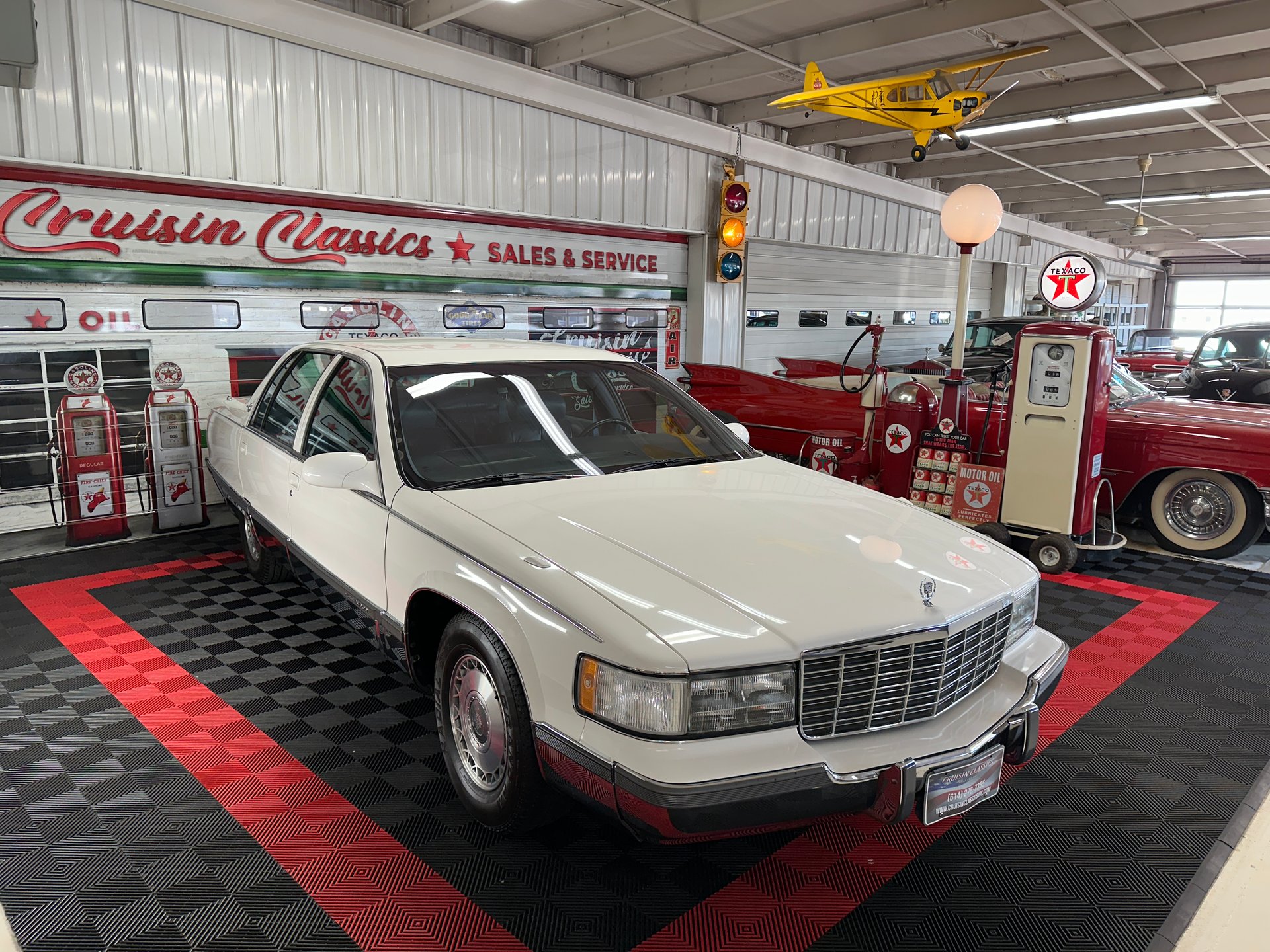
The story ends well. For 1993 Cadillac relaunched Fleetwood as a rear-wheel-drive flagship again, on the D-body shared with the Chevrolet Caprice and Buick Roadmaster but stretched, plusher and — from 1994 — powered by the Corvette-derived LT1 V8. That 1993 to 1996 car is the last of the line: the last body-on-frame Cadillac sedan, and the end of Fleetwood altogether when production stopped after 1996.
Our own listings show that whole arc in miniature. The Fleetwood pool on Classic Listings runs from a 1940 car to the final 1996 cars, and it is heavily weighted to the end of the story: a full third of the pool is the 1993 to 1996 generation, with the rest scattered across the 1950s fin cars, the big 1970s Broughams, the 1980s cars of both drive layouts, and a handful of earlier cars. Florida accounts for more of the pool than any other state, which fits both the retirement-era buying pattern of the late cars and the livery trade that bought the earlier ones new.

The models
Read this section as a map. There are six distinct Fleetwood buys, and the table separates them by the things that actually change your ownership: which wheels drive the car, which engine family is under the hood, and what the car was built to do. Production figures are given only where Cadillac reporting separates the model cleanly; where Fleetwood was reported inside a broader series total, the table says so rather than inventing a split.
| Model | Years | Engine | Output | Built | Character |
|---|---|---|---|---|---|
| Fleetwood formal cars and Series 75 | 1940–1976 | 346 flathead V8, then 331 / 390 / 429 / 472 / 500 OHV V8 | 150 hp flathead; up to 400 hp gross for 500 in 1970 form | Reported inside senior-series totals | The limousine line; division window, jump seats, working lives |
| Fleetwood Sixty Special | 1948–1976 | 331 / 365 / 390 / 429 / 472 / 500 V8 | 160–400 hp gross, era-dependent | Reported inside senior-series totals | The flagship owner-driver sedan the Brougham grew out of |
| Fleetwood Brougham, rear drive, full size | 1977–1986 | 425 / 368 / HT4100 4.1 / diesel 350 / 307 V8 | 125–195 hp net, year-dependent | Volume seller in early years | Downsized but still frame, rear drive and six seats |
| Fleetwood Brougham, rear drive, late | 1987–1992 | Oldsmobile 307, then Chevrolet 305 and 350 V8 | 140–185 hp net | Falling volumes as front drive took over | The traditionalists car; coupe dropped, sedan only from 1988 |
| Fleetwood, front-wheel drive | 1985–1992 | HT4100 4.1, then 4.5 and 4.9 V8; diesel and V6 early | 125–200 hp net | Sold alongside the rear-drive Brougham | DeVille-based, transverse engine; a different car entirely |
| Fleetwood and Fleetwood Brougham, D-body | 1993–1996 | 5.7 L05 TBI V8 (1993), then 5.7 LT1 (1994–1996) | 185 hp (L05); 260 hp (LT1) | About 90,000 over four years | The final flagship; last frame Cadillac sedan, tow-capable |
(Outputs mix gross ratings for the early cars and net ratings from 1972 onward, as Cadillac published them in period. Never compare a 1960s gross figure directly with a 1990s net figure — the measuring standard changed, not just the engines.)
The formal cars and the Series 75. The limousine line is the oldest Fleetwood buy and the most specialised. A Series 75 gives you a wheelbase far beyond any owner-driver sedan, a rear compartment trimmed as a separate room, and a specification built for ceremony and high mileages in professional hands. That cuts both ways today: a well-kept ex-family 75 can be superb, while an ex-livery car may have covered starship mileage in short urban hops, the hardest use there is. The 1962 Series 75 in our photo pool is the archetype. Buy a 75 for the occasion-car experience, and budget as for any low-production formal coachwork: mechanical parts for the shared Cadillac V8s are findable, rear-compartment trim is not.
The Sixty Special and the first Broughams. From the late 1940s to 1976 the Sixty Special was the senior owner-driver sedan, and from the mid-1960s the Fleetwood Brougham name was layered onto it, first as the richest trim and then, in the 1970s, as the model itself. These are the finned 1950s cars, the elegant mid-1960s cars and the enormous 1971 to 1976 cars — what most people picture when they picture a classic Fleetwood. The 1971 to 1976 Brougham is the extreme: the longest, heaviest and most opulently trimmed of the line, with the 472 and then 500 cubic inch V8s, and a ride that defines the word float. If you want the classic American flagship experience in its fullest form, this generation delivers it.
The downsized rear-drive Brougham, 1977 to 1992. The 1977 car kept the formula and lost the excess: shorter, lighter and far more manageable, still on a frame, still rear drive, still six seats. It is the most usable of the traditional cars and, in its first years with the 425 V8, genuinely well judged. The story then sours and recovers. The 368, the variable-displacement V8-6-4 of 1981, the HT4100 and the optional diesel all damaged the cars reputation in period — which is precisely why a good late car, the 1987 to 1992 sedan with the Oldsmobile 307 or the Chevrolet small-blocks, is such a rational buy: it feels like the traditional car, drives better in modern traffic, and carries none of the flagship price. The coupe, sold into the mid-1980s, is the rarity: the 1984 Brougham Coupe in our pool shows the two-door form that disappeared as the market moved to sedans.
The front-wheel-drive Fleetwood, 1985 to 1992. Treat this car as a DeVille in formal dress, because that is what it is: same front-drive platform, same transverse powertrains, with richer trim and equipment a DeVille buyer paid extra for. It is smaller inside than any rear-drive Fleetwood, and its fate is tied entirely to which engine is fitted, as the engines section explains. The early HT4100 cars are the cheapest Fleetwoods in any pool for a well-earned reason. The final 4.9-litre cars of 1991 and 1992 are a different proposition — adequate power, a mature platform and the best reliability of the front-drive run. Confusing this car with the rear-drive Brougham of the same years is the single most common Fleetwood buying mistake, made in both directions: traditionalists overpay for a front-drive car thinking it is the old formula, and good front-drive cars get dismissed by buyers who never learn which engine they have.
The D-body finale, 1993 to 1996. The last generation is the pool's centre of gravity and the easiest Fleetwood to recommend without caveats about era. It is a big car even by Fleetwood standards, with a full frame, a live rear axle, standard anti-lock brakes, and interiors trimmed to a standard the 1980s cars never approached. The 1993 car uses the throttle-body-injected L05 5.7, smooth and understressed but merely adequate. The 1994 to 1996 cars get the LT1, and the LT1 transforms it: a genuinely quick full-size sedan that can also tow serious weight in tow-package form, a combination no other Fleetwood offers. The Brougham name, demoted by now to a trim package, brings the vinyl roof, richer seating and chrome most buyers of the final cars want. When a seller says Fleetwood Brougham about a 1993 to 1996 car, that is trim, not a separate model — the opposite of the 1980s, when the words separated two different automobiles.


Engines and gearboxes
Almost every Fleetwood is a V8 — but there are at least seven distinct V8 families under these hoods, plus a V6 and a diesel that wear the same badge, and they range from some of the most durable engines General Motors ever built to one of the most fragile. The badge tells you nothing. The engine family and the service history tell you everything. Learn to identify what is actually fitted before you discuss price, because on the middle generations an engine swap is common enough that the engine in the car is not always the engine the car was sold with.
The overhead-valve V8s: 331, 365, 390 and 429
Cadillac invented the modern overhead-valve V8 in 1949, and the 331 cubic inch engine that powers the early post-war Fleetwoods is the original: a short-stroke, high-compression design advanced enough to dominate early stock-car racing and civilised enough to idle a limousine. The family grew by bore and stroke — 365 from 1956, 390 from 1959, and the redesigned, lighter 429 from 1964 — and the character stayed constant: strong low-speed torque, hydraulic lifters, a single four-barrel carburettor on most Fleetwoods (Rochester 4GC or Carter AFB depending on year), and a bottom end that tolerates enormous mileages if the oil was changed. A healthy one settles to a near-silent idle and shows no blue smoke beyond a possible puff at start-up from aged valve stem seals.
What kills them now is not design but age and storage. The nylon-toothed timing sprocket fitted in later years of the family sheds its teeth into the oil pan and eventually lets the chain jump — any 390 or 429 with no record of a timing set should be priced as needing one, a job in the region of 600 to 1,200 dollars at a general classic shop, and cheap insurance. Rear main seals weep, and on the early rope-seal engines a drip is a condition of ownership rather than a defect; judge the rate, not the existence. Carburettor trouble is overwhelmingly fuel-system trouble: modern ethanol fuel attacks old rubber, perishes accelerator pump cups and leaves varnish in a tank that sat for a decade. A car that hunts, hesitates or floods after storage usually needs the tank cleaned, the lines and pump renewed and the carburettor rebuilt — 800 to 1,800 dollars done thoroughly — not an engine rebuild. Exhaust manifolds crack, particularly on hard-worked Series 75 cars, and manifold bolts seize in the heads; price a snapped-stud extraction into any exhaust blow you can hear at idle.
The big blocks and the downsizing slide: 472, 500, 425, 368 and the HT4100
The 472 of 1968, enlarged to 500 cubic inches for 1970, is the engine the big Fleetwoods deserve: the largest production V8 Cadillac ever sold, designed for torque, with a Rochester Quadrajet doing the fuelling. In the 1971 to 1976 Brougham it moves two and a half tons with an ease that still surprises people, and in good order it is a 200,000-mile engine. Its known needs are specific. The timing chain set carries the same nylon sprocket concern as the earlier family. The Quadrajet wants a specialist rebuild when the throttle shaft wears and leaks air at the base — the test is a wandering idle that responds to spraying cleaner at the shaft ends — and a proper rebuild runs 500 to 900 dollars. Valve stem seals harden and give the classic puff of blue on start-up and on the overrun; seals alone are a top-of-engine job, not a rebuild. From 1975 the 500 breathes through a catalytic converter and air injection equipment, and a late cars value depends on whether that equipment is present and working in a state that requires it.
Downsizing cut the engine with the body. The 425 of 1977 to 1979 is a lightened descendant of the 472 architecture and is a good engine — the pick of the downsized years. The 368 that followed is underpowered rather than unreliable in plain form, but its headline variant, the V8-6-4 of 1981, varies its own displacement by disabling cylinders through solenoid-controlled valve gear, and the electronics that manage it were not ready. Most survivors have been fixed in eight-cylinder mode by disconnecting the system, which is the sensible ownership answer — but establish which state a given car is in, because a car that hunts between modes on the highway is miserable until it is sorted.
Then comes the engine that defines Fleetwood risk. The HT4100, a 4.1-litre aluminium-block V8 with cast-iron heads, standard in the rear-drive Brougham from 1982 and in the front-drive Fleetwood from 1985, was rushed, underdeveloped and installed in the heaviest cars Cadillac sold. Its failures are structural, not incidental. Aluminium threads and steel head bolts, dissimilar-metal expansion, and marginal cooling produce blown head gaskets and pulled head-bolt threads; neglected coolant corrodes the aluminium from inside; and a distinctive low-speed main-bearing thump signals bottom-end wear no oil change cures. The diagnostic rules are absolute. Milky residue under the oil filler, coolant loss with no visible leak, a cold-start misfire that clears as the engine warms, or bubbles in the coolant reservoir each condemn the car at any price until a combustion-gas test on the coolant proves otherwise. That test costs little, takes ten minutes, and is the highest-value test in this guide for an HT4100 car. Survivors exist — fastidiously maintained, coolant-changed cars with documented histories — and a late, documented HT4100 can be bought knowingly at HT4100 money. An undocumented one cannot. A rebuilt replacement engine runs into several thousand dollars before the ancillaries, which is why the body has to be exceptional to justify rescuing a car.
Two borrowed engines fill out the rear-drive 1980s. The Oldsmobile-built 350 diesel, optional into the mid-1980s, shares the HT4100s reputational problem with a different mechanism — head-gasket failures on an engine converted from a gasoline design, plus injection pump wear — and is a specialist buy only. The Oldsmobile 307 that replaced the HT4100 in the rear-drive Brougham for 1986 is the opposite: modest output, a computer-controlled Quadrajet that needs its mixture solenoid and oxygen sensor alive to run cleanly, and a bottom end that simply goes on. From 1990 the rear-drive cars move to Chevrolet small-blocks — a throttle-body 305 and, the one to want, the 350 — and ownership becomes ordinary small-block Chevrolet: cheap parts, known fixes, no drama.
The front-drive powertrains: HT4100, 4.5 and 4.9
The front-wheel-drive Fleetwood uses the HT4100 first, and everything said above applies, with tighter cooling margins and harder engine-out work in the transverse installation. The story then improves in steps. The 4.5 of 1988 is an enlarged, strengthened development of the same architecture; it is meaningfully better, though it still rewards documented coolant history above mileage claims. The 4.9 of 1991 and 1992, with port fuel injection, is the front-drive engine to buy: adequate power at last, a mature block, and a failure list reduced to the ordinary — water pumps, alternators, failed motor mounts, and intake gaskets that weep coolant externally before they fail internally. On any front-drive car, test the transaxle as carefully as the engine: the TH440-T4 and its successor, the 4T60-E, fail by slipping on the 2-3 shift and by losing reverse when hot, and a transaxle rebuild rivals the value of the car. A small number of early cars carry a Buick 4.1 V6 or the diesel; both are curiosities, not picks.
The finale: L05 and LT1, and gearboxes across the range
The 1993 Fleetwood uses the L05 5.7, a throttle-body-injected Chevrolet small-block tuned for smoothness: 185 horsepower, deep parts support, and faults limited to the familiar — distributor wear at the back of the engine, throttle-body injector dribble, EGR passages carboning up. It is the reliable, unexciting choice, and in a 1993 car condition matters far more than the missing performance.
The 1994 to 1996 LT1 is the headline engine of the whole Fleetwood story, and it needs precise buying because its one famous weakness is real. This is the iron-head version of the Corvette LT1: sequential port injection, 260 horsepower, and torque that finally matches the cars weight. It should start instantly, idle cleanly and pull hard without a misfire under load. The weakness is the Optispark distributor, mounted on the front of the engine directly beneath the water pump. When the pump weep hole starts to drip — and LT1 pumps announce failure exactly there — coolant falls straight into the Optispark, and the optical sensor and cap corrode. The presentation is a high-rpm misfire, then a hot-start failure, then a no-start, in that order over weeks. The test is simple: look for coolant staining below the pump, ask whether pump and Optispark have been replaced together, and treat a documented pair replacement as a selling point worth paying for. Parts and labour for the pair run roughly 900 to 1,600 dollars. The second LT1 trap is the reverse-flow cooling system: it fills and bleeds differently from a conventional system, an air lock after careless coolant work overheats a healthy engine, and the bleed screws exist for a reason. Any LT1 car with a recent coolant story and a wandering temperature gauge needs the bleed proven before it needs a head gasket.
Gearboxes are a strength of the line almost throughout. The early cars use the four-speed Hydra-Matic, whose correct behaviour includes firm shifts; judge it against its contemporaries, not a modern box. From the mid-1960s the Turbo Hydra-Matic 400 three-speed does the work in the big cars, and it is one of the strongest automatics ever fitted to a production car: failure shows as delayed reverse engagement when cold and flaring on the 2-3 shift when hot, and a rebuild at 1,800 to 3,000 dollars restores it completely. The downsized cars move through the TH200 family — the early three-speed TH200 is the one weak box in the rear-drive story and should be tested hot, at length — to the overdrive TH200-4R and, in the final rear-drive Broughams and the 1993 Fleetwood, the 4L60, all of which live or die on fluid history. The 1994 to 1996 cars use the electronically controlled 4L60E: smooth, durable, and intolerant of overheated fluid from towing without the tow-package cooler, which is why tow-package cars are often the best-maintained examples. On any automatic Fleetwood, the test is the same: fluid pink and sweet-smelling, engagement within a second, no flare, no shudder, and a kickdown without a bang.
Problem areas
A Fleetwood fails differently by generation, and the inspection that saves you on one car wastes your hour on another. A 1970s Brougham is a body and frame examination with an engine attached. A front-drive car is an engine and transaxle examination with a body attached. A final-generation car is an electronics, suspension and cooling examination on a fundamentally strong structure. What follows is organised by system, with the generation that owns each problem named every time.
Start with what our own photo work says about the pool. We examined the sellers photo sets in detail for 15 Fleetwoods, and rust was noted on 5 of those 15 cars, visible damage on 4, and a leak noted on 1, with no smoke noted in that sample. Read those numbers correctly: sellers photographs hide undersides, frame rails and trunk floors as a matter of routine, so a one-in-three visible rust rate in listing photos means you assume hidden rust until you have proven otherwise in person. The absence of smoke matches the engines general toughness outside the known problem families — but it says nothing about the HT4100 and diesel cars, whose failures announce themselves in coolant and oil, not in exhaust smoke.
Rust and structure: frame cars, vinyl roofs and the places water sits
Almost every Fleetwood except the 1985 to 1992 front-drive cars is a body on a separate steel frame, and that changes the rust verdict. Surface rust on a frame is normal and treatable; perforation of a frame rail, particularly around the rear axle kick-up, the steering box mount and the body-mount outriggers, is structural, and welding a frame correctly is fabrication work priced per car. Put the car on a lift and prod, do not just look. The factory coating after forty or fifty years is thin, patchy and honestly dirty. A uniform fresh black coating blown over rails, mounts and brake lines the week before sale is a cover story until the seller proves otherwise: nobody re-coats a sound underside as a gift to the next owner.
The bodies rot where water is thrown or trapped. Front fender heels behind the wheels, lower door skins where the drain holes block and the door becomes a tank, rocker panels under their stainless trim — the trim traps grit against the paint and hides the bubbling until it is advanced — and the lower rear quarters behind the wheels. Trunk floors rot from the top down: the rear window and trunk seals leak, water sits under the mat and the spare, and the first sign is a musty smell and a damp mat on a car described as always garaged. Lift the spare on every viewing. A trunk floor repair fitted and painted runs roughly 800 to 2,000 dollars, and it rarely travels alone — price the rear window channel that fed it, the seal and the glass-out work with it.
The Fleetwood-specific trap is the padded vinyl roof, fitted to the great majority of Broughams and final-generation cars. The vinyl cracks with sun and age, water enters the cracks and seams, and the padding then holds it against the steel roof and rear window frame — a permanent wet compress on the thinnest steel on the car. Rust under a vinyl roof announces itself late: bubbling or a soft, crunchy feel under the vinyl around the rear window and C-pillars, and staining at the headliner edges. Press, gently but firmly, all around the rear window through the vinyl on any padded-roof car. Softness there is a roof-skin and window-channel rebuild with the glass out, a job that runs well into four figures and writes off a cheap 1980s car on its own. A hard, drum-tight roof with tired vinyl is a cosmetic re-cover at a few hundred dollars plus fitting. The difference between those two bills is one fingertip test — a seller who will not let you press the roof has given you the answer.
On the front-wheel-drive cars there is no frame to save you: the unibody structure is the car. The rust map moves to the front subframe and its mounts, the rear strut towers, the floor pans under the rear seat, and the bottoms of the doors and rear quarters. Subframe perforation on a front-drive Fleetwood is a walk-away in a way frame surface rust is not, because the subframe carries the engine, transaxle and steering, and sound used subframes are now the limiting part. On the final 1993 to 1996 cars the structure is strong, and the rust that matters is regional: northern cars show it in the rear quarters, the rocker ends, the frame around the rear axle and the brake and fuel lines. Budget a full line set, in the region of 600 to 1,200 dollars fitted, on any salt-belt final car whose lines show heavy scale, and treat clean southern underbodies — much of our pool is Florida cars — as worth a real premium.
Suspension, steering and brakes: weight is the problem
A Fleetwood asks more of its suspension than almost any other car of its years, simply by weighing what it weighs. Front coil springs sag, and the stance tells you: measure arch to ground on both sides, because a car down on one front corner is usually a broken spring or a collapsed mount, not a tired pair. Ball joints, idler arms and centre links wear in proportion to mileage; black, burnt power steering fluid means the pump and box have lived on neglect. The recirculating-ball steering boxes develop play at centre that adjustment only partly cures; a rebuilt box is a few hundred dollars in parts and one of the best value transformations on a vague-driving car. Judge play at the wheel rim: more than about two inches of free movement before the road wheels respond is a box and linkage budget, not an adjustment.
At the rear, the traditional cars use coil springs and a live axle that is fundamentally unbreakable in road use, limited mainly by tired shock absorbers and perished bushings. The ownership issue is the levelling system. From the 1970s onward most Fleetwoods carry automatic level control: a compressor, air-adjustable rear shocks, and a height sensor. When it works, the car sits level regardless of load and the system is invisible. When it fails — perished shock bladders, a dead compressor, a sensor linkage popped off its ball stud — the car sits tail-down, rides on its bump stops and handles with a looseness sellers blame on age. The functional test is in the inspection section: load the trunk, wait, and watch it recover. Restoring level control with new air shocks and a compressor runs roughly 500 to 1,100 dollars in parts and labour; converting to conventional shocks and heavier springs costs less and gives up the levelling, which matters if you tow.
Brakes on every generation must be judged by stopping, not by pedal feel alone. A car that has sat wears rust bands on its discs, seizes its caliper slides and perishes its flexible hoses, and the full hydraulic refresh — calipers or slides serviced, hoses, fluid, pads and discs as needed — runs 800 to 1,800 dollars. Do that sum before the first fast road in any long-stored car. On the older cars, with drums at the rear on many years, a pulling brake is usually a perished hose collapsing internally and acting as a one-way valve, a cheap part that mimics an expensive caliper or cylinder fault. Replace hoses in pairs, by age, on any car whose history is unknown.
Interior, trim and the cost of ceremony
The Fleetwood cabin is the reason to buy the car, and the place where restoration money disappears fastest. Start with the seats. The broad benches and pillow-tufted Brougham seats lose their padding from the drivers entry bolster inward: sit in the drivers seat, not the passenger seat, and feel for the spring frame through the pad. Velour, the signature Brougham cloth, wears thin on the bolster and cannot be patched invisibly; leather, common on the final cars, cracks on the drivers bolster first and survives remarkably elsewhere. A professional retrim is a five-figure conversation in leather and a four-figure one in cloth, which is why a genuinely good original interior is worth more on these cars than a rebuilt engine. Interior condition is the true separator between cars, exactly as the photo sample suggests — visible damage was noted on 4 of the 15 cars we examined in detail.
Wood, on the cars that carry real veneer, cracks at the lacquer first and lifts at the edges second; the simulated wood of the later cars fades and peels at the door pulls instead. Neither is structural, both are in your eyeline for every mile, and full sets in the correct finish are interior-trimmer work, not breakers-yard finds, because every Fleetwood in a yard has the same sun damage yours does. Headliners sag on the 1980s and final cars as the foam backing crumbles, and a re-trim at 400 to 800 dollars fitted is the fix; pins and staples in a sellers photos tell you the car was run on a budget.
Power equipment is where the ceremony lives: power seats, windows, locks, trunk release and pull-down, automatic climate control, and on the final cars, digital instrumentation and memory seats. Test every switch from every door, because Fleetwood faults are usually per-corner, not systemic: one dead window is a motor or a broken wire in that doors hinge conduit, where the loom flexes ten thousand times and the copper snaps inside intact insulation. The test is specific — hold the switch and swing the door slowly; a window that cuts in and out as the door moves has a broken hinge-conduit wire, a cheap fix routinely misdiagnosed as a motor at several hundred dollars. Automatic climate control on the 1970s and 1980s cars is vacuum-operated through a programmer behind the dash, and its failure mode is air delivered to the wrong vents and a system that works only on defrost, the designed default when vacuum is lost. Perished vacuum hoses under the hood cause more climate faults than the programmer itself; replace the hoses before condemning the unit. On the final cars the common climate bill is the blower control module, which fails by leaving the fan running after the key is removed — a flat battery in the morning is its calling card.
Electrics, cooling and the systems that strand you
Fifty years of Fleetwood electrics fail at connections, grounds and switches, in that order. Dim lights, slow windows and a wandering fuel gauge on an older car are ground straps and corroded terminals until proven otherwise. Alternator bearings and diodes announce themselves with a whine that rises with revs and a battery flat after a weekend; a parasitic draw test belongs in any inspection of a car with a new battery fitted just before sale, because a new battery on a car for sale is so often a symptom dressed as a feature.
Cooling is the system that turns Fleetwood faults into Fleetwood funerals, because the marginal engines — HT4100 above all, but also any big-block in traffic with a silted radiator — have no reserve. Judge temperature behaviour precisely: a car that creeps upward in traffic and recovers at speed has an airflow or radiator problem, while a car that overheats at speed has a circulation or combustion-gas problem, and the two diagnoses have nothing in common. Electric fans on the front-drive and final cars must both be heard running with the air conditioning on. Heater cores leak into the passenger footwell on the older cars — a sweet smell, a misting windshield and a damp carpet are the triad — and replacement labour varies from reasonable to dashboard-out by generation.
Finally, the security system on the final cars: PASS-Key reads a resistor pellet in the key, and a worn key or failing lock cylinder produces the classic no-crank with a flashing security light, routinely misread as a starter fault. Two working keys, both tested, belong on your checklist. Every item in this section is cheaper found by you, before money moves, than explained by a seller afterwards.
How to inspect one
Allow ninety minutes, not an hour — these are big cars with more systems to test than any rival — and bring a torch, a magnet wrapped in cloth, and a combustion leak test kit if the car is an HT4100. Insist on a cold engine on arrival. If the car is warm, reschedule or price the concealment: a warm Fleetwood hides cold-start smoke, HT4100 cold misfires, level-control sag and transmission engagement faults, which between them are most of the money in this guide.
- Start with identity and paperwork. Match the VIN on the title to the plate at the base of the windshield and the door sticker. Decode the model from the VIN and trim plate, and establish which Fleetwood this actually is: rear drive or front drive, and which engine family it left the factory with. Then open the hood and confirm the engine in the car matches the paperwork — swaps are common in the 1980s cars, and a good swap (a 307 or a Chevrolet small-block where an HT4100 died) raises the cars value while a careless one lowers it, but either way you must know. Ask for invoices before you look at the car, so the story can be checked against the car, not fitted to it afterwards.
- Cold start. Turn the key yourself. Watch the exhaust for the first ten seconds — a blue puff that clears is valve stem seals, continuous blue smoke is rings or bores, white vapour that smells sweet and does not clear is coolant, and on an HT4100 car any coolant sign ends the inspection here pending the combustion test in step 3. Listen for timing chain rattle that persists beyond the first seconds, and for the level-control compressor running far longer than about a minute, which means it is feeding a leak.
- Fluids and the HT4100 test. Pull the engine dipstick: oil at the correct level, no emulsion, no fuel smell. Check the coolant reservoir for oil film and the underside of the oil filler cap for emulsion. On any HT4100 car, run the combustion leak test on the coolant now, engine warm, exactly as the kit directs; a colour change is a walk-away at any price unless the car is priced as a body for an engine swap. On every car, pull the transmission dipstick after a short run through the gears: fluid should be pink to light red and sweet; brown or burnt-smelling fluid reprices the gearbox into your offer.
- The roof and the trunk. Do the vinyl roof fingertip test from the problem areas section — press around the rear window and C-pillars through the padding and reject softness as a structural bill, not a cosmetic one. Then open the trunk, lift the mat and the spare, and look for water lines, rust and a damp smell in the well. A dry, crisp trunk floor on an old Fleetwood is one of the best single signs the car has been garaged and sealed properly.
- Underneath. On a lift if at all possible — pay for one if the car passes the rest — prod the frame rails at the rear kick-up and steering mount on frame cars, the subframe and rear strut towers on front-drive cars, and the rocker panels, floor seams and brake lines on all of them. Read the coating as the problem areas section describes: patchy and honest is factory, fresh and uniform over everything is a question. Check for the exhaust manifold blow you listened for in step 2.
- Stance and levelling. Sight the car on level ground: level side to side, and correct front to rear for its generation. Then load the trunk with weight, wait two minutes with the engine running, and watch a level-control car pump itself back to height. A car that does not recover needs the compressor, shocks or sensor priced in. A final-generation car sitting tail-high unloaded usually has the wrong springs or a conversion fitted; ask which, and why.
- Body, gaps and glass. Run the magnet over the fender heels, lower doors, rockers and rear quarters; filler announces itself by the magnet falling away. Open and close every door — Fleetwood doors are long and heavy, and a dropped hinge shows as a door that must be lifted to latch. Check glass for chips and delamination on the older cars; curved 1950s glass is an expensive conversation. Count the chrome pieces present and straight, and price absence, not just damage.
- Interior and every switch. Sit in the drivers seat first and judge the padding as the problem areas section directs, then sit in the rear — on a Series 75, check the jump seats and division window as a separate inspection. Work every power function from every switch: windows from each door (swinging each door slowly while its window runs, to catch the hinge-conduit wire fault), seats, locks, trunk release, mirrors, and the full climate system, whatever the weather. On a final-generation car, confirm the blower stops when the key is removed, and test both keys for the security light.
- The test drive. Twenty minutes minimum, including a highway stretch and a rough side street. The steering should centre and track without constant correction; wander plus a knock over bumps is linkage and box money. The automatic should engage drive and reverse within a second, shift without flare or shudder, and kick down cleanly. Brake hard from speed twice: the car should stop straight, the pedal should stay firm, and any pull, judder or fade is the hydraulic refresh from the problem areas section priced into your offer on the spot.
- Heat and idle. After the drive, let the car idle for ten minutes with the air conditioning on. Watch the temperature gauge for creep, confirm both electric fans run where fitted, and check for new leaks where the car sits. On an LT1 car, look under the water pump for fresh coolant staining — the Optispark evidence from the engines section — and ask the pump question directly if you have not already.
- Decide by generation, not by charm. Score the car against its own generations list before you negotiate: frame and roof on a traditional car, engine and transaxle on a front-drive car, Optispark, cooling and level systems on a final car, interior on all of them. A Fleetwood that passes its list with a tired interior is a better buy than a beautiful car that fails it — interiors can be improved in stages while you drive the car, while a failed frame, roof or HT4100 can only be replaced at a price that exceeds the car.
Values
The computed market block beneath this guide carries the current numbers — what is listed now, and what recorded sales have achieved — refreshed as the market moves, so this section deliberately carries no figures of its own. What it can teach you, durably, is how to read those numbers, because the Fleetwood market is one of the easiest classic markets to misread from a single listing.
The first lesson is that condition spread dwarfs model spread. Within any one generation, the distance between a stored, deferred-maintenance example and a documented, ready-to-drive car is wider than the distance between generations. Fleetwoods were bought new by owners who kept them a long time, then passed to owners who often kept them longer than they maintained them, so the pool contains a small number of genuinely sorted cars, a large middle of honest drivers, and a long tail of cheap cars whose cheapness is a down payment on the work in the problem areas section. When the market block shows a wide spread for a generation, that is the market accurately pricing condition — and your job is to work out which third of the spread the car in front of you belongs in, using the inspection, not the sellers description.
The second lesson is the asking-versus-achieved gap, which on Fleetwoods runs wider than on most classics. These are emotional, occasional purchases with a thin flow of buyers, so optimistic asking prices sit for months and the recorded sales beneath this guide are the honest evidence. Weight a cluster of achieved sales over any single asking price, and treat a car listed for a long season at one figure as a car the market has already valued below it. The exception is the genuinely exceptional car — a low-mileage, documented final-generation Brougham or a superbly preserved early car — whose buyer is buying the years of recommissioning they will not have to do.
Premiums attach to specific, provable things. On the final generation, the LT1 cars carry a clear premium over the single-year L05 car, and documented Optispark and water pump replacement, tow-package specification and a clean underside each add real value because each removes a known bill. On the 1980s rear-drive cars, the engine is the premium: the later small-block and 307 cars are worth more than cosmetically identical HT4100 cars, and the market is right to price them so. On the early cars, originality and completeness carry the premium — correct trim, correct glass, a complete rear compartment on a Series 75 — because those are the elements money cannot readily buy back. Colour matters at the margins: black and white, the two most common colours in our pool, sell on condition, while an unusual period colour in original paint can lift a good car. Vinyl roof condition deserves a line of its own in your valuation: a sound roof under tired vinyl is cosmetic, a soft roof is structural, and the two cars should never be valued as neighbours.
The project-versus-driver gap follows the same logic. A project Fleetwood is only cheap if its expensive systems are the mechanical ones, which can be rebuilt at predictable cost over time. A project whose deficits are the roof structure, the frame or a complete interior is not a project in economic terms — it is a parts car with a title, and should be valued as one however complete it looks in photographs. Negotiate from the inspection list, itemised and costed from the ranges in this guide, rather than from a percentage off the asking price: sellers respond to a specific, evidenced list, because most of them know the faults are real.
Parts and ownership
Fleetwood parts support splits cleanly by system. The mechanical heart of almost every generation is shared with high-volume General Motors cars, which is what makes these cars ownable at all.
Easy: service items for every engine family except the flathead — filters, plugs, ignition wear parts, belts and hoses. Brake consumables across the range at ordinary parts-store prices. Chevrolet small-block parts for the L05 and LT1, including the Optispark service items, from multiple suppliers. Suspension wear parts for the frame cars, because the same components served the full-size GM lines for years. Weatherstrip in reproduction for the popular generations, glass for the final cars, and level-control air shocks and compressors, which the Roadmaster and Caprice wagon market keeps in production.
Harder and dearer: HT4100-specific engine parts, where the honest route is a rebuilt engine from the shrinking number of specialists who will warranty one. Correct interior materials — the specific velours, final-generation leather in the right grain and colour — through specialist trim suppliers, at prices that reward buying a good interior in the first place. Vinyl roof mouldings and the clips that vanish during a re-cover. Curved glass for the 1950s cars, Series 75 rear-compartment fittings and jump seat hardware, and generation-correct chrome, where re-plating your own sound pieces at several hundred dollars per major piece is usually wiser than hunting replacements with the same pitting. A quality repaint on a car of this size starts well into five figures, which is the arithmetic behind this guides advice to buy paint and body first.
Running costs. Expect fuel consumption in the low-to-mid teens in mixed use for the big-block and traditional cars, modestly better for the downsized and front-drive cars, and the best of the range from the LT1 cars on a highway, where the tall overdrive gearing lets a big Cadillac loaf. Budget the first year honestly: catching up deferred maintenance on a running Fleetwood — fluids throughout, hoses and belts by age, brake hydraulics as needed, tyres by date code, and the item your inspection flagged — runs 2,000 to 5,000 dollars at a shop before you improve anything, and recommissioning a stored car runs higher. Club support is a bright spot: the Cadillac and LaSalle Club ecosystem means you are never diagnosing a Fleetwood fault alone. Buy use, not storage, even at the higher price — on a Fleetwood, storage is not preservation, it is deferral with better lighting.
Which one to buy
- The all-rounder: Fleetwood Brougham, 1994 to 1996. The LT1 engine, the mature D-body, the best parts support in the guide and the full traditional experience without the traditional fragility. Buy the best-documented car, with the Optispark and pump history proven.
- The value buy: Fleetwood Brougham sedan, 1990 to 1992. The Chevrolet small-block cars give you the traditional formula with ordinary running costs and none of the HT4100 risk, at soft prices. The 350 car over the 305, every time.
- The classic experience: Fleetwood Brougham, 1971 to 1976. The biggest cars, the 472 and 500 engines, the fullest expression of what Fleetwood meant. Buy on frame, roof and interior, and choose the best body over the lowest mileage.
- The usable downsized car: Fleetwood Brougham, 1977 to 1979. The 425 engine and the manageable size make these the easiest early cars to live with in modern traffic.
- The front-drive buy, if you must: Fleetwood, 1991 to 1992. Only the 4.9-litre cars, only with documented coolant and transaxle history. Any HT4100 car of either layout without full documentation is a purchase of the sellers risk at your price.
- The occasion car: Series 75 and the early Sixty Specials. Buy these for history and presence, with a specialist inspection and a restoration budget held separately from the purchase price. A good Series 75 is a commitment, not a toy — and for the right owner, the most rewarding one in this guide.
And the rule that overrides all of the above: buy the car whose generation-specific fatal flaw you have personally tested and seen pass — frame and roof on the traditional cars, coolant and head gaskets on the HT4100 cars, Optispark and cooling on the LT1 cars, interior on all of them. Engines, gearboxes and brakes are fixable at prices this guide has given you. A rotten structure, a ruined interior or a cooked problem engine costs more to put right than the finished car will be worth.