
Cadillac Eldorado buyer's guide
Cadillac Eldorado -- the model's own buyer's guide: variants, values and what to check.
Years listed: 1956-2002 · Series: Full Size
Overview and history
No single Cadillac model name covers more ground than Eldorado. It ran for fifty model years, from 1953 to 2002, and across that span it was, at different times, a hand-finished convertible flagship priced above every other car in the catalogue, a chrome-laden late-fifties dream car, the car that brought front-wheel drive to the American luxury market, the biggest-engined production car of the seventies, a downsized diesel-era coupe, and finally a sleek Northstar-powered personal coupe that bowed out just as the nameplate turned fifty. Buying one therefore starts with a question no other model guide has to ask quite so sharply: which Eldorado do you actually mean?
The name came first in 1952, on a show car built for General Motors' Motorama circuit — Eldorado, the mythical lost city of gold, chosen to mark Cadillac's golden anniversary year. For 1953 it became a limited-production convertible, essentially a Series 62 convertible given a lower, cut-down beltline, a wraparound windshield, a metal boot over the folded top and a price that put it in Rolls-Royce territory. Only about five hundred were built, and the formula was set: the Eldorado would always be the Cadillac you bought because you wanted it, not because you needed transport.
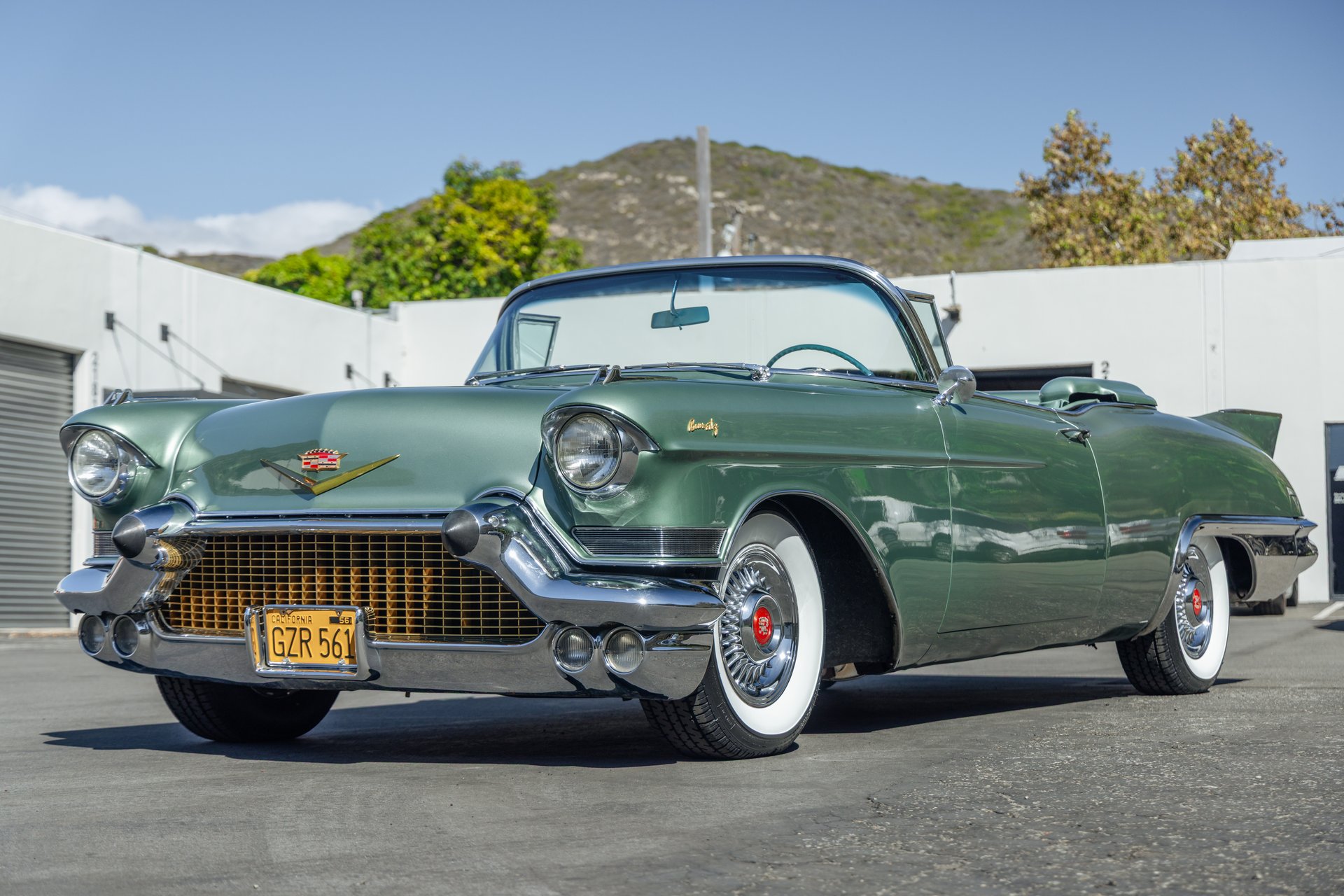
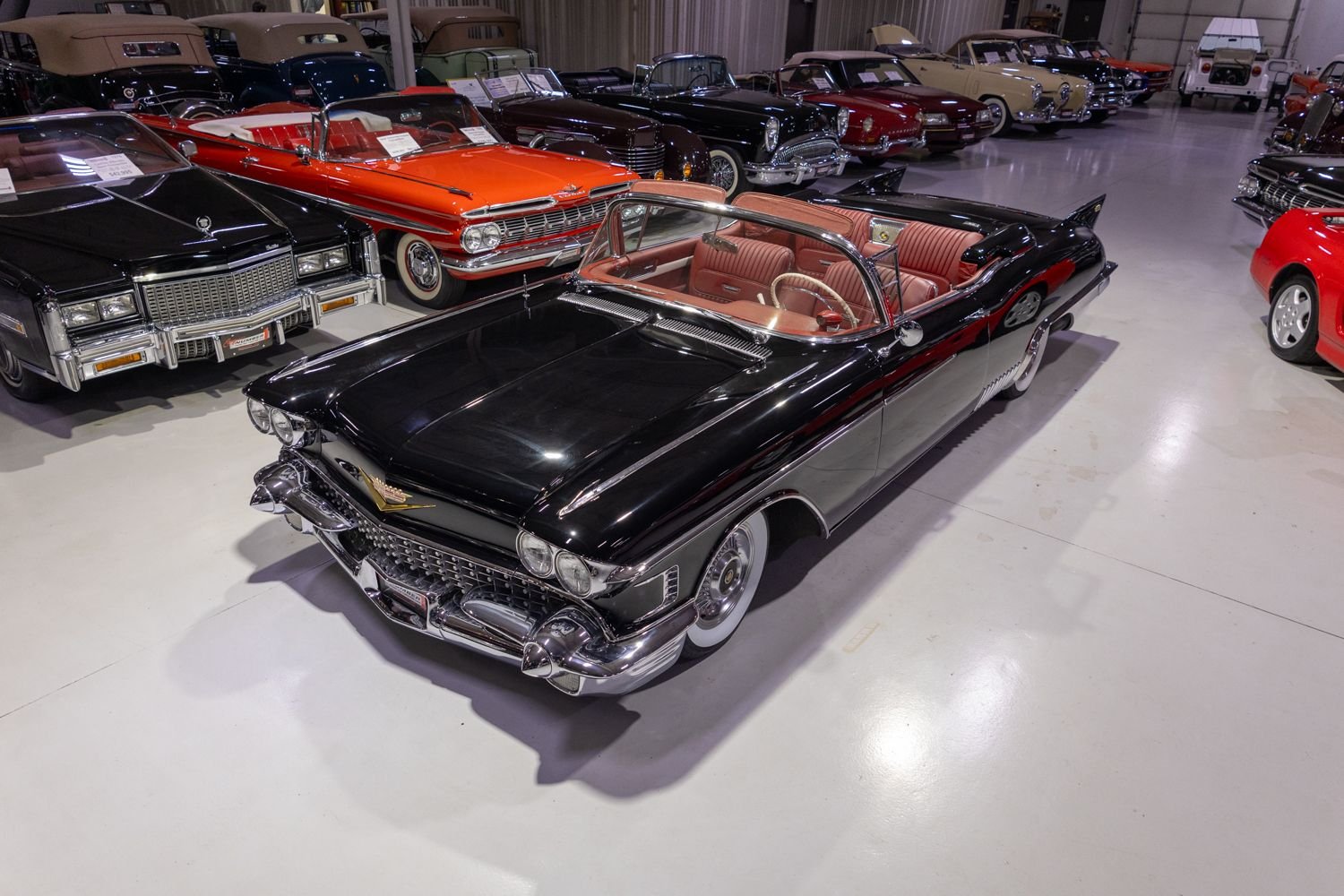
Through the fifties the name split into distinct cars. The Eldorado Biarritz was the convertible, the Eldorado Seville the hardtop coupe, and for 1957 and 1958 the Eldorado Brougham was something else again — a four-door hardtop sedan built in tiny numbers, with a brushed stainless-steel roof, quad headlamps, air suspension and a price roughly double a standard car's. The mainstream Biarritz and Seville shared the dramatic styling arc of the decade: restrained in 1954 and 1955, flamboyant by 1957, and crowned in 1959 by the tallest tailfins ever fitted to a production car. Those 1959 and 1960 cars are the ones the wider world pictures when it hears the name.
The sixties first rationalised the car and then reinvented it. From 1961 the Eldorado became a variant of the standard full-size line rather than a semi-separate model, still rear-wheel drive, still V8, increasingly a trim-and-style proposition. Then, for 1967, Cadillac did something genuinely radical: the Eldorado moved to front-wheel drive, on a platform shared with the Oldsmobile Toronado, with a completely new, crisp-edged body that hid the engineering revolution underneath it. A luxury coupe with the driven wheels at the front, a flat floor, torsion-bar front suspension and a chain-driven automatic transaxle was a decade ahead of the industry consensus, and it worked — these are among the best-driving American cars of their era.
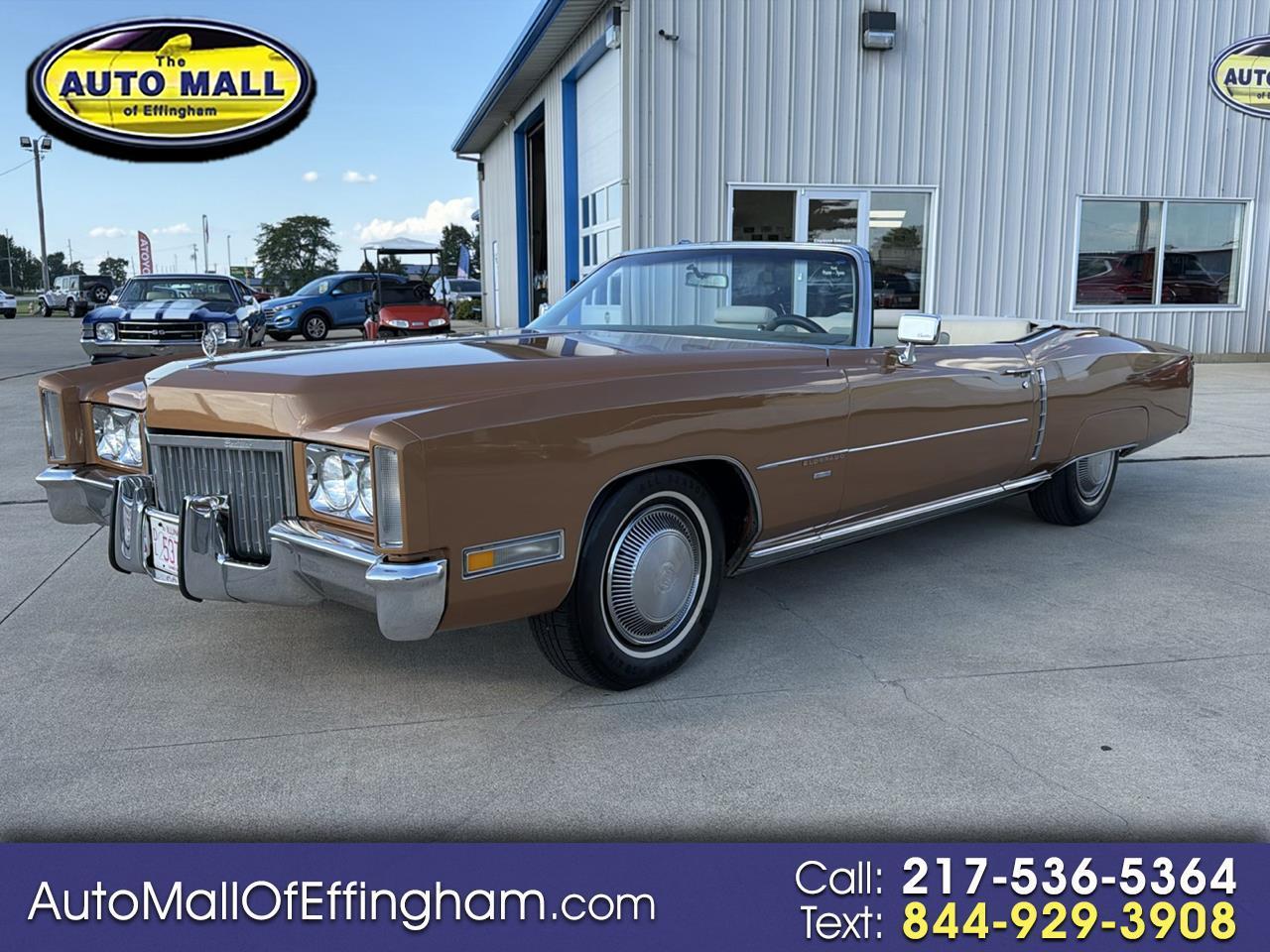
The seventies car, from 1971, grew again: longer, heavier, offered as coupe and convertible, and powered by the 500-cubic-inch V8 that remains the largest engine ever fitted to a standard production car. When Cadillac announced the 1976 convertible as the last American convertible, buyers stockpiled them as instant collectibles — a story with consequences for today's market that the Values section takes up. The 1979 car downsized intelligently, keeping the front-drive layout and much of the presence in a smaller, lighter package, but it landed in the middle of Cadillac's troubled diesel and early-electronics years. The 1986 redesign shrank the car too far for traditional buyers, and sales fell hard. The final generation, from 1992 to 2002, recovered the formula — long, low, front-drive, and from 1993 powered by the Northstar V8 — and the last cars, the 2002 Collector Series, closed the book deliberately evoking the 1953 original.
What unites all of them is the ownership pattern. Eldorados were expensive, cherished first cars that later became cheap, complicated old cars — and complicated is the operative word. Air suspension on the Brougham, the transaxle on every front-drive car, electronic fuel injection in 1976, the diesel and the variable-displacement V8 in the early eighties, the Northstar's electronics at the end: at every stage the Eldorado carried Cadillac's newest technology, and at every stage that technology is what you are really inspecting today. The bodies and the big cast-iron V8s are the durable parts of most Eldorados. The systems are where the money goes.
Our own listings underline how wide the pool is: we currently track 168 Eldorados spanning 1953 to 2002, and the centre of gravity is the seventies — 1976 alone accounts for 23 of them, with 1975 close behind — followed by a strong showing of mid-eighties cars. That spread is good news. Whatever era of Eldorado you want, cars exist. The work is in telling the cherished ones from the stored ones, and that is what the rest of this guide is for.
The models
Because the Eldorado spans fifty years and at least seven distinct engineering generations, treat the table below as a map of separate cars sharing a name, not as trim levels of one car. Cross-shopping a 1959 Biarritz against a 1995 ETC makes no more sense than cross-shopping any other two cars forty years apart. Pick your era first, using the character column, then shop condition within it.
| Model | Years | Engine | Output | Built | Character |
|---|---|---|---|---|---|
| Eldorado convertible | 1953 | 5.4 V8 (331) | 210 hp | about 532 | The original; Motorama show car made real |
| Eldorado Biarritz / Seville | 1954–1960 | 5.4–6.4 V8 (331/365/390) | 230–345 hp | tens of thousands across the run | The fifties dream car; 1959–60 carry the tallest fins |
| Eldorado Brougham | 1957–1960 | 5.7–6.4 V8 (365/390) | 325–345 hp | 704 in 1957–58; about 200 in 1959–60 | Hand-finished flagship; stainless roof, air suspension |
| Eldorado (Fleetwood) | 1961–1966 | 6.4–7.0 V8 (390/429) | 325–340 hp | tens of thousands across the run | Rear-drive, rationalised; style over separate identity |
| Eldorado (front-wheel drive) | 1967–1970 | 7.0–7.7 V8 (429/472) | 340–375 hp | tens of thousands across the run | The revolution; sharp styling, flat floor, superb manners |
| Eldorado coupe / convertible | 1971–1978 | 8.2 V8 (500), later 7.0 (425) | 190–235 hp net | hundreds of thousands across the run | The biggest engine ever; 1976 convertible the famous finale |
| Eldorado / Biarritz | 1979–1985 | 5.7 petrol and diesel, 6.0 V8-6-4, 4.1 HT4100 | 105–180 hp | hundreds of thousands across the run | Downsized and elegant; engine choice decides everything |
| Eldorado | 1986–1991 | 4.1 / 4.5 / 4.9 V8 | 155–200 hp | tens of thousands across the run | Too small for its buyers; the 4.9 cars are the pick |
| Eldorado / ETC | 1992–2002 | 4.9 V8, then 4.6 Northstar | 200–300 hp | tens of thousands across the run | The recovery; Northstar ETC is a genuine performance coupe |
(Outputs are period figures — gross ratings before 1972, net ratings after — and are not directly comparable across that divide. Production figures are given only where they are reliably documented; for the high-volume years Cadillac reported by series rather than by individual model in a form that survives consistently, so honest ranges stand in place of invented precision.)
The fifties cars (1953–1960). The 1953 convertible is a museum-grade rarity and priced like one. The volume fifties Eldorados — Biarritz convertible and Seville hardtop from 1956 on, when production broadened — are the chrome-era cars most buyers are actually shopping. The 1957 and 1958 cars add the quad-lamp face and, on the Brougham, that stainless roof and a standard-equipment list that included things most cars would not offer for decades. The 1959 and 1960 cars trade some of that exclusivity for the definitive finned silhouette. All of them are conventional rear-drive, body-on-frame cars with big overhead-valve V8s — mechanically straightforward, cosmetically bottomless.
The Brougham warning. The 1957–58 Brougham (built in Detroit, 400 cars then 304) and the 1959–60 Brougham (bodied by Pinin Farina in Italy, roughly a hundred a year) are the most complex American cars of their decade: air suspension, automatic load levelling, power everything, and on the early cars a host of bespoke trim and interior fittings that no catalogue reproduces. Buy one as a connoisseur, with specialist support, never as a cheap way into the name — there is no cheap way into a Brougham.
The sixties rear-drive cars (1961–1966). From 1961 the Eldorado was the top trim of the standard line — badged as a Fleetwood from 1965 — offered as a convertible and, in some years, a hardtop. They share their mechanicals with the DeVille range, which makes them the easiest Eldorados of the early era to keep, and the 1964-on 429 engine gives them real pace. Styling is the whole decision here: the crisp 1961–62 cars, the stacked-lamp 1965–66 cars, and nothing in between is a bad answer.
The first front-drive cars (1967–1970). The sweet spot of the whole fifty years for many experienced owners. The 1967–68 cars are the purest statement — hidden headlamps, razor edges, the 429 giving way to the 472 in 1968 — and the 1969–70 cars soften the styling slightly while keeping the formula. Everything said about the transaxle and torsion-bar front end in the sections below applies from here to 1985, because the architecture carried through.
The seventies cars (1971–1978). The largest Eldorados and, in coupe form, among the most plentiful in today's listings — our tracked pool is dominated by 1974–76 cars. The convertible returned for this generation and ended with the celebrated 1976 run. Engines shrank in rated output as emissions controls arrived, but the 500's torque means no seventies Eldorado feels slow in normal driving. The 1977–78 cars substitute the 425 engine and are usefully lighter in feel, if less mythic.
The downsized cars (1979–1985). A genuinely handsome generation — the bustle-back Biarritz with its stainless roof section is the signature — undermined or redeemed entirely by what is under the hood. The 350 petrol V8 is the safe choice; the diesel and the HT4100 require the careful reading given in the engines section. The 1985 cars, the last of this body, are heavily represented in our listings, which makes comparison shopping easy.
The small cars (1986–1991). The market rejected the shrunken 1986 car and history has mostly agreed, but the mechanical story improves year by year: the 4.5 of 1988 and especially the 4.9 of 1991 are willing, durable engines in a light car. These are the cheapest Eldorados to buy and among the cheapest to run — bought knowingly, they are the value play of the whole guide.
The last cars (1992–2002). The 1992 redesign restored the long-hood proportions, and from 1993 the Northstar system — 4.6-litre, twin-cam, 275 hp in the Eldorado and 300 hp in the ETC — made the flagship genuinely quick. The ETC, with its firmer suspension and full equipment, is the collector pick; the base car is the softer, cheaper cruiser. Production ended in April 2002 with the Collector Series, finished in the white and red of the 1953 original.
Engines and gearboxes
The cast-iron V8s: 331, 365, 390, 429, 472, 500 and 425
From 1953 to 1978 every Eldorado ran a version of the same engineering idea: a big, understressed, cast-iron overhead-valve V8, growing by stages from the 331-cubic-inch engine of the original car through the 365 and the 390 of the late fifties, the 429 of the mid-sixties, and then the purpose-designed big-block family — 472 cubic inches for 1968, stroked to 500 for 1970 in the Eldorado (a year before the rest of the range), and destroked to 425 for 1977 as fuel economy began to bite. These engines are the strongest part of any early Eldorado. They are torquey, tolerant of indifferent fuel by modern standards (though the high-compression pre-1971 engines want premium and, ideally, an octane supplement or a timing adjustment on today's petrol), and capable of very high mileages between rebuilds if the oil has been changed.
What to listen for is consistent across the family. A healthy engine starts readily, idles with a slow, even lope, and shows no blue smoke on start-up or on the overrun — blue smoke at start-up after sitting is valve-stem seals, a known and affordable job, while smoke under load is ring and bore wear and an engine-out rebuild, realistically $4,500–8,000 at a machine shop with the engine removed and refitted. Lifter tick that fades as the engine warms is common and usually harmless; a deep knock under load is a bottom-end verdict — walk away or price a rebuild. The multi-carburettor setups of the fifties — dual four-barrels and the three two-barrel Tri-Power of 1958–60 — look intimidating and are simply three (or two) carburettors to keep in tune together; budget $600–1,200 for a proper specialist rebuild and set-up of a Tri-Power set, and distrust any car whose seller describes its flat spots and hesitation as character. Single four-barrel cars — Quadrajet-equipped from the late sixties — are the easier ownership proposition, and a Quadrajet rebuilt by someone who understands the metering-rod system costs roughly $400–700 and transforms a car.
The 500 deserves its own paragraph because its reputation runs in both directions. It is genuinely the largest-displacement engine fitted to a regular production car, and in the heavy 1971–76 cars it needs to be: what it delivers is not speed but effortlessness, a wall of low-speed torque that moves two and a half tons without ever raising its voice. Rated outputs fell through the seventies as compression dropped and net ratings arrived — the same basic engine reads very differently on paper in 1970 and 1976 — but seat-of-the-pants performance changed far less than the figures suggest. Its vices are thirst (expect 10–13 mpg in mixed use, whatever the seller claims) and the sheer physical scale of everything attached to it: starters, alternators and water pumps are heavy-duty parts, still available, at heavy-duty prices.
Emissions-era engines, 1971 on, carry air-injection pumps, exhaust-gas recirculation and miles of vacuum hose. The hardware itself rarely fails expensively; the hoses perish, split and get reconnected wrongly, producing a car that idles badly, hesitates and fails visual inspections in states that have them. A vacuum-hose refresh with correct routing — the diagram is on a sticker under the hood of most cars — is a weekend and under $150 in hose, and it is the single highest-value job on a neglected seventies car.
The front-drive transaxle cars and the downsized engines, 1967–1985
The 1967 Eldorado's engineering centrepiece is the Turbo Hydra-Matic 425, a three-speed automatic transaxle mounted alongside the engine, driven from the torque converter by a wide, silent chain — the Hy-Vo chain — and driving the front wheels through a differential beside the gearbox. It sounds exotic and is, in service, one of the most durable transmissions General Motors ever built; the same basic unit later hauled motorhomes. The chain stretches over very high mileages and announces itself with a whine or rattle from the front of the engine bay at idle — distinguishing chain noise from engine noise is a stethoscope job, and a chain and sprocket replacement is an engine-out or transaxle-out repair at $2,500–4,500, so listen carefully on any high-mileage car. Normal THM425 service — fluid and filter — is cheap insurance, and a box that shifts firmly, kicks down cleanly and engages reverse without delay is a box you can largely forget. The layout also dictates the front suspension: torsion bars, which do not sag like tired coils but do lose their setting if the adjusters have been wound to compensate for other faults; ride height on a front-drive car is a measurement, not an opinion, and the figure is in the factory manual for each year.
The 1979 downsizing kept the transaxle concept in the smaller THM325 (and later the four-speed 325-4L) and changed everything about the engines. Three powerplants define this generation, and they are not equal. The petrol 350, an Oldsmobile-built engine with electronic fuel injection in most Eldorados of the period, is the dependable choice — conventional, well supported, and strong enough for the lighter car. The 6.0-litre V8-6-4 of 1981, which deactivated cylinders under cruise by locking selected rocker arms, was a sound idea executed a decade before the electronics were ready: solenoids and their wiring give trouble, and many cars have been permanently locked into eight-cylinder operation by specialists — ask which state a V8-6-4 car is in, because a car that still cycles and does it badly is miserable to drive. The diesel 350, offered through the early eighties, converted from a petrol block and rushed to market, has a documented history of head-gasket, head-bolt and injection-pump failures; survivors today are either cherished oddities or cars that have already had the expensive work done — buy only on paperwork.
Then there is the HT4100, the 4.1-litre aluminium-block, iron-head V8 fitted from 1982. This engine's reputation was earned: the dissimilar metals, marginal head-gasket sealing and a cooling system intolerant of neglect produced failures at mileages where a Cadillac engine should be barely run in, and coolant in the oil — shown as a mayonnaise-like emulsion under the filler cap — is the classic presentation. The honest counterpoint is that the cars were also cheap for decades and run without coolant maintenance, and an HT4100 that has survived forty years with documented coolant changes and the correct sealant tablets is a known quantity rather than a lottery ticket. Even so, on any HT4100 car the cooling system is the inspection: pressure-test it, check for combustion gas in the coolant, and budget $1,800–3,000 for head gaskets if the answers are vague. The engine grew into the 4.5 for 1988 and the 4.9 for 1991, and those later versions — same architecture, a decade of fixes — are genuinely durable; do not let the HT4100's reputation talk you out of a good 4.9 car.
The Northstar cars, 1992–2002
The final generation launched with the 4.9 and was transformed for 1993 by the Northstar 4.6: an all-aluminium, four-cam, 32-valve V8 making 275 hp in the standard Eldorado and 300 hp in the ETC, paired with the 4T80-E four-speed automatic transaxle — a heavy-duty unit that is rarely the problem. The Northstar is a superb engine to drive behind: smooth, eager and economical by Eldorado standards. It has two documented ownership issues, and both are priced into a sensible offer rather than treated as mysteries.
The first is head-gasket failure caused by the head bolts losing their hold in the aluminium block as the threads degrade — the symptom is overheating under sustained load, typically climbing a grade, with a car that behaves perfectly around town, plus unexplained coolant loss. The correct repair is not a gasket alone but thread inserts in the block (the Time-Sert style repair), an engine-out job at $3,000–5,000; a car with documented insert work done properly is worth more than a lower-mileage car without it. The second is oil consumption and leaks: the Northstar uses oil by design at a rate that alarms owners raised on the old cast-iron engines — a quart in 1,000–2,000 miles can be normal — and the crankcase half-seal and cam-cover seals weep with age, a reseal running $1,200–2,500 in labour-heavy work. Neither issue makes the car a bad buy; both make paperwork the most important part of the car.
Gearboxes
Rear-drive Eldorados use the Turbo Hydra-Matic 400 from 1964 (the earlier cars used the four-speed Hydra-Matic and the short-lived Turbine Drive variants), and the THM400's reputation is deserved — it is the default heavy-duty automatic of its era, rebuilds are routine at $2,200–3,800, and every transmission shop in America knows it. The front-drive cars use the THM425 and its downsized descendants as described above. There were no manual Eldorados in regular production at any point in the fifty years; any car presented with a manual gearbox is a conversion, and should be priced and judged as one. On any automatic, the test is the same: fluid that is red and sweet-smelling rather than brown and burnt, engagement of drive and reverse within a second or two, clean full-throttle upshifts, a working kickdown, and no flare — a rise in revs — between gears. A box that fails two or more of those tests is a rebuild priced into the offer, not a fluid change away from health.


Problem areas
Everything in this section follows one principle: on an Eldorado, condition is decided by systems and structure, not by the odometer. We have photo-examined 85 of the Eldorados we track, and rust was noted in the photographs of 26 of them — roughly one car in three — with visible damage noted in 23. That is a better rust record than many cars of the era, and it reflects the Eldorado's generally cherished first lives. But the sample also underlines the trap: these are big, heavily trimmed cars whose photographs flatter them, and the expensive faults — transaxle chains, head gaskets, air suspension, convertible top hydraulics — do not show in a listing photograph at all.
Rust and structure: the map
An Eldorado is a body-on-frame car in its rear-drive generations and a unit-body car in its front-drive ones, and the inspection differs accordingly — but the water paths are the same. Work through the car in this order.
Frame and underbody, rear-drive cars (1953–1966, and the 1971–78 cars are unitised at the front with a perimeter frame — treat both the same way). The frame rails themselves are heavy-gauge and rot slowly; what rots first is what the frame carries. Check the body mounts, especially the rearmost pair, where a sagging mount lets the body sit down on the frame and shows as door gaps that close at the top. Check the floor pans under the carpets — the windshield and cowl seals leak, water runs down behind the trim and sits under the sound deadening, and floors perforate from the top down, invisibly, until the carpet is lifted. Check the trunk floor and the spare-wheel well on exactly the same logic: the rear window seal and the trunk seal are the inlets, the well is the sump. A floor or trunk repair with proper panels, welded and painted, runs $800–2,000 a section; floors that have gone at the body mounts are a body-off conversation and should reprice the car entirely.
Front-drive cars (1967–1985, 1986–2002). The structural checks move to the front subframe and its mounting points, the front floor and toe-board area, and — critically on the 1967–78 cars — the torsion-bar anchor crossmember region, where road dirt packs and holds moisture against the metal. On the downsized and later cars, add the rear wheel-arch lips and the bottoms of the front fenders behind the wheels, the classic unit-body rot line. Sill and rocker rust on any Eldorado is structural on the unit-body cars and a $1,000–2,500 per side welding-and-paint job; on the framed cars it is cosmetic-structural — still welding, still priced, but not a write-off on its own.
The convertible problem. Every Eldorado convertible, fifties through 1976, has the same two weaknesses. The top well — the trough the folded top sits in — collects water whenever the top leaks or the drains block, and it rusts the floor and inner quarters around it from inside, where no listing photo ever looks. And the folding-top mechanism itself is a hydraulic system on the later cars: pump, lines, and lift cylinders that leak with age, at $150–400 per cylinder to reseal or replace and $300–600 for a pump, plus a top itself at $1,500–3,000 fitted in correct materials. Operate the top twice, fully, on any viewing. A seller who says the top works but would rather not demonstrate it has demonstrated it.
Chrome, stainless and trim. On fifties cars this is the rust section's expensive cousin. Eldorado brightwork is model-specific — the Biarritz and Brougham carry trim no other Cadillac shares — and replating is priced per piece: a full show-quality replate of a late-fifties Eldorado's brightwork is a five-figure job, and even a driver-quality refresh of bumpers alone runs $1,500–3,000 per bumper. Missing trim is worse than pitted trim, because the missing piece has to be found before it can be plated. On the Biarritz cars of 1979–85 the brushed stainless roof section dents and dulls, and polishing it back is specialist work; check it for parking dents with the light across it.
Suspension, steering and brakes
The rear-drive cars use conventional coil-sprung front suspension with ball joints, and wear presents conventionally: play in the joints, perished bushes, vague steering. A full front-end refresh — joints, bushes, idler and centre link — is $1,200–2,500 fitted and transforms a wallowing car. The Brougham's air suspension is the exception and the warning: the 1957–58 system, with its compressor, air springs and levelling valves, was troublesome when new and is a specialist preservation project now; many cars run coil conversions, which is a legitimate, reversible choice, but a car advertised as retaining working air suspension should be made to demonstrate a level stance after sitting overnight — a car that kneels by morning has leaks, and finding them is billed by the hour.
Front-drive cars ride on torsion bars at the front and, on most years, a leaf or coil arrangement with automatic level control at the rear — an air-assisted system with a compressor and height sensor that keeps the tail up under load. A car that sits tail-down has either a failed compressor, a leaking air spring or a dead sensor, in ascending order of price from about $250 to $900 in parts; the functional test is to load the trunk, start the engine, and watch the car lift itself back to level. The final-generation cars add electronically controlled dampers and, on the ETC, a firmer tune; replacement electronic dampers are expensive — $400–800 a corner — and many cars run passive conversions, which is acceptable if all four corners match and the warning systems have been dealt with properly rather than by removing a bulb.
Brakes are discs at the front on everything from the mid-sixties (four-wheel discs arrived on the front-drive cars early and spread later), and the story is the usual one for stored cars: seized calipers, perished flexible hoses, rusted lines and a master cylinder that bypasses internally, giving a pedal that sinks slowly at a standstill. Budget $900–2,000 for a full hydraulic recommissioning on a car that has sat. The parking brake on front-drive cars works on the rear calipers and seizes from disuse; free it or price it.
Systems: air conditioning, electrics and the electronic years
An Eldorado without working air conditioning is a car you cannot use in half the country for half the year, so treat the system as core equipment. The pre-1994 cars run R12 refrigerant or a conversion to R134a; a conversion done properly — compressor oil, seals, receiver-drier, a full flush — is fine, and one done by simply changing the fittings is a slow failure. A full system revival on a long-dead car runs $1,200–2,800. The automatic climate control systems add vacuum-operated doors and a programmer behind the dash; a system that blows only at the windshield or only hot has usually failed in the vacuum supply or the programmer, not the compressor, and the diagnosis order matters because the parts prices differ by a factor of ten.
Electrics follow the era. Fifties and sixties cars fail at earth points, generator or alternator brushes, and window and seat motors that need cleaning and lubrication more often than replacement — power windows that move slowly are usually stiff mechanisms and hardened grease, a strip-and-clean job, not four new motors. The 1975–76 Bendix electronic fuel injection, offered on the 500, deserves specific respect: it is an analogue system whose electronic control unit, injectors and sensors are now supported by a small number of specialists, a full system overhaul runs $2,000–4,000, and a car that runs badly on this system should be bought only with that figure already deducted. The digital-dashboard and trip-computer cars of the eighties fail in the displays and the body computer; rebuilt exchange units exist for most applications at $300–800. On the Northstar cars, the electronics are extensive but well documented — the recurring costs are crankshaft position sensors, the starter motor buried under the intake manifold ($600–1,100 fitted, almost all labour), and alternators that are liquid-cooled on some years and priced accordingly.
Vinyl roofs, seals and water management
A large proportion of Eldorados from the late sixties through the eighties wear a vinyl roof — padded landau roofs, half-roofs, and the full coverings that were the era's definition of luxury — and the vinyl roof is a water trap with a styling budget. The covering itself lasts well, but the seams split with age and sun, the padding beneath holds moisture like a sponge, and the steel roof panel underneath rusts from the outside in, invisibly, while the vinyl above it still presents acceptably. The tells are bubbling or a crackling feel under the vinyl, rust staining weeping from the seams and the rear-window surround, and a musty smell inside the car. Press the roof covering methodically with flat palms, especially around the rear window and along the seams; soft, crunchy or uneven areas mean the panel beneath is going. Repair means stripping the covering, welding or treating the panel, and re-covering — $1,500–3,500 done properly — and a car needing it should be priced with the roof treated as a body panel, not a trim item. The same logic applies to the opera windows and landau bars of the seventies cars: charming, model-specific, and sealed into exactly the area where the water sits.
The glass seals are the other half of the water story. Windshield and rear-window rubbers harden and shrink, and on a car of this width the rear window is a funnel aimed at the trunk and the rear floor. Inside the car, the fresh-air plenums and the cowl drains block with decades of leaf litter, so rain that should exit at the rocker panels instead overflows into the front footwells — wet front carpets on an otherwise dry-stored car are usually a blocked drain and an afternoon with a wire and a hose to prove it, but the same water, left for years, is what perforates the floors described above. Door seals and the convertible top's header and side seals complete the picture: a car that mists up inside after rain, or whose trunk smells of mildew, is telling you its seals have retired. Seal sets for the volume years are reproduced and affordable; the labour of fitting them correctly, with the glass out where the design demands it, is the real cost, and it is still cheaper than the welding that follows neglect.
Interior and trim
Cadillac interiors were the industry's richest, and they age in a specific order. Leather dries, cracks at the driver's bolster and the top of the rear seat where the sun lands, and then splits; a full retrim in correct leather is $6,000–12,000, which is why a supple original interior is worth a premium out of all proportion to its cost when new. The pillow-tufted seats of the Biarritz cars and the loose-pillow styles of the seventies collapse as the foam degrades — re-foaming and re-covering a pair of front seats runs $1,500–3,000. Headliners sag on the later cars, the bows-and-cloth headliners of the early cars hold up better, and a replacement is $400–900 either way. Simulated wood and real appliqué trim delaminate; dashes crack on sun-baked cars from the late seventies on, and a correct replacement dash pad, where available, is $500–1,200 before fitting. Carpets are reproduced for most years and are the cheap refresh — $300–600 a set. The rule across all eras: price the interior as a whole before you fall for the paint, because on an Eldorado the cabin is half the car.


How to inspect one
Allow two hours for a first viewing of any Eldorado — these are large, heavily equipped cars and the faults that cost money take time to surface. Bring a torch, a thin magnet, a tyre-pressure gauge, a long screwdriver to use as a listening rod, and a helper to work switches while you watch lights and listen outside. Insist on a cold start: a car that has been warmed up before you arrive is a car whose cold-start behaviour — smoke, lifter noise, injection faults, transaxle chain rattle — you are being asked not to hear.
- Paperwork and identity first. Match the VIN on the title to the plate on the car — on most years the cowl or door-jamb plate, on later cars the windshield-base plate — and match the engine to the car it claims to be. On a downsized car this step decides the whole purchase: confirm whether you are looking at a petrol 350, a diesel, a V8-6-4 or an HT4100 before you value anything else, because the same body spans the best and worst engines Cadillac made in the decade. On a Northstar car, ask directly for head-gasket or thread-insert paperwork.
- Cold start. Crank from cold and watch the exhaust: a puff of blue that clears is valve seals; continuous blue smoke is wear. Listen for lifter tick that should fade within a minute, and on a front-drive car listen at the front of the engine for chain rattle at idle — the THM425 drive chain announcing stretch. Note how an injected car starts: the Bendix-injected 500 and the later port-injected cars should fire immediately and settle.
- Under the hood, fluids. Engine oil on the dipstick should be oil, not emulsion — mayonnaise under the filler cap on an HT4100 or Northstar means coolant is going where it should not. Automatic transmission fluid should be red and unburnt. On an HT4100, check the coolant itself for oil film and ask when it was last changed with the correct sealant tablets; vague answers are a deduction, not a detail.
- Structure. With the torch, work the rust map from the problem areas section: floor pans from inside with the carpets lifted, trunk floor and spare-wheel well, body mounts on framed cars, subframe mounts and torsion-bar crossmember on front-drive cars, rocker panels and arch lips on the unit-body generations. Perforation at mounts or the crossmember reprices the car; perforation in a floor pan prices a repair.
- Convertible top, if fitted. Operate it twice, fully down and fully up. Watch for hydraulic leaks at the cylinders, listen to the pump, inspect the top well for water staining and rust, and check the rear window — plastic windows cloud and crack, glass ones survive. A top that hesitates, groans or leaves the car wet inside is a four-figure negotiation.
- Suspension and stance. Stand back and sight the car from all four corners: level, or sitting down at one end? On a level-control car, load the trunk and start the engine — the rear should lift back to trim height. On a Brougham, note the stance now and ask what it looks like after standing overnight. Bounce each corner; a car that keeps bouncing has dead dampers, and on an electronic-damper car ask whether replacements are electronic or a passive conversion.
- Steering and front end. Rock the steering wheel for free play, then have your helper do it while you watch the linkage and, on a front-drive car, the transaxle mounts. On the drive, the steering should centre itself and track straight hands-off on a flat road; wander plus knock over bumps is a front-end refresh priced into the offer.
- The test drive. Twenty minutes minimum, including a sustained higher-speed stretch — essential on a Northstar car, where the head-gasket failure mode shows as temperature creep under sustained load, not around town. The automatic should engage drive and reverse promptly, shift cleanly without flare, and kick down. Brake firmly from speed: straight, no judder, no pull. A pedal that sinks at a standstill afterwards is a master cylinder verdict.
- Systems sweep. Park, engine running, and work everything: air conditioning on full cold (measure the vent temperature by feel against the day — it should be unmistakably cold, not cool), heater on full hot, every window, the seat adjusters in every direction they offer, locks, lights, wipers and washers, cruise control on the drive if fitted, and on eighties and nineties cars every digital display and warning lamp — including confirming the lamps light at key-on, so you know none has been removed to hide a fault.
- Interior audit. Sit in every seat. Feel for collapsed foam through the covering, check the driver's bolster and the top of the rear seat for sun damage, look up at the headliner, and run a hand along the dash pad for cracks. Price what you find using the interior figures in the problem areas section — on this model the cabin is a budget line, not an afterthought.
- Chrome and trim count. Walk the car slowly and list every missing, pitted or dented piece of brightwork, and on a Biarritz the state of the stainless roof. On a fifties car this list, priced honestly, is often the difference between a fair price and an overpayment.
- The lift inspection. If the car has passed you this far, pay for an hour on a lift before money moves: subframe and mounts, brake and fuel lines, transaxle case and chain cover for leaks, exhaust, and the underside of every floor you could not see from above. On a car of this size and complexity it is the cheapest certainty you will ever buy.
Values
The Eldorado market is really seven markets wearing one badge, and the first skill in reading it is refusing to average them. A 1959 Biarritz, a 1976 convertible and a 1998 ETC share a name and nothing else — not buyers, not price drivers, not even the places they sell. The market block beneath this guide shows what is listed now and what has recorded sales; read it era by era, and read it against condition, because the condition spread within any single Eldorado generation is wider than the spread between generations.
Condition is the dominant variable everywhere in the range. These were expensive cars that became cheap cars, and the cheap decades sorted them brutally: the survivors divide into cherished, garaged, maintained cars and stored, deteriorating ones, with remarkably little in between. The cherished car costs multiples of the stored car in every era, and correctly so — the gap between them is not cosmetic. It is a hydraulic top system, a resealed engine, a working climate system and an interior that has never baked. When the listings show two apparently identical cars at very different money, that gap is the market pricing the systems, and the systems are genuinely worth it.
Within each era, the premiums have clear logic. Convertibles outrun coupes in the fifties and seventies generations, because production was lower and the open car is the era's signature — but the premium buys you the top-system inspection bill described above, so it is a premium for a verified car, not for a convertible-shaped project. The Brougham sits in a market of its own: thin, specialist, and driven by completeness and originality rather than shine. The 1976 convertible carries a specific distortion worth understanding: because it was sold as the last convertible, a great many were bought as investments and stored rather than used, so supply of low-mileage examples is unusually deep — low mileage alone does not make a 1976 convertible rare or valuable, and a stored 1976 needs the same recommissioning as any other stored car. In the downsized generation, the premium attaches to engine identity: petrol 350 cars are the liquid market, while diesel and unproven HT4100 cars trade in a much thinner pool of knowing buyers. In the final generation the ETC outruns the base car, and documented Northstar thread-insert work functions as a value feature in its own right — a car with the repair done and invoiced is worth more than a lower-mileage car still carrying the original risk.
Asking prices and achieved prices part company most visibly at the top of each era's market, where exceptional cars are offered optimistically and sell slowly, and in the project tier, where sellers price the car they remember rather than the car in the driveway. Auction results — the recorded-sales block below tracks them — are the honest benchmark for the liquid middle of each market: good drivers, honestly described. Use them to calibrate, and remember that a private-sale car with full paperwork and demonstrable recent use is worth a premium over an auction car bought unseen, because on an Eldorado the paperwork is not provenance decoration; it is the difference between known systems and unknown ones.
The project-versus-driver gap deserves a final word, because it is where Eldorado buyers most often miscalculate. A project Eldorado is not a cheap Eldorado with cosmetic needs; it is a car whose systems — top, suspension levelling, climate, injection, electronics — have all aged together, and whose restoration costs are set by Cadillac flagship parts and trim, not by the car's purchase price. The driver that costs twice as much almost always costs less by the end of the first year. Buy the project only if the project itself is the hobby.
Parts and ownership
Parts support for the Eldorado is a tale of two cars: the mechanical car, which is well served, and the trimmed, systematised car, which is where ownership gets interesting. The big cast-iron V8s share their service parts — filters, plugs, gaskets, water pumps, ignition components — with the rest of the Cadillac and wider General Motors ranges, and supply is deep and reasonably priced. Brake, steering and suspension wear parts for the rear-drive and early front-drive cars are routine catalogue items. The THM400 and THM425 transmissions are supported by the entire American automatic-transmission trade. For the Northstar cars, service parts remain available through normal channels, and the specialist knowledge — thread inserts, reseals — is well documented and widely held.
The harder tier is predictable from the problem areas: Eldorado-specific trim and chrome for the fifties cars, Brougham air-suspension components, Bendix injection parts for the 1975–76 cars, eighties electronic modules (mostly available as rebuilt exchanges), electronic dampers for the final cars, and correct interior materials — the specific leather grains, brocades and vinyls that separate a right interior from a redone one. None of it is unobtainable; all of it rewards joining the marque community early, because the Cadillac and LaSalle Club and the model-specific registers are where the remaining stock and the people who rebuild the unobtainable actually live. Budget-wise, a quality repaint on a car this size starts around $10,000 and rises quickly with chrome removal and refitting, which is why the standing advice for this model is to buy paint, chrome and interior, and fix the mechanics.
Running costs follow the era. The cast-iron cars drink fuel in the low teens per gallon at best and the 500 in the tens, but their servicing is simple and any competent independent shop can do it. The downsized cars are cheaper to fuel and, in HT4100 form, demand strict cooling-system discipline — coolant changed on schedule with the correct additives is the whole game. The Northstar cars are the most economical and the most dependent on specialist familiarity; a Cadillac-literate independent is worth finding before you need one. Across all eras, the first-year budget is the honest one: catching up deferred maintenance on a running car typically runs $2,000–5,000, and recommissioning a long-stored car — fuel system cleaned end to end, brakes overhauled, every seal and hose assessed — runs $4,000–9,000 depending on the generation's systems. Insurance is conventional classic-car money for the coupes and convertibles alike, agreed-value policies are readily available, and the cars' size means secure, dry, full-length storage is a real planning item: an Eldorado does not fit in every garage, and measuring yours before buying is not a joke but a step.
Which one to buy
- The icon: 1959–1960 Biarritz convertible. The definitive finned Eldorado and the one the world recognises. Buy on chrome completeness and body integrity, and accept that you are buying the era's jewellery as much as its car.
- The connoisseur's flagship: 1957–1958 Brougham. The most ambitious American car of its decade, in tiny numbers. Buy only with specialist support and a completeness audit — a whole Brougham is a treasure, an incomplete one is a research project.
- The driver's classic: 1967–1968 Eldorado. The front-drive revolution in its sharpest styling, with the 429 or 472 doing effortless work. The best-driving Eldorado of the classic era and the guide's own pick for a car to use.
- The seventies statement: 1971–1976 convertible, 500 engine. Maximum presence, minimum subtlety. A 1976 is the famous finale, but a used-and-maintained 1973–75 is often the better buy than a stored, low-mileage 1976.
- The downsized pick: 1979–1985 Biarritz with the petrol 350. The elegant bustle-back car with the dependable engine. Engine identity is everything in this generation — the badge tells you nothing, the paperwork tells you all.
- The value buy: 1991 Eldorado with the 4.9. The fixed version of the small car: durable engine, light weight, modern manners, and the lowest entry price of any Eldorado worth owning.
- The modern classic: 1993–2002 ETC, Northstar. Genuinely quick, genuinely luxurious, and the last of the line. Buy the one with the thread-insert paperwork, not the one with the lowest mileage.
And the rule that overrides all of the above: buy the car whose systems demonstrably work — top, levelling, climate, injection, electronics — in the era you actually love. On an Eldorado the engines are rarely what bankrupts an owner; it is the flagship technology, ageing all at once, on a car bought for its paint. A working car in your second-favourite year is worth more than a dormant car in your favourite one, every time.
See the 95 Eldorado cars currently listed.