
Cadillac Brougham Sedan 4D buyer's guide
Cadillac Brougham Sedan 4D -- the model's own buyer's guide: variants, values and what to check.
Years listed: 1967-1995 · Series: Full Size
Overview and history
Brougham is a word Cadillac spent nearly forty years moving up and down its own range, and you cannot shop for one until you know which rung of the ladder a given car sits on. The word itself is older than the motor car — a brougham was a closed, formal carriage, named for Lord Brougham — and Cadillac first put it on a production car in 1957, on the most ambitious automobile America had ever built. It then became the richest trim on the flagship Fleetwood sedan, then the name of that sedan itself, then — from 1987 to 1992 — the name of a standalone model that was, by the end, the last traditional Cadillac of all: separate frame, rear-wheel drive, a V8 in front and a padded vinyl roof over a formal rear window. When that car died, the name went back to being a trim package, on the 1993 to 1996 Fleetwood. Three different automobiles, one badge, and a market that prices them as if they were cousins. They are barely related.
The first Brougham, the Eldorado Brougham of 1957 to 1960, was a hand-built flagship built to answer the Continental Mark II and the imported flagships: a four-door hardtop sedan with a brushed stainless steel roof, rear doors hinged at the back, self-levelling air suspension, a memory power seat and a price above a Rolls-Royce Silver Cloud. Cadillac built 704 in Detroit for 1957 and 1958, then had Pinin Farina build 200 more in Turin for 1959 and 1960. It lost money on every one and established the name, permanently, as the top of the house.
Through the 1960s and 1970s the name lived one step down, as the best version of the car most buyers mean by a classic Cadillac. From 1965 the Fleetwood Sixty Special Brougham was the senior owner-driver sedan — padded vinyl roof, richer cloth, more chrome — and in the 1970s the Brougham effectively became the model, culminating in the 1971 to 1976 cars: among the longest and heaviest production sedans ever sold in America, powered by the 472 and then the 500 cubic inch V8. Downsizing in 1977 shrank the car without changing the formula, and the Fleetwood Brougham carried the traditional Cadillac — frame, rear drive, six seats — through the difficult 1980s while the rest of the range went front-wheel drive around it.
The car at the centre of this guide is what happened next. For 1987 Cadillac moved the Fleetwood name to its front-drive cars and left the old rear-drive sedan standing alone, renamed simply Brougham. Nothing changed except the badge and, in time, its engines — which improved. Built first in Detroit and then at Arlington, Texas, the 1987 to 1992 Brougham is the final flowering of the formula Cadillac had sold since the war. When it ended after 1992, the name reverted to a trim package on the new Fleetwood for 1993 to 1996 — a good car, covered at the end of this guide, but a different one.
Our own listings show exactly where the surviving population sits. The Brougham pool on Classic Listings runs from a single 1958 Eldorado Brougham to a single 1995 Fleetwood Brougham, but 24 of its 28 cars are the 1985 to 1992 rear-drive cars — the Fleetwood Broughams of 1985 and 1986 and the standalone Broughams that followed — with the 1988 to 1992 cars the heart of it. Blue, black, grey and white account for most of the pool, Florida and Ohio for more of it than any other states, which fits a car bought new by older owners in the Sun Belt and kept a long time. That is the ownership pattern that defines the market: one or two careful owners, a long retirement, then a sale — which is why condition and documentation, not mileage, separate the good cars from the traps.

The models
There are five distinct Brougham buys, and the table separates them by the things that decide what ownership costs: the engine family, the structure underneath, and what the car was built to do. Production figures are given only where Cadillac reporting separates the car cleanly; where Brougham was reported inside a wider Fleetwood total, the table says so rather than inventing a split.
| Model | Years | Engine | Output | Built | Character |
|---|---|---|---|---|---|
| Eldorado Brougham | 1957–1960 | 365 V8 (1957–58), 390 V8 (1959–60) | 325–345 hp gross | 904 total: 400 + 304 Detroit-built, 99 + 101 by Pinin Farina | Hand-built flagship; stainless roof, air suspension, collector car |
| Fleetwood Brougham (Sixty Special line) | 1965–1976 | 429, then 472 and 500 V8 | 340 hp gross (429) down to 190 hp net (500, 1975–76) | Reported inside Fleetwood totals | Top trim becomes the top model; the giant 1971–76 cars are the peak |
| Fleetwood Brougham, downsized | 1977–1986 | 425, 368, HT4100 4.1, Oldsmobile 307 V8; diesel V8 optional | 125–195 hp net, year-dependent | Volume production | Same formula, smaller car; engine decides everything after 1981 |
| Brougham | 1987–1992 | Oldsmobile 307, then Chevrolet 305 and 350 V8 | 140–185 hp net | Volume production, falling year by year | The standalone car; sedan only, the last traditional Cadillac |
| Fleetwood Brougham (trim package) | 1993–1996 | 5.7 L05 V8 (1993), then 5.7 LT1 V8 | 185 hp (L05); 260 hp (LT1) | Part of about 90,000 Fleetwoods | Brougham as an option again, on the final frame Cadillac sedan |
(Outputs mix gross ratings for the early cars with net ratings from 1972 onward, as Cadillac published them in period. A 1960s gross figure and a 1990s net figure were measured differently and are never directly comparable — the measuring standard changed, not just the engines.)
The Eldorado Brougham, 1957 to 1960. Two cars hide inside this one line. The Detroit-built 1957 and 1958 cars are the famous ones: stainless roof, centre-opening doors, air suspension, and a specification — memory seat, automatic headlamp dimmer, signal-seeking radio, power everything — that reads like a concept car. The 1959 and 1960 cars were designed by Cadillac but built by Pinin Farina in Turin and shipped to Detroit for their powertrains; they are sleeker, more conventionally trimmed, rarer still, and valued by a smaller circle of specialists. Neither is a usable-classic purchase in the sense the rest of this guide means: both are bought on originality and completeness, restored by specialists, and priced by a collector market that has nothing to do with the later cars. The 1958 car in our pool is the archetype of the whole name.
The Fleetwood Brougham, 1965 to 1976. Brougham began here as the top specification of the Fleetwood Sixty Special — a padded vinyl roof, a smaller, more formal rear window, button-tufted upholstery and extra brightwork — and as the Sixty Special name faded in the early 1970s, the Brougham became the senior sedan outright. The cars divide by size. The 1960s cars, like the 1967 example in our pool, are the elegant ones: 429 power, slim pillars, restrained chrome. The 1971 to 1976 cars, like our pool's 1976, are the maximal ones — the longest wheelbase, the deepest seats, the 472 and 500 engines, and a ride quality that is the whole point of the car. A two-door Fleetwood Brougham coupe was offered in this era and into the downsized years; coupes are the scarcity in every generation and the sedans are the value.
The downsized Fleetwood Brougham, 1977 to 1986. The 1977 car kept the frame, the rear drive and the six seats and lost roughly a foot of length and several hundred pounds — and with the 425 V8 of 1977 to 1979 it is a genuinely well-judged car. From there the engine story, told in the next section, takes over: the 368 and its V8-6-4 variant, then the HT4100 that powers the 1985 car in our pool, then rescue in 1986 by the Oldsmobile 307. The d'Elegance package — deeply tufted pillow seats, richer door trim, more chrome — was offered through this generation and the next, and it is the specification most buyers of any 1980s Brougham actually want. The 1986 car is the sleeper of the range: the old name, the fixed engine, one year only.
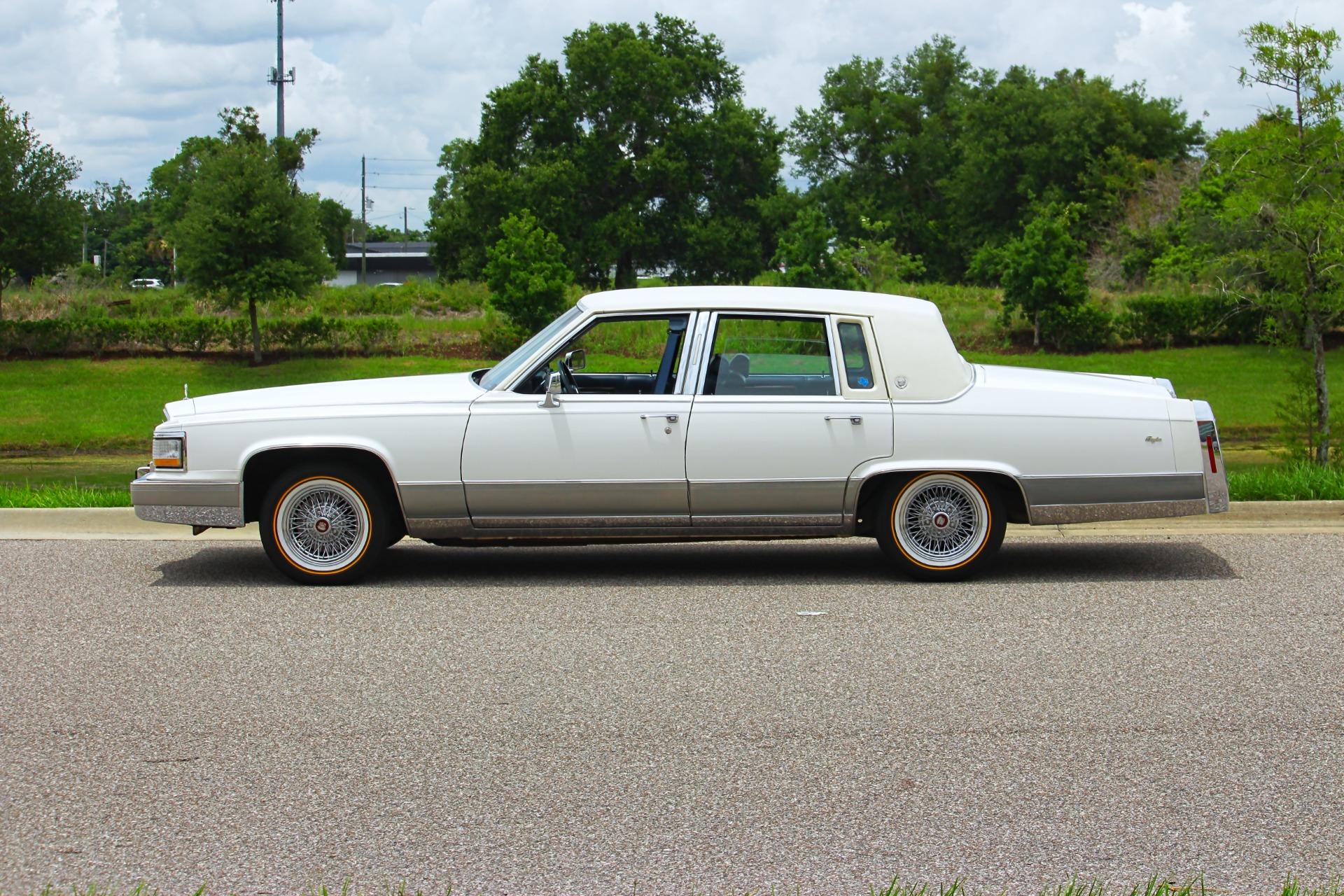
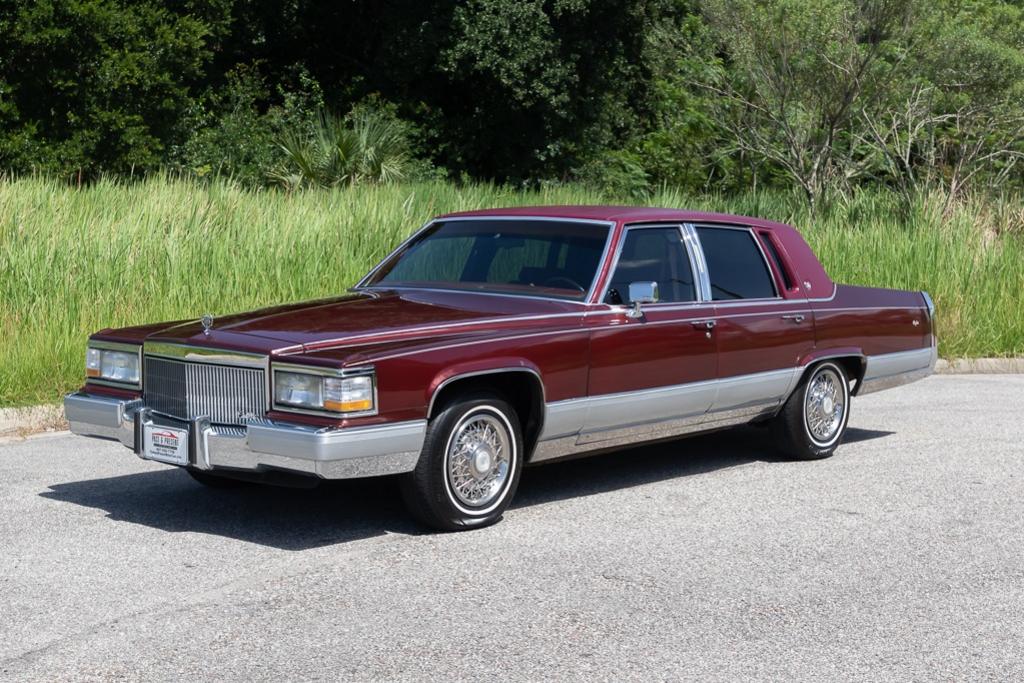
The Brougham, 1987 to 1992. The standalone car is mechanically the 1986 car continued, and it divides cleanly in two. The 1987 to 1989 cars run the Oldsmobile 307 with a computer-controlled carburettor: smooth, slow and utterly dependable when the electronics are alive. A 1990 facelift brought composite headlamps, revised trim and — the important part — Chevrolet engines: a throttle-body 305 as standard and a 350 as the option that transforms the car's motorway manners and towing ability. Production moved from Detroit to Arlington, Texas, during the run. Trim ran from the base car through the d'Elegance to a Premier package in the final years; all are sedans on the same 121.5-inch wheelbase, wearing the padded roof and opera windows that make the car unmistakable in profile. The white 1990 and maroon 1992 cars pictured in this guide are the type at its best: garaged Florida cars on wire wheels and gold-stripe whitewalls.
The Fleetwood Brougham, 1993 to 1996. When the rear-drive flagship returned for 1993 it was called Fleetwood again, and Brougham became its richest trim package — vinyl roof, tufted seating, extra chrome — rather than a model. The car underneath is the final D-body: bigger and rounder than the 1987 to 1992 car, with rear fender skirts, and from 1994 the LT1 engine that makes it the fastest Brougham of any era. Our pool's single 1995 car represents it. Buy one as you would a Fleetwood — because that is what it is — and treat the Brougham badge as the trim you want, not a separate model. The detailed buying logic for these cars sits in the Fleetwood guide; what follows in this guide concentrates on the cars the Brougham name actually stood for.
Engines and gearboxes
A Brougham badge has covered at least eight distinct V8 families, and they range from some of the most durable engines General Motors ever built to the most fragile Cadillac ever sold. Nothing about the badge tells you which one you are buying. Everything about the price should. Learn to identify the engine actually fitted — by year, by VIN and by looking at it — before you discuss money, because on the 1980s cars a later engine swap is common, and a good swap is worth more than the original engine it replaced.
The Cadillac big V8s: 429, 472, 500 and the downsized 425 and 368
The engines Cadillac designed for itself are the glory of the early cars. The 429 of the 1960s Fleetwood Broughams (340 hp in gross period terms) is a smooth, understressed torque engine with hydraulic lifters and a single four-barrel carburettor, and its known age faults are shared with the whole family: the nylon-toothed timing sprocket sheds its teeth into the sump and eventually lets the chain jump, so any car without a timing-set invoice is priced as needing one — a job in the region of 600 to 1,200 dollars at a general classic shop, and cheap insurance against a bent-valve bill. Rear main seals weep, carburettors suffer from modern ethanol fuel attacking old rubber, and exhaust manifold bolts seize in the heads. None of it is fatal; all of it is cheaper found before purchase.
The 472 of 1968, enlarged to the 500 for 1970, is the largest production V8 Cadillac ever sold and the right engine for the 1971 to 1976 Brougham: in its final 1975 to 1976 Fleetwood form it makes a modest 190 hp net but does it with a depth of low-speed torque that still defines the car. The Rochester Quadrajet is the service item — a wandering idle that responds to cleaner sprayed at the throttle shaft ends is a worn shaft leaking air, and a specialist rebuild runs 500 to 900 dollars. Valve stem seals harden and give the classic puff of blue at start-up; seals are a top-of-engine job, not a rebuild. One rarity deserves a flag: for 1975 and 1976 Cadillac offered Bendix electronic fuel injection on the 500, one of the first such systems on an American production car. An injected 500 is a collector's detail and a specialist's responsibility in equal measure — establish that it runs correctly on a long test drive, because the expertise to repair it is thin and priced accordingly.
Downsizing shrank the engine with the car. The 425 of 1977 to 1979 is a lightened descendant of the 472 design and a good engine — 180 hp, real torque, no vices beyond the family timing set and Quadrajet. The 368 that followed for 1980 is underpowered rather than unreliable in plain carburetted form. Its headline variant is not plain at all, and it belongs to the next section.
The problem years: V8-6-4, the HT4100 and the diesel
Three powertrains account for nearly every cheap 1980s Brougham you will ever see advertised, and you need to be able to recognise each on sight.
The V8-6-4 (1981). Cadillac's variable-displacement 368 disabled two or four cylinders at cruise by solenoid-controlled valve gear, managed by electronics that were not ready for the job. The engines themselves are sound 368s; the modulation system is the fault. Most survivors have been fixed in eight-cylinder mode by disconnecting the system, which is the correct ownership answer. Establish which state a 1981 car is in before the test drive: a car still hunting between modes on the motorway surges and hesitates in a way no tune-up cures, while a properly disabled car drives like the plain 368 it now is. Neither state is a reason to pay a premium; a hunting car is a reason to negotiate one.
The HT4100 (1982 to 1985 in the rear-drive car). The 4.1-litre HT4100 — aluminium block, cast-iron heads, throttle-body digital fuel injection, 125 hp — was installed in the heaviest cars Cadillac sold and is the engine the 1985 car in our pool carries. Its failures are structural. Dissimilar-metal expansion works the head gaskets, steel head bolts pull their threads out of the aluminium block, neglected coolant corrodes the aluminium from inside, and a low-speed main-bearing thump signals bottom-end wear no oil change fixes. The diagnostic rules are absolute and cheap: milky residue under the oil filler cap, coolant loss with no visible leak, a cold-start misfire that clears as the engine warms, or bubbles in the coolant reservoir each condemn the car until a combustion-gas test on the coolant — a ten-minute test with an inexpensive kit — proves otherwise. Survivors exist: fastidiously maintained cars on documented coolant changes, run with the factory coolant supplement, can and do live long lives. Buy one of those knowingly, at HT4100 money, with the test done. An undocumented HT4100 car is not a bargain at any price that assumes a running engine, because a warranted rebuilt replacement runs into several thousand dollars before ancillaries — more than the car around it is usually worth.
The diesel (optional to the mid-1980s). The Oldsmobile-built 350 diesel was converted from a gasoline design and shares the era's head-gasket reputation, with injection-pump wear on top. It is a specialist and curiosity buy. If one charms you, buy it as you would an HT4100: documentation, a cold start watched in person, and a price that assumes the engine is the hobby.
The borrowed five-litres: Oldsmobile 307 and Chevrolet 305 and 350
The rescue came from elsewhere in General Motors, and it is the reason the late cars are the rational buy.
The Oldsmobile 307 (1986 to 1989). The 5.0-litre 307 that replaced the HT4100 in the rear-drive car is a modest engine — 140 hp, its work done low in the rev range — with a bottom end that simply goes on. Its one complexity is the fuelling: a Rochester Quadrajet governed by GM's Computer Command Control, with a mixture-control solenoid cycling in response to an oxygen sensor. When the system is alive the car runs cleanly and economically for its size; when the sensor dies, the solenoid sticks or a previous owner has disconnected things at random, the car runs rich, flat and thirsty while remaining mechanically perfect. The fix is diagnosis, not parts-swapping: a solenoid and sensor service with the carburettor set up properly runs a few hundred dollars, and a 307 car that surges or smells of fuel at idle is usually that bill, not an engine bill. Check for the check-engine light proving out at key-on — a bulb removed to hide a fault is an old trick, and the light's absence at start-up is itself the finding.
The Chevrolet 305 and 350 (1990 to 1992). The facelift cars replaced the 307 with Chevrolet small-blocks and throttle-body fuel injection, and ownership became ordinary. The standard L03 305 makes 170 hp and is adequate; the optional L05 350 makes 185 hp with a usefully deeper reserve of torque, tows properly in tow-package form, and is the engine to hold out for — the two are visually near-identical, so verify by the VIN and the emissions label, not by the seller's memory. TBI faults are the familiar small-block list: an ignition module that fails hot and recovers cold, a fuel pump that grows noisy before it dies, EGR passages carboning up, exhaust manifold bolts snapping on removal. Parts are everywhere, cheap, and shared with every Chevrolet truck of the era. A documented 350 car is the lowest-risk Brougham purchase there is.
Gearboxes
Every Brougham in this guide is an automatic, and the boxes divide by era. The big-block cars use the Turbo Hydra-Matic 400 three-speed, one of the strongest automatics ever fitted to a production car: judge it by a one-second engagement of drive and reverse and no flare on the 2-3 shift hot, and budget 1,800 to 3,000 dollars for a rebuild if it fails those tests. The downsized cars moved through lighter three-speeds to the overdrive four-speeds that serve the late cars — the TH200-4R behind the 307 and the 700R4, later called the 4L60, behind the Chevrolet engines. Both overdrive boxes share one critical, cheap and routinely fatal detail: they have no kickdown cable in the old sense. The cable on the throttle linkage is a throttle-valve cable that sets the transmission's internal line pressure in proportion to throttle opening. A stretched, misadjusted or disconnected TV cable does not merely spoil the shifts — it drops line pressure, slips the clutches and can burn a healthy box in a few dozen miles. On any 1980s Brougham, check the cable is present, connected and correctly adjusted before the test drive, test the box hot at length, and treat soft, early upshifts at light throttle as a cable check first and a rebuild quote second. Fluid should be pink and sweet-smelling on every car; brown, burnt fluid reprices the gearbox into your offer on the spot.
Problem areas
A Brougham rarely dies of its engine — the problem engines of the last section excepted — and it rarely dies dramatically at all. It fades: a roof that rots from inside its own padding, fillers that crumble, a levelling system that gives up one winter, an interior worn past economic repair. The inspection that saves you is therefore a body, roof and interior inspection with a mechanical check attached, and it starts from a simple fact about how these cars were used. They were bought by older owners, garaged, serviced by the book — and then, very often, kept for a decade after the servicing stopped. The car in front of you is usually honest. It is the last ten years you are inspecting.
Start with what our own photo work can and cannot tell you. We have examined the sellers' photo sets in detail for only six Broughams, and we say so plainly because a sample that small proves little: rust was noted on one of the six, visible damage on one, and no smoke or leaks on any. Treat that as a hint, not a verdict — listing photographs hide undersides, roof padding and trunk floors as a matter of routine, and these cars fail exactly in the places photographs do not reach. The hidden examination is yours to do, in person, in the order below.
Rust, frame and the vinyl roof
Every Brougham in this guide sits on a separate steel frame, and that changes the rust verdict in your favour — up to a point. Surface rust on a frame is normal and treatable. Perforation is structural wherever it lands, but the places that write a car off are specific: the rear frame kick-up over the axle, the body-mount outriggers, and the rails around the steering box mount. Get the car on a lift and prod, do not just look. The factory coating after thirty or forty years is thin, patchy and honestly dirty; a uniform coat of fresh black blown over rails, mounts and brake lines the week before sale is a cover story until the seller proves otherwise, because nobody re-coats a sound underside as a gift to the next owner.
The body rots where water is thrown or trapped. Front fender heels behind the wheels, lower door skins where the drain holes block and the door becomes a tank, rocker panels under their bright cladding — the cladding traps grit against the paint and hides bubbling until it is advanced — and the lower rear quarters behind the wheels. Trunk floors rot from the top down: the rear window and trunk seals leak, water sits under the mat and the spare, and the first evidence is a musty smell and a damp mat in a car described as always garaged. Lift the spare on every viewing. A trunk floor repaired, fitted and painted runs roughly 800 to 2,000 dollars, and it rarely travels alone — price the rear window channel that fed it in the same conversation.
The Brougham-specific trap, the one that ends more of these cars than any mechanical fault, is the padded vinyl roof fitted to the great majority of them. The vinyl cracks with sun and age; water enters at the cracks and seams; and the foam padding beneath then holds that water against the steel roof skin and the rear window frame permanently — a wet compress on the thinnest steel on the car, working for years before it shows. It announces itself late: bubbling or a soft, crunchy give under the vinyl around the rear window and the C-pillars, staining at the edges of the headliner inside. The test costs nothing. Press, gently but firmly, all around the rear window and along both C-pillars through the padding. A hard, drum-tight roof under tired vinyl is a cosmetic re-cover, a few hundred dollars plus fitting. Softness is a roof-skin and window-channel rebuild with the glass out, well into four figures, and on a 1980s car it exceeds the value of everything else about it. A seller who will not let you press the roof has given you the answer.
Two smaller cosmetic items carry outsized weight on these cars. The flexible bumper filler panels — the painted plastic pieces that close the gap between body and chrome bumpers, front and rear — embrittle with age and crumble, and a Brougham with its fillers disintegrating looks derelict however sound it is. Reproduction filler sets exist and a full set, painted and fitted, runs roughly 600 to 1,400 dollars; price a car with crumbled fillers accordingly, and count yourself lucky the fault is visible. And the bright lower-body cladding and chrome that define the car's profile pit, dent and detach at their clips; individual pieces are findable, complete perfect sets are not, so count the damaged pieces on the viewing, not after it.

Suspension, level control, steering and brakes
A Brougham asks a great deal of its suspension simply by weighing what it weighs, and the stance tells you most of it before you touch anything. Sight the car on level ground. Level side to side is the springs and mounts talking; level front to rear is the levelling system. Most of these cars carry automatic level control at the rear — an engine-driven or electric compressor feeding air-adjustable rear shocks under the command of a height sensor. Working, it is invisible: the car sits at the same height empty or loaded. Failed — perished shock bladders, a dead compressor, a sensor linkage popped off its stud — the car sits tail-down, rides on its bump stops and wallows in a way sellers blame on age and character. The functional test is in the inspection section: load the trunk, wait with the engine running, and watch it recover. Restoring the system with new air shocks and a compressor runs roughly 500 to 1,100 dollars in parts and labour; converting to conventional shocks and heavier springs costs less and gives up the levelling, which matters if you intend to tow. A car sitting tail-high unloaded has usually been converted with the wrong springs — ask which, and why.
At the front, coil springs sag with age and mileage, and ball joints, idler arms and centre links wear in proportion to the car's weight and years. The recirculating-ball steering box develops play at centre that adjustment only partly cures; judge it at the wheel rim, where more than about two inches of free movement before the road wheels answer is a linkage and box budget, not an adjustment. A rebuilt box is a few hundred dollars in parts and transforms a vague car. Black, burnt-smelling power steering fluid means the pump and box have lived on neglect; budget the flush and the hoses with the box.
Brakes must be judged by stopping, not by pedal feel. A car that has sat wears rust bands on its discs, seizes its caliper slides and perishes its flexible hoses, and the full hydraulic refresh — slides serviced, hoses, fluid, pads and discs as needed — runs 800 to 1,800 dollars, to be spent before the first fast road in any long-stored car, not after it. On the earlier cars with rear drums, a brake that pulls is usually a perished hose collapsing internally and acting as a one-way valve: a cheap part that mimics an expensive cylinder fault. Replace hoses in pairs, by age, on any car whose history is unknown.
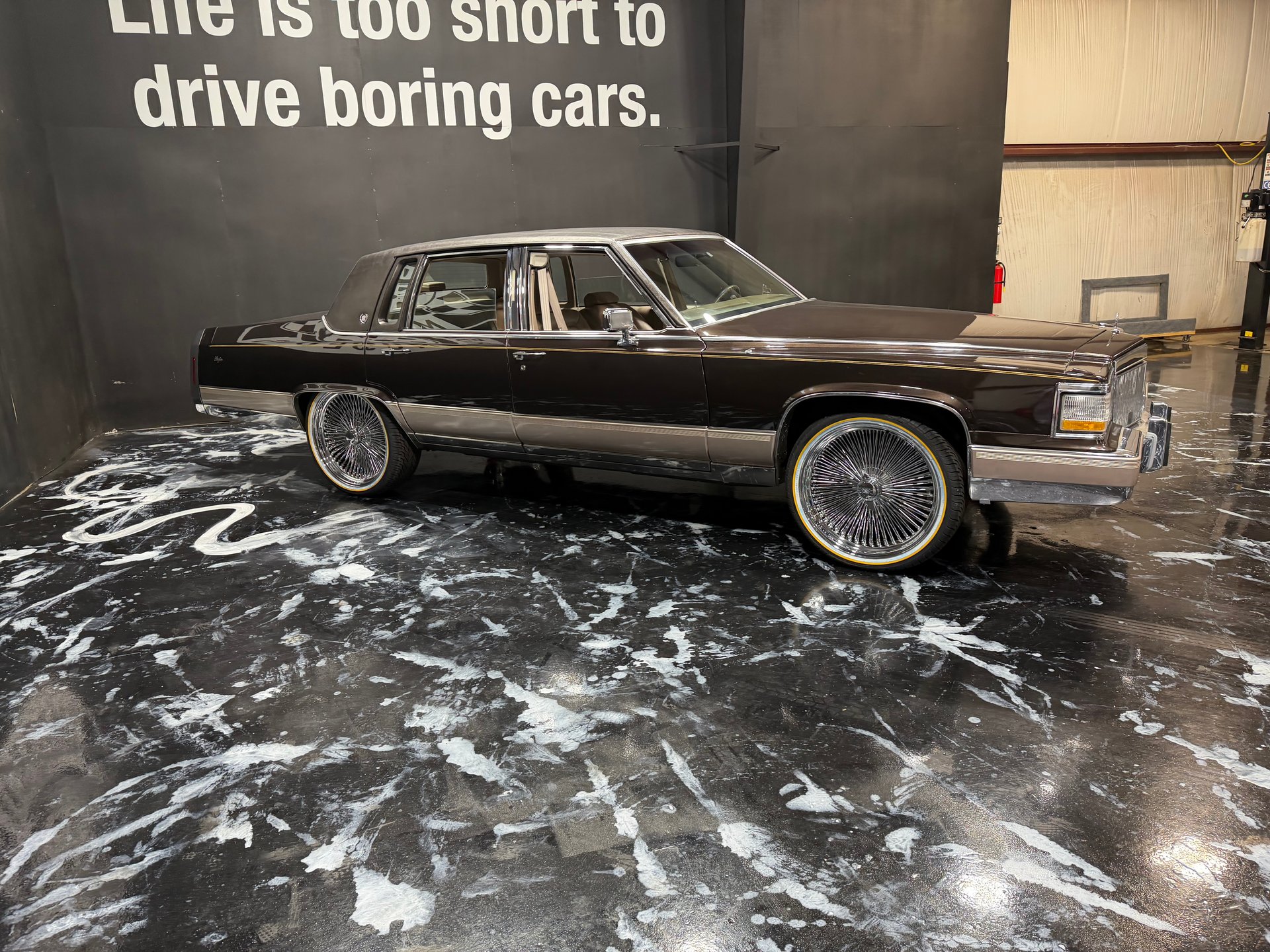
One modern complication deserves its own paragraph, because our pool is full of it: the modified car. Broughams have a second life in custom culture, and you will meet cars on oversized wire wheels, like the 1991 Huntsville car pictured below, and cars lowered or lifted to suit them. Big, heavy wheels load the ball joints and wheel bearings, alter the steering feel, lengthen braking distances and frequently arrive with cut springs or altered geometry underneath. None of that makes such a car a bad buy at the right price; all of it makes it a different car from the one this guide's ride and handling descriptions assume. Ask whether the original wheels come with the car, check the suspension for the work the wheels required, and never pay a stock-car price for a modified car unless the modification is the reason you came.
Interior and trim
The cabin is the reason to buy the car, and the place restoration money disappears fastest. Start with the seats, and sit in the driver's seat, not the passenger's: the broad pillow-tufted benches and the d'Elegance loose-pillow seats lose their padding from the driver's entry bolster inward, and once you can feel the spring frame through the pad the job is pads and covering together. The signature velour wears thin on that same bolster and cannot be patched invisibly; leather, where fitted, cracks on the driver's bolster first and survives remarkably elsewhere. A professional retrim is a five-figure conversation in leather and a solid four-figure one in cloth, which is the arithmetic behind the oldest rule in this guide: a genuinely good original interior is worth more on a Brougham than a rebuilt engine, because the engine can be bought and the interior, in the correct material, largely cannot.
Headliners sag as their foam backing crumbles — pins or staples holding one up in a seller's photographs tell you the car was run on a budget — and a re-trim fitted runs 400 to 800 dollars. The simulated wood of the later cars fades and peels at the door pulls; the door panels themselves crack around the armrests and pull handles under the weight of those long, heavy doors, whose hinges also wear and let the door drop, so it must be lifted to latch. Check every door's shut, not just the driver's. Opera lamps — the small lamps on the C-pillars that are part of the car's silhouette at night — fail with age and are a fiddly, per-side fix; a car with both working has usually been cared for in the small things too, which is the real information they carry.
Power equipment is where the ceremony lives: power seats, windows, locks, mirrors, trunk release and, on later cars, a powered trunk pull-down. Test every switch from every door. Brougham window faults are usually per-corner, not systemic — one dead window is a motor, or a wire broken inside that door's hinge conduit, where the loom flexes ten thousand times and the copper snaps inside intact insulation. The distinguishing test is specific: hold the switch and swing the door slowly, and a window that cuts in and out as the door moves has the cheap wiring fault, routinely misdiagnosed as a motor at several hundred dollars. Power antennas fail extended or retracted and are a modest fix either way; a mast bent by a car wash is the usual story.
Electrics, climate and cooling
The automatic climate control on these cars is vacuum-operated through a programmer behind the dash, and its signature failure — air delivered only to the defroster vents, at the wrong temperature — is the system's designed default when vacuum is lost. Perished vacuum hoses under the hood cause more climate faults than the programmer itself, so replace the hoses before condemning the unit; a system that works on defrost only is usually a hose bill, not a dashboard-out bill. The blower control module on later cars fails in the opposite and more annoying direction, leaving the fan running after the key is removed: a flat battery every morning is its calling card, and the module is a modest part once identified. Test the full climate system on every viewing, whatever the weather, including heat — a heater core that leaks into the passenger footwell announces itself with a sweet smell, a misting windscreen and a damp carpet, and replacement labour varies from reasonable to dashboard-out by generation.
Cooling is the system that turns faults into funerals, because the marginal engines — the HT4100 above all — have no reserve, and even the good engines are old. Judge temperature behaviour precisely: a car that creeps upward in traffic and recovers at speed has an airflow or radiator problem, while a car that overheats at speed has a circulation or combustion problem, and the two diagnoses have nothing in common. Radiators silt, fan clutches go lazy, and on stored cars the whole system wants flushing, hoses and a thermostat before it wants trusting. Air conditioning on a car of this era means R12 originally; many cars have been converted to R134a, some well and some with a can and a sticker. Ask which, look for the conversion fittings and labels, and price a silent system as a system — compressor, condenser, seals and labour — not as a re-gas.
The remaining electrics fail at connections, grounds and switches, in that order. Dim lights, slow windows and a wandering fuel gauge are ground straps and corroded terminals until proven otherwise. Twilight Sentinel automatic headlamps and the automatic dimming systems on earlier cars fail dark and are lived without or fixed by specialists. And treat a brand-new battery on a car offered for sale as a symptom dressed as a feature until a parasitic-draw test says otherwise: something on these cars — a blower module, a level-control compressor relay, a trunk light — is usually the reason the battery kept going flat.
How to inspect one
Allow ninety minutes and bring a torch, a magnet wrapped in cloth, and — if the car is a 1982 to 1985 HT4100 car — a combustion leak test kit, which costs little and settles the single most expensive question on the car. Insist on a cold engine on arrival. A warm Brougham hides cold-start smoke, HT4100 cold misfires, level-control sag and lazy transmission engagement, which between them are most of the money in this guide; if the car is warm when you arrive, reschedule or price the concealment.
- Start with identity and paperwork. Match the VIN on the title to the plate at the base of the windscreen and the door sticker, and decode the engine from the VIN: on a 1990 to 1992 car this is the step that proves whether you are looking at the standard 305 or the optional 350 the price assumes, because the two engines look alike and the badges do not distinguish them. Confirm the car is the generation the seller says it is — rear-drive Brougham, not a front-drive Fleetwood of the same years wearing similar clothes. Ask for invoices before you look at the car, so the story can be checked against the metal rather than fitted to it afterwards.
- Cold start. Turn the key yourself. Watch the exhaust for the first ten seconds: a blue puff that clears is valve stem seals, continuous blue smoke is rings or bores, and white vapour that smells sweet and does not clear is coolant — on an HT4100 car, any coolant sign moves you straight to the combustion test in step 3 before anything else. Note whether the check-engine light proves out at key-on and goes out; a light that never appears has usually had its bulb removed. Listen for the level-control compressor and time it: a run of more than about a minute means it is feeding a leak.
- Fluids and the HT4100 test. Pull the engine dipstick: correct level, no emulsion, no fuel smell. Check the coolant reservoir for oil film and the underside of the oil filler cap for mayonnaise. On any HT4100 car, run the combustion leak test on the coolant now, with the engine warm, exactly as the kit directs; a colour change ends the negotiation at any price that assumes a running engine. On every car, after a short run through the gears, pull the transmission dipstick: pink to light red and sweet-smelling is right, brown or burnt reprices the gearbox into your offer.
- The roof. Do the fingertip test from the problem areas section before anything else on the body: press firmly all around the rear window and along both C-pillars through the vinyl padding. Hard and drum-tight is a cosmetic re-cover one day; soft or crunchy is a structural rebuild with the glass out, and on a 1980s car it is the decision, not a deduction. Check the headliner edges inside for the staining that confirms water has been through.
- The trunk. Open it, lift the mat and the spare, and look for water lines, rust and a damp smell in the well. Operate the power pull-down if fitted and watch it draw the lid fully closed. A dry, crisp trunk floor on an old Brougham is one of the best single signs the car has been garaged and sealed properly; a wet one reprices the rear window channel and seal along with the floor.
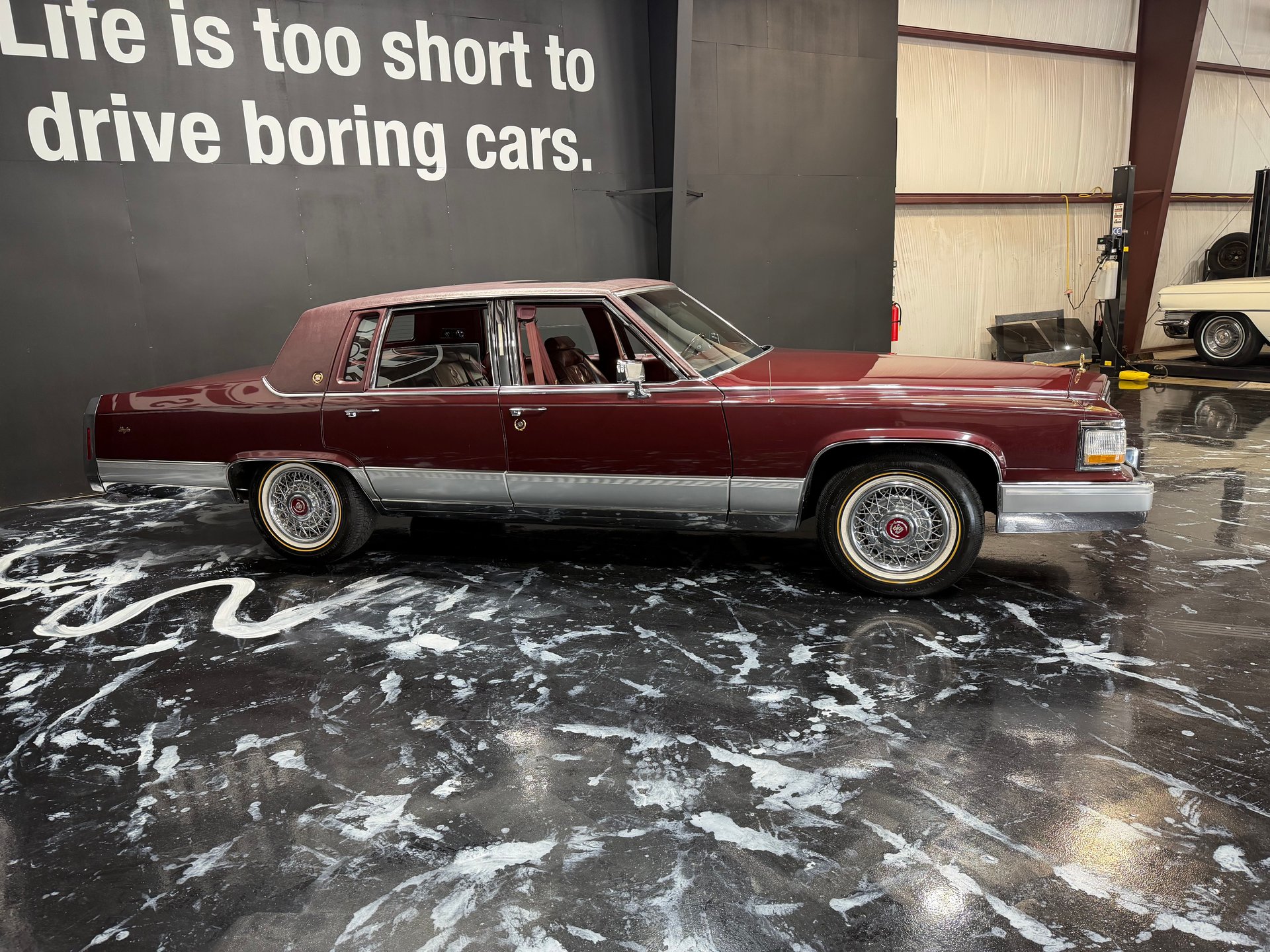
- Stance and levelling. Sight the car on level ground, as in the photograph above: level side to side, and correct front to rear. Then load the trunk with weight — luggage, a passenger sitting on the edge, whatever is to hand — wait two minutes with the engine running, and watch a level-control car pump itself back to height. A car that does not recover needs the compressor, shocks or sensor priced in; a car sitting tail-high unloaded usually wears a conversion, and you ask which springs and why.
- Underneath. On a lift if at all possible — pay for one if the car passes everything else — prod the frame rails at the rear kick-up, the body-mount outriggers and the steering box mount, and the rockers, floor seams and brake and fuel lines. Read the coating as the problem areas section describes: patchy and honest is factory, fresh and uniform over everything is a question. Check the TV cable at the throttle linkage on any overdrive car while you are in the engine bay: present, connected, correctly tensioned — the cheapest insurance in this guide.
- Body, gaps and chrome. Run the magnet over the fender heels, lower doors, rockers and rear quarters; filler announces itself where the magnet falls away. Open and close every door: Brougham doors are long and heavy, and a dropped hinge shows as a door that must be lifted to latch. Count the bumper filler panels, front and rear, and grade each one — intact, cracked or crumbling — because the set is a single bill. Count pitted or missing chrome and cladding pieces the same way, and price absence, not just damage.
- Interior and every switch. Sit in the driver's seat first and judge the padding as the problem areas section directs, then in the rear. Work every power function from every switch: windows from each door — swinging each door slowly while its window runs, to catch the hinge-conduit wire fault — seats, locks, mirrors, trunk release, antenna, opera lamps, and the full climate system on every setting including heat, whatever the weather. On a car with a new battery, ask why, and remember the blower module test: switch off, key out, and confirm the fan stops.
- The test drive. Twenty minutes minimum, including a motorway stretch and a rough side street. The steering should centre and track without constant correction; wander plus a knock over bumps is linkage and box money. The automatic should engage within a second, shift without flare or shudder, and hold overdrive without hunting; on a 307 car, hesitation and a rich smell are the carburettor electronics, on a V8-6-4 car, surging at cruise is the modulation system, and in both cases the drive has just named the bill. Brake hard from speed twice: straight stop, firm pedal, no pull, no judder.
- Heat and idle. After the drive, idle for ten minutes with the air conditioning on. Watch the temperature gauge for creep and distinguish the two overheating stories from the problem areas section — creep in traffic that recovers at speed is airflow or radiator, overheating at speed is circulation or combustion. Check for fresh leaks where the car sits, and listen to the fan clutch and ancillaries with the bonnet up.
- Decide by the fatal flaws, not by charm. Score the car against its own list before you negotiate: roof and frame on every car, coolant and head gaskets on an HT4100, TV cable and box on an overdrive car, Optispark-era cooling on a 1993 to 1996 car, interior on all of them. A Brougham that passes its list with a tired engine bay is a better buy than a gleaming car that fails it — engines, gearboxes and brakes are fixable at the prices this guide has given you, while a rotten roof, a rotten frame or a ruined interior can only be replaced at a price that exceeds the car.
Values
The computed market block beneath this guide carries the current numbers — what is listed now, and what recorded sales have achieved — refreshed as the market moves, so this section deliberately carries no figures of its own. What it can teach you, durably, is how to read those numbers, because Brougham is one of the easiest names in the classic market to misread from a single listing: the same badge covers a hand-built collectible and a mass-produced sedan, and a search that mixes them produces nonsense in both directions. Separate the generations first, always, and value a car only against its own kind.
Within the 1985 to 1992 cars that make up most of the market, the first lesson is that condition spread dwarfs everything else. These were expensive cars bought by careful people and then kept, very often, past the point where the maintenance kept pace, so the pool holds a small number of genuinely sorted, documented cars, a large honest middle, and a long tail of cheap cars whose cheapness is a down payment on the roof, filler, levelling and interior work set out in the problem areas section. When the market block shows a wide spread, that is the market pricing condition accurately. Your job is to place the car in front of you in the right third of it, using the inspection — never the seller's description.
The second lesson is the asking-versus-achieved gap, which runs wide on these cars. A big rear-drive Cadillac is an emotional, occasional purchase with a thin flow of buyers, so optimistic asking prices sit for months, and the recorded sales beneath this guide are the honest evidence. Weight a cluster of achieved sales over any single asking price, and read a car listed for a full season at one figure as a car the market has already valued below it. The exception is the genuinely exceptional car — low mileage, documented, original paint, a perfect roof and interior — whose buyer is paying for the years of recommissioning they will not have to do. That premium is real, and it is earned by paperwork, not by shine.
Premiums attach to specific, provable things. On the 1990 to 1992 cars, the engine is the premium: the 350 is worth more than the 305, which is worth more than the 307 cars, which are worth a great deal more than a cosmetically identical HT4100 car — and the market is right every time, because it is pricing the bills in the engines section. The d'Elegance specification adds a modest premium when its tufted interior is intact, and nothing when it is worn, because the interior is the premium. Originality pays on the Eldorado Brougham out of all proportion — correct stainless roof, correct trim, a complete and original cabin — because none of it can be bought back at any sensible price. Colour matters at the margins: blue, black and white, the common colours in our pool, sell on condition, while a sound unusual colour in original paint lifts a good car. Modified cars — big wheels, altered suspension — should be valued against other modified cars, in a thinner market of their own: the same car is worth less to a stock buyer and more to the custom buyer, and neither valuation is wrong.
The project-versus-driver gap follows the same logic. A project Brougham is only cheap if its deficits are mechanical, because mechanical work on these cars is predictable, widely understood and priced in this guide. A project whose deficits are the roof structure, the frame or a complete interior is not a project in economic terms — it is a parts car with a title, however complete it looks in photographs. Negotiate from the inspection list, itemised and costed, rather than from a percentage off the asking price: sellers of these cars usually know the faults are real, and a specific, evidenced list is the argument that moves them.
Parts and ownership
Brougham ownership is easier than the car's ceremony suggests, because underneath the formal clothes almost every generation shares its mechanical heart with high-volume General Motors cars. The chassis, suspension and brake components of the 1977 to 1992 cars served across the full-size GM lines; the Chevrolet-engined cars are small-block Chevrolets in every part that wears; and even the Cadillac-engined cars were built in numbers that keep a specialist trade fed. What is hard is not keeping a Brougham running. It is keeping it looking like a Brougham.
Easy: service items for every engine family in this guide — filters, plugs, ignition wear parts, belts and hoses. Brake consumables across the range at ordinary parts-store prices. Chevrolet small-block parts for the 305 and 350 cars, including the throttle-body service items, from multiple suppliers at truck prices. Suspension wear parts, steering boxes and level-control air shocks and compressors, kept in production by the wider full-size GM market. Weatherstrip in reproduction for the popular years, bumper filler sets in reproduction, and glass for the later cars.
Harder and dearer: HT4100-specific engine parts, where the honest route is a rebuilt engine from the shrinking number of specialists who will warranty one. Eldorado Brougham everything — stainless roof trim, air suspension components, one-off interior and chrome — where the part exists in a specialist's stock or it effectively does not exist. Correct interior materials for any generation: the specific velours and the d'Elegance pillow cloth in the right colour and pattern, through specialist trim suppliers, at prices that reward buying a good interior in the first place. Vinyl roof mouldings and the clips that vanish during a re-cover. Generation-correct chrome and lower cladding, where re-plating your own sound pieces, at several hundred dollars per major piece, is usually wiser than hunting replacements carrying the same pitting. A quality repaint on a car of this size starts well into five figures, which is the arithmetic behind this guide's standing advice to buy paint, body and roof first and fix the mechanics second.
Running costs. Expect fuel consumption in the low-to-mid teens in mixed use for the big-block and carburetted cars, modestly better for the throttle-body Chevrolet cars on a motorway run, where the tall overdrive gearing lets a big Cadillac loaf at low revs. Budget the first year honestly: catching up deferred maintenance on a running Brougham — fluids throughout, hoses and belts by age, brake hydraulics as needed, tyres judged by date code rather than tread, and the item your inspection flagged — runs 2,000 to 5,000 dollars at a shop before you improve anything, and recommissioning a stored car runs higher, because storage on these cars means perished rubber, varnished fuel systems and seized brake hardware, all at once. Club support is a bright spot: the Cadillac and LaSalle Club ecosystem, and the sheer number of these cars built, mean you are never diagnosing a Brougham fault alone. Buy use, not storage, even at the higher price — on a Brougham, storage is not preservation, it is deferral with better lighting.

Which one to buy
- The all-rounder: Brougham, 1990 to 1992, with the 350. The facelift car with the Chevrolet 350 gives you the complete traditional experience — frame, rear drive, padded roof, pillow seats — with the cheapest parts supply and the fewest vices of any Brougham in this guide. Buy the best-documented car, prove the engine by the VIN, and do the roof test before you fall for the interior.
- The value buy: Brougham, 1987 to 1989. The Oldsmobile 307 cars are the same sedan with less speed and a softer price. A sorted 307 car with its carburettor electronics alive is the cheapest honest route into the last traditional Cadillac — just make sure the check-engine light works and the TV cable is right.
- The one-year sweet spot: Fleetwood Brougham, 1986. The old name, the fixed engine, one model year only. Everything said about the 307 cars applies, a year earlier and usually cheaper, because sellers price it with the HT4100 cars it superficially resembles and it is not one of them.
- The classic experience: Fleetwood Brougham, 1971 to 1976. The biggest cars, the 472 and 500 engines, the fullest expression of what the name meant in its prime. Buy on frame, roof and interior, choose the best body over the lowest mileage, and keep the 1977 to 1979 425 cars in mind if you want the same flavour in a size modern roads forgive.
- The finale: Fleetwood Brougham, 1994 to 1996. The LT1 engine makes the trim-package cars the fastest Broughams ever sold and, mechanically, among the easiest to live with. Buy one as a Fleetwood with the trim you want, with the cooling and distributor history proven.
- The collector car: Eldorado Brougham, 1957 to 1958. A different purchase from everything above: hand-built, irreplaceable in detail, and bought on originality and completeness with a specialist inspection. The 1959 to 1960 Pinin Farina cars are rarer still and belong to the same conversation. Neither is transport; both are history you can drive.
- The one to walk away from: any HT4100 car without documentation. The 1982 to 1985 cars are not villains — a maintained, tested, documented example bought at the right price is a legitimate purchase — but an undocumented one is the seller's risk transferred to you at your expense. The ten-minute coolant test, or no deal.
And the rule that overrides all of the above: buy the car whose fatal flaw you have personally tested and seen pass — roof and frame on every Brougham, coolant on an HT4100, interior on all of them. Engines, gearboxes, levelling systems and brakes are fixable at prices this guide has given you. A rotten roof under its own padding, a rotten frame or a ruined interior costs more to put right than the finished car will be worth — and on a car whose whole point is ceremony, the ceremony is the part you cannot buy back.