
Buick Special buyer's guide
Buick Special -- the model's own buyer's guide: variants, values and what to check.
Years listed: 1937-1966 · Series: Full Size
Overview and history
The Buick Special is not one car. It is one nameplate worn, with interruptions, by three quite different automobiles between 1936 and 1969: Buick's entry-level full-size car of the pre-war and 1950s years, a compact in the early 1960s, and an intermediate after that. A buyer who treats every Special as the same machine will misjudge the car in front of them, so this guide is organised by era throughout — and weighted, deliberately, to the cars that dominate today's market.
Start with the pool behind this guide, disclosed plainly. We currently track 27 Buick Specials for sale or recently sold: 16 for sale and 11 sold. The composition is heavily concentrated. Eighteen of the 27 are the post-war full-size cars of 1950 to 1958, and five of those 18 are 1956 models alone, with four 1954s and three 1955s behind them — the 1954 to 1956 cars are the core of the market as we see it. Seven cars are pre-war, from 1937 to 1940. One car is a 1948. And exactly one car in the whole pool is from the later life of the name: a single 1966. There is not one 1961 to 1963 compact Special in the pool at all. Twenty-two of the 27 came through dealers and five through Facebook Marketplace sellers, which shapes what you will see: mostly presented, dealer-described cars, not a cross-section of every barn-kept survivor.
That weighting matters because the original Special — the Series 40 of 1936 — was conceived as Buick for people who could not quite stretch to a Buick. General Motors placed Buick above Oldsmobile and Pontiac and below Cadillac, and the Special was the bottom rung of that ladder: the cheapest way into straight-eight power, Fisher bodywork and Buick's reputation for building a car a banker would drive. It worked because the Special was not a cheap car made cheaper. It shared its engineering honesty with the bigger Century, Roadmaster and Limited, and for much of its life it shared their overhead-valve straight-eight in a smaller displacement. What you gave up was wheelbase, trim and some speed, not substance.
The pre-war Special, built from 1936 to 1942, rides the industry's great transition: running boards shrinking, headlamps faired into the fenders, all-steel turret-top bodies, hydraulic brakes and independent front suspension becoming normal. The 1939 and 1940 cars in our pool show the mature form — and 1939 also gives the pool its rarest body, a Model 41C convertible phaeton, discussed in the models section with the caution its listing claim deserves.
War stopped civilian production in early 1942. Buick returned for 1946 with warmed-over pre-war cars, and the all-new post-war body reached the Special late, so the 1949 Special was a short, transitional run and the volume post-war cars are really the 1950 to 1953 Jetback fastbacks and conventional sedans that followed. Those cars kept the straight-eight to the very end of its long life.
The decisive break came in 1954. Buick restyled the range completely, lowered and widened the bodies, and gave the Special a V8 at last: the new overhead-valve "Nailhead", in a Special-only 264-cubic-inch size. From 1954 to 1958 the Special is a proper 1950s American car: wraparound glass, two-tone paint, acres of chrome that peaked, some would say tipped over, in 1958. Then, for 1959, Buick renamed its whole range. The Special became the LeSabre, and the name went into a drawer.
It came back in 1961 on a completely different car: a compact, unit-body Special with Skylark as its glamorous sister, powered by a pioneering aluminium V8 and then by America's first modern production V6. In 1964 the Special moved up a size again to the A-body intermediate platform it kept until the name was retired after 1969. Those later cars are good automobiles, but they are a different ownership proposition — different parts world, different rust map, different character — and in our pool they are represented by that one 1966 car. This guide covers them honestly and briefly, and covers the full-size straight-eight and Nailhead cars in the depth the market actually demands.
Across all three lives, one trait survives: a Special was bought to be used, by an owner who wanted comfort and durability more than show. Survivors therefore tend to be honest, family-worn cars rather than pampered collector pieces — which is why condition, not rarity, decides almost every purchase in this guide.
The models
Read this section by era, not by badge. Within each era the body style is the real variant: a convertible or an estate wagon is a different purchase from a four-door sedan even when the mechanicals underneath are identical, because rarity, rust behaviour and trim costs all follow the body.
| Model | Years | Engine | Output | Built | Character |
|---|---|---|---|---|---|
| Series 40 Special | 1936–1942 | 233, then 248 cu in straight-eight | 93–110 hp | Volume seller; exact splits by body vary | The pre-war entry Buick; formal, upright, torque-rich |
| Special (post-war carryover) | 1946–1948 | 248 cu in straight-eight | 110 hp | Volume seller | Pre-war car in post-war clothes; the 1948 wagon is the prize |
| Special and Special Deluxe | 1949–1953 | 248, then 263 cu in straight-eight | 110–128 hp | Volume seller | Jetback fastbacks and sedans; last of the straight-eights |
| Special (Nailhead) | 1954–1958 | 264, 322, then 364 cu in V8 | 143–250 hp | Volume seller | The 1950s car; 1956 is the pool's centre of gravity |
| Special compact | 1961–1963 | 215 cu in aluminium V8; 198 cu in V6 | 155 hp; 135 hp | Substantial but scarce today | Light, clever, Skylark's sister; none in our pool |
| Special intermediate | 1964–1969 | 225 cu in V6; 300 and 340 cu in V8 | 155–260 hp | Volume seller | A-body family car; one 1966 in our pool |
(Outputs are period SAE gross figures and vary by year, compression and transmission; treat any single horsepower claim on a listing as approximate until the year and engine are pinned down. Production is described qualitatively here because reliable per-body splits are not published consistently across the whole span, and this guide does not invent them.)
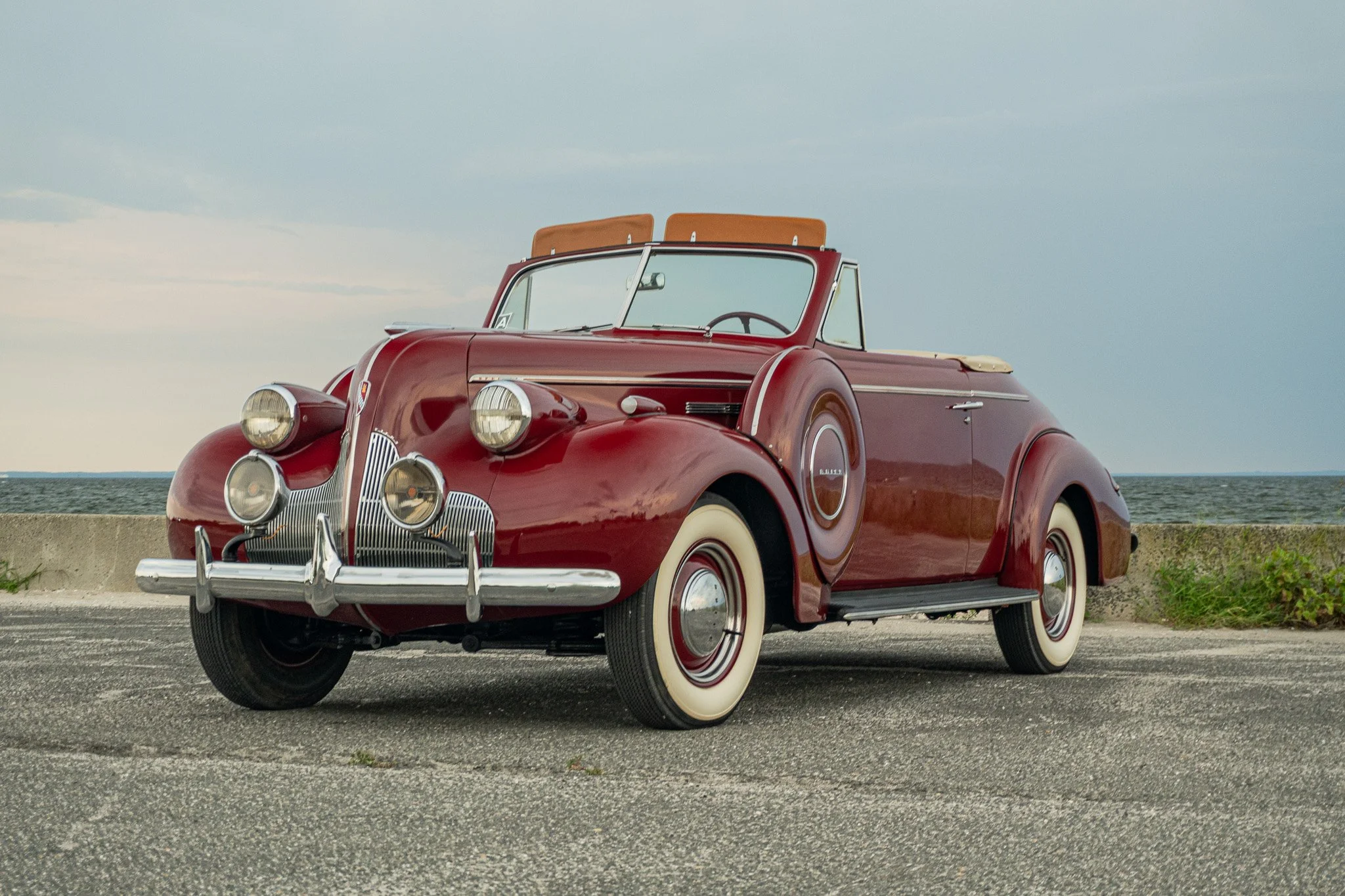
The pre-war Series 40, 1936 to 1942. The launch car of 1936 used the smaller 233-cubic-inch straight-eight; from 1937 the 248 engine that would serve the Special for sixteen years took over, and our pool starts there, with two 1937 two-door touring sedans — the slant-back body, whose sloping rear leaves little luggage room and a lot of charm. The 1939 cars are the pool's pre-war strength: three of them, including a convertible coupe and the Model 41C phaeton. A phaeton — four doors, open top, no roll-up side glass, side curtains instead — was already an anachronism in 1939, which is why so few were made. The listing for the pool's car describes it as one of 724 built. Treat that figure as a seller's claim to verify against Buick Club and factory-record sources before paying a rarity premium on it, not as a fact this guide can confirm from the listing alone. The 1940 cars, two coupes in the pool, are arguably the sweet spot of the pre-war range: the styling had settled, the mechanicals were fully developed, and a coupe or convertible still had real pace from the 248.
Body styles across the pre-war run cover two- and four-door sedans, slant-back and notchback, coupes, convertible coupes, the rare convertible phaeton, and station wagons. Identification is by the Fisher body plate and the model number, not by the seller's description: Buick model numbers encode the series and the body, and a "Special" that decodes as a Century or a Super is a different car with a different value. That check costs nothing and is step one of the inspection.
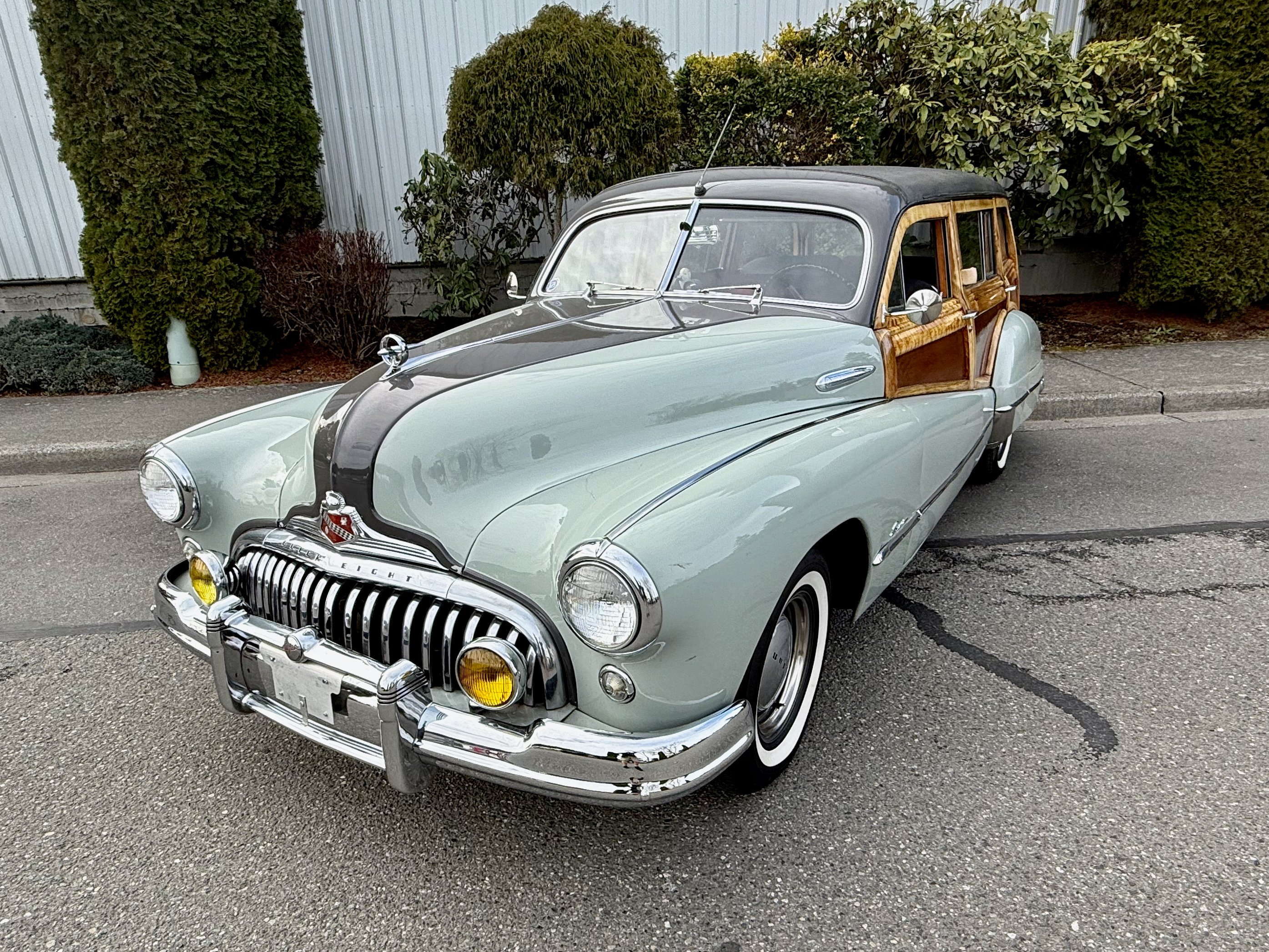
The carryover cars, 1946 to 1948. Buick's immediate post-war Specials are the 1942 design continued — mechanically simple, visually old-fashioned next to the all-new 1949 GM bodies. The pool's single car here is the one to covet: a 1948 Special Estate Wagon, a true woody with structural wood framing in the rear body. Rarity, beauty and a wood-maintenance bill unlike anything else in this guide make it a specialist purchase. Do not price it like a sedan with a longer roof.
The last straight-eights, 1949 to 1953. The new post-war Special arrived with fastback Jetback styling — sedanets whose roofline sweeps unbroken into the tail — alongside conventional notchback sedans under the Special Deluxe name, including the 1950 Deluxe Jetback Sedanet in our pool. The fastbacks are the period look; the notchbacks are roomier and usually cheaper. Underneath, the story is continuity: the 248, enlarged to 263 cubic inches — first for automatic cars, then across the range — and Dynaflow arriving as an option, which changed how these cars were used and how they wear. The pool holds a 1950, a 1951 and two 1953s. The 1953 is a hinge year: the straight-eight's last, and the step to 12 volts.
The Nailhead cars, 1954 to 1958. This is the heart of the guide, because it is the heart of the pool: five 1956s, four 1954s, three 1955s, a 1957 and a 1958. The 1954 redesign is total — new body, new chassis feel, V8 power — and the body range is the full 1950s catalogue: two- and four-door sedans, the Riviera hardtops (two-door for 1954, four-door hardtop joining for 1955 and after), convertibles, and estate wagons. Learn one naming trap now: on a 1950s Special, "Riviera" names a hardtop body style, not the later Buick Riviera personal-luxury car. The pool's 1957 car is listed as a "Special Riviera", and that is exactly what it means — a hardtop Special — not a misfiled Riviera, and not a car to price as one.
Year by year, the character shifts. The 1954 is the lightest and simplest of the V8 cars, on the smaller 264 engine. The 1955 adds power and the four-door hardtop. The 1956, the pool's commonest year, got the bigger 322 and is the developed car: more torque, better Dynaflow behaviour, and the styling most buyers picture. The 1957 is a one-year body, lower and wider, on the 364. The 1958 is the chrome climax — the heaviest ornamentation Buick ever fitted, and the year of the troublesome Flight Pitch transmission option. Nothing else in this guide costs as much to re-chrome, and nothing else turns heads like it.
The compact, 1961 to 1963. A different species: unit construction, the aluminium 215 V8, and from 1962 the 198 V6. The Skylark began as the Special's upscale coupe sister for 1961 and grew into its own line; Skylarks are not Specials, and a Skylark filed as a Special, or the reverse, changes both the parts conversation and the value — decode the trim and body numbers rather than trusting the badge. None appears in our current pool, so this guide treats the compact in proportion.
The intermediate, 1964 to 1969. On the A-body the Special was again the entry car — sedans, wagons, coupes and convertibles, with Skylark above it. The pool's single 1966 car belongs here. It is not a misfile: the name is correct for 1966. But note a defect in the pool's own classification: the store records all 27 cars, the 1966 included, under a "Full Size" series heading. A 1966 Special is an intermediate, not a full-size car. File that as a metadata error in the pool, not as a fact about the car.
Engines and gearboxes
The straight-eight: 248 and 263, 1937 to 1953
Buick's overhead-valve straight-eight is one of the great long-lived American engines, and the Special's version is the small one: 248 cubic inches from 1937 to the end of the 1940s, joined and then replaced by the 263 from 1950. Overhead valves when most rivals still ran side-valve eights, five main bearings, and a deep, lazy torque delivery that defines how every straight-eight Special drives. Output rose gently, from roughly 100 horsepower in 1937 to about 110 in the 248's mature form, with the 263 rated around 120 horsepower in manual cars and higher, around 128, behind Dynaflow. Do not chase the numbers: a healthy 248 and a tired 263 feel identical at the wheel, and condition is everything.
The engine's virtues are silence and endurance. A good one starts readily, ticks over almost inaudibly, and pulls from walking pace in top gear — the classic straight-eight party trick, and a genuine test: an engine that needs revs and gear changes to move the car is down on compression, timing or carburation. The carburettor on most cars is a single Carter or Stromberg two-barrel, simple and rebuildable, with an automatic choke on later cars whose arrangements go lazy with age and give the classic cold-start flood or fast-idle hang-up. The 1941 cars offered Buick's compound carburetion — twin carburettors, staged — on some models; if a 1941 Special genuinely carries it, verify it is complete, because half a compound setup is worse than a single carburettor.
Failure modes are mostly about age, heat and oil. Valve gear is mechanical on the early cars and wants its clearances checked; later straight-eights use hydraulic lifters that tick when the oil is old, thin or low — a tick that vanishes with fresh oil is a maintenance note, while a tick that stays hot on one cylinder is a lifter or a worn lobe. Exhaust manifolds crack, giving a ticking blow under load routinely misdiagnosed as a lifter; listen at the manifold joints cold and the location gives itself away. Core plugs corrode when antifreeze has been neglected, and a weeping plug is a cooling-system verdict, not just a plug: price a full system overhaul — radiator recore, hoses, water pump, plugs — as one job, realistically $1,200 to $2,500 at a shop. Head gaskets on a neglected engine fail between cylinders and show as a misfire with clean plugs; a compression test settles every one of these arguments in twenty minutes, and no straight-eight should be bought at strong money without one. A full professional rebuild of a 248 or 263 runs roughly $4,500 to $8,000. Oil leaks shape expectations too: a used straight-eight will mark its territory at the rear main, timing cover and valve cover, and damp is normal — but a car losing oil fast enough to drop the level between fuel stops has a specific fault, usually a rear-main seal or a blocked crankcase breather, and the breather check costs nothing, so do it before anyone sells you a rebuild.
The Nailhead V8: 264, 322 and 364, 1954 to 1958
For 1954 Buick replaced the eight-in-a-row with its new overhead-valve V8, the engine the hobby calls the Nailhead for its small, near-vertical valves and the narrow, upright valve covers they produce. The Special's first version displaced 264 cubic inches — a size used by no other Buick line, which matters for parts, below — rated at about 143 horsepower in its first year and rising to about 188 for 1955. For 1956 the Special stepped up to the 322, at about 220 horsepower, and for 1957 and 1958 to the 364, at about 250 horsepower. Each step is real at the wheel: the 264 is adequate and sweet, the 322 is the relaxed tourer, the 364 is genuinely quick by 1950s standards.
The Nailhead's character is torque delivered low, with a distinctive, slightly lumpy idle that is normal for the cam timing and valve layout — do not build a misfire diagnosis, or believe a seller's "performance cam" story, on that idle alone. The distributor sits at the back of the engine, awkward to service and therefore often unserviced: neglected points, condenser and advance mechanism produce exactly the flat, hesitant running owners blame on the carburettor, which is a Carter or Rochester four-barrel on most V8s, a two-barrel on some early specifications. Rebuild costs for the four-barrel, properly done with throttle-shaft bushes, run roughly $450 to $900; a distributor service is cheap parts and an hour of contortion. Do both before condemning anything deeper.
The mechanical traps are specific. Sludge in the rocker gear starves the top end, and a top-end rattle that persists hot is a warning, not a quirk. Timing chains stretch; a chain-and-gears job is roughly $900 to $1,600 fitted and is a normal mid-life service. Exhaust manifolds crack, particularly where heat-riser valves seize and cook one side of the system, so check that the counterweight moves. Engine identification matters before any parts order: the 264 shares less with the 322 and 364 than sellers assume, engine numbers are stamped on the block, and a 1954 or 1955 car carrying a later, larger engine is common enough that you should verify displacement from the number, not the air-cleaner decal. A swapped 322 in a 1954 is a fine driver and a wrong collector car, and the price should say which one you are buying.
Cooling is the Nailhead Special's systemic weakness in modern use: a marginal radiator, a missing fan shroud, retarded timing and lean modern fuel combine into the classic creeping temperature gauge in a queue. The fix is systematic — recore or high-efficiency core, correct thermostat, shroud and fan, timing to spec — budgeted at roughly $800 to $1,800 as a package, and a car that already stays cool in summer traffic has had real money spent in the right place. Ask for those invoices.
The later engines: aluminium 215, the V6s and the small V8s, 1961 to 1969
The 1961 compact Special introduced Buick's 215-cubic-inch aluminium V8: about 155 horsepower, light enough to transform the car's balance, and decades ahead of its time — the design was later sold to Rover in Britain and lived on for decades there. Its traps are aluminium traps. Corrosion from neglected coolant attacks block and heads; overheating warps heads and breaks the head-gasket seal, and repeated overheating is the one history that should genuinely scare you; thread damage in the soft block turns ham-fisted past repairs into helicoil archaeology. A 215 that runs cool, holds its coolant and shows no emulsion under the oil cap is a delightful engine. Budget a specialist's eye for any 215 at real money.
The 198 V6 of 1962 and 1963, enlarged to the famous 225 for the 1964 intermediate cars, is the 215's iron-block child with two cylinders removed — a 90-degree V6 built on V8 tooling, which gives it an odd-fire crankshaft and a deliberately uneven idle. This is the single most misdiagnosed trait in this guide: a 225 that idles as if it is gently missing is idling as designed, because its firing intervals are uneven. Judge it hot, under load and by its plugs and compression, never by idle smoothness alone. The later A-body cars also offered Buick's 300 V8, derived from the 215 with an iron block, and the 340 that followed: conventional, torquey, well-supported engines whose inspection is the standard V8 litany of smoke, rattle, leaks and cooling. For the pool's one 1966 car, pin down which engine it actually has — a six and a 340 are different purchases wearing the same grille.
Gearboxes: synchromesh three-speed, Dynaflow, and the later automatics
Most pre-war and early post-war Specials carry Buick's three-speed manual, column-shifted, with synchromesh on the upper gears. It is a strong box whose wear shows as second-gear crunch on a hurried downchange, jumping out of gear on the overrun — a serious fault, usually worn engagement teeth or bearings — and a noisy first gear, which is straight-cut character rather than damage. Clutch judder is usually oil contamination or a tired driven plate; a full clutch job runs roughly $900 to $1,600 fitted, and column-shift linkage bushes, cheap in themselves, transform a vague change when renewed.
Dynaflow, Buick's own automatic, optional on the Special from the late 1940s and increasingly the default through the 1950s, is unlike every other automatic of its era: in Drive it does not change gear at all in normal use, but drives through a torque converter whose characteristics do the work, with a manually selected Low for hills and engine braking. A buyer raised on modern automatics will read a healthy Dynaflow as "slipping" — the engine note rises, the car gathers speed smoothly, no shift ever arrives. That is correct behaviour. The tests that matter: engagement of Drive and Reverse should be prompt and without a bang; the car should pull cleanly from rest without shudder; fluid should be red to pink, not brown and burnt; and leaks — Dynaflows are famous leakers at the torque-ball joint where the transmission meets the torque tube, at seals and at the pan — should be graded from damp to dripping and priced, with a reseal and service realistically $600 to $1,400. Variable Pitch Dynaflow from 1955 added a stator that changes angle with throttle, giving a kickdown feel without a gear change; the 1958 Flight Pitch, a triple-turbine development, is the one to approach with genuine caution — complex, thirsty, and expensive to put right, with specialist rebuilds running $3,500 to $6,000 where a conventional Dynaflow rebuild is more typically $2,500 to $4,500. On a 1958, documented Flight Pitch work is worth a premium and an undocumented car should be priced as if the bill is coming.
Two period truths apply across the Dynaflow years. First, there is no Park in the modern sense on the earliest cars, so parking arrangements and handbrakes must be physically tested, not assumed. Second, Dynaflow cars place different loads on brakes and cooling than manuals — more creep, more heat, more brake use on hills — so judge those systems on an automatic car a grade more strictly.
The later cars simplify. The compact and intermediate Specials used a two-speed automatic — the Super Turbine 300, with a switch-pitch converter on mid-1960s cars that gives a distinctive, correct change of engine note at full throttle — alongside three- and four-speed manuals. Test for flare, delay into Reverse, and fluid condition, and price a rebuild in the $2,200 to $3,800 range if any of those tests fail.
One driveline feature unites the full-size cars to 1960: torque-tube drive. The propeller shaft runs inside a rigid tube bolted to the transmission and the rear axle, which locates the axle and carries the drive torque. There are no exposed universal joints to fail in the familiar way, but the torque-ball joint at the front is a wear and leak point, rear-axle removal is a bigger job than on an open-drive car, and any rear-end estimate that assumes an open drive is an estimate written for a different car. The compact and intermediate Specials were open-drive from the start.
Problem areas
Everything in this section should be read against the pool's own photo evidence, stated with its sample size. We examined photo notes for 11 of the 27 cars in the pool. Rust is mentioned in the notes for 7 of those 11 cars — nearly two in three — and damage of some kind in 3 of the 11. No smoke and no leak mentions appear in those 11 sets of notes at all, which tells you about sellers' photographs, not about the cars: nobody photographs a leak. Treat the rust figure as the honest headline. A Special of any era should be assumed to have rust somewhere until your own inspection proves otherwise.
Rust and the body: the map, by era
All full-size cars: floors, rockers and the dog leg. The rocker panels and the floor above them are the structural centre of every 1936 to 1960 Special and the first place to spend your inspection time. Water and road salt sit in the rocker box sections, the floor rots over them from inside the car where carpets hold damp against it, and the two failures meet in the middle. Press and prod the full rocker length, lift the carpets and the rear seat base, and look at the floor from below with a light: surface scale is a treatment job, perforation is welding, and rocker-plus-floor work done properly — panels cut out, new metal let in, protected and painted — runs roughly $1,500 to $3,500 a side depending on how far the rot has travelled into the pillars and braces. The short curved panel behind the rear door and ahead of the rear wheel, the dog leg, rots on four-door cars of every era and is fiddly to repair well; bubbling there is a reliable sign the rocker behind it is worse.
Pre-war cars: fenders, running boards and wood. On 1936 to 1942 cars add the cycle-fender traps: the bottoms and rear edges of the front fenders, the running-board aprons, the spare-wheel well, the cowl sides where water runs off the windshield, and the bottoms of the doors. Convertibles and phaetons add a structural question no sedan asks: the open bodies rely on the chassis and cowl for stiffness, the doors must still shut true, and a car whose doors drop or whose gaps wander has chassis or body-structure work ahead. The estate wagons carry structural wood: inspect it as structure, not trim. Sound ash framing is firm, tight at the joints and dry; blackened, soft or separating joints, a sagging door, or filler in a pillar are specialist woodwork, realistically $5,000 and upward for meaningful frame repairs before any refinishing, and a wagon with tired wood should be bought only with a woody specialist's written assessment in hand.
1949 to 1953: the fastback traps. The Jetback sedanets concentrate water at the base of that long rear slope: the rear window seal, the trunk floor under the mat, and the lower rear quarters. Lift the trunk mat on every car, without exception. The notchback sedans share the same risks in milder form. On all of these cars the battery tray and the inner fender beneath it corrode from acid, invisibly, with the battery in place — rock the battery, shine a light at the tray edges, and price a tray and inner-panel repair at roughly $400 to $900 fitted if it is holed, more if the corrosion has reached the firewall or frame beneath.
1954 to 1958: the chrome-era map. The later bodies rot in the same structural places — rockers, floors, trunk, dog legs, lower front fenders behind the wheels — and add three era-specific traps. First, the enormous chrome and stainless trim traps moisture against the panels it decorates: rust blooms from under side spears and behind bumper ends, and a car can look bright while the panel under the trim is perforated. Second, the 1957 and 1958 bodies carry more hidden seams and more ornament, and a 1958 in particular can hide serious lower-body work under fresh paint and new chrome; a magnet, a light and a lift are not optional on one. Third, convertibles and the pillarless Riviera hardtops depend on body stiffness and seal fit more than sedans do: check that hardtop doors shut flush, that the frameless door glass meets its seals, and that a convertible's top frame folds without binding — binding is a body-alignment symptom before it is a top symptom. Windshield and rear-window seals on all 1950s cars perish and feed the floor and trunk rot above; a set of glass seals is roughly $600 to $1,400 fitted, and it is the highest-value preventive spend on any car you buy.
1961 to 1969 cars: unit-body and A-body rust. The compact's unit construction moves the stakes: front subframe and torque-box areas, the cowl, the floor and the rear spring hangers are structure in a way a separate-chassis car's panels are not, and perforation there is a fabrication conversation, not a patch. The A-body intermediate cars rot conventionally and well-documentedly: rear window channels and the trunk floor beneath them, lower quarters, front fender heels, floors over the frame, and frame rails themselves on salt-belt cars — inspect the frame at the rear kick-up and around the body mounts, because a sound body on a thin frame is still a structural car.
Suspension, steering and brakes
Buick was an early believer in independent front suspension and coil springs: an unequal-length arm front end, matched — unusually for the era and a Buick signature — by coil springs at the rear on the full-size cars from the late 1930s onward, where most rivals still ran leaf springs. The ride that results is soft, level and quiet when the wear parts are right. Wear shows as knocks over broken surfaces from ball joints, arm bushes and links, a car that wanders on worn steering linkage and a tired steering box, and sagging on tired coils. None of it is exotic. A full front-end refresh runs roughly $1,200 to $2,500 fitted, and steering-box work a further $600 to $1,200. Lever-action shock absorbers on the earlier cars can be rebuilt or converted; telescopics on the later cars are ordinary service parts. Judge the system by driving it: a Special that floats, knocks and wanders is not "period character", it is a worn car, and the difference is obvious within a mile in a good one.
Brakes are drums all round on every full-size Special in this guide, power-assisted on many 1950s cars, and the system's age profile is the problem rather than any single part. Single-circuit hydraulics on cars before the 1967 model year mean one failed hose or cylinder can take the whole system — inspect every hose, every steel line along the frame, the master cylinder for weeping, and each wheel cylinder by peeling back a dust boot and looking for fluid. A full hydraulic renewal is the standard recommissioning job on a stored car and runs roughly $1,200 to $2,400 fitted. It is money that cannot be deferred. Power-brake boosters fail by hardening diaphragms, showing as a hard pedal and a hiss; vacuum leaks at the booster also lean the idle, which sends the unwary to the carburettor. On Dynaflow cars remember the extra brake load described in the gearbox section and grade marginal brakes as failed brakes.
Standing is the great destroyer here, as everywhere on these cars. A Special that has sat for years will need the fuel system cleaned end to end — tank, lines, pump and carburettor, roughly $800 to $1,800 as a package depending on the tank's fate — the brakes above, every rubber hose and belt, and tyres judged by date code rather than tread. Budget for the pattern, not the individual car.
Interior, trim and chrome
Interiors decide running costs more quietly than engines do, because a Special's cabin is big, well-made and expensive to redo to standard. Pre-war cars wear cloth and mohair-type fabrics and headliners that stain, sag and hold damp smells; seat springs and padding collapse in the driver's position first — sit in the driver's seat, always, because the passenger seat lies to you. Post-war cars move through cloth-and-vinyl combinations to the patterned interiors of the 1950s, and the failure list is consistent: split seams and sun-cracked vinyl, padding crumbling to dust under the covers, headliners sagging at the bows, carpets worn at the pedals and holding the damp that rots the floor from above. A driver-quality interior refresh runs roughly $2,500 to $6,000 depending on era and ambition; a show-standard full retrim in correct materials is a five-figure conversation on any of these cars. Price the interior you are actually looking at, not the one in the photographs.
Chrome is the 1950s Special's defining cost. Bumpers, grilles, spears, window surrounds and a forest of badges all pit, peel and thin with age, and re-plating is priced by the piece: a single large bumper, stripped, repaired and show-chromed, can run $800 to $1,800, and a 1958's full brightwork set can rival an engine rebuild as a budget line. Stainless trim fares better and can often be polished and straightened, which is one more reason the plainer years — a 1954 or 1956 over a 1958 — are cheaper to make beautiful. Pot-metal parts pit from inside their own material and cannot be un-pitted, only filled, coppered and plated by a specialist at specialist prices. Count the bad pieces on the car in front of you, out loud, and multiply before you offer.
Window mechanisms, vent-window rubbers and the big thin steering wheels that crack at the rim complete the cabin list: individually small, collectively the difference between a car that feels loved and one that feels tired. Electrically, the pre-1953 cars run a 6-volt system whose dim lights and slow cranking are usually earth connections, tired cables and a generator or regulator asking for service rather than a reason to convert; the 1953-onward 12-volt cars are conventional. Work every switch on any car — windows where fitted, heater fan on every speed, wipers, lights, horn, radio — because a cabin where everything works is the best proxy for a car that has been maintained rather than merely stored.
Mechanical wear beyond the engine
The rear axle on torque-tube cars is durable and its failures are usually noise — a whine on drive, a whine on the overrun, a clonk on take-up — each pointing at bearings or gear wear a specialist can price after hearing it, with axle work typically $1,000 to $2,200. Exhaust systems rot from the rear forward and are ordinary parts, $600 to $1,200 for a full system fitted. What remains is the universal rule of this nameplate: there is no single catastrophic Special fault that writes a good car off. There is only accumulation — rust plus chrome plus interior plus deferred hydraulics on the same car — and accumulation is what the inspection is designed to catch before it becomes yours.
How to inspect one
Allow two hours, bring a torch, a cloth-wrapped magnet, a notebook and a friend who will say the quiet part out loud. If the car passes you, pay for a lift inspection before money moves — on a car whose structural story is written in its rockers and floors, the lift fee is the best money in the whole purchase.


- Paperwork and identity first. Match the title to the serial plate and the engine number, and decode the Fisher body plate for series, body style and original trim and paint. A Special that decodes as another series, a Riviera hardtop described as the later Riviera model, or a Skylark wearing Special badges on a 1961 to 1963 car, is a pricing error waiting to happen — settle identity before condition, as the models section warns.
- Cold start, from outside the car. Insist the engine is stone cold. Stand at the exhaust: blue smoke is oil, white vapour that persists hot is coolant until proven otherwise, and an engine that needs prolonged cranking and throttle nursing is telling you about choke, carburation, compression or ignition — the engine sections give you the order to test them in. Listen for manifold tick against lifter tick while it is still cold.
- Compression or a credible substitute. On any car at strong money, a compression test across all cylinders, or recent documented evidence of one. Spread between cylinders matters more than the absolute figures. This one test arbitrates most engine arguments in this guide, including the tired-263-versus-healthy-248 question.
- Underneath, on a lift if humanly possible. Torch along both rockers, prod the floor seams, the dog legs, the body mounts and, on the later cars, the frame at the rear kick-up. Perforation in rockers, floors or frame is structural — price the welding described in the rust section, both sides, or walk. Read fresh underseal as a question, not an answer: honest old coating is patchy, and a uniform new coat over seams and brake lines alike is a cover-up until the seller proves otherwise.
- Trunk and spare well. Lift the mat and the spare. Look for water tracks from the rear window seal, perforation in the well corners and the smell of standing damp. On a Jetback car this step and the rust section's warning are the same sentence: the fastback's water ends up here.
- Floors from inside. Lift every carpet you are allowed to lift, front and rear. Wet carpet in a dry-stored car means leaking glass seals and rust already started; dry, solid pans are one of the best signs a Special can give you.
- Body, gaps and the magnet. Work the magnet over rockers, dog legs, lower doors, fender heels and quarter bottoms. Check door bottoms with a fingertip, the battery tray with the battery rocked and a torch on the tray edges, and every door's shut and gap — on convertibles, phaetons and hardtops, gaps and glass fit are structural evidence, not cosmetics, as the problem areas section explains. On a wagon, add the wood: joints, pillars and door sag, with a specialist's assessment before real money.
- Chrome and trim count. Walk the car and count, in writing, every pitted, peeling or missing brightwork piece, grading pot-metal worst. Multiply honestly using the ranges in the trim section. On a 1958, do this step twice.
- The drive: gearbox truth test. Fifteen minutes minimum, hills included. In a manual, test second-gear synchromesh on a downchange and watch for jumping out on the overrun. In a Dynaflow, unlearn your instincts: no shift in Drive is correct, so judge engagement promptness, shudder, fluid colour and smell, and Low's engine braking instead. In a later two-speed automatic, test for flare and delayed Reverse. A V6 car that idles unevenly but pulls cleanly is showing you its odd-fire design, not a misfire.
- Brakes and steering, driven hard enough to know. From speed, brake firmly: the car should stop straight without a rock-hard pedal, a hiss or a pull — and on a Dynaflow car marginal brakes count as failed. On a broken surface, listen for the knocks and feel for the wander that price a front-end refresh, and check the handbrake physically, never by assumption.
- Heat and electrics at idle. Let it idle hot after the drive. Watch the temperature gauge in still air — the Nailhead section explains why this is the cooling system's real examination — and work everything: heater fan on every speed, wipers, lights, horn, windows where fitted, gauges. On a 6-volt car, dim lights at idle that brighten with revs are the system's nature plus its connections, in that order.
- Interior and stance last, together. Sit in the driver's seat and feel for the collapsed springs the passenger side hides; look at headliner, seams and carpet wear as the priced items they are. Then stand back and photograph each side: a Special should sit level and even, and stance faults are obvious in a picture in a way your eye forgives in person.


Values
The market block beneath this guide carries the current listing figures, refreshed at every build, and this section deliberately carries none — because what a Special is worth is decided by forces that outlast any week's asking prices.
Start with the condition spread, which on this nameplate is enormous and is the whole story. The Special was a volume car bought to be used, so survivors run from stored, rusted projects that are really a title, a grille and a set of decisions, through honest drivers with tired chrome and sound structure, to a thin top layer of genuinely excellent cars. The gap between a project and a driver is not a percentage; it is the cost of the recommissioning pattern described in this guide — brakes, fuel system, cooling, tyres and deferred seals — and the gap between a driver and an excellent car is wider still, because it is made of chrome, paint, interior and wood, which cannot be shortcut. When two apparently identical 1956 sedans are priced far apart, the difference is almost never optimism alone. It is usually a chrome count, a floor and a history file.
Asking prices and achieved prices part company predictably here. Dealer-presented cars — and most of our pool arrives through dealers — are priced for the presentation and the business behind them, and they sit until the right buyer values exactly that. Private and Marketplace cars ask less and disclose less, and the discount is payment for the inspection work transferred to you. Auction results tend to reward the photogenic and punish the honest-but-dull, which is backwards for a buyer who intends to drive: the dull, documented, structurally sound sedan is routinely the best value transaction in this market precisely because it photographs like a Tuesday.
Variant premiums follow rarity of body, not rarity of badge. Convertibles carry the strongest premium in every era, followed by the estate wagons — the woody-era wagon priced as much as furniture and architecture as car — and then the two-door and Riviera hardtop bodies. Four-door sedans, the volume of production and of our pool, are the value end in every era, and a four-door 1956 is the standing bargain of this guide: the full Nailhead experience at the range's softest prices because fashion, not merit, prices two doors above four. Pre-war premiums concentrate in the open cars; a pre-war sedan is bought on condition almost alone. The 1958 premium is real but narrow — it belongs to excellent 1958s, and a merely average 1958 is harder to sell than a merely average 1956, because its restoration arithmetic is worse. Treat any rarity claim doing heavy lifting in an asking price — a production figure in a listing title, for instance — as unverified until confirmed from marque-club or factory sources, and pay for the car, not the claim.
Negotiation reality is kind to the prepared. These are not cars with a queue of buyers behind you; a Special listed for a season has usually been priced past its condition, and a seller shown a written list — rocker welding, a brake renewal, a chrome count, a Flight Pitch question on a 1958 — is negotiating against arithmetic, not against your opinion. There is no cheap Special that stays cheap, and no expensive one whose money you cannot see. Buy where you can see it.
Parts and ownership
The Special's parts story splits cleanly by era, and it is better than most buyers fear. These were high-volume GM cars, the marque has one of the strongest club ecosystems in the American hobby — the Buick Club of America and its model-year registers are the living memory for everything in this guide — and the mechanical kinship across Buick's range means wear parts were never unique to one low-selling model.
Easy: service and brake consumables across all eras, suspension wear parts, steering linkage, exhaust fabrication, cooling components, ignition parts for both the straight-eight and the Nailhead, carburettor kits for the Carter, Stromberg and Rochester units, glass seals and body rubbers for the volume 1950s bodies, and tyres in the correct sizes. The Nailhead additionally enjoys a hot-rod afterlife that keeps cams and gaskets in production, and the later V6 and small-block cars draw on the whole GM A-body supply world, the deepest parts pool in the American hobby.
Harder and dearer: the 264 Nailhead's engine-specific internals, which share less with the bigger Nailheads than the name suggests and reward learning the interchange lists before buying, not after; Dynaflow soft parts and, above all, Flight Pitch expertise, which lives in a small number of specialists; straight-eight internals at the quality end, where machining skill matters more than parts price; structural and decorative wood for the wagons; pot-metal brightwork in unpitted condition for any year, and 1958 brightwork in any condition worth having; correct patterned interior fabrics for the 1950s cars; and pre-war convertible and phaeton top and side-curtain hardware, where the answer is often a fabricator rather than a catalogue.
Running a Special is a commitment to rhythm rather than expense. These are simple, over-built cars that reward regular use and punish storage: a car driven monthly and serviced annually costs less, year for year, than one awakened each spring from a damp barn, because almost every big bill in this guide — brakes, fuel system, seals, cooling — is a storage bill wearing a mechanical disguise. Fuel consumption is period American: straight-eights and Nailheads alike live in the low-to-mid teens per gallon, Dynaflow cars at the thirstier end, the later V6 cars modestly better. Any competent American-classic independent can maintain the chassis and brakes; reserve the specialists for Dynaflow, Flight Pitch, the aluminium 215, woody structure and Nailhead internals.
The first-year budget is the figure to plan honestly. On a running car, catching up the deferred maintenance this guide describes — fluids, hoses, belts, brake hydraulics, cooling proven, ignition serviced — is a four-figure commitment at shop rates before you improve anything, and recommissioning a long-stored car is a larger one again. That is not a warning against the cars. It is the price of admission to one of the best-built volume automobiles America produced, and owners who budget it up front are the ones still enjoying the car in year five.
Which one to buy
- The all-rounder: a 1956 Special, sedan or Riviera hardtop. The developed Nailhead car — 322 power, the best-mannered Dynaflow, the deepest supply of cars and parts — and the centre of the market our pool shows. If you want one Special to drive, tour and keep, start here and buy the best structure you can find.
- The value buy: a 1954 or 1955 four-door sedan. The same essential car as the 1956 with less fashion premium and less chrome to restore. The 264 asks for more patience on hills and more care with engine-specific parts; the reward is the cheapest honest route into a Nailhead Special.
- The pre-war pick: a 1939 or 1940 coupe or convertible. The mature straight-eight cars, with the best balance of looks, development and usability pre-war. A sedan of the same years is the connoisseur's bargain — bought on condition alone, at sedan money.
- The showpiece: a 1957 Riviera hardtop or a 1958 in any body you love. One-year styling, 364 power and, in the 1958's case, the most extrovert brightwork Buick ever made. Buy either only with the chrome counted, the structure proven and, on a 1958, the transmission's history documented.
- The specialist's prize: the 1948 Estate Wagon, or a genuine pre-war open car. The wagon's wood and the phaeton's rarity are real, and so are their bills and verification work. Buy with a marque specialist beside you, and they repay it like nothing else here.
- The modern-driver pick: a 1964 to 1969 A-body car, V8 over V6. Conventional GM intermediate running gear, the deepest parts support in this guide and the easiest daily usability — remembering that the V6's uneven idle is its design, and that the pool's single 1966 car means you will usually be shopping beyond our listings to find one.
And the rule that overrides all of the above: buy the least rusty Special you can find, in the body style you actually want, with the chrome and interior already as good as you need them to be. Engines, Dynaflows, brakes and cooling are all fixable at prices this guide has put numbers on. A rotten shell, a tired woody frame or a 1958's worth of pitted pot-metal costs more to put right than the finished car will be worth — and it is the one part of a Special that can never be made original again.
See the 16 Special cars currently listed.