
Buick Skylark GS 350 buyer's guide
Buick Skylark GS 350 -- the model's own buyer's guide: variants, values and what to check.
Years listed: 1969-1972 · Series: GS
Overview and history
The Buick Skylark is three different cars wearing one name, and that is the first thing a buyer has to understand. It began as a flagship convertible in 1953, became a compact in 1961, and then settled into the shape most buyers mean when they say the word: a mid-size Buick built on General Motors' A-body platform. This guide covers the Skylark as it is actually filed on Classic Listings, where the pool of cars runs from 1963 to 1972 — the compact Skylark of 1961 to 1963, the first A-body cars of 1964 and 1965, and the second-generation A-body cars of 1968 to 1972. The 1953 to 1954 flagship is covered briefly because it explains the name, but none is in the current pool. The later Skylarks — the Colonnade cars of 1973 and 1974, the rear-drive compacts of 1975 to 1979, and the front-drive cars that carried the name to 1998 — are different cars on different platforms, and they are outside the scope of this guide.
The name began as Buick's 50th-anniversary statement. The 1953 Roadmaster Skylark was a limited-production convertible, one of the most flamboyant American cars of its year: wire wheels, a cut-down windshield, full wheel cutouts with no fender skirts, and a price above every other Buick. Buick built 1,690 of them, powered by the 322 cubic inch Fireball V8, the first of the Nailhead family, rated at 188 horsepower. A cheaper second version followed for 1954, and only 836 were built before the name went away for six years.
It returned in 1961, in a completely different role. Buick's new compact, the Special, rode on the Y-body platform shared with the Pontiac Tempest and the Oldsmobile F-85, and the Skylark was its top trim level, powered by the remarkable 215 cubic inch aluminium V8 — the lightest production V8 of its day. For 1963 the Skylark became a model line in its own right, and that is the first year represented in the pool: a 1963 Skylark in Glendale, California.

Buick had been building fast cars for years, but the Gran Sport, launched midway through the 1965 model year, was the division's first true entry into the muscle-car market that Pontiac's GTO had opened a year earlier. The formula was Buick's own: take the biggest engine the division had and put it in the lightest intermediate body. The 1965 GS carried the 401 cubic inch Nailhead, tuned to 325 horsepower and 445 pound-feet of torque. It was not a badge package — it had its own suspension, rear axle and badging — and contemporary road tests put it in the mid-14-second quarter mile.
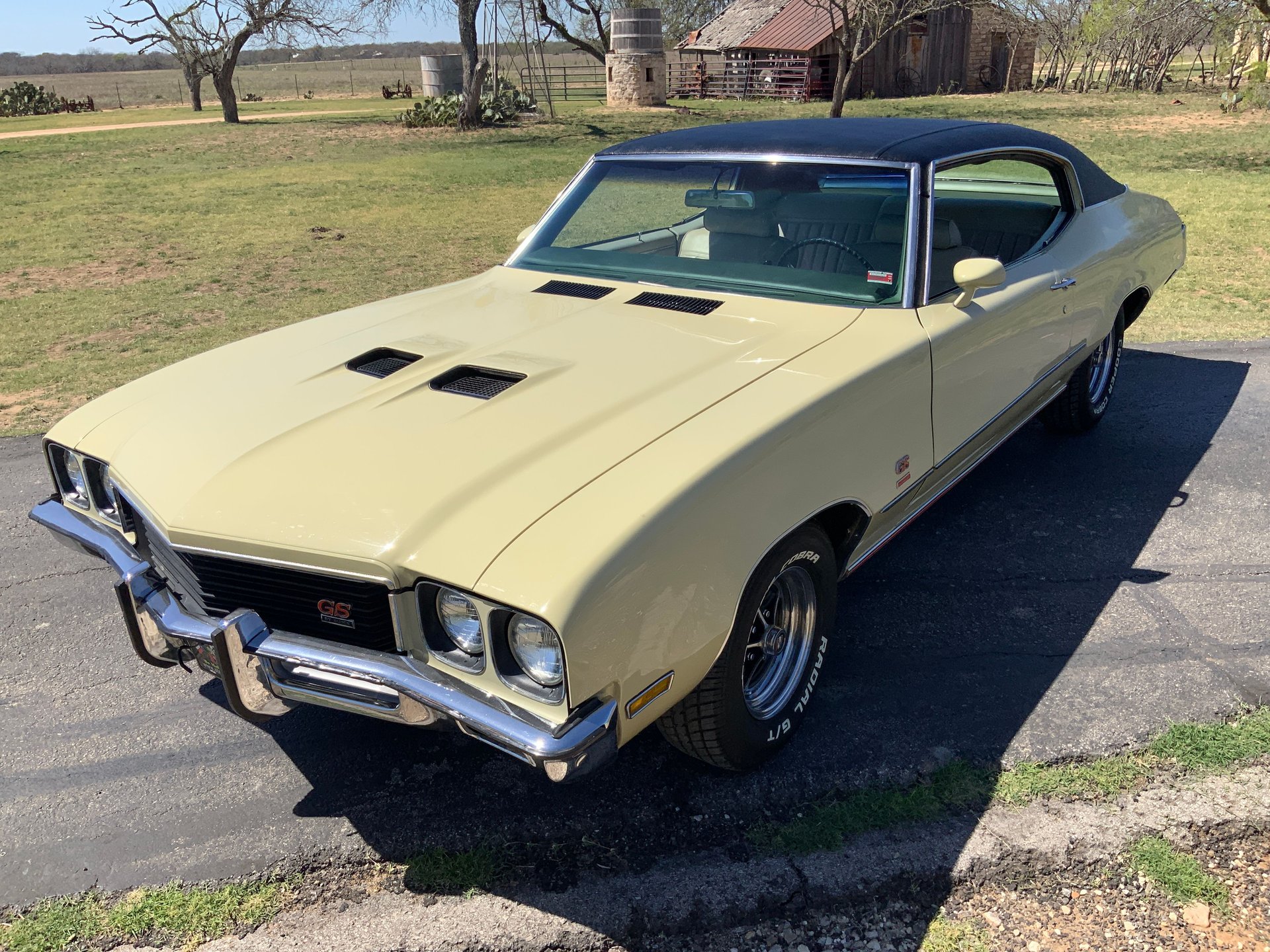
The GS evolved quickly. The Nailhead gave way to Buick's new big-block in 1967, the 400 cubic inch V8, and the GS 400 became the performance flagship. In 1968 the A-body was redesigned with the long-hood, short-deck proportions that define the classic muscle-car silhouette, and the GS 350 joined the GS 400 as the smaller-engined alternative. In 1970 the big-block grew to 455 cubic inches, the Stage 1 option arrived, and the GSX — a limited-production package in Saturn Yellow or Apollo White, with black stripes, a rear spoiler and a blacked-out hood — became the most collectible Skylark of all. Just 678 GSXs were built in 1970. Then the era ended, quickly: compression ratios fell in 1971 as General Motors prepared for unleaded fuel, and 1972 brought net horsepower ratings that made the published figures look dramatically smaller even where the cars had barely changed. The GS survived into 1972, the last year in the pool, but the performance story was over — which is what makes the 1968 to 1972 cars the core of today's market: the last of the big-block Buicks, built in numbers large enough to buy and small enough to matter. One more thing to understand before you start looking. The Skylark was never a rare car — Buick built them by the hundreds of thousands — but the GS cars were a small fraction of production, and the Stage 1 and GSX cars a small fraction of that. The pool on Classic Listings reflects that tension in an unusual way: all twelve cars currently filed under the Skylark model are filed under the GS series, yet the pool itself contains plain Skylarks, a Skylark Custom, a four-door Skylark Custom sedan, and one car openly described as a GS Tribute. That mismatch is why identity verification gets its own section in this guide. A car wearing GS badges is not automatically a GS.
The models
The table below covers the models that matter to a buyer, with the period horsepower figures as Buick published them — gross ratings through 1971, net ratings for 1972, which is why the 1972 figures look so much lower.
| Model | Years | Engine | Output | Built | Character |
|---|---|---|---|---|---|
| Skylark (Roadmaster) | 1953 | 322 Nailhead V8 | 188 hp | 1,690 | Anniversary flagship convertible; wire wheels, cut-down screen |
| Skylark | 1954 | 322 Nailhead V8 | 200 hp | 836 | Cheaper second year, Special-based; rarest Skylark of all |
| Skylark (compact) | 1961–1963 | 215 aluminium V8 | 155–185 hp | High volume | Light, quick compact; the 215 is the story |
| Skylark | 1964–1965 | 225 V6 / 300 V8 | 155–250 hp | High volume | First A-body; the template for everything after |
| Skylark GS (Gran Sport) | 1965 | 401 Nailhead V8 | 325 hp | About 15,800 | The original muscle Buick; torque first, revs second |
| Skylark GS 340 | 1966–1967 | 340 V8 | 260 hp | Modest volume | The cheaper GS; 1967 also brought the 400 |
| Skylark GS 400 | 1966–1969 | 401 Nailhead / 400 V8 | 325–340 hp | Modest volume | The big-block flagship; Stage 1 from 1969 |
| Skylark | 1968–1972 | 250 six / 350 V8 | 155–280 hp | High volume | The volume car; honest, cheap, well supported |
| Skylark GS 350 | 1968–1972 | 350 V8 | 280 hp | Modest volume | The affordable GS; the smart buy in most years |
| Skylark GS 400 / GS 455 | 1968–1972 | 400 / 455 V8 | 340–360 hp | Modest volume | The big-block car; Stage 1 is the one to chase |
| Skylark GSX | 1970–1972 | 455 / Stage 1 V8 | 350–360 hp | 678 / 124 / 44 | The collector flagship; verify everything |
(The GSX build figures are 678 for 1970, 124 for 1971 and 44 for 1972.)
The 1953 and 1954 cars. These are collector cars, not drivers, and they trade in a different market from everything else in this guide. The 1953 is the anniversary car: wire wheels, a lowered windshield frame, and the full Roadmaster specification. The 1954 is similar but built on the shorter Special chassis. Both are Nailhead-powered, both are convertibles only, and both are expensive to restore — the wire wheels alone are a specialist item, and the 1953's cut-down windshield glass is effectively irreplaceable.
The compact cars, 1961 to 1963. The Skylark began as the top trim of the Special and became its own series for 1963. The body styles were the two-door hardtop and the convertible, and the defining feature was the 215 aluminium V8 — an engine that weighed about the same as a four-cylinder and gave the little Buick genuinely lively performance. A 185-horsepower four-barrel version was available in 1962 and 1963, and the base Special also offered a 198 cubic inch V6 from 1962. These cars are light, simple and charming, but they are also the most fragile Skylarks to own: the aluminium engine has specific failure modes, the bodies are unit construction, and parts support is thinner than for the A-body cars.
The first A-body cars, 1964 and 1965. The 1964 Skylark is a bigger, more conventional car: a 115-inch wheelbase, perimeter frame, coil springs all round, and a choice of the new 225 V6 or the 300 V8. The 1964 car in the pool, in El Cajon, is a representative example — and it is worth noting that it is filed under the GS series in the current pool, which it is not. The 1965 model year matters most in this block, because midway through it Buick launched the Gran Sport: the Skylark hardtop and convertible, the 401 Nailhead with a four-barrel carburettor, heavy-duty suspension, a limited-slip differential and GS badging. It was an immediate success, and it established the pattern every later GS would follow.

The second-generation A-body, 1968 to 1972. This is the Skylark most buyers mean, and it is where the pool is concentrated: one car from 1969, two from 1970, two from 1971 and five from 1972. The 1968 redesign gave the Skylark the long-hood, short-deck proportions of the era, with a 112-inch wheelbase for the two-door cars and 116 inches for the four-doors and wagons. The base engine was now the 350 V8. The GS 350 replaced the GS 340 as the small-block performance car, and the GS 400 carried the big-block flag until the 455 replaced it in 1970. The 1970 model year is the peak of the line: the GS 455, the Stage 1 and the GSX all arrived together, and the styling is the most resolved of the whole run. The 1971 cars are nearly identical visually but carry lower compression ratios, and the 1972 cars are the last of the line, with net horsepower ratings and the final GSX run of just 44 cars.
The GS line, and why it dominates this guide. The Gran Sport is not a trim level. From 1965 onwards it was a separate series with its own VIN sequence, its own engines and its own equipment. The GS 350 was the volume performance car, the GS 400 and then the GS 455 were the big-block flagships, the Stage 1 was a factory performance option on the big-block cars, and the GSX was a limited-production package that could be ordered on a GS 455 or a Stage 1. The distinctions matter because the money follows them: a genuine Stage 1 or GSX is worth several times a plain Skylark in the same condition, and the market is full of cars that have been upgraded — or simply rebadged — to look like one.
The four-door cars. The Skylark was sold as a four-door sedan throughout the A-body years, and the pool contains one: a 1969 Skylark Custom four-door sedan in gold, from Oxon Hill, Maryland. Four-doors are the value end of the market and they are honest cars — same engines, same chassis, same rust patterns — but they are not collectible. Buy one if you want a usable classic Buick at the lowest price, not if you want an investment.
Engines and gearboxes
The Skylark's engines divide cleanly into four families, each with a distinct character and a distinct set of problems. Buick built its own engines throughout this period — these are not Chevrolet units with Buick badges — and the division's engineering choices (a front-mounted distributor, an oil pump driven from the timing cover, deep-skirt blocks) shape ownership on every car in this guide. Learn to tell the families apart: the engine in the bay is one of the most reliable ways to tell what a car actually is.
The small engines: the 215, the V6s and the 300
The 215 aluminium V8 (1961 to 1963). One of the most interesting engines ever fitted to an American production car: an all-aluminium 215 cubic inch V8 with a dry-sleeved block and a weight of roughly 320 pounds complete — lighter than many four-cylinders of the day. In two-barrel form it made 155 horsepower; the four-barrel version, fitted to the Skylark in 1962 and 1963, made 185. Buick dropped it after 1963 because the tooling cost more than the iron engines that replaced it, and Rover bought the rights in 1965 and built versions of it for thirty years. For a buyer, the 215's problems are specific: the head gaskets are the weak point, overheating is the enemy, and the steel cylinder liners can move if the engine has been cooked. A 215 that has overheated repeatedly is a rebuild, not a service job.
The V6s: the 198 (1962 to 1963) and the 225 (1964 to 1966). Buick's V6 was derived from the 215 by cutting off two cylinders, which is why it is an odd-fire engine — the firing intervals are uneven, and the idle has a distinctive, slightly lumpy character that is normal and should not be chased as a misfire. The 198 made 135 horsepower; the 225, with a longer stroke, made 155 and was the standard engine in the 1964 to 1966 Skylark. These are tough, simple engines with excellent torque for their size — good enough that Buick sold the tooling to Kaiser-Jeep in 1967 and bought it back in 1974 when the fuel crisis made small engines valuable again.
The 300 V8 (1964 to 1967) and the 340 (1966 to 1967). The 300 was Buick's new small-block for the A-body era: an iron block with aluminium heads and intake manifold in 1964, iron heads from 1965. In two-barrel form it made 210 horsepower; the four-barrel made 250 and was standard in the Skylark Custom. The 340 was a stroked version, fitted to the 1966 and 1967 Skylark and to the GS 340, rated at 260 horsepower. The one thing to know is that the 1964 aluminium heads and intake are year-specific and increasingly hard to find, so a 1964 car with a damaged head is a harder fix than a 1965.
The 350: the engine most Skylarks carry
Buick's 350, introduced for 1968, is the engine in the majority of the cars in the pool — the standard engine in the Skylark range from 1968 onwards. It is a Buick design from the ground up, not a variant of anyone else's 350: a deep-skirt iron block, the distributor at the front driven off the camshaft, and the oil pump housed in the aluminium timing cover. It is a torquey, low-revving engine that suits the car perfectly — 280 horsepower in four-barrel form in 1968 and 1969, 260 in 1970, and 195 net in 1972; the two-barrel versions made 230.
The 350's virtues are durability and parts support. Its vices are specific. The oil pump lives in the aluminium front cover, and the pump gears run directly against the cover's end plate. After fifty years that plate wears, the clearances open up, and the oil pressure falls — particularly at hot idle, where a tired 350 can drop to a pressure that makes the gauge and the owner nervous. The fix is a pump rebuild with a new end plate or a booster plate, a few hundred dollars in parts, and it is one of the first jobs to budget on any 350 car with a low hot-idle reading. The rope rear main seal weeps on almost every car that still has one; a neoprene conversion seal exists but is a transmission-out job, so most owners live with a small drip and check the level. And the carburettor — a Rochester Quadrajet on the four-barrel cars — is an excellent unit when rebuilt properly and a source of flat spots and poor idle when it is not. A professional Quadrajet rebuild runs $300 to $600 and transforms the car.
The big blocks: the Nailhead, the 400 and the 455
The 401 Nailhead (1965 and 1966 GS). The Nailhead is named for its valves, which stand vertically in the head and are small for the engine's size — the design traded high-rpm breathing for low-end torque, and the result is an engine that pulls from idle with a smoothness no rival could match. The GS version, the Wildcat 445, made 325 horsepower and 445 pound-feet of torque, with a single four-barrel Rochester. Its problems are age and rarity: it shares almost nothing with what came after, and parts — particularly valvetrain parts and the correct carburettor — are specialist items. A Nailhead GS is a connoisseur's car, and the engine is the reason.
The 400 (1967 to 1969). Buick's new big-block replaced the Nailhead for 1967: a modern thin-wall casting with conventional inclined valves, rated at 340 horsepower and 440 pound-feet of torque in GS form. It is stronger and freer-revving than the Nailhead, with much better parts support, because it is the direct ancestor of the 455. The GS 400 also carried the Stage 1 option in its first year, 1969 — a package of camshaft, carburettor, distributor and exhaust changes that Buick conservatively rated at the same output as the standard engine.
The 455 (1970 to 1972). This is the engine the market wants. Bored out from the 400, the 455 made 350 horsepower and 510 pound-feet of torque in standard GS form for 1970 — the highest torque figure of any American production engine that year, and the number that defines the car. The Stage 1 version added larger valves, a more aggressive camshaft, a specific Quadrajet, a modified distributor and a low-restriction exhaust, and was rated at 360 horsepower, a figure every contemporary test suggested was understated. For 1971, compression fell from 10.0:1 to 8.5:1 and the gross figures dropped to 345 for the Stage 1; for 1972 the net ratings put the standard 455 at 250 horsepower and the Stage 1 at 270.
The 455's weaknesses are cooling and oil pressure, and both are manageable. The engine makes a great deal of heat in a bay designed for a smaller motor, and a marginal radiator or a slipping fan clutch shows up as creeping temperature in traffic — a recored radiator or a modern aluminium replacement is $300 to $700 in parts and is money well spent. The oil pump is the same timing-cover design as the 350, with the same wear mode. And the 455 is hard on its rear main seal and its motor mounts, both torque-related: check the mounts by watching the engine rock under a brake-torque load.
Gearboxes
Four transmissions cover the whole range.
Dual-Path Turbine Drive (1961 to 1963). The compact cars use a small two-speed automatic with a torque converter and a variable-pitch stator. It is a specialist item today: parts are scarce, few transmission shops have seen one, and a rebuild means finding the right person rather than paying the going rate. Budget $1,500 to $2,500.
Super Turbine 300 (1964 to 1969). The two-speed automatic fitted to most V6, 300, 340 and 350 cars in the middle years. It has a switch-pitch torque converter on many applications, which gives a brief high-stall phase under full throttle — a feature, not a fault. It is a strong, simple box; a rebuild runs $1,200 to $2,000 at a shop that knows it. Turbo Hydra-Matic 350 and 400 (1969 onwards). The three-speeds that replaced the two-speeds are among the best-supported automatic transmissions ever made. The TH350 sits behind the 350 V8; the TH400 sits behind the 400 and 455, and it is the stronger unit by a wide margin — a TH400 in a GS 455 is close to unbreakable in normal use. Both are cheap to rebuild ($1,000 to $1,800 for a TH350, $1,200 to $2,200 for a TH400). On a test drive, both should shift firmly and promptly; a long, soft upshift or a delayed engagement of reverse is wear, priced into the offer rather than treated as a mystery.
Manual gearboxes. A three-speed manual was standard on many models, with a floor-shifted four-speed — a Borg-Warner T-10 in the earliest GS cars, then a Muncie M20 or M21 — as the enthusiast option. Manual GS cars are rare and desirable, and the four-speed is the one to test hard: second-gear synchromesh wears first, the clutch linkage is a wear item, and a Muncie rebuild runs $800 to $1,500 before the clutch. Most cars in the pool are automatics — every one of the eleven cars with a recorded transmission is an automatic — so a genuine four-speed car is a find, and one whose provenance deserves extra care.
Rear axles. Buick used the 8.2-inch 10-bolt axle in most A-body cars, with the stronger 8.5-inch 10-bolt behind the 455 cars. Ratios are street-friendly — 2.56 to 3.42 cover most cars, with the Stage 1 typically at 3.42. A Positraction limited-slip was optional throughout and is worth having. Axle whine on the overrun is bearing wear, and a full rebuild with new gears runs $800 to $1,500.
Problem areas
The Skylark's mechanicals are fundamentally strong, and the engines in particular have a reputation for outlasting the cars around them. What kills Skylarks is rust, neglect, and deferred maintenance on cars that spent twenty years being worth very little. The site's own photo examination tells the same story in miniature: of the 5 Skylarks in the pool whose photo sets have been examined in detail, damage of some kind was noted on 4, while visible rust was noted on only 1 — a reminder that on these cars the obvious problems are usually cosmetic, and the ones that matter are the ones you have to go looking for. No smoke and no leaks were noted on any of the 5, which is consistent with the engines' reputation: the motors are rarely the problem.
Rust: the map
The A-body Skylark is a body-on-frame car, which changes the rust conversation completely compared with a unit-body car. A rotten floor does not automatically write the car off, because the frame carries the structure — but a rotten frame does, and the frame is exactly where a buyer's examination has to start.
The frame. General Motors A-body frames rust in predictable places: the rear rails where they kick up over the axle, the boxed sections behind the rear wheels, the front crossmember and the areas around the body mounts. Surface rust on a frame is normal and treatable. Perforation is not. Get under the car with a torch and a screwdriver and prod the rear rails hard — the metal there is thinner than it looks, and a frame rusted through at the kick-up is a fabrication job priced per car, not a repair with a catalogue price. A car with a sound frame and rotten floors is a project. A car with a rotten frame and sound floors is a parts car, whatever the seller calls it.
Floor pans and the trunk floor. Water gets in past the windshield seal, the rear window seal and the cowl, and it sits under the carpets and the trunk mat. Lift every carpet. The front footwells go first, then the rear seat pan, then the trunk floor — the worst of them, because the spare wheel well traps water against the metal and the rot is invisible until you lift the wheel out. Replacement pans are available and cheap as panels; the cost is the labour to fit them, realistically $800 to $2,000 a side for floors done properly with the interior out, and $600 to $1,500 for a trunk floor. Treat floor rust as a marker for the whole car: a Skylark with rotten floors has been wet for years, and everything else in this section needs checking twice.
Front fenders, doors and rear quarters. The classic A-body pattern. The lower rear corner of the front fender, behind the wheel, traps mud against the cowl and rusts from the inside out — look for bubbling at the bottom edge and feel for filler with a magnet. Door bottoms rust when the drain holes block, which they always do; run a fingertip along the lower edge of every door and check the drain slots are open. The rear wheel arches and the lower rear quarters are the most visible rust on the car and the most expensive to fix properly, because the repair has to follow the arch line — a quarter-panel replacement with paint runs $1,500 to $3,500 a side, and a patch that is not shaped correctly will look wrong forever.
The cowl, the windshield surround and the vinyl roof. The cowl area below the windshield is a water trap, and rust there leaks directly into the front footwells. The windshield and rear window surrounds rust under their chrome trim; look for bubbling at the edges of the glass. The vinyl roof, fitted to a large proportion of Skylark Customs and GS cars, is a rust mechanism in its own right: it traps moisture against the roof and sail panels, and a car with a bubbled vinyl roof can have serious rust underneath that is completely invisible. Press the sail panels through the vinyl and listen for the crunch of thin metal. A roof needing metal work under the vinyl is a $2,000 to $4,000 job with the glass out, and it is the most under-diagnosed problem on these cars.
Engines and drivetrain in service
The engines themselves are the strongest part of the car, and the problems that stop them are almost always in the ancillaries. Work through the list in this order.
Oil pressure. Covered in the engines section, but repeated here because it is the most common mechanical finding on a viewing: the oil pump in the aluminium timing cover wears, and hot-idle pressure falls. Verify with a mechanical gauge screwed into the sender port before you condemn or excuse an engine — the dash gauge and its sender are both old, and both lie. A 350 or 455 showing genuinely low pressure at hot idle needs the pump and cover inspected; if the cover itself is scored, a replacement cover is the fix. Budget $400 to $900 for the pump, plate and labour; a new timing cover adds several hundred more.
Cooling. Every Skylark in this guide is at least fifty years old, and the cooling system is the first casualty of age. The 455 in particular runs hot in traffic if the radiator is silted, the fan clutch is weak or the shroud is missing — and shrouds go missing constantly, because they have to come off for other work and never go back on. Check that the shroud is present and that the fan clutch resists turning when the engine is hot. Overheating on a test drive is a walk-away signal until the cause is known, because a 455 that has been run hot repeatedly will have head-gasket consequences that no radiator will fix.
Carburettors, fuel and ignition. The Rochester Quadrajet is a superb carburettor and the source of most running complaints, almost none of which are the carburettor's fault. The pattern to learn: a flat spot off idle is usually the accelerator pump or a vacuum leak at the base gasket or throttle shaft; a rich idle is usually a sunk float or a leaking needle and seat; a hot-start problem is usually fuel percolation in modern ethanol-blended petrol, which boils at a lower temperature than the fuel these cars were designed for. Modern fuel attacks old rubber fuel lines, swells old carburettor components and evaporates out of the float bowl during a week's storage, which is why so many of these cars crank for a long time on the first start of the week. That long crank is normal, not a fault. Replace every rubber fuel line on any car you buy, regardless of appearance: an ethanol-rotted line above a hot exhaust manifold is how classics burn. Ignition is the other half of the same story: worn points, a tired condenser or a perished vacuum-advance diaphragm produce exactly the symptoms owners blame on the carburettor. Check the dwell, check for play in the distributor shaft, and check that the advance can holds vacuum. Many cars have been converted to electronic ignition, a sensible upgrade and not a deduction, provided the conversion is a quality unit.
The Nailhead and the 215 in service. Both early engines have failure modes the later ones do not, covered in the engines section: the 215's head gaskets and liners, the Nailhead's valve guides, stretching timing chain and leaking rear main seal. Neither is a reason to avoid a car. Both are reasons to insist on evidence of specialist work rather than generalist work.
Transmissions and axles. The automatics are covered in the gearboxes section; the service finding that matters is fluid condition. Pull the dipstick: bright red fluid is a maintained box, brown fluid is an old box, and burnt-smelling fluid is a rebuild being announced. On the Super Turbine 300, remember the switch-pitch converter before you diagnose slip.
Interior and trim
The Skylark's interior is where the difference between a Custom and a plain Skylark lives, and it is also where restoration costs hide.
Seats and upholstery. The vinyl is durable but it splits at the seams and at the driver's entry bolster, and the foam underneath crumbles with age — a seat that looks presentable can sit like a hammock. Sit in the driver's seat, always. Reproduction seat covers and foam are available for the A-body cars and a front bench or a pair of buckets re-trimmed in correct vinyl runs $800 to $1,800 in parts and labour. The GS cars' bucket seats and console are the desirable specification and the one most often added later, so check the floor for the correct brackets and the cowl tag for the trim code before you pay a bucket-seat premium.
Dashboard and instruments. The padded dash cracks in the sun, usually along the speaker grille and at the corners, and a correct replacement pad is one of the harder parts to find — reproduction pads exist but the fit varies, and a dash cap is a cosmetic fix a knowledgeable buyer will spot. The instruments are simple and repairable; the clock rarely works, the fuel gauge sender in the tank is the usual cause of a wandering gauge, and the printed circuit behind the cluster on the later cars is a known source of intermittent faults.
Brightwork, glass and weatherstripping. The Skylark carries a great deal of chrome and stainless, and re-plating is priced by the piece: budget $300 to $800 per bumper and considerably more for a full set of pot-metal trim, which pits badly and cannot always be saved. Wheel-arch and rocker mouldings are reproduction items and cheap; the specific GS emblems, hood scoops and GSX stripes are also reproduced, which is convenient for a restorer and a warning for a buyer. Weatherstripping perishes on every car: a full set of door, trunk and window seals is $300 to $600 in parts and a weekend of labour, and it is the difference between a car that leaks into its own floors and one that does not. Fit new seals before you chase floor rust, not after.
Identity: GS, Stage 1 and GSX verification
This is the section that protects your money. The pool itself makes the point: twelve cars filed under the Skylark model, all twelve filed under the GS series — and the pool contains a plain 1963 Skylark, a 1964 Skylark, a 1970 Skylark Custom, a 1969 Skylark Custom four-door sedan, and a 1971 car openly listed as a Skylark Custom GS Tribute. If the site's own filing cannot be taken at face value, neither can a seller's. The GS badge is desirable, the parts to apply it are reproduced and cheap, and fifty years is a long time for a car to acquire equipment it did not leave the factory with. Verify the car, not the listing.
Start with the VIN. From 1965 onwards the GS was a separate series with its own VIN sequence, distinct from the Skylark's. The series digits in the VIN tell you what the car was built as. A car whose VIN decodes as a Skylark but which wears GS badges is a Skylark with badges, and it should be priced as one — however good the 455 under the hood is, and however honestly the seller describes it. The one car in the pool listed as a GS Tribute is exactly this, described honestly, and it is the model for how such cars should be sold.
The cowl tag and the build record. The cowl tag on the firewall carries the body style, the trim code and the paint code, and it lets you check that the interior and the colour are the ones the car was built with. For the strongest evidence, Buick's records survive: documentation for many of these cars is available through the Sloan Museum in Flint, Michigan, which holds Buick's production records, and a factory invoice or build record settles questions that no amount of staring at badges will. On a Stage 1 or GSX, that documentation is not optional.
Stage 1 specifics. The Stage 1 was an option, not a series, so there is no separate VIN sequence for most years — which is precisely why it is the most faked specification in the range. For 1972, the engine code in the VIN does identify the Stage 1, and that is the first check on a 1972 car. For the earlier cars, the evidence is a combination of the correct engine components (the Stage 1 heads with their larger valves, the specific carburettor and distributor part numbers), the correct rear axle ratio, and factory documentation.
GSX specifics. The GSX was built in 1970, 1971 and 1972 in tiny numbers — 678, 124 and 44 — and every panel of it is reproduced: the stripes, the rear spoiler, the blacked-out hood, the emblems. A GSX is a GS 455 or a Stage 1 underneath, so the VIN check comes first, and then the documentation.
Engine numbers. Buick stamps the engine's production code and a partial VIN derivative on the block. On the 350 and 455 the stampings are on the front of the block and the deck surface, and matching them against the car's VIN is the standard numbers-matching check. A replacement engine is not a catastrophe on a plain Skylark — these were working cars, and engines were swapped — but it is a material fact on a GS, and it should move the price.
How to inspect one
Allow at least an hour, and bring a torch, a cloth-wrapped magnet, a screwdriver for prodding (with the seller's permission), and a mechanical oil-pressure gauge if you have one. If the car passes you, pay for a lift inspection before money changes hands. On an A-body Buick, the frame examination is the whole game, and you cannot do it properly on a driveway.

- Start with the paperwork and the VIN. Match the VIN on the title to the plate on the car, then decode the series digits. On any car claimed to be a GS, a Stage 1 or a GSX, this is the step that decides everything else: a Skylark-series VIN means a Skylark, whatever the badges say. Ask for the cowl tag readings, any factory documentation, and the history file. A thick file is worth real money on these cars.
- Cold start. Insist the engine is cold when you arrive. A 350 or 455 should start after a few seconds of cranking (longer if the car has sat for a week, because the Quadrajet's float bowl empties — that is normal) and settle to an even idle. Watch for blue smoke at start-up, which is valve stem seals, and blue smoke under load, which is rings.
- Oil pressure, verified. Watch the dash gauge come up, then, if the reading is low at hot idle later in the inspection, verify it with a mechanical gauge in the sender port. The timing-cover pump wear described in the problem areas is the usual cause, and it is a known, priced job.
- Under the car: the frame. Torch along the full length of both frame rails, prod the rear kick-up sections and the boxed rails behind the rear wheels, and check around every body mount. Perforation in the rear rails is the walk-away finding on an A-body. Then check the floor pans and the trunk floor from below, and read the underseal as you go: patchy, thin and dirty is honest; a fresh, uniform coat of black over everything, applied the week before the sale, is a question.
- Trunk. Lift the spare wheel and the mat. Look for water staining, rust in the well corners and perforation in the floor. Check the rear window seal while you are there, and press the sail panels if the car has a vinyl roof.
- Floors inside. Lift all four carpets and prod the pans. Wet carpets in a dry-stored car mean the cowl or a window seal is leaking, and the rust is already started. Check the front footwells first — that is where the cowl leaks land.
- Body and gaps. Run the magnet over the lower front fenders behind the wheels, the rear wheel arches, the lower quarters and the door bottoms. Check the door drain slots are open. Count the pitted chrome pieces and price them. Look down each flank for ripples, and check the panel gaps for accident history.
- Suspension and steering. The A-body uses ball joints, not kingpins, and they are cheap and available — but check them anyway: jack each front wheel and rock it top-to-bottom for ball-joint play, and side-to-side for tie-rod and centre-link wear. Worn idler arms and centre links are the standard A-body finding and make the steering vague in a way owners describe as character.
- The test drive. Fifteen minutes minimum, with a highway stretch. The automatic should shift firmly and promptly; a delayed reverse engagement is wear. A 350 should pull cleanly without a flat spot; a 455 should pull very hard indeed, and a big-block car that feels merely adequate has a problem worth finding. Brake hard from speed — the car should stop straight, with no pull and no judder.
- Heat and cooling. Let the car idle in traffic or in the seller's yard after the drive. Watch the temperature: a 455 that creeps upward at idle has a radiator, fan clutch or shroud problem, and the shroud check takes ten seconds — look for it. Run the heater on every speed, whatever the weather, and work the air conditioning if fitted; a dead blower motor is a dashboard-out job on these cars too.
- Electrics and accessories. Work every window, the lights, the wipers and washers, the horn, the radio and the gauges. Check the fuel gauge against what the seller says is in the tank. Electrical faults on a Skylark are almost always grounds and connections rather than components, and a car where everything works has usually been used and maintained — the best sign there is.
- Interior last. Sit in every seat and feel for collapsed foam. Check the dash pad for cracks, the headliner for sagging, and the trim codes against the cowl tag if you are paying for a specific interior. On a GS, check the floor for the correct bucket-seat brackets and console mounts. A sound original interior is the hardest thing to recreate on these cars, so weight it heavily.
Values
The figures that matter for this model are computed from this site's own listings and recorded sales, and they sit below this guide — the listed-now summary and the market block are refreshed every time the site rebuilds, so use them rather than any number quoted elsewhere. What follows is how to read them, and it matters more than usual here, because the Skylark market is really four markets sharing a nameplate.
The first market is the plain Skylark and the Skylark Custom: volume cars, priced by condition and usefulness, with the two-door hardtop and the convertible at the top of the band and the four-door sedan at the bottom. The spread between the cheapest and the dearest is set almost entirely by the body — a rust-free southern four-door is worth more than a rusty northern hardtop, and it should be. The second market is the GS 350, which carries a genuine premium and is the most liquid performance Skylark there is. The third is the big-block GS — the GS 400 and the GS 455 — where the premium is larger and the condition spread wider. The fourth is the Stage 1 and the GSX, which trade as collectibles: low production, strong club support, and prices driven by documentation and originality as much as by condition.
That structure produces the Skylark's characteristic trap, and it is the reason the identity section of this guide exists. The premium for a genuine GS over a plain Skylark in the same condition is large. The premium for a genuine Stage 1 or GSX over a GS is larger still. And the cost of the badges, stripes and scoops that imitate those cars is trivial by comparison. So the market is full of cars priced somewhere between what they are and what they look like, and the only protection is verification. Read any individual asking figure against the car's documented identity first and its condition second — the reverse of the order you would use on almost any other model in this programme. A tribute car, honestly described, is worth what a well-specified Skylark is worth, and not a penny of GS money. A genuine GS with its documentation is worth a premium that a car with a story is not.
Two more cautions. The pool behind the figures below this guide is small — twelve cars filed under the model at the time of writing, eleven of them for sale — so the medians and ranges move sharply when a single exceptional or desperate car enters or leaves the sample, and the range matters far more than any single central figure. And these are asking prices, not achieved prices: sellers of muscle-era Buicks routinely ask ahead of the market, and the auction record is the corrective. Where a model trades at auction regularly, its achieved figures usually sit below its asking figures.
The project-versus-driver gap is wide on these cars and it is honest. A running, driving GS 350 with a sound frame and a tired interior can be used while you improve it, and it is worth a substantial premium over a non-running car that looks the same in photographs, because the recommissioning bill on a car that has sat for a decade — fuel system, brakes, tyres, seals, fluids, cooling system — arrives all at once and is rarely small. Buy the car that has been in regular use.
Parts and ownership
The A-body Skylark is one of the best-supported American classics of its era, for a simple reason: it shares its platform with the Chevrolet Chevelle, the Pontiac GTO and LeMans, the Oldsmobile Cutlass and a dozen other General Motors cars, and the reproduction industry serves that platform as a single market. Chassis, suspension, brake and glass parts are effectively universal across the A-body range, and Buick-specific trim is reproduced because the GS cars are collectible enough to justify it. Easy: service items, filters, plugs, points and condensers; brake discs, drums, pads, shoes and hydraulics; ball joints, tie rods, centre links and bushings; water pumps, radiators and fan clutches; exhaust systems in standard form; weatherstripping and glass rubbers; floor pans, trunk pans and most A-body sheet metal; Quadrajet rebuild kits and exchange carburettors; TH350 and TH400 parts, which are available everywhere. Most of this is order-today, fit-this-weekend.
Harder and dearer: Buick-specific engine parts for the 350 and 455 — the aftermarket is smaller than Chevrolet's, and the specialist supplier that matters most is TA Performance in Arizona, which makes the timing covers, oil pump components, cylinder heads and internal parts that keep these engines alive; Nailhead parts, which are specialist-only; 215 aluminium V8 parts, where the Rover connection helps more than you would expect; correct GS emblems, hood scoops and GSX stripe kits, all reproduced but of variable quality; padded dash pads; convertible top frames and mechanisms; and the Super Turbine 300 and Dual-Path transmissions, for which the parts exist but the expertise is concentrated in a handful of shops. A quality repaint starts in five figures, which is why this guide's advice is to buy the body and the frame, and fix the mechanics.
Running costs. A sorted Skylark is a realistic regular-use classic. Fuel consumption is in the low-to-mid teens for a 350 and in single figures to low teens for a 455 driven as a 455 invites you to drive it. Servicing is within the ability of any good independent shop familiar with carburetted American V8s, and the specialist knowledge that matters — the timing-cover oil pump, the Quadrajet, the switch-pitch converter — is concentrated in the Buick community rather than in the general trade. Join it: the GS Club of America and the Buick Club of America between them hold the technical knowledge, the parts sources and the registry information that make owning one of these cars straightforward, and the Sloan Museum in Flint can supply factory documentation for a fee. The budget line that catches new owners is the first year: catching up deferred maintenance on a running car honestly costs a few thousand dollars before you improve anything, and recommissioning a car that has sat for years costs considerably more, because everything rubber, everything hydraulic and the entire fuel system needs attention at once.
Which one to buy
- The all-rounder: GS 350, 1970 to 1972. The genuine GS specification — the suspension, the badges, the four-barrel 350 — at the price the market asks for a well-specified Skylark. Deep parts support, and a deep market to buy from and sell into.
- The value buy: Skylark Custom hardtop or convertible, 1968 to 1972. The same body, the same 350 V8, the better interior, and no GS premium. Buy the best-bodied one you can find.
- The muscle car: GS 455, 1970. The 510 pound-feet year, the best styling of the run, and the car the market wants most. Verify the VIN series and the engine stampings, and pay for documentation.
- The collector car: Stage 1 or GSX. Genuine low production, genuine performance, and genuine money. Buy only with factory documentation — a Sloan Museum record or equivalent — because without it you are buying an argument.
- The connoisseur's car: GS, 1965, with the 401 Nailhead. The first and in some ways the most characterful Gran Sport: the torque, the smoothness, and a pre-muscle-car innocence the later cars lost.
- The character buy: Skylark, 1963, with the 215 aluminium V8. The lightest Skylark ever made and the most interesting engine Buick ever built. Entirely its own thing.
- The honest workhorse: Skylark Custom four-door, 1969 to 1972. The cheapest route into a usable A-body Buick, with the same engines and the same rust map. Buy it to drive, not to sell.
And the rule that overrides all of the above: buy the car whose identity you can prove, on the soundest frame you can find. Engines, gearboxes, brakes, interiors and chrome are all fixable at prices you can plan for. A perforated frame is a fabrication bill with no ceiling, and a GS that is not a GS is worth Skylark money no matter what you paid for it — so settle the VIN before you fall for the paint, and settle the frame before you settle the price.