Buick Grand National buyer's guide
Buick Grand National -- the model's own buyer's guide: variants, values and what to check.
Years listed: 1984-1987 · Series: Grand National
Overview and history
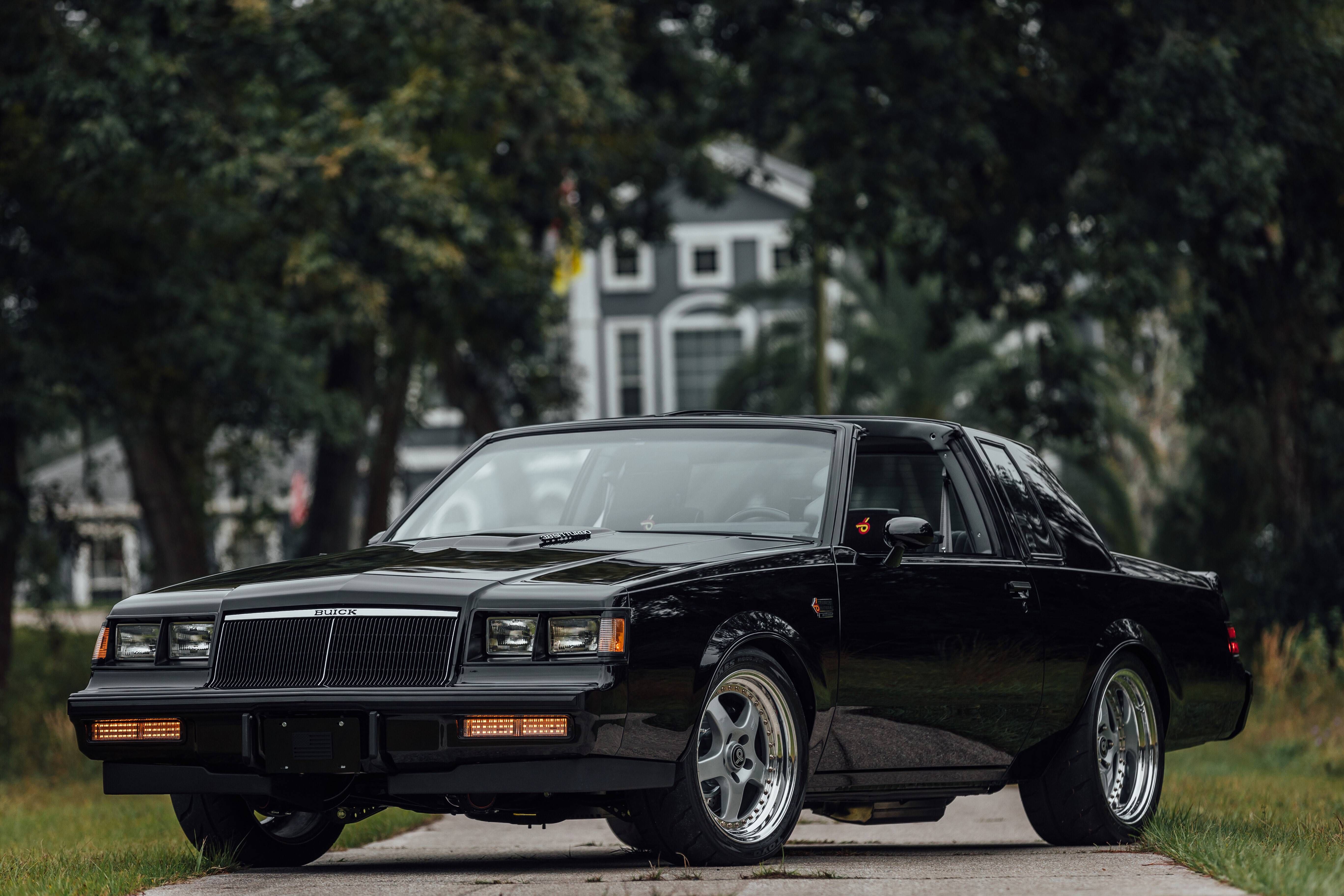
The Buick Grand National is the car that proved, in the middle of the 1980s, that a turbocharger and electronic fuel injection could do the work the big V8 had done a generation earlier — and do it in a formal, rear-wheel-drive American coupe that looked, from fifty feet away, like a bank manager's Regal. That tension is the whole appeal. A Grand National is a Buick Regal in a black suit, with a turbocharged 3.8-litre V6 under a flat bonnet, no chrome to speak of, and a reputation earned at traffic lights and drag strips against cars that cost far more and announced themselves far louder. If you are standing in front of one now, you are not really shopping for transport. You are shopping for the last great Buick performance car of its era, and for a very specific set of mechanical facts that separate a genuine, sorted car from a black Regal with badges.
The name arrived first as a package on the Regal for 1982, Buick's celebration of its NASCAR Grand National success. Those cars are the odd ones out: not all black — most wore two-tone silver-grey and charcoal — and mostly not turbocharged. The formula that defines the name today was set when the Grand National returned for 1984. From 1984 on, every Grand National was black, turbocharged, fuel-injected, and built on the rear-drive G-body Regal coupe. Production ran through 1987, the fastest year and by far the biggest: in the pool behind this guide, 30 of the 37 Grand Nationals we track are 1987s, with a handful of 1986s, two 1984s and a single 1985. That matches production reality — Buick built more than twenty thousand for 1987 alone, against a few thousand in each earlier return year. You will mostly be offered 1987 cars. That is not a compromise: the 1987 is the developed, intercooled car, and for most buyers it is the one to have.
Underneath, the car is deliberately conventional, and that is part of its durability. The G-body is a full-frame platform with double-wishbone front suspension, a live rear axle on coil springs, front disc brakes and rear drums. The exotic part — for 1984 — sits under the bonnet: a 231-cubic-inch (3.8-litre) V6 with sequential fuel injection and a Garrett turbocharger, computer-managed at a time when most American performance cars still ran a carburettor. For 1986 Buick added an air-to-air intercooler, and power, drivability and tuning headroom all stepped up together. The intercooled cars are the performance peak of the line, short of the limited-production GNX that closed the run.
These cars lived different lives, and which life a given example lived is the central question of any purchase. Some were bought as collectibles almost from new — garaged, kept stock, their low mileage documented year by year. Others were bought to be raced and modified, and the turbo V6 responds so well to more boost, more fuel and better breathing that a large share of the fleet has been tuned at some point, whether or not the current seller knows or says so. A third group simply became old used cars in the 1990s, run on deferred maintenance until something expensive stopped working. Today's market contains all three, often at overlapping asking prices and with identical black paint. The mechanicals are fundamentally strong, and the difference between a good Grand National and a money pit is almost entirely verification: is it a real Grand National, is the turbo system original and healthy, has the boost ever been turned up beyond what the fuel system could feed, and has the body — particularly a T-top body — stayed dry inside. Everything in this guide is organised around those four questions.
One more orientation point. Almost every Grand National you will meet is black — in our tracked pool, black accounts for effectively the entire sample — is a coupe, and is an automatic. There was no manual Grand National in the turbo years, no convertible, and no four-door. If a car offered to you breaks one of those rules, it is a conversion, a clone or a misdescription, and should be priced as the Regal underneath until paperwork proves otherwise. Year, originality, turbo-system health and body condition are the whole game.

The models
Every turbo-era Grand National is a two-door Regal coupe with the same basic silhouette, so the model story is told in years, not body styles. The changes that matter are under the bonnet — hot-air versus intercooled induction — and in one famous limited edition. Read this section with the identity checks in mind, because the ease of turning a plain Regal into a visual Grand National is the model's defining market trap: badges, wheels and black paint are all buyable, so the year-by-year details below are also your authentication checklist.
| Model | Years | Engine | Output | Built | Character |
|---|---|---|---|---|---|
| Grand National (first series) | 1982 | 4.1 V6, carburetted; turbo 3.8 optional | 125 hp; turbo 175 hp | 215 | The NASCAR tribute; two-tone, mostly non-turbo, a collector curiosity |
| Grand National (hot-air) | 1984 | 3.8 V6 turbo, SFI, no intercooler | 200 hp | 2,000 | The formula set: all black, injected, quick — and heat-limited |
| Grand National (hot-air) | 1985 | 3.8 V6 turbo, SFI, no intercooler | 200 hp | 2,102 | A carry-over car; the rarest of the black years by survival |
| Grand National (intercooled) | 1986 | 3.8 V6 turbo, SFI, intercooled (LC2) | 235 hp | 5,512 | The step change: cooler charge, more boost, real tuning headroom |
| Grand National (intercooled) | 1987 | 3.8 V6 turbo, SFI, intercooled (LC2) | 245 hp | 20,193 | The final and most numerous year; the default buy |
| GNX | 1987 | 3.8 V6 turbo, SFI, uprated intercooler and turbo | 276 hp (rated) | 547 | The ASC-built limited edition; numbered, documented, a different market |
(Outputs are Buick's period SAE net ratings. The GNX's 276 hp was widely understood at the time to be understated; what matters for a buyer is not the true figure but the car's documentation, covered below.)
The 1982 car. Treat the first-series Grand National as a separate model that happens to share the name: a Regal package in two-tone paint, standard engine a naturally aspirated 4.1-litre V6, the turbocharged 3.8 optional and fitted to only a minority of the 215 built. None of the all-black identity applies. A 1982 is bought for rarity and NASCAR-period charm, not performance in the later sense; if your heart is set on the black turbo coupe, it does not scratch that itch, however it is described.
The hot-air cars: 1984 and 1985. The 1984 relaunch is where the legend starts: the Regal painted black, trim blacked out, bucket seats and console fitted, and the turbocharged 3.8 with sequential fuel injection installed — the "hot-air" engine, so called because its turbo feeds heated, compressed air straight into the intake with no intercooler. Rated at 200 hp with strong low-speed torque, it made the Grand National one of the quickest American cars of its year, and the injection made it start, idle and drive like a modern car next to its carburetted rivals. The 1985 is mechanically a close repeat. The limitation is thermal: charge temperature caps safe boost, which caps both factory output and sensible tuning headroom. Because buyers pass these cars over for intercooled examples, a genuinely good 1984 or 1985 is a value route into the model — provided you accept its lower stock ceiling and resist chasing intercooled power with boost alone. Intercooler conversions exist; a converted car is a modified car and should be bought and priced as one.
The intercooled cars: 1986 and 1987. The air-to-air intercooler fitted for 1986 — the LC2 engine specification — is the single most important change in the model's life. Cooling the charge let Buick raise boost and output to 235 hp, improved consistency in hot weather and hard use, and gave the engine the headroom that made the Grand National a tuning legend. The 1987, the final year of the rear-drive Regal, gained a further small rise to 245 hp and was built in far greater numbers as word spread that the line was ending. Mechanically the two years are near-identical, and condition should always beat model year between them: a documented, stock 1986 is a better buy than a thrashed 1987. Cosmetically and in detail the cars are close enough that sellers occasionally mis-year them; the paperwork and the build codes, not the seller's memory, settle the year. The 1987 also carried the WE2 option code for the Grand National package — the code that matters in the identity checks in the inspection section.
The GNX. For 1987 Buick commissioned ASC to build 547 Grand Nationals into something harder. The changes were real engineering, not stickers — a Garrett turbocharger with a ceramic turbine wheel, a larger intercooler, recalibrated engine and transmission management, a revised rear suspension with a torque arm and Panhard rod in place of the standard four-link geometry, wider wheels under flared arches, functional bonnet vents, Stewart-Warner instruments and a numbered dash plaque. Period testing put it among the fastest production cars in the world over a standing quarter mile. A GNX is not bought the way a Grand National is bought: the population is small, numbered and documented by specialist registries, and a car without its paper trail — or a standard car wearing GNX parts, of which there are many — is worth a fraction of a verified one. Everything in this guide applies to a GNX, plus a layer of provenance verification involving the marque specialists before any money moves. Never buy a GNX on a viewing alone.
The near relations you will meet in listings. Sellers use "Grand National" loosely. The Regal T-Type and, for 1987, the Turbo-T carry the same turbo engine in cars that could be ordered in other colours, with brighter trim; they are excellent cars and the intercooled versions are mechanical equals, but they are not Grand Nationals and should not carry a Grand National price. The WE4 Turbo-T of 1987 — black, blacked-out, and actually lighter thanks to aluminium components — is the closest relative and the one most often honestly confused with the real thing. And the ordinary black Regal with badges and wheels added is the outright clone. The defence against all three is the same: the SPID label in the boot, the VIN's engine digit, and the build sheet where it survives — set out step by step in the inspection section, before any discussion of condition or price.
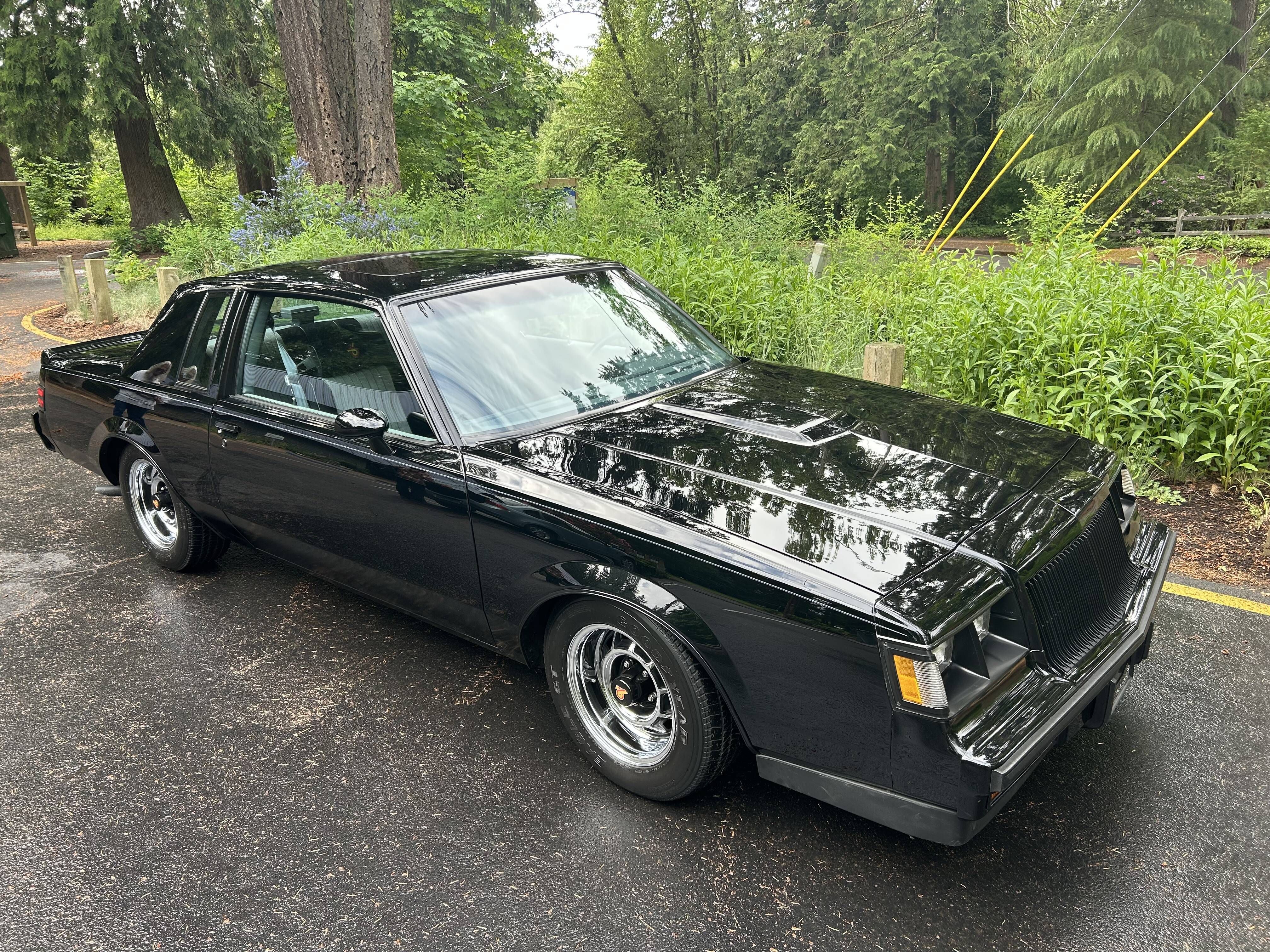
Roofs: hardtop and T-top. Grand Nationals were sold as solid-roof coupes and with the CC1 T-top — removable glass roof panels. T-top cars are prominent in our listing pool and desirable for the open-air feel, but the roof opening removes stiffness, the seals are decades old, and water that gets past them runs into the pillars and floors where it cannot be seen. A T-top car is not one to avoid; it is one to inspect harder. The solid-roof car is the stiffer, quieter, drier long-term bet.
Engines and gearboxes
The hot-air turbo V6: 1984–1985
The engine that relaunched the Grand National is Buick's 231-cubic-inch (3.8-litre) 90-degree V6, an iron-block, iron-head design with its roots in the 1960s, fitted with a Garrett turbocharger, sequential port fuel injection and electronic spark control. Do not let the architecture's age fool you into expecting a lazy engine. The turbo cars received the strong internals the application demanded, and the bottom end — crank, rods and block — has a well-earned reputation for surviving power levels well beyond the factory 200 hp when the tune is right. The operative phrase is when the tune is right: a turbo engine lives or dies on detonation control, and almost every catastrophic Grand National engine failure traces back to knock — too much boost, too little fuel, too much heat — rather than to any weakness in the castings.
The "hot-air" name describes the induction path. The turbo compresses the intake air and sends it directly to the throttle body; there is no intercooler, so the charge arrives hot, and hot air is less dense and more knock-prone. Buick managed this with conservative boost and careful electronic control for its day: a knock sensor listens for detonation and the computer pulls ignition timing in response, and a mass airflow (MAF) sensor meters incoming air so fuelling can follow it. The system works well on a stock, healthy car. Its failure points forty years on are the sensors and their wiring rather than the concept: original MAF sensors are scarce and expensive, their failure gives erratic fuelling, hesitation and stalling that owners routinely misdiagnose as a fuel-pump or ignition fault, and the test is substitution with a known-good unit or a properly executed modern translator conversion — not another guess. The electronic ignition is distributorless, using a coil pack and ignition module under it; the module and coils cook slowly in engine-bay heat and fail as intermittent hot misfires and no-starts that vanish when the car cools. A car that "sometimes won't restart hot, then is fine an hour later" is describing that pair until proved otherwise.
Fuelling margins on a hot-air car are the tightest of the range: the factory pump was adequate for stock boost and nothing more, and a forty-year-old pump is rarely adequate even for that. Low pressure under boost leans the mixture at exactly the moment the engine can least afford it. Have fuel pressure verified under load on any car you buy; most long-term owners fit an uprated in-tank pump and a "hot-wire" relay harness feeding it full battery voltage — a modification to welcome, provided it is neatly done and the rail pressure is documented.
The intercooled turbo V6: LC2, 1986–1987
The intercooled engine — option code LC2 — is the definitive Grand National powerplant, and the one most buyers should target. The architecture is the same Buick 3.8 V6, but the turbo now blows through an air-to-air intercooler mounted ahead of the engine, stripping heat from the charge before it reaches the intake. Denser, cooler air means more oxygen per cylinder, more resistance to knock, and therefore more boost, safely: 235 hp for 1986 and 245 hp for 1987, with torque that arrives low and in a great, sustained shove. On the road the intercooled car feels a full generation stronger than the hot-air car, not because the peak numbers are far apart but because it delivers its performance repeatedly — the third full-throttle run on a hot day feels like the first, where a hot-air car fades as everything heat-soaks.
The supporting systems are where buying judgment concentrates. The intercooler is a simple aluminium core, but its hoses and clamps are consumables: a split hose, or one blown off under boost, gives an instant, dramatic loss of power — an alarming event that is, in itself, a cheap fix, and a good test of maintenance, because hose condition is visible at a glance. The intercooler's scoop and ducting under the front of the car must be present; a missing scoop quietly costs the performance the intercooler exists to provide. Turbo health is judged by shaft play, oil in the intake tract and smoke behaviour: a trace of oil film in the pipes is normal, pooled oil is not, and blue smoke on a trailing throttle points to turbo seals among the usual suspects. A turbo rebuild or quality replacement is a four-figure job fitted — and renew the oil feed and drain lines with it, because a coked, restricted drain will kill a new turbo the way it killed the old one.
Engine management follows the same philosophy, developed further: sequential injection, coil-pack ignition, MAF metering, knock sensing with electronic spark control, and computer-scheduled boost. Two consequences follow for buyers. First, the car's chip — the removable calibration in the computer — is a specification item. Stock, aftermarket and adjustable chips all exist, often undocumented; a car running an unknown chip is a car whose engine life is being decided by a stranger's guesses. Ask what chip is fitted, what boost the car runs, and whether a scan-tool reading (knock counts, fuelling values) can be shown to you. The Grand National world has a mature scan-tool culture, and a caring seller can usually talk fluently about knock behaviour. Second, boost is trivially easy to raise and the stock fuel system is the limit: the responsible tuning path adds pump, injectors and calibration together. A car with an adjustable boost controller and a stock fuel pump is a detonation story waiting for its final chapter, and its engine should be priced as a risk even if it runs sweetly on the day — compression and leak-down figures are the only honest reassurance, which is why they appear in the inspection checklist.
Oil leaks deserve a calm word, because nearly every 3.8 weeps somewhere. The rear main seal is the famous one: the original rope-type seal gives way with age and drips from the bellhousing area. Done properly it is an engine-out or transmission-out job — budget in the low four figures at a shop — and it is a negotiation point, not a walk-away. Valve-cover weeps smell worse than they are. What is not acceptable is oil pressure that will not hold: a gauge that sags badly at a hot idle with a rattling top end is telling you about bearing and timing-chain wear, not a seal. The factory timing chain uses a nylon-toothed cam sprocket whose teeth age and can shed; most engines that have been apart now carry a steel double-roller set. Ask. A documented timing set, rear main and valve-stem seals are the sign of an engine that has had its middle-age service, and they are worth a premium over a shiny engine bay.

The GNX engine
The GNX uses the same LC2 architecture with detail upgrades: the Garrett turbocharger with its low-inertia ceramic turbine wheel, a larger intercooler, recalibrated management, higher boost and a freer exhaust. For a buyer, the mechanical differences matter less than two facts. GNX-specific components range from expensive to effectively irreplaceable, so originality is not a fetish on a GNX, it is the asset itself; and a modified GNX has surrendered the very thing its price rests on. Inspect a GNX as a Grand National first — compression, knock history, body, codes — then as a document exercise.
Gearboxes: the 200-4R automatic
Every turbo Grand National uses GM's Turbo-Hydramatic 200-4R: a four-speed automatic with overdrive and a lock-up torque converter. There was no manual option. The Grand National's version is not the generic Regal box — it carries its own calibration (the sought-after BRF-code specification) with firmer, higher shift points and a converter matched to the turbo engine's torque. A standard Regal 200-4R bolts in and works, but shifts softly and early and dulls the car, so the transmission's identity matters on any car whose gearbox has been replaced. On a viewing, the box should engage drive and reverse promptly, shift firmly under load — a Grand National's shifts are meant to be felt — hold its gears without flaring on the 2–3 change, and drop into overdrive lock-up at a cruise without shuddering. The 200-4R's mixed reputation is really a maintenance reputation: a light-duty design asked to handle serious torque, it survives well at stock power with clean fluid, and suffers when power has been raised without the box being built to match. A standard rebuild is a mid-four-figure job at a specialist; a built unit costs more, and on a tuned car its invoice is a document you want to see. Fluid tells the usual truth — bright is good, dark and burnt is a rebuild being announced — and the TV (throttle valve) cable is this gearbox's private trap: it controls line pressure as well as shift timing, and a misadjusted cable after engine work can destroy a healthy box in a few hundred miles. Its correct setting is a specialist check worth paying for.
Behind the gearbox sits GM's 8.5-inch ten-bolt rear axle with 3.42:1 gearing, with limited-slip (Positraction, code G80) optional rather than standard. Check the SPID label for G80 if a limited slip matters to you; a car without it will spin its inside rear wheel out of tight corners, which is correct behaviour, not a fault. Axle whine and clunks on taking up drive are fixable at ordinary axle money — one of the cheapest major components on the car to put right.
Problem areas
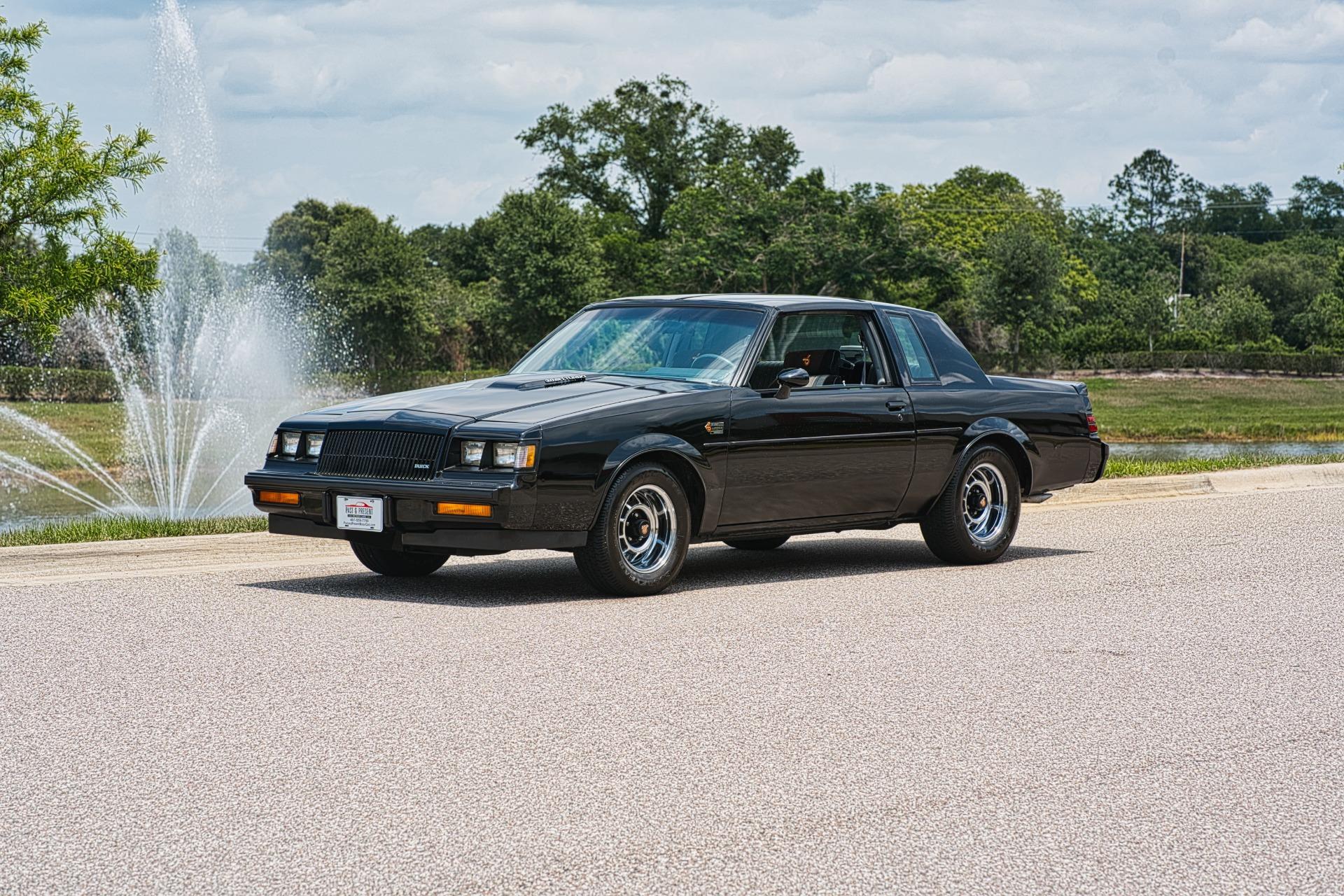
Read this section against the evidence of the cars themselves. For this guide we have photo-note detail on 16 Grand Nationals from our listings pool: visible damage was noted on 6 of those 16 cars, rust on 1, and a leak on 1, with no smoke mentions at all. That does not say Grand Nationals do not rust — it says the cars reaching the market today, many of them garaged collector cars like the Florida examples in our pool, present far better than the G-body's reputation suggests, and that damage and cosmetics are a bigger day-to-day issue than perforation on the cars actually offered. It also reflects what sellers photograph: undersides and T-top channels are the views listing sets most often skip, and exactly where this model's expensive problems live. Expect a presentable car; verify like a sceptic.
Rust and the body: the G-body map
The Grand National's body is a steel coupe shell on a separate frame, and the two rot on different schedules and for different reasons. The frame, being heavy-gauge and mostly in the open underneath, is usually the survivor; the shell's water traps are where the money goes.
Doors. The G-body door is long, heavy and prone to holding water along its bottom seam when the drains block. Run a fingertip along the bottom edge of both doors for bubbling, look at the underside of the skin, and check for sag: a door that must be lifted to close is telling you about hinge pins and bushes (cheap) or pillar rot (not cheap) — have a helper lift the trailing edge and watch where the play is.
Rear quarters, wheel arches and boot floor. The lower rear quarters catch everything the tyres throw up, and the boot (trunk) floor collects whatever the rear window and boot seals let in. Lift the boot carpet and spare wheel without exception: staining is a clean-and-reseal job, perforation is panel work and paint, and it rarely travels alone — a rotten boot floor earns a close look at the rear body mounts and frame rails beneath. Those rear rails, kicking up over the axle to the back bumper, are the frame's known thin spot on G-bodies; prod them from underneath, because rail repair is fabrication, priced per car, and converts a driver into a project.
Floors and sills. Water from failed window seals, a leaking heater box and — above all — T-top leaks ends up under the carpets. Lift all four carpet corners; the front footwells are the telling spots. Surface scale is treatable; holes are a welding programme. Sills rot from the inside at their ends, where mud packs. Fresh black underseal blown uniformly over everything the week before a sale is a cover-up until proved otherwise: honest factory coating is patchy, chipped and dirty at forty years old.
The T-top problem. On CC1 cars, treat the roof as a system: the glass panels' seals, the centre bar, the channels the water is supposed to drain through, and the A-pillars and roof edges the water actually reaches when the drains block. Perished panel seals are a parts-and-patience job; rust in the roof aperture and pillars is structural, skilled and expensive, and it hides under the seals and headlining where a viewing without removing the panels will not find it. Always remove both panels on a viewing — a seller who discourages it has answered your question — and look for water staining on the headlining, rust tracks down the pillars, and damp front carpets. In the photo sample behind this guide the T-top cars present beautifully; that is precisely why the check matters, because the failure is invisible in photographs by design of where the water goes.
Paint. The factory black finish is now famous for checking, crazing and micro-blistering with age, and a high proportion of survivors have been repainted at least once. Judge paint harshly, because black shows everything: ripples down the flanks, orange peel that varies panel to panel, overspray on rubbers, and colour that shifts between panels under a streetlight. A quality repaint is a five-figure job done properly, so an honest original car with tired but uniform paint is often worth more than a fresh, cheap respray over unknown preparation. Prefer the seller who can show you photographs from before the paint was applied.
The Powermaster brakes
The single most Grand National-specific system on the car, and the one most likely to be misdescribed by a seller, is the Powermaster brake booster fitted to the turbo cars. Instead of a conventional vacuum servo, the Powermaster is an electro-hydraulic unit: an electric pump charges an accumulator with high-pressure brake fluid, and that stored pressure provides the power assistance. When it is right, the pedal is firm and the brakes are strong. When the accumulator loses its gas charge or the pump motor tires — and at forty years both are service items, not possibilities — the symptoms are a pedal that goes hard with little assistance, a pump that runs too often or too long, warning lights, and in the worst case a sudden loss of assistance that arrives without the gradual warning a vacuum system gives. Test it deliberately on every viewing, as set out in the inspection: with the engine off, deplete the stored pressure with several pedal applications, then switch on and time how long the pump runs to recharge; a healthy system charges in seconds, a tired one labours. A replacement accumulator is a few hundred dollars and is the common fix; a full Powermaster rebuild or quality replacement unit runs into four figures, and many owners have converted to a conventional vacuum booster — a conversion that works well and costs less, but which changes the car's originality and should be disclosed and priced as the modification it is. A car that has already been converted, neatly, with the fact stated up front, is a perfectly buyable car. A car whose Powermaster is failing and whose seller calls the hard pedal "normal for these" is not.
Turbo system, sensors and the modified-car problem
The turbo system itself — turbocharger, wastegate, intercooler on the later cars — was covered in the engine section; the problem-area view is about what forty years and previous owners do to the system around it. Vacuum hoses perish, split and get reconnected wrongly after other work, and because boost control, the fuel-pressure regulator and several sensors all depend on correct vacuum and pressure signals, a perished hose set can produce a car that is simultaneously slow, thirsty and knocking. A full vacuum-hose renewal in correct materials is a few hundred dollars in parts and an afternoon, and its absence on a car presented as "sorted" tells you about the standard of the sorting. The wastegate actuator and its linkage seize or weaken, giving low boost (a merely brisk car) or, with a sticking linkage and an enthusiastic boost controller, uncontrolled boost (a short-lived engine). Verify boost with a gauge on the test drive if the car has one fitted — many do — and be suspicious of a car whose boost gauge has been disconnected.
The deeper problem is historical modification. These engines were tuned in period with chips, adjustable wastegates, alcohol and water injection, larger injectors, front-mount intercoolers and bigger turbos, and many cars were later returned to something like stock for sale, leaving no visible trace except in the engine's bearings and rings. You cannot fully detect a tuned past from the kerb. What you can do is stack the evidence: compression and leak-down numbers, oil pressure hot, blow-by at the filler cap, knock behaviour on a scan tool under load, tell-tale hardware (injection nozzles in the up-pipe, extra wiring, non-standard injectors), and the seller's fluency when asked directly. A car modified openly, competently and with its fuel system intact — invoices present — is a legitimate buy at the right price. A car with a mysterious past and a seller performing innocence is the most expensive Grand National you can buy, at any sticker.
Suspension, steering and chassis wear
The G-body's wear items are ordinary: ball joints, control-arm bushes, tie-rod ends, idler arm, sagging springs, and dampers that were mediocre when new. None is expensive by classic-car standards — a full front-end refresh is a low-four-figure job at a shop — and a car that wanders and knocks over bumps is usually a weekend-and-alignment away from civility. Judge the steering box for play at centre; a rebuilt box is a few hundred dollars exchanged. Rear four-link bushes harden and crack, letting the axle tramp under hard launches, and the GNX's torque-arm rear end has its own bushes and a near-total absence of spares — a GNX ownership cost rather than a defect. Body mounts are invisible and consequential: the cushions between shell and frame perish, the car sits subtly wrong and squeaks multiply. A mount set is cheap in parts and a day's labour, and a car that has had them done drives noticeably tighter than its mileage suggests — a good shibboleth for the genuinely maintained car.
Interior, trim and electrics
The cabin is specific: bucket seats (the 1984–85 cars offered distinctive Lear Siegler seats with adjustable bolsters; later cars use a more conventional sport bucket), a console with floor shifter, a boost gauge and tachometer in the cluster, and grey-and-black trim. Its enemies are sun and time. Dash pads crack across the top (several hundred dollars before fitting); seat fabric wears through on the driver's bolster, and a full retrim in correct reproduction fabric is a four-figure job; headlinings sag on every G-body ever built — a few hundred dollars fitted, so budget it, do not fear it. The console trim, correct steering wheel and boost-gauge cluster are the pieces clones most often lack and whose absence devalues a real car, so inventory them.
Electrically, the car behaves like an early-electronic GM product: the coil-pack issues described earlier, power-window motors that slow to a crawl (a few hundred dollars per door to refresh), ageing cluster capacitors on digital cars, and earth points whose corrosion produces haunted behaviour across several systems at once. Air conditioning uses period components; a proper conversion to modern refrigerant with new compressor, condenser and drier is a four-figure job, and "just needs a recharge" on a system that has sat empty for years should be heard as "needs the job". In our photo sample, the damage mentions — six of sixteen cars — were mostly this cosmetic end of the catalogue: trim, paint and cabin wear rather than structure. On the typical car you will actually be offered, the interior and cosmetics budget will be spent before the welding budget is.
How to inspect one
Allow two hours, not one: this inspection is an authentication exercise first, a condition check second, and a turbo-engine health check third, and each stage can end the purchase on its own. Bring a torch, a magnet wrapped in cloth, and — if you are serious — arrange a scan tool and compression gauge, or pay a marque-literate inspector to bring them. Insist the engine is cold when you arrive. If the seller allows one professional step, make it a lift inspection with compression and leak-down figures.
- Authenticate before anything else. Find the service parts identification (SPID) label — the white option-code label on the underside of the boot lid — and read it. On a 1987 car you are looking for WE2, the Grand National package, alongside LC2 for the intercooled turbo engine; on earlier cars the codes must agree with the year claimed. Check the VIN's engine digit: on the turbo cars the eighth digit is 7. Match the VIN on the dash plate, door label, SPID label and title. A missing SPID label is not proof of a clone — boot lids get replaced — but it moves the burden onto every other document: build sheet, original invoice, window sticker, registry records. No codes, no documents, no premium: a car that cannot be proved a Grand National is priced as a Regal until it can.
- Paperwork and history. Read the file for the story this guide has warned about: modifications fitted and removed, engine and transmission work, turbo replacement, Powermaster attention, paint. Invoices from known turbo-Buick specialists carry weight. Ask directly, and write down the answers: what chip is in the computer, what boost does the car run, has it ever run higher boost or injection, and when were the fuel pump and filter last changed. A fluent, specific seller is a good sign even when the answers include modifications; a vague seller with a modified-looking engine bay is not.
- Cold start. From cold, a healthy injected 3.8 starts promptly, settles to a steady idle, and shows strong oil pressure. Watch the exhaust: a puff of blue on start-up that clears points to valve-stem seals (a known, priceable job); continuous blue smoke, or smoke that returns on a trailing throttle after a run, points to rings or turbo seals. Listen for top-end rattle that does not fade in a second or two, and for any deep knock under light load — either ends the viewing until a specialist has heard it.
- The Powermaster test. Before driving: switch the ignition on and listen for the brake pump; note how long it runs. Then, engine off, press the brake pedal firmly several times to deplete the accumulator — the pedal will harden — and switch on again and time the recharge. Seconds is healthy; a long, laboured run, a pump that cycles repeatedly at rest, or a brake warning light that stays lit means accumulator or pump work, priced from the problem-areas section. Do not road-test a car whose pedal is hard and unassisted until you understand why.
- Under the bonnet: originality and the turbo system. Identify which engine you are looking at: intercooler and piping present on a 1986–87, absent on a genuine 1984–85 — a mismatch with the claimed year needs a documentary answer. Check intercooler hoses and clamps for splits, the scoop underneath for damage, vacuum hoses for perishing, and the turbo's intake side for pooled oil. Look for injection nozzles, extra controllers or cut wiring that betray a tuned past, and check the coil pack for heat damage. Smell the dipstick oil for fuel, then look for the rear-main weep at the back of the sump.
- Compression, leak-down and scan data. On any car beyond the cheapest project money, get figures. Compression should be even across all six; one low cylinder, or leak-down hissing into the crankcase, reprices the car as an engine job. On a scan tool, watch knock counts under load and fuelling corrections at idle and cruise: repeated knock retard on ordinary driving means the engine is detonating on its current tune and has been living the life described in the problem areas. These three numbers are the closest thing to an X-ray of a tuned past that money can buy.
- Body and T-tops. Work the rust map from the problem areas in order: door bottoms and hinges, rear quarters, boot floor with carpet and spare wheel lifted, footwells with all four carpet corners raised, sill ends, rear frame rails from underneath. On a T-top car, remove both panels and inspect the aperture, channels and pillar tops, and check the headlining for water staining. Run the magnet over quarters, door bottoms and arches; filler over a rust repair is acceptable only when the seller describes it as such. Judge the black paint in daylight and under a streetlight — panel variation is easiest to see after dark.
- The test drive: boost and gearbox together. Fifteen minutes minimum, including a stretch where you can use full throttle safely and legally. The car should pull hard and cleanly, boost rising smoothly without hesitation, surge or audible detonation (a faint rattle under load that the computer then corrects is knock — note it). Watch the boost gauge if fitted and compare it with step 2's answers. The 200-4R should shift firmly, hold its gears without flaring on the 2–3 change, and settle into overdrive lock-up at a cruise. A soft, early-shifting car may have the wrong gearbox calibration, or a tired right one; either is a price conversation.
- Brakes, steering and stance on the drive. Brake firmly from speed more than once: the car should stop straight with consistent assistance — growing pedal hardness returns you to step 4's verdict. Note steering play at centre, knocks from the front end, and axle tramp under a hard launch. Afterwards stand back: sagging, a list, or a nose-up sit points at springs, body mounts or both, all priceable from the problem areas.
- Interior and electrics, last but completely. Sit in both front seats and judge bolster wear and support, not just appearance. Inventory the model-specific pieces — correct seats for the year, console and shifter, boost-gauge cluster, steering wheel — because missing specifics are real money. Work everything: windows (slow ones are a priced job), air conditioning from cold, heater, lights, washers, horn, radio, and the cluster's warning lights, including the brake light. Check headlining sag and dash cracks in daylight.
- Underneath, on a lift if the car has passed you so far. Frame rails — rear ones twice — body mounts, floor seams, fuel and brake lines, axle leaks, gearbox and rear-main oil, and the exhaust for bodged repairs. Read the underseal as evidence: patchy and honest is factory, fresh and uniform is a question.
- Decide on the evidence stack, not the shine. Four verdicts: identity (step 1), engine health (steps 3 and 6), turbo and brake systems (steps 4, 5 and 8), and body (steps 7 and 11). A failure in the first is absolute; in the second, it reprices the car as a project; in the third and fourth, it is knowable, quotable money, and belongs itemised in the offer.

Values
No figures are quoted in this section, deliberately: the market block beneath this guide carries the current listings and recorded sales for the Grand National, refreshed from our own store, and that is where numbers belong. What belongs here is how to read those numbers like someone who understands the model — because on the Grand National the spread between the cheapest and the dearest car is not noise, it is information, and most of it is explained by four factors you now know how to test.
The first is year and induction. The intercooled 1986 and 1987 cars sit above the hot-air 1984 and 1985 cars, and the gap is rational: more performance, more headroom, more of everything the model is famous for. Within the intercooled pair, 1987's greater numbers make it the easier car to buy and to sell, but condition routinely overturns the year premium — a documented 1986 will and should outprice a tired 1987. Treat any asking price that ignores this hierarchy — a hot-air car priced as an intercooled one, say — as a seller error to be corrected with the models section of this guide, not negotiated around.
The second is verified originality, worth more on this model than mileage. A stock, documented car — SPID label, correct engine and gearbox calibration, original turbo hardware, paper trail — carries a premium because the supply of unmodified cars only shrinks: the model's whole culture pulled the other way for forty years. Modified cars are not worthless, but they sell to a smaller room, and their prices should reflect that and the inspection burden above. The clone question sits at the extreme: an unprovable car has no Grand National premium at all, whatever its paint, because what is being sold is the name, and the name is exactly what cannot be evidenced.
The third is condition spread within a year, which is wider here than on most classics because the failure modes are so unevenly distributed. Two 1987 cars can differ by a T-top roof aperture's worth of welding, a Powermaster rebuild, an engine that has lived on knock, or none of those — a range of outcomes that mileage alone will not tell you. This is why the honest driver with high mileage, a thick file and clean compression figures is so often the value buy in this market, and why the low-mileage car with no file deserves suspicion rather than reverence: low miles claimed without documentation are a story, and on a car whose odometer and history are easily romanticised, stories are the most overpriced commodity in the market.
The fourth is the GNX discontinuity. Do not use Grand National prices to reason about a GNX or the reverse: the GNX trades in a small, provenance-driven market where numbered identity and paperwork are the asset, and a single exceptional or compromised car distorts any average. The same caution applies, in miniature, to the 1982 cars.
On negotiation: asking prices are opening positions, and the gap between ask and achievement widens as faults move from cosmetic to structural in the identity–engine–body order of the inspection. The strongest negotiating document is not a printout of cheaper listings but an itemised list from your own inspection: the accumulator test result, the compression spread, the T-top channels, the missing documentation. Sellers discount for facts. Finally, buy the car, not the market moment: values have risen in steps around anniversaries and auction headlines and corrected in between. A car bought right on condition survives those cycles; a car bought in a headline week, on shine, does not.

Parts and ownership
The Grand National enjoys a support ecosystem out of all proportion to its four-year production run, because it sits at the crossing of three strong currents: the G-body was built in the millions in all its forms, so chassis, suspension, brake and trim hardware is ordinary GM parts-bin material; the turbo Buick community is one of the most technically literate in the American hobby, with decades of accumulated knowledge, active forums and specialists who do nothing else; and the car's fame keeps reproduction parts commercially viable in a way that lesser models never achieve. Ownership is therefore a realistic proposition for a car you intend to drive, provided you understand where the easy parts end.
Easy: service items, filters, plugs, brake discs, pads, drums and hydraulics in standard form, suspension and steering wear parts, dampers, springs, exhaust systems in standard and performance form, weatherstrips and seals in reproduction, headliners, carpet sets, and the great majority of G-body hardware shared with the Monte Carlo, Cutlass and Grand Prix. Order today, fit this weekend, at prices close to ordinary-car money.
Harder and dearer: original MAF sensors (scarce enough that tested used units and modern translator conversions are the realistic routes), Powermaster accumulators and rebuilt units, correct Grand National interior fabrics and the Lear Siegler seat components of the early cars, correct instrument clusters, the BRF-calibration transmission's specific components when originality matters, rust-free body panels — clean original doors, quarters and boot lids are hunted parts now — and, at the extreme, anything GNX-specific, where the honest answer is often that the part is not available at any sensible price and a car's completeness is its protection. Turbochargers themselves sit in the middle: rebuildable and replaceable through the specialist trade, at the four-figure fitted cost noted earlier, provided the oil feed and drain are renewed with the unit.
Running costs. A sorted Grand National is a usable classic: fuel consumption in the high teens in ordinary driving, falling briskly when the boost gauge is exercised; servicing that any competent independent can perform, with the turbo-specific checks — fuel pressure, knock behaviour, hose condition — added by a specialist at intervals. Insurance through the collector market is routine for the standard car and a more deliberate conversation for a GNX or a heavily modified car, where agreed value and an accurate modification declaration are essential; an undeclared tuned car is an uninsured one in any dispute that matters. The budget line that catches new owners is, as on most classics, the first year: catching up deferred maintenance on a running car — fluids, hoses, brakes including the Powermaster service, tyres aged out rather than worn out, and the small electrical jobs — honestly runs into the low four figures before you improve anything, and recommissioning a car that has sat for years costs more, because a standing turbo car needs its fuel system cleaned end to end, its brake hydraulics gone through completely, and its turbo's oil supply verified before the engine is asked to make boost. Buy a car in regular use over a sleeping car at the same price, every time.
Living with it. The Grand National asks two things of an owner that ordinary classics do not. The first is fuel discipline: knock control is a safety net, not a strategy, so run the best fuel available and check knock behaviour periodically — the scan-tool habit is part of ownership. The second is security realism. These cars were theft targets when new — distinctive, valuable and, by modern standards, easy to take — and they remain so. Garaging, layered immobilisation and discretion about where the car is kept are line items of ownership, and insurers will ask about all three. Against those, set the pleasures: a parts network that answers, a community that has solved every problem you will ever have and written it down, and performance that still startles people who have only read about it.
Which one to buy
- The all-rounder: 1987 Grand National, solid roof, documented and stock. The developed intercooled car in its most numerous year, with the deepest market to buy from and sell into. If you want one Grand National to drive for years, this is it — best condition your budget reaches, paper intact.
- The value buy: 1986 Grand National. Mechanically the 1987's near-twin, built in a quarter of the numbers, routinely priced a step below it for no reason condition cannot overturn. The smartest money in the model.
- The entry point: 1984 or 1985 hot-air car, honestly described. Slower and thermally limited, but the full black-car experience at the range's lowest prices. Buy it for what it is, keep it stock, and do not pay intercooled money for it.
- The driver's pick: a T-top car with a dry, inspected roof. The open roof suits the car's cruising side, and garaged examples with sound seals exist in numbers. It earns this place only with the panels-off inspection passed and floors proved dry; otherwise the same money buys a sounder solid-roof car.
- The modified car, deliberately: a documented build with its fuel system to match. A car tuned openly — pump, injectors, calibration and gearbox built together, invoices present, knock behaviour demonstrated — is a better buy than turning a stock car into one. Price the smaller resale room into what you pay.
- The collector car: the GNX. A documented, numbered artefact first and a car second, with registry-level verification before money moves. A different purchase altogether, made with specialist help.
- The left-field buy: the 1982 first-series car. For the buyer who values rarity and period NASCAR flavour over speed — ideally a turbocharged example, verified as carefully as any later car.
And the rule that overrides all of the above: buy the car whose identity is proved and whose engine has never lived on knock — everything else on a Grand National is fixable at a price you can plan for. Gearboxes can be rebuilt, Powermasters renewed, roofs resealed and interiors retrimmed. A clone bought at Grand National money, or a turbo engine quietly destroyed by detonation, cannot be un-bought — and on this model, uniquely, those two failures wear exactly the same black paint as the real thing.