
Buick Century buyer's guide
Buick Century -- the model's own buyer's guide: variants, values and what to check.
Years listed: 1938-1994 · Series: Full Size
Overview and history
The Buick Century is not one car. It is a name Buick kept reaching for whenever it wanted to say the same thing in a new decade: a mid-size Buick with the big engine. The first Century, built from 1936 to 1942, put the large 320 cubic inch straight-eight from the Roadmaster into the shorter, lighter Series 60 body, and Buick sold it on a single boast — that it was the fastest Buick, a car that would cruise at a hundred miles an hour. The second Century, built from 1954 to 1958, did the same trick with the new Nailhead V8. The third, the Colonnade Century of 1973 to 1977, did it with the 455. And then the name went on living for another thirty years on cars that had nothing to do with that idea at all — sensible front-wheel-drive family sedans that sold in the hundreds of thousands and are now almost invisible. This guide covers the name as it actually appears on Classic Listings: fifteen Centuries in the store, eleven for sale and four sold, and the weight of that pool tells you where the buying action is. Ten of the fifteen are from 1954 to 1956, two are 1938 cars, and there is one car each from 1974, 1985 and 1994. So the depth of this guide follows the pool: the pre-war Century and the 1954 to 1958 Nailhead cars get the full treatment, the Colonnade cars get a serious chapter, and the front-wheel-drive Centuries of 1982 to 2005 are covered at the honest depth the pool and the market support.
The first Century arrived in 1936, and the logic of it was pure Buick. Buick's Series 60 was the middle of its range — bigger than the Special, smaller than the Roadmaster and Limited. For 1936 Buick dropped the Roadmaster's 320 straight-eight into the Series 60 chassis, creating a car that weighed less than the Roadmaster and had the same power. The result was the fastest car Buick had ever built: the name Century was a reference to its hundred-mile-an-hour cruising speed, a claim few American cars of the day could make with a straight face. It sold well, and in 1938 came a sleeker body with a lower roofline and an integrated trunk. Production ran through 1942, when the war stopped civilian car building, and the Century name went away with it — for twelve years.
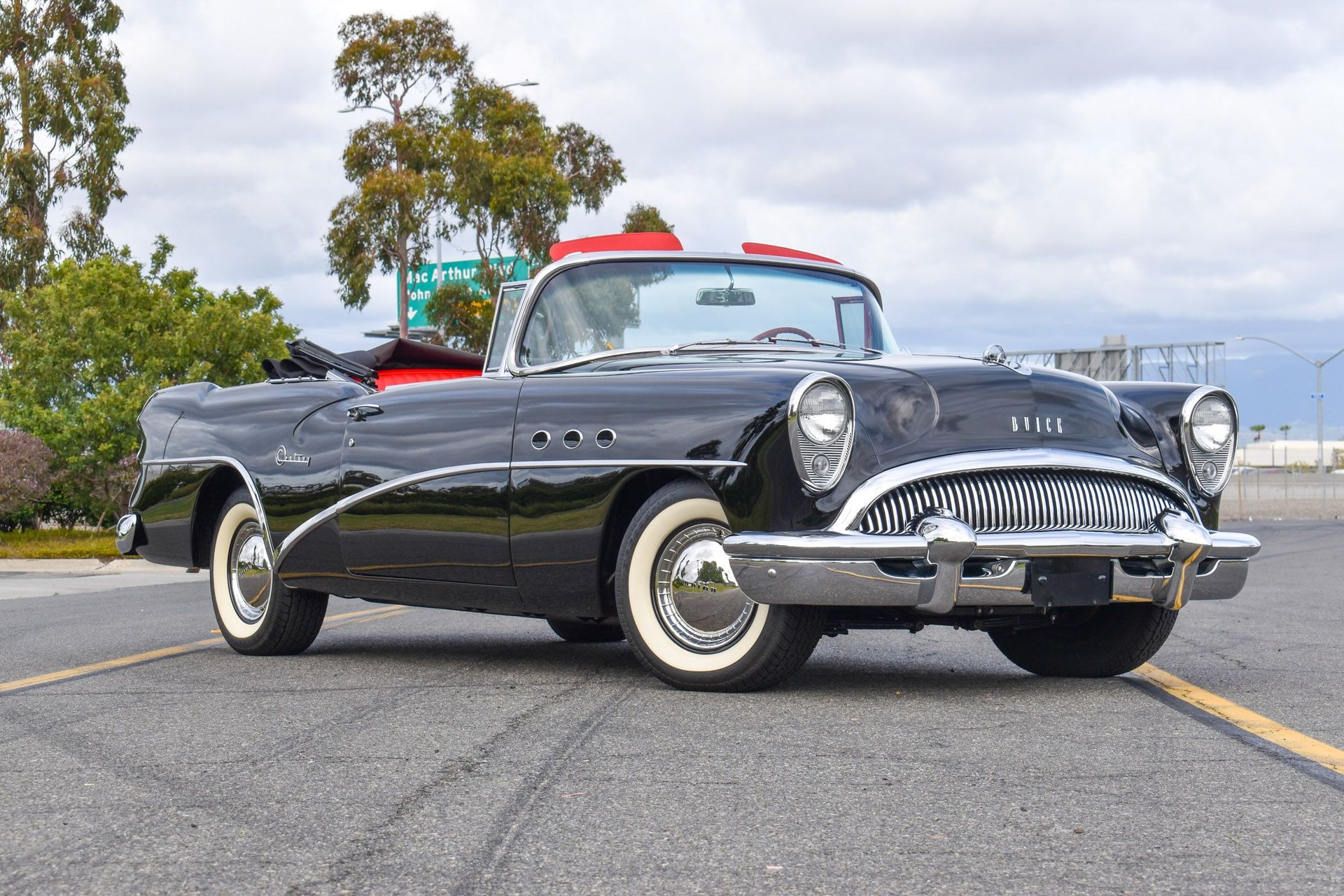
It came back in 1954, and the comeback was the high point of the name. Buick's new Nailhead V8, introduced in 1953, gave the division a modern overhead-valve engine, and in 1954 the Century became the Series 60 again: the 322 cubic inch Nailhead shared with the Roadmaster and Super, in the shorter Special-sized body. The 1954 car is the one you will meet most often in this market — three of the fifteen cars in the store are 1954s, four are 1955s and three are 1956s — and it is easy to see why they survive. The styling is the confident mid-fifties Buick at its best: the big chrome grille, the sweep-spear side trim, the wraparound windshield from 1955, and the hardtop Riviera coupe that looks like a car costing far more. The second Century ended after 1958, a casualty of the 1958 recession and Buick's decision to simplify its range, and the name slept again.

The third Century arrived in 1973, on the new Colonnade intermediate body that General Motors built for all its mid-size cars. This time the name covered a whole range rather than one fast model: sedans, a coupe, a wagon, and the Regal, which began life as a Century trim level before becoming its own model. The performance car of this generation was the Century GS, built from 1973 to 1975, which carried the 455 big-block in a mid-size body — the last true expression of the original Century idea. The Colonnade cars were good-looking and comfortable, but they were built in the years when American cars were getting heavier, slower and rustier, and the Century's reputation never recovered its fifties shine. The 1978 restyle shrank the car onto the new downsized A-body, and the 1982 car moved to front-wheel drive, where the Century spent the rest of its life as Buick's sensible mid-size sedan. The last Century was built in 2005, replaced by the LaCrosse, and the name has not been used since.
The models
The Century name covers four distinct generations, and within each generation the model that matters is usually the body style and the engine, not a trim badge — a 1955 Century Riviera is a different car from a 1955 Century sedan in the ways that count, and a 1974 Century GS is a different car from a 1974 Century Luxus in the ways that count even more. The table below lists the generations the store actually carries, with the engines and outputs as Buick rated them in period (gross horsepower before 1972, net after, so a 1955 figure and a 1975 figure are not measured the same way).
| Model | Years | Engine | Output | Character |
|---|---|---|---|---|
| Century Series 60 | 1936–1942 | 320 straight-eight | 120–165 hp | The original: big engine, light body, fastest Buick |
| Century Series 60 | 1954–1956 | 322 Nailhead V8 | 200–255 hp | The classic: fifties chrome, Dynaflow, Riviera hardtop |
| Century Series 60 | 1957–1958 | 364 Nailhead V8 | 250–300 hp | Bigger engine, more chrome, Caballero wagon |
| Century Colonnade | 1973–1977 | 231 V6; 350 and 455 V8 | 110–270 hp | The intermediate: GS muscle car, Regal spin-off |
| Century A-body | 1978–1981 | 231 V6; 301, 305 and 350 V8 | 105–170 hp | Downsized: lighter, slower, Turbo Coupe in 1979–80 |
| Century A-body FWD | 1982–1996 | 2.5 four; 2.8, 3.0, 3.3 and 3.8 V6 | 90–165 hp | The family sedan: front-wheel drive, high volume |
| Century W-body | 1997–2005 | 3.1 and 3.8 V6 | 160–200 hp | The last Century: solid, anonymous, cheap |
The pre-war Century, 1936–1942. The first Century was the Series 60, in every body style Buick built: two-door and four-door sedans, coupes, convertibles, and the open sport phaeton in the early years. The 1936 car had a 120 horsepower version of the 320 straight-eight; power rose to 130 in 1937, 141 in 1938, and 165 in 1941, when Buick fitted compound carburetion — two carburettors working in sequence — to the big eight. The 1938 cars in the store are the facelifted body with the integrated trunk, and they are the sweet spot of the pre-war run: the styling is resolved, the engine is the 141 horsepower version, and the cars are old enough to be genuinely rare without being so early that parts are impossible. The 1941 and 1942 cars are the fastest pre-war Centuries and the most desirable, but they are also the scarcest, and the compound-carburettor setup is a specialist item. The two 1938 cars in the store are both black sedans, which is the honest, common specification — the convertibles and coupes command the money, the sedans are the value buy.

The Nailhead Century, 1954–1958. This is the generation the store is really about: ten of the fifteen cars are 1954 to 1956 models, and the 1955 is the single most common year. The 1954 car introduced the formula at its purest — the 322 Nailhead V8 with 200 horsepower, Dynaflow automatic as standard, and the Special-sized body with Roadmaster-grade trim. The 1955 car is the one most buyers picture: the wraparound windshield, the revised grille, 236 horsepower, and the Riviera hardtop in two-door and four-door form. The 1956 car added 255 horsepower, a revised grille and tail, and the four-door Riviera hardtop that is, to many eyes, the best-looking four-door Buick of the decade. The 1957 and 1958 cars are bigger, heavier and more heavily chromed, with the 364 Nailhead at 250 horsepower in standard form and 300 horsepower with the four-barrel carburettor, and the 1957 Caballero — a pillarless hardtop station wagon — is the collector car of the whole run. Body styles matter more here than in any other generation: the convertible is the flagship, the two-door Riviera hardtop is the driver's pick, the four-door Riviera is the elegant family car, the sedan is the value buy, and the wagon is the specialist's car, with the most complex bodywork and the highest restoration cost.
The Colonnade Century, 1973–1977. The third Century was a different kind of car: a mid-size intermediate on the Colonnade body, with frameless door glass, a fixed B-pillar, and a big, comfortable cabin. The base engine was the 350 V8, the 231 V6 arrived as the economy option in 1975, and the 455 V8 was available in the early years, most famously in the Century GS. The GS was built from 1973 to 1975 as a genuine performance model — 455 cubic inches, a four-barrel carburettor, heavy-duty suspension, and GS badging — and it is the Colonnade Century that collectors want. The one 1974 car in the store is a Century GS, and that is the car to study: the GS is where the documentation matters most, because the 455 was an option on ordinary Centuries too, and a GS clone is a weekend's work with a badge kit and a junkyard engine.
The downsized and front-wheel-drive Centuries, 1978–2005. The 1978 car shrank onto the new A-body, and the 1979 and 1980 Turbo Coupe — a 3.8 litre turbocharged V6 coupe — is the interesting car of this generation, a genuine attempt at performance in the malaise era. The 1982 car moved to front-wheel drive on the A-body platform shared with the Chevrolet Celebrity, Oldsmobile Cutlass Ciera and Pontiac 6000, and the Century spent the next fourteen years as Buick's mid-size family sedan, with the 2.5 litre Iron Duke four, the 2.8 and 3.3 V6s, and the 3.8 V6 as the strong option, plus a short-lived 4.3 litre diesel V6 nobody should buy now. The 1997 car moved to the W-body platform, with the 3.1 V6 as standard and the 3.8 as the option, and stayed in production until 2005. The store carries one 1985 Century Limited coupe and one 1994 Century sedan, both representative of their eras: honest, low-drama cars whose buying logic is entirely different from the collector generations, covered here with full mechanical advice and brief collector advice — because nobody collects a 1994 Century, and pretending otherwise would be dishonest.
Engines and gearboxes
The straight-eight: the 320 Dynaflash
The pre-war Century carries one engine, the Buick 320 cubic inch overhead-valve straight-eight, part of the Dynaflash family that powered Buicks from the thirties into the early fifties. It is a long, heavy, cast-iron engine with a reputation for smoothness that was deserved — a well-kept straight-eight idles so quietly you check twice to be sure it is running. The 1936 version made 120 horsepower, the 1937 version 130, and from 1938 the output was 141 horsepower, where it stayed until 1941, when compound carburetion — a second carburettor that opened at wider throttle — lifted it to 165 horsepower and made the last pre-war Centuries genuinely fast cars.
Judge a straight-eight by its smoothness and its temperature. A healthy one starts from cold with the choke, settles to a near-silent idle, and pulls from low speed in top gear without complaint. Rough running is usually ignition or fuel, not the engine itself: points, condenser and coil are service items, and the carburettor is a single downdraft Stromberg or Carter any good carburettor shop can rebuild. The engine's real enemies are heat and neglect. The low-pressure cooling system works well when it is clean — but eighty years of scale in the block and radiator will make it marginal, and a straight-eight that overheats will warp its long cylinder head, a machine-shop job, not a gasket swap. Ask when the radiator was last recored. Oil consumption on a high-mileage straight-eight is normal to a degree, but oil pressure is not negotiable: strong pressure at speed, held at a hot idle. A car that loses oil pressure hot, or knocks from the bottom end under load, needs a rebuild — a specialist job at $6,000–12,000. The 1941 and 1942 compound-carburettor cars deserve a specific check: both carburettors must be present and correct, because the parts are not reproduced, and a car converted to a single carburettor has lost the thing that made it valuable.
The Nailhead V8: 322 and 364
The 1954 to 1958 Century is defined by the Nailhead, Buick's first V8 and one of the great American engines. The name comes from the small, upright valves — they look like nails — which allowed a compact pent-roof combustion chamber with the spark plug in the centre. The 322 cubic inch version powered the 1954 to 1956 Century, rated at 200 horsepower in 1954, 236 in 1955 and 255 in 1956, with a four-barrel carburettor and, on the Century, a higher compression ratio than the same engine in the Special. The 364 arrived in 1957, rated at 250 horsepower in standard form and 300 with the optional four-barrel, and powered the 1957 and 1958 Century.
The Nailhead is a torque engine. It makes its power low in the rev range, pulls hard from idle, and is famously durable — the bottom end is overbuilt, with a forged crankshaft and deep-skirt block, and a well-maintained Nailhead will run 150,000 miles without opening. The top end is where the age shows. The rocker shafts wear, the pushrods are hollow and carry oil to the rockers, and a Nailhead that ticks at idle is usually asking for rocker shaft and pushrod attention, not a rebuild — a top-end refresh runs $600–1,200 in parts and labour. The valve stem seals harden with age and give blue smoke on start-up that clears as the engine warms; that is a seal job, $400–800, not a ring job. Smoke that continues under load is rings and bores, and that is a rebuild, $5,000–9,000 at a Buick specialist. The oiling system deserves respect: the oil pump is driven from the camshaft, and sludge in an engine that sat for decades will starve the top end first, which is why a Nailhead that has been asleep needs its oil changed, its pickup checked and its rocker gear inspected before it is run hard.
The fuel system is a four-barrel carburettor — a Carter WCFB or AFB on most cars, a Rochester 4GC on some — and the carburettors are good, rebuildable units. The failure mode that catches buyers is the heat-riser valve in the exhaust manifold: a flap that routes exhaust gas under the carburettor when cold, it seizes with age, usually shut, which cooks the carburettor and gives a car that runs rich, floods hot and is miserable to restart. A Nailhead that starts perfectly cold and will not restart hot is describing a seized heat riser or a flooding carburettor until proven otherwise, and the fix is freeing or removing the riser and rebuilding the carburettor, $400–900, not an engine problem. Ignition is points and a single coil, and the distributor sits at the back of the engine — awkward to service, which is why it is often neglected, and why a misfire on a car that has sat is points and condenser before it is anything else.
The Colonnade and later engines: 350, 455, 231 and the front-wheel-drive V6s
The Colonnade Century of 1973 to 1977 offered the widest engine choice of any Century. The base V8 was the Buick 350, rated from 150 to 190 horsepower in net terms across the run. The 455 big-block was the performance option, rated at 225 horsepower in the ordinary Century and up to 270 in the 1973 and 1974 GS; by 1975 the GS was a handling and appearance package as much as an engine, and the 455's output had fallen with emissions tuning. The Buick 231 V6 arrived in 1975 as the economy engine — the same basic design that would power Buicks for thirty years — tough, simple, and underpowered in a Colonnade car but rarely troublesome. The 1978 to 1981 cars used the 231 V6, the Pontiac 301 V8, the Chevrolet 305 V8 and the Buick 350; their performance entry, the 1979–80 Turbo Coupe's turbocharged 231, is genuinely quick for its era when it works, a specialist diagnosis when it does not, and its turbocharger is a rebuild item at $800–1,500.
The Buick 350 and 455 are conventional, well-supported engines. The 350 is the pick for a driver Colonnade car — lighter, cheaper to run, and strong enough. The 455 is the pick for a GS, and its checks are the big-block checks: oil pressure hot, timing chain condition (the factory nylon-toothed timing gear crumbles with age and must have been replaced with a steel set — ask, and if nobody knows, budget $500–900, because a slipped chain on a 455 bends valves), and cooling, because a big-block in a Colonnade engine bay with a marginal radiator overheats in traffic. The smog equipment matters for value and for legality in some states: a 1973 or 1974 car with its air pump, EGR and correct carburettor intact is worth more than a de-smogged car, and in states with visual emissions inspection a de-smogged car may not register.
The front-wheel-drive Centuries use General Motors' corporate engines: the 2.5 litre Iron Duke four (tough, slow, and noisy), the 2.8 and 3.3 litre 60-degree V6s, and the 3.8 litre Buick V6, which is the engine to have in any front-wheel-drive Century — smooth, torquey and long-lived. The 1997 to 2005 cars use the 3.1 litre V6 as standard and the 3.8 Series II as the option. The known failure on the 3.1 and the early 3.8 Series II is the intake manifold gasket and, on the 3.8, the plastic upper intake manifold itself, which warps and leaks coolant into the engine — a $600–1,100 job that, caught late, hydrolocks the engine and ends the car. On any 1997 to 2004 Century with a 3.8, ask whether the upper intake and gaskets have been done; the paperwork is worth more than the seller's reassurance. The 4.3 litre diesel V6 offered in the early eighties A-body cars is the one engine to refuse outright: unreliable when new, parts scarce, and no Century is rare enough to justify one.
Gearboxes
The gearbox story follows the generations. The pre-war Century is a three-speed manual with synchromesh on second and top and a conventional clutch. Judge it on synchromesh — second gear wears first — and on clutch judder from rest, which means oil on the plate or a worn pressure plate. The boxes are strong, and a clutch is a $700–1,200 job at a pre-war specialist. Dynaflow was not a Century feature in this era, so a pre-war Century with an automatic is a conversion and should be priced as one.
The 1954 to 1958 Century is a Dynaflow car. The Dynaflow is not a conventional automatic: it is a torque-converter transmission with a variable-pitch stator, and in Drive it does not shift as a modern automatic shifts — it multiplies torque continuously, which gives the smooth, seamless surge the period ads promised and the slightly elastic feel modern drivers notice. There is a Low range for hills and engine braking. A healthy Dynaflow pulls away smoothly, does not flare or slip under load, and does not leak from the front pump seal or the rear extension. The failure modes are age: hardened seals that leak and lose pressure, a converter that shudders, and slip under full throttle. A Dynaflow rebuild is $2,500–4,500 at a specialist who knows the unit — and the specialist part matters, because a general transmission shop may never have seen one. The variable-pitch stator on the 1955 and later cars is controlled by a linkage from the carburettor; a disconnected or maladjusted linkage gives a car that feels gutless, and that is a linkage adjustment, not a rebuild.
The Colonnade cars use the Turbo-Hydramatic: the TH350 behind the 350 and V6 engines, the TH400 behind the 455. Both are strong, conventional three-speed automatics that any transmission shop can rebuild for $1,500–2,800, and both should shift firmly, engage reverse without a long delay, and hold second gear on a closed-throttle descent. A manual Colonnade Century is a rarity — a four-speed was offered on the GS in the early years — and a factory four-speed GS is genuinely collectible, so verify the gearbox against the paperwork before paying a manual premium. The downsized cars use the TH200 and TH350; the TH200 is the weak unit of the era, and a slipping TH200 behind a turbo V6 is a rebuild, not an adjustment.
The front-wheel-drive cars use the TH125C three-speed in the early A-body years, the 440-T4 and 4T60 four-speed overdrive units in the later A-body cars, and the 4T65-E in the W-body cars. Judge them on fluid colour, shift quality and overdrive engagement, and budget $1,800–3,000 for a rebuild if one slips or shudders. On a car worth what a nineties Century is worth, a failing automatic is a walk-away, not a negotiation — the repair approaches the value of the car, and there is always another Century.
Problem areas
Everything in this section is drawn from the cars themselves, and the store's own evidence sets the order: five of the store's Century photo sets were examined for this guide, and rust is mentioned in four of the five. That is a small sample and it is cited as one, but it matches the market — a Century of any generation is a car you buy with your eyes on the metal first.
Rust: the map
The pre-war cars, 1936–1942. A pre-war Century body is steel panels over wood framing, mounted on a separate chassis, and it rusts in two different ways at once. The steel rusts where water sits: the bottoms of the doors, the lower edges of the fenders, the running boards, the trunk floor, and the cowl sides. The wood rots where water gets into the door frames, the roof rails and the body pillars, and wood rot is the worse problem, because a door with rotten framing sags, will not shut properly, and needs a woodworker, not a welder. Test every door: it should open and close with a clean click and even gaps all round. A door that has to be lifted to close is telling you the framing or the pillar is soft. Prod the door bottoms and the lower body with a blunt screwdriver, with the seller's permission, and press hard on the floorboards from inside — the wood beneath the seats and in the toe boards rots too. The chassis frame is heavy steel and rarely rusts through, but check the rear kick-up over the axle and the body mounting points, because a frame rusted at a mount is a body-off repair. Structural wood and steel work on a pre-war Century runs $3,000–10,000, and it is the reason a pre-war sedan with a sound body is worth more than a coupe with a rotten one, whatever the body-style price guides say.
The Nailhead cars, 1954–1958. These are all-steel bodies on a perimeter frame, and they rust in the classic mid-fifties places. Work in this order. First, the rocker panels and the floor pans above them: the rockers trap road dirt and water, rust from the inside out, and are structural, because the body mounts to the frame through the floor. Press hard along both rockers, look for bubbling at the bottoms of the front fenders behind the wheels, and lift the carpets and check all four footwells. A rocker and floor repair done properly runs $1,200–2,800 a side, and floors rarely rot alone. Second, the trunk floor and spare wheel well: the rear window and trunk seals leak, water collects under the spare, and the well rusts through. Lift the spare and the mat on every car. Third, the front fender eyebrows above the headlights, the lower rear quarters, and the dogleg where the rear door meets the rear wheel arch — all water traps, all common, all repairable at $400–1,000 a panel if caught before the inner structure goes. Fourth, the battery tray and the firewall beneath it, which rust from acid, from the top down, invisibly, with the battery in place. Wagons add their own map — rear floor, tailgate and hinges, roof gutters, rear side window frames — and a wagon's rear bodywork is the most expensive rust repair on any fifties Century: a rotten Caballero or Estate Wagon rear is a five-figure conversation. The 1956 wagon in the store, a maroon car described as a long-term Florida car now in Malone, New York, is the right kind of candidate precisely because the claim, if it checks out, means the rear bodywork spent its life out of the salt; verify it in the rear floor and tailgate, not in the description.

The Colonnade cars, 1973–1977. The Colonnade body added a rust trap the earlier cars never had: the landau vinyl roof. Water gets under the vinyl at the edges, sits against the steel roof, and rusts it from the outside in, invisibly, until the vinyl bubbles or the roof perforates around the rear window. Press the vinyl roof all over, especially around the rear window and at the base of the C-pillar; a crunchy or soft feel under the vinyl is rust, and a roof repair with new vinyl runs $1,500–3,500. The rest of the Colonnade map is conventional: rocker panels, floor pans (check under the rear seat, where the floor is thin and the seat springs hide the rust), the lower rear quarters, the trunk floor, the door bottoms, and the frame rails at the rear kick-up — a rotten rear frame rail is a walk-away at Colonnade prices. Perished door seals let water into the doors and the cabin, and wet carpets in a Colonnade car mean rust is starting under them. The one 1974 GS in the store is the car where this matters most, because a GS is worth restoring and a Luxus is not, and the difference between the two decisions is the state of the shell.
The front-wheel-drive cars, 1982–2005. These rust like the modern cars they are: rocker panels, subframe mounting points, rear wheel arches, strut towers, and the floor at the front seat mounts. The A-body cars rust at the rear control arm mounts and around the rear wheelhouses; the W-body cars rust at the rockers and the rear strut towers, and a perforated rear strut tower on a W-body Century is a structural failure that ends the car. On any front-wheel-drive Century, get it on a lift and look at the subframe and its mounts before anything else — the mechanical parts are cheap and plentiful, the shell is the car, and a rusty nineties Century is a parts car, because another one with a sound shell costs the same money.
Suspension, steering and brakes
The pre-war Century has coil-spring independent front suspension, lever-arm shock absorbers, semi-elliptic rear springs and hydraulic brakes. The checks are the pre-war checks: kingpin play (rock each front wheel top to bottom; play means a kingpin and bush job at $600–1,200 a side), lever shock absorbers that have lost their oil and their damping (rebuildable, $150–300 each), and brakes that pull evenly. A pre-war Century's brakes are adequate when they are right and frightening when they are not, and a full hydraulic refresh — wheel cylinders, master cylinder, hoses and shoes — runs $800–1,600 and should be assumed on any car that has sat.
The 1954 to 1958 cars have coil-spring independent front suspension with ball joints, a live rear axle on coil springs, and drum brakes all round, with power assistance common. Ball joint and bush wear gives vague steering and uneven tyre wear; a full front-end rebuild with ball joints, bushes and an alignment runs $900–1,800. The steering box is a recirculating-ball unit that develops play at centre; some is adjustable, and a box still loose after adjustment is a rebuild at $400–800. The brakes are let down by age rather than design — the aluminium-finned front drums are good brakes when serviced — and perished hoses, seized wheel cylinders and a tired master cylinder are the standard list on a car that has sat, $700–1,500 for a full refresh. Power brake boosters fail with age and give a hard pedal; a rebuilt booster is $300–600. Many fifties Centuries have been converted to front disc brakes, a genuine improvement for a driver car that costs originality points on a show car — decide which kind of car you are buying before you praise or condemn the conversion.
The Colonnade cars have the standard General Motors intermediate running gear of the seventies: independent front suspension, a live rear axle on coil springs, front disc brakes and rear drums, and power steering that is light, vague and leak-prone at the pump and hoses. The checks are wear checks — ball joints, idler arm, centre link, shock absorbers — plus the rear control arm bushes, whose wear makes the rear axle steer the car over bumps. A Colonnade car that wanders at highway speed is usually tyres, alignment and worn linkage in some combination, all fixable for $600–1,400, and none of it is a reason to reject a sound car. The front-wheel-drive cars have MacPherson struts in front; worn struts and mounts are the standard bill, $500–1,000 for a front pair fitted.
Interior, trim and electrics
On a pre-war Century the interior is wool or mohair cloth on the sedans and leather on the open cars, with wood-grained metal on the dashboard. The costs are the retrim costs: a correct cloth retrim of a sedan interior runs $4,000–8,000, and a leather retrim of a convertible more. Original, sound interiors are therefore worth a premium out of all proportion to their appearance — a slightly shabby original interior is a better buy than a shiny incorrect one, because the original can be conserved and the incorrect one has to be done again to be right. Check the headliner, which sags as its stitching rots, and the instruments, a matched set that is expensive to restore individually.
On the fifties cars the interior is vinyl, cloth or a combination, with the hardtops getting the plusher trim, and the cost driver is the brightwork. A fifties Century carries an enormous amount of chrome and stainless — grille, bumpers, sweep-spear, window frames, side trim — and re-chroming a full set runs $3,000–8,000 depending on how much needs doing. Count the pitted, dented and missing pieces on any car and price them before you fall for the paint. Stainless trim can be straightened and polished, $50–200 a piece; pot-metal chrome — grille pieces, tail light housings, ornaments — pits in a way that only re-plating fixes, and some pieces are too far gone to plate at all. The electrical system is six-volt on the pre-war cars and twelve-volt on the V8 cars from 1953 on — verify on the car, because conversions exist in both directions — and the electrics fail at the earth points and the switches, not in the looms. A generator and regulator that charge properly, lights bright at idle, and a starter that turns a hot engine are the three checks that summarise the whole system.
On the Colonnade cars the interior is the weak point of the whole car: the seventies plastics crack, the seat foam crumbles, the headliner sags, and the dashboard pad splits in the sun. Reproduction interior parts for Colonnade cars are far thinner than for the fifties cars, so a Colonnade Century with a sound, complete interior is worth a real premium over a mechanically identical car with a tired cabin — you can rebuild a 350 in a weekend with catalogue parts, but you cannot buy a new Colonnade dashboard pad at any price on most days. The GS interior pieces — bucket seats, console, rally gauges — are the scarcest of all, and a GS missing its correct interior has lost value no engine rebuild restores. The front-wheel-drive cars have durable, dull interiors whose failure points are the headliner, the power window motors and the climate controls, all cheap, all available, and none of them a reason to reject a car that is sound in the shell.
The generation-specific traps
Every Century generation has one trap that catches buyers who know the other generations. On the pre-war cars it is the wood: a car can present beautifully, with sound paint and a strong engine, and have door and pillar framing that is quietly rotten, because the rot is inside the body and the paint hides it — the door-shut test in the rust section is the trap test. On the fifties cars it is the Dynaflow: a car that slips slightly and leaks slightly can honestly be described as driving well, and the rebuild bill arrives six months later — drive any Dynaflow car until the fluid is fully hot, and test it under full throttle from a stop and on a hill in Low. On the Colonnade cars it is the clone: the GS badges, hood and trim are bolt-on parts, the 455 was an option on ordinary cars, and the only reliable proof of a GS is the paperwork and the codes. Price any undocumented GS as the ordinary Century it may be.
How to inspect one
Allow at least an hour for a collector-generation car, bring a torch, a magnet wrapped in cloth, and a blunt screwdriver for prodding with the seller's permission. For a pre-war or fifties car that passes you, pay for a lift inspection before money changes hands — the frame, the floors and the rear bodywork cannot be judged from a driveway.

- Start with the paperwork and the numbers. Match the serial number on the title to the plate on the car — on the pre-war cars it is on the frame and the engine, on the fifties cars on the driver's door pillar and the engine pad, on the Colonnade and later cars on the VIN plate at the base of the windshield. On a Colonnade GS, decode the trim tag and ask for the build sheet; an undocumented GS is priced as an ordinary Century, per the clone trap in the problem section.
- Cold start. Insist the engine is cold when you arrive. A Nailhead should start with a short crank and settle to an even idle; a straight-eight should start on the choke and go quiet. Watch for blue smoke at start-up (valve stem seals, a known and bounded job) and smoke that continues (rings, an engine conversation).
- The oil and coolant check. Pull the dipstick: the oil should be oil, not mayonnaise (head gasket or, on a 3.8 Series II, the intake manifold drinking coolant) and not thin and petrol-smelling (a flooding carburettor washing the bores). Check the coolant level and colour, and on a front-wheel-drive 3.8 ask directly whether the upper intake and gaskets have been done, and ask to see the invoice.
- Under the car. Torch along both rocker panels, prod the floor seams, check the frame at the rear kick-up, and on a pre-war car check the body mounts. Perforation in rockers, floors or frame is structural money. Read the underseal as you go: patchy and honest is factory, a fresh uniform black coat over everything — seams, brake pipes, mounts — is a question, not an answer. This step decides whether you continue at all.
- The door-shut test, pre-war cars. Open and close every door. Even gaps, a clean click, no lifting to close. A sagging door is rotten framing or a soft pillar until proven otherwise, and it outranks everything else on a pre-war car because the repair is woodwork, not welding.
- Trunk and spare well. Lift the spare wheel and the mat on every car. Look for water staining, rust in the well corners and a damp smell. On a wagon, work the tailgate, check its hinges and the rear floor, and look up at the roof gutters. On a Colonnade car, press the vinyl roof for the crunch of rust under the vinyl, especially around the rear window.
- Body, chrome and gaps. Run the magnet over the rockers, the lower fenders, the rear quarters and the door bottoms — filler announces itself. Count the pitted, dented and missing brightwork pieces on a fifties car and price the count; re-chroming is the bill that surprises fifties buyers. Check panel gaps for accident history, and look down each flank for ripples.
- Suspension and steering. Rock each front wheel top to bottom and side to side: top-to-bottom play is ball joints or kingpins, side-to-side is steering linkage. Bounce each corner and watch it settle in one movement. On the drive, the steering should be free of knocks over bumps; vagueness plus a knock is a front-end rebuild priced into the offer, per the suspension section.
- The test drive, long enough to get hot. Twenty minutes minimum, including a highway stretch and a hill. A Dynaflow car must be tested fully hot, under full throttle from a stop and in Low on the hill — a cold Dynaflow hides the slip that prices the rebuild. A Turbo-Hydramatic should shift firmly and engage reverse without a long pause. A straight-eight should pull from low speed in top gear without pinking. Brake hard from speed: the car should stop straight, with no pull and no judder.
- Heat and electrics. Let the car idle hot after the drive. Watch the temperature gauge — a straight-eight or a Nailhead that climbs at idle has a cooling system that needs money, and a big-block Colonnade car that climbs in traffic needs a radiator before it needs anything else. Work every electrical item: lights, wipers, heater blower on all speeds, windows, horn, radio, gauges.
- Interior last, and judge it as a cost. Sit in every seat. On a Colonnade car, weight the interior heavily — a sound Colonnade cabin is scarcer than a sound Colonnade engine, and the parts to fix a bad one barely exist. On a pre-war car, prefer honest original cloth to a shiny incorrect retrim.
- Stance and the walk-around. Stand back and look at the car level. A fifties Century should sit even, a Colonnade car should not sag at the rear, and a front-wheel-drive car should not sit down on a rusted strut tower.

Values
The figures that matter for this model are computed from this site's own listings and recorded sales, and they sit below this guide — the listed-now summary and the market block are refreshed every time the site rebuilds, so use them rather than any number quoted elsewhere. What follows is how to read them, and the first thing to understand is that the Century pool is several markets sharing a name, so a single median across the whole pool means almost nothing.
The pre-war cars trade in the pre-war market, where condition and originality do nearly all the pricing and body style does the rest. Convertibles and coupes sit at the top, sedans at the bottom, and the spread between a project sedan and a restored convertible is the widest of any generation here — wide enough that the cheap end is genuinely cheap, because a pre-war sedan with rotten wood is a liability dressed as a bargain. The fifties cars are the volume market and the deepest one: the 1954 to 1956 cars trade across a broad band set by body style first (convertible, then two-door hardtop, then wagon, then four-door hardtop, then sedan), by body and chrome condition second, and by mechanical condition third, because the Nailhead and the Dynaflow are both rebuildable at bounded cost and the chrome is not. The Colonnade cars are the thin market: ordinary examples are cheap cars, priced as seventies drivers, while a documented GS with the 455 carries a real premium over the same car undocumented — a premium for the paperwork as much as the car, because the clone risk is priced in by every experienced buyer. The front-wheel-drive cars are used cars, priced as used cars, and their market block is a guide to what a running, sound-shelled example costs against a rusty one, nothing more.
Two cautions apply to every figure in the block below. These are asking prices, not achieved prices, and the gap between the two is widest exactly where the pool is thinnest — the pre-war cars and the GS — because a seller with a rare car can ask with optimism and wait. And the samples are small: fifteen cars in the whole pool, ten of them from three years of the fifties run, so a single exceptional or desperate listing moves a year's figures violently. Read the range, not the median, and read any individual car against the condition spread for its own generation. The cheap cars at the bottom of every band share the same story — rust, wood, chrome or a clone question — and a car priced in the middle of its band with a sound shell and a thick history file is almost always better value than the cheapest example of a dearer body style. There is no such thing as a cheap Century that stays cheap, in any of its four lives.
Parts and ownership
Parts support follows the generations. The fifties cars are the best supported: Buick built the Nailhead Century in large numbers, the cars share mechanical parts with the Special, Super and Roadmaster, and a strong specialist trade exists. Easy: service items, filters, plugs, points, brake and hydraulic parts, suspension wear parts, water pumps, carburettor rebuild kits for the Carter and Rochester four-barrels, glass and most rubber seals, and Dynaflow service parts through the specialists. Harder and dearer: Nailhead engine internals are available but the knowledge is concentrating in fewer shops — a rebuild is $5,000–9,000 and the shop choice matters — pot-metal chrome in restorable condition, wagon-specific body and trim parts, convertible top frames, and correct interior materials in the less common colours. A quality repaint on a fifties Century starts around $8,000 and the chrome to go with it can add half as much again, which is why this guide keeps saying to buy the body and the brightwork and fix the mechanics.
The pre-war cars are supported the way all popular pre-war American cars are supported: mechanical parts through the pre-war trade and the Buick club network, straight-eight engine parts from specialists, and body and wood work in the hands of restorers who do pre-war cars for a living. A pre-war Century is a car you maintain with a network — the Buick Club of America and its local chapters are the parts department, the technical library and the social life in one — and a buyer without that network should budget for a specialist's labour on anything beyond servicing. The Colonnade cars are mechanically easy and cosmetically hard: the 350, 455 and 231 are among the best-supported American engines ever built, Turbo-Hydramatic parts are everywhere, and suspension and brake parts are catalogue items — while interior trim, correct-grain vinyl roof material and GS-specific pieces are thin and getting thinner. The front-wheel-drive cars are supported like any high-volume modern General Motors car: everything mechanical is available cheaply, and the limiting factor is not parts but the value of the car — a repair that costs half the car's worth is a decision, not a service item.
Running costs. A sorted fifties Century is a realistic regular-use classic: fuel consumption in the low-to-mid teens, servicing any good independent shop with fifties experience can handle, and insurance in line with other cars of its value. The budget line that catches new owners of any collector Century is the first year: catching up deferred maintenance on a running car honestly costs $2,000–5,000 before you improve anything, and recommissioning a car that has sat for years runs $4,000–8,000 at a shop, because a car that has sat needs its fuel system cleaned end to end (modern ethanol fuel attacks old rubber and leaves varnish in tanks and carburettors), every brake component inspected, and all fluids, seals and hoses renewed. Buy a car that has been in regular use over one that has been asleep, even at a higher price — on a Century of any generation, use is the best preservative there is.
Which one to buy
- The all-rounder: 1955 or 1956 Century Riviera hardtop. The wraparound-windshield cars with the 322 Nailhead at full strength, the best parts support in the name's history, and the deepest market to buy from and sell into. The two-door is the driver's pick; the four-door Riviera is the elegant one and usually the better value.
- The value buy: 1954 Century sedan. The first Nailhead year in the cheapest body, with the same engine and the same Dynaflow as the hardtops. A sound 1954 sedan is the cheapest honest route into a Nailhead Buick — just make sure the Dynaflow test in the inspection has been passed hot, not cold.
- The pre-war pick: 1938 Century sedan. The resolved styling, the 141 horsepower engine and the integrated trunk, in the body style the market prices gently. Judge it on the door-shut test and nothing else first — a sound-wooded 1938 is a fine car, and a rotten one is a restoration, whatever the engine does.
- The collector car: 1957 Century Caballero wagon. The pillarless hardtop wagon is the rarest and most desirable of the fifties Centuries, with the 364 engine and the most complex bodywork of the run. Buy the rear bodywork, verify the dry history in the metal, and expect wagon parts to test your patience.
- The muscle car: 1973 or 1974 Century GS with the 455. The last expression of the original Century idea, and the Colonnade car collectors want. Documentation is the car: trim tag, engine code and paperwork, or it is priced as a clone.
- The honest driver: 1997 to 2005 Century with the 3.8 V6. Not a collector car and not priced as one — a smooth, durable, cheap-to-run sedan whose whole buying test is the intake-manifold paperwork and a sound shell on the lift.
And the rule that overrides all of the above: buy the least rusty car you can find, in the specification you can live with. On a pre-war car that means sound wood as well as sound steel; on a fifties car it means a sound shell under complete chrome; on a Colonnade car it means a documented car with a living interior; on a front-wheel-drive car it means a shell that passes on the lift. Engines, gearboxes, brakes and carburettors are all fixable at prices you can plan for. A rotten shell costs more to put right than the finished car will be worth — and it is the one thing about a Century, in any of its four lives, that can never be made original again.
See the 9 Century cars currently listed.