
AMC Rambler buyer's guide
AMC Rambler -- the model's own buyer's guide: variants, values and what to check.
Years listed: 1959-1969 · Series: Rambler
Overview and history
This is the model guide to the Rambler, and it works at a different depth from the series guide beside it. The series guide tells the line's story — Romney's bet on the compact car, the three-tier range, the 1963 Car of the Year award. This guide assumes that outline and goes where a buyer needs to go: variant by variant, engine by engine, through the differences between a 1958 American with a flathead six and a 1969 American with a 232, between a Classic 770 hardtop and the Ambassador-badged cars in the same showroom, between the Marlin's fastback roof and the Rebel that replaced the Classic in 1967. The name covers more genuinely different cars than almost any single badge of its era, and treating them as one car is the first buying mistake.
Start with what the name meant, because it changed. From 1958 to about 1965, Rambler was effectively the marque — American, Classic, Ambassador — and American Motors was the small print. From 1966 AMC promoted itself as the brand and Rambler retreated, first off the Ambassador, then into the single compact American line, which kept the name until 1969. So a "Rambler" on a title can be a 100-inch economy two-door from the Eisenhower years or a V8 intermediate from the end of the sixties. The platform, year and engine tell you everything; the badge tells you almost nothing.
The cars filed here reflect that breadth. We currently track 21 Ramblers — 17 for sale and 4 recently sold — spanning 1958 to 1969. The single biggest year in the file is 1963, with five cars — fitting, because 1963 was the line's high-water mark, the year of the all-new Classic and Ambassador body and the Motor Trend award. The rest spread thinly across 1959 to 1968, one or two cars in most years — what a real survivor population of working cars looks like.
Geography and source tell the same story. The cars sit from Massachusetts and Pennsylvania through Florida and Texas to California, no state holding more than three. Thirteen of the 21 arrived through Facebook Marketplace sellers and eight through dealers: the Marketplace cars are the private, inherited, long-parked end of the market, usually cheaper and usually needing everything, while the dealer cars have at least been made presentable. Transmissions follow the era: of the 16 cars with a recorded gearbox, 11 are automatics, 4 are manuals and 1 is a four-speed manual — a manual car today is the exception you may have to wait for.
Why buy one, when Ford and Chevrolet built millions of easier classics? Engineering character — unit body, seven-main-bearing sixes, travel-bed seats, the Weather Eye heater — and honesty: a Rambler was never a status object, so it was rarely faked. Prices are handled by the market block beneath this guide; what follows is the knowledge that lets you read it.
One warning shapes everything after it. Our examined-photo sample for this model file is still very small — two cars looked at in close detail so far — and both showed rust, with one also showing visible damage. Two cars prove nothing statistically, and this guide says so wherever it cites them. But they match fifty years of marque experience: a Rambler is a unit body built down to a price in Kenosha, and rust is not a risk to be checked for but a condition to be mapped. Buy the structure first, the variant second and the badge last.
The models
Every Rambler variant sits on one of three platforms, and the platform — not the trim badge — decides the ownership experience. The American is the compact: 100 inches of wheelbase in its first two series, 106 in the third. The Classic is the mid-size car on 112 inches, and the car the Marlin fastback was built from. The Ambassador is the flagship, V8-powered and stretched in its early form. The Rebel, from 1967, is the Classic's successor under a new name. Learn those sentences and the period trim ladder — Deluxe, Super, Custom, 440, 550, 660, 770, SST — reduces to upholstery, chrome and marketing.
| Model | Years | Engine | Output | Built | Character |
|---|---|---|---|---|---|
| American, first series | 1958–1960 | 195.6 flathead six | about 90 hp | high volume | Revived fifties compact; austere, charming |
| American, second series | 1961–1963 | 195.6 six, flathead or overhead-valve | 90–125 hp | high volume | Restyled; overhead-valve car preferred |
| American, third series | 1964–1969 | 199/232 six, 290 V8 from 1966 | 128–200 hp | high volume | Modern compact; Rogue, SC/Rambler |
| Classic | 1961–1966 | 195.6/232 six, 287/327 V8 | 125–270 hp | high volume | Family car; 1963-on is the sweet spot |
| Marlin | 1965–1967 | 232 six, 287/327/343 V8 | 155–280 hp | low volume | Fastback showpiece |
| Rebel | 1967–1970 | 232 six, 290/304/343/360/390 V8 | 145–340 hp | moderate volume | Intermediate turns muscular; Machine |
| Ambassador (Rambler-badged) | 1958–1965 | 250/287/327 V8 | 215–270 hp | moderate volume | The flagship |
(Outputs are period gross ratings, approximate where sources disagree; judge any car on its own engine and paperwork. Production is described qualitatively where exact per-variant figures are not reliably separable.)
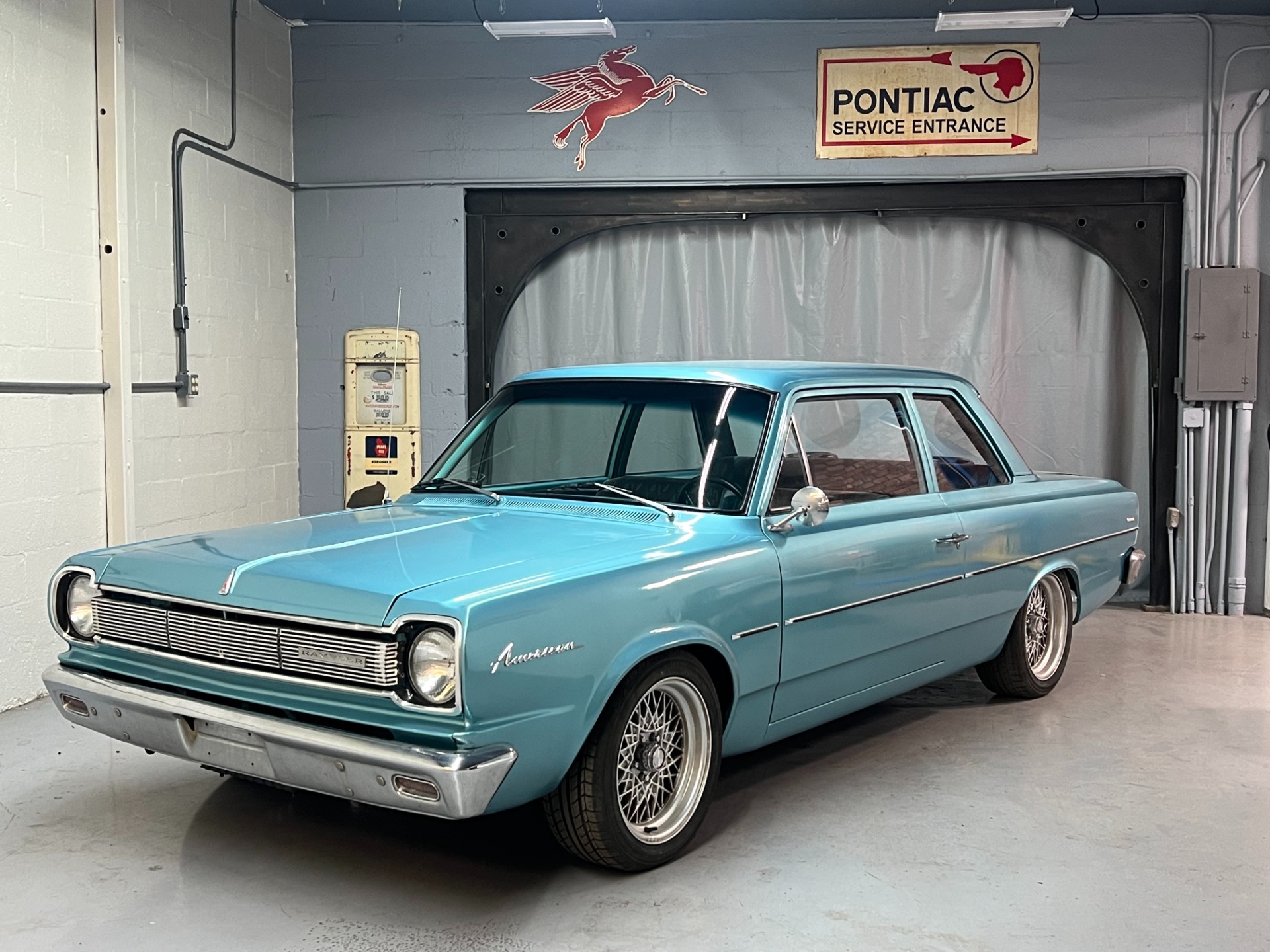
The American, first series (1958–60). When the 1958 recession hit, Romney reached back to the 1950–55 Nash Rambler tooling — a design already eight years old — and put the compact back into production at a bargain price while Ford and Chevrolet still sold size. The result looks like 1952 and was sold as 1958: upright, narrow, small fins, a 100-inch wheelbase, in two- and four-door sedan, wagon and convertible forms — the convertible now the rarest of the line. All use the flathead 195.6 six, a three-speed manual (overdrive desirable) or the Flash-O-Matic automatic. Judge it as a fifties car: vacuum wipers, drum brakes, trunnion front suspension, and trim unique to a three-year run of an old design. Completeness is everything; a missing 1958-only script can take a season to find.
The American, second series (1961–63). Same platform and wheelbase, completely new clothes: squarer, cleaner, unmistakably early-sixties. The mechanical news is the overhead-valve 195.6 six, offered alongside the flathead and worth seeking out — roughly a third more power and better economy. This series also brought the E-Stick semi-automatic of 1962–64, covered under gearboxes: interesting as history, demanding as ownership. Hardtops joined the range, and trim settled into Deluxe, Super and Custom, with the sporty 440 for 1963. Marginally better parts support than the first series; the same structural checks underneath.
The American, third series (1964–69). The clean-sheet car, and the one most buyers should aim at. A new unit body on a 106-inch wheelbase, styled under Richard Teague, lower and roomier, with the all-new AMC sixes — the 199 as the economy engine, the 232 as the one to have — replacing the 195.6 by the middle of the run. From 1966 a V8, the 290, was offered in a compact AMC for the first time, and the range grew teeth: the Rogue hardtop and convertible (1966–69) as the style-and-performance flagship. The last flourish was the SC/Rambler of 1969: a Hurst-collaboration car with the 390 V8, a four-speed manual, a functional bonnet scoop and red, white and blue paint, built in small numbers — about 1,500 is the commonly documented figure — as a drag-strip special. It is the most valuable American and the most cloned; its identity checks are in the inspection section. Ordinary third-series cars are the easiest Ramblers of all to own, with the best parts support in the guide.
The Classic (1961–66). The family Rambler, and really two cars. The 1961–62 Classic is a handsome, conventional car on the older engineering — 195.6 six or GEN-1 287 and 327 V8s, trunnion front end. The 1963–66 Classic is a different proposition: all-new Advanced Unit Construction body on the same 112-inch wheelbase, deep-dip rustproofing, curved side glass, and from mid-1964 the new 232 six replacing the 195.6. Trim ran 550, 660 and 770; body styles covered sedans, wagons, a hardtop and a convertible. The Classic also hosted the Typhoon hardtop of 1964, which launched the 232, and for 1966 the Rebel name as a special Classic hardtop. Treat 1963 as the dividing line the market does: within the later body, the 232 cars are the drivers' pick and the 327 cars the collectors'.
The Marlin (1965–67). AMC's fastback, launched as a Rambler for 1965 on the Classic platform, rebadged as an AMC for its last two years, and moved to the longer Ambassador chassis for 1967. A single sweeping roofline over a roomy six-seat interior, pillarless glass, and trim a step above the Classic's. Engines were the 232 six in theory and the 287, 327 and (for 1967) 343 V8s in most real cars. It sold slowly when new, and that failure is now its appeal: low production, unmistakable looks, mechanicals shared with the commonest cars in this guide. The 1967 car is the quickest; the 1965 car is the purest Rambler Marlin. Marlin risks are the rear glass and its seal, the unique rear panels no donor Classic can supply, and fastback trim — check all three twice as hard as the mechanicals.
The Rebel (1967–70). The Classic's replacement, restyled, renamed and re-engined in one move. Sedans, wagons, hardtops and a convertible offered for 1967 only make this the broadest intermediate range AMC built; the SST was the luxury trim. Six-cylinder Rebels are honest family cars; the interest builds through the V8 ladder — 290 and 343, then the GEN-3 revisions for 1970 bringing the 304 and 360, with the 390 at the top. The summit is the Rebel Machine of 1970: 390 V8 rated at 340 hp, a functional bonnet scoop carrying a tachometer in its rear face, and the famous patriotic launch livery. Like the SC/Rambler, the Machine is a documented one-year performance car whose premium is entirely a provenance premium. Below it, ordinary V8 Rebels are the best-value performance Ramblers, with the AMX and Javelin parts world behind them.
The Ambassador-badged Ramblers (1958–65; the line runs to 1970 as filed here). While it wore the Rambler name, the Ambassador was the flagship: from 1958 a stretched, V8-standard luxury car — the only Rambler of its years with the big engines as the default — and the carrier of the GEN-1 327. Bodies followed the Classic's generations with more length, chrome and the longest options lists in Kenosha. The 1963 Ambassador shared the Car of the Year body programme and is the best-built of the Rambler-badged flagships; the 1965 car was the last to carry the name. Two Ambassadors sit in our current file against a field of Americans and Classics, which mirrors survival: flagships were expensive to feed and were scrapped when a six-cylinder American was still worth keeping. An honest Ambassador is a bargain for the metal it contains — and a needy one is the most expensive restoration in this guide relative to its value.


Engines and gearboxes
The sixes, first family: the 195.6 flathead and overhead-valve
Every Rambler six before 1964 uses the 195.6 cubic inch engine — usually called the 196 — in two forms that share a block architecture and little else.
The flathead is the original: a side-valve design whose roots reach back through Nash to before the Second World War. Valves sit in the block beside the cylinders, the head is a flat slab, and the engine is built for low-speed torque, silence and indifference to fuel quality rather than power — about 90 hp in Rambler tune. It is quiet to the point of eeriness at idle and simple enough that little can go wrong that a competent owner cannot fix at the roadside. Its weaknesses are the flathead weaknesses everywhere: breathing limits power and economy at speed, exhaust heat soaks through the block, and cooling margins are modest. A flathead American is a 55 mph car in spirit whatever the speedometer says; a buyer who expects to cruise at seventy will blame the car for his own misreading. Parts support is thinner than for the later six, and a rebuild is a machining project, not a crate swap.
The overhead-valve 195.6, sold from 1961 in the American and available in the Classic, keeps the bottom end and puts a modern head on it. Output rises to about 125 hp and the car transforms from adequate to genuinely pleasant in period traffic. It also gains the family's one sharp edge: the conversion was done economically, the head and its gasket work hard, and the engine earned a period reputation — deserved when cooling systems were neglected, exaggerated when they were not — for head-gasket failure and overheating distress. The mechanism matters: a marginal radiator lets temperatures climb, the head expands differently from the iron beneath it, the gasket's sealing is worked cycle after cycle, and failure shows as coolant loss without a visible leak, mayonnaise under the oil filler cap, bubbles in the header tank, or a cold-start misfire that clears as the plug dries. None of that condemns a healthy example, but the temperature gauge's story is engine evidence here in a way it is not on the later six.
The sixes, second family: the 199, 232 and 258
The engine that defines the later Rambler — and the one this guide recommends for a car bought to be driven — is AMC's modern six, introduced during 1964 as the 232 cubic inch Typhoon in the Classic, engineered from a clean sheet to be the company's six for decades. It went on, enlarged and developed, to power Jeeps into the twenty-first century.
The design points are the inspection points. It is a thin-wall iron casting with seven main bearings where most contemporary American sixes made do with four — the crankshaft is short, stiff and fully supported, which is the root of the engine's smoothness and its tolerance of high mileages. The head is a conventional overhead-valve design with none of the 195.6 conversion's compromises, and the engine was sized from the start for air conditioning, power steering and automatic transmission. The 199, same architecture with a shorter stroke, became the American's standard engine from 1966: about 128 hp, happiest in the light compact. The 232 is the all-rounder: roughly 145 hp with a single-barrel carburettor, around 155 hp with the two-barrel, and torque that makes a Classic or Rebel feel effortless. The 258, arriving in 1971 just beyond this guide's period, adds stroke and the best low-speed torque of the three.
Failure modes are few and mostly external. Timing components wear at high mileage, announced by a front-cover rattle on a cold start that fades as oil pressure builds. Valve-stem seals harden and give a puff of blue smoke on start-up that clears within seconds — a seal job, not a rebuild. Cover gaskets weep oil down the block, which looks dreadful and matters little. The engine itself is the last thing to price on a 232 car; blue smoke under sustained load is the one expensive sign, pointing to rings and bores, and even then the Jeep world's parts make a rebuild plannable.
The V8s, first generation: the 250, 287 and 327
AMC's first V8 family — the GEN-1 — debuted at 250 cubic inches in 1956, before this guide's period, and reaches the Rambler buyer in two sizes that matter. The 287, from 1963, was the working V8 of the Classic and Ambassador: sturdy, built for torque and longevity, about 198 hp in period tune. The 327, from 1957, is the famous one: standard in Ambassadors, optional across the Classic range until 1966, rated up to 270 hp with a four-barrel carburettor, and later sold to Kaiser Jeep for the Wagoneer as the Vigilante.
One correction, because it wastes more buyer time than any other in this guide: the AMC 327 is not the Chevrolet 327. They share a displacement figure and nothing else — no parts interchange, no shared architecture. The GEN-1 is its own heavy, tall, slow-revving design: it does not rev like a small-block Chevrolet and does not need to, making its pace from displacement and torque in a heavy car.
Wear signs are the heavy-engine signs. Oil pressure strong when cold and sagging hot at idle points to bearing and pump wear, and on this family it is a rebuild conversation rather than a gauge quirk. Lifter noise that never settles after warm-up suggests worn lifters, tired oil or both — check the oil's age before condemning the hardware. Cooling systems were sized in the fifties for the traffic of the fifties; a 327 Ambassador in modern summer traffic wants its radiator recored, hoses new and shroud correct. Parts are the family's real ownership cost: internals come from the specialist trade at specialist prices, and a full rebuild is a budgeted project in the several-thousand-dollar range. Buy the best GEN-1 engine you can verify — the premium for a healthy one is smaller than the bill for making a tired one healthy.
The V8s, second and third generations: the 290, 343, 390 and their successors
For 1967 AMC replaced the GEN-1 with a thoroughly modern thin-wall V8 family — the GEN-2 — and the Rebel, Marlin and Ambassador ranges changed character with it. The 290 (about 200 hp in four-barrel tune) brought real performance to the compact American in Rogue form. The 343 (up to about 280 hp) powered the 1967 Marlin and the stronger Rebels and Ambassadors. The 390, from 1968, is the performance summit: 315 hp in the SC/Rambler installation and 340 hp in the Rebel Machine with its cold-air induction. For 1970 the family was revised into the form usually called GEN-3 — raised deck, new heads — with the 304 replacing the 290, the 360 replacing the 343, and the 390 growing into the 401 for 1971, just after this guide's period.
The traps are identity and heat, and both are checkable. Because every engine in the family presents the same valve covers and silhouette, displacement swaps are common and routinely misdescribed — innocently by sellers repeating a previous owner's claim, less innocently where a 390 badge carries a premium. The displacement is cast into the side of the block. Read the casting with a mirror and torch, and believe it over the air-cleaner decal, the fender badge and the advertisement: a car that casts as a 304 is a 304, priced as a 304. Heat is the second trap, usually a conversion sin: a V8 installed where a six lived, cooled by the six's radiator without the correct shroud, idles happily and boils in the first traffic queue of July. On any swapped car the radiator's size, the shroud's presence and the fan's correctness are engine evidence, checked in step 6 of the inspection. Carburettors are conventional Motorcraft and Holley units; a rebuild in the $350–700 range cures most GEN-2 running complaints. Exhaust manifolds crack with age, particularly on hard-used 390s.
Gearboxes: Flash-O-Matic and Torque-Command automatics, overdrive, Twin-Stick and E-Stick
The automatic story is one gearbox family wearing two names. Nearly every automatic Rambler uses a Borg-Warner three-speed built to AMC's specification — Flash-O-Matic in the earlier cars, Torque-Command from the mid-sixties. The light six-cylinder Americans received the M-35 family; early versions were air-cooled, which is why some early cars have no transmission cooler lines to the radiator. The bigger sixes and the V8s received the stronger, water-cooled M-40-series boxes. Their lifespan is decided by fluid history: a box that has had its fluid changed behaves for decades, and a box run on burnt fluid does not recover because you change it now. Wear announces itself as delayed engagement on a cold morning, flaring on the two-three change, and a whine in first. A full rebuild at a shop fluent in Borg-Warners runs roughly $2,000–3,500; fluid, filter and band adjustment in the low hundreds is the maintenance that postpones it, and a seller who can show fluid changes is showing you the most valuable service record an automatic Rambler can have. Selector furniture — column lever, floor lever, pushbuttons — is trim, not specification.
Manual gearboxes are where Rambler ownership gets genuinely interesting. The standard box is a three-speed with synchromesh on the upper gears, usually column-shifted. Its best companion, and the most desirable option on a touring six, is the Borg-Warner overdrive: an electrically engaged, freewheeling unit behind the gearbox that drops cruising revs by roughly a third, engaging above about 30 mph when you lift off the throttle and dropping out under the kickdown switch beneath the accelerator. When an overdrive car will not engage, suspect electrics before mechanics — the solenoid, kickdown switch, relay and governor circuit fail far more often than the unit itself, and all are cheap, testable parts. Step 8 of the inspection tests it properly.
From 1963 to 1965 the American and Classic offered the Twin-Stick: two console levers, one working the three-speed gearbox and one commanding the overdrive manually, giving five usable ratios and a driving experience shared with nothing else in period America. Twin-Stick cars are rare and sought after, and the console with its second lever is the visible evidence — verify a factory installation before paying the premium. Performance V8s received the Borg-Warner T-10 four-speed; judge it on second-gear synchromesh first. The oddity is the E-Stick of 1962–64, a semi-automatic with a vacuum-operated automatic clutch and no clutch pedal, troublesome when new and now specialist archaeology; priced as an interesting survivor it is fair, priced as a convenience feature, walk away.
The rear axles are AMC's own — Model 15 behind sixes, Model 20 behind V8s — with one service item that matters: the Model 20's two-piece rear hubs are retained by large axle nuts that must be torqued correctly. Axle whine under load that falls silent on the overrun is wear priced into the offer.

Problem areas
On a Rambler, structure outranks mechanics, and it is not close. Every engine here can be rebuilt and every brake part bought; the unit body cannot be un-rotted, and structural repair is fabrication billed by the hour. That is why the rust map comes first — and why the two cars we have so far examined in photographic detail for this model file, a sample of two stated plainly, both showed rust. Treat that pair as an illustration of the marque's reputation, not a statistic; then inspect every car as if the reputation were a certainty and let the metal argue otherwise.
Rust: the map of a unit body
A Rambler has no separate chassis for rust to spare. The body is the structure — Advanced Unit Construction in the 1963-on cars — so every location below is structural, in order of consequence.
Front spring towers and the front crossmember. The Rambler-specific killer, and the check inexperienced buyers miss because it hides in a crowded engine bay. On the 1963-on Classic, American and their descendants, the front coil springs seat high in towers formed in the inner front wings, and the suspension and steering loads feed into the unit body around those towers. Mud and salt collect at the tower bases and crossmember ends, and the metal perforates exactly where the loads are highest. A tower that has lost its section announces itself not in listing photographs but as vague steering and a front end that will not hold alignment. This is fabrication work, priced per car after cutting, and it writes off ordinary examples outright. Get the car on a lift or on stands with the front wheels removed, and prod the tower bases, crossmember ends and bay seams with a screwdriver. Sound metal rings; rotten metal crunches. There is no cheaper test in this guide, and no more expensive one to skip.
Sills and rocker panels. The sills carry the body between the wheels and are fed road water by the front wheels and by their own blocked drain slots. They rot from the inside out, so the outside paint is the last thing to know: press hard along the full length, sight along the sill line for ripples, and treat fresh underseal or bright new sill covers on an otherwise scruffy car as a confession rather than a repair. On convertibles the sills are reinforced because there is no roof to stiffen the shell, and their condition is the structural verdict on the whole car. Cutting out and welding in sound sills properly runs roughly $1,000–2,500 a side; plating over rot is a postponement with your name on a later invoice.
Floor pans, seat mounts and the trunk floor. Rambler glass seals leak with age, the cowl and the Weather Eye intake pass water when their drains block, and the water's destination is always the same: under the carpets and into the spare-wheel well. Lift every carpet and prod the pans and seat mounts. Surface rust is a weekend of wire brush, treatment and paint; perforation means cutting and welding at roughly $600–1,500 a side fitted, and floor rust never travels alone — a car wet enough to hole its floors has been wet for years, and the sills and lower firewall tell the same story. In the trunk, lift the mat and spare wheel and examine the well corners and the seam where the trunk floor meets the rear panel: that seam is the collection point. One of the two photo-examined cars in our small sample also showed visible damage alongside its rust — a bent panel should prompt a second pass over the structure behind it.
The rest of the map. Door bottoms (run a fingertip along the lower edge of every open door for bubbling), the bottoms of the front wings and the valance, wheel-arch lips, the battery tray and the inner wing beneath it, the lower rear quarters, and on the Marlin the panel and seal at the base of the rear glass, where water runs into the trunk and the panel has no donor-car source. Wagons add the tailgate frame and rear floor. None of these alone kills a car; together they price the bodywork, and bodywork here is priced by the hour because the catalogue does not exist.
Front suspension, steering and brakes
Cars through the mid-sixties use trunnion joints at the outer ends of the control arms in place of conventional ball joints — a threaded, grease-lubricated design that is strong, precise and entirely dependent on the grease gun, whose nipples want attention every few thousand miles. On a car that has been greased, trunnions last and feel tight; on a car that has not, they wear oval, and the symptoms — knocks over bumps, vague steering, tyre wear no alignment cures — are indistinguishable from general front-end ruin until you test properly. Rock each front wheel top-to-bottom and side-to-side, and ask the seller when the front end was last greased. An owner who cannot answer has answered. One caution in your favour: a joint starved of grease can feel worse than it is, because hardened grease exaggerates movement — so play on an ungreased car is a budget line, not a verdict. Rebuilding a worn trunnion front end is specialist work in the $900–1,800 range; price it into any early car that knocks. Later cars moved to conventional joints but kept the deep coil springs, and front springs sag with age — connect any nose-down stance to the spring-tower check above.
Steering is recirculating-ball, manual on most sixes and power-assisted on V8s and Ambassadors. Play at the wheel rim beyond roughly an inch means wear in the box or linkage; the boxes adjust to a point, and beyond it the answer is a rebuild. A groaning power-steering pump is usually low fluid from a leaking hose, not a dying pump.
Brakes are drums all round on most cars in this guide, with front discs appearing as an option and then as standard fitment on later, heavier and performance models. The system's famous first deserves its sentence: Rambler was among the very first American makers to fit a dual-circuit master cylinder as standard, in 1962, so a single hydraulic failure does not take the whole system. What sixty years does to the rest is standard and budgetable: seized wheel cylinders, perished hoses, a master cylinder weeping into its booster, drums scored by shoes worn to their rivets, handbrake cables seized. A full hydraulic refresh runs roughly $700–1,600 with labour and transforms how the car feels. Judge the car on pedal travel, on whether the pedal sinks under sustained pressure (a master cylinder confessing), and on straight-line stopping; a car that pulls to one side is showing you a seized cylinder or collapsed hose, both cheap, both non-negotiable before regular use. At the rear, look for sagging or cracked leaf springs and perished shackle bushes.
Cooling, the Weather Eye, vacuum wipers and electrics
Cooling is the support system that kills Rambler engines, because the margins were economy-car margins from new. A silted radiator core, a lower hose collapsing under suction at speed, a missing fan shroud on a V8, a thermostat of the wrong rating or none at all — each is trivial alone, and together they turn the first hot traffic queue into a boil-over. The overhead-valve 195.6 is the least tolerant engine in the guide, for the head-gasket mechanism set out in the engine section; the GEN-1 V8s run it close. Read the temperature gauge across the whole test drive and a ten-minute hot idle afterwards, and the coolant's colour — rust-brown water is a neglected system confessing. Be most suspicious of the boast about a removed thermostat, a symptom dressed as a cure. A radiator recore or replacement runs roughly $400–800, and on any car that runs hot it is money spent before all other tuning.
The Weather Eye heater — Nash's fresh-air system, a Rambler selling point for decades — works superbly when its cables, flaps and matrix are sound. A leaking matrix announces itself with a sweet smell, a misting windscreen the demister cannot clear, and a damp front carpet — which is also a floor pan rusting from above, so a heater leak is a structural item in disguise. Test the heater on every viewing, in July as in January, on every setting.
Vacuum wipers on earlier six-cylinder cars deserve their warning. Driven by inlet-manifold vacuum, usually with a booster section in the fuel pump, they slow to a crawl precisely when you accelerate or climb — that is the design, not a fault — and stop altogether when the pump's vacuum section tires. Rebuilding that section or converting to electric wipers are both known jobs in the low hundreds.
Electrics are the good news: AMC adopted the alternator early, standard across the line from 1963, and failures concentrate at connections and at the earth strap between engine and body — a corroded strap produces dim lights, slow cranking and gauges that lie, all from one cheap cause.
Interior, trim and the orphan problem
Rambler interiors were a genuine design strength — imaginative fabrics, and the reclining front seats that folded flat into the famous travel beds, a feature no rival offered. The materials, however, were bought to an economy car's budget. Vinyl splits along its stitching and at the driver's entry bolster first; patterned cloths fade and sun-rot; headlinings sag; seat padding crumbles until you sit on the spring case. Sit in the driver's seat on every viewing — it is the seat that prices the retrim, and the passenger seat will flatter the car. A professional retrim in correct-style vinyl runs into four figures quickly, and correct patterned cloth for higher trim levels can be effectively unobtainable, which is why a sound original interior carries a premium out of proportion to what the same condition earns on a Ford. Trim is the orphan marque's sharpest edge. Rambler chrome was never thick and it pits; pot-metal badges blister, and re-plating a significant piece well runs roughly $150–400 per piece, more for a grille. Model-specific brightwork — scripts, lenses, one-year treatments for a 1958 American, a Marlin, a Rebel convertible — can take a season of hunting to replace. It is the argument for buying the most complete example you can find: on a Rambler, completeness is money already spent by somebody else.


How to inspect one
Allow at least an hour, bring a torch, a magnet wrapped in cloth and a screwdriver for prodding (with the seller's permission), and arrange a lift inspection for any car that passes you — the spring-tower test from the rust section cannot be done properly any other way.
- Start with the paperwork and the identity. Match the serial number on the car's plate to the title: AMC serial plates identify the model line, body style and trim, and the engine fitted should agree with the badges. On a claimed SC/Rambler, Rebel Machine or Marlin, the premium rides entirely on identity — ask for documentation, prior titles, club verification, anything beyond the seller's word and the paint. A premium price supported by decals and a story is a standard car at a special price.
- Cold start. Insist the engine is stone cold when you arrive; a warm engine is a seller managing the evidence. A good AMC six or V8 starts readily on the choke and settles to an even idle. Watch for blue smoke — a puff that clears is valve-stem seals, smoke that persists or deepens under load is rings and bores — and listen for lifter clatter on a V8 that never settles, and for a front-cover rattle on a modern six that fades as oil pressure builds.
- The structure, underneath. On the lift or on stands with the front wheels off: prod both sills along their full length, the floor seams, the trunk-floor corners, the crossmember ends and, above all, the bases of the front spring towers. Perforation at a spring tower or crossmember is a walk-away on an ordinary car and a fabrication quote on a special one. Read the underseal as you go — thin, patchy and honest is factory; a fresh, uniform black coat over everything is a question, not an answer.
- Floors and trunk from inside. Lift all the carpets. Look for water tracks from the windscreen base, cowl vents and heater, prod the pans and seat mounts, and lift the trunk mat and spare wheel to check the well corners. Wet carpets in a dry-stored car mean leaking seals and rust already started; a damp front carpet plus a sweet smell points back to the Weather Eye matrix, and forward to a floor rusting from above.
- Body and gaps. Run the magnet over the sills, arches and lower doors — filler announces itself by the magnet's indifference. Run a fingertip along the bottom edge of every open door for bubbling. Check the battery tray, panel gaps for accident history, and on a Marlin the seal at the base of the rear glass. Count the pitted or missing trim pieces and price them; on this marque trim is a budget, not a footnote.
- Engine checks. On a GEN-2 or GEN-3 V8, find the displacement cast into the block side and confirm it matches the badges — swaps are common and decals lie. On any engine, pull the dipstick, look for mayonnaise under the filler cap, check the coolant for rust colour, and confirm the fan shroud is present on a V8. On the overhead-valve 195.6, pay double attention to temperature behaviour and head-gasket distress.
- Front end and steering. Rock each front wheel top-to-bottom and side-to-side. Play on a trunnion car that has not been greased in years is a question, not a verdict — but price the front-end rebuild in, in the $900–1,800 range, unless the seller can show it has been done. On the drive, vagueness plus a knock over bumps is worn trunnions or joints, priced into the offer.
- The test drive, gearboxes included. Fifteen minutes minimum, including a hill and a stretch at speed. An automatic should engage drive and reverse promptly and change cleanly without flaring on the two-three change. A manual's second-gear synchromesh is the first thing to test. On an overdrive car, get above 30 mph, lift off, and feel for the overdrive engaging — then use the kickdown to drop it out again. On a Twin-Stick car, work both levers through all five ratios. A six should pull cleanly; a flat spot is carburettor or ignition, in that order.
- Cooling, heat and wipers. Let the car idle hot after the drive and watch the temperature gauge for ten minutes. Run the Weather Eye heater on all settings and check for the sweet smell of a leaking matrix. If the car has vacuum wipers, watch them on a hill under throttle — wipers that stall are a tired vacuum section of the fuel pump.
- Brakes and stance. Brake firmly from speed: the car should stop straight, with a firm pedal that does not sink under sustained pressure. Check the handbrake holds on a slope. Then stand back: a Rambler should sit level. A nose-down front connects to the spring and spring-tower checks in step 3 — decide which you are looking at before you excuse it — and a sagging rear is tired leaves or shackle bushes.
- Interior last. Sit in every seat and feel for collapsed padding; check the driver's bolster, the headlining, and whether travel-bed hardware works if fitted. Work every window, light, gauge and switch. A sound, complete, original interior is the hardest thing about a Rambler to recreate — a car that passes step 3 and step 11 has passed the two tests money cannot easily fix later.
- Completeness audit. Before you talk money, list what is missing: badges, scripts, hubcaps, lenses, the spare, the jack, the owner's manual, the service file. On a Ford or a Chevrolet each is a catalogue order; on a Rambler each is a hunt measured in months. Price the hunt, add it to the budgets from the steps above, and negotiate from the total — or buy the car that does not need the hunt at all.
Values
The market block the site builds beneath this guide carries the current numbers for the Rambler, and this section teaches you how to read it — because with Ramblers the distance between the best and the worst car wearing the same badge is wider, proportionally, than on almost any contemporary Ford or Chevrolet, and a single figure for a model conceals more than it reveals.
The first force in this market is thinness. Rambler is an orphan marque with a small, knowledgeable buyer pool. Fewer buyers means a lid on prices for ordinary cars — the four-door six-cylinder sedan has a ceiling set by how few people want one — but the same thinness means the right car, the one-year special or the documented performance model, can sit unsold at a fair price for months and then sell within a weekend when its one buyer appears. Asking and achieved prices diverge accordingly: sellers who price from optimism or from money spent wait, and the cars that change hands are usually the honestly described ones. Treat any single asking price as an opening position, and a long-listed car as information — either the price is wrong or the car is, and your inspection tells you which.
Condition is the second force, and it works asymmetrically. Body and trim restoration on a Rambler costs the same per hour as on a far more valuable car, while the panels and brightwork cannot be ordered from a catalogue. The gap between a project and a finished car is therefore mostly the cost of the work itself. A rusty American or Classic is worth close to its parts value however straight it looks in photographs, while a genuinely sound, complete car earns a strong premium over any average figure, because the average is dragged down by cars that need everything. Buyers new to the marque overpay for shiny projects whose structure they never lifted, and undervalue honest survivors whose sills, towers and trim were all sound. The market block's spread for any model is mostly that story told in numbers.
Variant premiums are real but narrow, and they follow rarity plus verifiable identity rather than raw performance. The SC/Rambler and the Rebel Machine sit at the top because they are documented, one-year, low-production performance cars — and for exactly that reason they attract clones, so their premiums belong only to cars whose identity survives step 1 of the inspection. The Marlin carries a style premium over the Classic beneath it. Convertibles carry the usual open-car premium, with the one-year Rebel convertible at the top of that small pile, and Rogue Americans lead the ordinary American range. Wagons, long the cheapest way into the line, no longer trail the sedans by much. At the bottom, four-door sedans with the small six and an automatic are among the cheapest classic American cars to buy at all — bought to be driven, and priced as transport, not treasure.
Finally: provenance and completeness move Rambler prices more than mileage does, because every buyer in this market knows what the missing pieces cost to find. And source matters — our own file leans toward private Marketplace sellers over dealers by roughly three to two, and private cars are more often priced from sentiment or ignorance, in either direction. In both channels, the inspection is the valuation.
Parts and ownership
AMC has been gone since 1987, and Rambler ownership means living comfortably with that fact. The cars were built in serious numbers, the mechanical design is conventional, and a specialist trade has had four decades to organise itself around them: you can keep any Rambler in this guide running indefinitely, and what you cannot always do is restore one to perfection quickly.
Easy: service items for the modern six and the GEN-2 and GEN-3 V8s — filters, plugs, points, belts, hoses, water pumps, carburettor kits. The 232 and 258 sixes powered Jeeps into the modern era, so their supply is effectively mainstream, and the later V8s share the Javelin and AMX world's supply chain. Brake hydraulics, wheel bearings, universal joints, exhausts for the common models, alternators and starters are all obtainable without drama.
Harder and dearer: GEN-1 V8 internals, especially for the 327; 195.6 parts beyond the service essentials; trunnion components, from specialists and priced like it; E-Stick and Twin-Stick specific parts; vacuum wiper motors and fuel-pump vacuum sections; correct patterned interior cloth; and anything in chrome or pot metal for a specific year. Body panels are the hard limit: there is no meaningful reproduction sheet-metal programme for Ramblers, so rust repair means fabrication, donor panels, or new-old-stock found by patience. Hence the guide's recurring advice — buy the body, fix the mechanics, in that order.
The support network is the marque's quiet strength. The AMC Rambler Club and the broader AMC clubs maintain registers, technical libraries and classifieds where good cars often change hands without reaching a public listing. The online AMC Forum is the working knowledge base for obscure questions — the overdrive wiring fault, the trunnion specification, the one-year trim interchange. Long-established specialists, among them Kennedy American, Blaser's Auto, American Parts Depot and Galvin's AMC Rambler Parts, stock the new-old-stock and reproduction lines between them. Join the club before you buy the car, not after.
Running costs. A sorted Rambler is among the cheapest classics in the world to run: the sixes return fuel economy in the low-to-mid twenties on a run, insurance is ordinary classic-car money, and routine servicing sits within the ability of any competent home mechanic. The budget line that catches new owners is the first year. Catching up deferred maintenance on a running car honestly costs in the region of $1,500–3,500 before you improve anything, and recommissioning a car that has sat for years — fuel system cleaned end to end, every brake component inspected, all fluids, seals and hoses renewed — runs roughly $3,000–6,000 at a shop. Buy a car in regular use over a sleeping one, even at a higher price; the premium for a runner is smaller than the recommissioning bill.
Which one to buy
- The all-rounder: a 1964–66 Classic with the 232 six. The best-engineered body in the guide, the best engine AMC made in the period, and the deepest supply of cars and parts. If you want one Rambler to drive everywhere, this is it.
- The value buy: a third-series American (1964–69) with the 199 or 232 six. Modern enough to use daily, simple enough to maintain on a driveway, and the cheapest route into a genuinely good Rambler. An overdrive manual is the connoisseur's version.
- The character car: a 1958–60 American. Pure fifties economy motoring — flathead six, upright styling, recession-era charm. Slow, simple and likeable; buy the most complete one you can find, because its trim is the hardest in the guide to replace.
- The early V8 car: a Classic or Ambassador with the 327. The GEN-1 flagship engine in the car it suits — heavy, torquey, characterful — provided the engine's health is documented rather than described.
- The style buy: the Marlin. Classic or Ambassador mechanicals under the most dramatic roofline AMC ever drew. The 1967 car with the 343 V8 is the quick one; all are judged on rear glass, rear panels and trim first.
- The muscle car: the Rebel Machine (1970), or an SC/Rambler (1969). Real, documented, one-year performance cars with values to match — and the two models where identity verification matters most. A genuine car at a fair price is a blue-chip Rambler; a clone is a Rebel or an American with expensive paint.
- The cruiser: an Ambassador with a GEN-2 V8, or a 327 car for the early route. The full-size experience — space, trim, air conditioning, effortless torque — for less than the equivalent Ford or Chevrolet. The 1963-on cars are the best built.
- The family wagon: a Classic or Rebel wagon. The load-carrying versions of the recommended cars, with the same mechanicals — check the tailgate frame and rear floor twice as hard as on a sedan.
And the rule that overrides all of the above: buy the least rusty, most complete car you can find, in the specification you can live with. Engines, gearboxes, brakes and carburettors are all fixable at prices you can plan for. A rotten unit body — above all, rotten spring towers — and a box of missing trim cost more to put right than the finished Rambler will be worth, and on an orphan marque, completeness is the one thing money cannot quickly buy back.
See the 14 Rambler cars currently listed.